



Galvanic Oxygen Sensors
A galvanic oxygen sensor is a self-powered electrochemical metal-air cell. Oxygen diffuses into the sensor and is reduced at the cathode while a sacrificial anode is oxidized. The resulting current is related to the oxygen reaching the cathode, making galvanic cells useful for portable safety, medical, diving and process oxygen measurement.

Technology overview
What is a galvanic oxygen sensor?
Why it is often called an oxygen “fuel cell”
The sensing element is a spontaneous electrochemical cell. Oxygen acts as the reactant at the cathode, while the anode material supplies the counter-reaction. That is why the cell can generate its own signal without a heater or sensing bias.
Where galvanic oxygen sensing fits
- Portable and fixed oxygen-deficiency monitoring
- Medical and ventilator oxygen measurement
- Diving and rebreather systems
- Oxygen concentrators
- Controlled-atmosphere and industrial gas analysis
For a broader technology comparison, see Oxygen Sensors.
With essentially no oxygen entering the cell, cathode reduction and anode oxidation are minimal, so the galvanic current remains close to baseline.
Working principle
How does a galvanic oxygen sensor work?
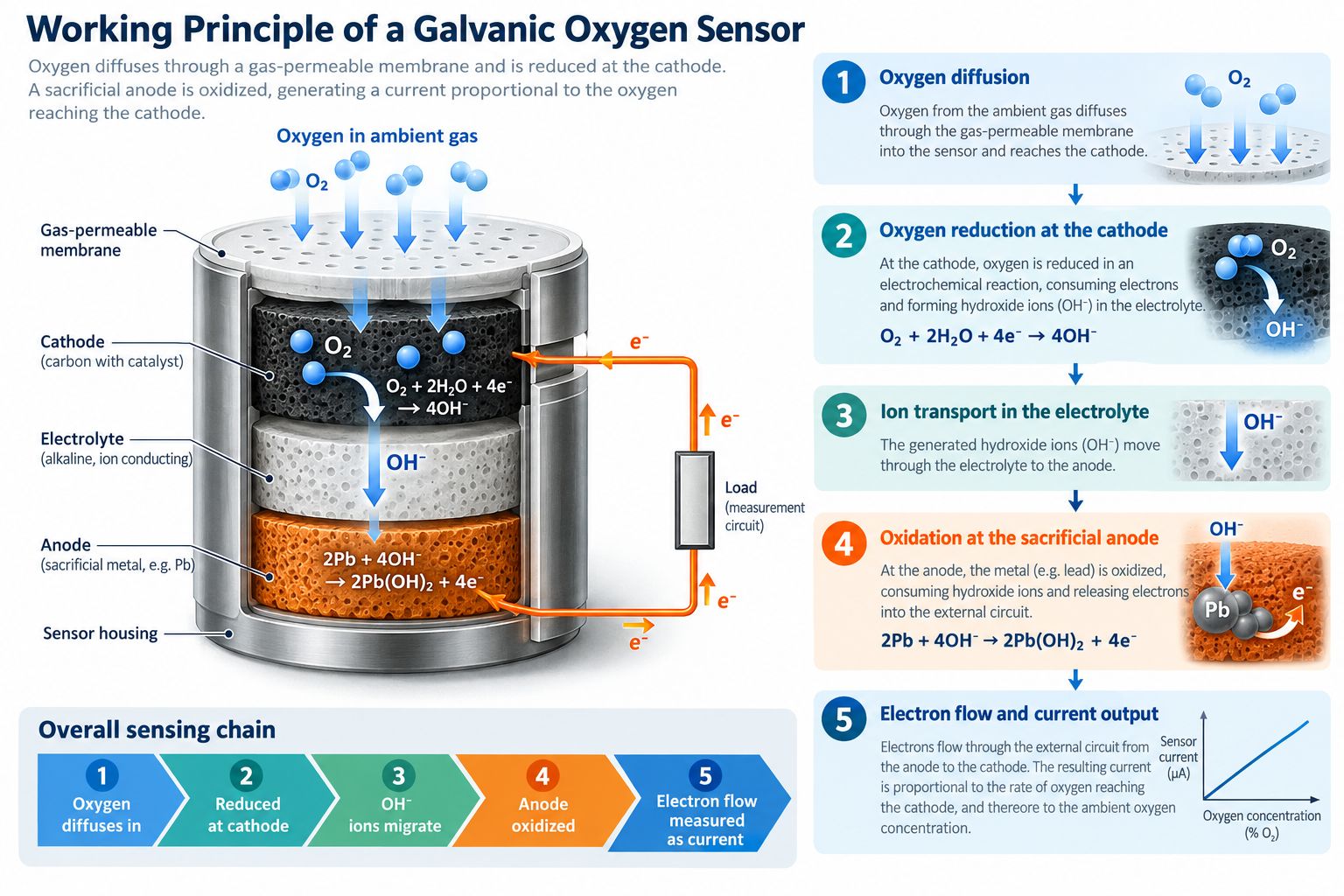
Five-step sensing chain
- 1. Oxygen diffusion: O₂ enters through the gas-permeable membrane or capillary inlet.
- 2. Cathode reduction: oxygen accepts electrons at the cathode and forms ionic reaction products.
- 3. Ionic transport: ions move through the electrolyte to maintain charge balance.
- 4. Sacrificial anode oxidation: the anode metal is consumed and releases electrons.
- 5. External current: electrons move through the measurement circuit, creating a current related to oxygen flux.
Internal construction
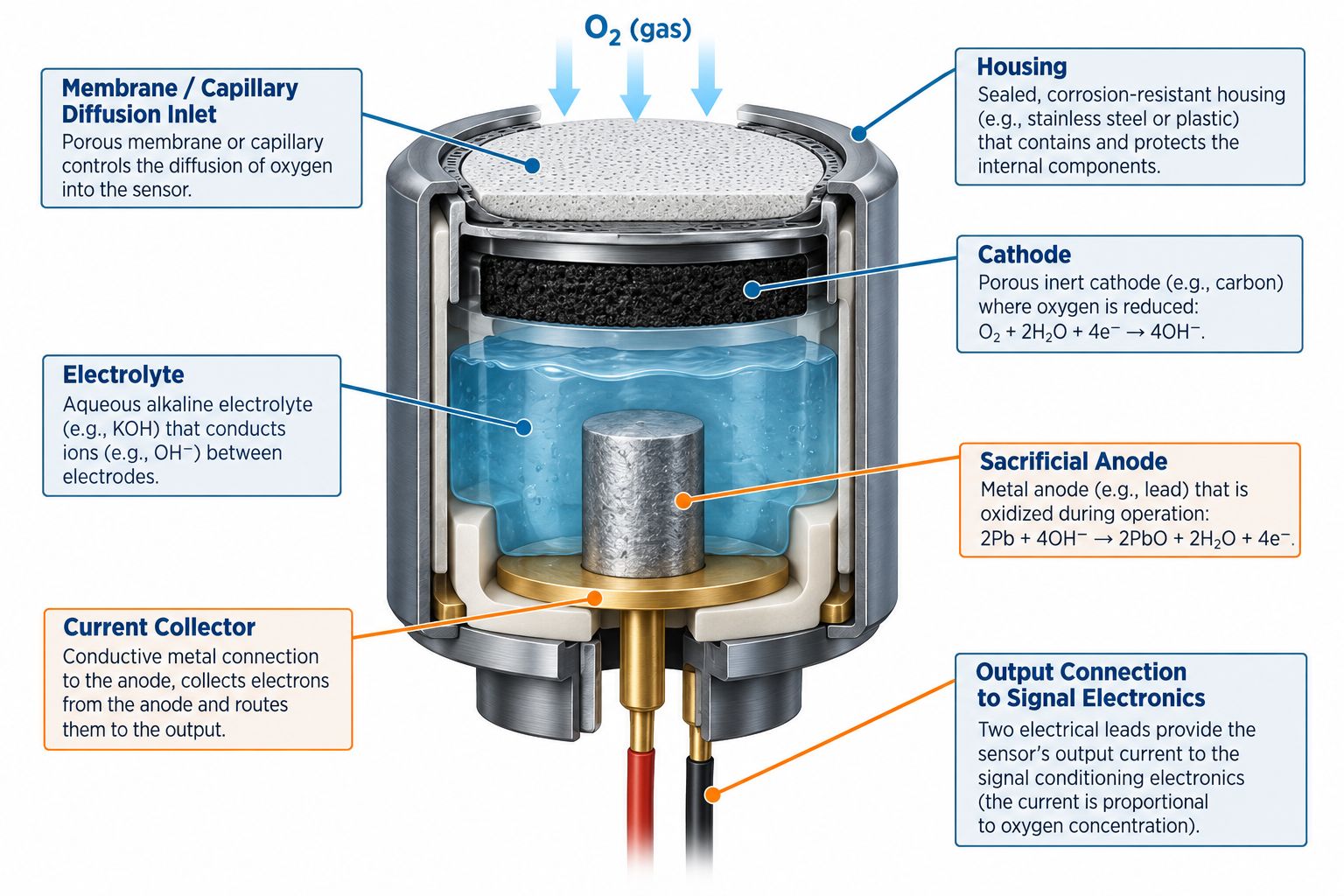
What is inside a galvanic oxygen sensor?
Membrane or capillary inlet
Controls oxygen transport into the cell and helps define response, pressure sensitivity and lifetime.
Cathode
Porous, catalytically active electrode where oxygen is electrochemically reduced.
Electrolyte
Provides ionic conductivity between cathode and anode. Chemistry varies by sensor design.
Sacrificial anode
Oxidizes during sensing and is gradually consumed over the sensor's operating life.
Current collector
Provides the electrical path from the electrochemical cell to the external circuit.
Signal electronics
Convert the small DC current into a calibrated oxygen reading and system-level output.
Cell chemistry
Electrochemical reactions in a classic lead-based galvanic O₂ cell
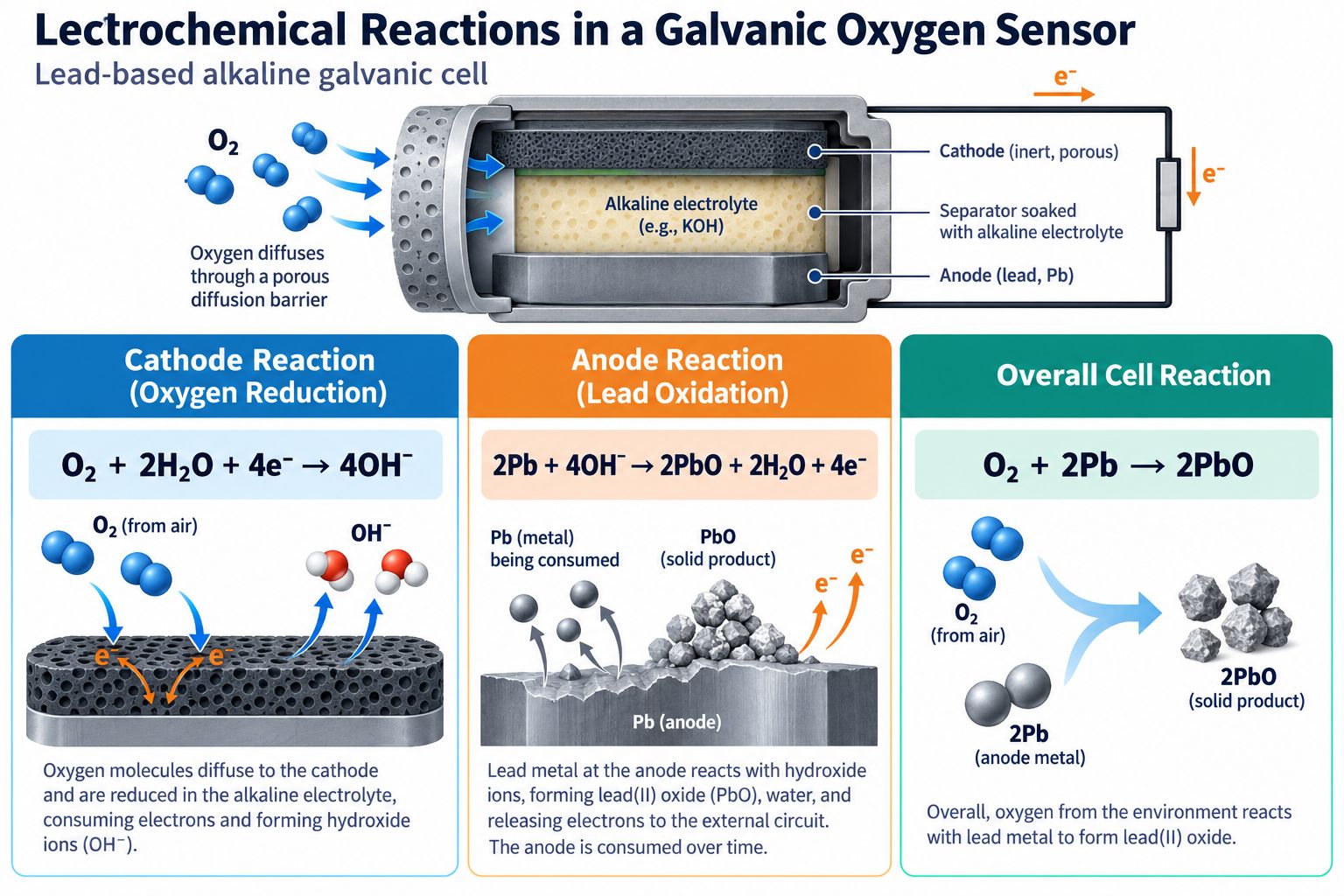
Cathode reaction
Oxygen is reduced at the cathode. The rate is controlled in large part by how quickly O₂ reaches the electrode through the diffusion barrier.
Anode and overall reaction
Overall: O₂ + 2Pb → 2PbO
This makes the lifetime mechanism easy to understand: every sustained oxygen measurement consumes some sacrificial anode inventory.
Diffusion architecture
Mass-flow controlled vs partial-pressure controlled galvanic O₂ sensors
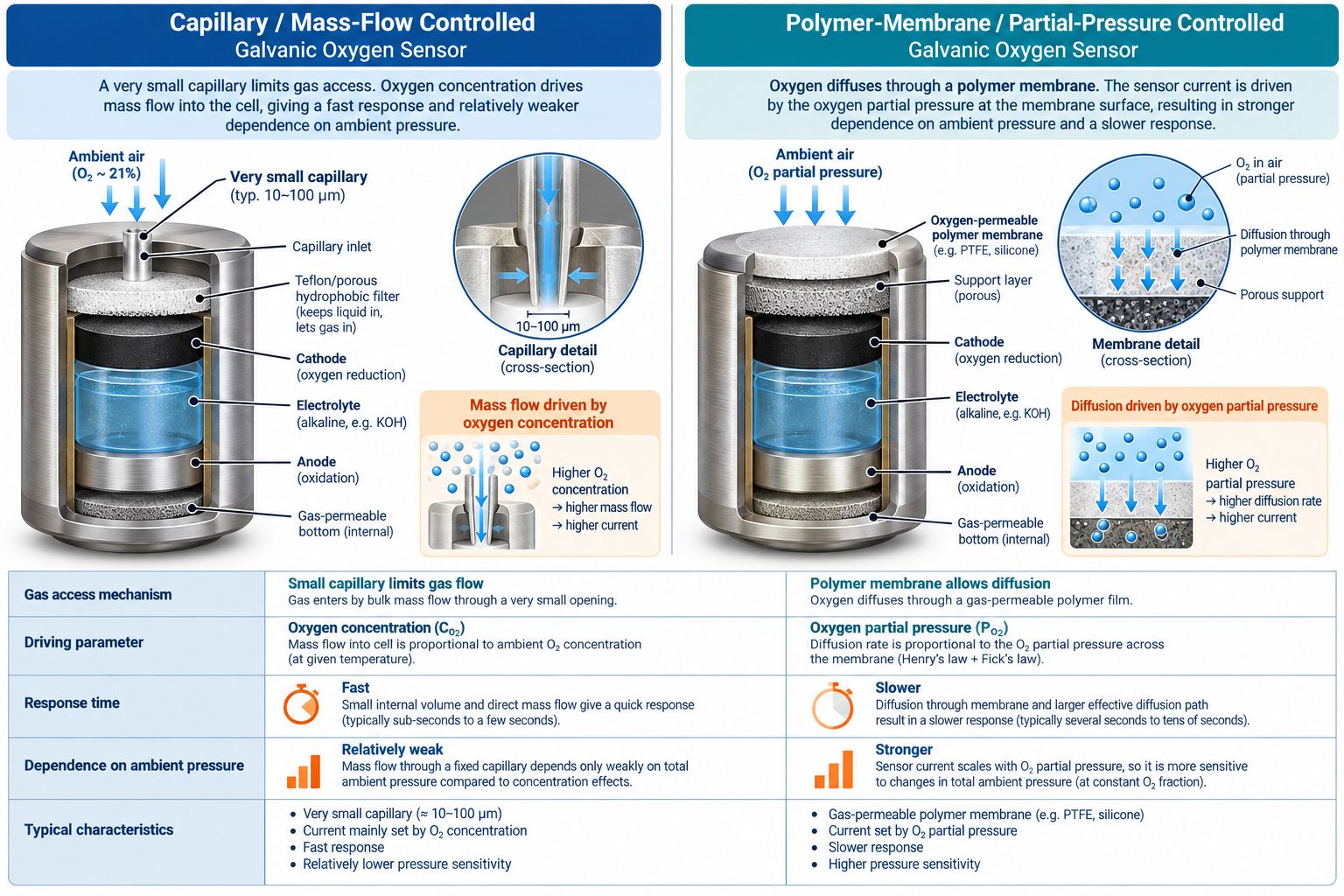
| Factor | Capillary / mass-flow controlled | Polymer-membrane / partial-pressure controlled |
|---|---|---|
| Gas access | Very small capillary restricts gas flow | O₂ diffuses through a gas-permeable membrane |
| Primary driving behavior | More closely tied to O₂ concentration under normal conditions | More closely tied to oxygen partial pressure across the membrane |
| Pressure dependence | Often weaker at steady ambient pressure | Usually stronger |
| Temperature dependence | Often relatively modest | Membrane diffusivity can be strongly temperature dependent |
| Response | Can be faster | Often slower because diffusion occurs through a membrane |
| Best fit | Common in industrial safety and portable detectors | Useful where partial-pressure response is intentionally desired |
Finite chemical life
Why galvanic oxygen sensors eventually reach end of life
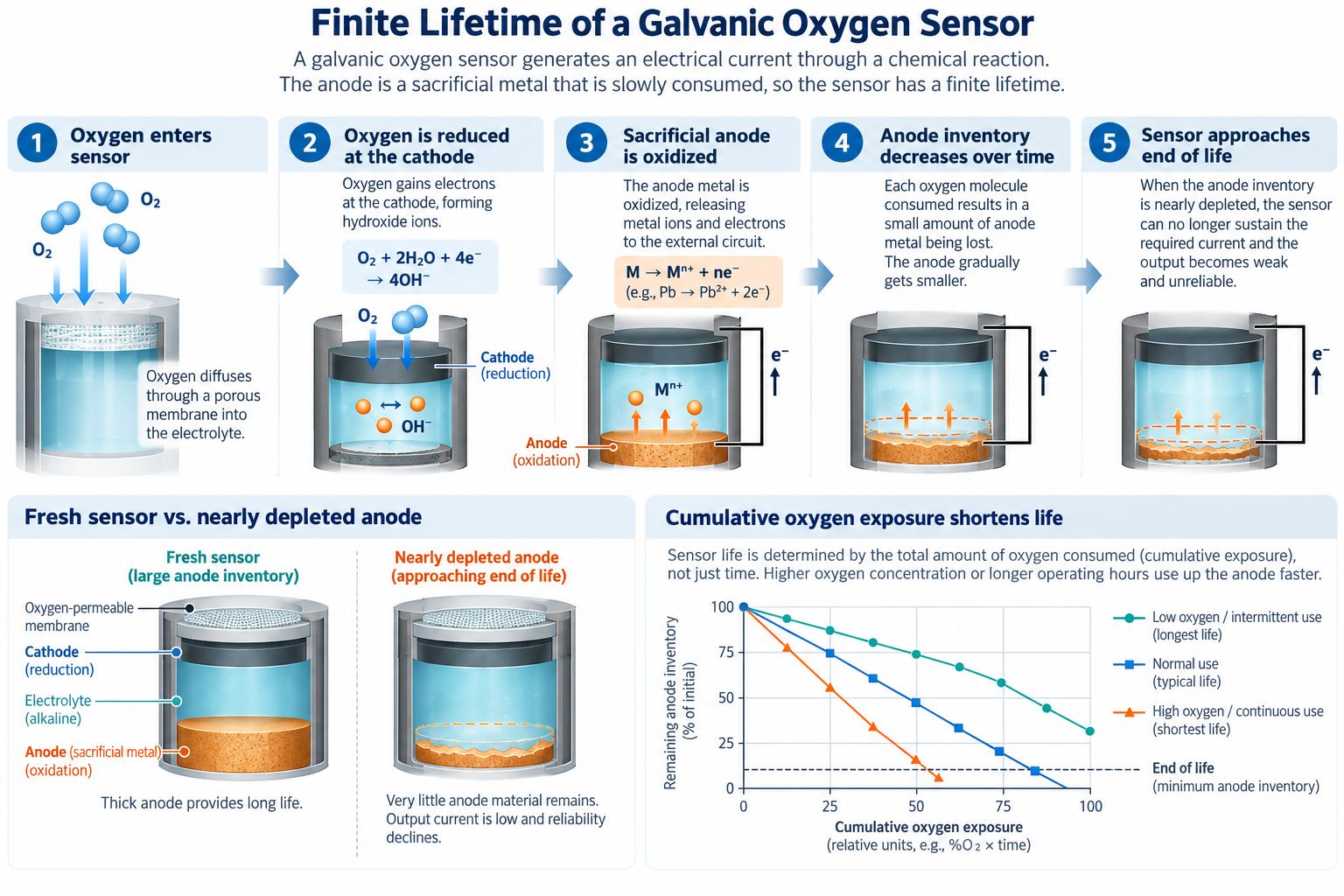
What controls practical life?
- Total anode inventory
- Cumulative oxygen exposure
- Average oxygen concentration
- Temperature and storage conditions
- Electrolyte condition and sealing
- Membrane or capillary aging
Storing a cell in lower oxygen can reduce ongoing electrochemical consumption, but real shelf-life requirements still depend on the manufacturer's packaging, seal and electrolyte specifications.
Environmental behavior
Pressure, temperature, humidity and carrier gas can all change the reading
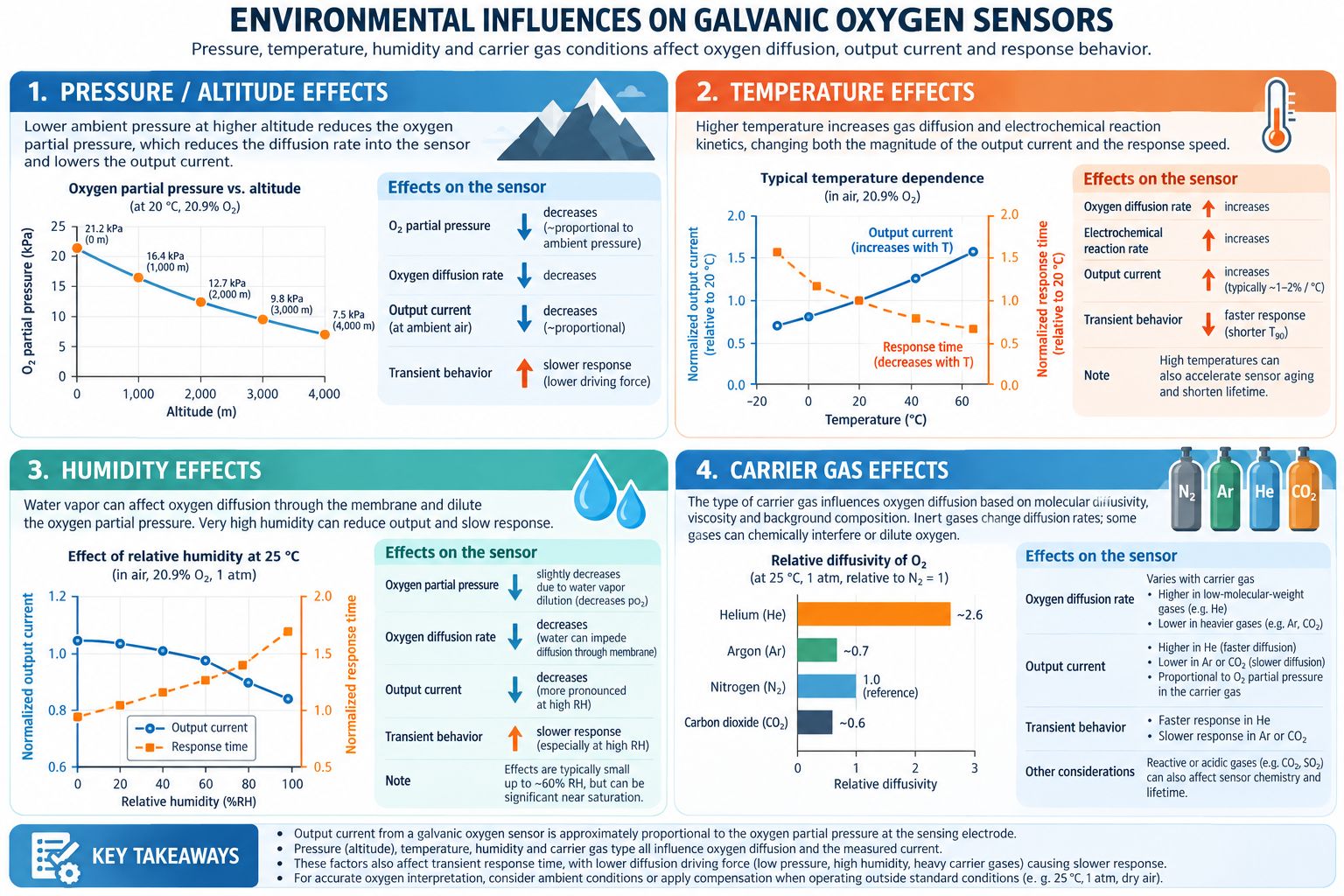
Pressure / altitude
Partial-pressure-controlled cells respond directly to changing pO₂. Capillary mass-flow cells can be less sensitive at steady pressure but still show transients during pressure steps.
Temperature
Changes diffusion, membrane permeability, electrolyte conductivity and reaction kinetics. The size of the effect depends heavily on sensor architecture.
Humidity
Water vapor dilutes dry-air oxygen fraction and rapid RH changes may create transient effects. Some membranes and electrolytes also have direct humidity sensitivity.
Carrier gas
Helium, nitrogen, argon or CO₂ can change oxygen diffusion rate, so the same nominal %O₂ does not always produce identical behavior in every gas matrix.
Materials evolution
Lead-based vs lead-free galvanic oxygen sensors
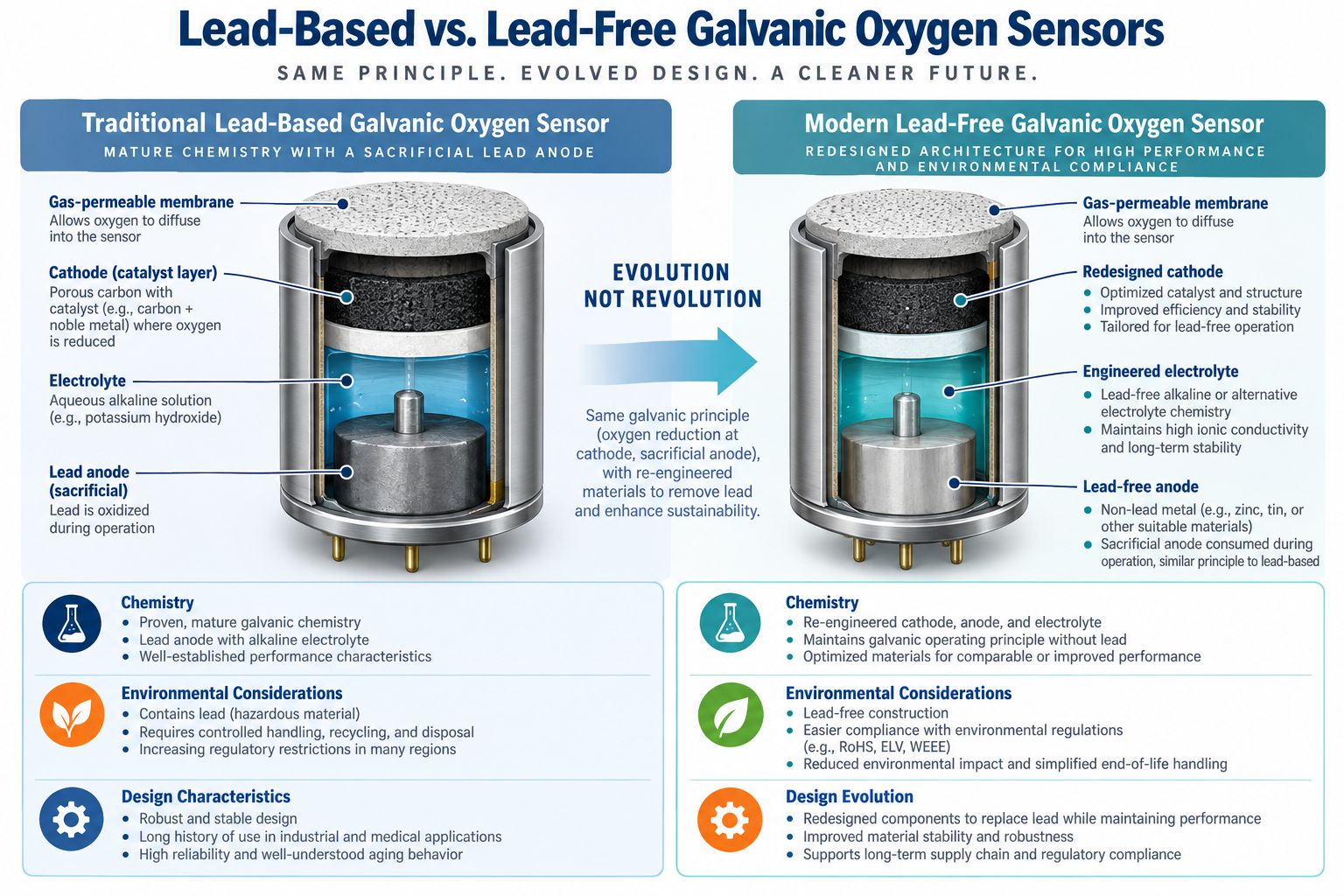
Traditional lead-based cells
- Mature, well-understood electrochemical chemistry
- Predictable consumption-based lifetime
- Long history in safety and medical oxygen sensing
- Lead content creates environmental and end-of-life concerns
Modern lead-free cells
- Use non-lead anode chemistry
- Often require redesigned cathode and electrolyte as well
- Can simplify environmental compliance
- Performance must be validated by specific model, not assumed from chemistry name alone
Electrochemical comparison
Galvanic O₂ vs potentiostatic electrochemical O₂ sensors
| Factor | Galvanic O₂ sensor | Potentiostatic O₂ sensor |
|---|---|---|
| Cell behavior | Self-powered metal-air electrochemical cell | Electrode potential is controlled electronically |
| Sensing bias | Normally no external sensing bias | Bias / potentiostat commonly required |
| Typical electrode arrangement | Often 2-terminal | Often 3-electrode or multi-electrode |
| Anode consumption | Sacrificial chemistry is common | Depends on architecture |
| Electronics | Relatively simple current readout | Potentiostat + current readout |
| Lifetime mechanism | Frequently limited by finite chemical inventory | Architecture-dependent |
Oxygen sensor comparison
Galvanic vs zirconia oxygen sensors
| Factor | Galvanic O₂ sensor | Zirconia O₂ sensor |
|---|---|---|
| Principle | Self-powered metal-air electrochemical cell | High-temperature O²⁻ conduction through YSZ |
| Operating temperature | Near ambient | High temperature |
| Heater | No | Usually yes |
| Sacrificial anode | Common | No |
| Power | Very low sensor-cell power | Higher due to heater |
| Lifetime profile | Finite chemical capacity | Electrolyte is not consumed like a galvanic anode |
| Best fit | Portable safety, medical, diving, ambient/process gas | Combustion, exhaust, furnace and high-temperature process O₂ |
| Related guide | Zirconia Oxygen Sensors | |
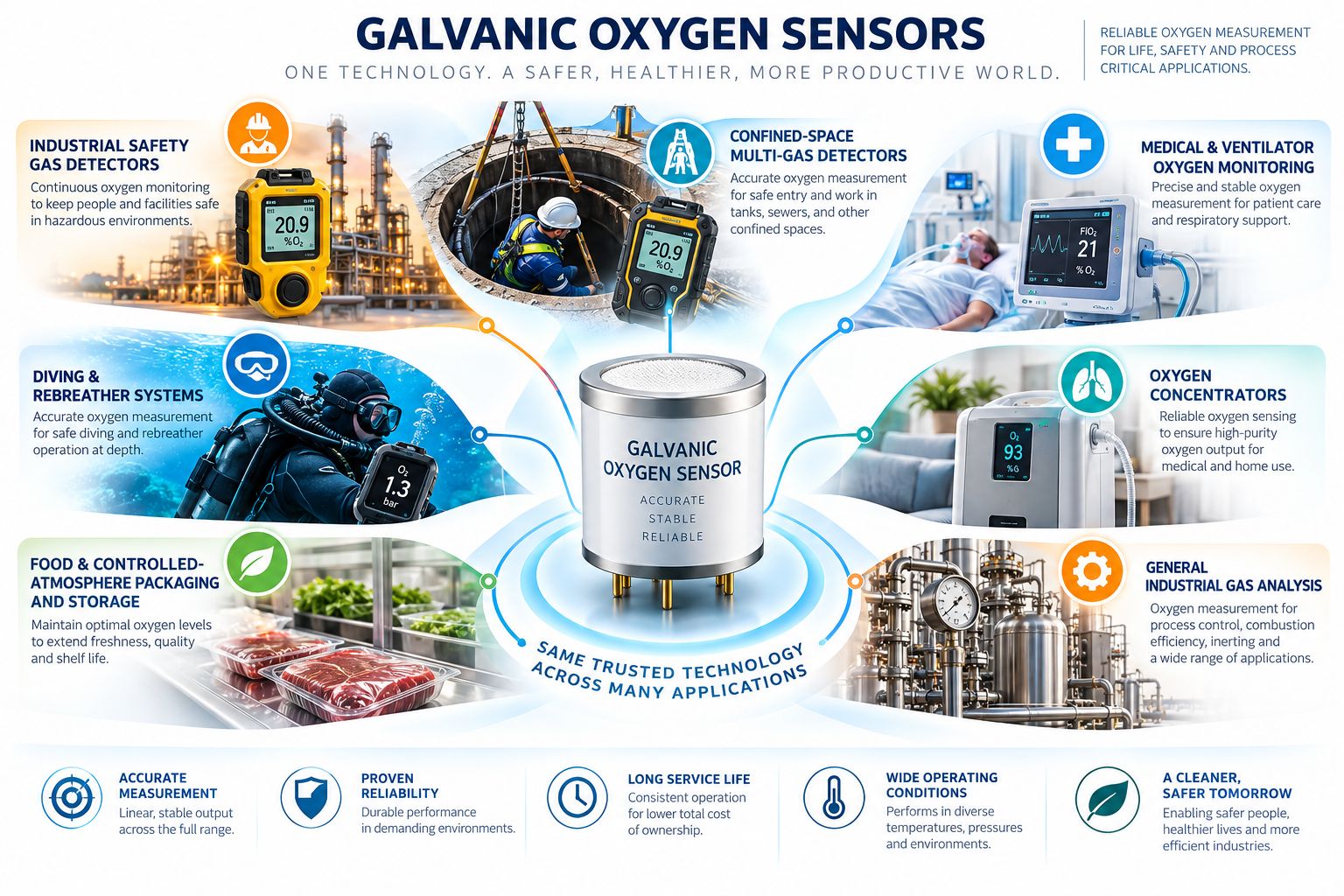
Applications
Where galvanic oxygen sensors are used
Industrial safety
Oxygen-deficiency and oxygen-enrichment monitoring in portable and fixed gas detectors.
Confined spaces
Multi-gas detectors used for tanks, sewers, vessels and other permit-required confined spaces.
Medical & ventilator monitoring
Percentage oxygen measurement in respiratory and anesthesia systems using models designed for the required O₂ range.
Oxygen concentrators
High-range cells can monitor oxygen-rich product gas where standard industrial 0–25% cells would be unsuitable.
Diving & rebreathers
Galvanic cells are widely used for oxygen monitoring, but pressure behavior and application-specific qualification are critical.
Food & industrial gas analysis
Useful for controlled atmospheres, packaging, storage and percentage-O₂ process measurements.
Selection workflow
How to choose a galvanic oxygen sensor
1. Define the O₂ range
Industrial safety, medical 0–100%, oxygen concentrator and diving applications need very different cell ranges.
2. Identify diffusion architecture
Know whether the cell is capillary mass-flow or membrane partial-pressure controlled.
3. Check environment
Review pressure, altitude, temperature, humidity and carrier-gas composition.
4. Plan for lifetime
Account for cumulative O₂ exposure, storage conditions, calibration and end-of-life replacement.
Before design freeze
- Required O₂ range and accuracy
- Capillary vs membrane transport
- Pressure and altitude range
- Carrier gas: air/N₂, He, Ar, CO₂ or other
- Humidity and temperature range
- Response time target
- Cumulative oxygen exposure
- Lead-based vs lead-free requirement
- Calibration interval and replacement policy
- Application-specific certification or medical/diving requirements
Galvanic O₂ OEM checklist
The cell cannot be selected from “0–25% O₂” alone. Diffusion architecture, gas matrix, pressure, lifetime and electronics all matter.
- Confirm actual diffusion-control principle
- Validate output in the intended balance gas
- Test pressure steps and altitude behavior
- Characterize temperature and humidity compensation
- Define enriched-O₂ lifetime expectations
- Use the correct high-range cell for oxygen concentrators / medical service
- Plan calibration and end-of-life diagnostics
- Do not substitute cells solely by mechanical footprint
FAQ
Galvanic oxygen sensor FAQ
What is a galvanic oxygen sensor?
A galvanic oxygen sensor is a self-powered electrochemical cell in which oxygen is reduced at the cathode while a sacrificial anode is oxidized. The resulting current is related to the oxygen reaching the sensing electrode.
Why is it called a fuel-cell oxygen sensor?
Because the sensor behaves like a small metal-air electrochemical cell: oxygen participates in the cathode reaction and a metal anode supplies the counter-reaction, producing an electrical current without a sensing heater.
Does a galvanic oxygen sensor need external power?
The raw sensing cell normally requires no heater and no sensing bias. The finished detector still needs power for amplification, ADC, MCU, display, alarms and communications.
Why do galvanic oxygen sensors have a finite life?
The sacrificial anode is gradually oxidized during normal sensing. Once the available anode inventory or another critical cell component reaches its end-of-life condition, the sensor can no longer maintain its calibrated output.
Does higher oxygen concentration shorten sensor life?
Generally, higher cumulative oxygen exposure increases electrochemical consumption and can shorten the usable life of a galvanic cell, although real lifetime also depends on cell design, temperature, electrolyte and storage conditions.
Are all galvanic O₂ sensors pressure dependent?
No. Polymer-membrane partial-pressure cells are typically more pressure dependent, while capillary mass-flow cells can be much less sensitive to steady ambient-pressure changes. Rapid pressure steps can still create transient errors.
What is the difference between oxygen concentration and oxygen partial pressure?
Oxygen concentration describes the fraction of O₂ in the gas mixture. Oxygen partial pressure is that fraction multiplied by total pressure. A 20.9% O₂ mixture therefore has lower pO₂ at high altitude than at sea level.
Does carrier gas affect a galvanic oxygen sensor?
It can. Oxygen diffuses differently in helium, nitrogen, argon and carbon dioxide, so a cell calibrated in one balance gas may not behave identically in another.
What is the difference between lead-based and lead-free galvanic oxygen sensors?
Traditional cells often use a lead sacrificial anode. Lead-free designs retain the galvanic principle but use alternative anode chemistry and may also redesign the cathode, electrolyte and membrane system.
Can a 0–25% industrial O₂ sensor be used in an oxygen concentrator?
Not automatically. Oxygen concentrators and many medical systems require cells designed and calibrated for high oxygen concentrations, often up to 100% O₂, plus the appropriate safety and regulatory characteristics.
How is a galvanic oxygen sensor different from a zirconia oxygen sensor?
Galvanic sensors work near ambient temperature using a self-powered electrochemical cell with a consumable anode. Zirconia sensors use a heated solid ceramic electrolyte and are better suited to combustion, exhaust and high-temperature process measurement.
What should engineers check before selecting a galvanic O₂ sensor?
Check oxygen range, diffusion architecture, pressure and altitude behavior, temperature and humidity range, carrier gas, response time, cumulative oxygen exposure, lifetime, lead-free requirements, calibration needs and application-specific certification.
Choosing an oxygen-sensor technology?
Use galvanic cells when you need compact, low-power oxygen measurement near ambient temperature, but validate the diffusion architecture, pressure behavior, carrier gas and finite chemical lifetime before finalizing the design.