



NDIR Gas Sensors
Non-dispersive infrared (NDIR) sensors measure gases by tracking how much infrared light is absorbed at a target wavelength. They are widely used for CO₂, methane, combustible gases, refrigerants, N₂O, SF₆ and other gases with useful infrared absorption bands—especially where long life, optical selectivity and low maintenance are important.
Working principle
How does an NDIR gas sensor work?
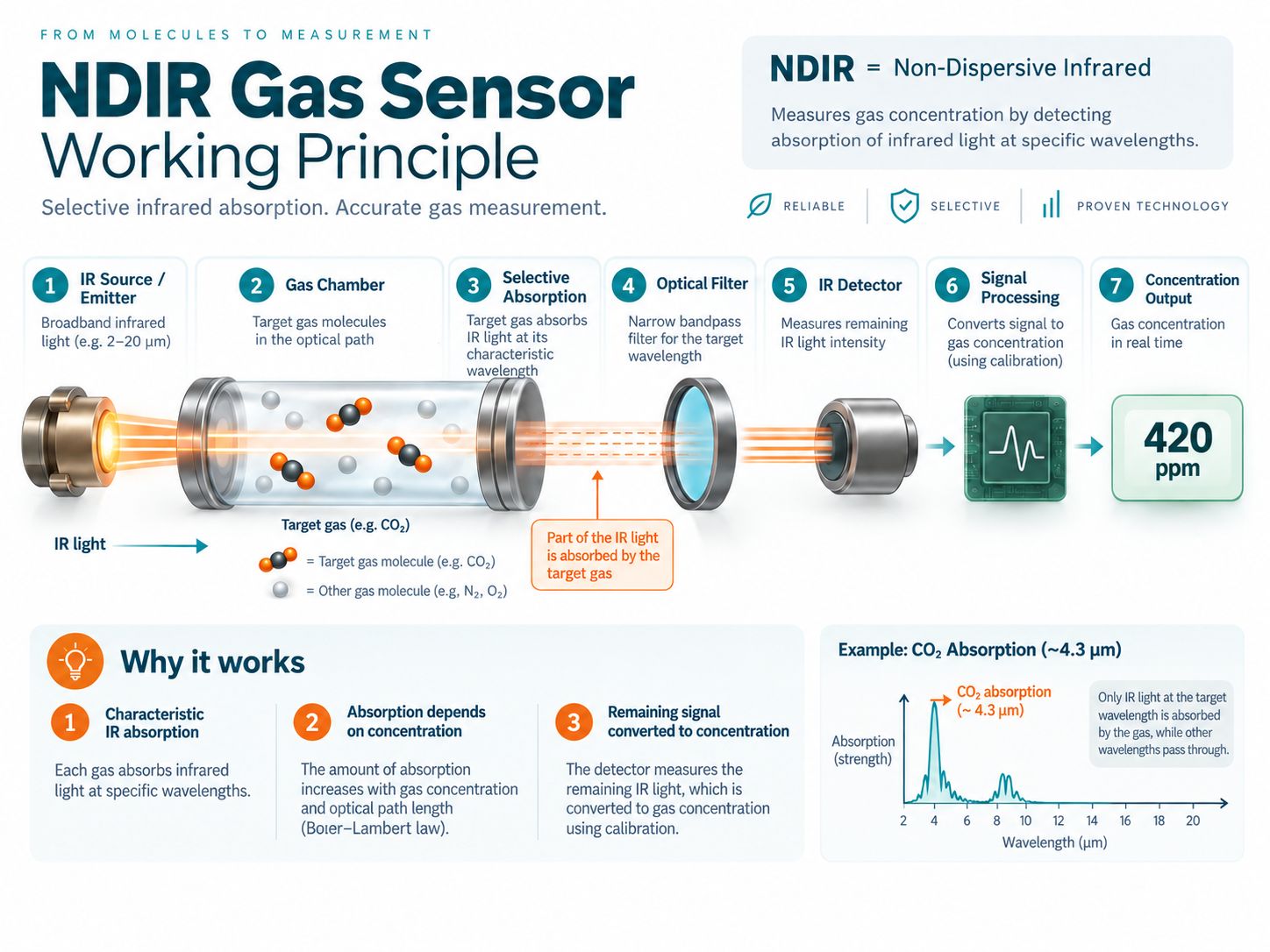
The measurement chain
- IR source: creates broadband or sufficiently wide infrared radiation.
- Gas chamber: defines the optical path through the sample.
- Target absorption: gas molecules remove energy around characteristic bands.
- Optical filter: passes the target wavelength region to the detector.
- Detector + electronics: measure signal attenuation and apply calibration, temperature and other compensation.
A concise manufacturer overview is available from smartGAS on the NDIR principle ↗.
At low concentration, only a small fraction of the target wavelength is absorbed, so relatively more measurement-channel light reaches the detector.
Inside the optical system
What is inside an NDIR gas sensor?
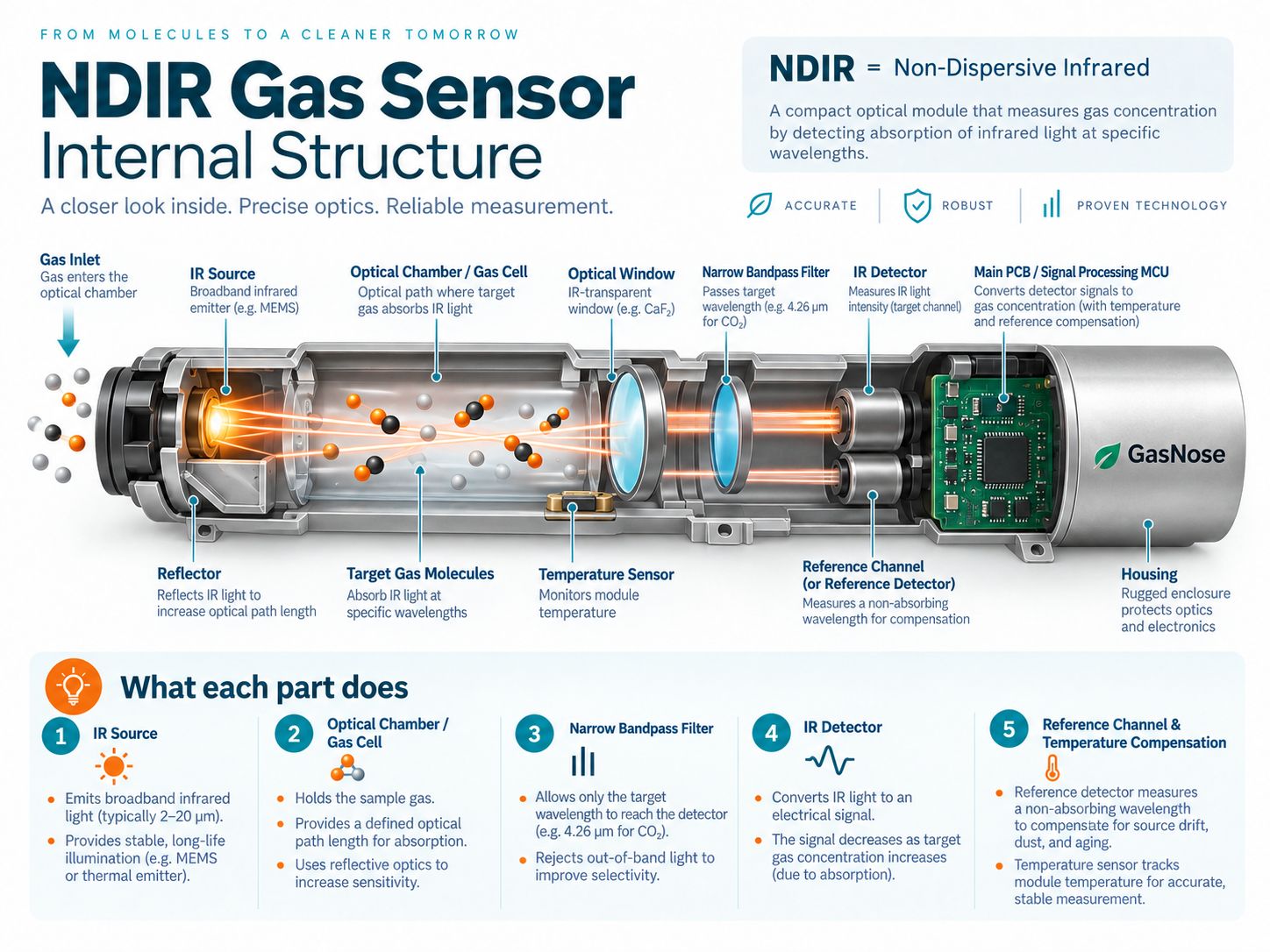
The optical bench is the real sensing engine. It defines how much gas is sampled, how far the light travels, which wavelengths reach the detector and how much drift can be compensated.
IR source
MEMS emitters, thermal lamps and other broadband sources can be used. Source stability, modulation strategy and lifetime affect measurement quality.
Gas cell / optical path
Path length is a core design variable. A longer effective path strengthens absorption but can increase size, gas-exchange time and sensitivity to contamination.
Filter + detector
The optical filter selects the target band; the detector converts received IR energy into an electrical signal.
Reference + compensation
A reference wavelength, temperature sensor and firmware can help distinguish gas absorption from source aging, optical losses and environmental change.
Molecular fingerprint
Why different gases need different NDIR wavelengths
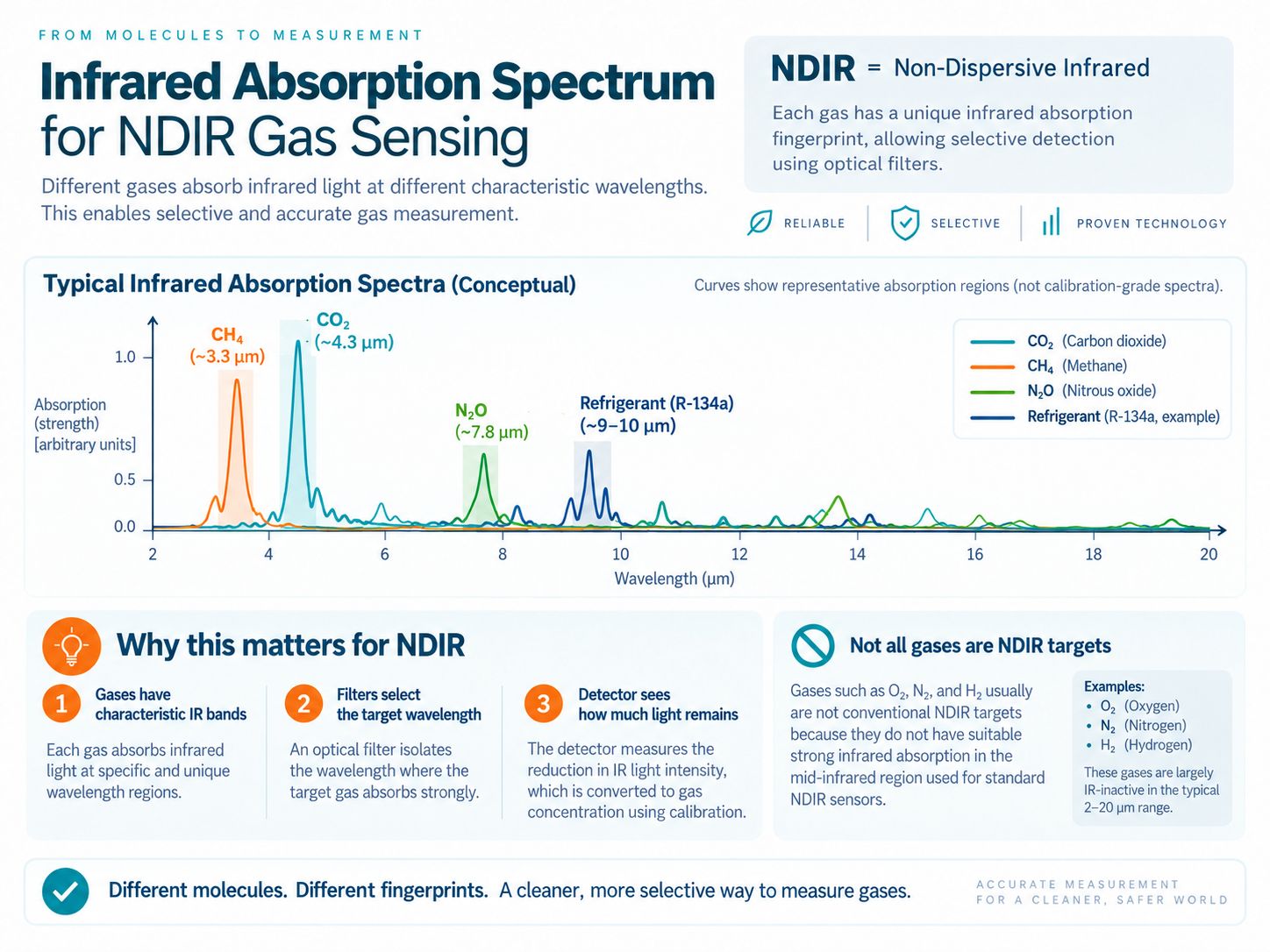
Molecules absorb infrared light when specific vibrational or rotational modes interact with the optical field. The result is a gas-specific spectral fingerprint rather than one universal NDIR wavelength.
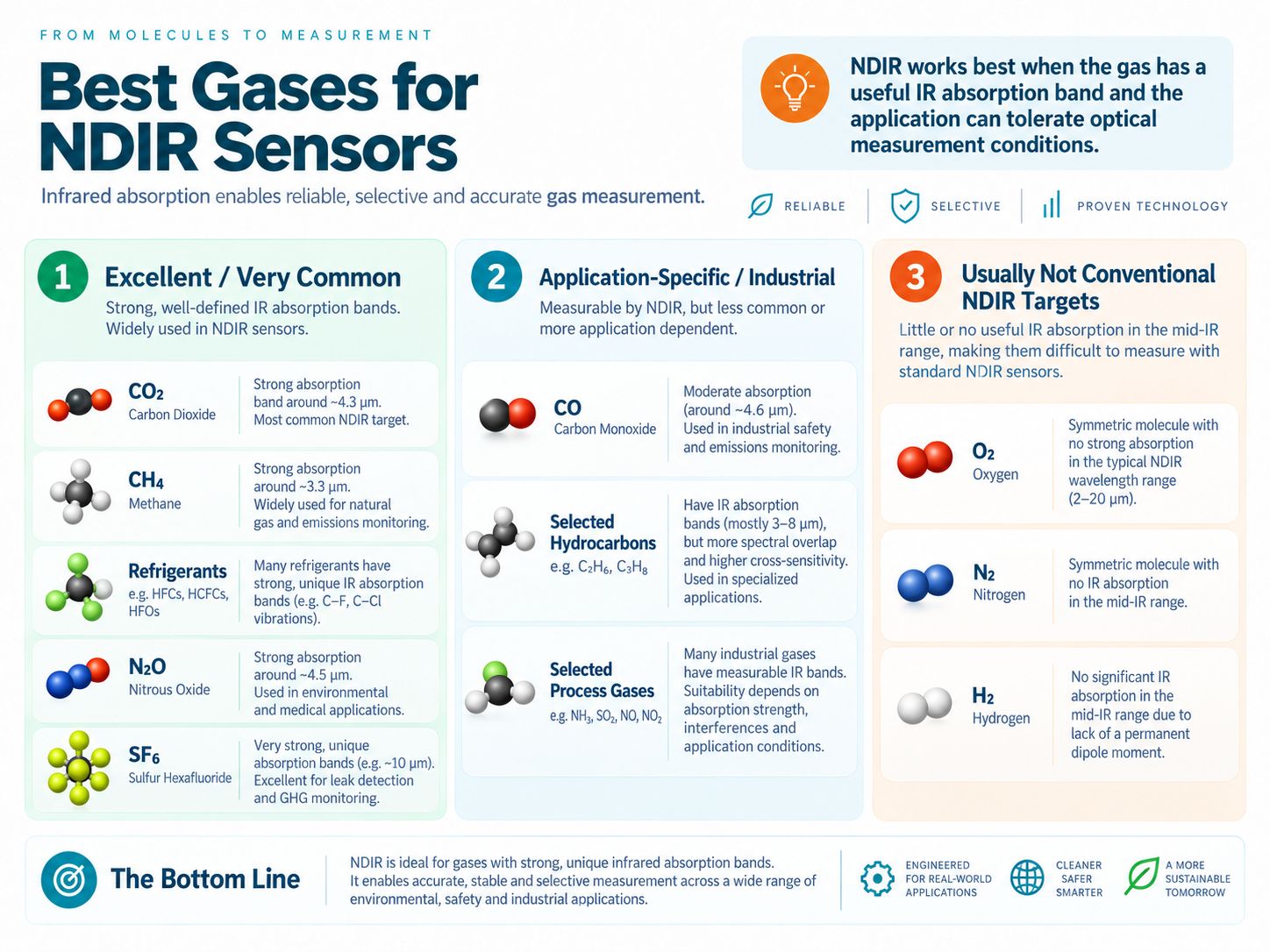
- CO₂ is commonly measured near a strong band around 4.3 µm.
- CH₄ is commonly targeted around the 3.3 µm region.
- N₂O, SF₆ and refrigerants use other bands selected to balance signal strength and interference.
- O₂, N₂ and H₂ are homonuclear diatomic molecules and are generally not conventional mid-IR NDIR targets.
This is why a methane NDIR sensor does not become a CO₂ or refrigerant sensor by software alone: the optical filter, detector response and calibration basis are tied to the target spectrum.
Vaisala describes the same core idea as gases having unique infrared wavelength “fingerprints,” with optical filtering used to isolate them. Vaisala NDIR technology overview ↗.
Beer–Lambert relationship
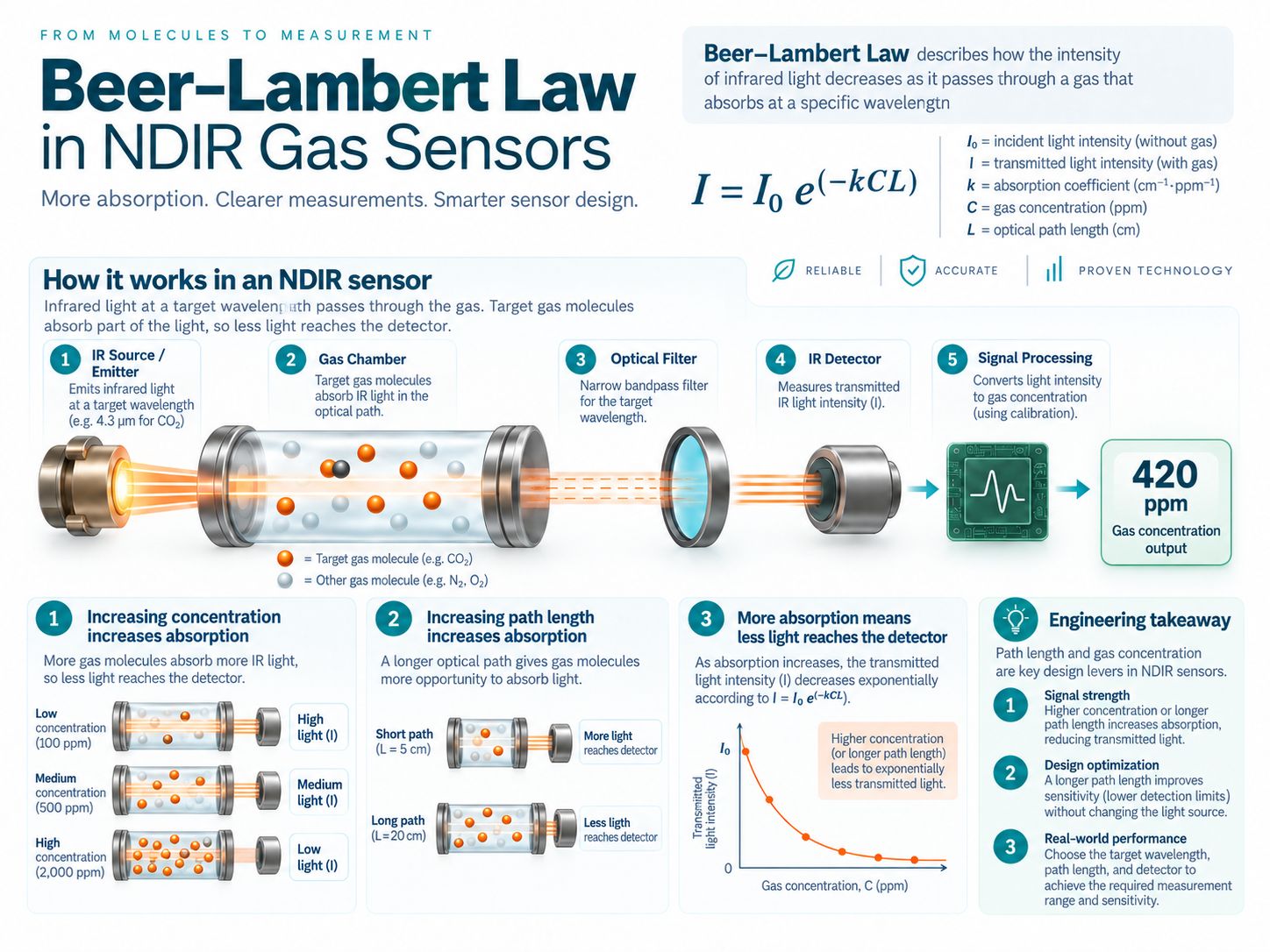
Why concentration and optical path length change the NDIR signal
Three practical implications
More molecules → more absorption
Higher target-gas concentration removes more energy from the measurement band.
Longer path → stronger signal change
Long-path or folded cells can improve low-concentration sensitivity without changing the target gas chemistry.
Too much absorption can saturate
Low-ppm and %vol sensors often need different optical lengths or calibration strategies.
For OEM work, the useful question is not “does Beer–Lambert apply?” but “what path length, bandpass, detector and calibration model produce the required range without losing resolution or saturating?”
Long-term stability
Single-wavelength vs dual-wavelength NDIR
The measurement channel tracks a wavelength absorbed by the target gas. A reference channel is placed at a wavelength where the target gas absorbs little or not at all, helping the instrument separate real gas absorption from common optical-intensity changes.
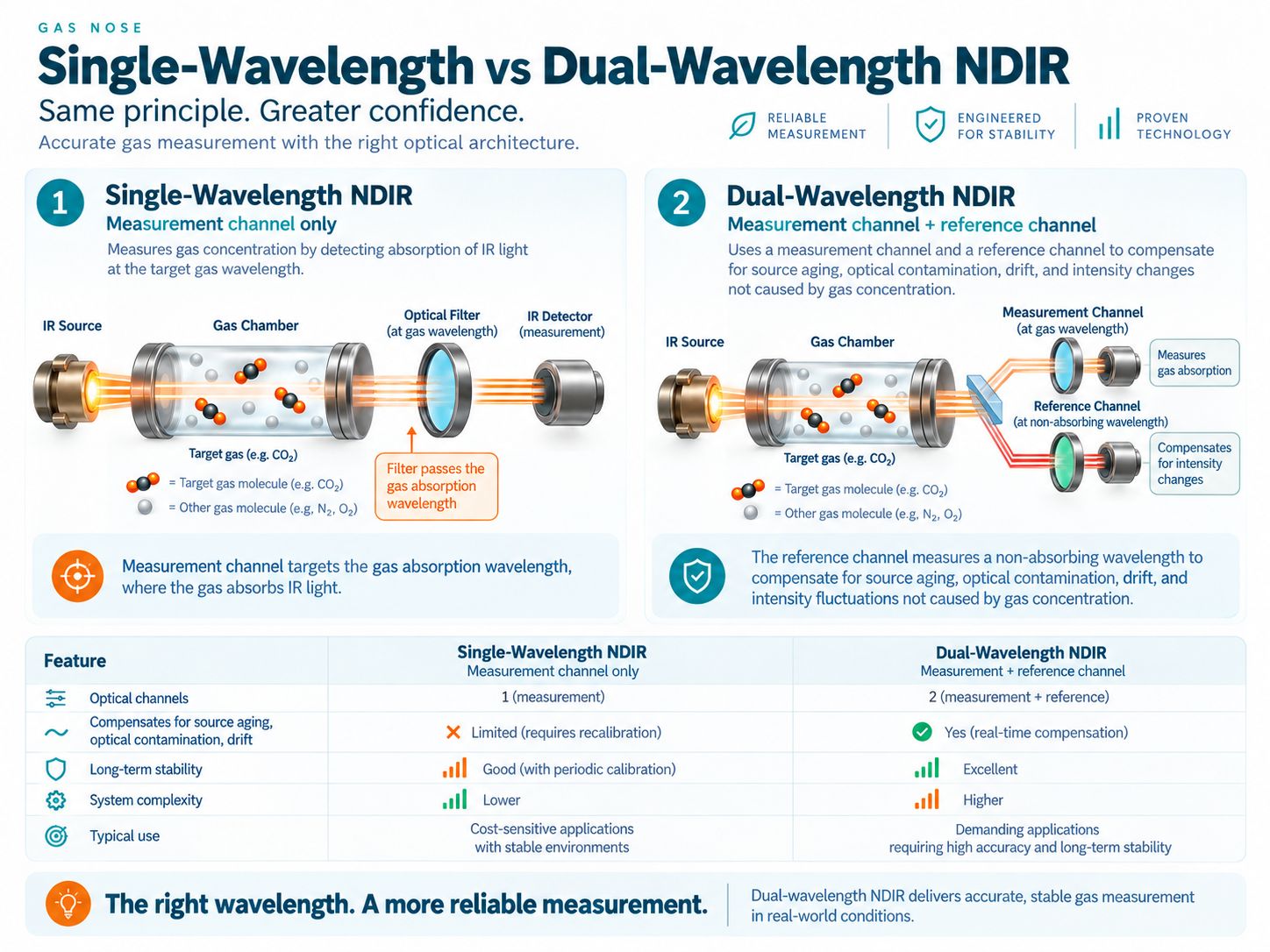
Measurement-channel-only
- Lower optical and electronics complexity
- Can be effective in stable environments
- May rely more heavily on recalibration or source/drift modeling
Measurement + reference
- Better visibility into source intensity and common optical losses
- Useful for long-life or demanding environments
- Adds optical, electronic and algorithm complexity
Dynament’s NDIR architecture is a useful real-world example: its Gold Series integrates an infrared source, dual-wavelength detector, temperature sensor, optical cavity and electronics. Dynament sensor overview ↗.
Technology fit
Which gases are best suited to NDIR?
CO₂
The most familiar NDIR target: strong mid-IR absorption, broad IAQ-to-process use and mature compact sensor modules.
CH₄ / hydrocarbons
Used from ppm/%vol analysis to combustible gas and %LEL applications.
Refrigerants
NDIR is widely used for R32, R454B, R290, R134a and other refrigerants where gas-specific calibration is available.
N₂O / specialized gases
N₂O, SF₆ and selected process gases can be measured optically when the wavelength, detector and interference strategy are appropriate.
What NDIR is usually not good at
O₂, N₂ and H₂ are not conventional NDIR targets because homonuclear diatomic molecules do not provide the strong standard mid-IR absorption behavior used by ordinary NDIR gas sensors. Those gases normally use other sensing methods.
Engineering trade-offs
Why engineers choose NDIR—and where it needs care
Why NDIR works well
- Non-consumptive optical measurement
- Strong gas selectivity when the target band is well chosen
- Long service life in many applications
- No dependence on catalytic oxidation for hydrocarbon measurement
- Useful from ppm to %vol / %LEL
- Can provide stable digital modules with temperature compensation
Where NDIR needs engineering care
- Condensation, dust and optical contamination
- Temperature and pressure compensation
- Spectral overlap and background-gas effects
- Source and detector aging
- Optical path trade-offs between sensitivity, size and response
- Higher peak power than some low-power electrochemical or MEMS routes
Environmental compensation
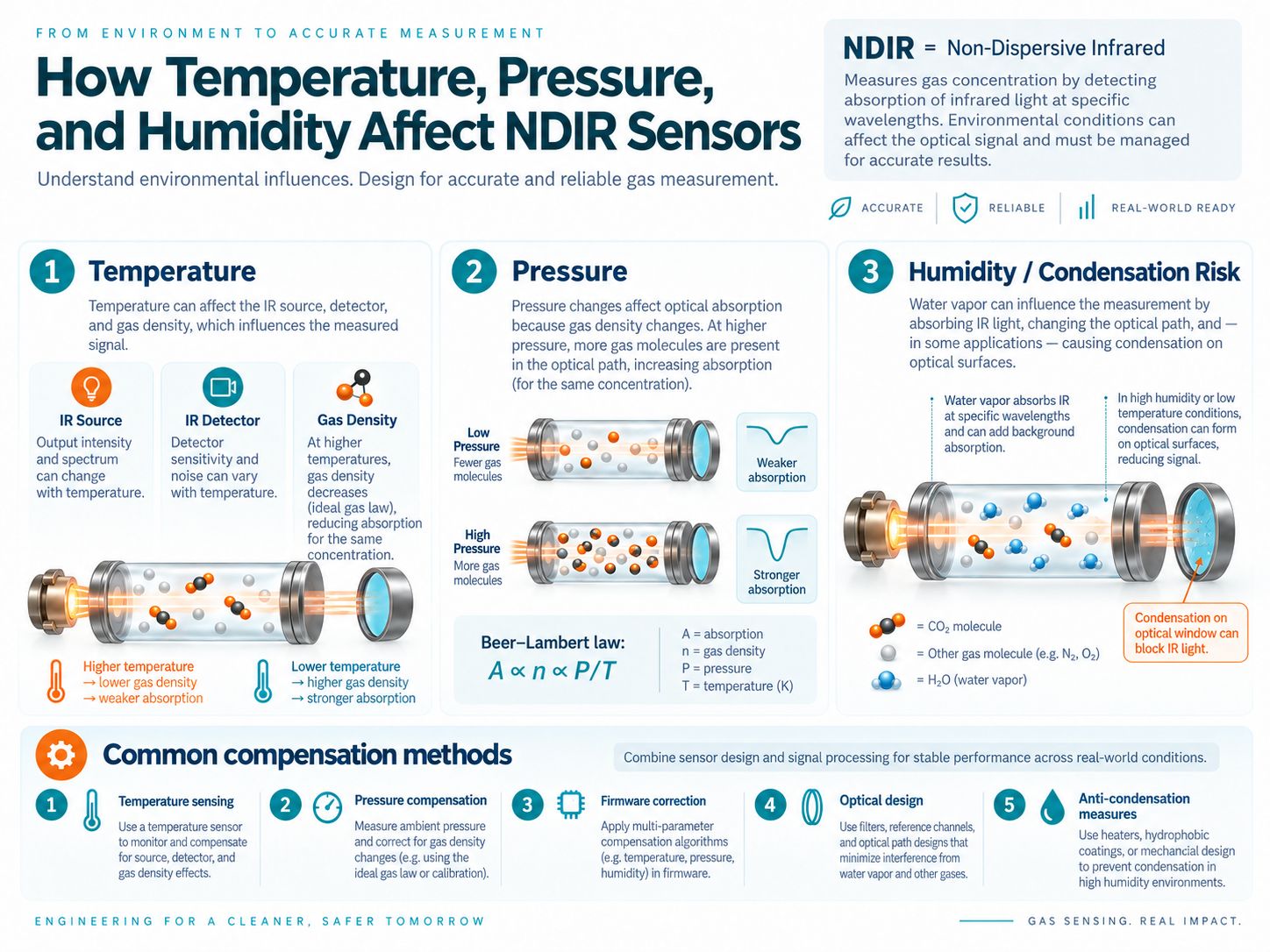
Temperature, pressure and humidity can all move an NDIR reading
NDIR measures optical absorption, but the optical system sits inside a real gas environment. Temperature can affect the source, detector and gas density; pressure changes gas density and line behavior; humidity may introduce background absorption and, more importantly in many products, condensation risk.
Temperature
Compensation may be required for source output, detector response, mechanical optics and gas-density effects.
Pressure
Pressure changes alter the number of gas molecules in a fixed optical volume and therefore the absorption signal.
Humidity
Water vapor can overlap some spectral regions and high humidity can cause condensation on optical surfaces.
Vaisala’s current CO₂ probe documentation explicitly supports compensation for temperature, pressure, relative humidity and background-gas oxygen where needed. Vaisala environmental compensation ↗.
Optical reliability
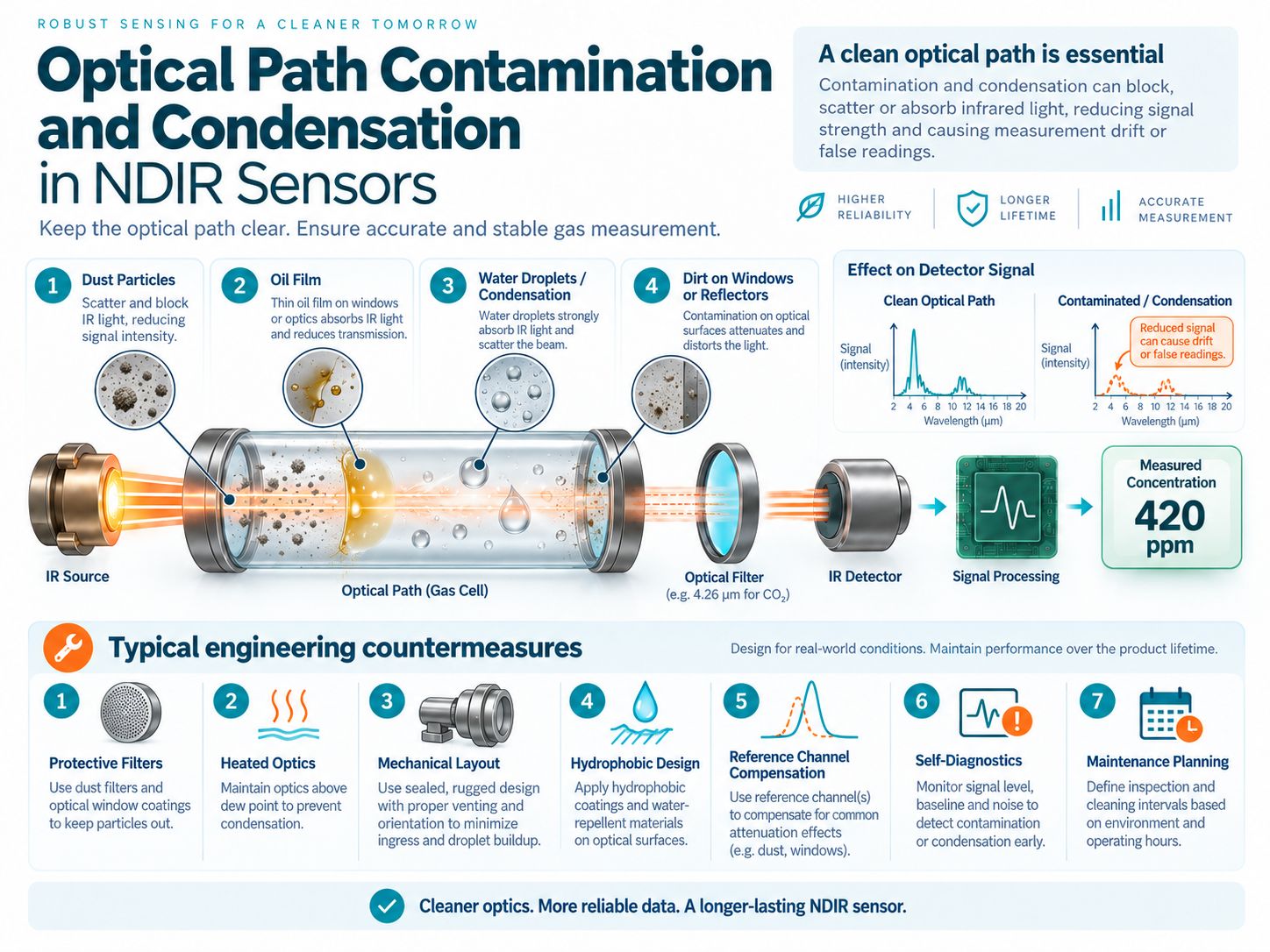
Condensation and contamination are not minor details—they change the optical path
Common failure mechanisms
- Dust: scatters or blocks part of the optical beam.
- Oil or aerosol film: changes window transmission and may absorb in the measurement band.
- Condensation: can strongly attenuate or distort the beam and may produce large temporary errors.
- Dirty reflectors: reduce multipass efficiency and effective path length.
Design responses
- Hydrophobic membranes and suitable filters
- Heated optics or dew-point margin in harsh humidity
- Mechanical orientation that avoids liquid pooling
- Reference-channel diagnostics and optical-health monitoring
- Service strategy for inspectable analyzers
Sample transport
Diffusion, flow-through and pumped NDIR are different system designs
Simple fixed sensing
Common in IAQ and compact modules. Response depends on vents, enclosure diffusion and local airflow.
Controlled process sampling
Useful where gas is already moving through tubing or an analyzer chamber and flow conditions can be controlled.
Remote and multi-point sampling
Useful for remote locations or multi-zone monitoring, but adds tubing delay, condensation risk, pump maintenance and sample-conditioning questions.
A fast optical detector can still produce a slow instrument if gas transport into the chamber is slow. Always separate intrinsic optical response from system sample-delivery response.
Related optical technologies
NDIR vs PAS, TDLAS and FTIR
| Technology | Core measurement idea | Typical strength | Typical trade-off |
|---|---|---|---|
| NDIR | Broadband IR source + optical filter + detector | Mature, robust, compact, cost-effective for known target gases | Filter bandwidth and spectral overlap limit selectivity versus narrow-line spectroscopy |
| PAS | Absorbed optical energy becomes an acoustic signal | Compact effective path without a long physical cell | Acoustic and mechanical design become critical |
| TDLAS | Narrow laser scans a specific absorption line | High selectivity, fast response, excellent process capability | Higher optical/electronic complexity and gas-specific laser requirements |
| FTIR | Broad spectral measurement with interferometric analysis | Multi-gas identification and rich spectra | Larger, more complex analyzer platform |
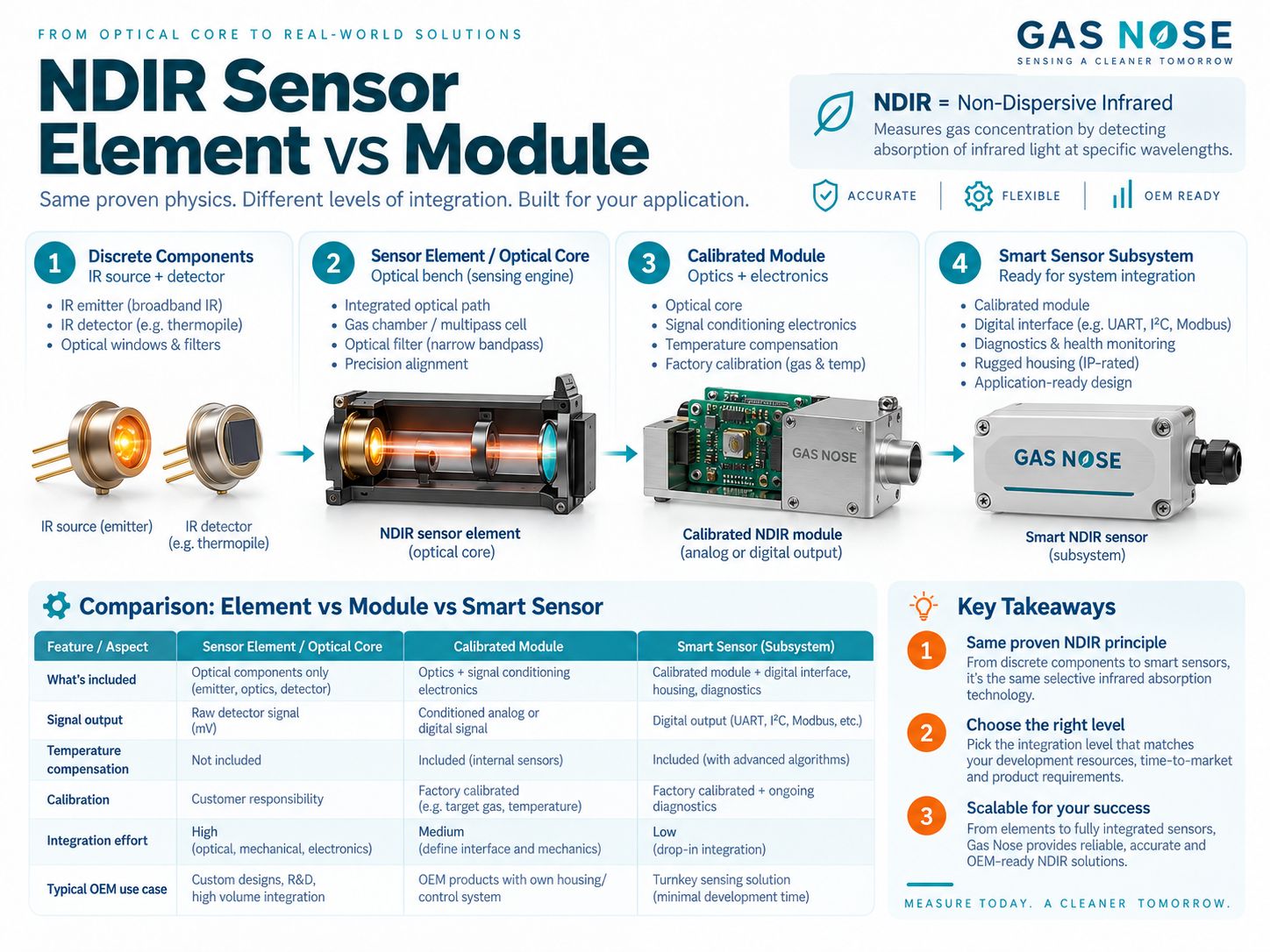
OEM integration
NDIR optical element vs calibrated module vs smart sensor
“NDIR sensor” can mean anything from separate emitter/detector components to a fully calibrated module with digital output and diagnostics. The integration level changes who owns optical alignment, signal conditioning, compensation and calibration.
- Optical core: maximum design freedom, highest optics/mechanics burden.
- Calibrated module: optics + AFE + temperature compensation + factory calibration.
- Smart subsystem: rugged housing, digital protocol, diagnostics and application-ready behavior.
For a broader framework, see Sensor Element vs Sensor Module and Gas Sensor Output Signals.
Example OEM implementations
How NDIR appears in real sensor products
The purpose of these examples is to show how the same optical principle is packaged for very different gases and ranges—not to turn this technology guide into a product catalog.
| Example | Target / range direction | What it demonstrates | Typical integration |
|---|---|---|---|
| Winsen MH-Z19C | CO₂, 400–10,000 ppm options | Compact NDIR IAQ module with temperature compensation and UART/PWM | HVAC, IAQ, ventilation |
| Winsen MH-Z1341B | Methane / combustible gas, up to 100%LEL options | Low-power NDIR combustible-gas architecture, no oxygen dependence | Residential gas alarms, HVAC |
| Winsen MH-441D Refrigerant | R32 / R454B / R410A / R134a, 0–5%vol | Refrigerant-specific calibration on a compact NDIR platform | Refrigeration OEM systems |
| Winsen MH-T5052B | SF₆, up to 3000 ppm | Specialized infrared sensing for a high-value industrial gas | GIS / switchgear / industrial monitoring |
Selection workflow
How to choose an NDIR gas sensor
1. Define the gas
Confirm target species, expected interferents and whether a useful IR absorption band exists.
2. Define the range
ppm, %vol and %LEL ranges drive path length, optical design and calibration strategy.
3. Define the environment
Temperature, pressure, humidity, condensation, dust, oil and sample matrix determine the compensation burden.
4. Define integration level
Choose between optical core, calibrated module and smart subsystem based on OEM capability and time-to-market.
Before design freeze
- Required accuracy and resolution
- T90 / system response requirement
- Diffusion, pumped or flow-through sampling
- Reference channel requirement
- Pressure and humidity compensation
- Warm-up and power budget
- Expected lifetime and calibration plan
Engineering checklist
Record the conditions that define the optical design, not just the target gas name.
- Target gas and measurement basis
- Minimum / maximum concentration
- Likely interfering gases
- Temperature / pressure / RH envelope
- Condensation and contamination risk
- Sample flow or diffusion geometry
- Output and communications
- Calibration / verification interval
Useful Gas Nose tools: Gas Sensor Product Finder and Gas Concentration Converter.
FAQ
NDIR gas sensor FAQ
What does NDIR stand for?
NDIR stands for Non-Dispersive Infrared. The sensor does not fully disperse the complete spectrum like a spectrometer; instead it measures selected infrared wavelength bands associated with the target gas.
Why is NDIR commonly used for CO₂?
CO₂ has a strong and useful infrared absorption band, and compact sources, filters and detectors are widely available. This makes NDIR practical from indoor-air-quality ranges to high-concentration process measurement.
Can NDIR detect methane?
Yes. Methane has useful infrared absorption near the 3.3 µm region and is widely measured with NDIR in natural-gas, combustible-gas and industrial applications.
Can NDIR detect oxygen or hydrogen?
Conventional NDIR generally does not measure O₂, N₂ or H₂ effectively because these homonuclear diatomic molecules lack the strong standard mid-IR absorption behavior used by ordinary NDIR instruments. Other sensing principles are normally chosen.
Why does optical path length matter?
A longer optical path gives target molecules more opportunity to absorb light, increasing sensitivity. The trade-off is that long paths can increase size, sample-exchange time and contamination sensitivity.
Why does an NDIR sensor use a reference channel?
A reference channel measures a wavelength that the target gas does not absorb strongly. Changes common to both channels—such as source aging or some optical attenuation—can then be separated from target-gas absorption more effectively.
Does an NDIR sensor need calibration?
Yes. The optical signal must be mapped to concentration for the specific target gas, range and instrument design. Some modules are factory calibrated and require little field adjustment, but calibration-free operation should not be confused with validation-free operation.
What is the main weakness of NDIR?
NDIR needs a clean and stable optical path. Condensation, dust, oil film, pressure changes, spectral overlap and source/detector drift can all affect performance if they are not managed by mechanical design, reference channels, compensation and calibration.
Need to select an NDIR sensing architecture?
Start with the target gas and concentration range, then define the optical environment, sample transport, lifetime and integration level. For OEM development, the right decision is usually made by matching the optical architecture to the real application—not by choosing the smallest module first.