


TDLAS Gas Sensors
TDLAS—Tunable Diode Laser Absorption Spectroscopy—uses a narrow-linewidth laser tuned across a molecular absorption feature. By measuring how much light is absorbed at a gas-specific wavelength, a TDLAS system can provide fast, highly selective and non-contact concentration measurement.

Technology overview
What is a TDLAS gas sensor?
TDLAS stands for
Tunable Diode Laser Absorption Spectroscopy. The key word is tunable: laser current and temperature are controlled so the emitted wavelength scans across a very narrow spectral feature.
Why this is different from a broad IR sensor
- TDLAS: uses a narrow laser line and resolves a selected molecular transition.
- NDIR: normally uses a broader infrared source plus optical filtering.
- Semiconductor / MOX: relies on surface chemistry and resistance change.
- Electrochemical: uses electrode reactions and electrical current.
With no target gas in the optical path, the detector sees almost the full baseline intensity and the selected absorption line is absent.
Working principle
How does TDLAS gas sensing work?
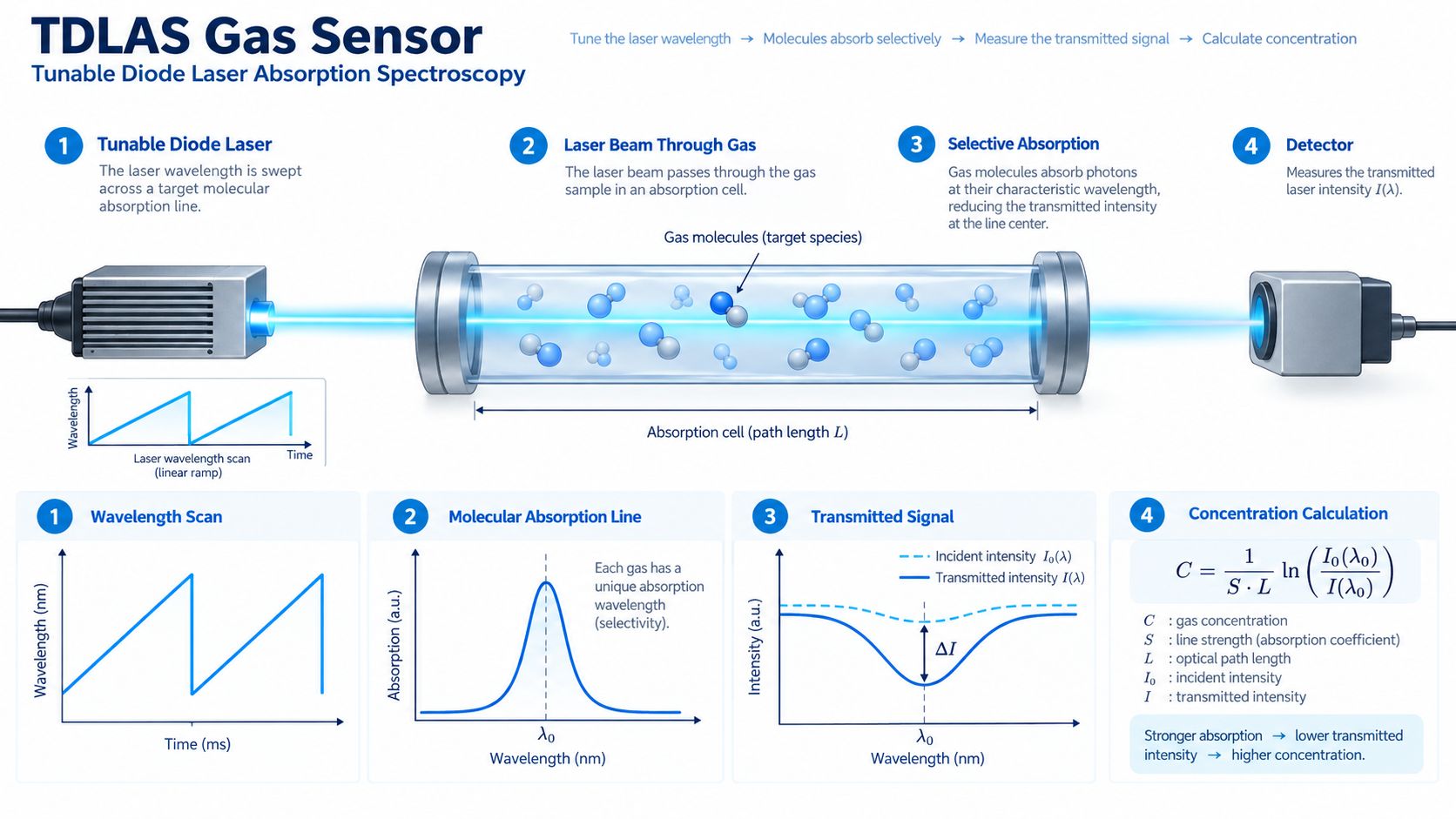
From wavelength scan to concentration
- 1. Tune the laser: current and temperature control move the diode laser across the selected absorption feature.
- 2. Send light through the gas: the optical path can be a compact gas cell, a multipass cell, or an open/in-situ path.
- 3. Selective absorption occurs: target molecules remove photons at their characteristic wavelength.
- 4. Detect transmitted light: the photodiode measures intensity as the laser scans through the line.
- 5. Extract the spectrum: signal processing separates absorption from optical baseline and noise.
- 6. Calculate concentration: the measured absorption is converted using a spectroscopic model and compensation inputs.
TDLAS therefore identifies and measures a gas through its spectral absorption line, not through a chemical reaction with the sensor.
Optical architecture
What is inside a TDLAS gas sensing system?
Tunable laser diode
Often a DFB laser selected for a narrow emission line near the target molecular absorption feature.
Beam-shaping optics
Collimators and lenses guide the laser through the intended measurement path.
Gas cell / optical path
Defines how much target gas the laser interacts with. Longer effective path length increases absorption.
Photodetector
Converts transmitted optical power into an electrical signal for spectral analysis.
Laser driver + TEC control
Stabilizes current and temperature so the wavelength scan remains repeatable.
Signal processing
Fits direct absorption or demodulates WMS signals and applies pressure, temperature and baseline compensation.
The laser source is a critical component. For DFB laser architecture and wavelength options, see DFB Laser Diodes.

Quantitative spectroscopy
Beer-Lambert law: how absorption becomes gas concentration

Why temperature and pressure matter
Molecular line strength and line shape depend on gas temperature and pressure. Accurate industrial TDLAS therefore normally combines optical fitting with process temperature/pressure information or an application-specific compensation model.
Laser source
Why TDLAS commonly uses DFB laser diodes
Narrow linewidth
The laser can resolve a molecular absorption line instead of illuminating a broad infrared band.
Current tuning
Small current changes provide rapid wavelength modulation around the target line.
Temperature tuning
TEC or package temperature control sets the central wavelength and stabilizes operation.
Compact OEM integration
TO, butterfly and other packages can be integrated into compact optical gas sensing systems.
Advanced signal processing
Direct absorption vs wavelength modulation spectroscopy (WMS)
Direct Absorption Spectroscopy
- Scans directly across the absorption line
- Measures the baseline-to-line intensity change
- Straightforward physical interpretation
- Works well when absorption is sufficiently strong and baseline is stable
Wavelength Modulation Spectroscopy
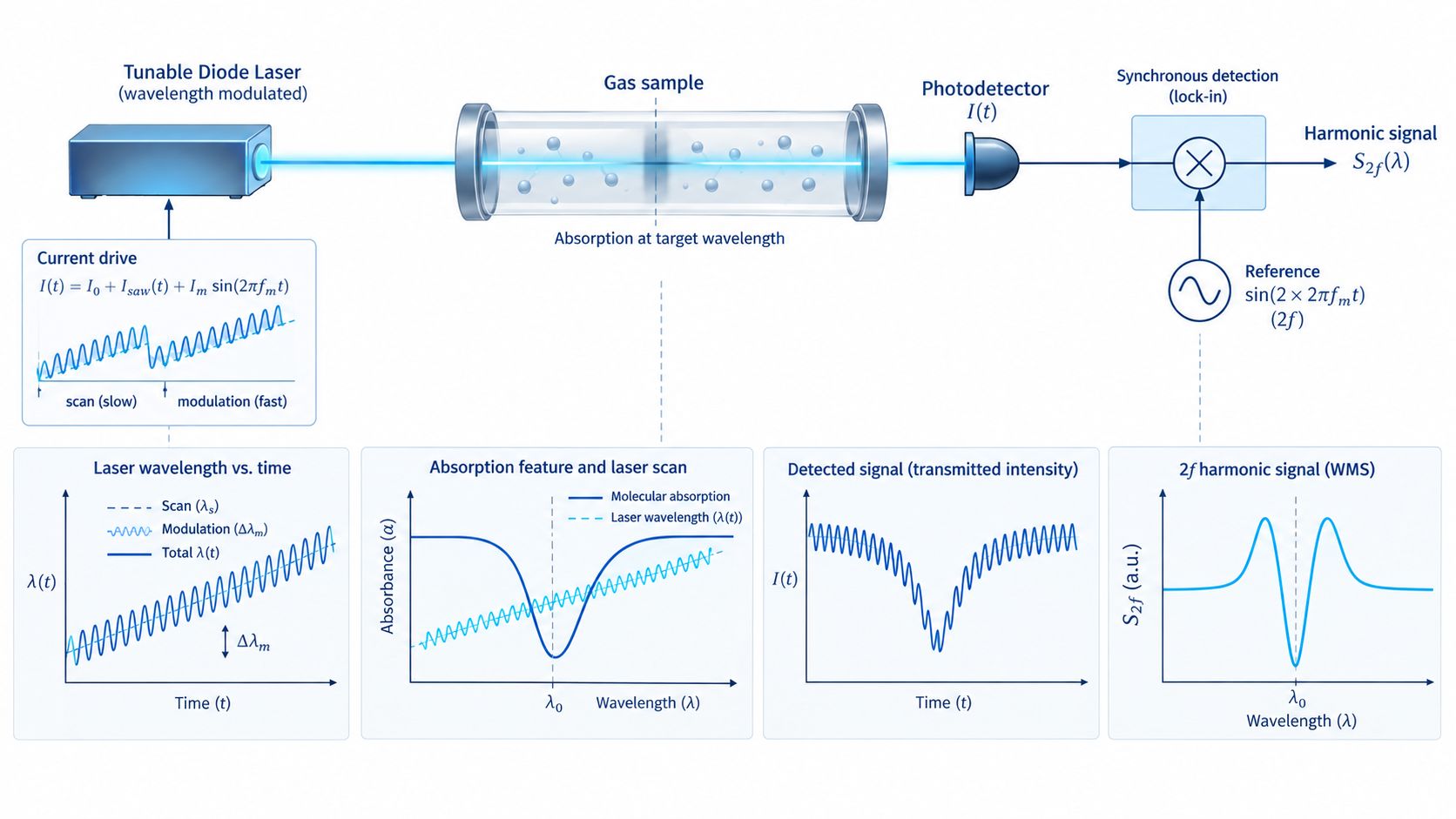
- Adds a fast wavelength modulation to the slower scan
- Uses synchronous / harmonic detection
- Commonly analyzes the 2f signal
- Can improve sensitivity and reject low-frequency baseline noise
WMS does not change the molecular physics. It changes how the absorption information is encoded and extracted, which can substantially improve signal-to-noise ratio in demanding measurements.
Measurement configuration
In-situ vs extractive TDLAS measurement
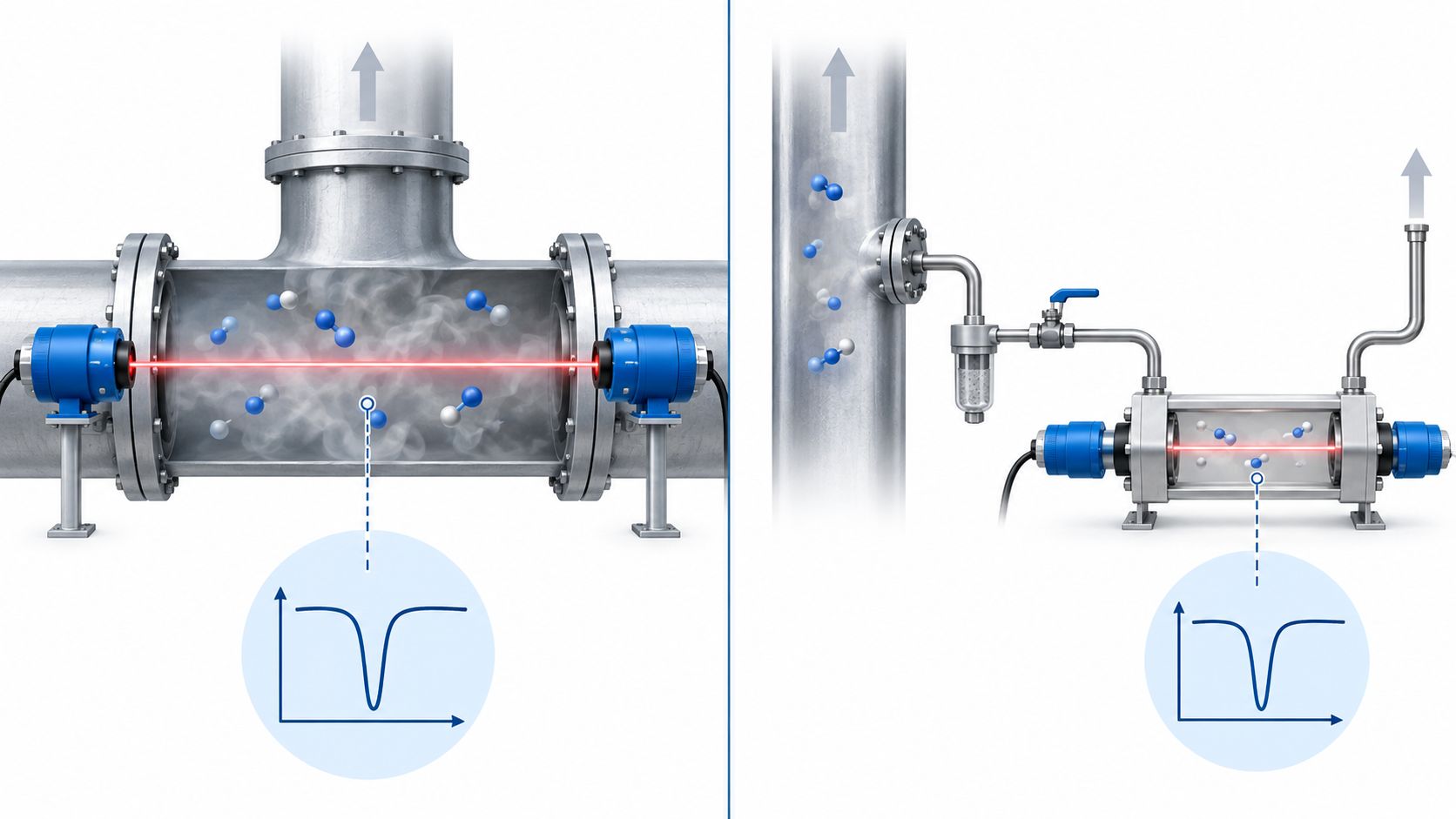
In-situ TDLAS
- Laser passes directly through duct, stack or process gas
- No sample transport delay
- Very fast process response
- Optics must tolerate process dust, vibration and temperature
- Path-averaged concentration across the optical beam
Extractive TDLAS
- Gas is drawn into a dedicated measurement cell
- Pressure and temperature can be better controlled
- Optical path can be optimized for sensitivity
- Sampling system adds maintenance and transport time
- Sample conditioning can change the gas if poorly designed
Molecular fingerprint
Why TDLAS can achieve very high gas selectivity
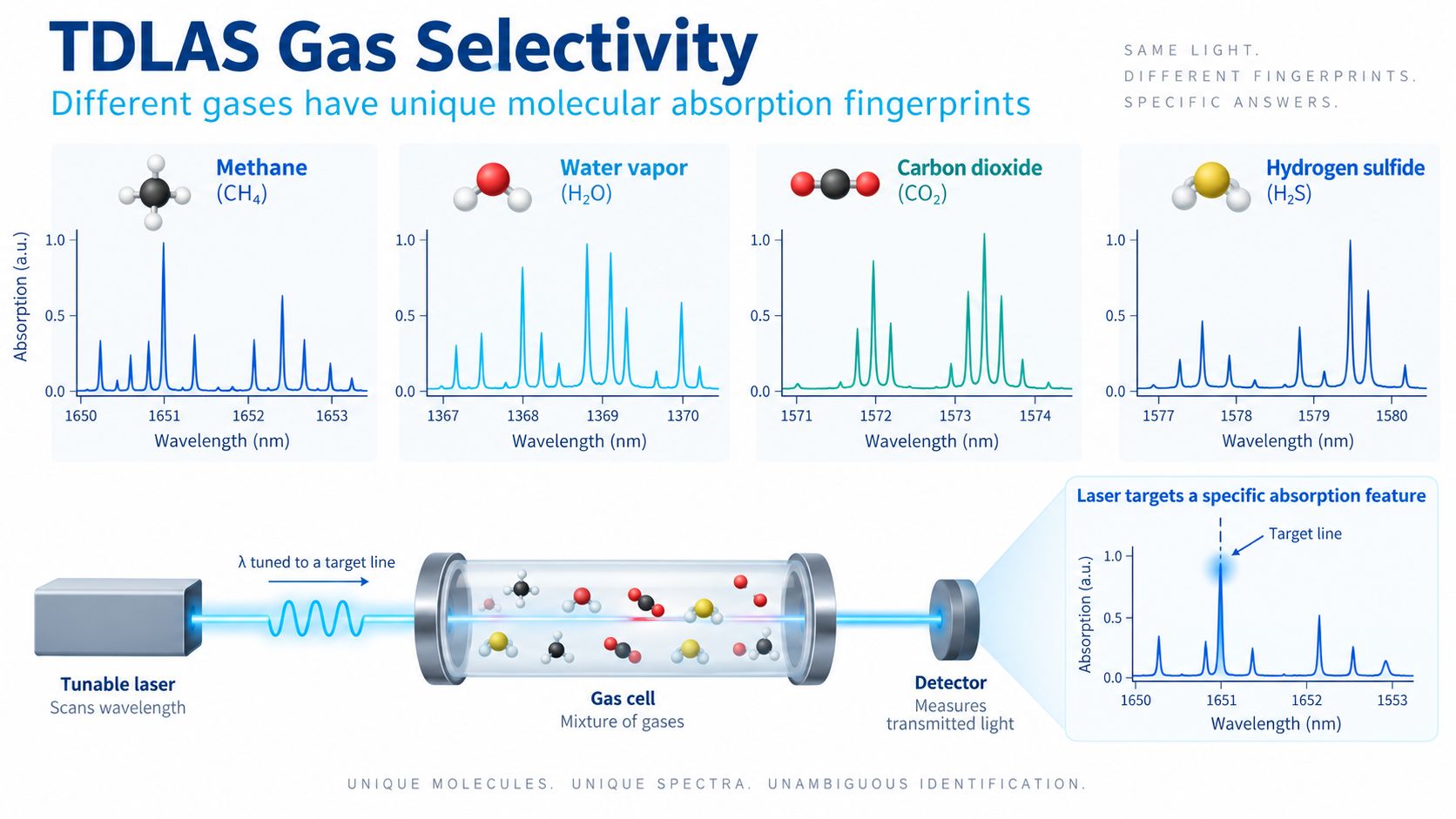
Gas molecules do not absorb infrared or near-infrared light uniformly. Rotational-vibrational transitions create structured spectral lines. A TDLAS system chooses a wavelength region where the target line is strong enough and nearby interfering lines are manageable.
Selectivity comes from line selection
- Methane: strong practical TDLAS applications use selected CH₄ lines in the near-IR or mid-IR.
- Water vapor: moisture measurement is a major TDLAS application because H₂O has many accessible lines.
- CO₂: suitable diode-laser bands support process and emissions measurement.
- H₂S, NH₃, CO, HCl, HF and O₂: can be measured when an appropriate absorption line and laser/detector combination are available.
Target gases
Which gases can TDLAS measure?
| Gas | Typical TDLAS use | Engineering note |
|---|---|---|
| CH₄ | Natural gas, emissions, leak and process monitoring | One of the most common diode-laser gas targets. |
| H₂O | Trace moisture in gas streams and process control | Strong line selection is available across several bands. |
| CO₂ | Process, combustion and carbon-management measurement | Choice of line depends on concentration and interfering gases. |
| CO | Combustion and process monitoring | Often uses longer-wavelength diode sources than methane systems. |
| NH₃ | SCR / DeNOx slip monitoring and process analysis | Fast response is valuable in combustion control. |
| H₂S | Sour-gas and process applications | Requires careful wavelength and moisture-interference design. |
| HCl / HF | Combustion and emissions monitoring | Useful where fast in-situ optical measurement is preferred. |
| O₂ | Combustion and process oxygen measurement | TDLAS can target oxygen absorption lines, typically outside the wavelength bands used for hydrocarbons. |
Engineering trade-offs
TDLAS advantages and limitations
Why engineers choose TDLAS
- Very high molecular selectivity when line selection is well designed
- Fast optical response with no consumable electrolyte
- Non-contact measurement path
- Long-term stability potential without catalytic poisoning
- Excellent fit for in-situ process measurements
- WMS can support trace-level detection in suitable applications
Where TDLAS needs engineering care
- Higher optical/electronic complexity than simple chemical sensors
- Laser wavelength must match the target absorption feature
- Pressure and temperature affect line shape and strength
- Dust, window fouling and optical misalignment can reduce signal
- Etalons and reflections can create spectral artifacts
- Some gases do not have convenient absorption lines for the desired laser platform
Technology comparison
TDLAS vs NDIR, semiconductor and electrochemical gas sensors

| Factor | TDLAS | NDIR | Semiconductor / MOX | Electrochemical |
|---|---|---|---|---|
| Principle | Tunable narrow-line absorption | Broadband / filtered IR absorption | Surface chemistry changes resistance | Electrode reaction generates current |
| Selectivity | Very high with proper line selection | High for suitable IR-active gases | Usually broader / cross-sensitive | Often high but cross-sensitivity exists |
| Response | Fast optical measurement | Fast optical measurement | Material and heater dependent | Diffusion/reaction dependent |
| Consumable chemistry | No | No | No electrolyte; surface aging possible | Electrolyte/electrode lifetime is finite |
| System complexity | High | Medium | Low to medium | Low to medium |
| Best fit | Selective process / trace / in-situ gas analysis | Robust IR gas measurement | Compact broad detection / classification | Toxic gases and oxygen |
Related technology guides: NDIR Gas Sensors, Semiconductor Gas Sensors, and Electrochemical Gas Sensors.
Applications
Where TDLAS gas sensors are used
Oil & gas
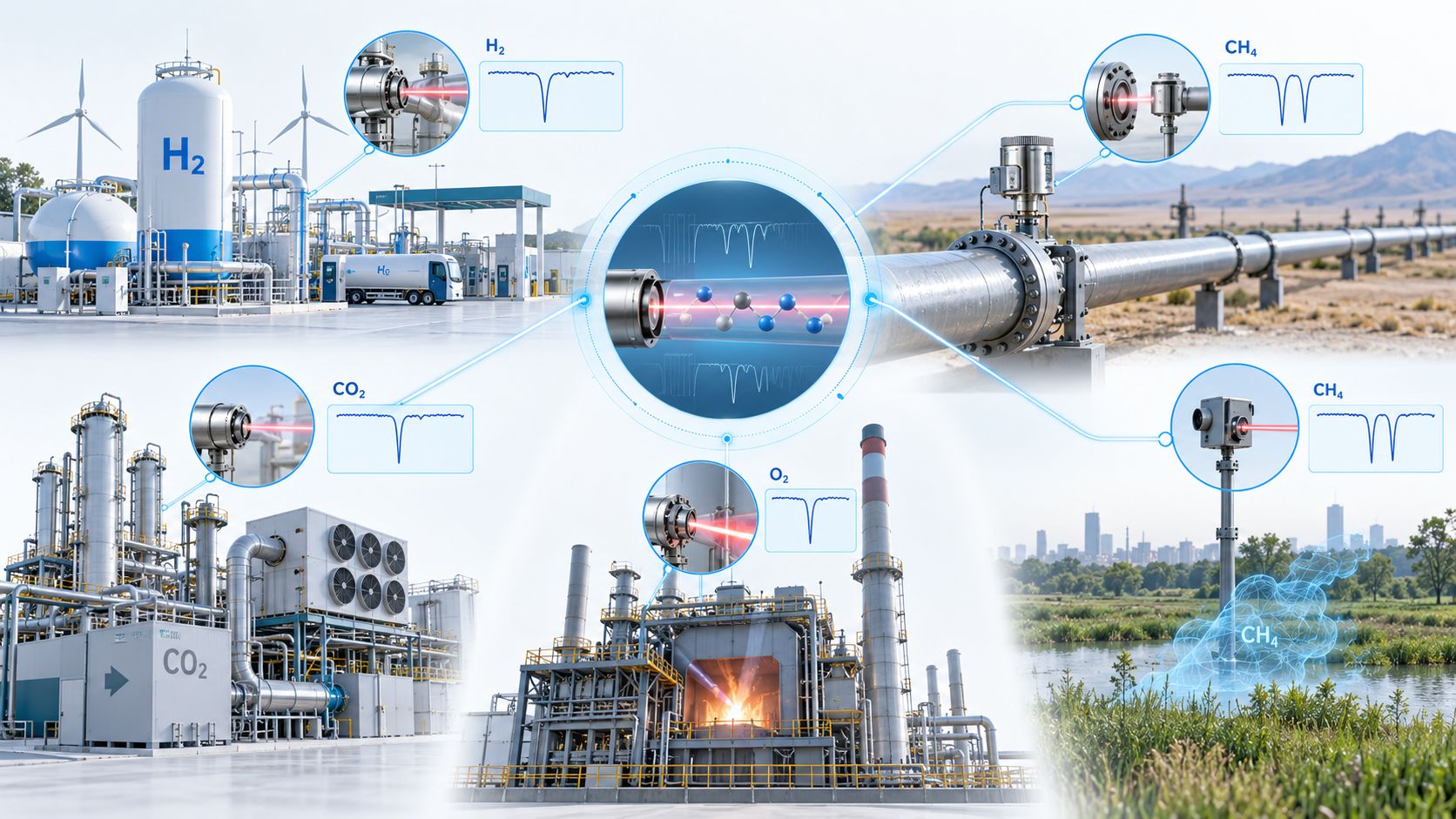
Methane, moisture, H₂S and other process measurements in pipelines, natural gas treatment and production systems.
Combustion control
Fast O₂, CO, NH₃ or other gas measurements for burners, furnaces, SCR and combustion optimization.
Carbon management
CO₂ concentration measurement in capture, transport and industrial process streams.
Environmental monitoring
Methane emissions, open-path measurements and fast monitoring around industrial sources.
High-purity gases
Trace moisture and selected impurity measurement where non-contact optical sensing is valuable.
Process analytics
Fast in-situ or extractive measurement for chemical, petrochemical and specialty process control.
OEM design workflow
How to design or select a TDLAS gas sensor
1. Start with spectroscopy
Select a target absorption line that is strong enough while minimizing overlap from expected background gases.
2. Match the laser
Choose DFB/VCSEL or another diode source whose tuning range covers the target line with sufficient optical power and stability.
3. Design the optical path
Balance path length, cell pressure, mirrors, window materials, beam quality and detector sensitivity.
4. Build the algorithm
Choose direct absorption or WMS and include baseline, pressure, temperature and optical-health compensation.
Before design freeze
- Target gas and concentration range
- Expected interfering gases
- Absorption line and laser wavelength
- Laser tuning range and temperature control
- Optical path length
- Process pressure and temperature range
- Detector responsivity at the chosen wavelength
- Window fouling / dust / condensation risk
- Direct absorption vs WMS
- Calibration and validation strategy
TDLAS engineering checklist
A good TDLAS design begins with the molecule, not with the laser package.
- Verify line data for the real gas matrix
- Check water and neighboring spectral interference
- Model pressure broadening
- Confirm laser wavelength over temperature
- Control optical reflections and etalons
- Provide detector headroom for window contamination
- Define zero/span or reference validation
- Plan optical-health diagnostics
For laser-source options, see DFB Laser Diodes.
Reliability and maintenance
Optical contamination, alignment and diagnostics
Window fouling
Dust, aerosols or deposits reduce received optical power and can distort the baseline if they are not uniform.
Condensation
Water films or droplets on windows can strongly attenuate the beam and introduce additional optical artifacts.
Alignment
Vibration, thermal expansion or mechanical movement can reduce coupling from laser to detector.
Signal diagnostics
Received intensity, baseline shape and spectral residuals can be used to identify optical-health problems before measurement fails.
FAQ
TDLAS gas sensor FAQ
What does TDLAS stand for?
TDLAS stands for Tunable Diode Laser Absorption Spectroscopy. It uses a tunable semiconductor laser to scan across a molecular absorption line and determine gas concentration from the measured absorption.
How does a TDLAS gas sensor work?
The diode laser is tuned across a gas-specific absorption feature. The beam passes through the sample, a photodetector measures the transmitted intensity, and signal processing converts the absorption line into gas concentration.
Why is TDLAS selective?
TDLAS targets a narrow molecular absorption line rather than a broad optical band. Careful wavelength selection can separate the target line from many interfering gases.
What is the Beer-Lambert law in TDLAS?
The Beer-Lambert relationship describes how transmitted light decreases as molecular absorption increases. In TDLAS, the measured absorbance is related to target-gas amount, path length and spectroscopic line properties, with temperature and pressure included in practical models.
What is wavelength modulation spectroscopy (WMS)?
WMS adds a rapid wavelength modulation to the laser scan and uses synchronous harmonic detection, commonly the second harmonic or 2f signal, to improve sensitivity and reduce low-frequency baseline noise.
What is the difference between in-situ and extractive TDLAS?
In-situ TDLAS sends the laser directly through the process gas in a duct, stack or pipe. Extractive TDLAS removes a sample and measures it in a controlled cell.
What gases can TDLAS measure?
Common targets include methane, water vapor, carbon dioxide, carbon monoxide, ammonia, hydrogen sulfide, oxygen, hydrogen chloride and hydrogen fluoride, provided the system uses a suitable absorption line and laser wavelength.
Can TDLAS directly measure hydrogen?
Conventional direct near-infrared TDLAS is generally not used to measure molecular hydrogen itself because H₂ lacks the strong dipole-allowed vibrational lines that make many other gases practical diode-laser targets. Other optical or indirect hydrogen techniques may be used instead.
What is the difference between TDLAS and NDIR?
TDLAS uses a narrow tunable laser to resolve a selected molecular absorption line. NDIR normally uses a broadband infrared source and optical filter to measure a wider absorption band. TDLAS can provide higher spectral selectivity but requires more precise optical and laser control.
What limits TDLAS accuracy?
Important factors include laser wavelength stability, pressure and temperature effects, interfering spectral lines, optical contamination, etalons, detector noise, alignment and the quality of the spectroscopic model.
Why are DFB lasers common in TDLAS?
DFB lasers provide narrow spectral output and controllable wavelength tuning, making them suitable for scanning across selected molecular absorption lines in compact gas sensing systems.
Need to choose a TDLAS gas sensing architecture?
Start with the target molecule and its absorption spectrum, then select the laser wavelength, optical path, detector and signal-processing method. TDLAS performs best when the spectroscopy, optics and algorithm are engineered as one measurement system.