



Acoustic gas leak detection technology
Ultrasonic Gas Leak Sensors
Ultrasonic gas leak detectors (UGLDs) listen for high-frequency airborne sound generated by gas escaping from pressurized equipment. They can identify a qualifying leak without waiting for gas to reach the detector—but they do not measure ppm, %LEL or the identity of the released gas.
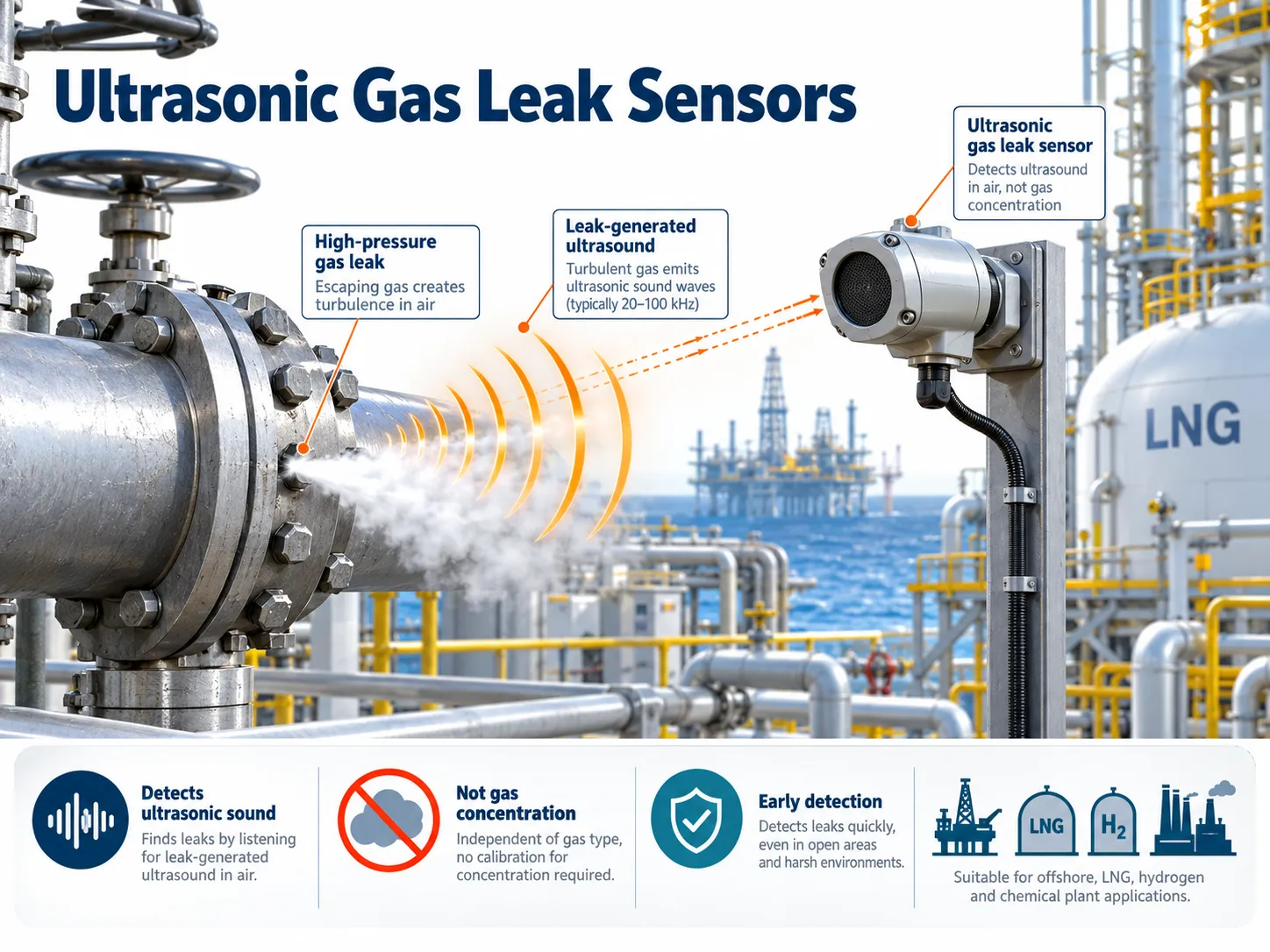
Technology definition
What is an ultrasonic gas leak sensor?
What it can do
- Recognize qualifying acoustic events from high-pressure escaping gas.
- Provide early warning in windy or highly ventilated locations where gas clouds might dilute quickly.
- Protect leak-prone areas with suitable site-specific acoustic coverage.
What it cannot do
- Report methane or hydrogen concentration in ppm or %LEL.
- Identify the chemical identity of the released gas from ultrasound alone.
- Guarantee detection of slow, low-pressure or low-acoustic-energy leaks.
Physics & signal chain
How ultrasonic gas leak detection works
A pressurized release can generate turbulent gas motion and broadband sound. The detector listens in the ultrasonic band and evaluates signal magnitude, duration and sometimes spectral characteristics against its configured criteria.
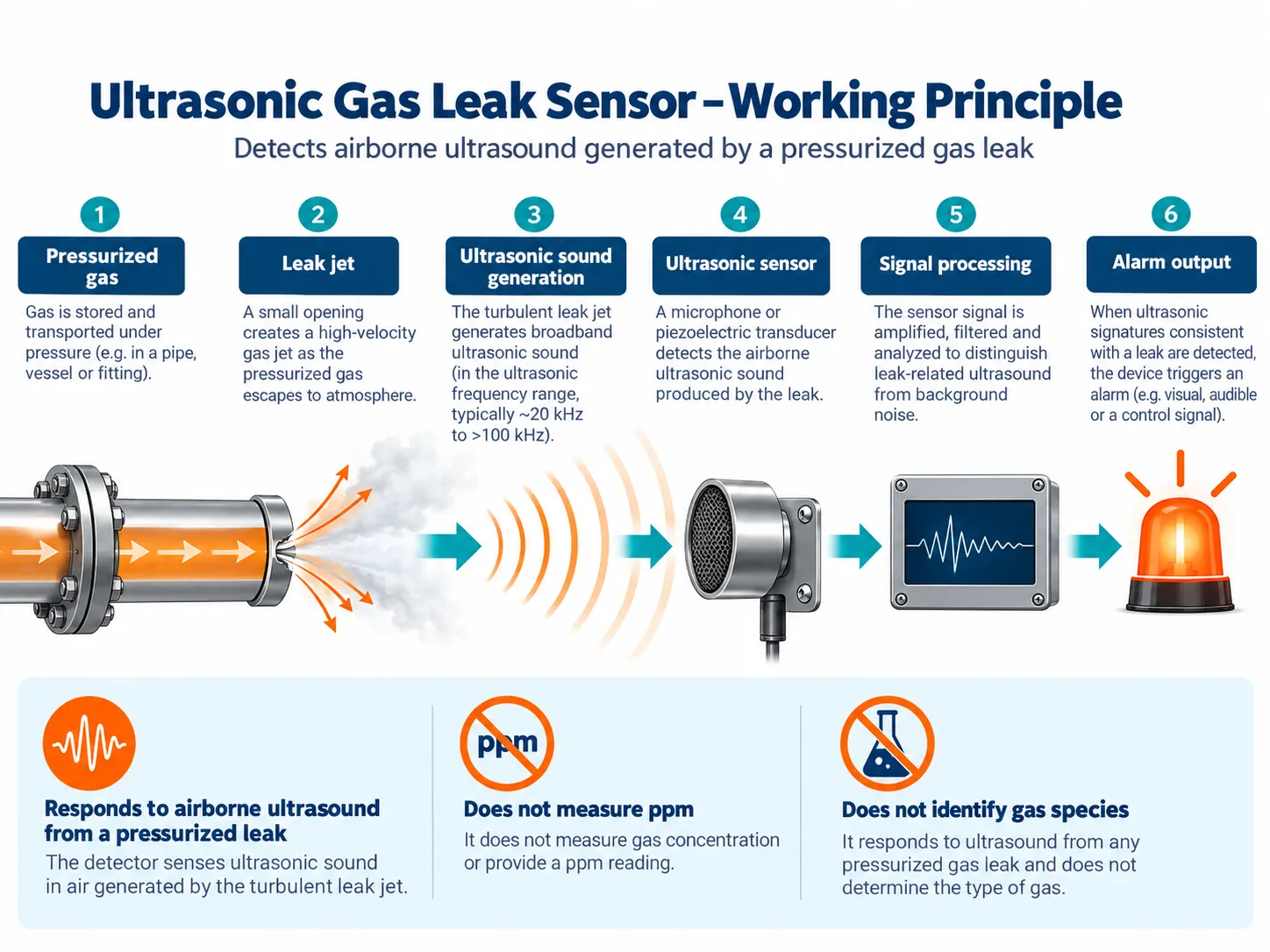
Leak physics
Why do high-pressure gas leaks produce ultrasound?
A pressure difference drives gas through an opening. Depending on the gas, pressure ratio, orifice and downstream conditions, flow may accelerate substantially and develop turbulence or even choking. Pressure fluctuations in the jet radiate acoustic energy, some of it above the audible band.
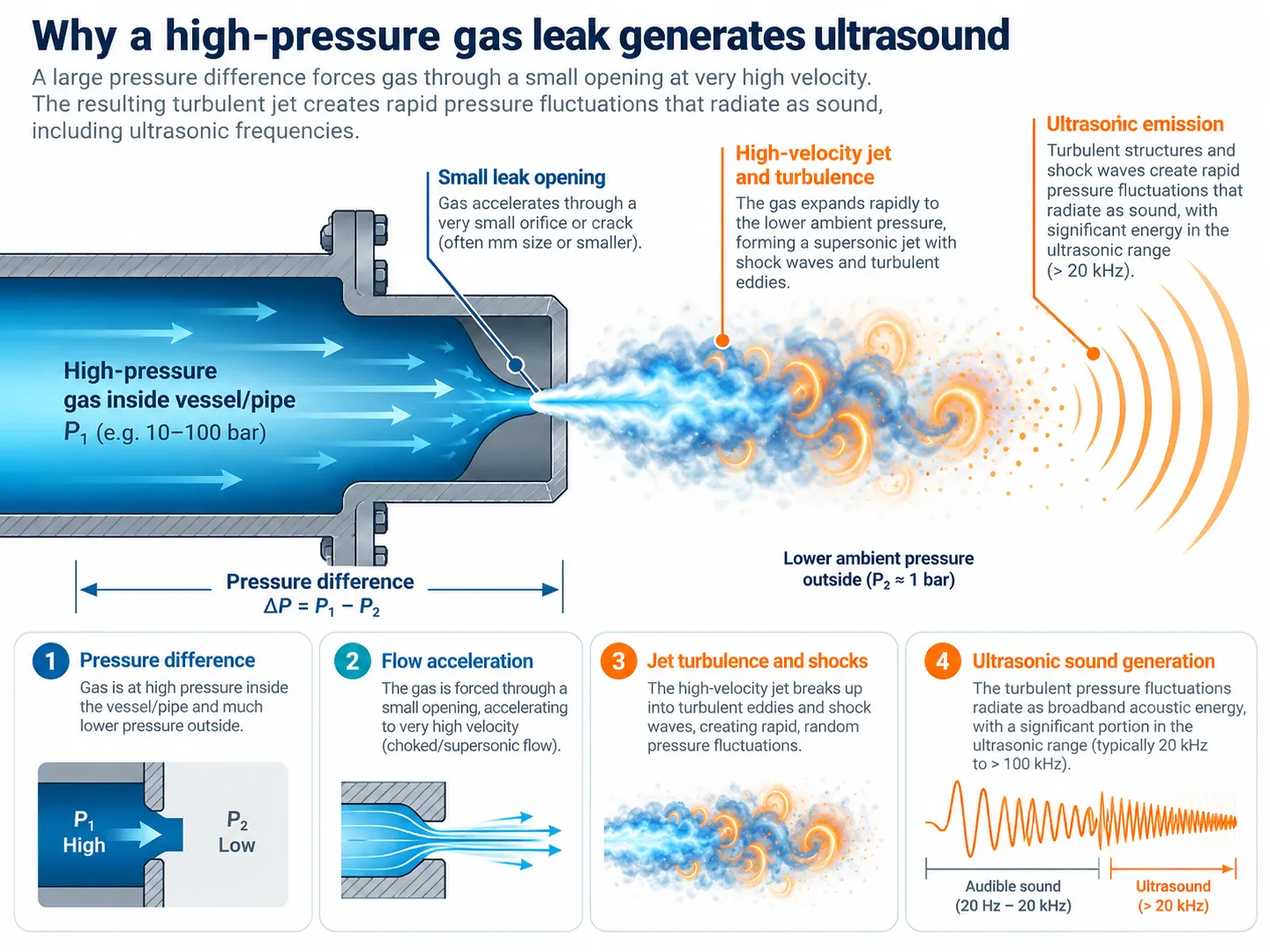
Pressure differential
Larger upstream-to-ambient pressure differences can create more energetic jets, but the acoustic relationship is not a single universal conversion.
Leak geometry
Small cracks, orifices and flanges change jet velocity, turbulence and emitted sound. Two leaks at the same pressure can sound different.
Gas and process conditions
Gas composition, temperature, pressure ratio and surrounding structures all influence acoustic emission and propagation.
Instrumentation
Inside a fixed ultrasonic gas leak detector
UGLDs use an acoustic sensing chain rather than a chemical sensing chamber. Exact transducer count, protective geometry and communications depend on the product design.
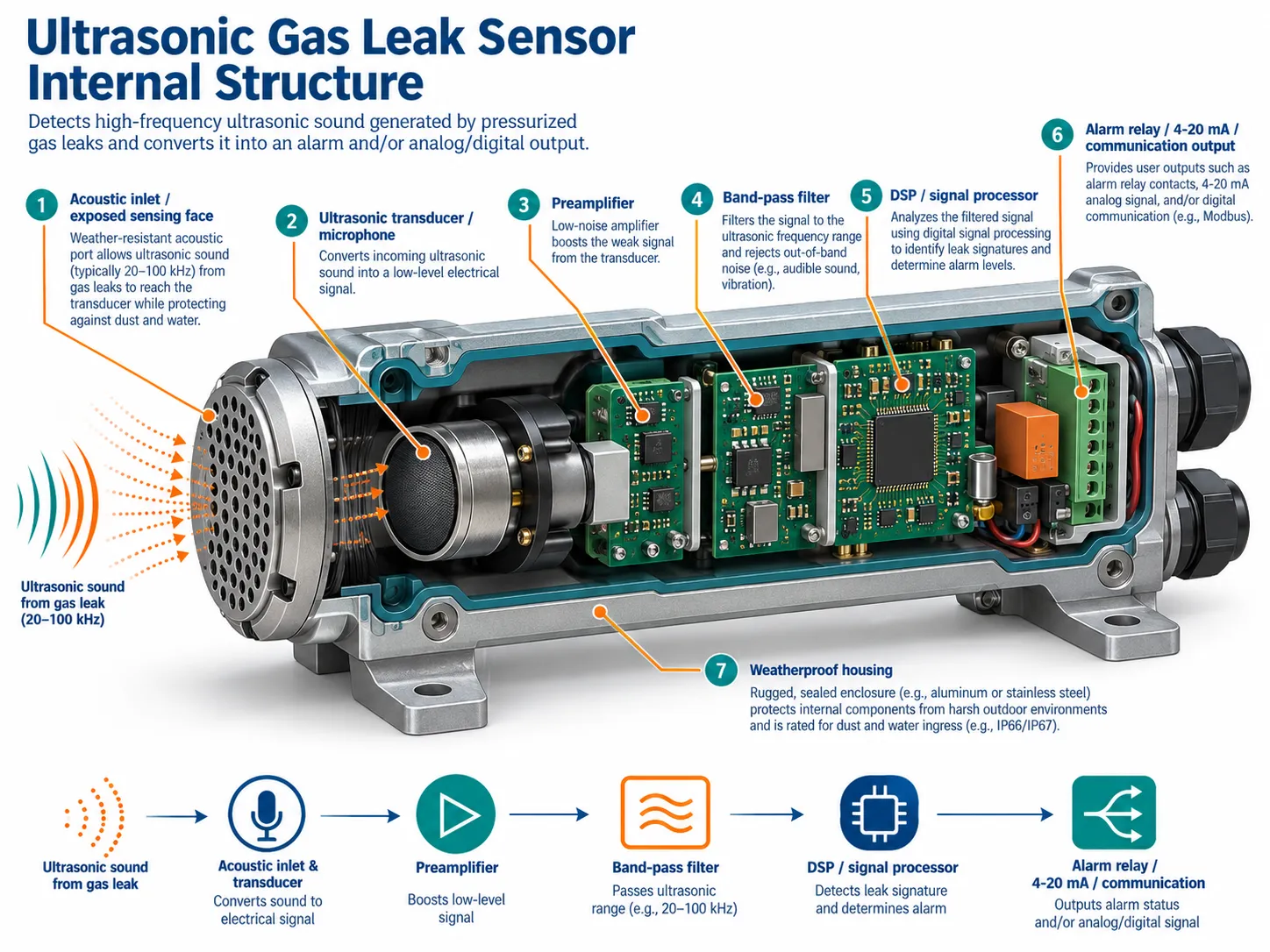
Acoustic transducer
A microphone or piezoelectric sensing element converts ultrasonic pressure changes into an electrical signal.
Filtering and DSP
Frequency filters and processing suppress out-of-band noise and help classify or qualify acoustic events.
Industrial I/O
Depending on product, signals may reach the PLC/DCS/F&G panel using relays, 4–20 mA and digital diagnostics.
Acoustic spectrum
Leak ultrasound vs everyday industrial noise
Ultrasound conventionally means sound above about 20 kHz. Speech and much machinery energy lie predominantly below this threshold—but compressors, pneumatic valves, steam releases and electrical equipment can also generate substantial ultrasonic components.
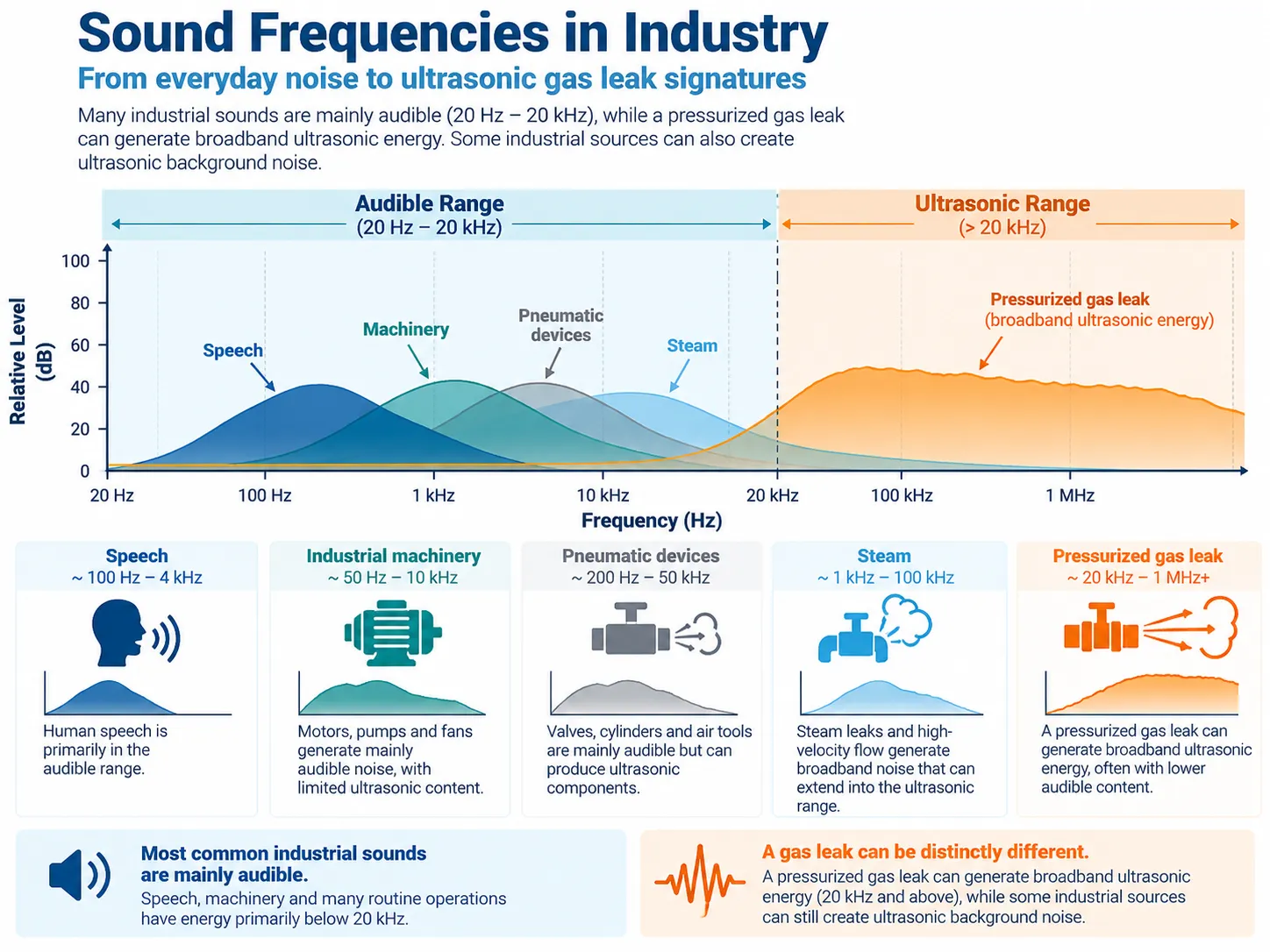
As a product-specific example, the Emerson Rosemount Incus reference manual describes listening in the 25–100 kHz range. That range should not be assigned to every UGLD.
Interactive engineering explanation
How leak strength and background ultrasound change the result
A UGLD compares leak-related acoustic evidence with the ambient sound environment. This conceptual model illustrates four situations; it is not a physical detector model or a basis for alarm set-point selection.
Acoustic Leak Detection Simulator
Conceptual · Not calibratedA sustained leak signature sufficiently above the ambient ultrasonic noise may qualify for an alarm, subject to detector settings and the required persistence time.
Relative bar levels only. Not dB, leak rate, calibrated detection distance, probability of detection or a safety design calculation.
Field of coverage
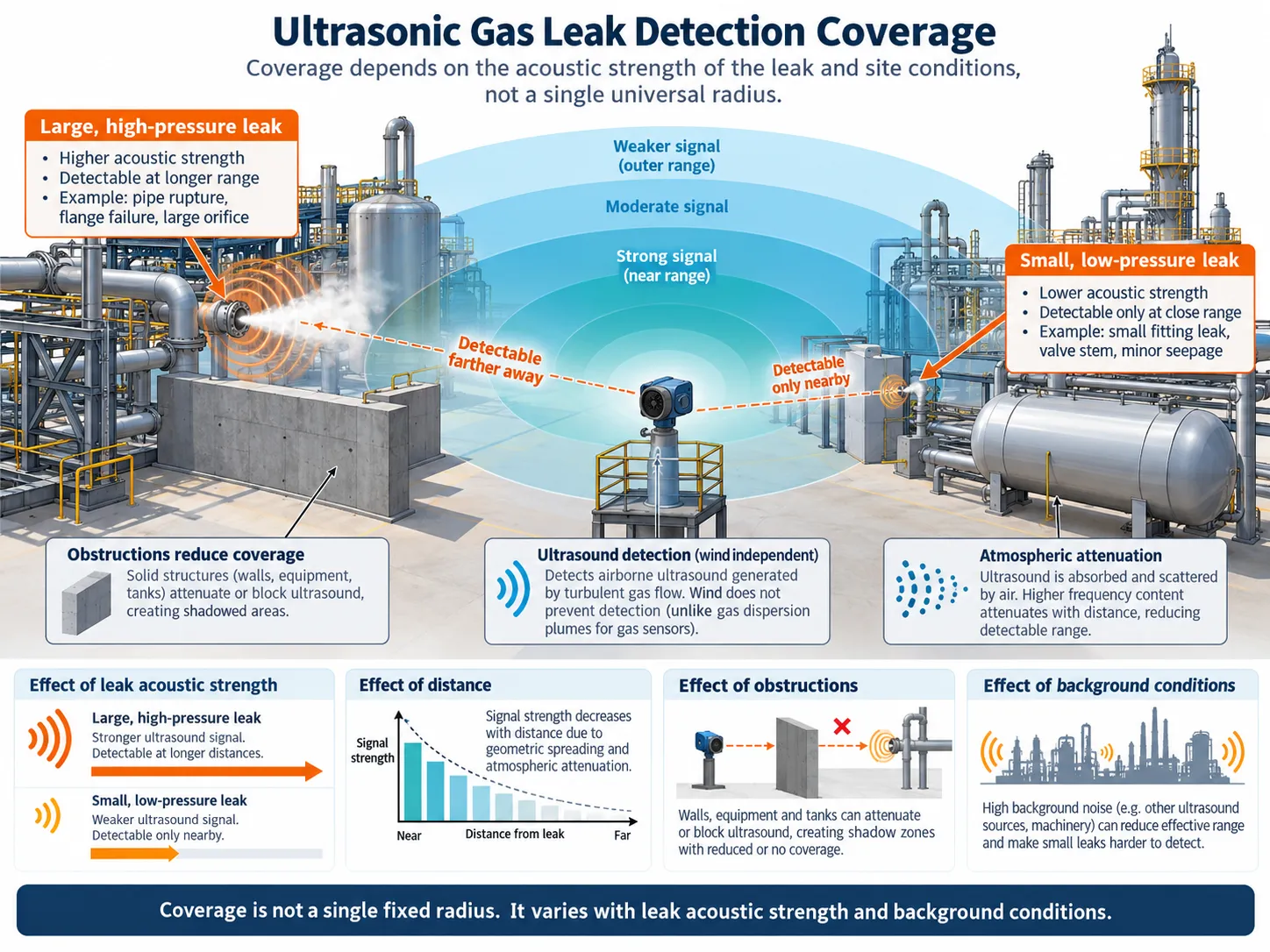
Detection radius is not one fixed number
A quoted “maximum detection distance” belongs to a particular leak scenario, background-noise environment, detector orientation and product configuration. Acoustic coverage must be verified against the credible leaks at the real site.
| Coverage driver | Effect on detection | What to check on site |
|---|---|---|
| Leak acoustic strength | Strong jets tend to be detectable farther away; weak emissions are more difficult. | Credible leak size, pressure and release direction. |
| Distance and absorption | Sound amplitude falls with distance; high-frequency air absorption can add significant attenuation. | Atmospheric conditions and manufacturer range assessment. |
| Obstacles / reflections | Vessels, pipe racks and structures may shadow, scatter or reflect the ultrasound. | Line of acoustic propagation and three-dimensional geometry. |
| Ultrasonic background | Competing noise raises the effective threshold for a reliable alarm. | Survey during real equipment operation, including intermittent processes. |
| Detector placement | Height, mounting orientation and local structures affect acoustic coverage. | Instrument mounting instructions and commissioning proof. |
Commissioning & alarms
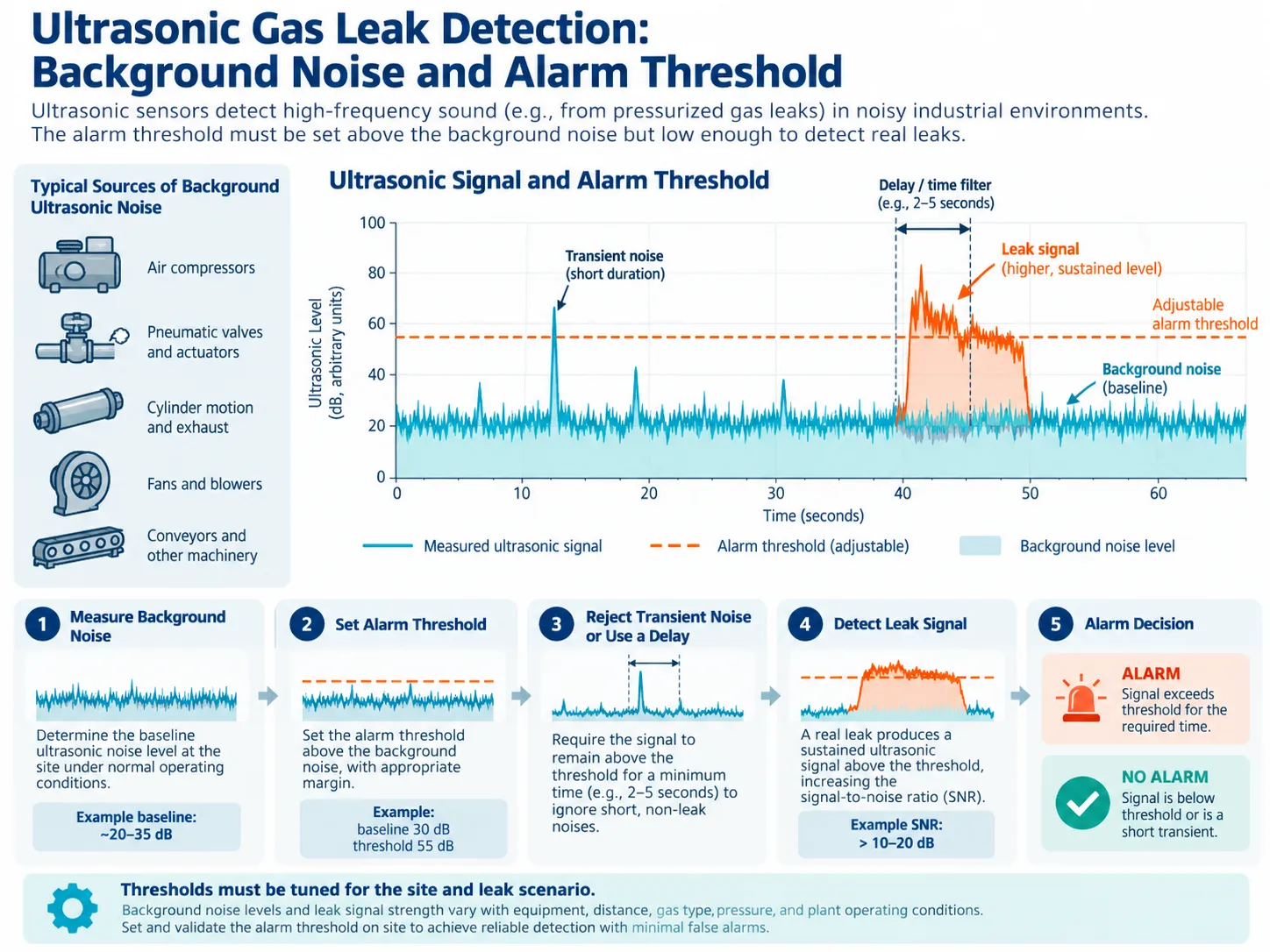
Background-noise mapping and alarm threshold design
A reliable UGLD installation begins with an ultrasonic site survey. The target is to identify leaks while rejecting transient or unrelated events from compressors, steam, pneumatic actuators or other sources.
What gases can be detected?
Ultrasonic sensing responds to the leak—not the gas species
When the pressure, leak geometry and acoustic propagation are suitable, gas leaks involving hydrogen, methane, nitrogen, carbon dioxide, ammonia, compressed air and other gases can generate recognizable ultrasound. The detector does not identify the chemical.
Hydrogen (H₂)
Useful for high-pressure compression, storage and refueling infrastructure when release scenarios produce sufficient airborne ultrasound.
Methane / natural gas
Strong fit around compressors, manifolds and high-pressure gas processing equipment; the acoustic alarm is not %LEL.
Nitrogen and compressed air
Acoustic leak detection can apply to nonflammable pressurized gases too, because jet turbulence—not flammability—creates the sound.
CO₂ and other process gases
Potentially detectable in pressurized systems, subject to jet emission, attenuation, hardware ratings and site verification.
Ammonia / specialty gases
Some releases are suitable, but toxicity does not guarantee acoustic detectability; concentration-based safety channels may still be essential.
Oxygen deficiency scenarios
UGLD cannot measure oxygen depletion, because oxygen concentration is not part of its measurement principle.
Technology selection
Ultrasonic vs point vs open-path gas detection
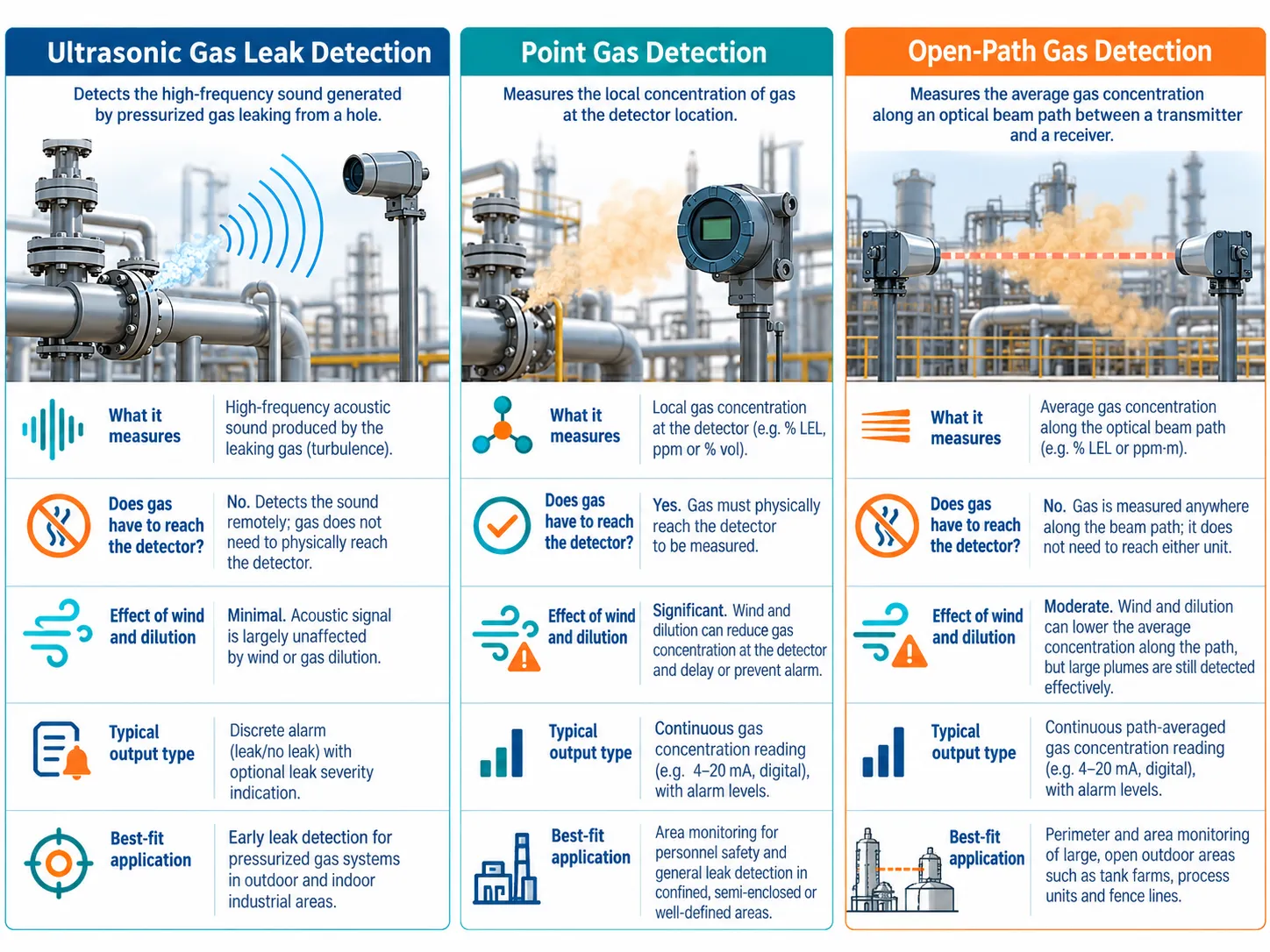
These technologies measure different physical phenomena. A robust fire-and-gas strategy frequently combines them rather than trying to choose a single detector type for every hazard.
| Factor | Ultrasonic UGLD | Point gas detector | Open-path optical detector |
|---|---|---|---|
| Measured quantity | Ultrasonic acoustic signature / level | Gas concentration at one location | Gas absorption integrated along a beam |
| Common reporting | Alarm and acoustic information | ppm, %LEL or %vol | ppm·m or LEL·m, depending on device |
| Gas must contact detector? | No—sound must reach acoustic transducer. | Yes—gas must reach sensing region. | Gas must intersect the optical beam path. |
| Wind and dilution | Does not rely on cloud accumulation, but environmental propagation still matters. | Can affect plume reaching sensor and local concentration. | Can change whether/where plume crosses beam. |
| Low pressure / slow release | May be weak or undetectable. | Can detect if sufficient gas reaches sensor. | Can detect if plume intersects path. |
| Chemical identity | Does not distinguish gas species. | Technology-/target-dependent. | Technology-/wavelength-dependent. |
| Best-fit role | Early warning of sufficiently energetic pressurized releases. | Local toxic, combustible and oxygen hazard measurement. | Area or boundary plume interception and cloud monitoring. |
Equipment categories
Fixed UGLD vs portable acoustic leak inspection
Fixed ultrasonic gas leak detector
- Continuously monitors an industrial risk area.
- Provides alarms and integration with PLC, DCS or fire-and-gas systems.
- Requires formal detector placement, noise survey and commissioning.
- Usually does not give a camera image of the exact release point.
Portable ultrasound / acoustic imaging
- Used by technicians for equipment inspection and leak localization.
- May use handheld sensors or microphone arrays for acoustic imaging.
- Well suited to compressed-air audits and maintenance routes.
- Does not automatically satisfy fixed fire-and-gas protection requirements.
When sourcing a “ultrasonic gas leak sensor,” distinguish an area safety detector from a handheld industrial ultrasound tool. Similar acoustic physics does not imply identical performance standards, coverage or alarm functions.
Performance testing
EN 50724:2023 and what installation verification must consider
Performance conditions considered
- Test gas, leak rate, nozzle and gas pressure.
- Distance, direction, field of coverage and mounting height.
- Wind, temperature, humidity and background noise.
- Nearby structures, ground surfaces and vibration.
What this means for OEM selection
- Ask what leak scenario underpins the stated detection radius.
- Review test methods and background-noise assumptions.
- Request the applicable conformity, hazardous-area and safety documentation for the exact model.
- Verify suitability for the finished installation and protective function.
Standard description: NEN-EN 50724:2023. Consult the full licensed standard and relevant local requirements for engineering compliance.
Service & verification
Calibration, acoustic bump tests and maintenance
Factory-calibrated acoustic sensing does not mean “never test the system.” Separate the detector's internal calibration from commissioning, proof of coverage and field functional verification.
Factory calibration
Determines the detector’s acoustic measurement response under defined manufacturing conditions; vendor maintenance claims are product-specific.
Functional acoustic testing
Uses an approved ultrasonic test source or manufacturer procedure to verify sensor and alarm chain behavior.
Coverage verification
Confirms the installed geometry and defined leak scenarios meet the required coverage and noise margin.
- Inspect and clean the acoustic inlet according to the manual.
- Verify the signal / alarm relay path to the fire-and-gas controller.
- Reassess the background when compressors, pneumatic valves or plant layouts change.
- Document detector locations, settings, commissioning results and maintenance intervals.
Industrial applications
Where ultrasonic gas leak detection is most useful
The most compelling applications involve pressurized gas inventories, credible high-energy releases and environments where dilution could delay conventional cloud-based detection.
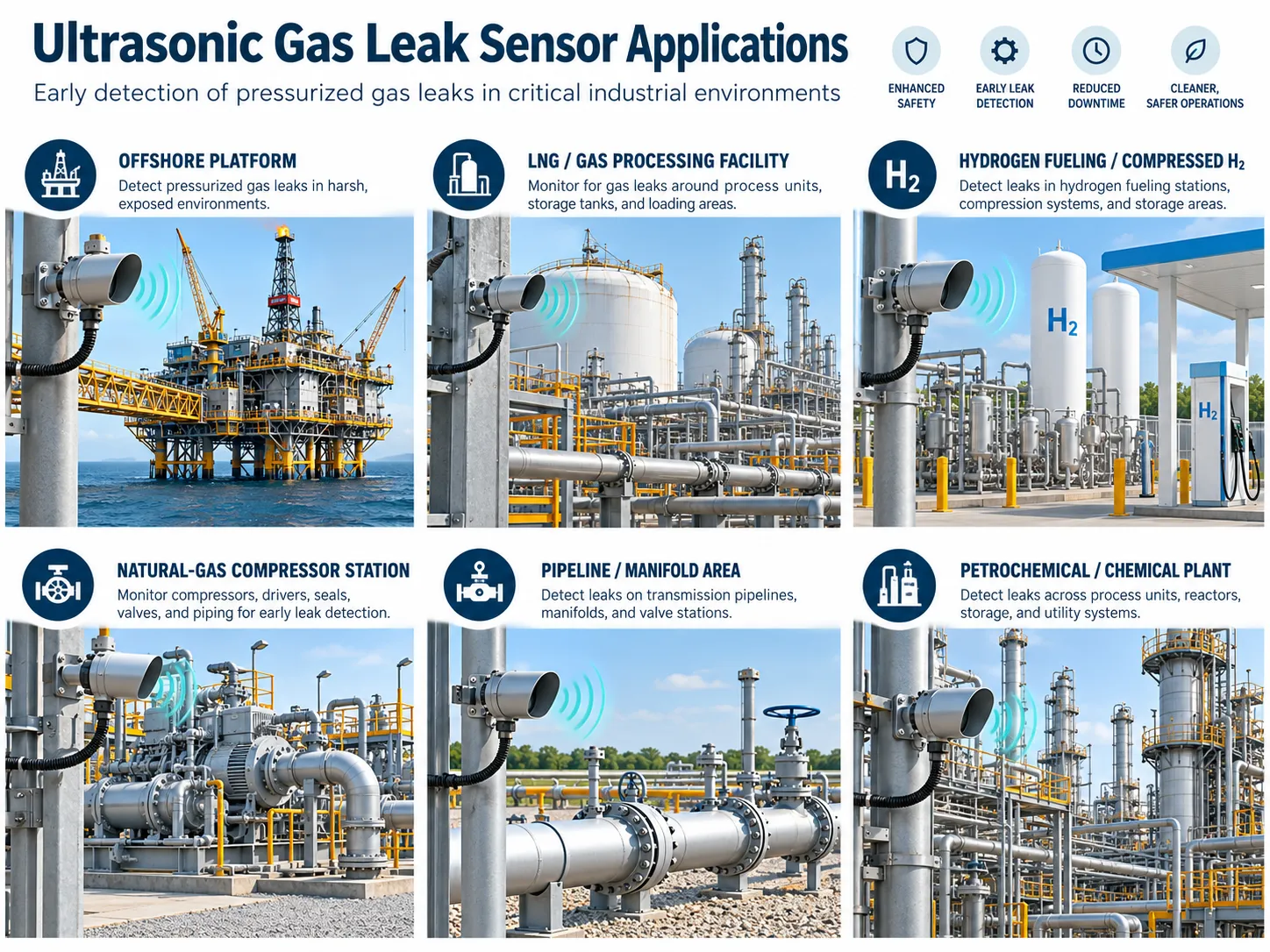
Offshore oil and gas
Open, ventilated processing modules and pipework where wind can carry released gas away from point detectors.
LNG / natural gas processing
Pressurized valves, flanges, compressor packages and process manifolds where early acoustic warning is valuable.
Hydrogen compression and refueling
High-pressure storage, compressors and dispensers; acoustic UGLD can complement H₂-specific concentration sensing.
Compressor stations
Pressure-containing equipment, piping connections and gas train installations.
Pipelines and manifolds
Accessible acoustic detection around high-pressure connections and valve assemblies.
Petrochemical units
Pressurized process areas where different gas hazard technologies should be layered.
Engineering workflow
How to select and locate ultrasonic gas leak detectors
Start with the hazard scenario—not the published headline range. A credible system design accounts for pressure, opening sizes, operating background, geometry and the required alarm function.
01 · Define credible leaks
List gas inventories, pressures, credible failure points, release directions and minimum leaks to recognize.
02 · Assess acoustic emission
Check manufacturer data or validated engineering models for the chosen release scenarios.
03 · Survey the soundscape
Map airborne ultrasound with machines operating in relevant steady and transient modes.
04 · Plan 3D coverage
Place instruments with consideration of obstacles, elevation, reflections and attenuation.
05 · Configure alarm logic
Select threshold, persistence, diagnostics, power and communications consistent with the safety study.
06 · Commission and maintain
Validate using manufacturer procedures; revisit coverage when site conditions change.
Frequently asked questions
Ultrasonic gas leak detection FAQ
What is an ultrasonic gas leak sensor?
An ultrasonic gas leak sensor detects airborne high-frequency sound generated when gas escapes from pressurized equipment. It does not directly measure the gas concentration or gas species.
Does a UGLD measure ppm or %LEL?
No. A UGLD measures an acoustic signature or ultrasonic sound level. Use a suitable concentration-based gas detector when ppm, %LEL or oxygen measurement is required.
Why does a pressurized leak generate ultrasound?
Gas accelerates through a leak opening and forms a high-velocity turbulent jet. Rapid pressure fluctuations radiate broadband sound, including ultrasonic frequencies.
Can an ultrasonic sensor detect a hydrogen leak?
Yes, if the hydrogen release generates enough airborne ultrasonic energy at the detector. This does not make the instrument hydrogen-specific, and a hydrogen concentration detector may still be required.
Can an ultrasonic sensor detect methane or nitrogen leaks?
Yes, provided the gas release has sufficient pressure, leak geometry and acoustic propagation. Acoustic detection is not based on flammability or chemical species identity.
Will ultrasonic gas leak detection work with low-pressure leaks?
Not necessarily. Low-pressure or low-flow releases may generate too little ultrasound to be detected reliably at the installed location.
How far can an ultrasonic gas leak detector detect?
There is no universal radius. Coverage depends on leak acoustic power, pressure, leak size, distance, atmospheric attenuation, detector characteristics, structures and background ultrasonic noise.
Can wind prevent an ultrasonic detector from responding?
Unlike cloud-based detection, UGLD does not require a gas cloud to drift to the instrument. However, environmental conditions and acoustic propagation still affect detection performance.
Does industrial machinery create ultrasonic interference?
Yes. Steam releases, pneumatic actuators, compressors and some other industrial processes can produce ultrasound. Site surveys, filtering and qualified alarm logic help manage interference.
Does a fixed UGLD replace point or open-path gas detectors?
No. UGLD provides acoustic early warning of suitable pressurized leaks; point and open-path detectors measure gas at a location or along a beam and fulfill different safety functions.
Do ultrasonic gas detectors need calibration or bump testing?
Requirements vary by model. Some sensing elements are factory calibrated, but the installed detector, alarms, acoustic inlet and coverage still need manufacturer-specified functional checks and periodic verification.
What is EN 50724:2023?
EN 50724:2023 is a standard on general requirements and test methods for fixed ultrasonic gas leak detectors, including relevant leak tests, backgrounds and field-of-coverage conditions.
Can a fixed ultrasonic detector locate the exact leak?
Usually a conventional fixed UGLD indicates a leak-related acoustic event within its monitored region rather than pinpointing a leak. Specialized portable acoustic-imaging tools may provide leak localization.
Designing detection coverage for a pressurized gas facility?
Share the gas service, operating pressure, credible leak scenarios, background ultrasound, installation geometry and desired alarm integration. These details are more meaningful than requesting a “universal 20-meter ultrasonic sensor.”
Discuss your gas detection project ↗