



Catalytic Bead Gas Sensors
Catalytic bead gas sensors—also called pellistors or catalytic combustion sensors—measure combustible gases by oxidizing fuel on a heated catalyst bead. The resulting heat changes the resistance of the active bead, unbalances a Wheatstone bridge and produces an electrical signal that is commonly calibrated in %LEL.

Technology overview
What is a catalytic bead or pellistor gas sensor?
Common names for the same core technology
- Catalytic bead sensor
- Pellistor
- Catalytic combustion sensor
- Catalytic LEL sensor
These names refer to the same general principle, although package size, catalyst formulation, heater design, poisoning resistance and power can differ substantially.
In clean air, the active and reference beads are at similar heater conditions. The Wheatstone bridge remains close to balance and the combustible-gas output is near zero.
Working principle
How does a catalytic bead gas sensor work?

From gas to signal
- 1. Gas diffusion: combustible gas enters through the protective cap or sintered structure.
- 2. Oxygen reaches the bead: the gas mixes with oxygen at the catalyst surface.
- 3. Catalytic oxidation: the fuel oxidizes on the active bead without a free flame.
- 4. Heat release: the exothermic reaction raises active-bead temperature.
- 5. Resistance rises: the embedded platinum coil changes resistance as temperature rises.
- 6. Bridge imbalance: the active and reference arms are no longer equal.
- 7. Output increases: electronics convert the differential signal into a combustible-gas reading.
A pellistor therefore measures reaction heat indirectly through resistance. It does not identify the fuel molecule by spectroscopy or electrochemistry.
Internal structure
What is inside a catalytic bead sensor?
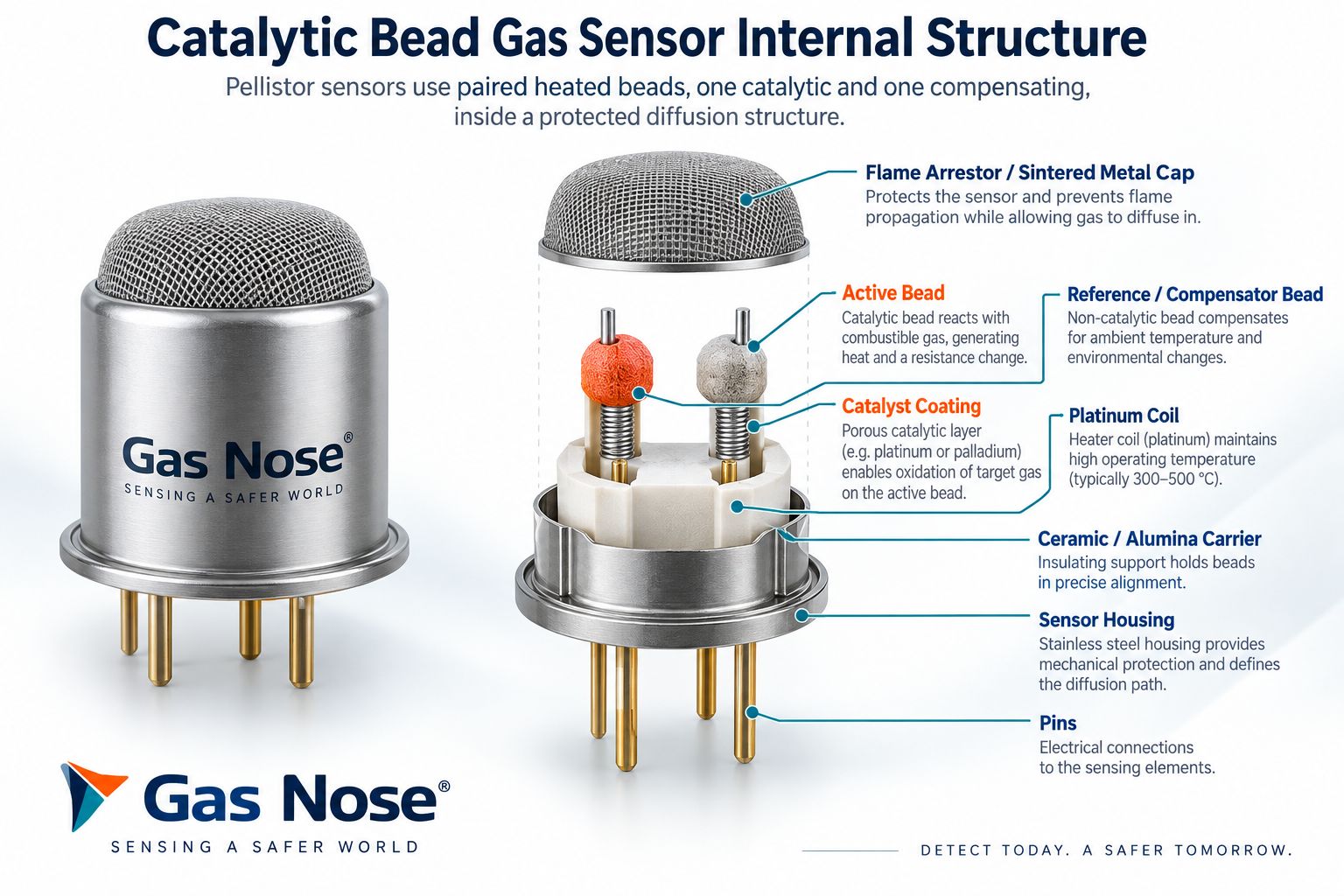
A reliable pellistor combines the hot sensing pair with mechanical and flame-protection structures. The package must allow gas diffusion while protecting the heated elements.
Flame arrestor / sintered cap
Allows gas diffusion while helping prevent an internal ignition from propagating into the surrounding atmosphere.
Active bead
Contains catalyst and responds to combustible-gas oxidation with additional heat.
Reference bead
Designed not to catalytically oxidize the fuel; it compensates for common thermal and environmental changes.
Platinum coil
Acts as both heater and temperature-sensitive resistance element.
Ceramic / alumina carrier
Supports and electrically isolates the bead pair at high temperature.
Housing and pins
Provide mechanical protection, diffusion geometry and electrical connection to the bridge circuit.
Differential sensing
Why pellistors use an active bead and a reference bead
Active bead
- Contains catalytic material
- Combustible gas + oxygen react on the surface
- Reaction releases heat
- Bead temperature increases
- Platinum resistance increases
Reference / compensator bead
- Heated similarly to the active element
- Does not intentionally catalyze the combustible gas
- Tracks ambient temperature changes
- Helps cancel common thermal effects
- Provides the reference arm for differential measurement
Electrical readout
How a Wheatstone bridge converts catalytic heat into an electrical signal

Clean air
Active and reference bead resistances are adjusted to produce a near-balanced baseline. The differential output is close to zero after zeroing.
Combustible gas exposure
Only the active bead receives significant catalytic reaction heat. Its resistance rises relative to the reference element, creating a bridge output that can be amplified and calibrated.
Constant-voltage vs constant-current drive
Different sensor and instrument designs use different drive strategies. The important requirement is to operate the bead pair at the conditions defined by the sensor manufacturer while preserving stable bridge behavior.
%LEL measurement
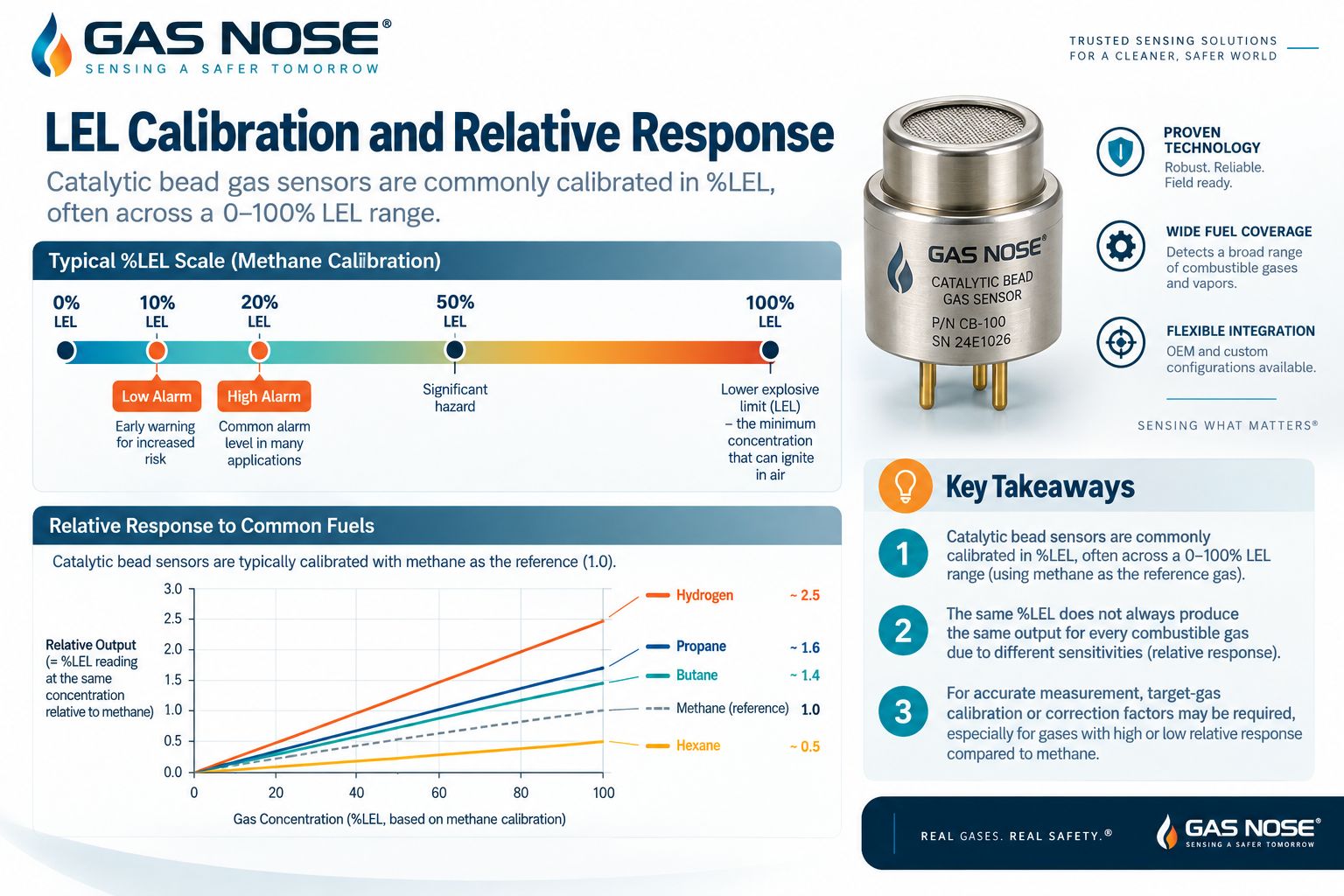
Why catalytic bead sensors are commonly calibrated in %LEL
Pellistors are especially useful for combustible-gas safety because they respond across a wide family of fuels. In many portable and fixed gas detectors the output is therefore expressed as a percentage of the lower explosive limit rather than as a low-ppm analytical concentration.
Early warning zone
Useful for detecting a developing leak well below the explosive threshold.
Common alarm region
Many safety instruments use alarm setpoints in this range according to their application and standard.
Increasing hazard
The gas mixture approaches the lower explosive limit and requires immediate risk control.
For concentration conversion, use the dedicated LEL Converter and verify the gas-specific LEL value used by the applicable standard or instrument.
Cross calibration
Why methane calibration does not automatically give perfect propane, hydrogen or hexane readings
Target-gas calibration
Use the actual target gas when practical and when the application requires the highest confidence.
Correction factors
Some instruments provide manufacturer-defined correction factors for alternate combustible gases.
Validation
Cross-calibration should be verified for the exact sensor, instrument, range, atmosphere and intended alarm strategy.
Reaction requirement
Why catalytic bead sensors depend on oxygen

The pellistor signal is created by oxidation:
Combustible gas + O₂ → oxidation products + heat
Suitable environments
- Normal air with sufficient oxygen
- Portable and fixed LEL safety monitoring in ventilated spaces
- Applications where oxygen remains within the sensor’s specified operating basis
Poor-fit environments
- Nitrogen blanketing
- Argon or other inert process atmospheres
- Strong oxygen deficiency
- Closed process streams where oxygen concentration is unknown or intentionally low
For oxygen-independent hydrocarbon detection, compare with NDIR Gas Sensors and the dedicated NDIR vs Catalytic Sensors guide.
Reliability risk
Catalytic bead poisoning and inhibition
Because pellistor sensitivity depends on an exposed catalyst surface, some chemicals can temporarily suppress the reaction or permanently reduce catalytic activity.
Poisoning
- Can cause persistent or irreversible sensitivity loss
- Silicones and siloxanes are a major concern
- Lead compounds and some sulfur compounds can damage catalyst performance
- Some halogenated compounds can also reduce sensitivity
Inhibition
- Suppresses catalytic activity during exposure
- Response may recover after the inhibitor is removed
- Recovery can depend on concentration and exposure duration
- Field testing is required to confirm that sensitivity has returned

Field verification
Bump test vs calibration: why pellistors need both concepts
Bump test
- Confirms the sensor responds to gas
- Helps reveal poisoning, blockage or gross sensitivity loss
- Verifies alarms and instrument response
- Does not necessarily adjust the calibration
Calibration
- Exposes the instrument to a known reference gas
- Adjusts zero and/or span as required
- Restores measurement accuracy within the supported correction range
- Cannot restore a permanently poisoned catalyst
For a detailed operational comparison, see Bump Test vs Calibration.
Engineering trade-offs
Catalytic bead sensor advantages and limitations
Why catalytic bead sensors remain widely used
- Broad response to many combustible gases and vapors
- Direct fit for 0–100% LEL safety measurement
- Mature, field-proven technology
- Can detect hydrogen as well as hydrocarbons
- Useful in portable and fixed multi-gas instruments
- Relatively straightforward bridge-based electronics
Where catalytic bead needs care
- Requires sufficient oxygen
- Catalyst poisoning and inhibition
- Heater power consumption
- Cannot identify which combustible gas is present
- Relative response varies by fuel
- Regular bump testing and calibration are important
Technology comparison
Catalytic bead vs NDIR combustible gas sensing
| Factor | Catalytic Bead / Pellistor | NDIR |
|---|---|---|
| Measurement principle | Catalytic oxidation heat | Infrared absorption |
| Oxygen required | Yes | No for the optical measurement itself |
| Hydrogen detection | Can detect H₂ with suitable sensor | Conventional hydrocarbon NDIR does not detect H₂ |
| Catalyst poisoning | Possible | No catalytic poisoning mechanism |
| Broad combustible response | Strong across many fuels | Depends on gas-specific IR absorption and calibration |
| Inert / low-O₂ atmosphere | Poor fit | Often better for suitable IR-active gases |
| Typical fit | Portable/fixed LEL safety monitoring | Long-life methane/hydrocarbon sensing, low-O₂ processes |
For the full engineering comparison, see NDIR vs Catalytic Sensors.
Miniaturized pellistors
Traditional pellistor vs MEMS pellistor
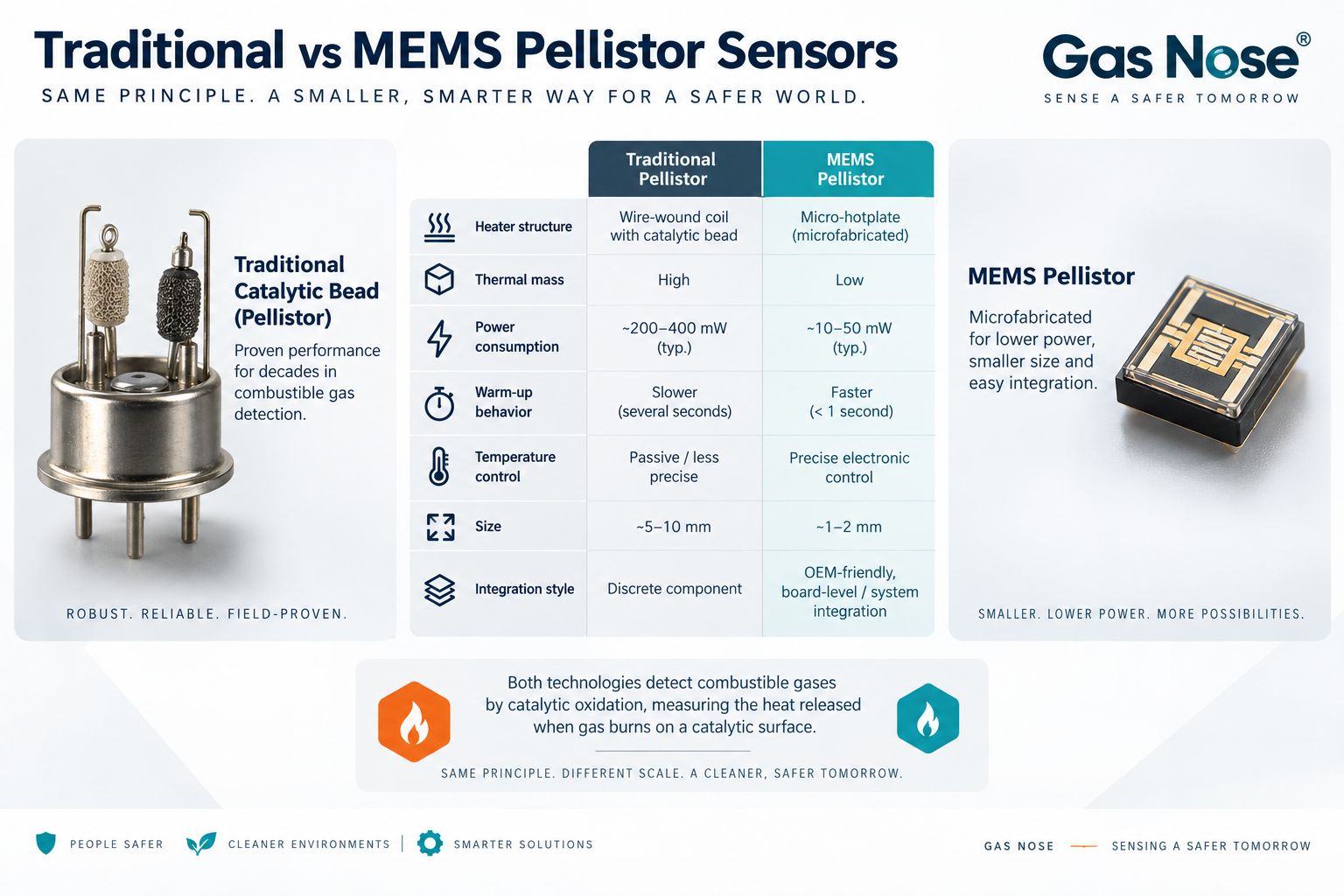
| Factor | Traditional Pellistor | MEMS Pellistor |
|---|---|---|
| Heater | Wire-wound / larger bead | Microfabricated hotplate |
| Thermal mass | Higher | Lower |
| Power | Typically higher | Potentially much lower |
| Warm-up | Longer | Faster |
| Size | Larger discrete element | Micro-scale structure |
| Core chemistry | Catalytic oxidation | Catalytic oxidation |
For the broader MEMS architecture discussion, see MEMS Gas Sensors.
Application landscape
Where catalytic bead gas sensors are commonly used
Portable multi-gas detectors
Combustible-gas channel in personal and confined-space instruments, commonly paired with O₂, CO and H₂S sensors.
Fixed industrial LEL transmitters
Continuous combustible-gas monitoring in process plants, production areas and hazardous zones.
Mining and underground safety
Methane and combustible-gas monitoring where proven LEL detection is required.
Oil & gas / petrochemical
Leak detection around processing, storage and transfer areas.
Hydrogen and fuel systems
Suitable pellistors can detect hydrogen, providing an option where conventional hydrocarbon NDIR cannot.
Natural gas / LPG
Combustible-gas detection in industrial, commercial and selected residential or utility equipment.

Representative OEM implementations
Example catalytic bead sensor products
These examples show the technology progressing from raw catalytic elements to application-ready combustible-gas modules.
| Example | Type / target | What it demonstrates | Integration direction |
|---|---|---|---|
| Winsen MC101 | General catalytic combustible-gas element | Classic active + compensator pellistor architecture for combustible gas | Raw bridge element for OEM instruments |
| Winsen MC113 / MC113C | Industrial combustible-gas sensor | 0–100% LEL-oriented industrial pellistor family | Fixed and portable gas detection |
| Winsen MC115 | Miniature catalytic element | Compact pellistor format for space-constrained combustible sensing | OEM instrument integration |
| Winsen MC119 | Broad combustible-gas response | Illustrates pellistor response across hydrogen, hydrocarbons and combustible vapors | Multi-fuel safety sensing |
| Winsen ZC401 / ZC41 platform | Conditioned combustible-gas module | Moves from catalytic element to vehicle / system-level signal conditioning and interfaces | Application-ready module integration |
Selection workflow
How to choose a catalytic bead gas sensor
1. Define the fuel
Identify methane, propane, hydrogen, solvent vapor or another combustible gas and list likely interferents.
2. Define the range
Confirm whether the requirement is %LEL safety monitoring or a different concentration basis.
3. Define the atmosphere
Confirm oxygen availability, humidity, temperature and potential catalyst poisons.
4. Define the maintenance plan
Set bump-test, calibration and replacement procedures appropriate to the risk and instrument instructions.
Before design freeze
- Target combustible gas / vapor
- 0–100% LEL or other range
- Calibration gas and correction factor
- Minimum expected oxygen level
- Potential silicone / sulfur / halogen exposure
- Required response and recovery time
- Heater power budget
- Flameproof / hazardous-area integration requirements
Pellistor OEM checklist
Record the atmosphere and maintenance assumptions, not only the target fuel.
- Target and interfering combustible gases
- Expected oxygen range
- Poison / inhibitor exposure
- Bridge supply and AFE design
- Alarm setpoints
- Bump-test interval
- Calibration interval and gas
- End-of-life / sensitivity-loss strategy
Useful Gas Nose tools: LEL Converter and Gas Sensor Product Finder.
FAQ
Catalytic bead gas sensor FAQ
What is a catalytic bead gas sensor?
A catalytic bead gas sensor, also called a pellistor, detects combustible gas by oxidizing the gas on a heated catalyst bead. The reaction releases heat, changing bead resistance and creating a bridge output.
What is a pellistor?
Pellistor is a common name for a catalytic combustible-gas sensing element that uses a heated active bead and a compensating reference bead, typically connected in a Wheatstone bridge.
Why does a catalytic bead sensor need oxygen?
The signal depends on oxidation of combustible gas on the catalyst surface. If oxygen is too low, the reaction produces less heat and the sensor can under-respond or become unreliable.
What does a catalytic bead sensor measure?
It is commonly used for combustible-gas concentration expressed as %LEL. The exact reading depends on the calibration gas and relative response to the actual fuel.
Why are there two beads in a pellistor?
The active bead catalyzes combustible-gas oxidation, while the reference bead is designed not to react. Their differential resistance helps compensate for ambient temperature and other common thermal changes.
What is catalytic bead poisoning?
Poisoning occurs when chemicals such as silicones, some sulfur compounds, lead compounds or halogenated materials reduce the activity of the catalyst, causing persistent or permanent sensitivity loss.
What is the difference between poisoning and inhibition?
Poisoning generally causes persistent sensitivity loss, while inhibition temporarily suppresses catalyst activity and may recover after the interfering substance is removed.
Can catalytic bead sensors detect hydrogen?
Yes, suitable pellistors can detect hydrogen because hydrogen is combustible and can oxidize on the catalyst. The exact sensitivity must be verified for the specific sensor.
Can a catalytic bead sensor identify which combustible gas is present?
No. Pellistors respond broadly to combustible gases and vapors. They measure combustible-gas response rather than molecular identity.
Why does calibration gas matter?
Different combustible gases produce different relative responses on the same sensor. Methane calibration therefore does not guarantee identical accuracy for propane, butane, hydrogen, hexane or other fuels without validated correction.
What is the difference between a catalytic bead sensor and NDIR?
Catalytic bead sensors measure oxidation heat and require oxygen. NDIR measures infrared absorption and does not require oxygen for the optical measurement. NDIR can also avoid catalyst poisoning, while catalytic sensors can detect hydrogen.
Need to choose a catalytic combustible-gas sensing architecture?
Start with the fuel, LEL range, oxygen availability, catalyst-poisoning risk, maintenance plan and power budget. Pellistors remain a strong choice when broad combustible-gas response and proven %LEL safety monitoring matter most.