



Colorimetric Gas Sensors
Colorimetric gas sensors use chemical reagents that change color when exposed to a target gas. The response may be read visually from a detector tube, recorded on a passive indicator, measured optically on a moving tape, or interpreted as a multi-dye color fingerprint.
The essential engineering question is not simply “does the reagent change color?” It is whether that change indicates a spot concentration, an accumulated exposure, or a continuous concentration trend.
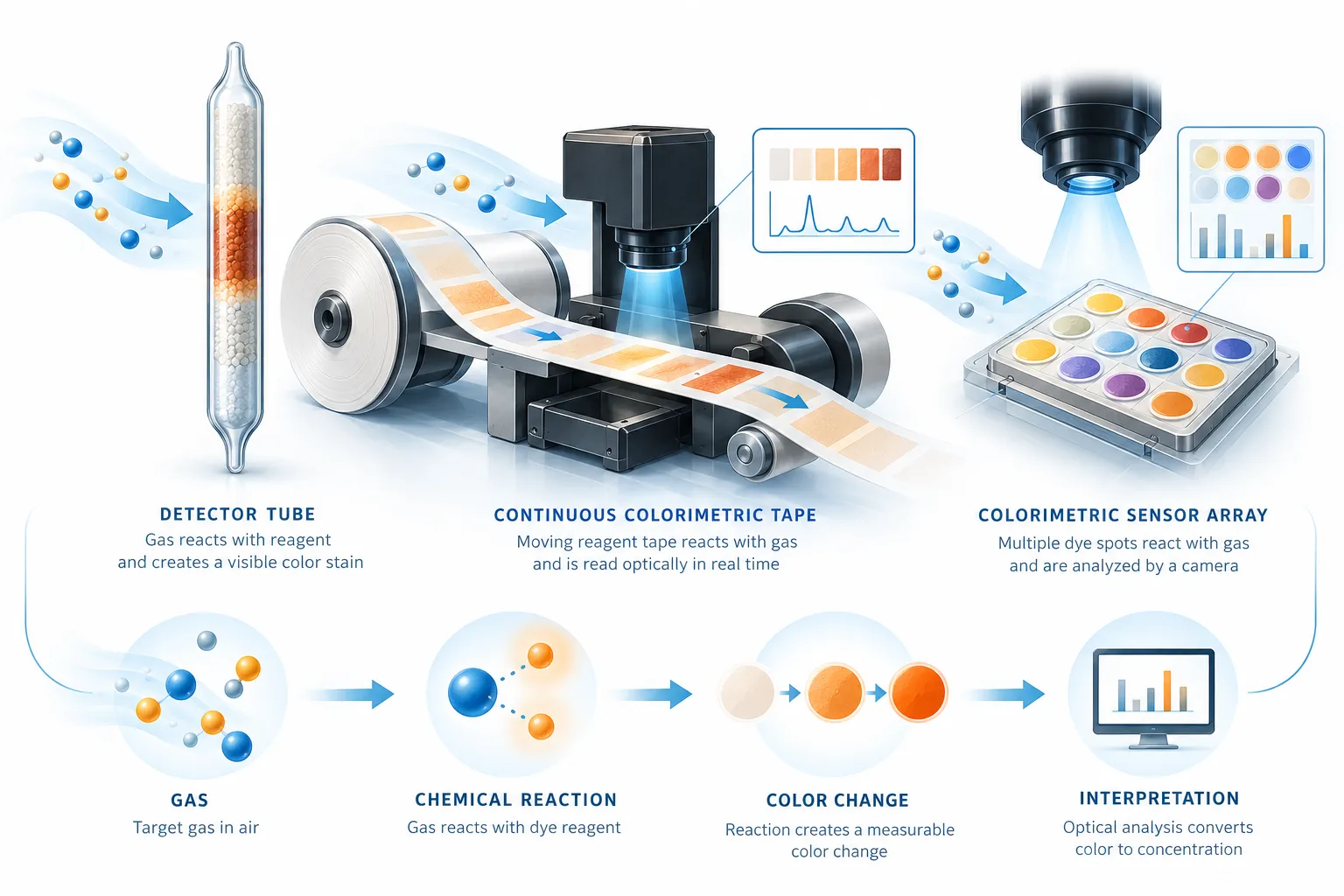
Technology definition
What is a colorimetric gas sensor?
Unlike an electrochemical sensor, which converts an electrode reaction into current, or an infrared sensor, which detects light absorption by molecules, a colorimetric device makes the chemistry directly visible or optically readable.
But a colorful stain is not automatically a calibrated ppm measurement. Some products are qualitative indicators; others are quantitative only when the correct tube, pump, reagent, sampling procedure or optical calibration is used.
Modern systems combine chemical specificity with optical electronics. This lets a chemically treated tape or sensor array deliver a digital result while retaining a color-producing reagent as the actual sensing element.
No target-gas reaction is represented. This illustration cannot calculate ppm without a real reagent, exposure time and calibration.
Fundamental operation
How do colorimetric gas sensors work?
The sensing chain begins with chemical access, not electronics. A target molecule reaches the reactive material; the reaction changes an optical property; that change is interpreted using a method-specific calibration.
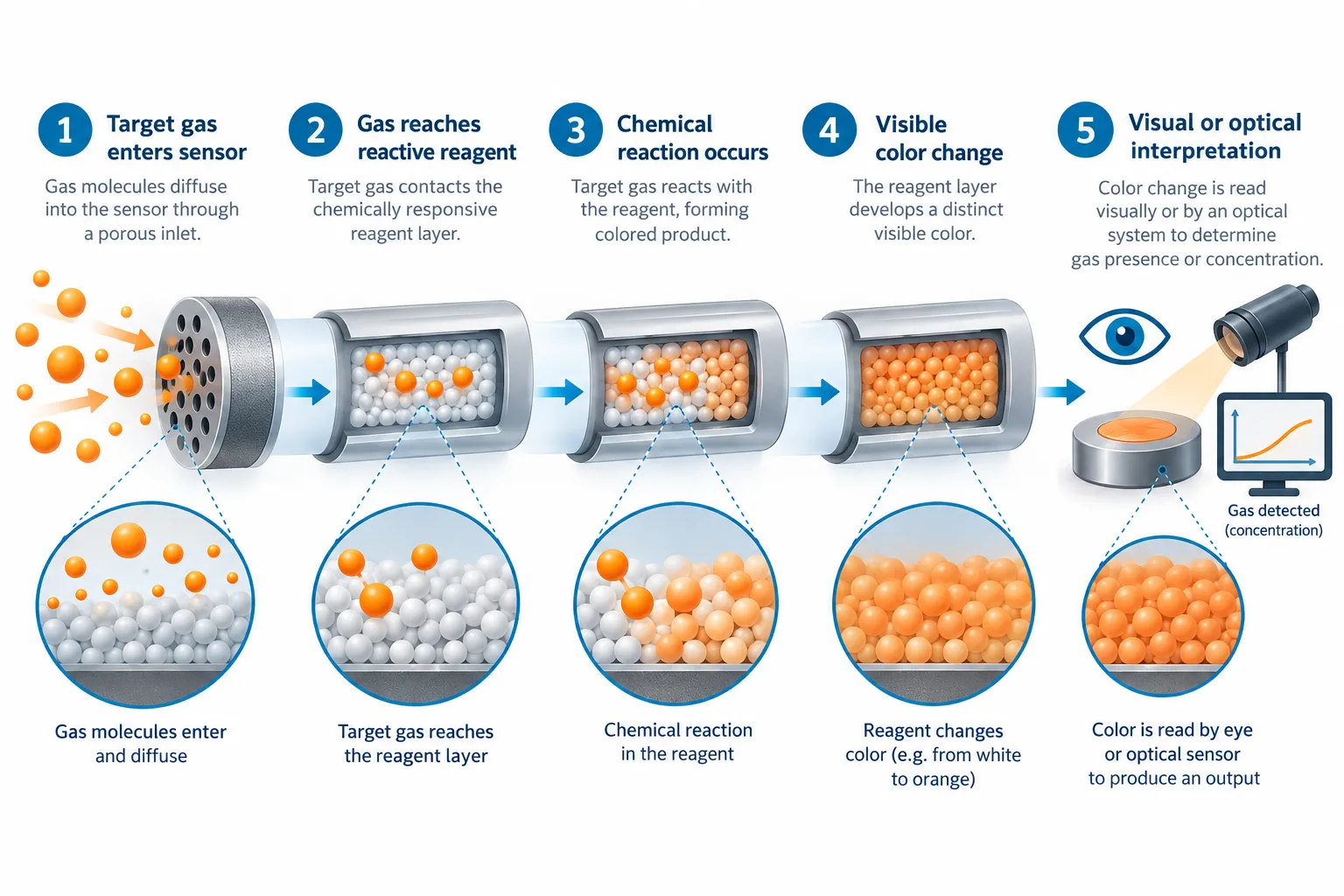
- Sampling: pump-driven or passive diffusion delivers a defined amount of gas.
- Contact: the gas reaches the impregnated reagent layer.
- Reaction: acid–base, redox, coordination or another chromogenic reaction occurs.
- Color development: the stain progresses or the optical response grows.
- Readout: an operator or optical system interprets the result using the specified exposure conditions.
Technology classification
Four main types of colorimetric gas detection
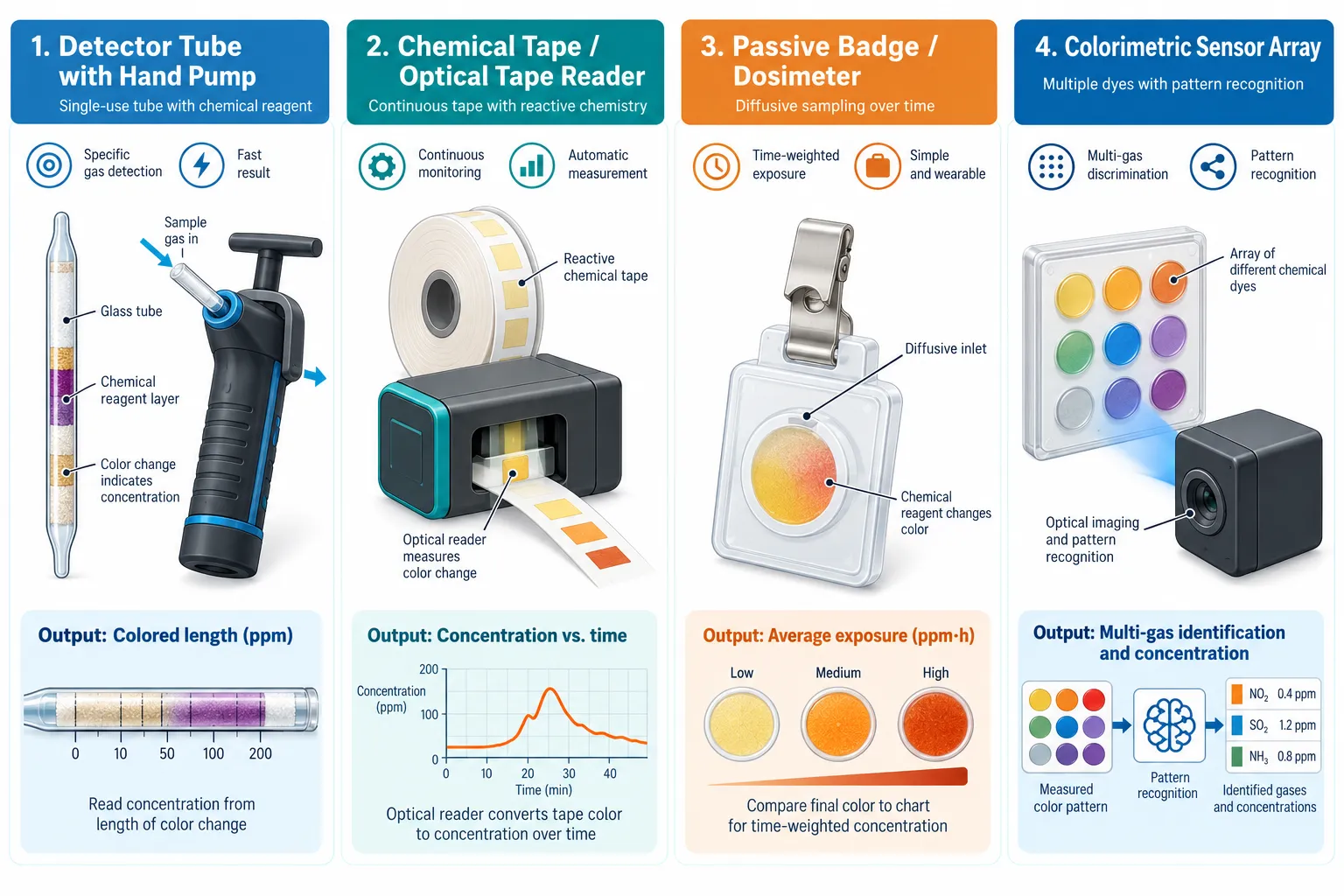
| Architecture | What is measured | Sampling and readout | Best fit |
|---|---|---|---|
| Detector tubes | Stain length, endpoint or color change | Specified sample volume through calibrated tube, usually hand pump | Spot checks and industrial hygiene |
| Chemical detection tapes | Stain density / optical reflectance over monitored intervals | Controlled pumped sample with optical electronics and tape indexing/advance | Continuous or sequential toxic gas monitoring |
| Passive indicators / badges | Visible reaction or accumulated color response | Diffusion over a defined exposure period | Personal or area exposure indication; TWA only where calibrated |
| Colorimetric sensor arrays | Pattern of multiple dye color changes | Camera/scanner optical data and chemometric processing | Mixture discrimination, screening and research |
Spot measurement
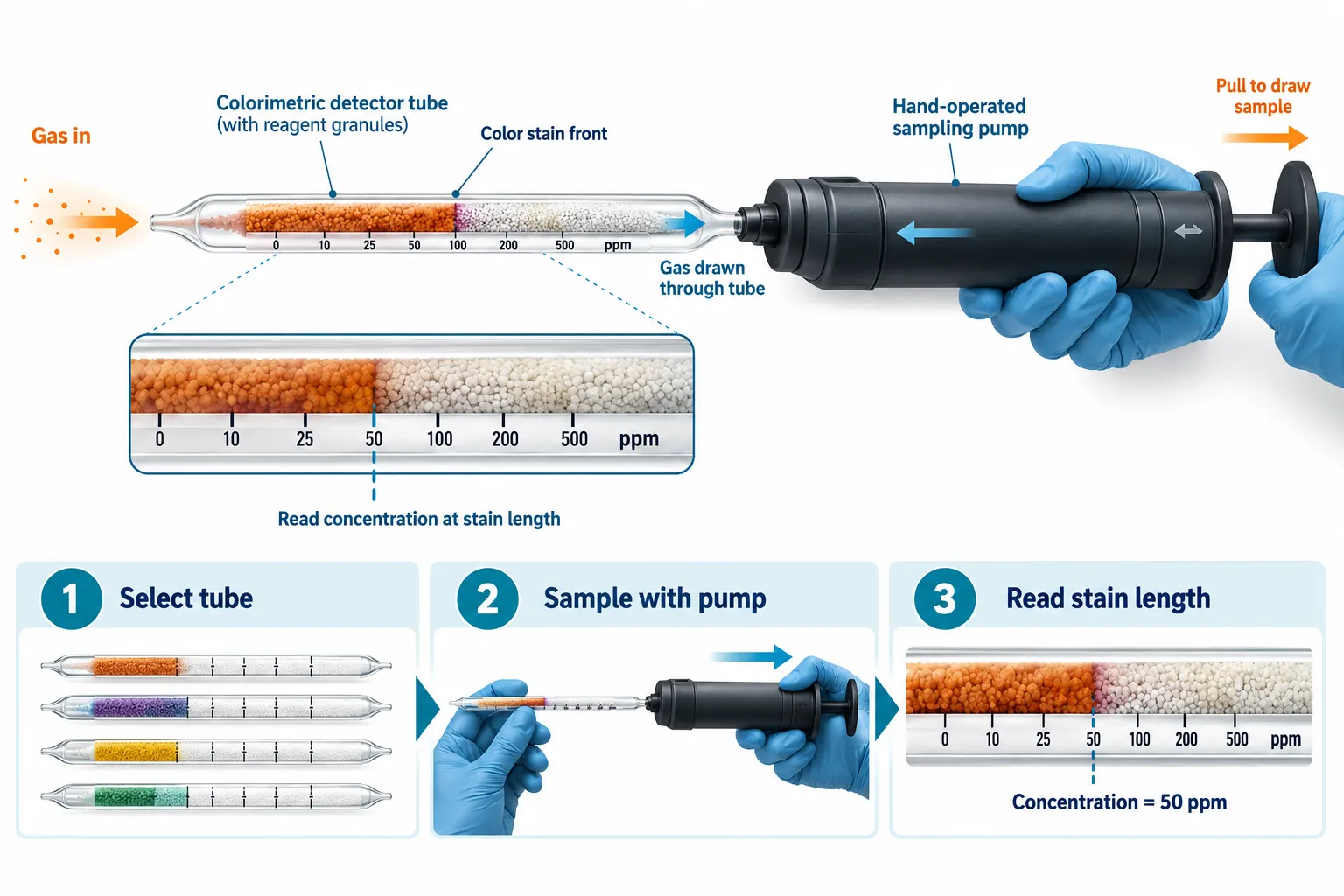
Detector tubes: concentration from the length of a color stain
A quantitative tube is a complete calibrated sampling method. Its scale only applies when the manufacturer’s specified tube, pump, pump strokes, timing and corrections are used.
A reliable sampling sequence
- Select the correct gas, range and tube.
- Perform the prescribed pump leak check.
- Break the tube ends carefully and insert it in the specified direction.
- Draw the stated number of pump strokes, waiting for sampling to finish.
- Read the stain boundary according to the manufacturer's rules.
- Apply any specified temperature, pressure, humidity or stroke correction.
Manufacturer procedure reference: GASTEC — measuring know-how and temperature/humidity effects ↗
Automated monitoring
Continuous chemical tape systems use color chemistry with optical electronics
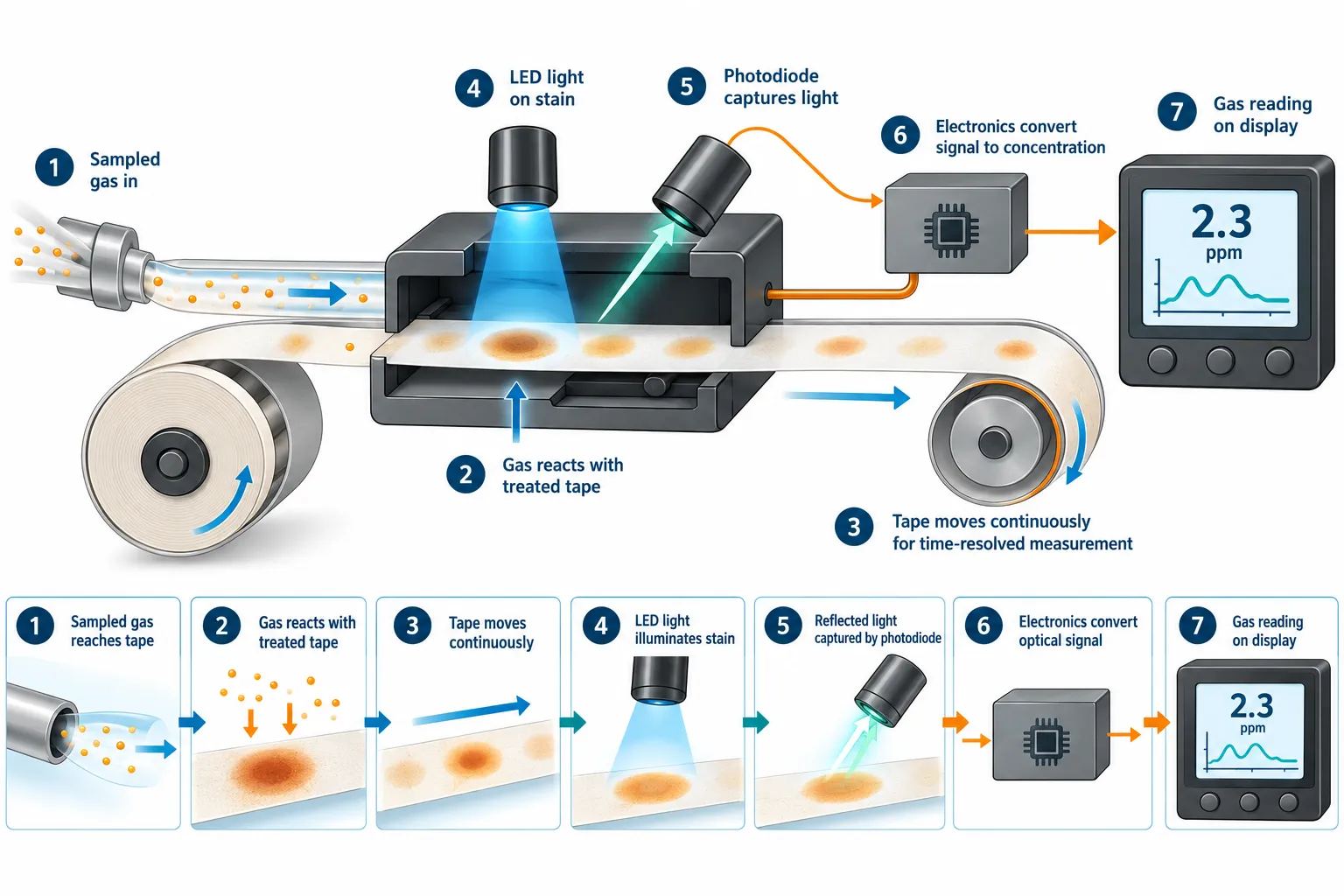
- Sample collection: a pump delivers gas at a defined flow rate to treated tape.
- Reaction: the target gas forms a colored stain in the reagent area.
- Illumination: a light source illuminates the spot under controlled geometry.
- Detection: a photodiode or optical system reads reflected intensity or stain change.
- Conversion: calibrated software reports ppm/ppb and logs alarms or trends.
- Consumable management: tape advancement, reagent shelf life, optics and filters need monitoring.
Honeywell's Chemcassette systems are a real commercial example used for low-concentration hazardous gases in semiconductor manufacturing. In that class of system, stain reflectance, not naked-eye color matching, becomes the primary numerical signal.
Color formation
Reaction chemistry: why a gas reagent changes color
Colorimetric gas sensing is a family of reagent reactions, not a single chemical formula. In an instrument, the chemistry must be selected and validated for the gas, exposure range and expected interferents.
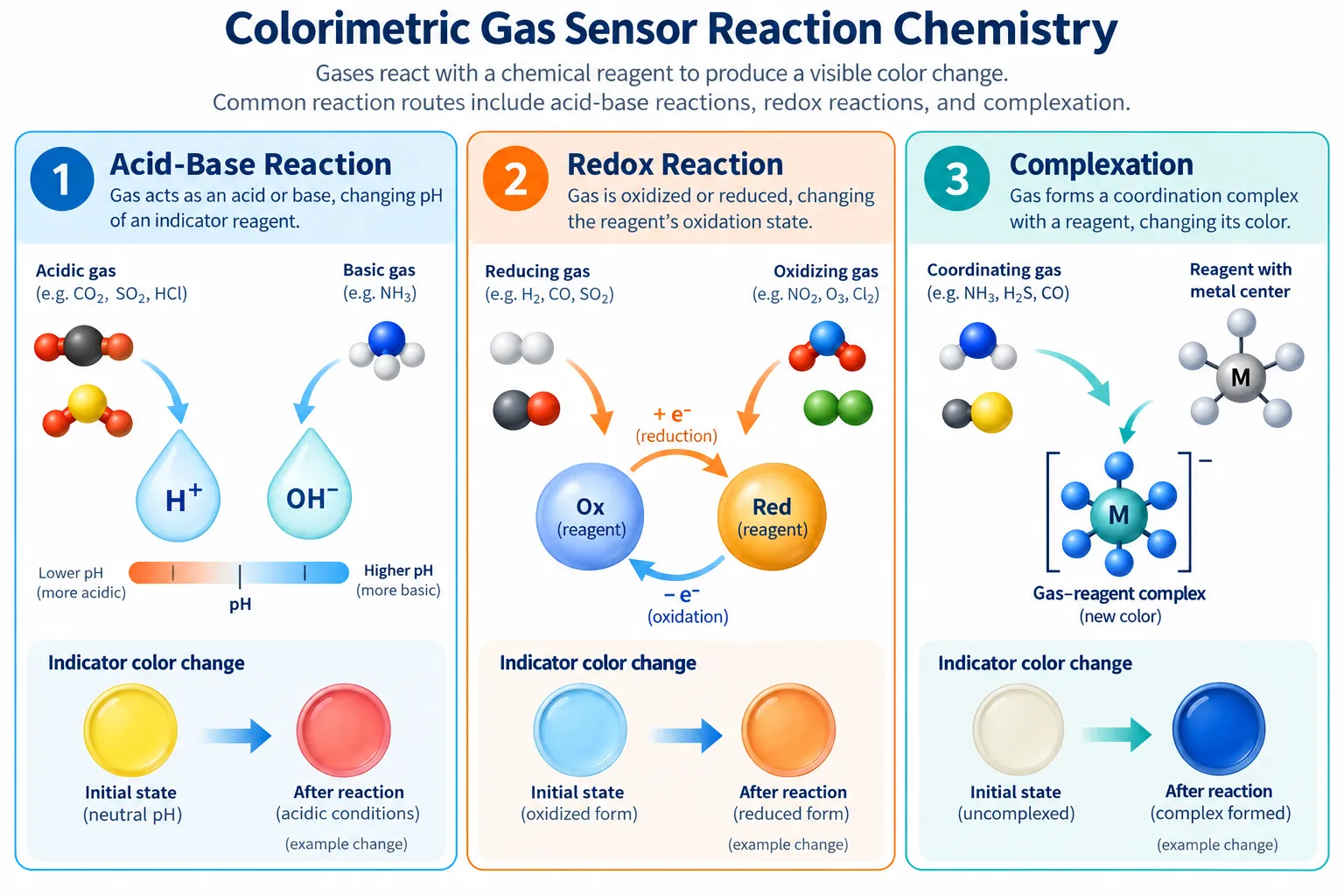
Change in chemical environment
An acidic or basic vapor modifies the local chemical conditions in a supported indicator. The indicator transitions between differently colored forms.
Change in oxidation state
Oxidizing or reducing analytes react with a reagent and alter its electronic structure, producing a visible stain or different optical spectrum.
Formation of a colored complex
A gas-derived species binds to a reagent, often involving a metal center, changing absorption and the observed color.
Measurement terminology
Spot concentration, cumulative exposure and TWA are different quantities
The measurement time meaning must be specified before interpreting a color change. This is especially important when comparing spot detector tubes with passive badges and diffusion dosimeters.
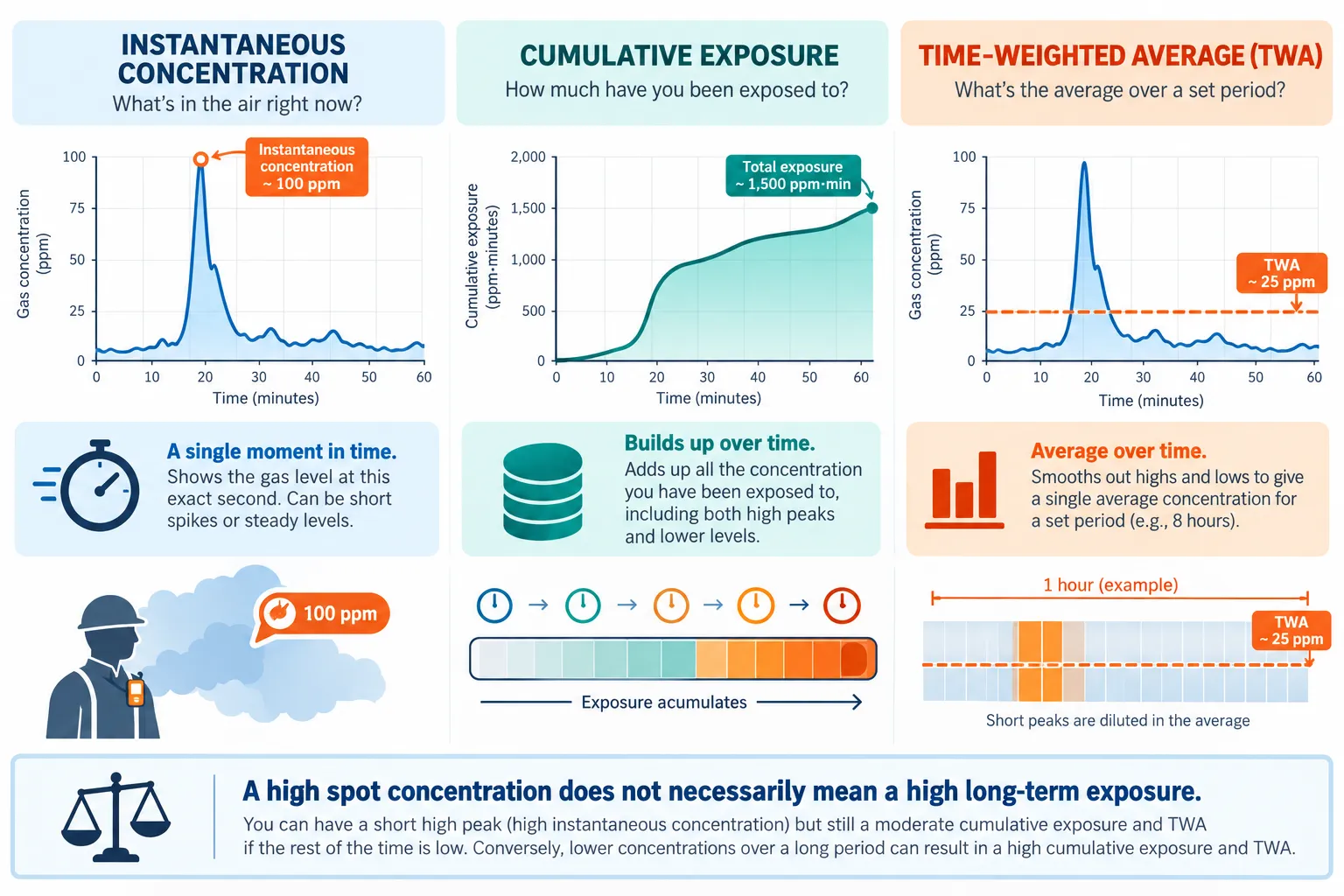
Spot concentration
A short sample gives a concentration estimate for the sampled interval (for example ppm). It may miss a peak before or after the measurement.
Cumulative exposure
Integrated exposure is the area under the concentration–time curve. It may be represented as ppm·h or ppm·min, depending on the method.
Time-weighted average
TWA is the integrated exposure divided by the corresponding time. Its value depends on exactly which period was measured.
How passive diffusion tubes are read
Some long-term diffusion tubes record the product of concentration and exposure duration. For example, a tube designed with a ppm·h scale can be converted to a TWA over its specified exposure period by dividing by the number of hours.
This is not permission to divide arbitrary badge color intensity by time. The procedure must be explicitly validated by the manufacturer.
Why peak exposure still matters
A low TWA can hide a brief high concentration. Some gas hazards depend on short-term or ceiling exposure limits, while others are evaluated over longer durations. The chosen measurement method has to match the safety decision being made.
Reference: Dräger — diffusion tubes and long-term measurements ↗.
Optical signal interpretation
Stain length, intensity, reflectance and digital color are not the same output
The result can be encoded in where color appears, how dark it becomes or how the full color vector changes. Each readout requires its own calibration and acceptance criteria.
| Readout | Measured feature | Calibration requirement |
|---|---|---|
| Length of stain | Distance traveled by the colored reaction front | Tube-specific scale, defined pump strokes/volume and applicable correction factors |
| Color intensity | Darkness or hue change after exposure | Defined exposure duration, reagent batch, optical reference and concentration standards |
| Reflectance | Change in returned illumination from the reagent spot | Controlled LED, optical geometry, timing, zero reference and calibration model |
| RGB / ΔE / multispectral | Digital color coordinates or change from baseline | Lighting control, white balance, calibration references and trained quantitative or classification model |
A digitally sampled RGB value is an optical feature, not automatically a gas concentration. Similarly, a normalized sensor-array fingerprint can distinguish samples but does not become a quantitative measurement until it is trained and validated for the intended gas matrix.
Sensor materials and lifecycle
Reversible vs irreversible colorimetric gas responses
Permanent stain or reagent consumption
The chemical reaction leaves a lasting mark or uses up active reagent. Single-use tubes, many badges and chemical tapes often belong to this category. The remaining reagent capacity, exposure and expiry date matter.
Color recovers after gas removal
Selected indicator films and optical array materials can change color and return toward baseline. Reversibility does not guarantee stability: drift, hysteresis, repeated-cycle response and humidity must still be checked.
Target gas compatibility
Which gases can colorimetric sensors detect?
Different tubes and paper-tape formulations target different chemicals. The following are common application categories, not a claim that a single reagent detects all of them.
| Gas / gas family | Common colorimetric use | Selection caution |
|---|---|---|
| H₂S | Wastewater, industrial hygiene, enclosed-space checks | Verify range, interferents and exposure duration |
| NH₃ | Refrigeration plant and agricultural/industrial monitoring | Humidity and reagent-specific interference can matter |
| Cl₂ | Water treatment, chemical storage, leak investigation | Use a chlorine-specific and validated device |
| CO | Industrial hygiene and combustion-related spot tests | Correct tube and sample procedure required |
| SO₂ / NO₂ | Workplace monitoring and process gas sampling | Other oxidants/reductants may affect interpretation |
| Formaldehyde | Indoor and occupational exposure assessment | Choose between spot and integrated sampling methods |
| PH₃ / AsH₃ | Semiconductor and specialty-process toxic gas monitoring | Very low detection limits may require engineered continuous tape systems |
| HF / HCl / other acid gases | Semiconductor fabs, chemical plants, emergency screening | Sample-system compatibility and possible pretreatment are critical |
| Selected VOCs | Solvent spot checks or optical array discrimination | Broad response does not identify an individual VOC without validation |
For broad volatile-organic screening, compare PID Gas Sensors. For continuous toxic-gas measurements with a different sensing mechanism, see Electrochemical Gas Sensors.
Performance and accuracy
Detection limit, response time and accuracy depend on the complete method
Detection limit
A faint but detectable color change defines the limit for some tube products. Low-ppb results require specialized chemistry and optical instrument design.
Measuring range
Tube and tape formulations each have specified working ranges. High exposure can exhaust reagent or saturate an optical signal.
Sampling duration
Short tubes, passive dosimeters and continuous analyzers integrate gas over very different timescales.
Accuracy / uncertainty
Readability, sampling volume, environmental corrections, operator judgment and gas interferences are all relevant.
Real-world measurement errors
Humidity, temperature, pressure, sampling errors and cross-reactive gases
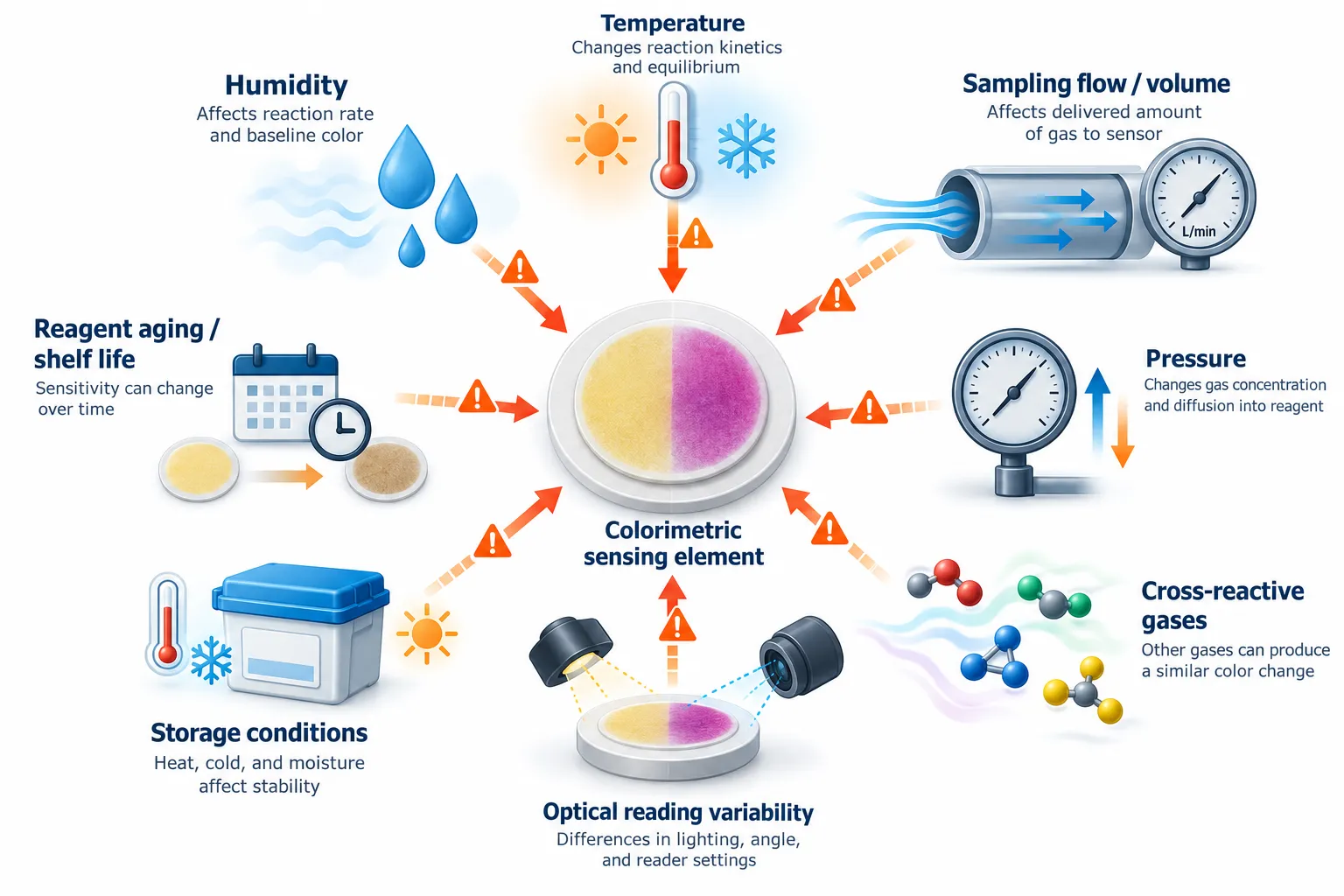
Color development depends on chemistry and gas delivery. A valid result can fail if the same tube is operated outside its approved sampling and environmental range.
- Humidity: may change baseline color, reagent kinetics or surface hydration.
- Temperature: influences reaction rate and the calibrated stain boundary.
- Pressure: changes gas sampling conditions and may require a product-specific correction.
- Volume / pump strokes: incorrect sampling delivers the wrong amount of analyte.
- Interfering gases: another compound may produce the same or opposite color change.
- Reagent aging: heat, light, water and shelf time can reduce reliability.
- Optical readout: lighting, reflectance geometry and camera settings affect electronic color measurements.
Why chemical cross-interference matters
Many colorimetric reagents are selected for strong response to one gas or chemical family, but perfect one-to-one specificity is not guaranteed. Another oxidizing, reducing, acidic or basic gas may react with the same material and alter the stain. Product manuals may list positive interference, negative interference or the color caused by the interferent.
Read more: GASTEC detector-tube specification definitions, including interferences and corrections ↗.
Modern colorimetric technology
Colorimetric sensor arrays and optical electronic noses
An imaging reader records each dye before and after exposure. Software extracts optical features—RGB changes, calibrated color difference or spectral features—and identifies patterns using statistical or machine-learning methods.
- Select chemically diverse dyes or pigments.
- Expose the array under controlled sampling conditions.
- Capture a reference and response image with consistent optics.
- Extract multi-spot color features.
- Apply validated pattern recognition or concentration models.
Color arrays are especially interesting for food freshness, environmental screening, chemical differentiation and research prototypes. A useful classification result is not automatically a selective, accurate measurement of every gas present in an unknown mixture.
What changes between a single reagent and an array?
Array response is a calibrated multivariate signature—not proof that any single dye independently identifies a chemical.
Further reading: Suslick et al. — The Optoelectronic Nose: Colorimetric and Fluorometric Sensor Arrays ↗.
Technology selection
Colorimetric vs electrochemical vs PID gas sensors
| Factor | Colorimetric | Electrochemical | PID |
|---|---|---|---|
| Sensing principle | Reaction-driven color change | Electrode redox current | UV photoionization current |
| Output | Visual stain, optical reflectance or color pattern | Current converted to gas concentration | Current / digital VOC indication |
| Spot testing | Strong fit with detector tubes | Possible with portable instruments | Strong fit for ionizable VOC screening |
| Continuous monitoring | Yes, with dedicated tape/optical analyzer | Common in portable and fixed detectors | Common for relevant VOCs |
| Consumable or aging mechanism | Reagent/tape/tube may be consumed | Electrodes/electrolyte age | Lamp contamination and maintenance |
| Gas selectivity | Reagent and sampling chemistry dependent | Electrode, bias, diffusion and filters dependent | Ionization energy and response factor dependent |
| Typical strength | Targeted spot checks, specialty-gas tape systems | Low-power toxic-gas monitors | Broad VOC screening and monitoring |
Real-world applications
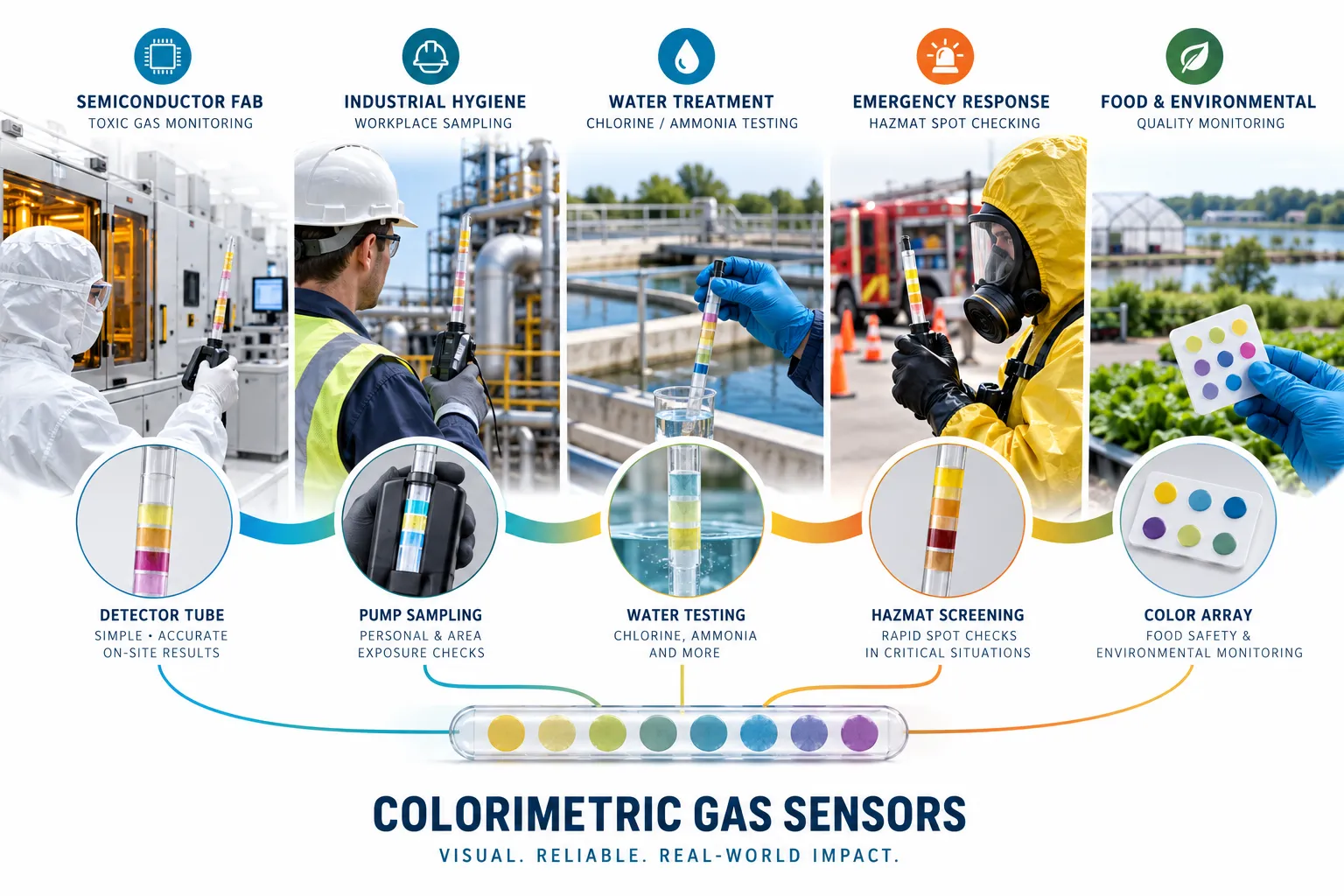
Where colorimetric gas sensors are used
Semiconductor manufacturing
Specialized continuously monitored chemical tapes for low concentrations of hydrides, acid gases and other specialty process gases.
Industrial hygiene
Detector tube screening of selected workplace gases during inspections and exposure investigations.
Water and wastewater
Gas-phase checks around chlorine handling, ammonia refrigeration and hydrogen sulfide sources. Use separate approved methods for dissolved substances.
Emergency response
Targeted spot checks when a suspected gas is known or a suitable screening tube is available.
Occupational exposure
Validated passive diffusion tubes or badges for time-integrated assessment over a specified period.
Food / environmental research
Multi-dye arrays for volatile-mixture fingerprinting, freshness and laboratory chemical classification.
Engineering selection guide
How to select a colorimetric gas detection method
Target gas + decision
Define the analyte and why the result is needed: leak screening, exposure assessment, compliance, or continuous safety alarm.
Required time basis
Choose spot concentration, integrated exposure / TWA, or continuous trends before selecting the detector type.
Required sensitivity
Specify concentration range, limit of detection, response time and repeatability in the real gas environment.
Sampling + interference
Validate pump, tube volume, sample line, temperature, humidity, pressure, and expected interfering chemicals.
Before ordering detector tubes
- Exact target gas and concentration range
- Specified compatible hand pump or automatic sampler
- Number of strokes, sample volume and timing
- Stain reading rule and possible scale correction
- Interference list and environmental limits
- Reagent expiry, storage and disposal requirements
- Appropriateness for the safety decision
Before selecting an automatic tape system
- Gas family and tape chemistry availability
- Number of required monitoring points
- Sampling-line length, response and flow verification
- Optical reference, diagnostics and calibration strategy
- Tape consumption / change interval and shelf life
- System alarms, fault handling and compliance
- Maintenance access and environmental protection
Common engineering questions
Colorimetric gas sensor FAQ
What is a colorimetric gas sensor?
It is a gas detection device that uses a reagent producing a visible or optically measurable color change when exposed to a target gas. The result can be qualitative or quantitative depending on the chemical formulation and sampling/readout method.
How does a colorimetric gas detector tube work?
A specified volume of gas passes through a packed reagent bed. The chemical reaction creates a stain. The operator reads the stain length or endpoint using the calibrated scale and applies any manufacturer-required corrections.
What is the difference between detector tubes and chemical tape gas analyzers?
Detector tubes usually provide a spot reading after manual or controlled sampling. Chemical tape analyzers automate sampling, color development, optical detection and instrument readout for ongoing or repeated monitoring.
Can colorimetric gas sensors provide continuous monitoring?
Yes, specially designed chemical tape and optical reader systems can provide continuous or sequential monitoring. Basic single-use tubes and passive badges do not inherently provide live digital measurements.
Are colorimetric gas sensors accurate?
Accuracy depends on the reagent, concentration range, sampling equipment, environmental conditions, interferences and interpretation procedure. No universal accuracy number applies to all colorimetric devices.
What is the difference between instantaneous concentration and cumulative exposure?
Instantaneous concentration describes gas level at a particular time. Cumulative exposure integrates concentration over time (such as ppm·h); dividing a valid integrated exposure by its duration gives the time-weighted average.
Does humidity affect colorimetric sensor readings?
It can. Moisture may influence reagent reaction rates, gas transport and initial color. Some specific tubes have little humidity sensitivity, while others require correction according to their instruction sheets.
Which gases can be measured with colorimetric methods?
Examples include hydrogen sulfide, ammonia, chlorine, carbon monoxide, sulfur dioxide, nitrogen dioxide, formaldehyde and selected specialty process gases. Each gas needs a suitable reagent and validated method.
Are colorimetric gas sensors reusable?
Many reagent tubes, badges and chemical tapes are single-use or consumable. Some specially engineered color-changing films are reversible. Reusability cannot be assumed solely from the term “colorimetric.”
What causes false readings in colorimetric detection?
Common causes include cross-reactive gases, incorrect sampling volume, temperature or humidity outside the specified range, pressure differences, expired reagent and uncontrolled optical lighting or calibration.
How do colorimetric sensor arrays identify gases?
Multiple dyes respond differently to a gas or mixture. The resulting multichannel color fingerprint is processed by statistical or machine-learning methods and compared with validated reference patterns.
Can a detector tube replace a fixed toxic-gas alarm?
Not by default. A spot test measures a limited interval and does not continuously monitor a location. Safety-critical decisions require equipment, alarms, coverage and procedures suited to the application and applicable regulations.
Technical sources
Selected manufacturer guidance and research
The page is based on established detector-tube operating procedures, optical tape technology and published work on chemoresponsive color arrays. Verify product-specific specifications with the original manufacturer instructions.
Working principles, tube correction, gas interferences, sampling and environmental conditions.
Read manufacturer guide ↗Long-term passive diffusion tubes and conversion of ppm·h readings to TWA concentrations.
Read technical handbook ↗Chemically treated tape and automatic optical colorimetric detection used in hazardous gas monitoring.
Read product technology ↗Review of chemoresponsive colorants, colorimetric arrays and multivariate pattern recognition.
Read research overview ↗Choosing between detector tubes, optical tapes and electronic gas sensors?
Define the target gas and measurement objective first: one-time screening, integrated occupational exposure or live continuous monitoring. From there, compare reagent chemistry, sampling requirements, interference, detection limit, consumable lifetime and total instrument design.