



PID Gas Sensors
PID—Photoionization Detector—gas sensors use ultraviolet photons to ionize VOC molecules whose ionization energy is below the lamp photon energy. The resulting ions and electrons create a tiny electrical current that can be measured from low ppb to ppm levels, depending on the sensor and instrument design.

Technology overview
What is a PID gas sensor?
PID stands for Photoionization Detector
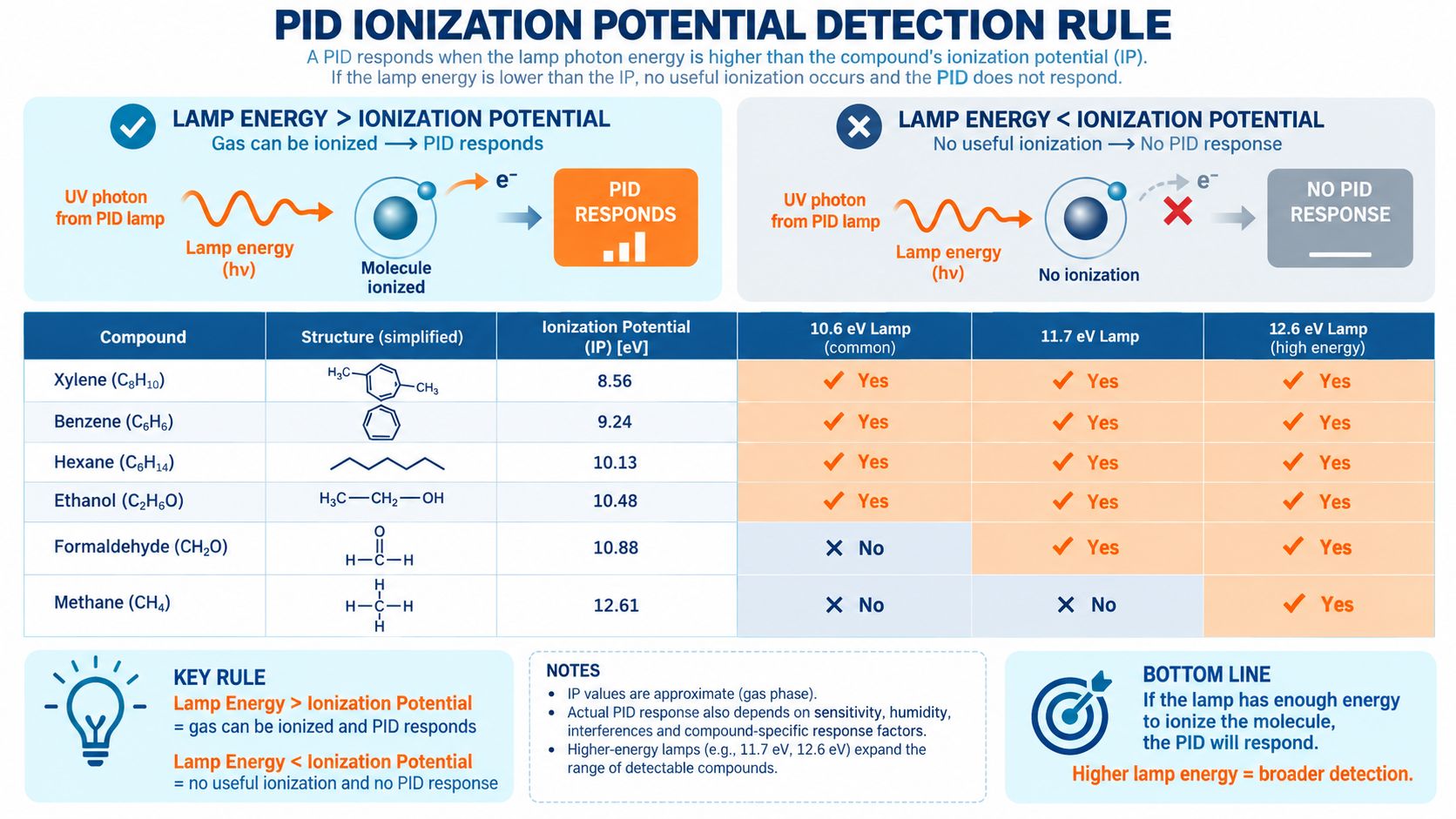
PID is particularly useful for VOC screening because many solvents, aromatics and organic vapors have ionization potentials below the energy of a common 10.6 eV lamp.
What PID is good at
- Low-level VOC screening
- Industrial hygiene and worker exposure monitoring
- Hazmat / unknown VOC response
- Environmental remediation
- Leak and fence-line monitoring
A 10.6 eV lamp has more photon energy than benzene's ionization potential, so benzene can be ionized efficiently and produces a useful PID signal.
Working principle
How does a PID gas sensor work?
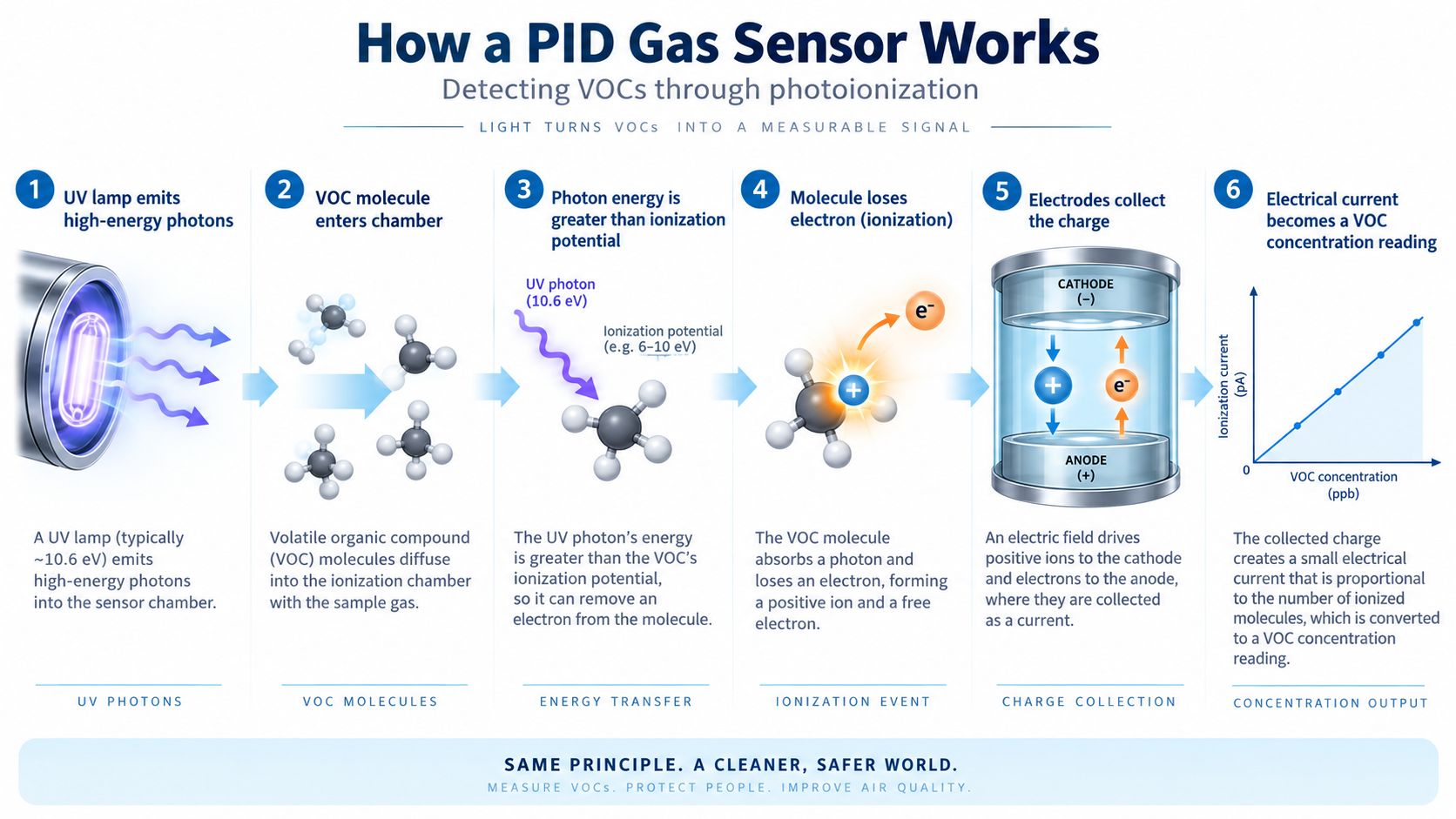
From VOC molecule to electrical signal
- 1. UV lamp emits photons: a common general-purpose lamp provides 10.6 eV photon energy.
- 2. VOC enters the chamber: sample gas diffuses or is pumped into the ionization region.
- 3. Photon energy is compared with molecular IP: if lamp energy is high enough, photoionization can occur.
- 4. Molecule loses an electron: one positive ion and one free electron are produced.
- 5. Electric field collects charge: the electrodes drive ions and electrons toward opposite polarities.
- 6. Current is measured: the tiny ionization current is amplified and converted to a VOC reading.
Sensor construction
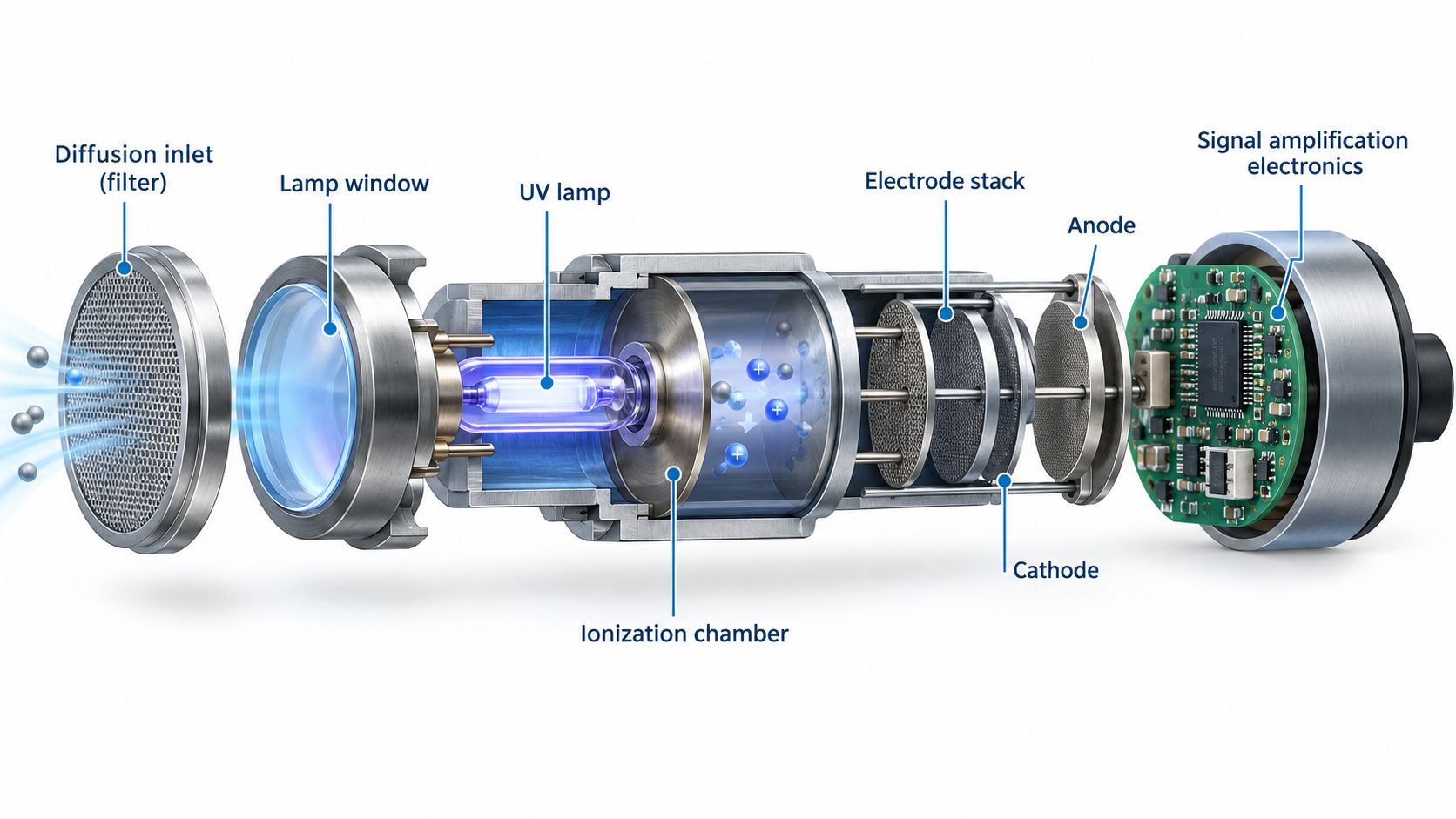
What is inside a PID sensor?
Diffusion inlet / filter
Controls sample access and helps protect the internal lamp and electrode stack from dust or aerosols.
UV lamp + lamp window
Generates the photon energy that determines which compounds can be ionized.
Ionization chamber
Defines the region where VOC molecules interact with UV photons.
Electrode stack
Applies an electric field and collects ions/electrons as a measurable current.
Amplifier electronics
Converts picoamp- or nanoamp-scale charge signals into a stable measurement output.
Mechanical sealing
Keeps the optical and electrode geometry stable while controlling gas diffusion and contamination.
The key selection rule
Ionization potential determines whether a PID can see a compound
UV lamp selection
10.0 vs 10.6 vs 11.7 eV PID lamps
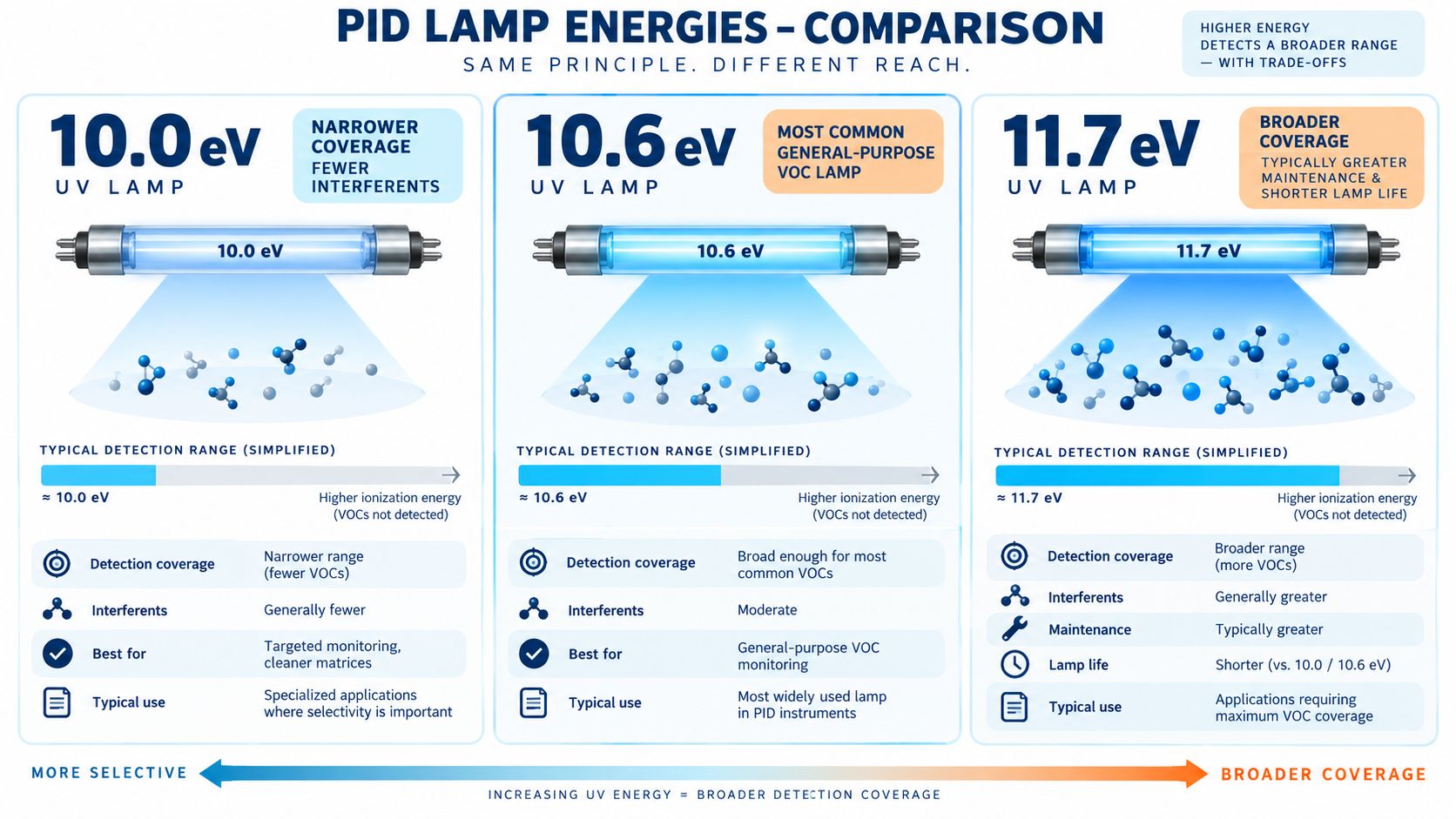
Lamp photon energy sets the upper ionization-potential threshold for compounds that can be detected. Higher-energy lamps broaden compound coverage, but the engineering trade-off is not simply “higher is always better.”
10.0 eV
Narrower compound coverage. Useful when excluding higher-IP compounds improves application-level discrimination.
10.6 eV
The most common general-purpose VOC lamp because it covers many solvents and aromatics while offering practical lamp life and maintenance.
11.7 eV
Ionizes more compounds, but usually with higher cost, shorter service life and more demanding lamp handling or maintenance.
Compound coverage
What can—and cannot—a 10.6 eV PID detect?
Typical strong / useful PID targets
- Benzene, toluene and xylene
- Styrene and many aromatic hydrocarbons
- Hexane and many solvent vapors
- Acetone and ketones
- IPA / isopropanol
- Ethanol and many common VOCs
- Many fuels and organic process vapors at low ppm
Usually poor or no useful 10.6 eV PID response
- Methane
- Hydrogen
- Carbon monoxide
- Carbon dioxide
- Oxygen
- Many permanent gases with high ionization potential
- Compounds whose IP is above the lamp photon energy
Selectivity boundary
Why a standard PID cannot identify one VOC in a mixture
Benzene
Ionizable → contributes current.
Toluene
Ionizable → contributes current.
Xylene
Ionizable → contributes current.
PID output
Combined ionizable-VOC response, not separate concentrations.
Calibration
Why PID instruments are commonly calibrated with isobutylene
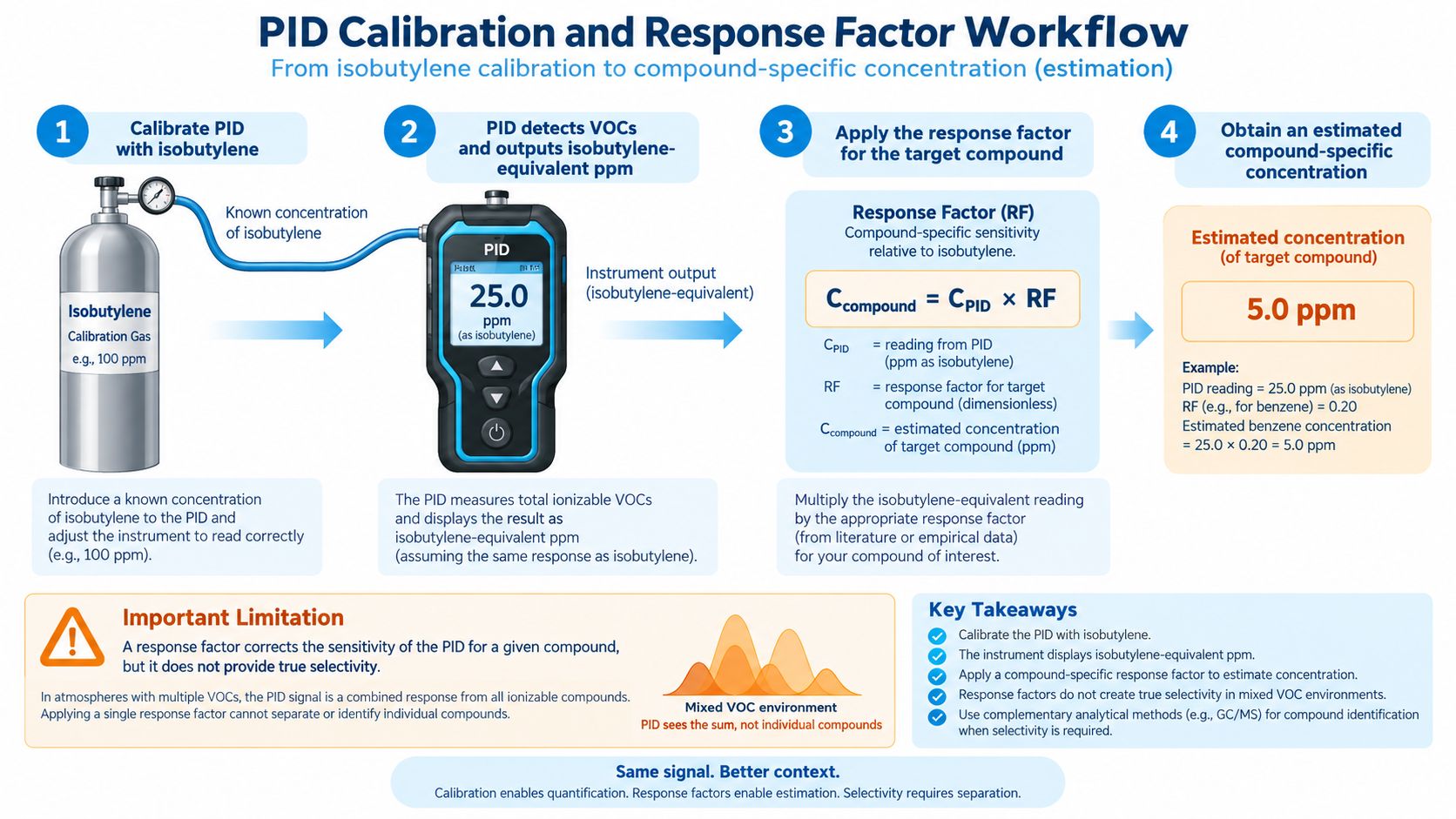
Isobutylene is widely used because it is a practical calibration standard and extensive compound response-factor data exist relative to it.
Typical workflow
- 1. Zero the PID with clean air or the specified zero gas.
- 2. Apply known isobutylene concentration and adjust the span.
- 3. Instrument reports isobutylene-equivalent concentration.
- 4. If the target compound is known, apply the manufacturer's compound-specific response/correction factor.
- 5. For critical accuracy, validate with the actual target gas whenever practical.
Measurement range
PID range: ppb sensitivity vs wide ppm range
The term “PID” covers sensors optimized for very different ranges. A high-sensitivity ppb PID and a 10,000 ppm PID use the same underlying photoionization principle, but the chamber, electronics, gain and calibration strategy are not interchangeable.
Trace VOC detection
Requires very low-noise electronics, clean optics and strong control of humidity, baseline drift and contamination.
Industrial hygiene
Typical worker-exposure, environmental and indoor-air applications where sensitivity is more important than extreme headroom.
Wide-range VOC screening
Designed to tolerate much higher vapor loading, usually with less emphasis on ultra-low detection limits.
Environmental effects and upkeep
Humidity, lamp contamination and PID maintenance
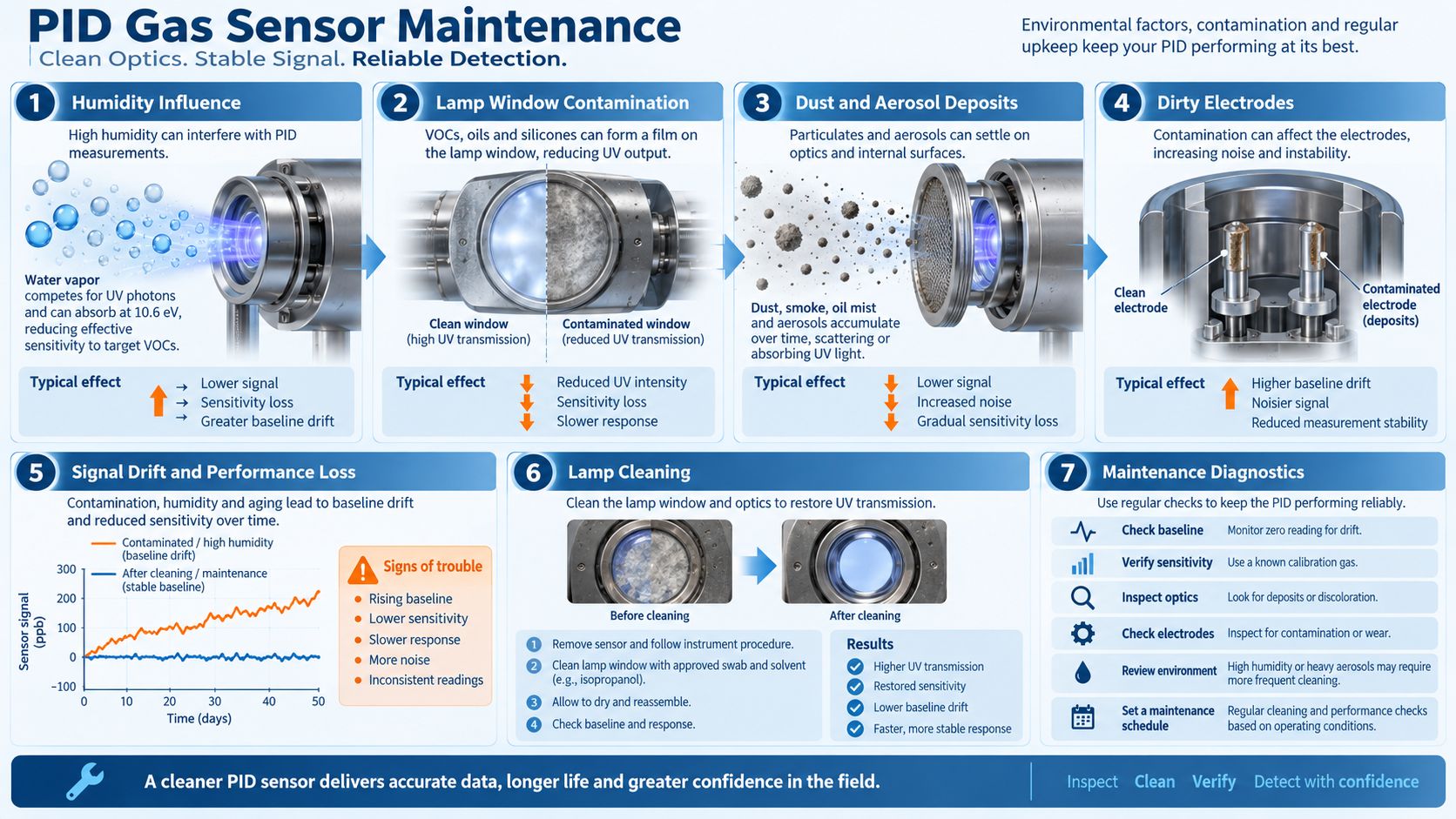
PID performance depends on clean optics and stable charge collection. Moisture, dust, aerosols and vapor residues can alter the lamp output, chamber field and baseline.
Humidity
High humidity can change sensitivity and baseline. The magnitude depends on lamp, chamber, electrode design and compensation algorithm.
Lamp-window film
Oil, silicone and condensed VOC residues can reduce UV transmission and lower sensitivity.
Dust and aerosols
Particles can block diffusion, scatter UV light or contaminate the optical path.
Electrode contamination
Deposits can increase noise, drift and instability in the collected ion current.
Typical maintenance signals
- Rising or unstable zero baseline
- Slower response
- Reduced span sensitivity
- Greater humidity dependence
- Inconsistent readings after calibration
Technology comparison
PID vs catalytic LEL, electrochemical, NDIR and semiconductor sensors
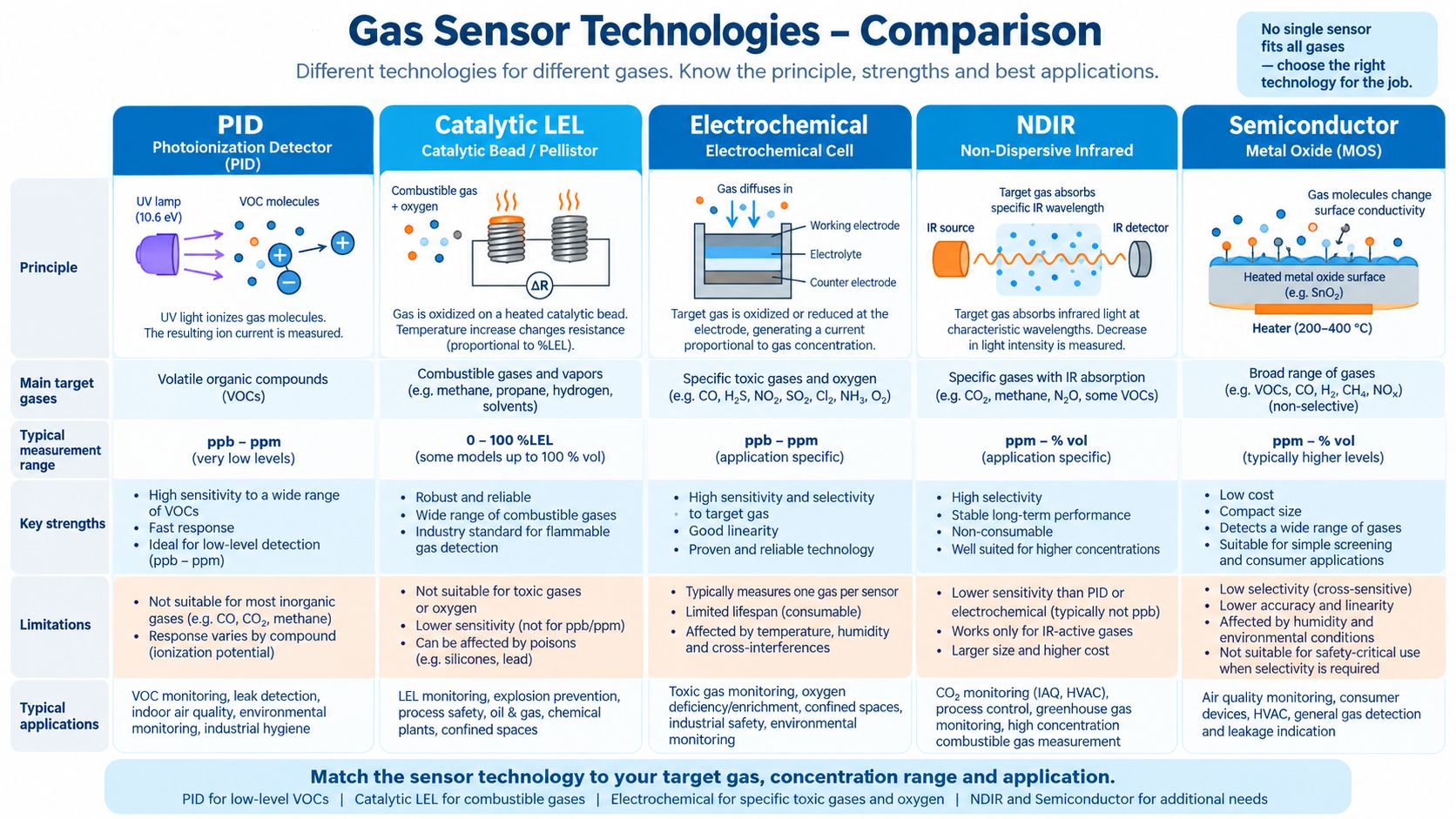
| Factor | PID | Catalytic LEL | Electrochemical | NDIR | Semiconductor / MOX |
|---|---|---|---|---|---|
| Primary principle | UV photoionization | Catalytic oxidation heat | Electrode reaction current | IR absorption | Surface conductivity change |
| Typical target | VOCs / organic vapors | Combustible gases | Specific toxic gases / O₂ | IR-active gases such as CO₂ / CH₄ | Broad gas / VOC families |
| Typical range | ppb–ppm, depending on model | 0–100% LEL | ppm / ppb depending on chemistry | ppm to %vol | ppm to %vol depending on design |
| Oxygen required | No | Yes | Depends on electrochemistry | No | Generally not as a combustion requirement |
| Methane | Common 10.6 eV PID: no | Yes | Not the normal choice | Yes with methane-specific NDIR | Yes with suitable MOX |
| Low-level benzene / solvent VOCs | Strong fit | Poor low-ppm fit | Compound-specific sensor needed | Application-specific | Broad response / lower selectivity |
Related guides: Catalytic Bead Gas Sensors, NDIR Gas Sensors, Electrochemical Gas Sensors, and Semiconductor Gas Sensors.
Applications
Where PID gas sensors are used
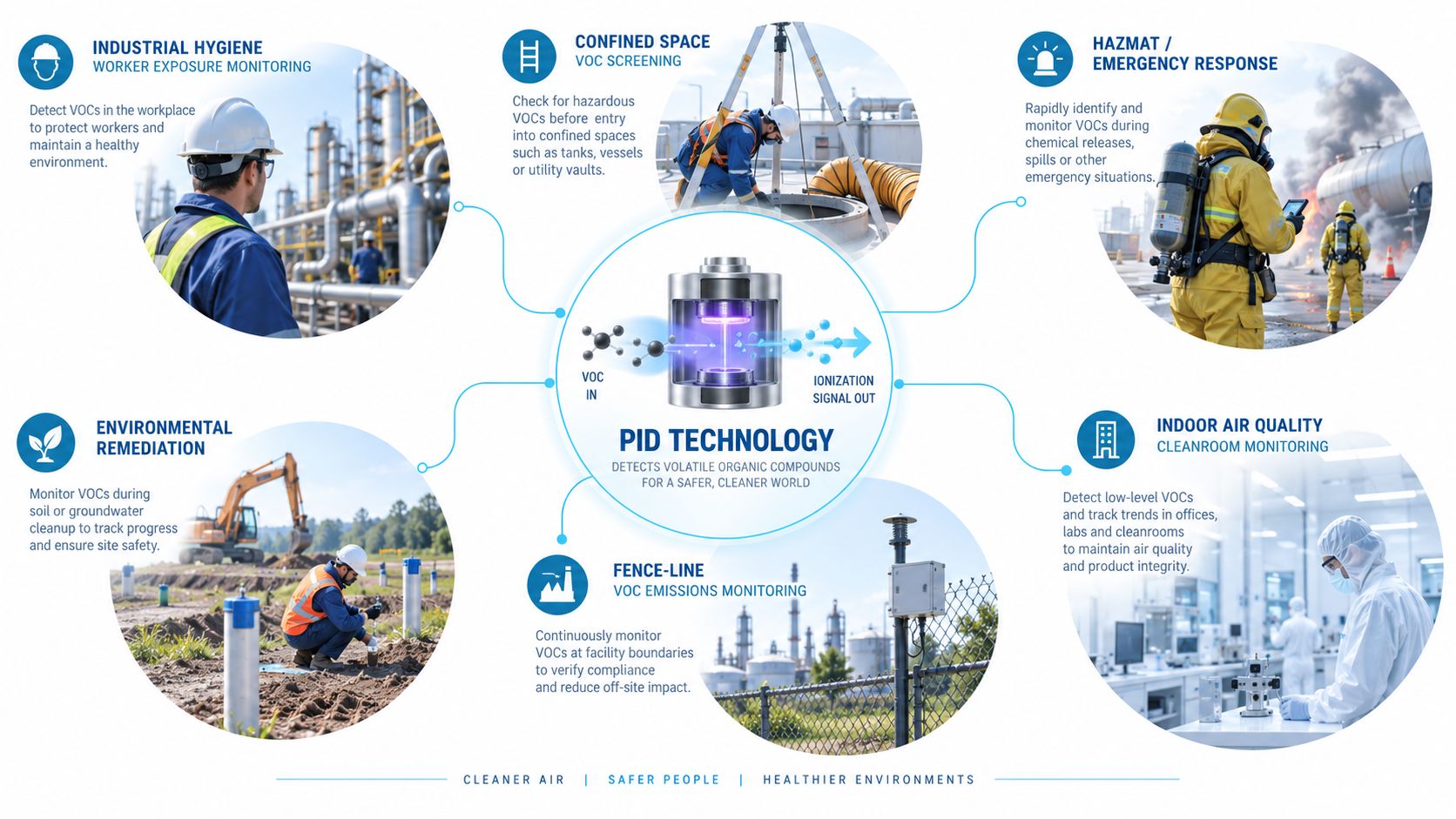
Industrial hygiene
Worker exposure monitoring for solvents and volatile organic compounds in manufacturing, coating and chemical environments.
Confined spaces
VOC screening before and during entry into tanks, vessels, pits and utility spaces.
Hazmat / emergency response
Rapid broad-spectrum screening for unknown or mixed volatile chemical releases.
Environmental remediation
Tracking VOCs during contaminated soil and groundwater cleanup.
Fence-line monitoring
Continuous or periodic VOC monitoring around industrial facility boundaries.
Indoor air / cleanrooms
Low-level VOC trend monitoring where broad organic-vapor sensitivity is useful.
Selection workflow
How to choose a PID gas sensor
1. List the compounds
Identify known VOCs, likely interferents and whether the atmosphere is a mixture or one dominant compound.
2. Check ionization potential
Confirm the selected lamp energy can ionize the compounds you need to detect.
3. Define the range
Choose ppb, low-ppm or wide-range PID hardware around the actual exposure or process window.
4. Define maintenance
Account for humidity, dust, aerosols, lamp cleaning, calibration and replacement access.
Before design freeze
- Target compounds and their ionization potentials
- 10.0 / 10.6 / 11.7 eV lamp choice
- Expected VOC mixture
- Required ppb / ppm range
- Humidity range
- Dust, aerosol and oil-mist exposure
- Diffusion vs pumped sampling
- Calibration gas and response-factor policy
- Maintenance interval
- Need for true compound identification
PID OEM checklist
Choose PID because the chemistry and concentration range fit—not simply because the target is called a VOC.
- Verify IP against lamp photon energy
- Check compound response-factor data
- Model mixture interference
- Define allowable baseline drift
- Design lamp/electrode access for service
- Validate humidity compensation
- Test saturation and recovery after high exposure
- Verify calibration with real target gas where accuracy is critical
Useful Gas Nose references: PID vs LEL Gas Detector and Gas Sensor Product Finder.
FAQ
PID gas sensor FAQ
What does PID stand for in gas detection?
PID stands for Photoionization Detector. It uses ultraviolet photons to ionize gas molecules whose ionization potential is below the lamp photon energy, then measures the resulting ion current.
How does a PID gas sensor work?
A UV lamp emits high-energy photons into the sample chamber. Ionizable VOC molecules lose electrons, creating positive ions and free electrons. Electrodes collect those charges and the resulting current is converted into a concentration reading.
Can a 10.6 eV PID detect methane?
No useful response is expected because methane's ionization potential is much higher than 10.6 eV. Methane normally requires another sensing technology such as catalytic bead, NDIR or a suitable semiconductor sensor.
What is ionization potential?
Ionization potential is the energy required to remove an electron from a molecule. A PID lamp must provide photon energy above that threshold for the compound to be photoionized.
Why is 10.6 eV the most common PID lamp?
A 10.6 eV lamp can ionize a wide range of common VOCs while offering a practical balance of compound coverage, lamp life, stability and maintenance.
What is the difference between 10.0, 10.6 and 11.7 eV PID lamps?
Higher-energy lamps can ionize compounds with higher ionization potentials. 10.0 eV is more selective, 10.6 eV is the common general-purpose choice, and 11.7 eV provides broader coverage with additional maintenance and lamp-life trade-offs.
Why is PID calibrated with isobutylene?
Isobutylene is a practical reference gas with widely available calibration standards and extensive compound response-factor data. Instruments can then express results as isobutylene-equivalent concentration or apply a target-compound correction factor.
Does a response factor make PID selective to one VOC?
No. A response factor adjusts the estimated concentration for a known compound; it does not remove responses from other ionizable VOCs in a mixture.
Can PID identify benzene?
A standard broad-spectrum PID can detect benzene, but it cannot prove that the signal is benzene when other ionizable VOCs are present. Compound-specific benzene measurement requires additional selectivity, separation or analytical methods.
Does PID require oxygen?
No. Photoionization uses UV photon energy and does not require ambient oxygen for the sensing reaction, unlike catalytic combustible-gas sensing.
How does humidity affect PID sensors?
High humidity can change sensitivity and baseline through chamber, lamp and charge-collection effects. The magnitude varies by sensor design, so humidity compensation and application validation are important.
What is the difference between PID and an LEL sensor?
PID is designed for low-level ionizable VOC detection, often in ppb–ppm ranges. Catalytic or infrared LEL sensors measure combustible-gas hazard relative to the lower explosive limit. They solve different safety problems and are often used together.
Need to choose a PID VOC sensing architecture?
Start with the actual compounds, ionization potentials, concentration range, VOC mixture, humidity and maintenance environment. PID is strongest when broad low-level VOC sensitivity is useful and the limits of compound identification are understood.