



Paramagnetic Oxygen Sensors
Paramagnetic oxygen sensors measure O2 by exploiting the unusually strong magnetic susceptibility of oxygen. In a non-uniform magnetic field, O2 is attracted into the stronger field region, and the resulting force, pressure difference or gas flow is converted into an oxygen reading.

Technology overview
What is a paramagnetic oxygen sensor?
What this means in practice
- Oxygen molecules move toward regions of stronger magnetic-field strength.
- The analyzer detects the resulting torque, pressure difference or flow effect.
- The final output is converted to oxygen concentration, commonly in percentage ranges.
Why it matters
This is one of the most elegant oxygen-measurement principles because the core physics is selective, fast and non-consumptive. That is why paramagnetic analyzers remain a benchmark in industrial oxygen analysis.
With no oxygen in the measurement zone, the magnetic-field interaction is essentially absent, so the suspended element remains near its null position and the feedback signal stays close to zero.
Working principle
How does a paramagnetic oxygen sensor work?
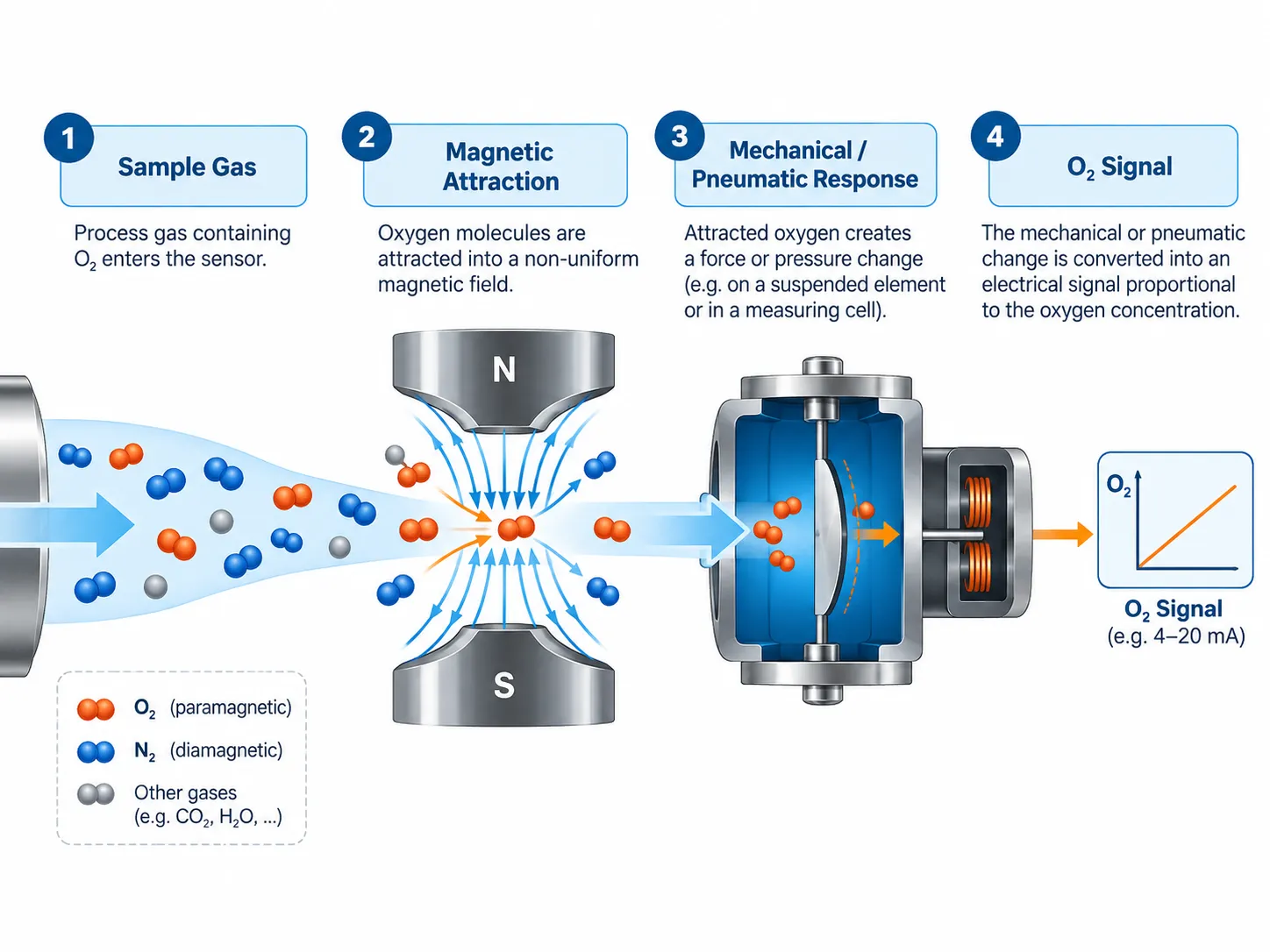
Four-step sensing chain
- 1. Sample gas enters the measuring region.
- 2. O2 is attracted into a non-uniform magnetic field.
- 3. The oxygen attraction creates a measurable physical effect such as dumbbell torque, pressure difference or thermomagnetic convection.
- 4. Electronics convert that effect into an oxygen reading or output signal.
Classical magnetodynamic design
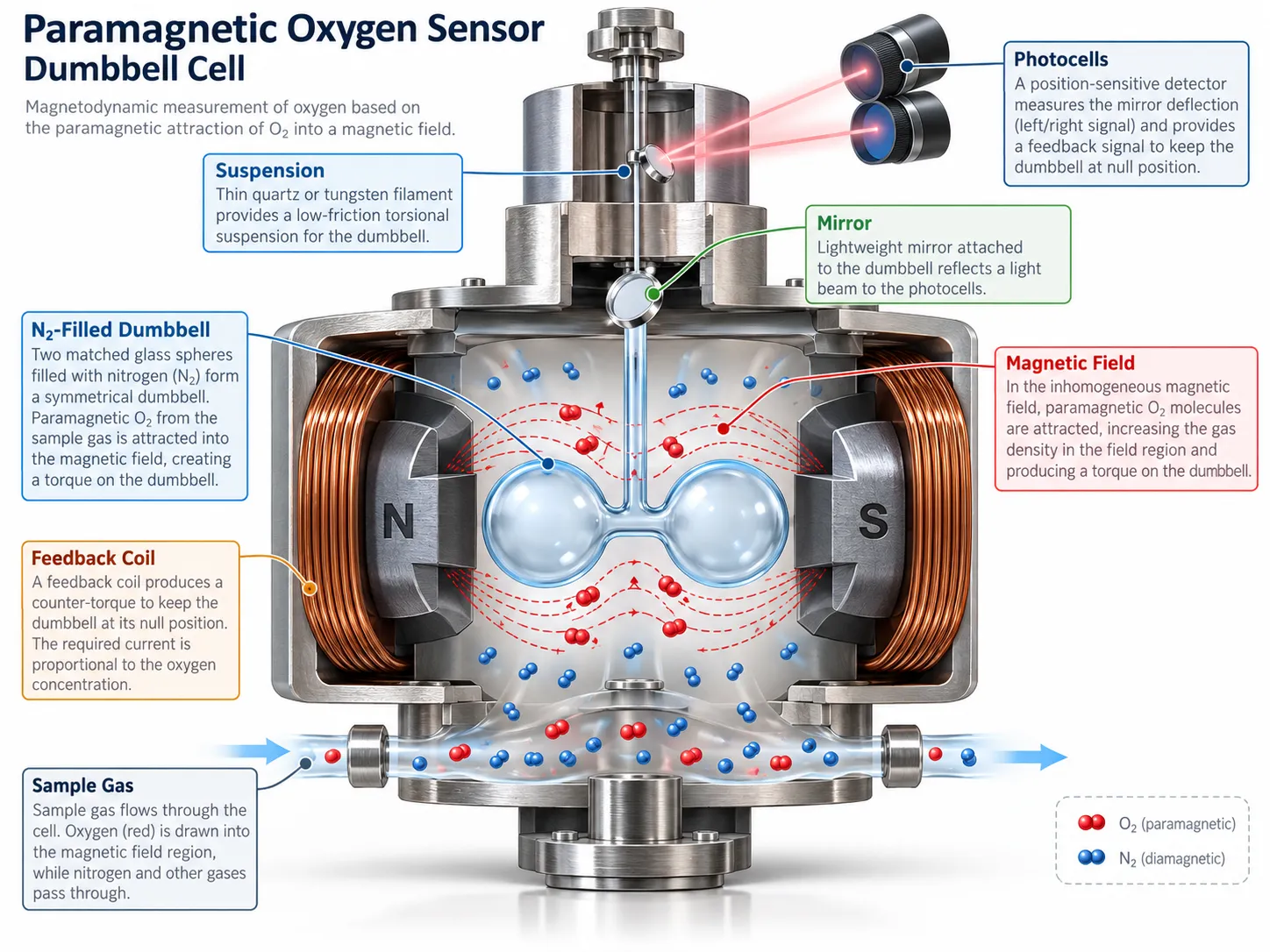
The dumbbell cell: the most iconic paramagnetic oxygen sensor architecture
- Suspension filament provides a low-friction torsional mount.
- Dumbbell test body responds to the oxygen-induced magnetic field effect.
- Optical system detects tiny angular displacement.
- Feedback coil applies a balancing torque.
- Feedback current becomes proportional to O2.
Physics foundation
Why oxygen can be measured magnetically
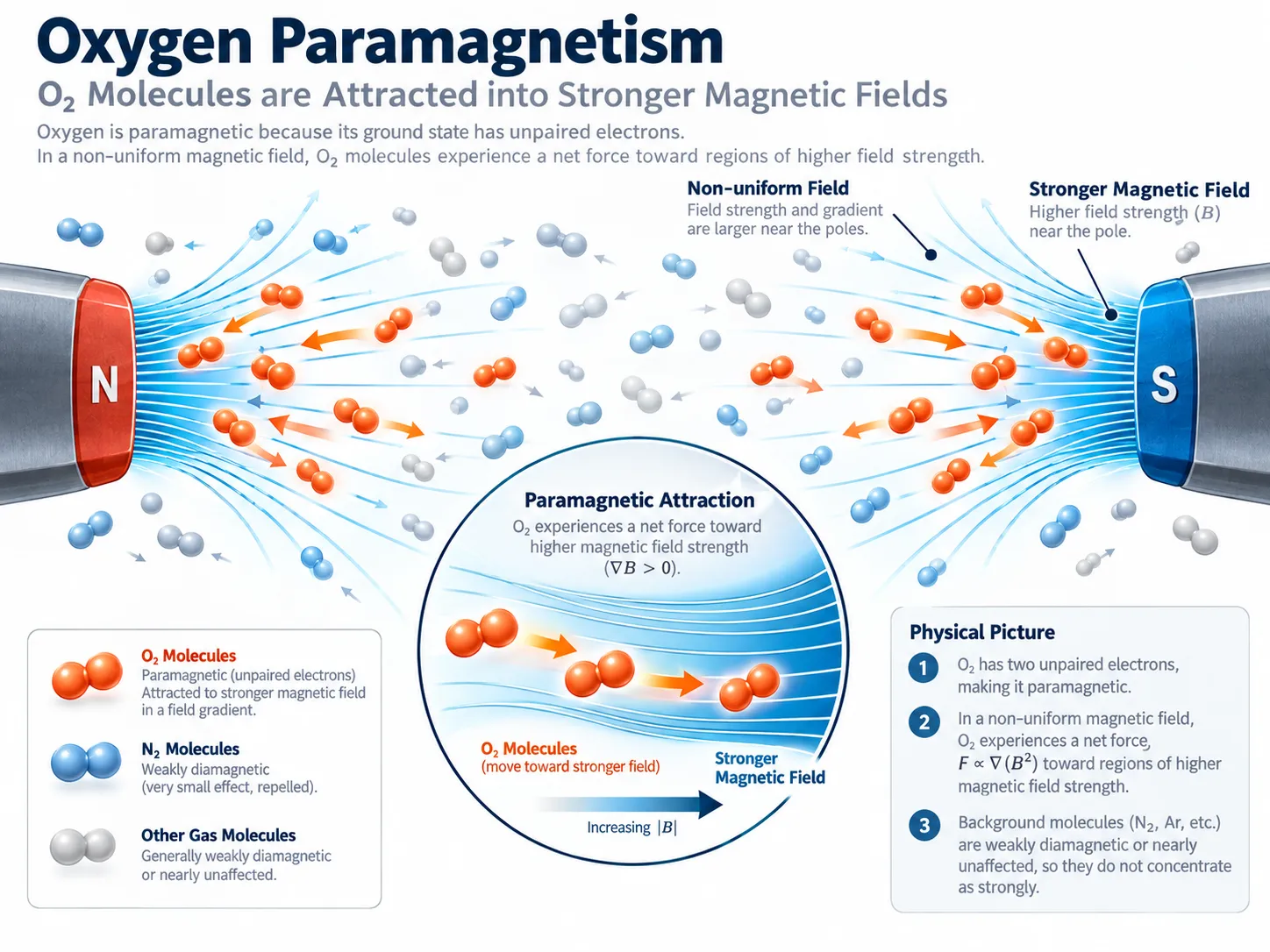
What makes O2 special
Oxygen has unpaired electrons in its ground state, which makes it strongly paramagnetic. In contrast, many common gases such as N2, Ar and CO2 are weakly diamagnetic or nearly non-responsive in comparison.
Why analyzers need a field gradient
A uniform field alone is not enough. The analyzer uses a non-uniform magnetic field so oxygen experiences a net force toward the stronger field region. That force is then turned into the actual measurement signal.
Architecture map
Three major paramagnetic oxygen sensor architectures
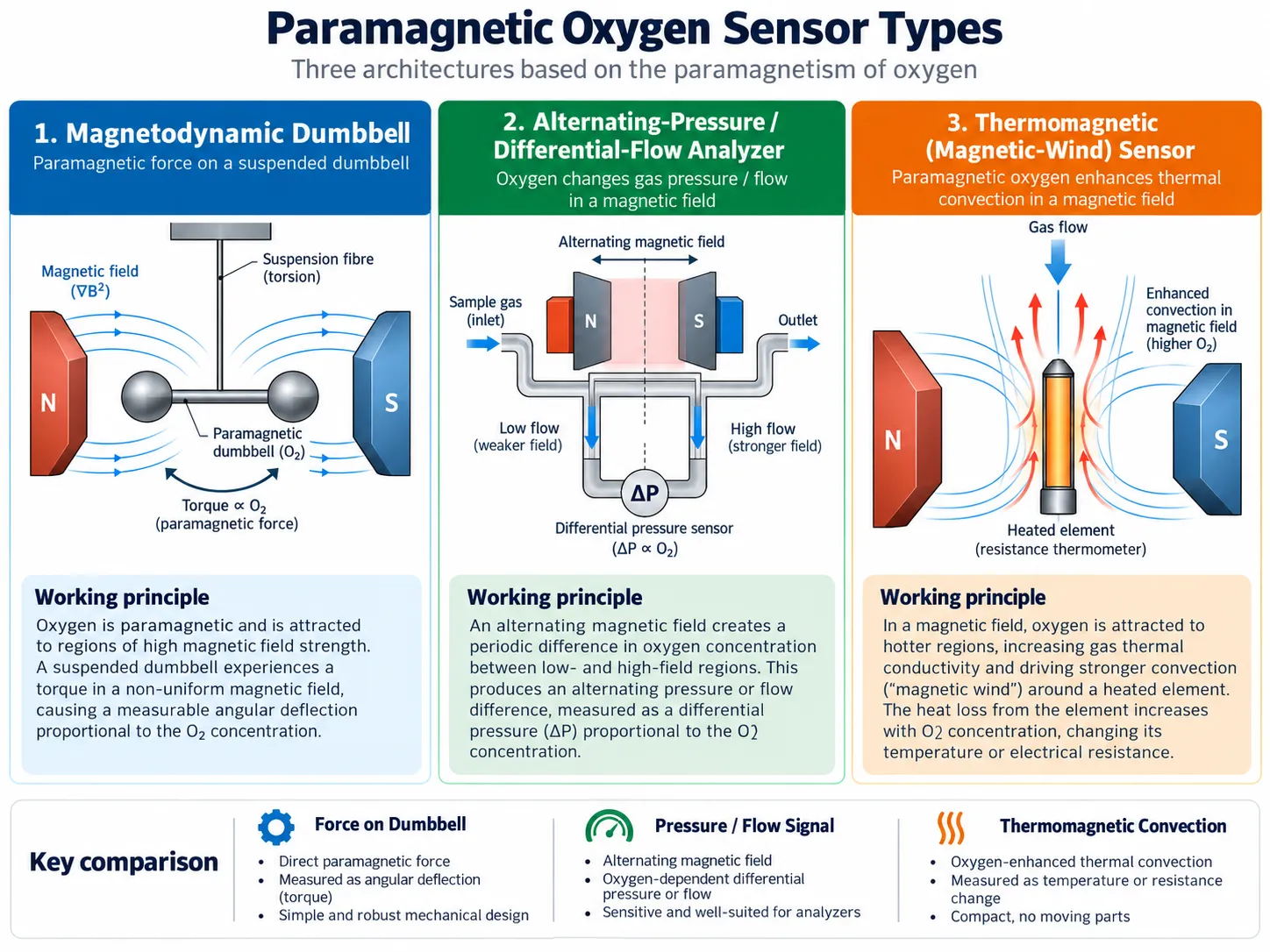
Magnetodynamic dumbbell
Directly converts paramagnetic force into dumbbell deflection and feedback current. The best-known classic architecture.
Alternating-pressure / differential-flow
Uses oxygen attraction in a magnetic field to create pressure or flow differences, often measured with microflow or thermal detectors.
Thermomagnetic
Uses oxygen’s paramagnetic behavior to intensify magnetic-wind or thermomagnetic convection effects around a heated element.
Closed-loop measurement
How the feedback current becomes the oxygen signal
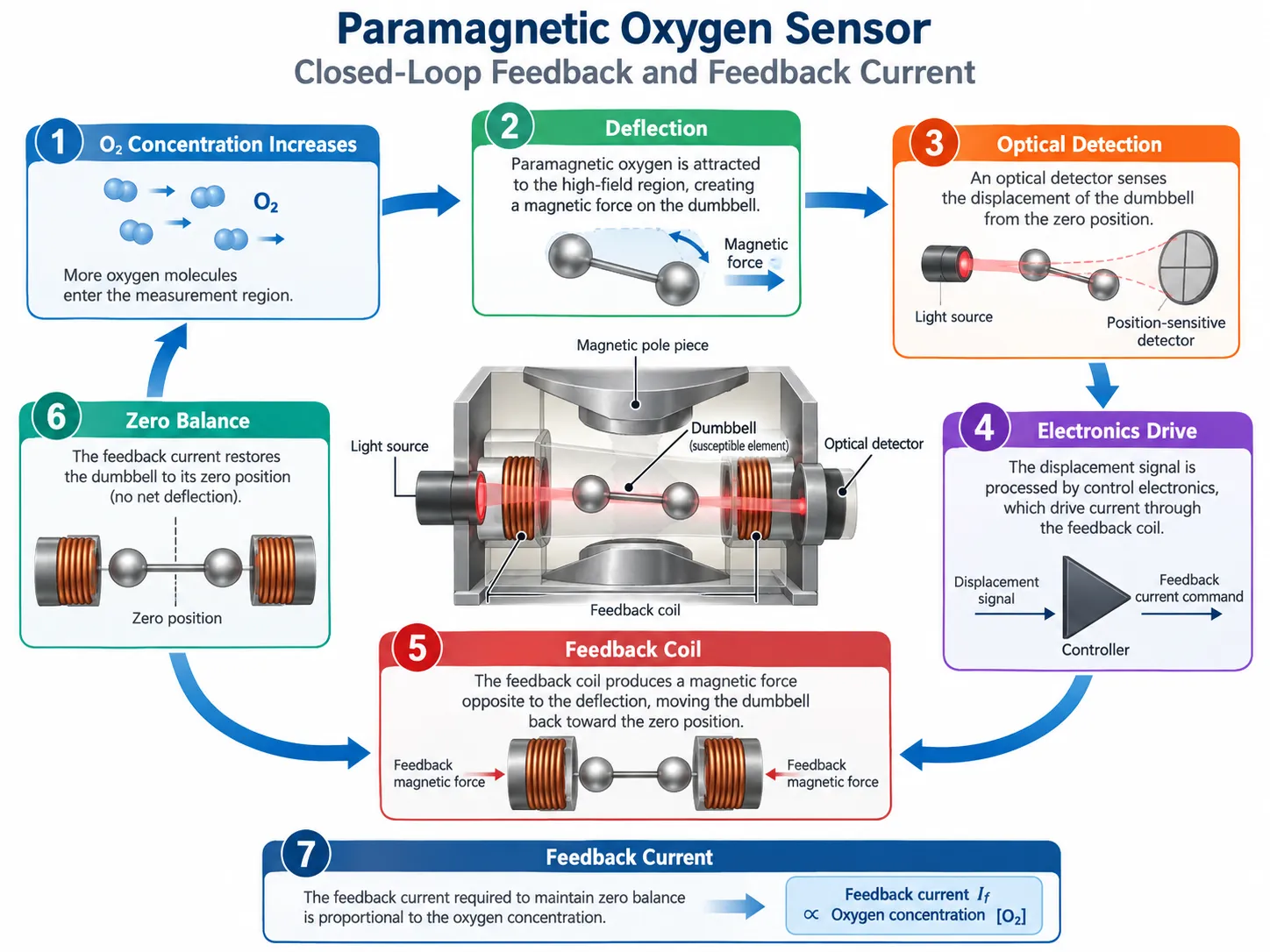
- Oxygen increases and the magnetic force rises.
- The suspended element deflects slightly from the null position.
- Optics detect the displacement and send an error signal to the controller.
- A feedback coil applies an opposing force that restores balance.
- The required feedback current is proportional to oxygen concentration.
Technology evolution
From classic glass dumbbells to modern silicon microwing designs
Traditional dumbbell concept
- Glass spheres or similar mechanical test body
- Mirror + optical detection
- Long-proven industrial principle
- Highly accurate, but mechanically delicate
Modern microfabricated variants
- Silicon sensing elements such as microwing structures
- Improved manufacturing consistency and repeatability
- More compact mechanical construction
- Same paramagnetic foundation, updated sensing element
Real-world installation factors
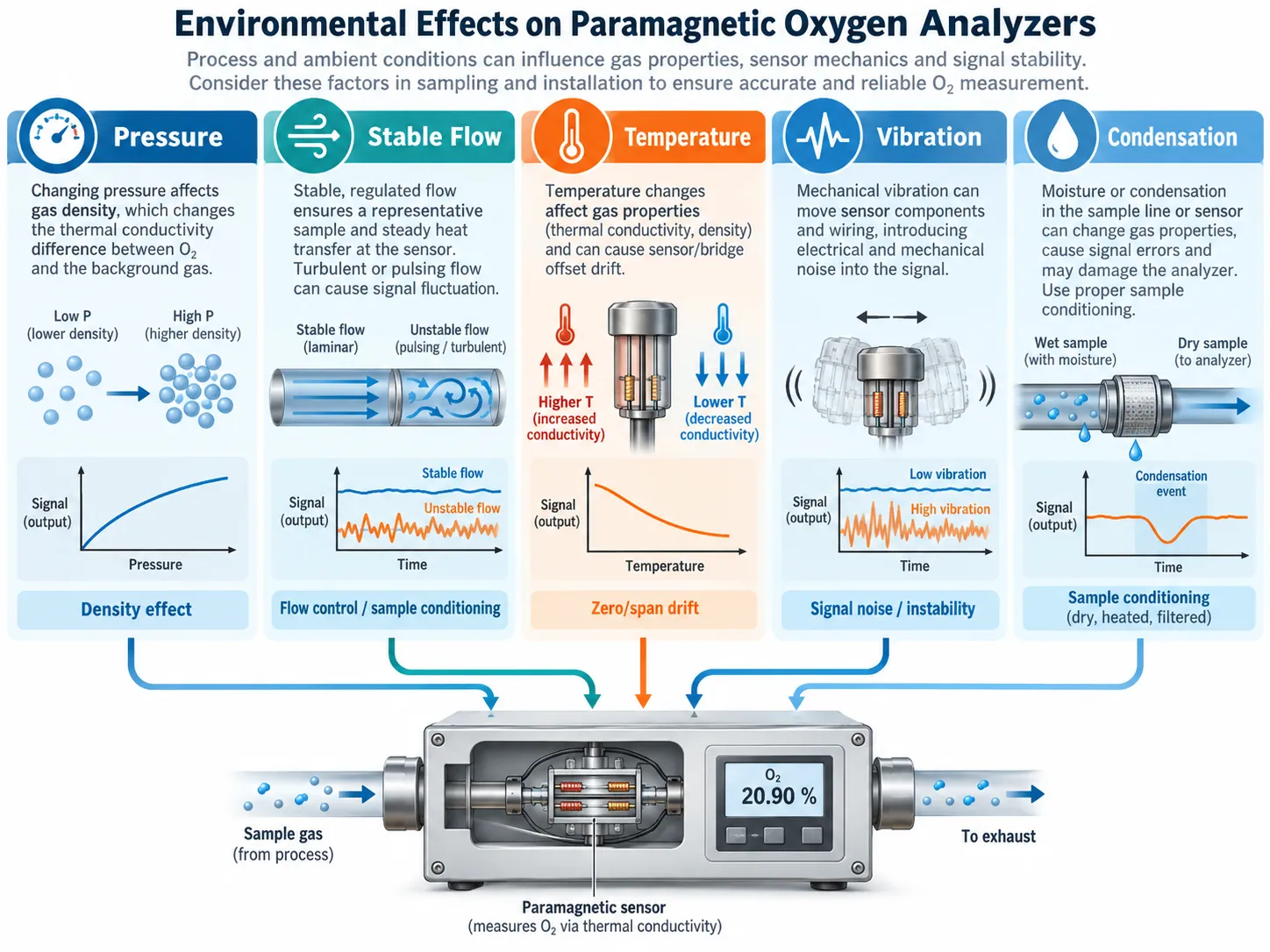
Pressure, flow, temperature, vibration and condensation all matter
Pressure and density
Changing pressure alters gas density and can influence analyzer response, so many instruments use pressure control or compensation.
Flow stability
Stable sample flow helps maintain repeatable cell conditions. Pulsing or unstable flow can cause extra noise or offset.
Temperature
Temperature can shift gas properties and detector balance, so precise process analysis often requires thermal control or compensation.
Vibration
Mechanical vibration especially matters for some suspended-element designs, which is why vibration mitigation is a real engineering issue.
Condensation
Sample gas should be conditioned so liquid water does not enter the measurement cell, which can distort or damage the analyzer.
Cleanliness
Dust and contamination can disrupt the measurement cell and should be removed upstream using suitable filters and sample handling.
Background-gas effects
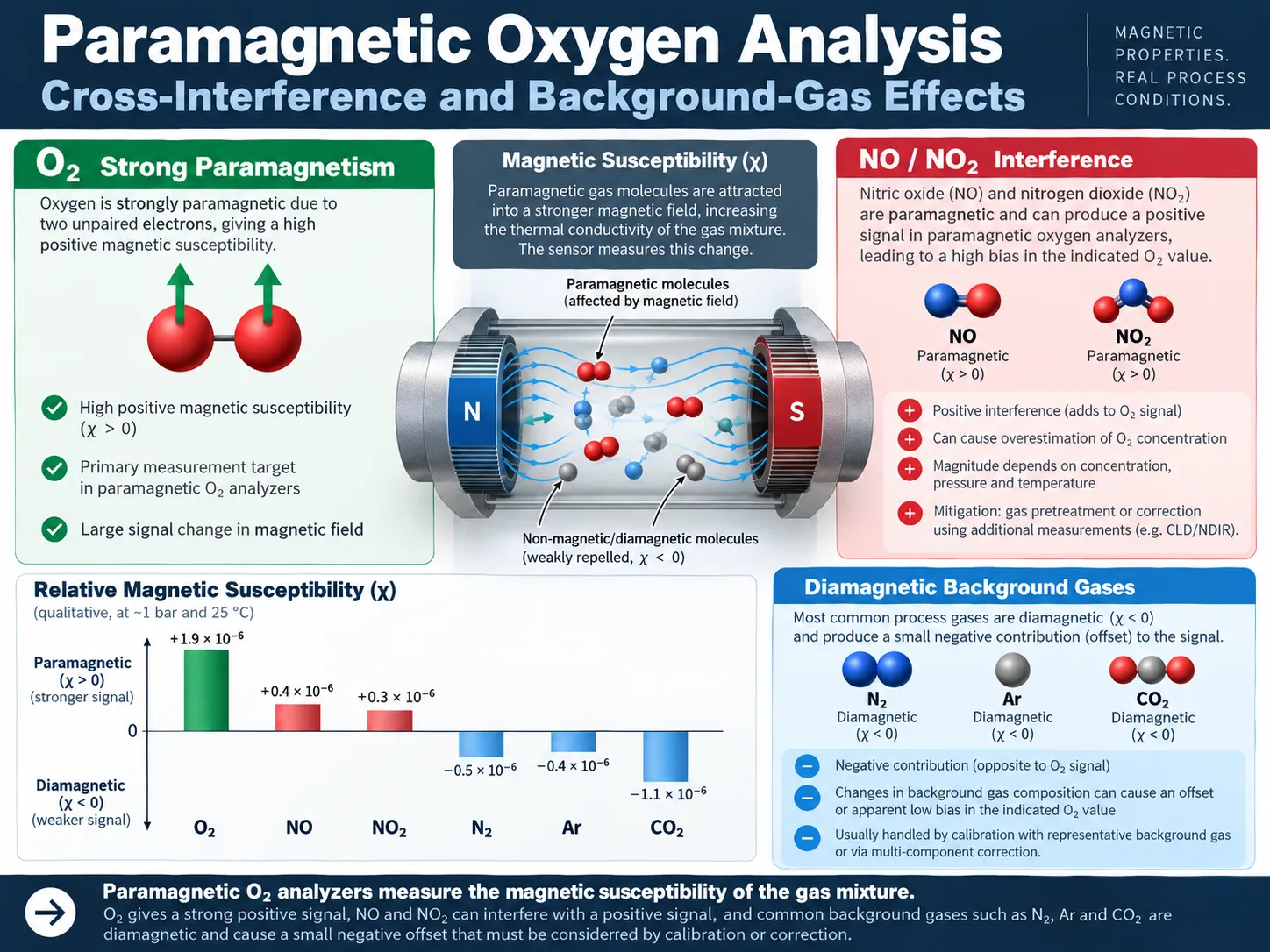
Cross-interference: why background gas composition still matters
Interference sources to watch
- NO and NO2 can cause positive interference because they are also paramagnetic.
- Diamagnetic background gases such as N2, Ar and CO2 can change the background susceptibility and shift the apparent reading.
- Gas matrix changes can matter even if oxygen concentration is unchanged.
Practical mitigation
- Calibrate with a representative background gas when possible.
- Use sample pretreatment if interfering components are known.
- Consider multi-component analysis or correction when the process matrix varies significantly.
Applications
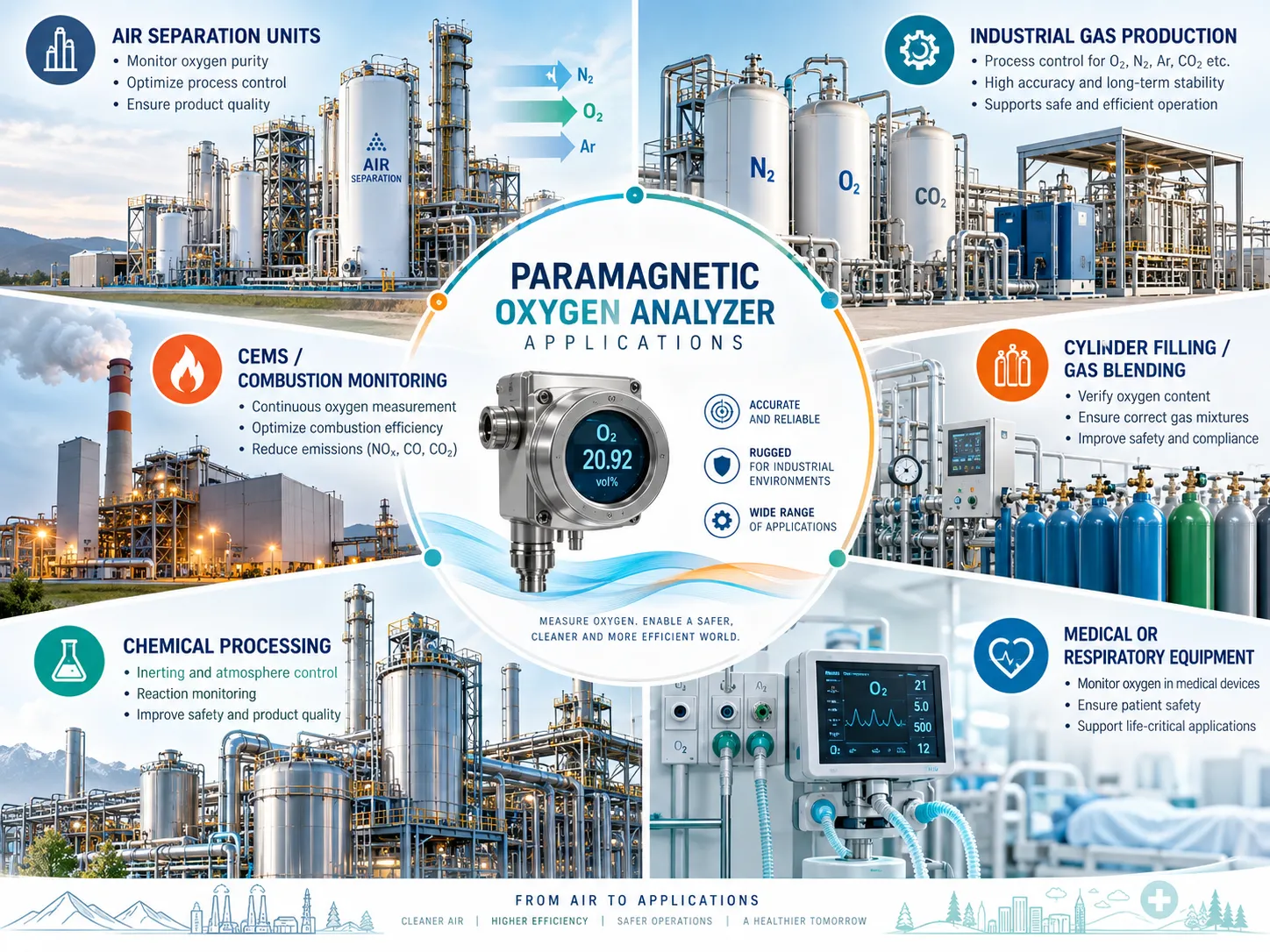
Where paramagnetic oxygen analyzers are used
Air separation units (ASU)
Monitor oxygen purity, optimize process control and support product quality in oxygen, nitrogen and argon systems.
Industrial gas production
Used in bulk gas production, purification and monitoring systems where percentage-level O2 analysis is essential.
CEMS / combustion
Support oxygen reference correction and combustion optimization in industrial monitoring systems.
Chemical processing
Useful for inerting, oxidation control and process safety in oxygen-sensitive applications.
Cylinder filling / gas blending
Verify oxygen content in industrial, specialty and medical gas mixtures.
Medical / respiratory equipment
Paramagnetic oxygen measurement is also used in certain life-support and respiratory applications.
Technology comparison
Paramagnetic vs galvanic vs zirconia oxygen sensors
| Factor | Paramagnetic | Galvanic | Zirconia |
|---|---|---|---|
| Measurement basis | Magnetic susceptibility of oxygen | Metal-air electrochemical reaction | Hot oxygen-ion conduction in YSZ |
| Consumptive sensing chemistry | No | Yes, anode capacity is finite | No sacrificial anode |
| Heater required | No high-temperature cell heater | No | Yes |
| Typical strength | Accurate %O2 process analysis | Portable, medical and lower-power O2 sensing | Combustion and high-temperature oxygen analysis |
| Sample handling | Often extractive analyzer with sample conditioning | Often diffusion or flow-cell based | In-situ or extractive depending system |
| Flammable mixtures | Can be suitable with the correct analyzer system | Application dependent | Can be more problematic in some combustible streams |
| Related guide | See Galvanic Oxygen Sensors and Zirconia Oxygen Sensors for the other main oxygen-sensing technology pillars. | ||
Selection workflow
How to evaluate a paramagnetic oxygen analyzer
1. Confirm the oxygen range
Paramagnetic analyzers are strongest in percentage-level O2 measurement and suppressed ranges within that domain.
2. Review the gas matrix
Check for NO, NO2 and changing background gases that could affect magnetic susceptibility balance.
3. Design the sample system
Stable pressure, clean gas, dry sample and controlled flow are often just as important as the analyzer itself.
4. Match installation demands
Consider vibration, maintenance accessibility, environmental conditions and the need for continuous process duty.
Checklist before final selection
- Expected O2 range and accuracy target
- Continuous process or intermittent measurement?
- Background gas composition stable or variable?
- Any NO / NO2 or other paramagnetic interference gases?
- Sample pressure, flow and temperature control available?
- Risk of dust, oil, moisture or condensation?
- Vibration severity at installation site
- Need for extractive conditioning and analyzer cabinet design
Practical OEM note
Paramagnetic oxygen analysis often delivers excellent stability and long service life, but the analyzer system matters as much as the sensor principle. Good sample conditioning is part of the technology, not an optional extra.
- Control sample quality before it reaches the cell
- Evaluate interference gases and gas-matrix changes
- Manage pressure and flow stability
- Protect the measurement cell from moisture and dirt
- Address vibration when required by the architecture
FAQ
Paramagnetic oxygen sensor FAQ
What is a paramagnetic oxygen sensor?
A paramagnetic oxygen sensor measures O2 by using the fact that oxygen is strongly attracted into a magnetic field compared with most common gases. The analyzer converts that magnetic effect into an oxygen reading.
Why can oxygen be measured magnetically?
Oxygen is paramagnetic because it has unpaired electrons. In a non-uniform magnetic field, oxygen experiences a net force toward the stronger field region, which can be turned into a measurable signal.
Is every paramagnetic oxygen sensor a dumbbell sensor?
No. The dumbbell cell is a classic and very important architecture, but paramagnetic oxygen analysis also includes alternating-pressure / differential-flow and thermomagnetic designs.
What is the dumbbell cell in a paramagnetic analyzer?
It is a suspended sensing element, often represented as a dumbbell, that experiences a torque because oxygen is attracted into the magnetic field. Its deflection is detected and balanced by a feedback system.
Why is feedback current used as the measurement signal?
In a closed-loop analyzer, feedback current is the control effort needed to restore the sensing element to its null position. This often gives better linearity and stability than simply measuring raw deflection alone.
Do paramagnetic oxygen sensors consume a chemical cell like galvanic sensors?
No. The sensing principle is non-consumptive, so it does not rely on sacrificial anode consumption during normal oxygen measurement.
What can interfere with a paramagnetic oxygen analyzer?
Strongly paramagnetic gases such as NO and NO2 can cause positive interference. Changing background gases such as N2, Ar and CO2 can also influence the apparent reading through matrix effects.
Do pressure and flow matter?
Yes. Pressure, flow, temperature, vibration and sample conditioning all matter in real paramagnetic oxygen analysis, especially in extractive analyzer systems.
Where are paramagnetic oxygen analyzers used?
They are widely used in air separation units, industrial gas production, combustion monitoring, chemical processing, gas blending and some medical or respiratory applications.
How does a paramagnetic analyzer compare with zirconia and galvanic oxygen sensors?
Paramagnetic analyzers are strong for accurate, non-consumptive percentage-level oxygen analysis. Galvanic sensors are often used in portable or medical applications, while zirconia sensors are especially strong in combustion and high-temperature oxygen measurement.
Need to compare oxygen sensor technologies for a process application?
Start by deciding whether your priority is non-consumptive process accuracy, portable / medical electrochemical sensing or high-temperature combustion oxygen analysis. Then match the sample conditions, gas matrix and installation constraints to the right technology family.