



Residential Safety · Sensor Selection
Residential Gas Alarms: Natural Gas, LPG & Carbon Monoxide
A home gas alarm is only useful when it is designed for the right hazard. Natural gas, LPG and carbon monoxide are different targets, and they require different sensing, alarm and installation considerations.
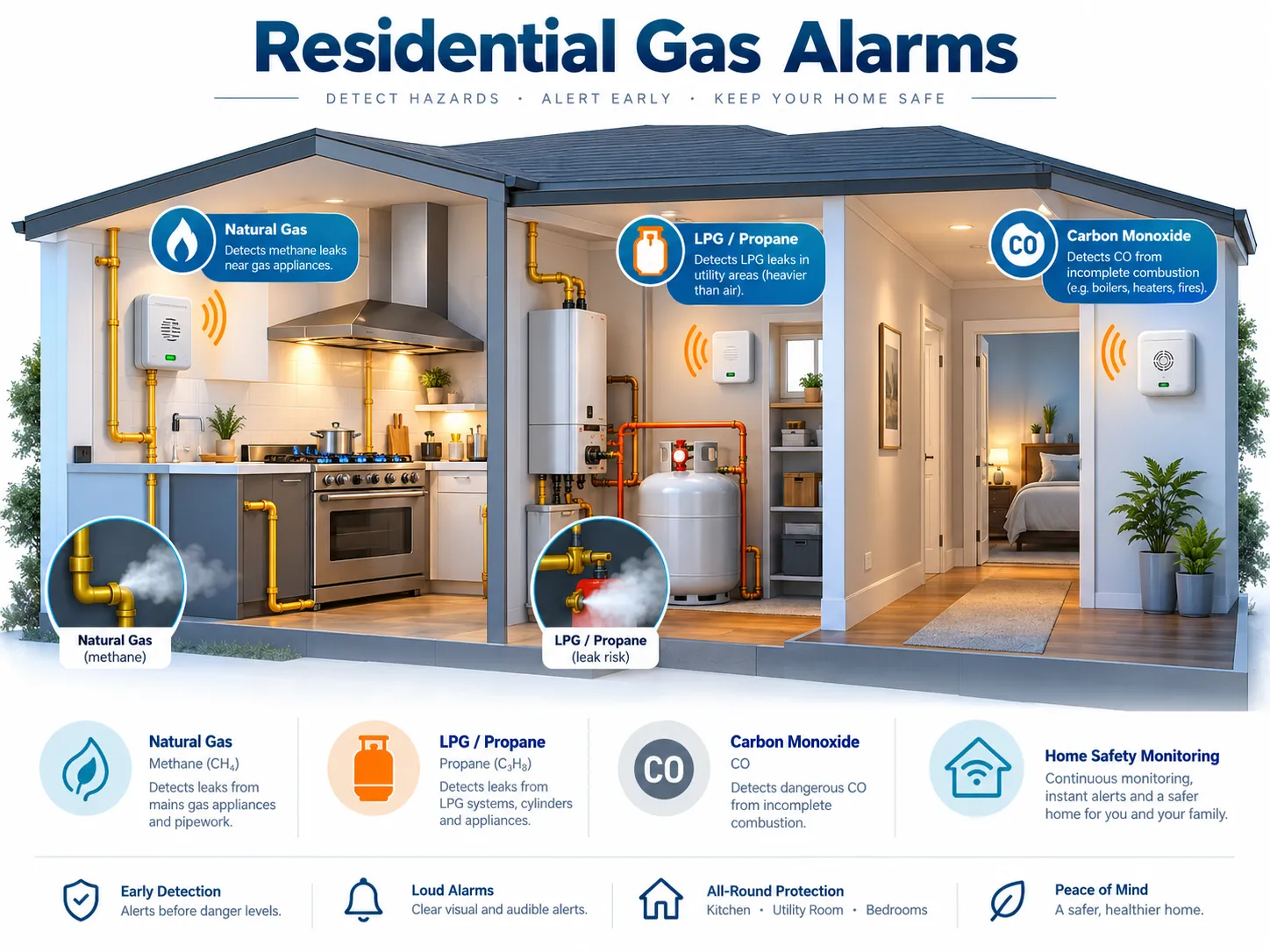
01 · Identify the hazard
Which Gas Does Your Home Need to Detect?
Start with the fuel or contaminant that could actually be released. Natural gas supplied to homes is mainly methane; LPG may contain propane, butane or a defined blend; carbon monoxide is a toxic combustion by-product. These are not interchangeable alarm targets.
Natural Gas
Used by gas ranges, furnaces, boilers and water heaters. A residential fuel-gas alarm must be designed for the target fuel and the relevant product requirements.
Related guide: Natural Gas Sensors
Propane / Butane
LPG composition varies by market and supply. Verify whether the finished detector is intended for propane, butane or the specified LPG blend instead of assuming a universal response.
Related guides: LPG Sensors · Propane Sensors
Carbon Monoxide
CO can be produced by malfunctioning or improperly vented combustion appliances. It is odorless and cannot be reliably identified by smell. Use a dedicated CO alarm suitable for the intended residential application.
Related guide: Carbon Monoxide Sensors

| Target | Typical source | Primary risk | Selection priority |
|---|---|---|---|
| Natural gas / methane | Household gas piping and appliances | Fire or explosion from a fuel-gas leak | Validated methane response, alarm threshold and complete-product compliance |
| LPG / propane / butane | Cylinders, LPG piping, heaters and cookers | Fire or explosion from a fuel-gas leak | Fuel composition, calibration basis and product-specific installation guidance |
| Carbon monoxide (CO) | Faulty or poorly vented combustion equipment | Poisoning | CO-specific alarm performance, end-of-life indication and applicable CO alarm standard |
| Hydrogen (specialized use) | Home fuel-cell or hydrogen-energy equipment | Fire or explosion | A detector specifically validated for hydrogen; do not assume a standard methane alarm is suitable |
02 · Sensor engineering
How Do Residential Gas Alarm Sensors Work?
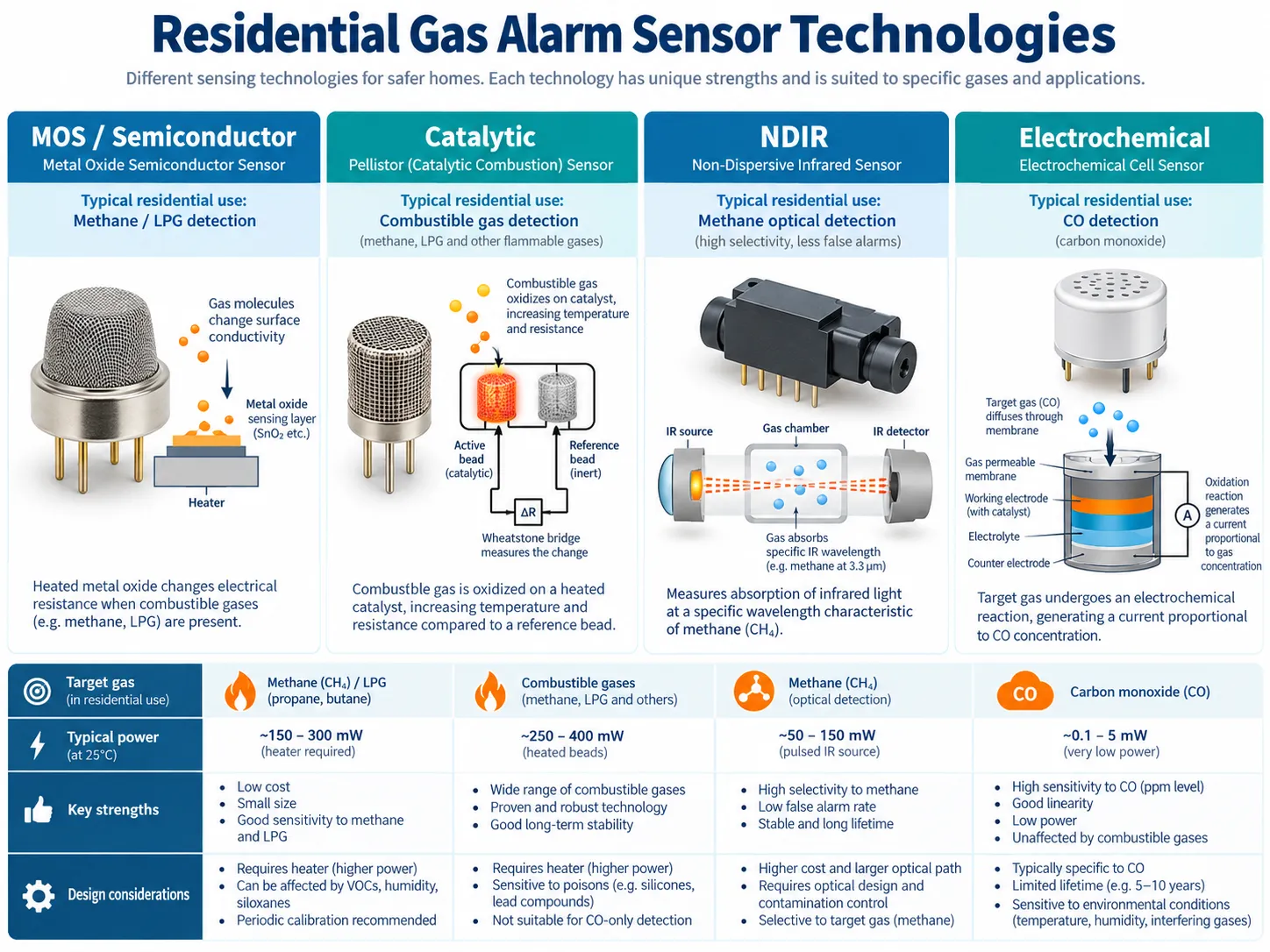
Several sensing principles can be used in gas alarm products, but suitability depends on the target gas, required alarm behavior, power budget, service life and complete-product testing. A sensor element is one component of an alarm, not a certification of the finished product.
| Technology | Potential application | Strengths | Design checks |
|---|---|---|---|
| Semiconductor / MOS | Selected natural gas and LPG alarm designs | Compact, cost-effective and suitable for embedded electronics | Heater power, warm-up, humidity, VOC interference, baseline drift and target-specific response |
| Catalytic bead | Selected combustible-gas detection systems | Established combustible-gas sensing principle | Oxygen dependence, catalyst poisoning, power consumption and residential-product suitability |
| NDIR | Methane and selected infrared-active hydrocarbons | Can provide gas-specific optical response and low drift in a suitable design | Optical path, condensation, contamination, cost and validation for the exact gas |
| Electrochemical | Dedicated CO alarms and selected toxic-gas applications | Low-power quantitative sensing for appropriate target gases | Cell lifetime, environmental conditions, cross-sensitivity, electronics and end-of-life strategy |
Residential alarm sensor vs. industrial gas detector
Industrial transmitters, portable personal monitors and self-contained residential alarms can share some sensing principles, but their enclosures, electronics, alarm behavior, intended environment and product standards may differ substantially. Do not select a component solely because it appears in an industrial instrument.
For broader engineering comparisons, see Combustible Gas Sensors and Semiconductor Gas Sensors.
03 · Installation and airflow
Where Should a Residential Gas Alarm Be Installed?
Correct placement depends on the gas, the detector's listed installation instructions, the likely release point and the movement of air through the room. Gas density is useful context, but it is not a substitute for the product instructions or applicable local requirements.
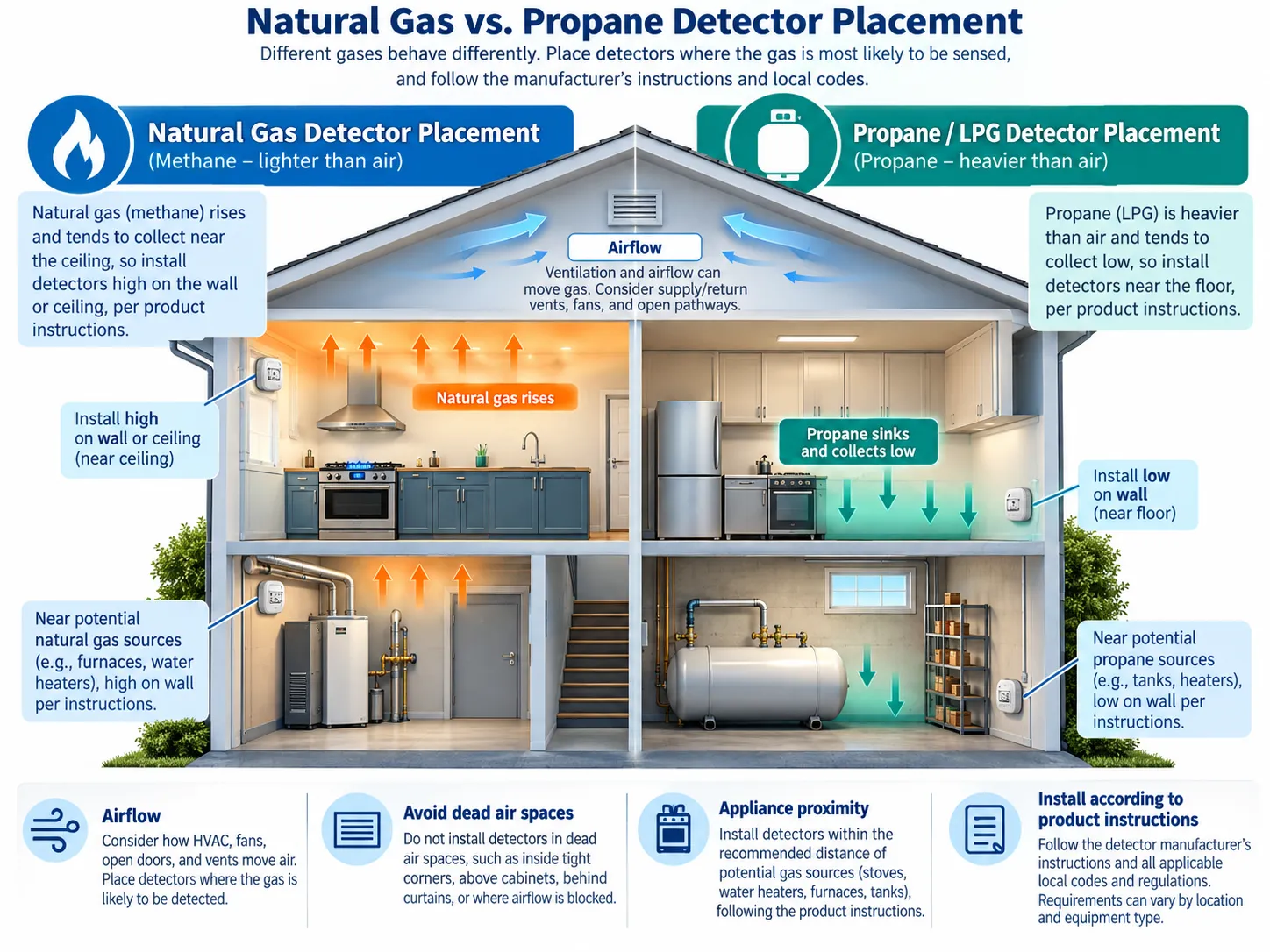
Natural Gas / Methane
Methane is lighter than air under ordinary conditions and may rise, but temperature, ventilation, enclosure geometry and the release conditions affect dispersion. Use a detector location permitted by the product instructions.
LPG / Propane
Propane is heavier than air and can accumulate in low areas under some conditions. The approved location still depends on the detector model, airflow and the relevant installation rules.
Check the actual room and airflow
- Identify likely leaks from appliances, connections, regulators and piping.
- Consider supply and return vents, fans, open doors, drafts and dead-air pockets.
- Avoid placing a detector where furniture, curtains or storage can block gas access to its sensing inlet.
- Keep the device away from conditions specifically prohibited by its manufacturer, such as direct steam or condensation.
- For CO alarms, follow the product instructions and local guidance for each level of the home and sleeping areas.

04 · Product formats
Plug-In, Battery-Powered, Hardwired and Smart Gas Alarms
Plug-in
Can simplify installation where a suitable outlet is available. Check whether the outlet location is compatible with the detector's instructions and whether backup power is provided.
Battery-powered
Offers flexible installation and can continue operating during some power interruptions, but battery monitoring, replacement and low-power sensor design are essential.
Hardwired / interconnected
Can support permanent installation and linked alerts. Confirm wiring, backup power, compatibility and the behavior of the system during a fault.
A smart gas alarm may provide remote status or notifications, but connectivity should not silently disable local safety functions. Cloud access, a mobile app or a Wi-Fi connection is not evidence that the device meets a particular safety standard.
05 · System architecture
Residential Gas Alarm with an Automatic Shutoff Valve
A connected gas alarm may be designed to initiate a local audible/visual warning, send a remote notification or operate a compatible shutoff valve. Each function must be designed and tested as part of the complete product.
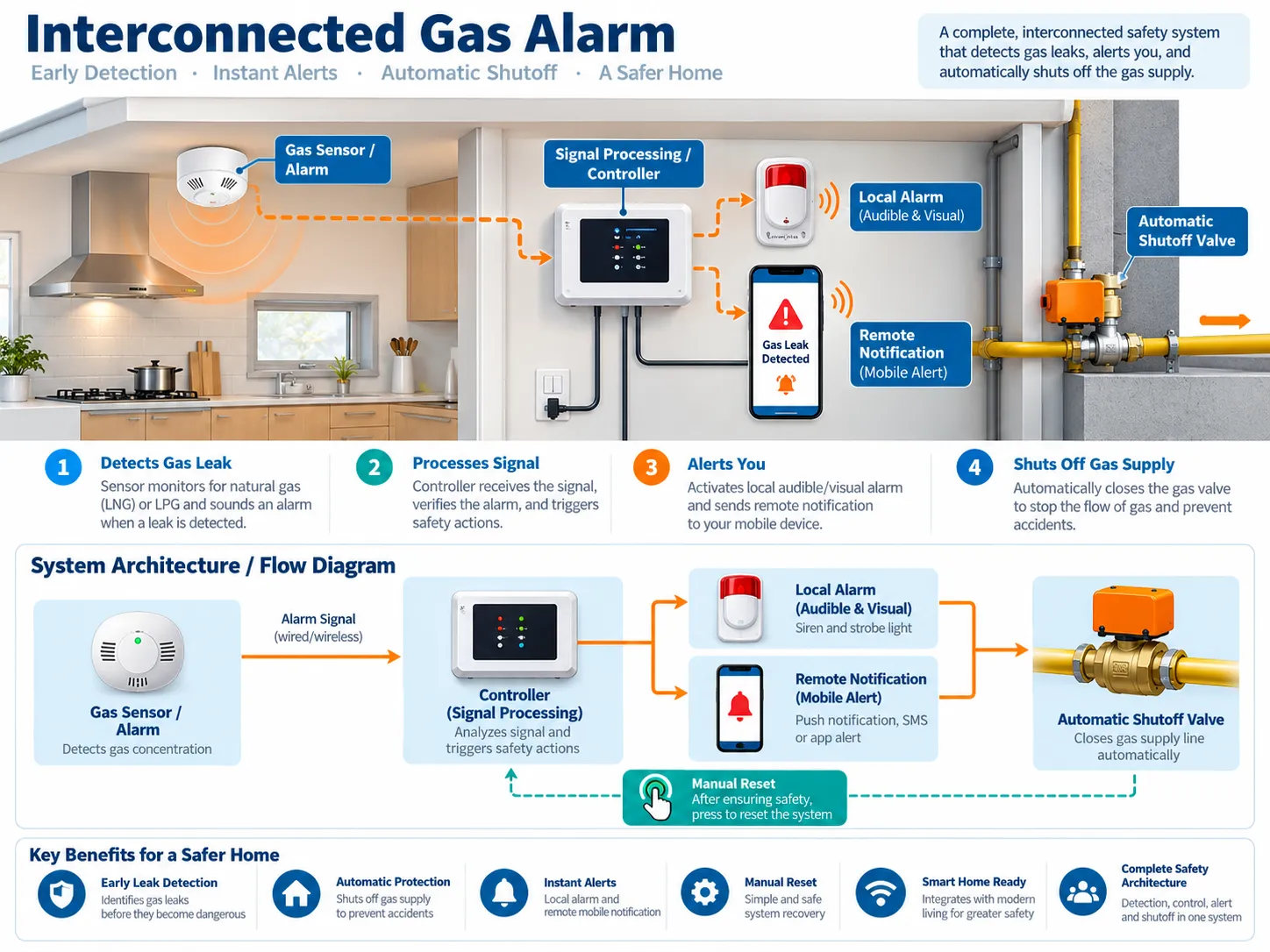
Detect
The sensing element responds to its validated target gas and passes a signal to the alarm electronics.
Decide and alert
Signal processing evaluates the input and triggers the defined local alarm and any supported communication function.
Act safely
If the system is designed for shutoff, the controller operates a compatible valve and handles faults and recovery according to its safety design.
06 · Reliability
False Alarms and Household Interference
Some sensing technologies can respond to vapors other than the target gas. Cooking fumes, aerosol sprays, alcohol-containing cleaners, humidity, condensation or restricted airflow may affect some detectors, depending on their sensor chemistry and design.
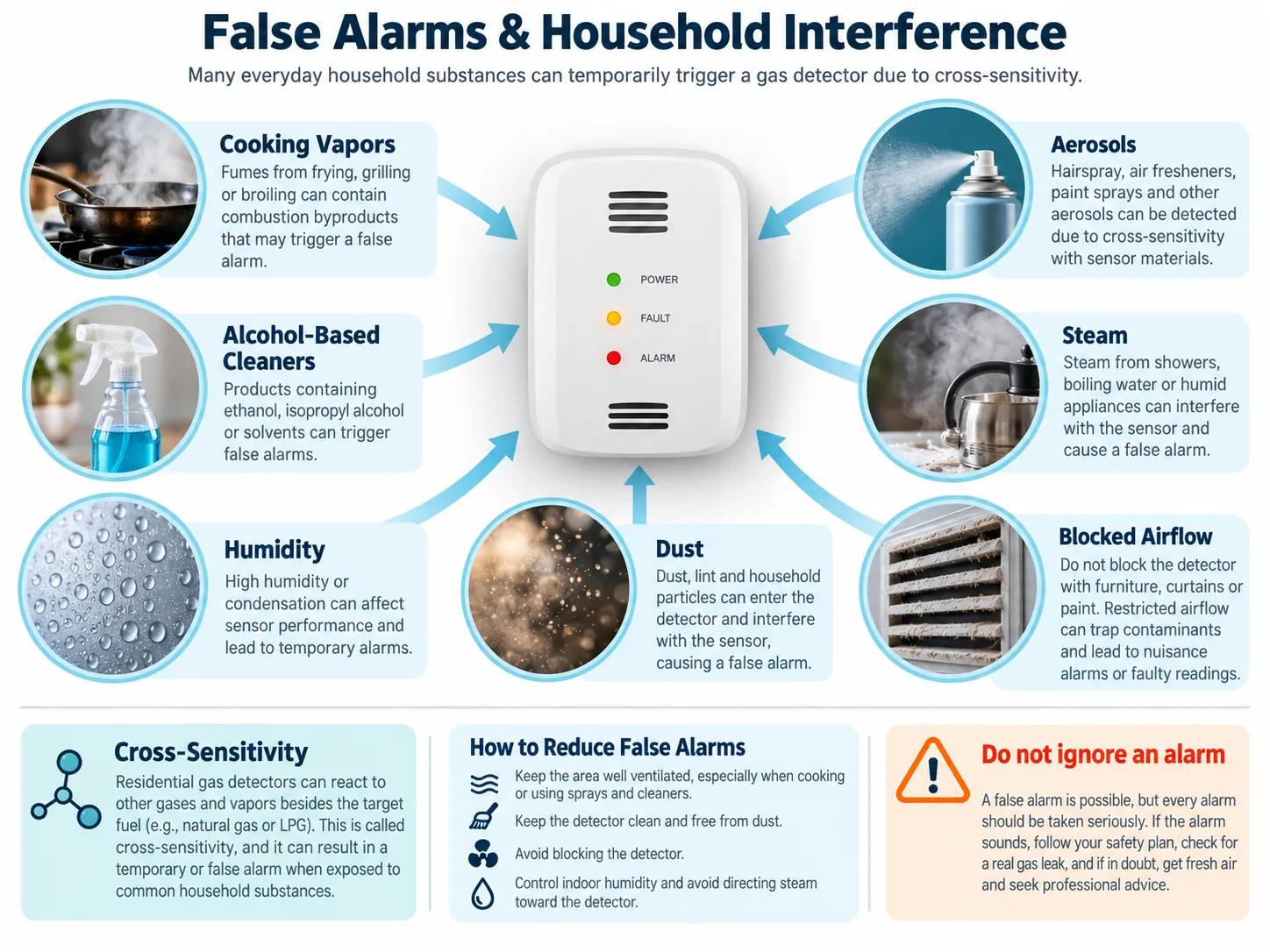
How OEM designers can reduce nuisance alarms
- Choose a sensor validated for the exact target gas and intended alarm range.
- Review cross-sensitivity data for common household vapors and expected cleaning products.
- Validate temperature, humidity, condensation, airflow and aging effects in the final enclosure.
- Define warm-up, fault, end-of-life and recovery behavior.
- Test the finished alarm, including its gas inlet, filters, housing and firmware—not only a bare sensing element.
07 · Lifetime and service
Testing, Maintenance and Sensor Lifetime
Residential alarms are often expected to operate for years with limited user intervention. That makes end-of-life indication, fault reporting, power management and clear replacement instructions important design requirements.
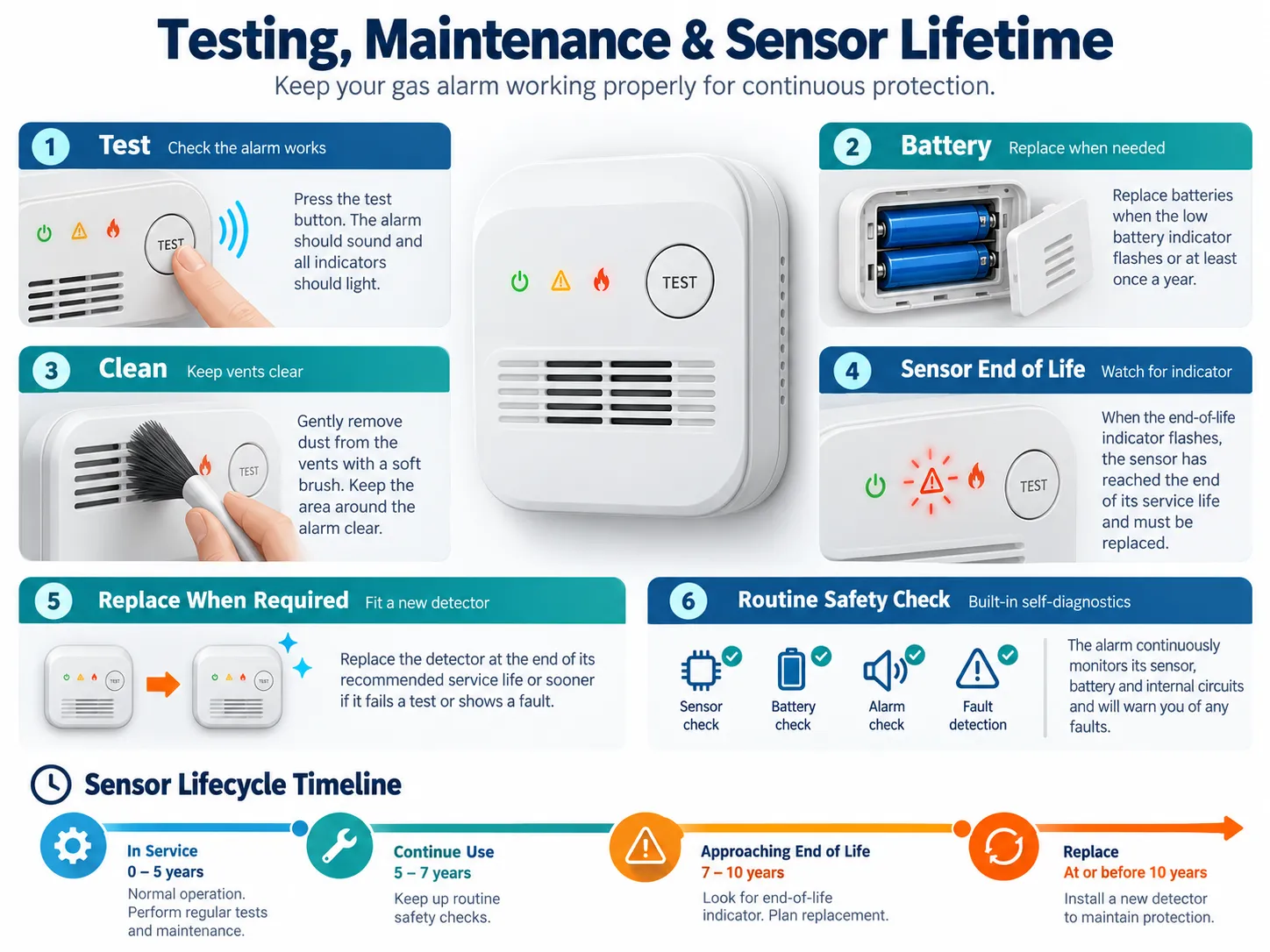
User checks
- Use the test function as directed by the manufacturer.
- Keep sensing inlets and alarm openings clear.
- Respond to low-battery, fault and end-of-life indicators.
- Replace the alarm when required by its instructions.
OEM verification
- Test gas response through the final enclosure and inlet.
- Validate the complete alarm and notification path.
- Define diagnostics and sensor end-of-life behavior.
- Verify performance after environmental and aging tests.
A test button usually checks specified alarm electronics and signaling; it does not necessarily prove the sensor responds correctly to the target gas. Do not assume every product has the same test, calibration or replacement interval.
08 · Standards and compliance
Residential Gas Alarm Standards and Certification
Standards are tied to the intended product, gas, market and installation. A self-contained residential fuel-gas alarm is not the same product category as an industrial transmitter or a dedicated CO alarm.
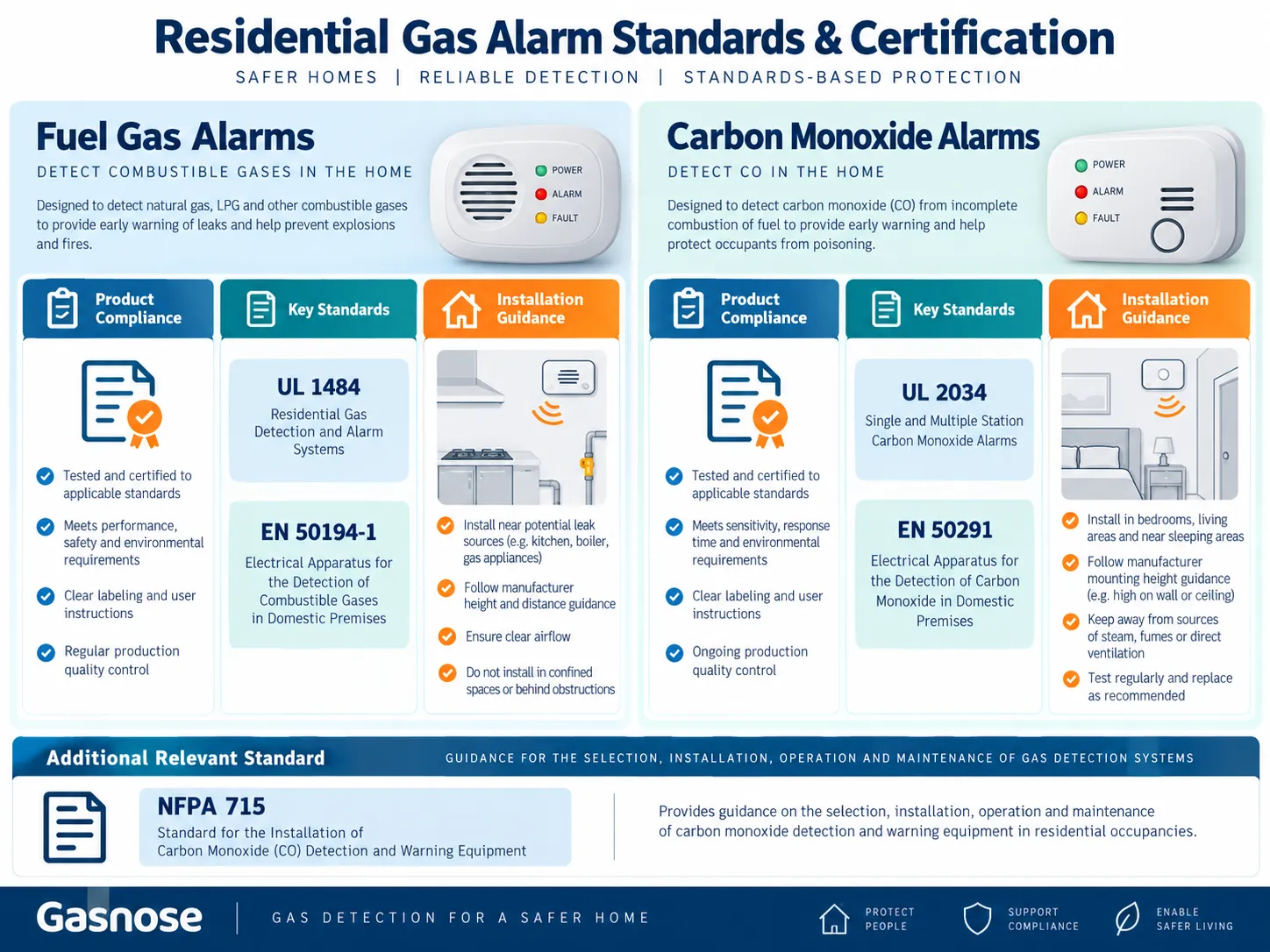
| Standard / reference | Relevant scope | What to verify |
|---|---|---|
| UL 1484 | Electrically operated fuel-gas alarms for residential occupancies and recreational vehicles, including natural gas and propane | Current edition, intended occupancy, gas target, complete alarm assembly and listing |
| EN 50194-1 | Electrical apparatus for detecting combustible gases in domestic premises; check the current edition and exact product scope | Applicable European/national adoption, fuel gases covered and complete-device requirements |
| CO alarm requirements and guidance | Residential carbon monoxide alarm safety and placement guidance in the United States | Applicable CO alarm product standard, local code and installation instructions |
| NFPA 715 | Installation of fuel-gas detection and warning equipment within its adopted scope | Current adopted edition, local code, system configuration, testing and maintenance |
09 · OEM selection
How to Select a Sensor for an OEM Residential Gas Alarm
For a new residential alarm, define the application and compliance target before selecting a sensor. A lower component price is not useful if the sensor's response, power budget, service life or cross-sensitivity cannot meet the finished-product requirements.
- Exact target gas and fuel composition
- Required detection range and alarm threshold
- Response, recovery and warm-up behavior
- Operating temperature and humidity
- Power budget and backup-power strategy
- Expected sensor and product service life
- Cross-sensitivity and nuisance-alarm limits
- Analog, digital or conditioned module interface
- Enclosure, filter and gas inlet design
- Destination market and finished-product certification
Interactive engineering aid
Residential Gas Alarm Selector
Choose the primary hazard and product architecture to see the engineering checks that should guide a shortlist. This is a starting point, not a safety certification or final design approval.
Selection direction
Natural gas / methane alarm
Review residential fuel-gas alarm designs using a methane-validated MOS or suitable NDIR sensing approach.
Key validation checks
Confirm target-gas response, alarm threshold, environmental performance, nuisance-vapor response and complete-product compliance.
Standalone alarm: verify the local audible/visual warning, fault indication and power behavior.
10 · Safety response
What Should You Do When a Home Gas Alarm Sounds?
Suspected fuel-gas leak
- Leave the building and alert others as you exit.
- Do not operate switches, appliances or anything that could create an ignition source.
- From a safe location, contact emergency services or the gas utility.
- Do not re-enter until authorities or qualified responders say it is safe.
Carbon monoxide alarm
- Move everyone outdoors to fresh air immediately.
- Call emergency services from outside and follow their instructions.
- Seek medical attention if anyone has symptoms or may have been exposed.
- Do not re-enter until the source has been addressed and the area is declared safe.
This page provides general educational information. In an active emergency, follow local emergency guidance and instructions from qualified responders.
11 · Frequently asked questions
Residential Gas Alarm FAQ
What is the difference between a gas alarm and a CO alarm?
Can one residential gas alarm detect both methane and propane?
Can a CO alarm detect natural gas?
Where should a natural gas detector be installed?
Where should an LPG or propane detector be installed?
Which sensor technology is best for a home gas alarm?
Can a smart gas alarm shut off the gas supply automatically?
What can cause nuisance alarms?
How often should a home gas alarm be tested?
When should a residential gas alarm be replaced?
Which standards apply to residential gas alarms?
What information should an OEM provide when selecting a sensor?
Technical references
Standards and Safety Resources
- UL Standards & Engagement — UL 1484, Fuel Gas Alarms
- National Fire Protection Association — NFPA 715
- U.S. Consumer Product Safety Commission — Carbon Monoxide Safety
- PG&E — Residential Methane Detection
Standards and regulations may be revised or adopted differently by jurisdiction. Verify the latest official edition and local requirements before designing, installing or certifying a product.
Designing a Residential Gas Alarm?
Start with the target gas, alarm threshold, power budget, environment and destination market. Those requirements determine the sensor shortlist and the tests needed for the finished product.