




An AI Nose is an artificial olfaction system that combines chemical sensing hardware with signal processing and artificial intelligence to recognize patterns in gases, volatile organic compounds (VOCs), odors, and changing chemical environments.
Instead of relying on a single sensor to answer a question such as “How much carbon monoxide is present?”, an AI Nose often uses multiple sensing channels to answer a different type of question:
“Does this combination of chemical signals match a known odor, process condition, contamination event, material state, or abnormal pattern?”
This distinction is important.
Traditional gas detection remains essential when a specific gas must be measured against a defined concentration or safety threshold. An AI-powered electronic nose, by contrast, can look at the combined response pattern of multiple chemical sensors and use machine-learning models to interpret that pattern.
The technology is often described using related terms such as electronic nose (e-nose), digital olfaction, artificial olfaction, machine olfaction, and AI electronic nose.
Interest in the field is increasing as better MEMS sensors, edge computing, machine learning, connectivity, and larger real-world datasets make it possible to move electronic noses beyond controlled laboratory measurements and toward continuous industrial monitoring.
A recent example came on August 17, 2026, when Ainos announced its second-generation AI Nose platform. The company says the new generation combines upgraded software and firmware, Edge AI, improved airflow management, industrial hardware changes, OTA updates, and fleet management to support continuous real-world deployment. Ainos also reported that its Smell AI network had accumulated more than 878 million real-world smell data records. These figures and deployment claims are company-reported rather than independent performance validation. Ainos announcement
The development illustrates a broader trend: the electronic nose is evolving from an isolated odor-recognition instrument into a potential connected chemical sensing node.
What Is an AI Nose?
An AI Nose is best understood as an AI-enhanced electronic nose.
A conventional electronic nose generally combines:
- A method for drawing or exposing a sample to sensors
- An array of chemical or gas-sensitive elements
- Signal acquisition and preprocessing
- Pattern-recognition algorithms
- A reference database or trained model
The purpose is usually not to reproduce a laboratory chemical analyzer molecule by molecule. Instead, the system captures a characteristic response from the sensor array and converts it into a digital pattern or chemical fingerprint.
Digital olfaction systems can then compare an unknown sample with fingerprints learned during training. Aryballe, for example, describes odor recognition as a process in which odor fingerprints are recorded, annotated and compared with a database, rather than treating every measurement as conventional chemical analysis. Aryballe: odor recognition vs. chemical analysis
The terminology overlaps, but the following distinctions are useful:
| Term | Practical Meaning | Typical Focus |
|---|---|---|
| Gas sensor | Sensing element that responds to a gas or gas family | Concentration or gas presence |
| Electronic nose / e-nose | Multiple sensing responses combined with pattern recognition | Odor or chemical fingerprint |
| AI Nose | Electronic nose with AI/ML-based interpretation | Classification, prediction and anomaly recognition |
| Digital olfaction | Broader digitization and interpretation of smell information | Capture, compare and analyze odor data |
| Machine olfaction | Machine-based perception of airborne chemical information | Intelligent systems and robotics |
| Artificial olfaction | General technical field that mimics aspects of biological smell | Sensors, algorithms and olfactory models |
These definitions are not rigid industry standards. Different manufacturers and researchers may use the terms differently.
How Does an AI Nose Work?
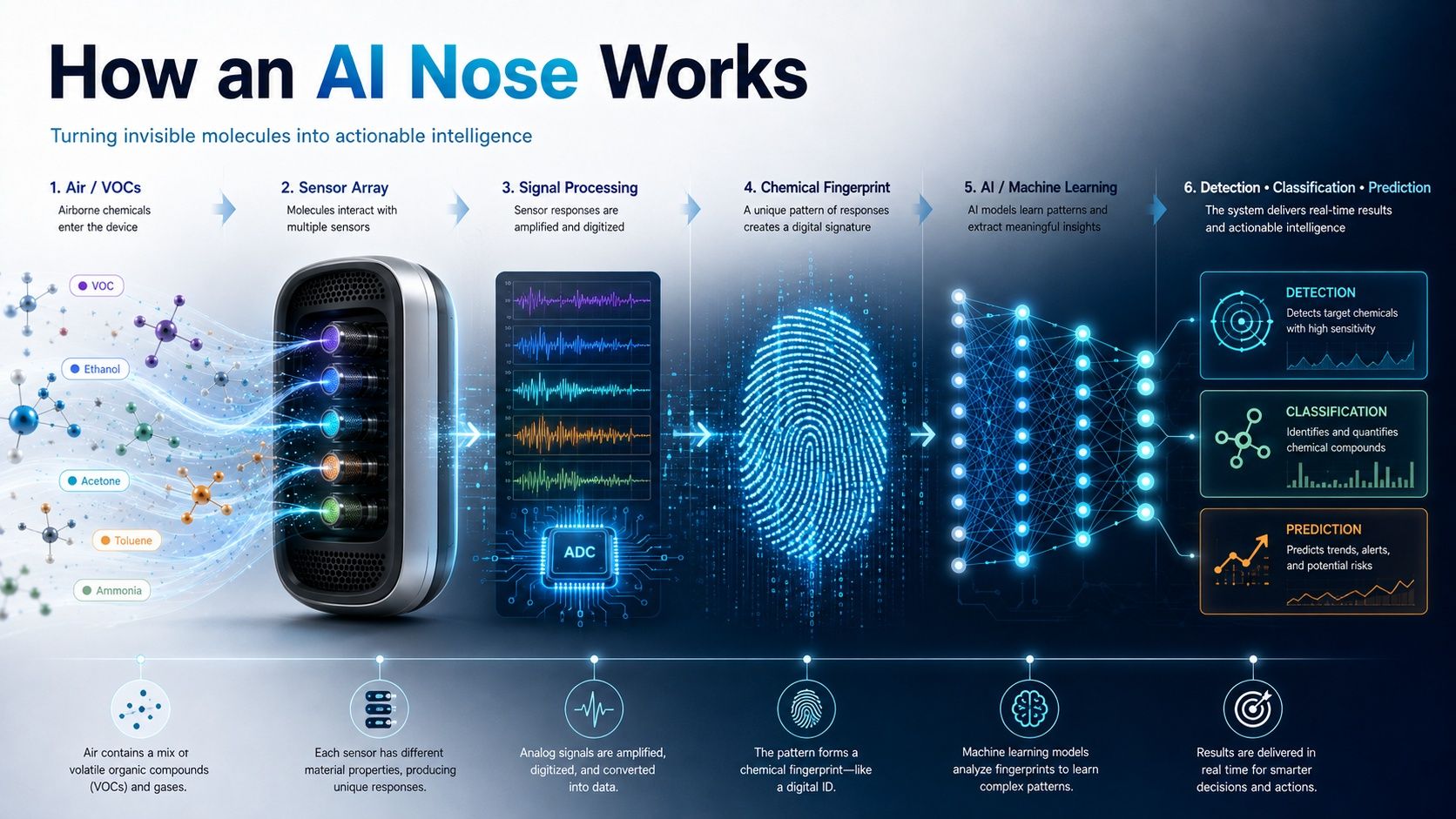
At a high level, most AI Nose systems follow the same information pathway:
Air or VOC sample → sensor responses → signal processing → chemical fingerprint → AI model → classification or prediction
1. Air or VOC Sampling
The system first needs a repeatable way to expose its sensing elements to the chemical environment.
Depending on the design, this may involve:
- Passive diffusion
- A miniature pump
- Controlled airflow
- Headspace sampling
- Tubing and sampling lines
- Filters
- Sample chambers
- Flow controllers
Sampling is more important than it may appear.
Two measurements of the same chemical mixture can produce different sensor responses if airflow, humidity, temperature, dilution, sampling time or contamination conditions change.
This is one reason industrial electronic noses are not simply “a group of sensors plus AI.” Mechanical design, sample handling and environmental compensation can be as important as the algorithm.
Ainos, for example, specifically highlighted an optimized airflow system and a long-life brushless pump as part of its second-generation platform for continuous deployment.
2. A Sensor Array Responds to the Chemical Mixture
Once the sample reaches the sensing chamber, several sensors respond simultaneously.
Depending on the system, sensing technologies can include:
- Metal oxide semiconductor (MOS/MOX) sensors
- MEMS gas sensors
- Conductive polymer sensors
- Electrochemical sensors
- Optical sensing elements
- Quartz crystal or acoustic sensors
- Colorimetric sensor arrays
- Biosensors and biomimetic receptors
- Emerging nanomaterial and MOF-based sensors
The core concept is response diversity.
An electronic nose does not necessarily require every sensor to be perfectly selective for one molecule. In many designs, partially selective or cross-sensitive sensors are useful precisely because each sensor responds differently to the same mixture.
A 2025 review of sensor-based electronic noses describes the sensor array as the core of the system: multiple chemical or gas sensors generate different responses to VOCs, producing a pattern that can be analyzed as a fingerprint.
3. Raw Signals Are Processed
The sensor array produces electrical or optical signals, but raw signals are usually not ready for machine learning.
Processing may include:
- Baseline correction
- Noise reduction
- Signal normalization
- Drift compensation
- Temperature compensation
- Humidity compensation
- Feature extraction
- Response/recovery-time calculation
- Dimensionality reduction
Environmental compensation matters because gas-sensor behavior can change with humidity, temperature and long-term aging.
Humidity drift, for example, has been studied as a major source of error in electronic-nose measurements, leading researchers to develop specific humidity compensation methods.
4. The System Creates a Chemical Fingerprint
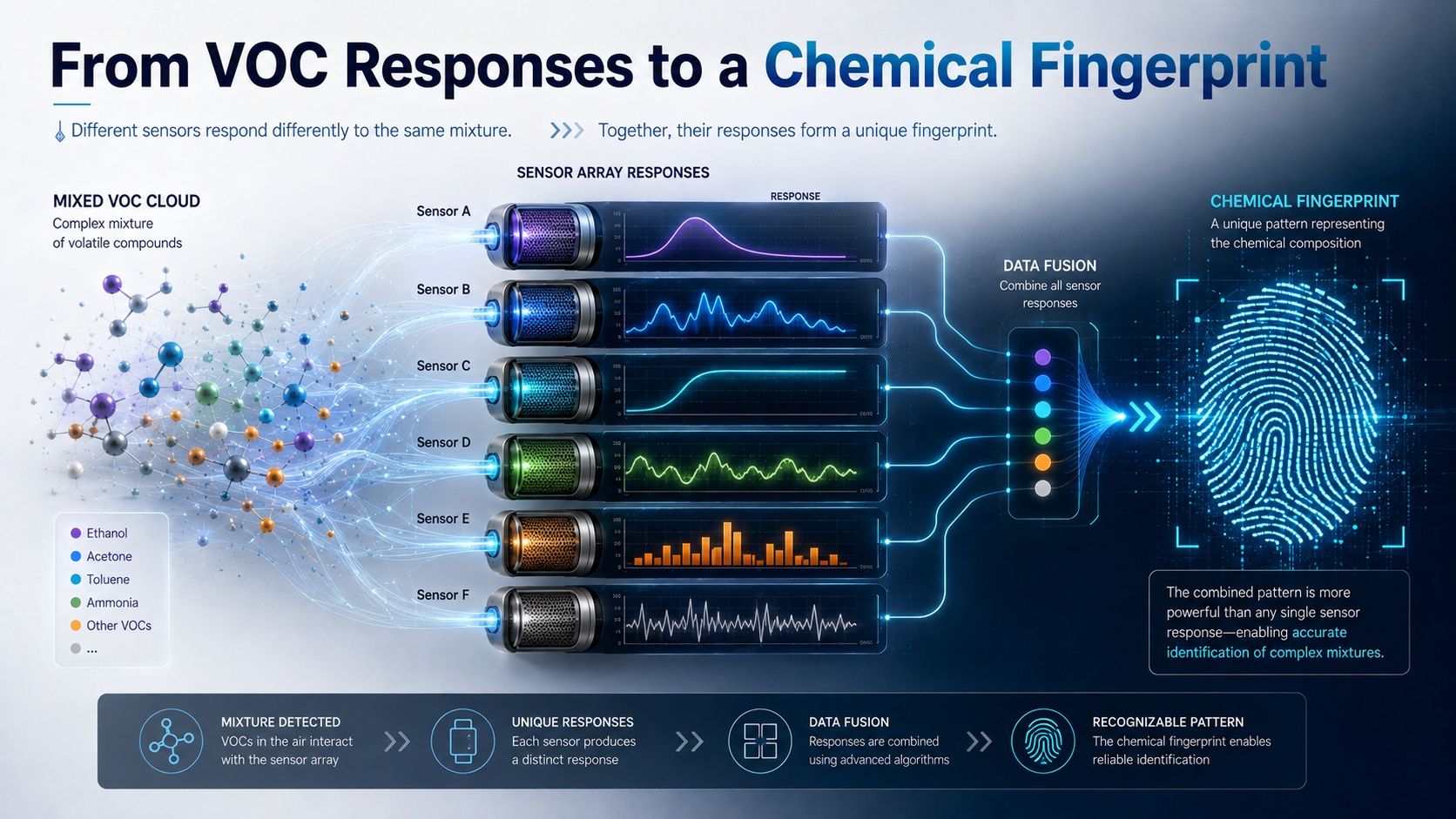
Imagine six sensors exposed to the same VOC mixture.
One might respond strongly.
Another might respond moderately.
A third might react slowly.
Another may be more affected by one component of the mixture.
Taken separately, these signals may provide limited information.
Taken together, they create a multidimensional pattern.
That pattern can act like a chemical fingerprint.
Commercial electronic-nose systems already use this concept. Alpha MOS, for example, describes electronic-nose measurements in terms of odor fingerprinting, VOC detection, multivariate statistics and qualitative or quantitative models. Alpha MOS electronic nose
5. Machine Learning Interprets the Pattern
After features are extracted, an AI or statistical model can compare the new measurement with previously collected data.
Typical tasks include:
Detection
Is the target odor or chemical condition present?
Classification
Which known category does this sample most closely resemble?
Regression
Can the pattern be related to a continuous value such as concentration, ripeness or process state?
Anomaly detection
Does the current chemical environment differ significantly from normal operation?
Prediction
Does the evolving pattern indicate that a particular event is likely to occur?
Aryballe describes machine-learning applications in digital olfaction that include detection, classification and regression, with model performance depending heavily on representative training situations. How machine learning in digital olfaction works
Human Nose vs. AI Nose
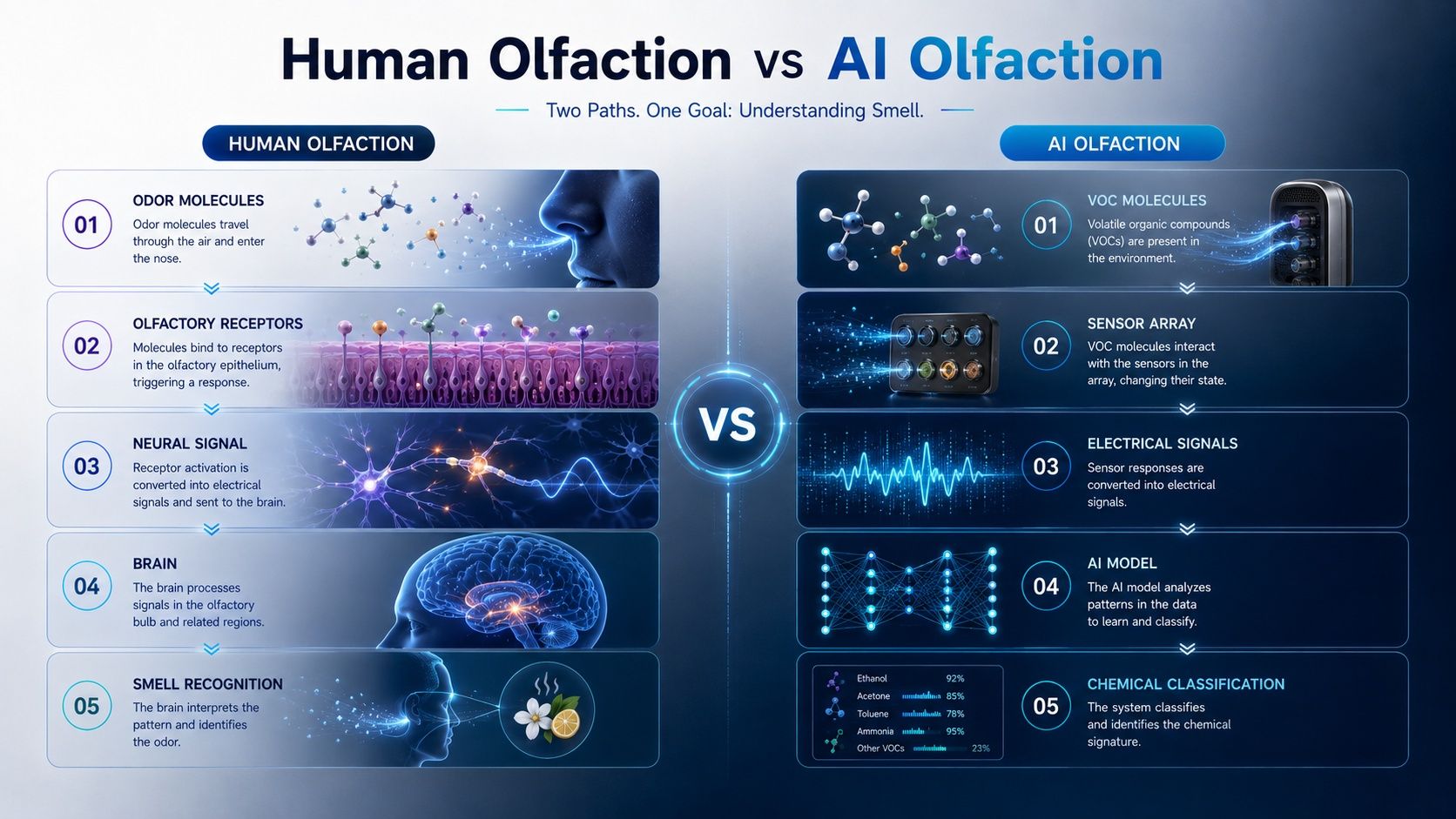
Electronic noses are frequently described as systems that “mimic” biological smell.
The analogy is useful, but it should not be taken literally.
| Human Olfaction | AI / Electronic Olfaction |
|---|---|
| Odor molecules enter the nose | VOCs or gases reach the sampling system |
| Olfactory receptors respond | Chemical sensor array responds |
| Receptors generate neural signals | Sensors generate electrical/optical signals |
| Brain processes combined responses | Processor extracts features |
| Learned experience supports recognition | Training data supports classification |
| Human perceives an odor | Algorithm outputs a class, score, trend or prediction |
The similarity lies mainly in distributed pattern recognition.
Humans do not normally identify an odor by measuring one chemical compound in isolation. Our olfactory system interprets patterns generated by many receptors.
An electronic nose attempts to create a machine version of that general architecture using chemical sensors and computation.
That does not mean an electronic nose experiences smell like a human or reproduces every capability of biological olfaction.
AI Nose vs. Traditional Gas Sensor
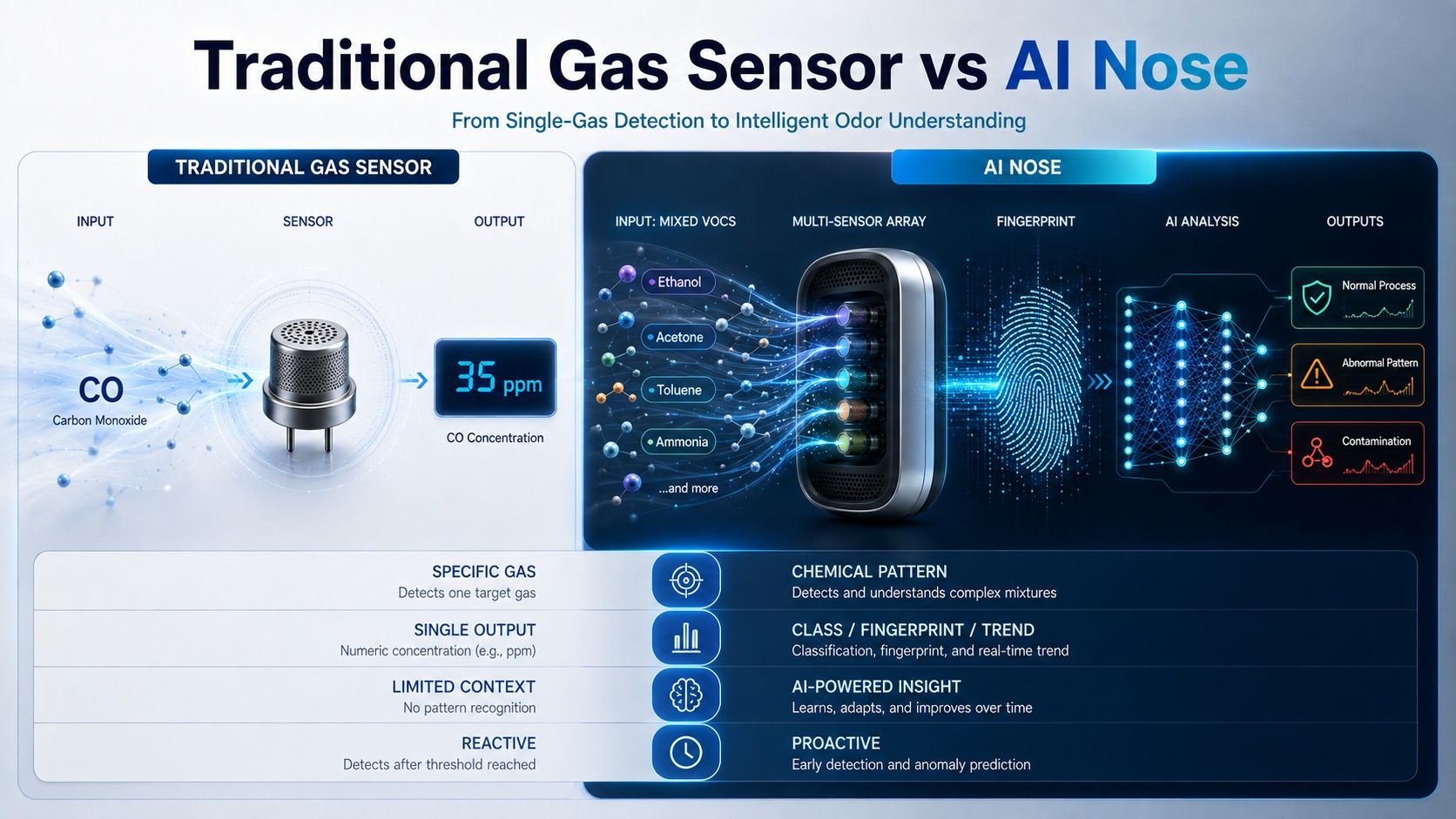
This is one of the most important distinctions when evaluating AI Nose technology.
A traditional gas sensor and an AI Nose may both respond to chemicals in air, but their measurement objectives can be very different.
Traditional Gas Detection
A conventional gas-detection application often starts with a known target:
- Carbon monoxide
- Hydrogen sulfide
- Methane
- Hydrogen
- Ammonia
- Chlorine
- Oxygen
- Refrigerant
- A specific VOC
The engineering question may be:
What is the concentration of this target gas, and has it exceeded an alarm threshold?
For many safety applications, this is exactly what is needed.
Gas Nose maintains dedicated resources for different gas categories, including toxic gases, flammable gases, refrigerants, VOCs and semiconductor specialty gases.
AI Nose
An AI Nose is more likely to examine the relationship between multiple responses.
The engineering question may become:
Does the current chemical fingerprint correspond to normal production, contamination, leakage, degradation, spoilage or another learned condition?
| Feature | Traditional Gas Sensor | AI Nose / E-Nose |
|---|---|---|
| Measurement target | Usually known gas or gas family | Chemical or odor pattern |
| Sensing channels | Often one primary sensing element | Usually multiple sensing responses |
| Typical output | ppm, ppb, %, %LEL, presence/absence | Class, score, fingerprint, trend or probability |
| Calibration basis | Known gas concentration | Reference samples + training data |
| Machine learning | Usually unnecessary | Frequently central |
| Complex mixtures | May cause cross-interference | Often the primary measurement problem |
| Learning from data | Limited | Core capability in many systems |
| Safety alarm role | Established in many applications | Application-dependent |
The distinction is especially relevant for VOCs and solvent vapors, where complex mixtures and cross-sensitivity can make interpretation difficult.
What Can an AI Nose Detect?
An AI Nose should not be described as a device that can automatically identify every molecule in the air.
Its capabilities depend on:
- Sensor materials
- Number and diversity of sensing channels
- Target concentration
- Sampling architecture
- Training data
- Environmental conditions
- Model quality
- Calibration
- Deployment environment
Depending on its design, an AI Nose may be trained to recognize:
- VOC mixtures
- Odor profiles
- Product aroma
- Spoilage patterns
- Contamination signatures
- Process changes
- Emission changes
- Material degradation
- Breath VOC patterns
- Abnormal industrial conditions
It may also monitor how those patterns change over time.
This is different from analytical instrumentation such as GC-MS, which is designed to separate and identify chemical constituents. Digital olfaction instead often works with a global response fingerprint associated with the overall sample.
The two approaches can therefore be complementary rather than competing.
Where Are AI Noses Used?
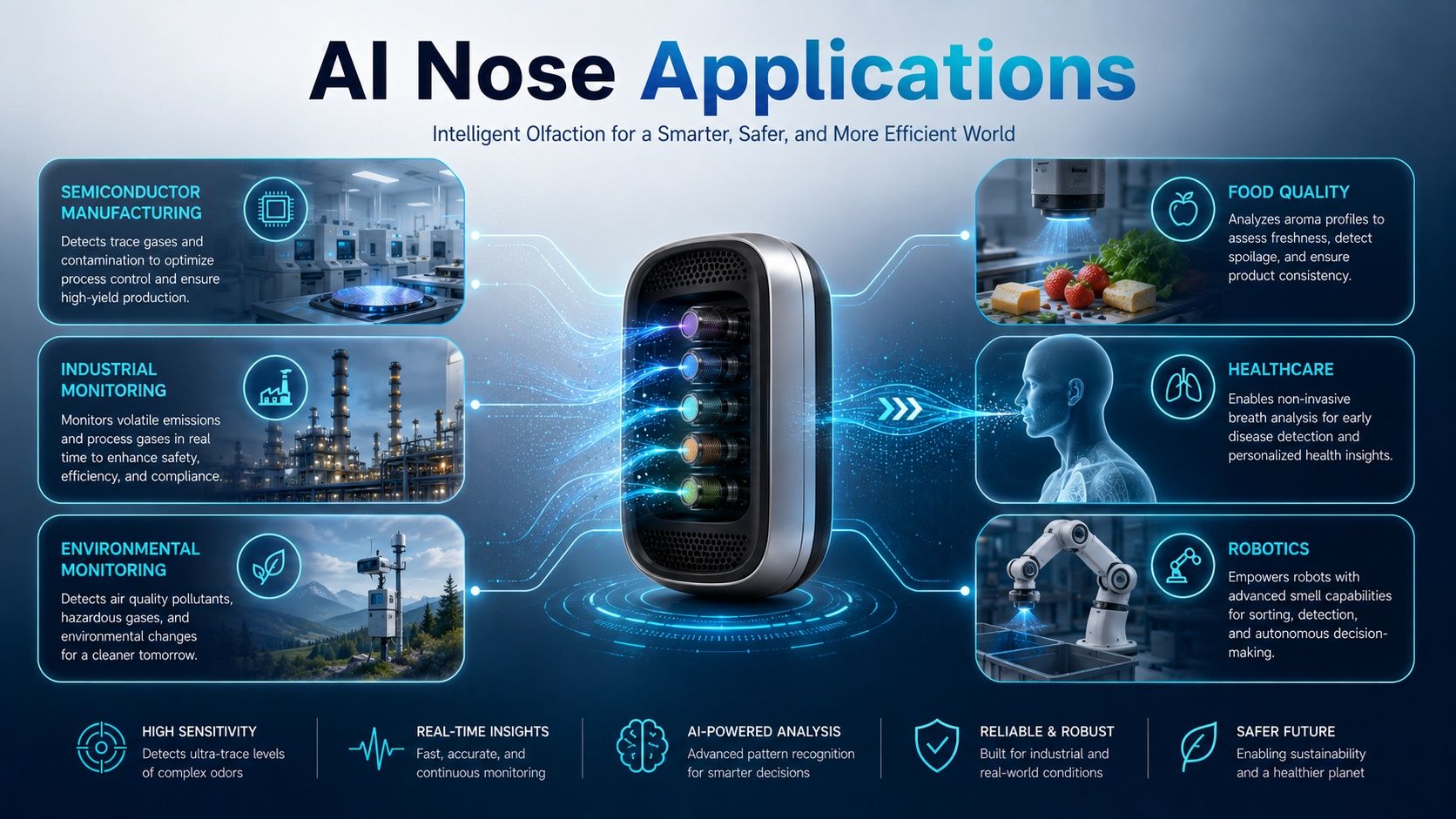
Electronic noses have been investigated or deployed across many industries. The most interesting opportunities for industrial gas sensing are applications where chemical patterns carry useful information before a conventional visual or mechanical signal becomes obvious.
Semiconductor Manufacturing
Semiconductor manufacturing uses numerous specialty gases, precursors, solvents and complex process chemistries.
Potential machine-olfaction applications include:
- Process-environment monitoring
- Abnormal chemical-pattern detection
- Contamination recognition
- Exhaust or process trend monitoring
- Material or equipment-state monitoring
However, an AI Nose intended for process intelligence should not automatically be treated as a replacement for dedicated toxic-gas or flammable-gas safety systems.
Semiconductor facilities may handle gases such as silane, phosphine, arsine and other specialty gases where gas-specific safety engineering remains critical. See the Gas Nose Semiconductor & Specialty Gas Guide for gas-specific information.
Industrial Process Monitoring
Industrial equipment continuously emits small chemical signals.
Changes may be associated with:
- Lubricant degradation
- Polymer aging
- Overheating
- Combustion changes
- Solvent emissions
- Process drift
- Material contamination
If an electronic nose learns the normal chemical background of a machine or process, a significant change in its fingerprint may become another predictive-maintenance signal.
The challenge is proving that the detected pattern is sufficiently repeatable and specific to the failure condition.
Environmental and Odor Monitoring
Electronic noses can also monitor changing atmospheric or odor conditions around:
- Wastewater facilities
- Waste treatment
- Chemical plants
- Agricultural facilities
- Industrial boundaries
- Indoor environments
- Smart buildings
Long-term environmental deployment remains technically challenging because weather, humidity, temperature, airflow and sensor drift can all affect measurements.
A 2026 study specifically addressing long-term environmental odor monitoring illustrates that reliable continuous field deployment remains an active research area rather than a solved problem.
Food and Beverage Quality
Food is one of the most established electronic-nose application areas.
Potential measurements include:
- Freshness
- Spoilage
- Batch consistency
- Fermentation
- Roasting
- Aroma profiles
- Storage changes
- Product authentication
Commercial systems such as Alpha MOS HERACLES already use odor fingerprinting and multivariate analysis for product quality and R&D applications.
Healthcare and Breath Research
Human breath contains numerous volatile compounds.
Researchers are studying whether VOC fingerprints could provide non-invasive information related to disease or physiological states.
Potential research areas include:
- Respiratory disease screening
- Metabolic changes
- Infection monitoring
- Gastrointestinal conditions
- Cancer-related breath signatures
These applications require caution.
An experimental electronic nose that distinguishes VOC patterns in a research dataset should not automatically be interpreted as a clinically validated diagnostic device.
Clinical deployment requires appropriate validation, controls, repeatability and regulatory review.
Robotics and Physical AI
Robots already have increasingly sophisticated versions of:
- Vision through cameras
- Hearing through microphones
- Touch through tactile sensors
- Position through inertial and ranging sensors
Machine olfaction could add another sensing dimension:
chemical perception.
A robot equipped with an electronic nose could potentially search for gas sources, identify environmental changes, inspect materials or support hazardous-area operations.
Recent reviews of robotic olfaction highlight applications including environmental monitoring, source localization, healthcare and search-and-rescue scenarios.
Why Edge AI Matters for Electronic Noses
Traditional connected sensing architectures often follow:
Sensor → network → cloud → analysis → response
For some applications this is sufficient.
But continuous industrial sensing may benefit from:
Sensor → local AI processing → immediate decision → cloud synchronization
This is where Edge AI becomes important.
Potential advantages include:
- Faster response
- Lower latency
- Reduced dependence on continuous cloud connectivity
- Lower communication bandwidth
- Local anomaly detection
- Distributed intelligence
- Easier scaling across many sensing nodes
Edge processing does not eliminate the need for cloud computing. Instead, the two can serve different roles.
The edge can handle immediate local interpretation, while cloud infrastructure can support fleet management, model updates, long-term analytics and cross-site learning.
Ainos’ Second-Generation AI Nose: What Changed in 2026?
On August 17, 2026, Ainos announced a new generation of its AI Nose platform aimed at longer-duration, real-world operation.
According to the company, the platform includes six major engineering changes.
Upgraded Software and Firmware
The architecture is designed to support continuing optimization of analytics and device management, including over-the-air updates.
For distributed industrial sensing, OTA capability can become important because algorithms and models may continue evolving after equipment has been installed.
Long-Life Brushless Pump
Ainos says the new pump architecture is intended to reduce mechanical wear and improve durability during continuous 24/7 operation.
This may sound less exciting than AI, but sampling hardware can become a major reliability constraint in long-term chemical sensing.
Optimized Airflow
The company also redesigned airflow pathways and sampling controls.
Consistent sampling is fundamental because an AI model cannot fully compensate for a measurement system that delivers highly inconsistent samples.
Enhanced Edge Intelligence
On-device processing is intended to provide faster local analysis while reducing dependence on continuous cloud computation.
Modular Maintenance
Replaceable filters and modular sensing and communication components are intended to make deployed systems easier to service.
Cloud Intelligence and Fleet Management
Ainos describes individual AI Nose units as connected edge nodes rather than isolated devices.
The company says its Smell AI network has accumulated more than 878 million real-world smell data records and presents this dataset as a foundation for continually improving models. Again, this number is reported by Ainos and should not be interpreted as independent validation of model accuracy or industrial performance.
What makes the announcement interesting is therefore not simply a new sensor.
It reflects a larger shift:
Electronic nose → AI-enabled sensing node → connected chemical intelligence network
From Electronic Nose to Chemical Intelligence
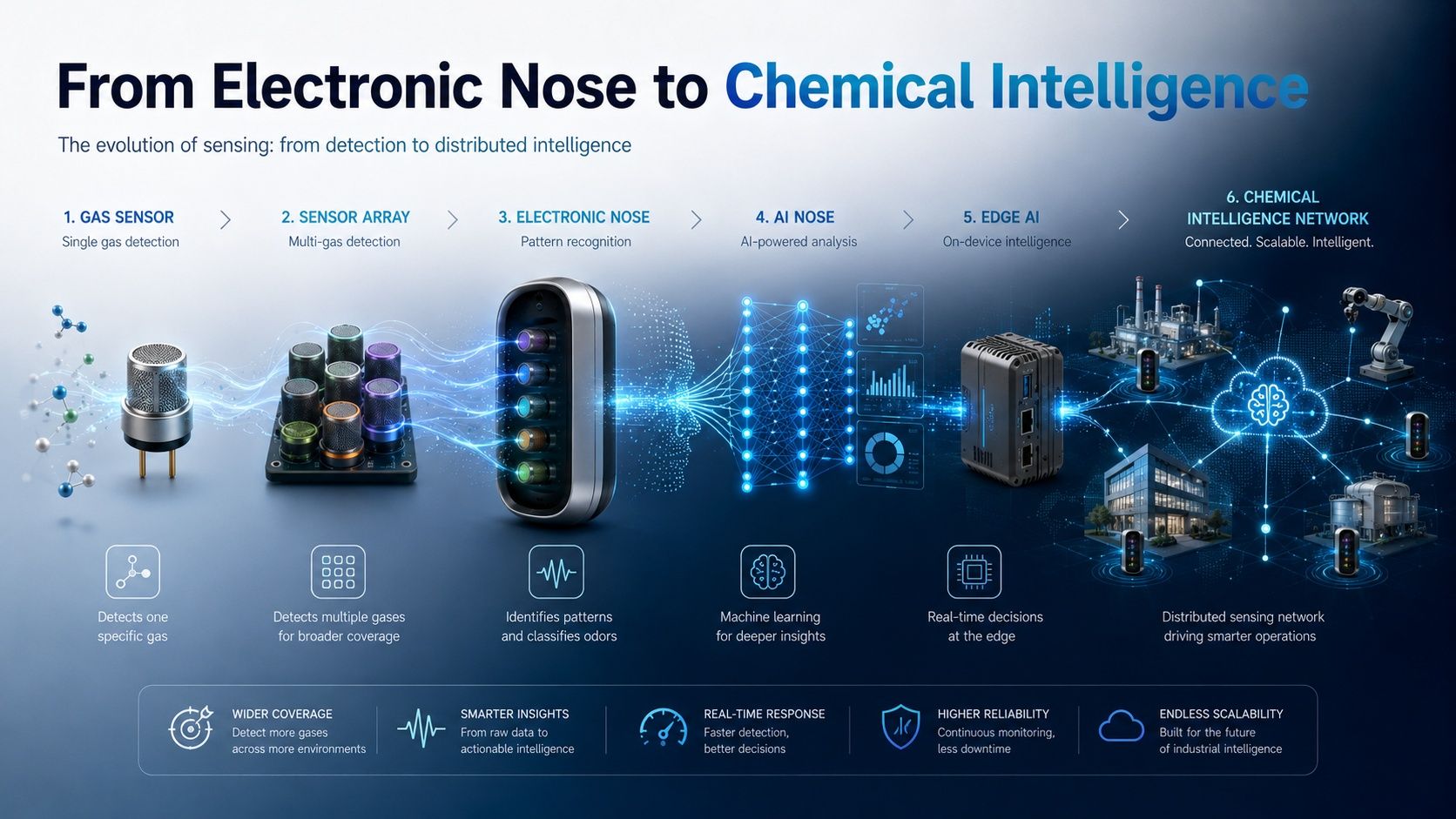
One possible way to understand the evolution of machine olfaction is:
Gas Sensor
↓
Sensor Array
↓
Electronic Nose
↓
AI Nose
↓
Edge AI Nose
↓
Distributed Chemical Intelligence
A gas sensor converts a chemical interaction into a measurable signal.
A sensor array produces multiple responses.
An electronic nose turns those responses into recognizable patterns.
Machine learning improves classification and prediction.
Edge computing moves interpretation closer to the sensing point.
Networking then makes it possible to combine information from many distributed devices.
Ainos uses the term Chemical Intelligence for its broader vision of machines learning from chemical changes across connected deployments. This is currently a company-defined concept rather than a universally standardized category for all electronic-nose technology.
Nevertheless, the underlying direction is significant.
Chemical sensing could eventually become another data layer for industrial AI systems alongside vision, vibration, temperature, acoustic monitoring and other sensor inputs.
What Are the Limitations of AI Nose Technology?
AI does not eliminate the physical limitations of chemical sensing.
In fact, moving from a laboratory demonstration to years of continuous field operation creates several major challenges.
Sensor Drift
Sensor responses can change as sensing materials age.
A model trained on data from a new sensor array may gradually become less accurate if the hardware response changes.
Drift compensation therefore remains an important electronic-nose research topic.
Temperature and Humidity
Many chemical sensors are sensitive to ambient environmental conditions.
Humidity may alter baseline resistance, sensitivity, adsorption behavior or response dynamics.
Temperature can also change reaction rates and sensor output.
Cross-Sensitivity
Cross-sensitivity is useful when creating a pattern-recognition array, but it can also create ambiguity.
A signal attributed to one known condition may change when additional interfering gases appear.
Training Data Dependency
An AI model can only learn from the conditions represented in its training data.
A model trained in one factory, climate or product environment may not automatically generalize to another.
Unknown Chemical Conditions
Classification systems are usually strongest when they encounter patterns similar to those seen during training.
A completely new chemical environment creates an out-of-distribution problem.
A responsible system therefore needs a way to recognize uncertainty rather than confidently assigning every unknown sample to the nearest known class.
Sampling Consistency
Sampling tubes, pumps, chamber materials, flow rates, filters and contamination can all influence the measured fingerprint.
Reliable AI begins with reliable physical measurements.
Calibration and Maintenance
Despite terms such as “self-learning,” real chemical sensing equipment can still require:
- Baseline checks
- Reference measurements
- Sensor replacement
- Filter replacement
- Cleaning
- Drift monitoring
- Model verification
Lack of Universal Odor Standards
There is no single universal digital odor database that allows every electronic nose to recognize every smell.
Different sensor technologies create different signal spaces, and datasets collected by one platform may not transfer directly to another.
Will AI Noses Replace Gas Detectors?
For most safety-critical applications, no.
The technologies solve different problems.
Consider methane monitoring.
A safety system may need to determine whether methane has reached a specific percentage of its lower explosive limit.
That is a quantitative safety requirement.
An AI Nose might instead recognize that a complex chemical pattern around a machine has shifted away from its normal baseline.
Both signals could be valuable, but they are not interchangeable.
The future is therefore more likely to involve sensor fusion:
- Gas-specific sensors for safety
- VOC sensors for broad monitoring
- Electronic noses for chemical-pattern recognition
- Temperature and humidity sensors for compensation
- Pressure and flow sensors for process context
- Cameras and acoustic sensors for multimodal AI
Rather than asking whether AI noses will replace gas sensors, a better question is:
Where does chemical-pattern intelligence provide information that conventional gas measurement alone cannot provide?
The Future of AI Olfaction
The next generation of electronic noses will probably depend on progress across several technologies at once.
Smaller and More Diverse Sensor Arrays
MEMS manufacturing could enable more sensing channels in smaller, lower-power packages.
New Sensing Materials
Researchers continue developing nanomaterials, porous materials, biological receptors, optical sensing structures and MOFs to improve sensitivity and discrimination.
Better Drift Compensation
Long-term field reliability will require algorithms that can recognize and compensate for changing sensor behavior without destroying useful chemical information.
Edge AI
More processing will move directly into sensing devices, making local classification and anomaly detection possible even with limited network connectivity.
Larger Real-World Datasets
Laboratory datasets are useful, but industrial AI systems need data collected across actual operating conditions.
More diverse deployment data could improve model robustness—provided the data is well labeled and representative.
Multimodal Sensing
An AI system may combine:
smell + temperature + humidity + vision + vibration + acoustic signals + process data
This could provide better context than any sensor type alone.
Robotic Olfaction
Robots may eventually use chemical information not only to identify an odor but also to locate a source and navigate toward or away from it.
Distributed Chemical Monitoring
Perhaps the biggest change will occur when electronic noses stop being isolated instruments.
Connected sensing nodes could monitor chemical changes across factories, buildings, cities or infrastructure networks.
That concept remains technically demanding, but the transition from isolated sensing to networked chemical intelligence is becoming a visible direction in both research and commercial development.
Key Takeaway
An AI Nose is not simply a gas sensor with an AI label.
It is better understood as a system that combines:
chemical sensing + multiple sensor responses + signal processing + reference data + machine learning
to recognize patterns in the chemical environment.
Traditional gas detectors remain critical when the objective is measuring a known hazardous gas against a defined concentration or alarm threshold.
AI-powered electronic noses address a different problem: interpreting complex chemical fingerprints and changes over time.
The most important development may therefore not be whether machines can “smell” exactly like humans.
It is whether chemical signals can become a useful, machine-readable data layer alongside vision, sound, temperature, vibration and other industrial sensor information.
The second-generation Ainos AI Nose announced in August 2026 provides one example of this transition, with its emphasis on Edge AI, continuous operation, serviceability and connected learning rather than a standalone odor detector.
For industrial users, the practical question should remain application-specific:
What chemical change needs to be recognized, what sensing technology can reliably capture it, and how will the result be validated under real operating conditions?
That engineering question matters more than the term used to describe the device.
Frequently Asked Questions
What is an AI Nose?
An AI Nose is an electronic olfaction system that combines chemical or gas sensors with signal processing and artificial intelligence. Instead of relying only on one gas measurement, it can analyze patterns from multiple sensing responses and compare them with trained chemical or odor fingerprints.
Is an AI Nose the same as an electronic nose?
The terms overlap. An electronic nose generally uses a sensor array and pattern recognition to identify odors or chemical profiles. “AI Nose” usually emphasizes the use of modern machine-learning models, Edge AI, connected data and predictive analysis.
How does an AI Nose detect smells?
Air or VOCs are exposed to an array of chemical sensors. Each sensor produces a different response. These responses are processed and combined into a multidimensional pattern, sometimes called an odor or chemical fingerprint. An AI model then compares the pattern with previously learned data.
Does an AI Nose detect VOCs?
Yes, many electronic-nose systems are designed around volatile organic compounds. However, capability depends on the sensing materials, target concentrations, environmental conditions and training data. An AI Nose should not be assumed to identify every VOC individually.
For more information on VOC measurement, see the Gas Nose VOCs & Solvent Vapors and TVOC guides.
What sensors are used in an electronic nose?
Common technologies include MOS/MOX sensors, MEMS sensors, conductive polymers, electrochemical sensors, optical sensors, acoustic devices, colorimetric arrays and biomimetic sensing technologies. Different electronic-nose architectures may use completely different sensing principles.
Can an AI Nose identify individual gases?
Some systems can classify specific compounds or estimate concentration when properly trained, but electronic noses are often designed primarily for pattern recognition rather than definitive compound-by-compound identification.
When accurate identification and quantification of individual chemicals are required, additional analytical techniques may be necessary.
Is an electronic nose more accurate than the human nose?
There is no universal answer.
Electronic noses can provide repeatable digital measurements and can operate without human olfactory fatigue. Humans, however, have an extremely sophisticated biological olfactory system and can interpret odor in context.
Performance depends on the odor, sensor technology, training dataset and measurement objective.
Can an AI Nose replace a gas detector?
Usually not in safety-critical applications.
A certified or application-specific gas detector may be required to measure a known gas against a defined threshold. An AI Nose is more suited to recognizing patterns, classes, trends and abnormalities in complex chemical environments.
The two technologies can complement each other.
What industries use electronic noses?
Applications include food and beverage quality, industrial monitoring, environmental odor monitoring, agriculture, automotive, healthcare research, semiconductor manufacturing, product development and robotics.
What is digital olfaction?
Digital olfaction is the broader field of converting odor or chemical information into digital data that can be stored, analyzed, compared and interpreted by computers.
Why is AI useful for electronic noses?
Sensor arrays can generate large, multidimensional datasets. Machine-learning models are useful for identifying relationships within those responses, classifying learned patterns and detecting deviations that would be difficult to define using a single fixed threshold.
What is chemical intelligence?
“Chemical intelligence” is an emerging description for systems that convert chemical-environment information into machine-readable insights. Ainos currently uses the term for its vision of connected AI Nose nodes that learn from distributed chemical data. It is not yet a universal industry-standard definition.
References and Further Reading
- Ainos — Next-Generation AI Nose Announcement, August 17, 2026
- Aryballe — Digital Olfaction for Odor Sensing
- Aryballe — How Machine Learning in Digital Olfaction Works
- Aryballe — Odor Recognition vs. Chemical Analysis
- Alpha MOS — HERACLES Electronic Nose
- Gas Nose — Gas Library
- Gas Nose — VOCs & Solvent Vapors
- Gas Nose — Semiconductor & Specialty Gases
