



Thermal Conductivity Gas Sensors
Thermal conductivity gas sensors—often called TCD sensors—measure how quickly the surrounding gas removes heat from a heated element. Because different gases conduct heat at different rates, the resulting heater temperature, resistance or required power can be converted into gas concentration when the background composition is known.
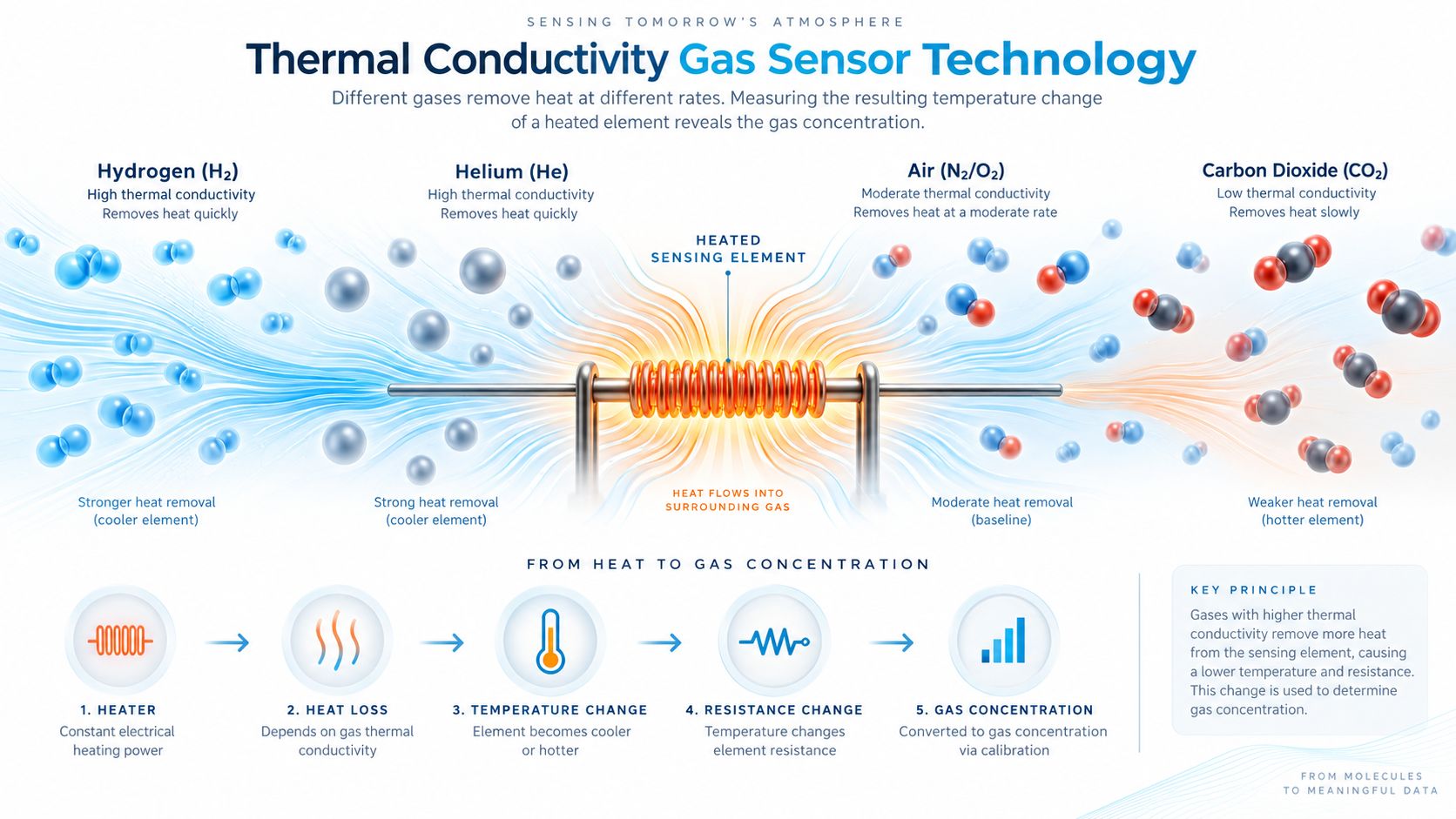
Technology overview
What is a thermal conductivity gas sensor?
Why TCD is different
- No catalytic combustion: the target does not need to burn on a catalyst.
- No electrolyte: there is no electrochemical reagent consumed by the measurement.
- No absorption line: gas concentration is inferred from heat transfer rather than spectroscopy.
- No adsorption chemistry required: the principle is thermophysical.
Air provides a moderate heat-loss baseline. TCD normally interprets another gas relative to this or another known reference condition.
Working principle
How does a thermal conductivity gas sensor work?
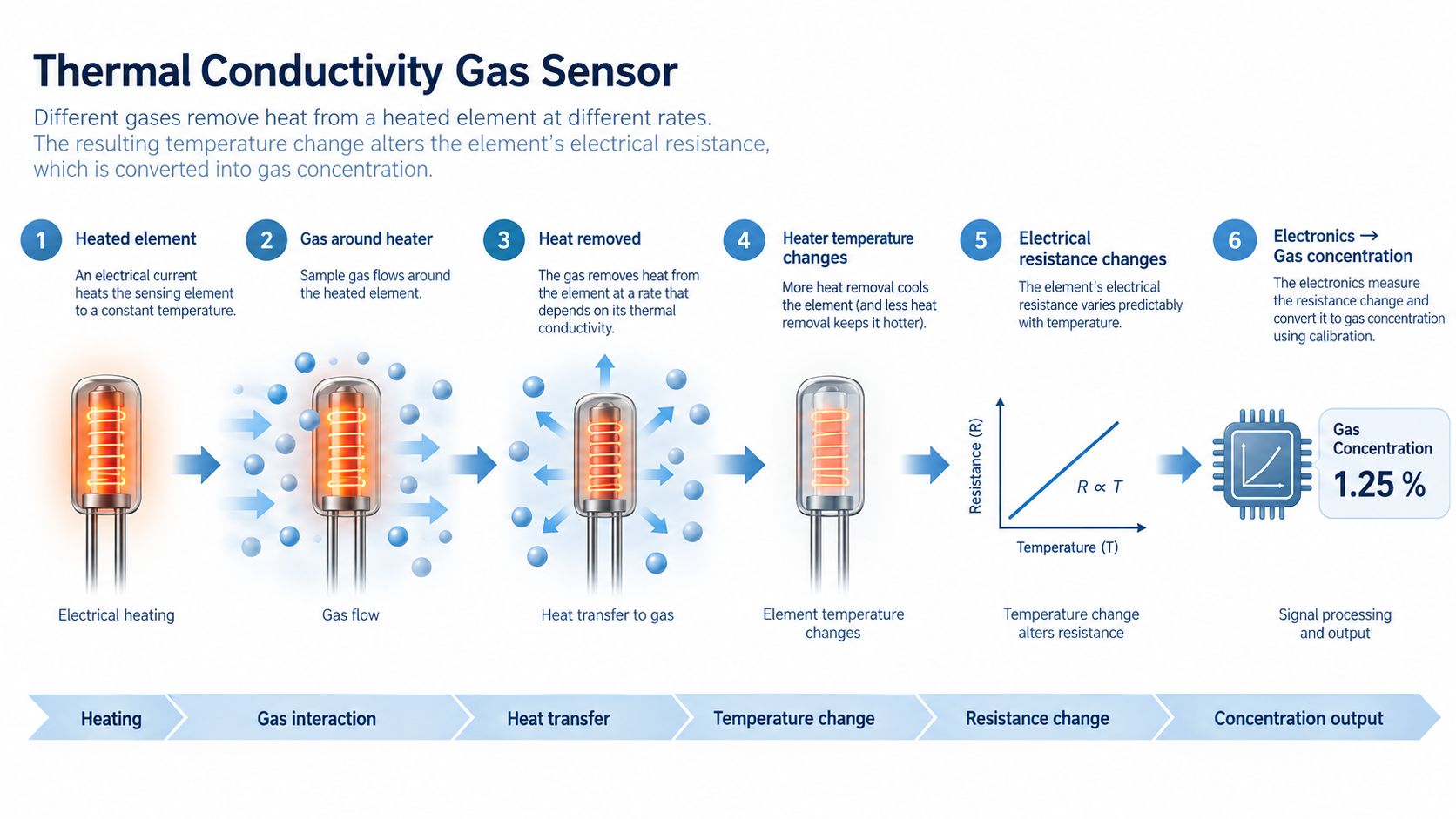
From gas to signal
- Heat the element: current raises the heater above ambient.
- Expose it to gas: surrounding molecules transport heat away.
- Heat loss changes: thermal conductivity, flow and pressure influence cooling.
- Temperature changes: high-conductivity gas cools the heater more strongly.
- Resistance or power changes: the electrical readout tracks the thermal shift.
- Calibration converts signal to concentration: using a known gas/background system.
Sensor architecture
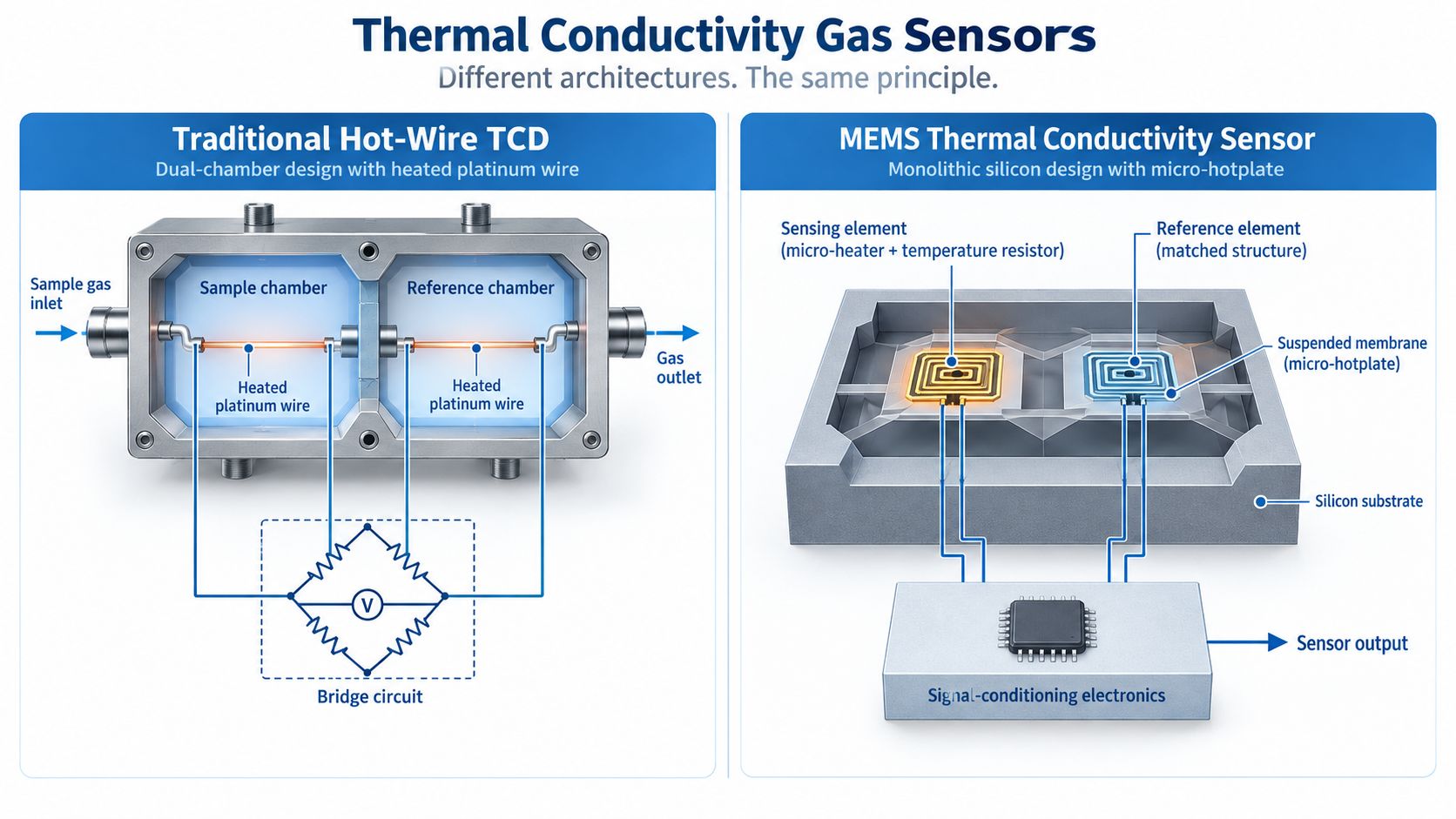
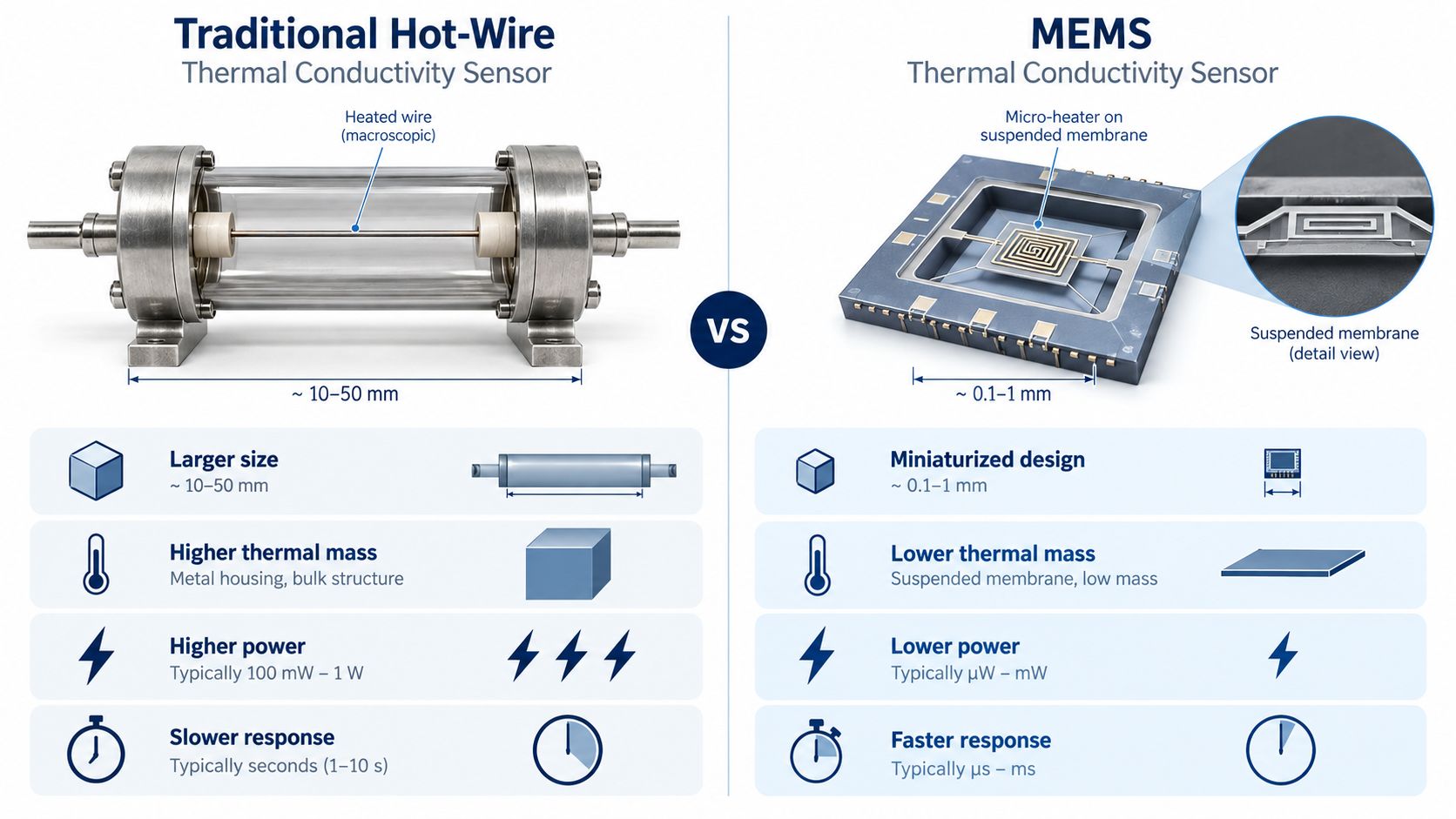
Traditional hot-wire TCD vs MEMS thermal conductivity sensor structure
Traditional hot-wire TCD
- Heated platinum or similar wire
- Sample and reference chambers
- Larger thermal mass
- Bridge-based differential readout
- Mature industrial analyzer architecture
MEMS TCD
- Micro-heater on suspended membrane
- Very low thermal mass
- Lower power consumption
- Fast thermal response
- Compact ASIC-friendly integration
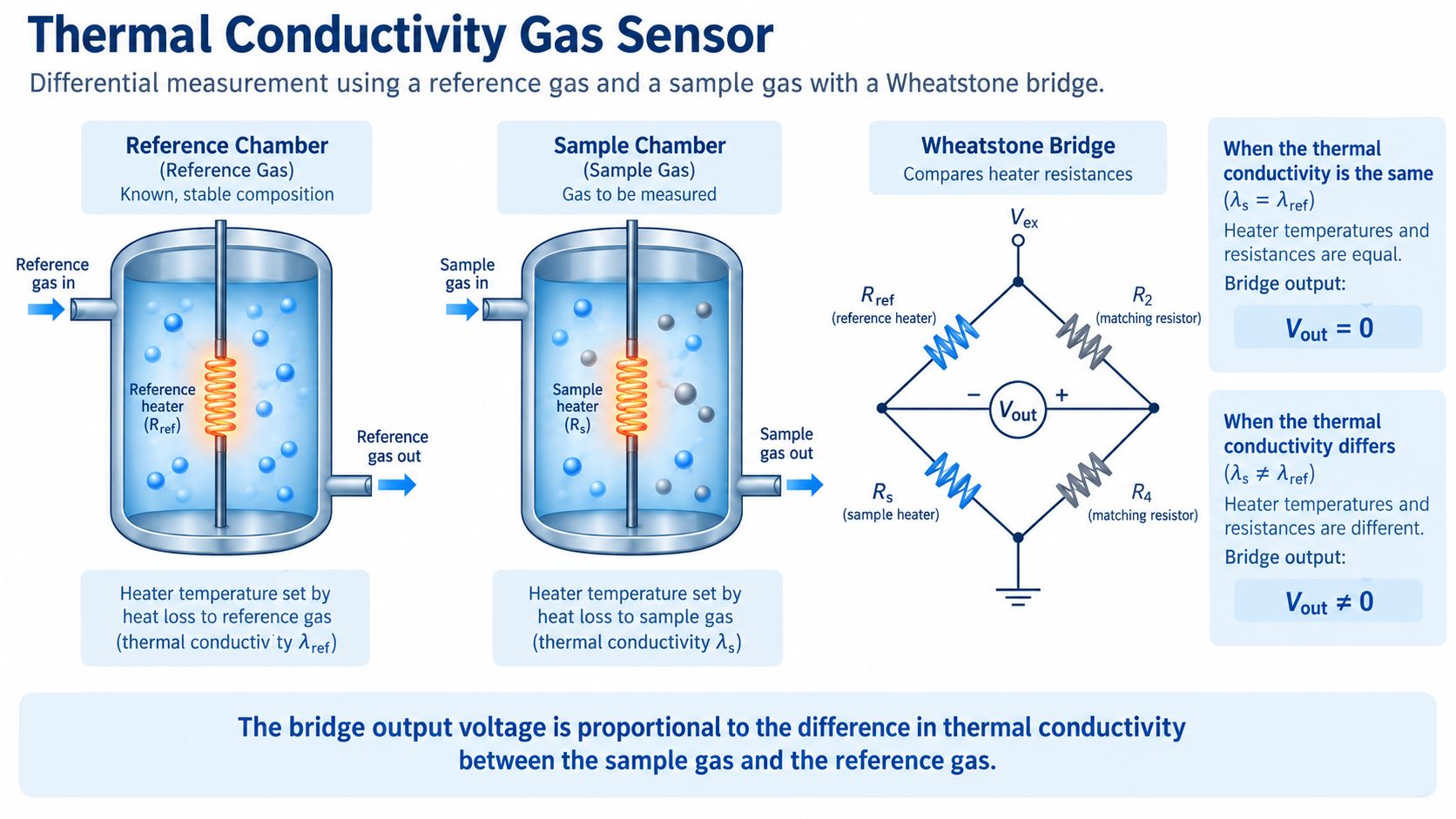
Differential measurement
Why many TCD sensors use sample and reference elements
Hydrogen sensing
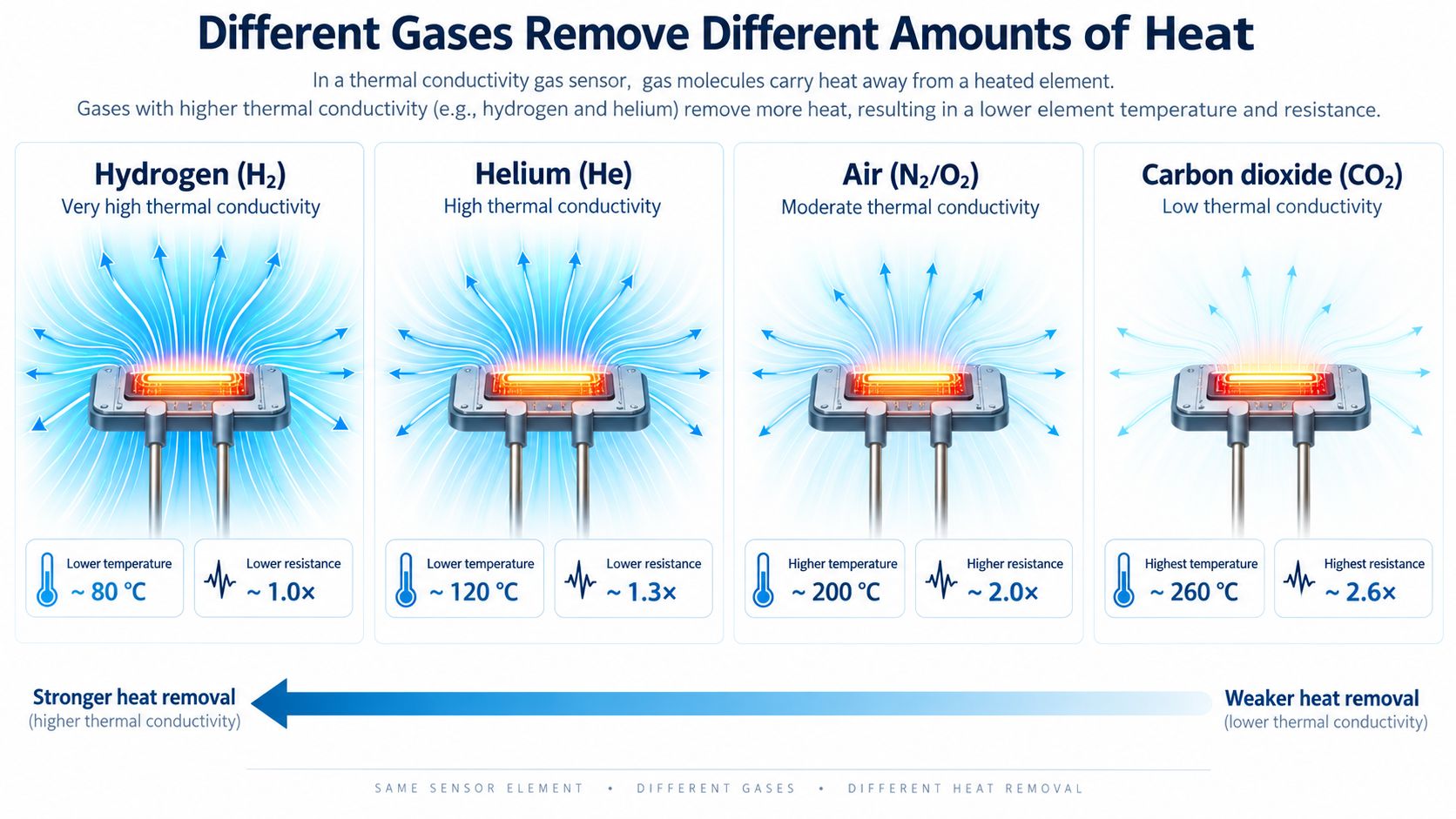
Why hydrogen is especially suitable for thermal conductivity sensing
Hydrogen removes heat from a hot element much more efficiently than air, nitrogen and many heavier gases. In a controlled background, that large contrast creates a strong signal.
Strong thermal contrast
H₂ produces much stronger cooling than air or N₂.
No oxygen requirement
The sensing mechanism is physical heat transfer rather than H₂ combustion.
Wide concentration capability
TCD is particularly useful at percent-level and high-volume-fraction H₂.
No catalyst poisoning
No catalytic surface must remain chemically active for the sensing mechanism.
For gas-specific technology selection, see Hydrogen Sensors.
Selectivity boundary
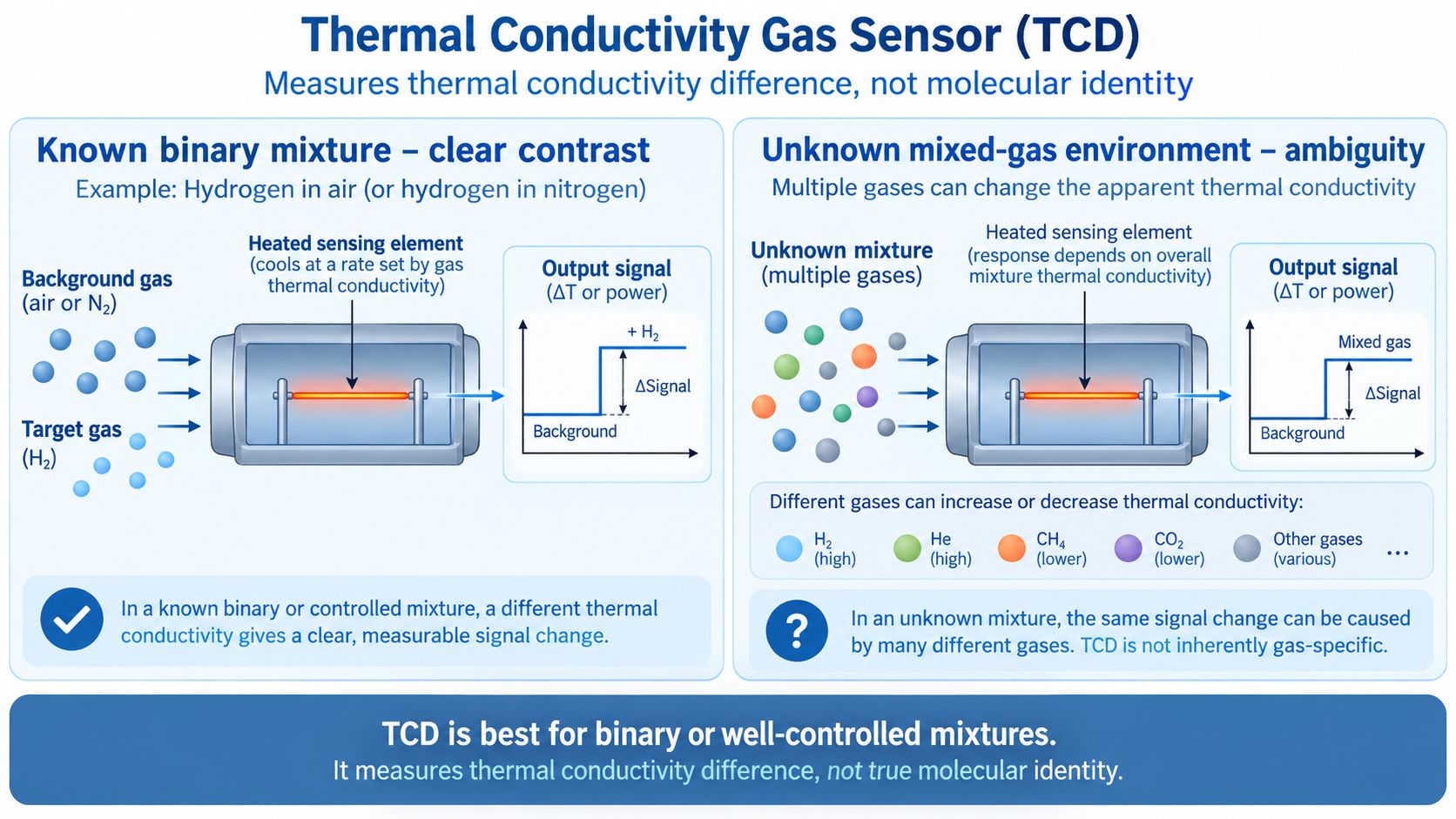
The biggest TCD limitation: it measures thermal conductivity, not molecular identity
Strong use case
Hydrogen in nitrogen, hydrogen in air, helium in nitrogen, or another controlled binary mixture.
Weak use case
An unknown atmosphere where H₂, He, CH₄, CO₂, water vapor and other gases may all change at once.
Environmental effects
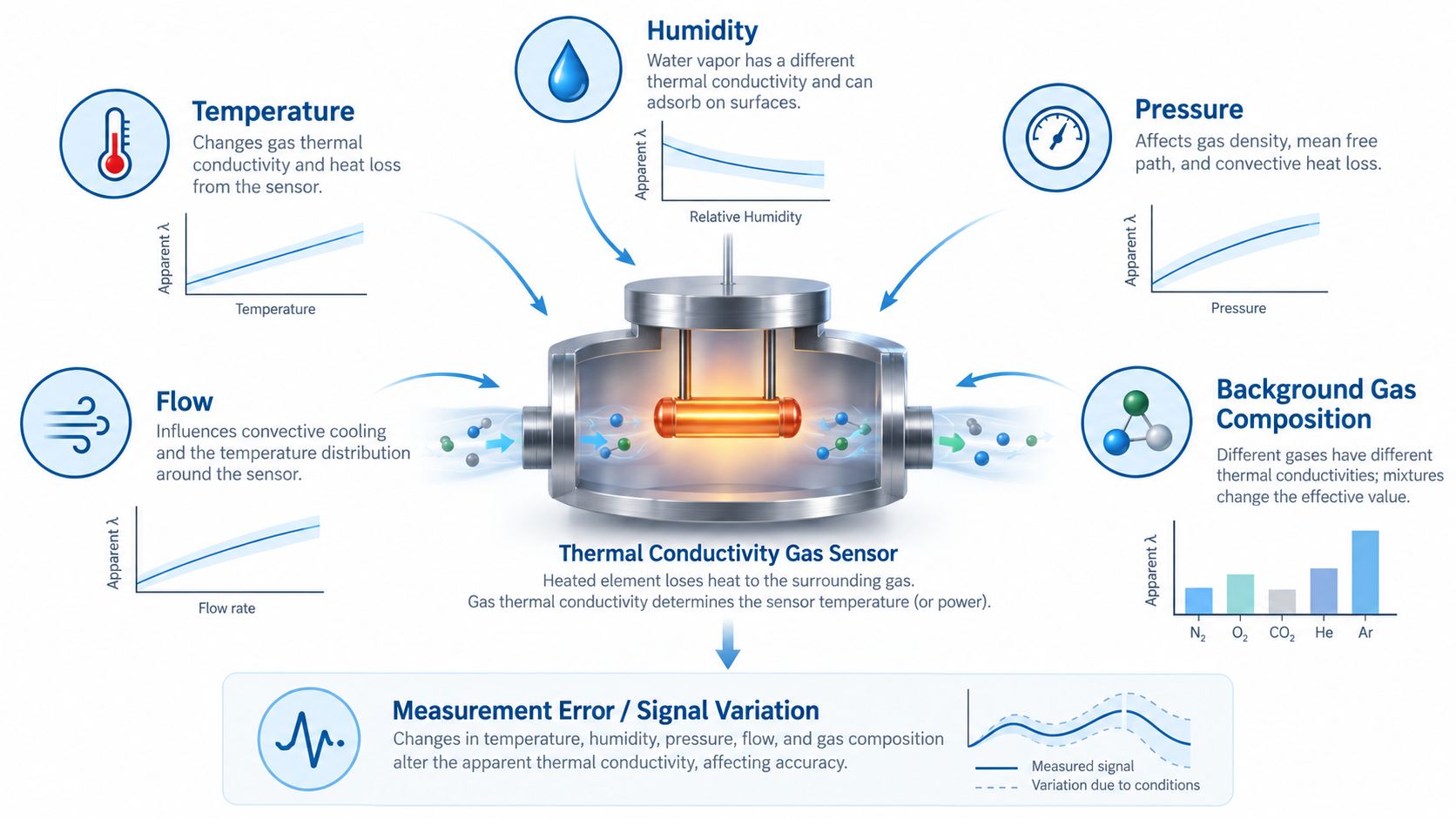
Temperature, humidity, pressure, flow and background gas all affect TCD output
Temperature
Gas thermal conductivity and heater losses change with temperature.
Humidity
Water vapor changes the effective gas mixture and thermal transport.
Pressure
Gas density and heat transfer vary with pressure.
Flow
Convection can add to conduction and alter heater cooling.
Background gas
A different carrier gas changes the reference thermal conductivity.
Geometry
Cavity, membrane and diffusion-channel design change the thermal boundary conditions.
Heater operation
Steady-state vs transient thermal conductivity measurement
Steady-state TCD
- Constant current
- Constant voltage
- Constant temperature
- Constant power
- Measure once thermal equilibrium is reached
Transient TCD
- Pulse heating
- Thermal decay
- Sweep heating
- AC / lock-in methods
- Extract information from temperature or resistance versus time
MEMS heaters make transient methods attractive because their low thermal mass allows rapid heating and cooling with low energy.
Technology evolution
Traditional hot-wire vs MEMS thermal conductivity sensors
| Factor | Traditional TCD | MEMS TCD |
|---|---|---|
| Heater | Wire / larger element | Micro-heater / hotplate |
| Thermal mass | Higher | Very low |
| Power | Higher | Lower |
| Response | Slower | Faster |
| Dynamic heating | Possible | Well suited |
| Integration | Discrete analyzer | Compact ASIC/module |
See also MEMS Gas Sensors.
Hydrogen technology comparison
Thermal conductivity vs catalytic hydrogen sensing
Thermal conductivity
- Physical heat transfer
- No combustion reaction
- No oxygen requirement for sensing
- No catalyst poisoning mechanism
- Best in known gas matrices
Catalytic bead
- H₂ + O₂ oxidize on catalyst
- Reaction heat raises bead temperature
- Requires sufficient oxygen
- Catalyst can be poisoned
- Strong for combustible %LEL safety
Technology comparison
TCD vs catalytic, MOX, electrochemical and NDIR gas sensors
| Factor | TCD | Catalytic | MOX | Electrochemical | NDIR |
|---|---|---|---|---|---|
| Principle | Physical heat transfer | Catalytic oxidation heat | Surface chemistry / resistance | Electrochemical current | IR absorption |
| Chemical reaction required | No | Yes | Surface reaction | Yes | No |
| O₂ required | No | Yes | Not as combustion requirement | Chemistry-dependent | No |
| H₂ suitability | Excellent in known background | Good | Good with suitable material | Good with H₂ cell | Conventional NDIR: no direct H₂ |
| Gas specificity | Low without known matrix | Broad combustible | Low–medium | Higher but cross-sensitive | High for IR-active target |
| Typical range | %vol / composition | %LEL | ppm to %vol | ppb / ppm | ppm to %vol |
Target gases and mixtures
Which gases can thermal conductivity sensors measure?
H₂ and He
Very high thermal conductivity creates strong contrast against air, N₂ and many heavier carrier gases.
CO₂, CH₄, Ar and others
Can be measured when the reference gas is defined and thermal contrast is sufficient.
Unknown mixed atmospheres
When several gases vary at once, thermal conductivity alone usually cannot identify which component changed.
Search-intent clarification
Standalone TCD gas sensor vs GC-TCD detector
Standalone TCD gas sensor
- Measures the gas mixture directly
- No chromatography column
- Needs known background for meaningful selectivity
- Common use: H₂ concentration or gas purity
Gas chromatography TCD
- GC column separates components first
- Compounds reach the TCD at different retention times
- TCD then responds to each separated component
- “Universal detection” depends heavily on prior separation
Applications
Where thermal conductivity gas sensors are used
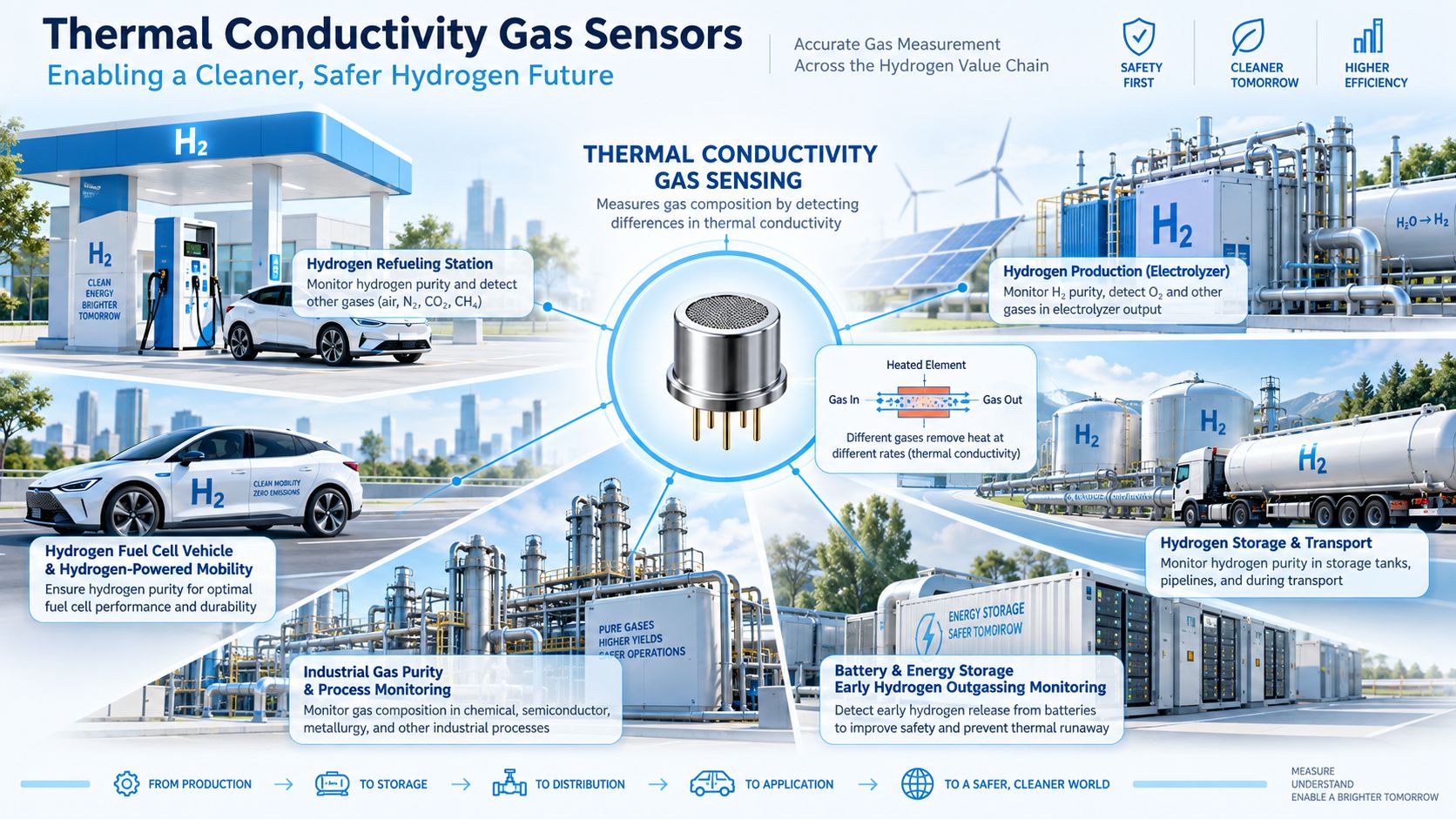
Hydrogen refueling
Hydrogen concentration, purity and process monitoring in controlled streams.
Electrolyzers
H₂-rich process gas measurement and purity monitoring.
Fuel cell systems
Hydrogen concentration or purge-gas monitoring.
Storage & transport
Gas composition and purity monitoring in tanks, pipelines and distribution equipment.
Industrial gas purity
Binary-mixture and carrier-gas analysis in process industries.
Battery / ESS monitoring
Selected H₂-related early-warning applications when the gas matrix and failure signature are validated.
Selection workflow
How to choose a thermal conductivity gas sensor
1. Define target + background
Performance depends on thermal-conductivity contrast between target and carrier gas.
2. Define the range
Determine whether you need low concentration change, %vol or near-pure gas composition.
3. Define the environment
Temperature, humidity, pressure and flow must stay inside the calibrated design envelope.
4. Define the architecture
Choose hot-wire, differential chamber or MEMS based on power, size and response requirements.
Before design freeze
- Target gas and background gas
- Thermal-conductivity contrast
- Minimum/maximum concentration
- Temperature and pressure range
- Humidity and gas flow
- Diffusion vs pumped sampling
- Steady-state vs transient heating
- Calibration and compensation strategy
TCD OEM checklist
TCD works best when the gas matrix and thermal boundary conditions are controlled.
- Model carrier-gas variation
- Check interfering gas composition
- Control heater/cavity geometry
- Compensate temperature
- Validate pressure and humidity effects
- Minimize uncontrolled convection
- Use differential/reference design where possible
- Verify zero/span with real process mixtures
Useful references: Hydrogen Sensors and Gas Sensor Product Finder.
FAQ
Thermal conductivity gas sensor FAQ
What is a thermal conductivity gas sensor?
A thermal conductivity gas sensor measures how quickly a surrounding gas removes heat from a heated element. The resulting change in heater temperature, resistance or required power is related to gas composition.
How does a TCD gas sensor work?
An electrical heater is maintained above ambient temperature. Gases with higher thermal conductivity remove more heat. Electronics measure the resulting resistance, temperature or power difference and convert it into concentration.
Why is hydrogen easy to detect with thermal conductivity?
Hydrogen has much higher thermal conductivity than air, nitrogen and many heavier gases. In a known background this creates a large heat-transfer contrast and a strong TCD signal.
Does a thermal conductivity hydrogen sensor need oxygen?
No. The sensing principle is physical heat transfer, not hydrogen combustion.
Can a TCD identify which gas is present?
Not inherently. TCD measures effective thermal conductivity and is most selective in binary or well-controlled mixtures.
What gases can TCD measure?
Hydrogen and helium are strong targets. CO₂, methane, argon and other gases can also be measured in suitable controlled mixtures.
What affects TCD accuracy?
Important factors include temperature, humidity, pressure, gas flow, carrier-gas composition, heater geometry and calibration conditions.
What is the difference between traditional and MEMS TCD?
Traditional TCD uses larger heated wires or chambers. MEMS TCD uses a micro-heater on a thermally isolated membrane, reducing thermal mass, power consumption and response time.
What is the difference between TCD and catalytic hydrogen sensing?
TCD measures physical heat transfer. Catalytic sensing measures heat produced by hydrogen oxidation on a catalyst and therefore requires sufficient oxygen.
Why is a standalone TCD different from GC-TCD?
In gas chromatography, a column separates mixture components before they reach the TCD. A standalone TCD has no separation column and measures only the overall thermal-conductivity effect of the mixture.
Need to choose a thermal-conductivity sensing architecture?
Start with the target gas, background composition, thermal-conductivity contrast, concentration range and environmental conditions. TCD performs best when the gas matrix is controlled and the heater, cavity and compensation strategy are designed as one thermal system.