



When selecting a gas sensor, three datasheet parameters deserve close attention: measurement range, linear range, and maximum overload. They may appear next to each other in a specification table, but they describe different aspects of sensor performance.
The measurement range tells you the concentration interval the sensor is specified to measure. The linear range describes where the output follows a sufficiently proportional relationship with gas concentration. Maximum overload is a manufacturer-defined high-exposure limit outside normal measurement operation.
Confusing these parameters can lead to an unsuitable sensor selection. A sensor with a 0–5 ppm measurement range and a 10 ppm maximum overload does not become a 0–10 ppm sensor. The overload value is not an additional measurement point and should not be used as a normal operating target.
This guide explains how to interpret these specifications, how they relate to other datasheet parameters, and how engineers can use them when comparing gas sensors.
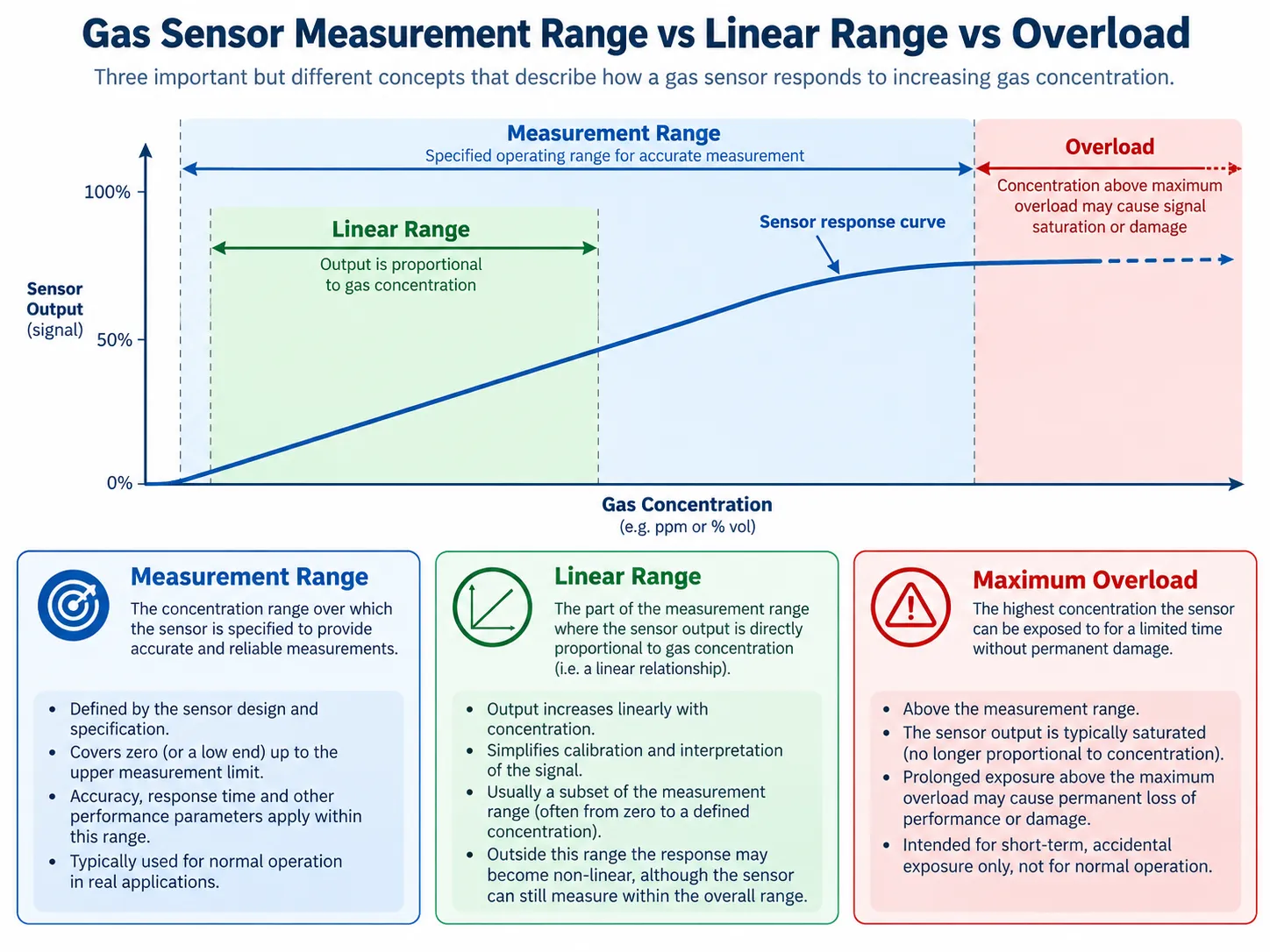
The measurement range, linear range, and maximum overload describe different limits. The diagram is conceptual; actual boundaries and definitions must be taken from the individual sensor datasheet.
1. Measurement Range vs Linear Range vs Maximum Overload
The three terms answer three different engineering questions:
- Measurement range: Over what gas concentration interval is the sensor specified to provide measurements?
- Linear range: Over what interval does its output follow the specified linearity relationship?
- Maximum overload: What high-concentration exposure limit does the manufacturer specify outside normal measurement operation?
| Datasheet parameter | What it describes | How to use it |
|---|---|---|
| Measurement range | The concentration interval covered by the sensor’s measurement specification | Check that it covers the expected operating concentrations |
| Linear range | The interval over which the response meets the manufacturer’s linearity criterion | Check whether required quantitative measurements fall within this interval |
| Maximum overload | A manufacturer-defined high-exposure parameter beyond normal operation | Use it to understand exposure limitations, not as an extended measurement range |
These values are not interchangeable. They also do not follow one universal format across all manufacturers. One datasheet may state a linear range as an interval, while another may list only its upper limit.
The exact definitions, test conditions, and notes in the manufacturer’s datasheet take priority over a generic interpretation.
A simple example
Imagine a hypothetical sensor with these specifications:
| Parameter | Example value |
|---|---|
| Measurement range | 0–100 ppm |
| Linear range | 0–80 ppm |
| Maximum overload | 200 ppm |
In this example, the sensor is specified for measurements from 0 to 100 ppm, its response meets the stated linearity criterion from 0 to 80 ppm, and the manufacturer specifies 200 ppm as a maximum-overload parameter.
The 200 ppm value does not mean that the sensor can accurately measure concentrations between 100 and 200 ppm. Nor does it mean that continuous exposure at 200 ppm is acceptable.
This example is illustrative only. Real sensor specifications and overload definitions vary.
2. What Is a Gas Sensor Measurement Range?
The measurement range is the concentration interval over which a sensor or instrument is specified to measure the target gas under stated operating conditions.
It is commonly expressed in units such as:
- ppm (parts per million)
- ppb (parts per billion)
- %vol (percentage by volume)
- %LEL (percentage of the lower explosive limit)
- mg/m³ (mass concentration)
For example, a carbon monoxide sensor may have a measurement range of 0–1,000 ppm, while a low-concentration chlorine sensor may be designed for a range of only a few ppm.
The correct range depends on the gas, application, expected concentration, and required performance.
Does measurement range always start at zero?
No. Some sensors have a specified lower measurement limit above zero. A datasheet may also distinguish between measurement range, lower detectable limit, and resolution.
For example, a specification of 1–100 ppm does not mean that the sensor can provide a validated quantitative measurement at 0.1 ppm.
Always check both the lower and upper endpoints.
Sensor range vs gas detector range
The sensing element and the complete gas detector are not necessarily specified in the same way.
A detector may include a sensing element, signal-conditioning electronics, an analog-to-digital converter (ADC), firmware and calibration coefficients, alarm thresholds, and a display or digital communication interface.
The final instrument range may be limited by the sensor, electronics, firmware configuration, or display. When integrating a sensor into an instrument, check the complete measurement chain rather than relying only on the sensing element’s datasheet.
3. What Is a Gas Sensor Linear Range?
The linear range is the concentration interval over which the sensor output follows an approximately proportional relationship with the target-gas concentration, within the manufacturer’s stated linearity tolerance.
In a simplified linear response:
[
S = S_0 + kC
]
Where:
- (S) is the sensor output.
- (S_0) is the baseline output.
- (k) is the response coefficient or sensitivity.
- (C) is the gas concentration.
Within the linear region, a similar increase in concentration produces a predictable increase in output.
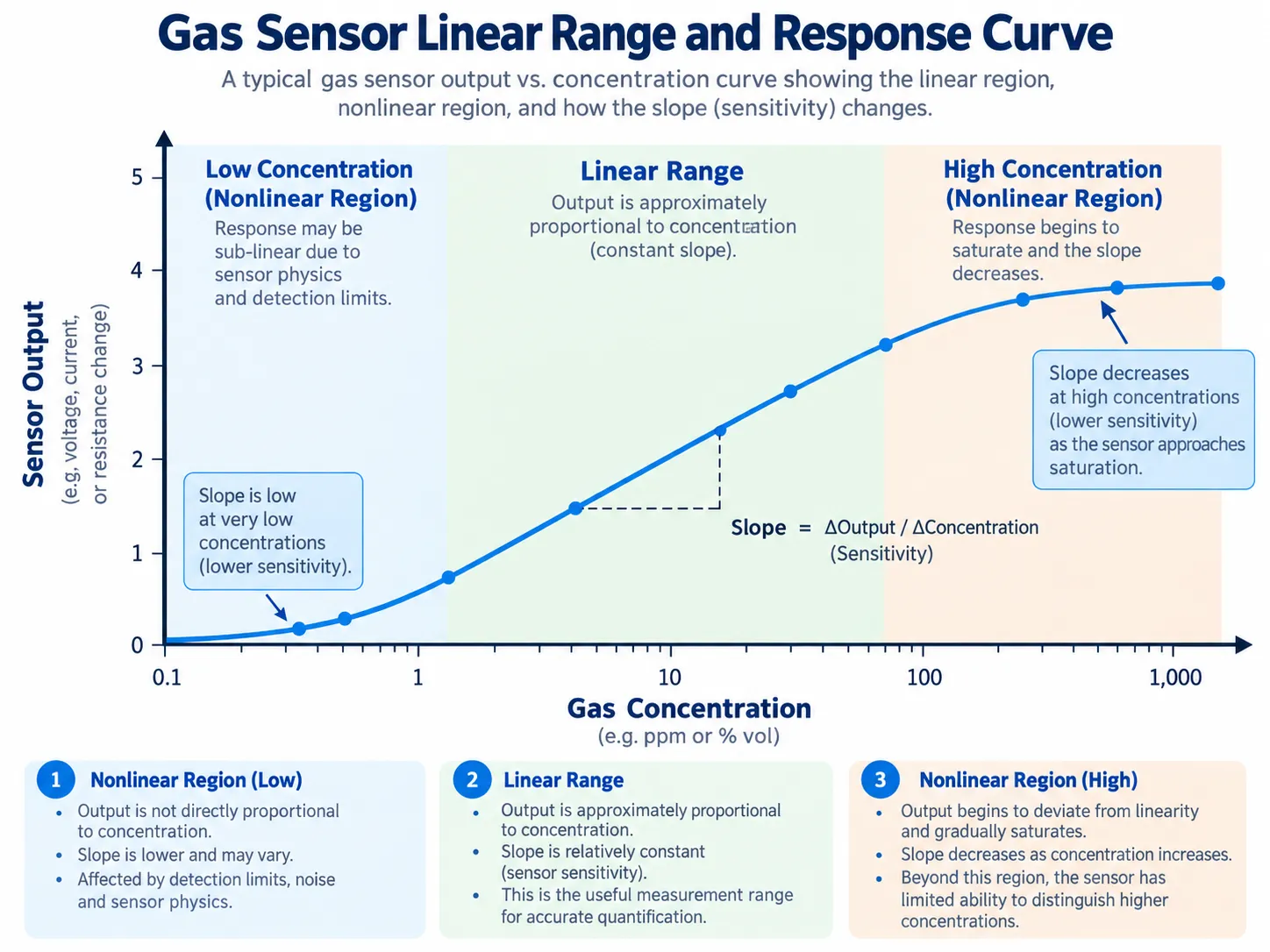
Conceptual response curve showing a low-concentration nonlinear region, an approximately linear region, and a high-concentration region where the response begins to deviate from linearity.
Why does linearity matter?
A predictable relationship between concentration and output makes calibration and measurement interpretation more straightforward.
If a sensor’s output is nonlinear, the instrument may still be able to measure concentration using a validated nonlinear calibration model. However, the relationship must be characterized and supported by the manufacturer’s specifications.
Linearity is not the same as accuracy. A sensor can have a highly linear response but still have a calibration offset or sensitivity error. Conversely, a nonlinear sensor may still provide useful measurements if its nonlinear response is accurately characterized over the specified range.
For a deeper explanation, see Gas Sensor Linearity and Linear Range Explained.
Is the linear range always smaller than the measurement range?
Not necessarily.
Some manufacturers specify the linear range as the full measurement range. Others define a narrower linear interval or provide a linearity tolerance over a stated concentration span.
For example, a datasheet may show:
- Measurement range: 0–5 ppm
- Linear range: 5 ppm
In this format, the linear-range value may indicate the upper concentration limit, rather than a separate range beginning at 5 ppm.
Do not assume that a number in the Linear Range row is a lower boundary. Read the table headings, units, footnotes, and manufacturer’s definitions.
4. What Does Maximum Overload Mean on a Gas Sensor Datasheet?
Maximum overload describes a manufacturer-defined high-concentration exposure limit beyond the sensor’s normal measurement operation.
It is not an extended measurement range.
A sensor may produce erroneous readings when exposed above its normal operating range. Depending on the sensor design and exposure conditions, it may also need an extended recovery period. Exposure beyond the manufacturer’s maximum-overload specification may cause permanent performance degradation or damage.
Honeywell’s Technical Note TN-114 provides a manufacturer-specific distinction:
- Range: The normal operating concentration where the best linearity is found. Exceeding the normal range may cause erroneous readings and long recovery times, while remaining below the stated maximum overload should not permanently damage the sensor under the note’s definition.
- Maximum overload: The maximum exposure concentration. Exceeding it is likely to cause erroneous readings and permanent sensor damage.
This is Honeywell’s terminology in TN-114. Other manufacturers may define overload parameters differently, so the exact sensor datasheet must always be checked.
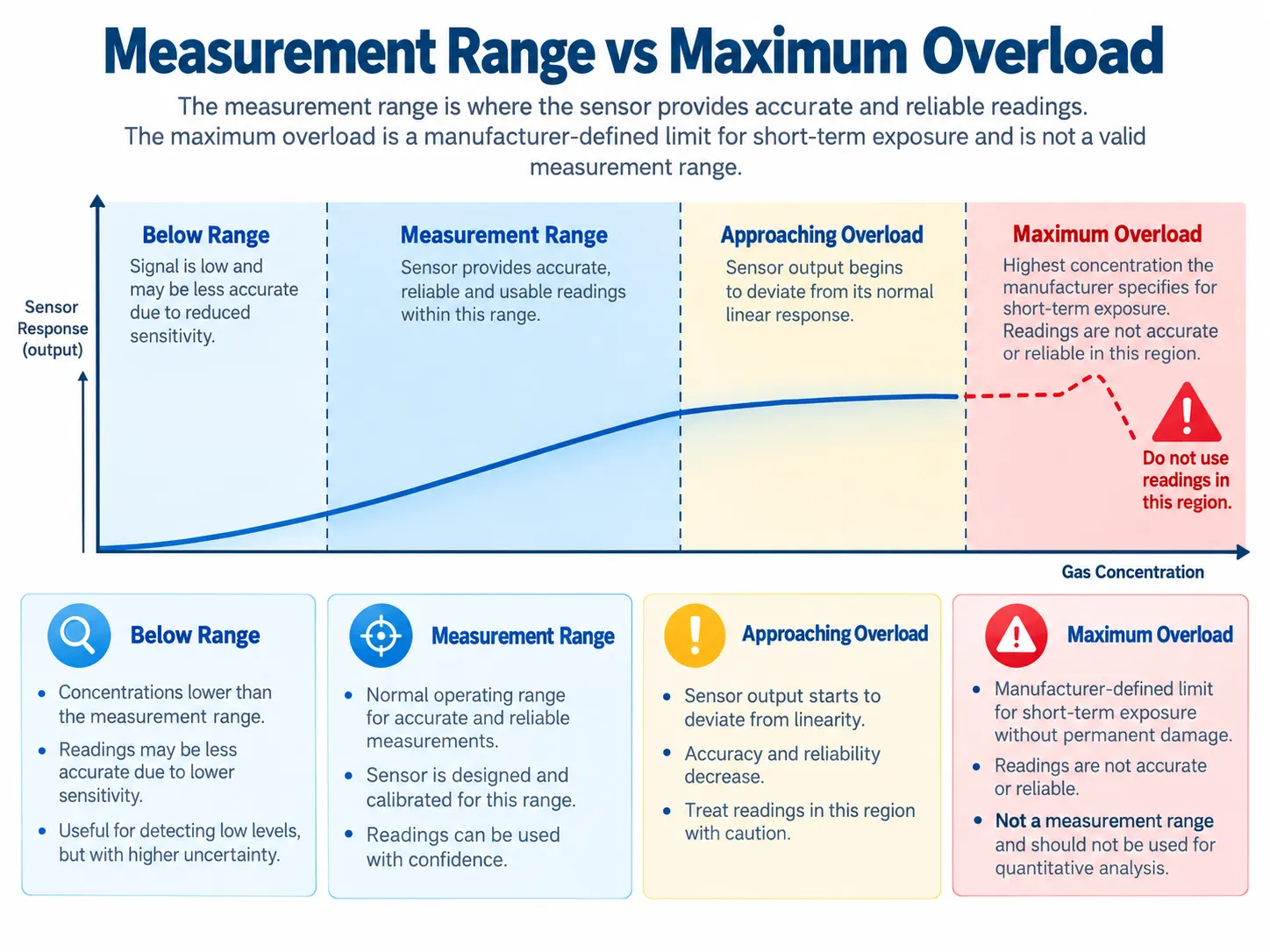
Conceptual illustration distinguishing the specified measurement region from a manufacturer-defined overload limit. It does not represent a universal response curve or a guaranteed damage threshold.
Why you should not use maximum overload as a design target
Suppose a sensor is specified for 0–100 ppm with a maximum overload of 200 ppm.
Selecting it for an application that regularly reaches 150 ppm would be inappropriate unless the manufacturer explicitly specifies valid measurement performance at that concentration.
The overload value does not establish measurement accuracy above the normal range, long-term stability at that concentration, continuous-exposure tolerance, a guaranteed recovery time, or a universal no-damage threshold for every exposure duration.
For the difference between over-range, saturation, and overload, see Gas Sensor Saturation and Over-Range Explained.
5. A Real Datasheet Example: SGX PS1-CL2-5 Chlorine Sensor
A real manufacturer datasheet makes the distinction easier to understand.
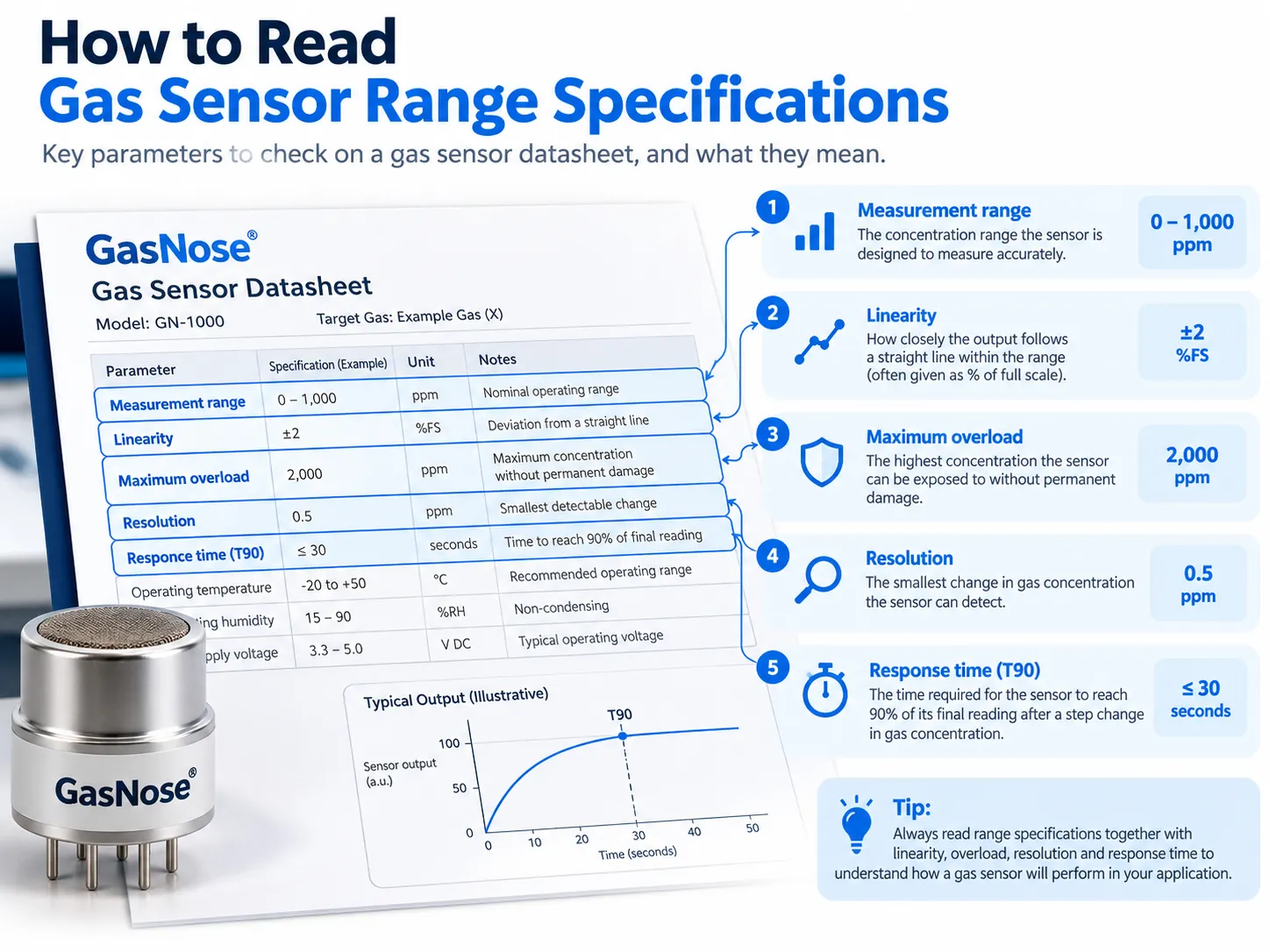
Use the datasheet’s parameter names, units, footnotes, and test conditions together; do not interpret a single value in isolation.
The SGX PS1-CL2-5 is an electrochemical chlorine sensor. Its official PS1/PS4-CL2-5 datasheet lists the following specifications:
| Parameter | Published specification |
|---|---|
| Measurement range | 0–5 ppm |
| Linear range | 5 ppm |
| Maximum overload | 10 ppm |
| T90 response time | Less than 60 seconds |
| Resolution (16-bit ADC) | Less than 0.01 ppm |
| Operating temperature range | -20°C to +40°C |
| Operating humidity range | 15–95% RH |
| Pressure range | 800–1200 hPa |
The datasheet also states that performance specifications are based on defined test conditions, including 20°C, 50% RH, and 1 atm.
How should these values be interpreted?
Measurement range: 0–5 ppm
This is the stated concentration range for measurement.
Linear range: 5 ppm
The datasheet lists 5 ppm as the linear-range value. In this context, it should be read as the stated upper limit of the linear range, not as a separate range beginning at 5 ppm.
Maximum overload: 10 ppm
This is a separate high-exposure specification. It does not extend the sensor’s stated measurement range to 10 ppm.
Resolution: less than 0.01 ppm
This describes a small concentration increment associated with the specified 16-bit ADC implementation. It does not mean that the sensor’s accuracy is ±0.01 ppm.
This example demonstrates why range, linearity, overload, and resolution should be read as separate parameters.
6. Measurement Range, Linear Range, Full Scale, Resolution, and Accuracy
A common datasheet-reading mistake is to treat every number associated with concentration as if it described the same performance characteristic.
They do not.
| Parameter | Main question it answers | Example |
|---|---|---|
| Measurement range | What concentration interval is specified for measurement? | 0–100 ppm |
| Linear range | Where does the output meet the specified linearity criterion? | 0–80 ppm |
| Full scale (FS) | What value represents the upper end of a defined measurement span? | 100 ppm FS |
| Resolution | What is the smallest distinguishable or reportable increment under the stated conditions? | 0.1 ppm |
| Accuracy | How close is the measured result to the reference value? | ±2 ppm, or a specified percentage |
| Detection limit | What is the lowest concentration that can be distinguished from the background under defined conditions? | 0.5 ppm |
| Maximum overload | What high-exposure limit does the manufacturer specify outside normal measurement operation? | 200 ppm |
The values in this table are illustrative, not specifications for a particular sensor.
Resolution is not accuracy
A detector that displays readings in 0.1 ppm increments is not necessarily accurate to ±0.1 ppm.
Display increment, ADC resolution, sensor noise, calibration uncertainty, and accuracy are different considerations.
Linearity is not accuracy
A sensor may have a linear response but still have an offset or sensitivity error. Accuracy also depends on calibration, environmental conditions, repeatability, and other error sources.
Detection limit is not the measurement range
A sensor may respond to a concentration below its specified quantitative measurement range. Detecting a signal does not automatically mean that the sensor can measure that concentration accurately.
For more detail, see Gas Sensor Detection Limit: LOD vs Resolution vs Accuracy.
7. How Operating Conditions Affect the Usable Measurement Range
A range specification is meaningful only when its associated operating conditions are understood.
Temperature, humidity, pressure, gas flow, and other environmental factors can influence sensor response. The direction and magnitude of the effect depend on the sensing technology and model.
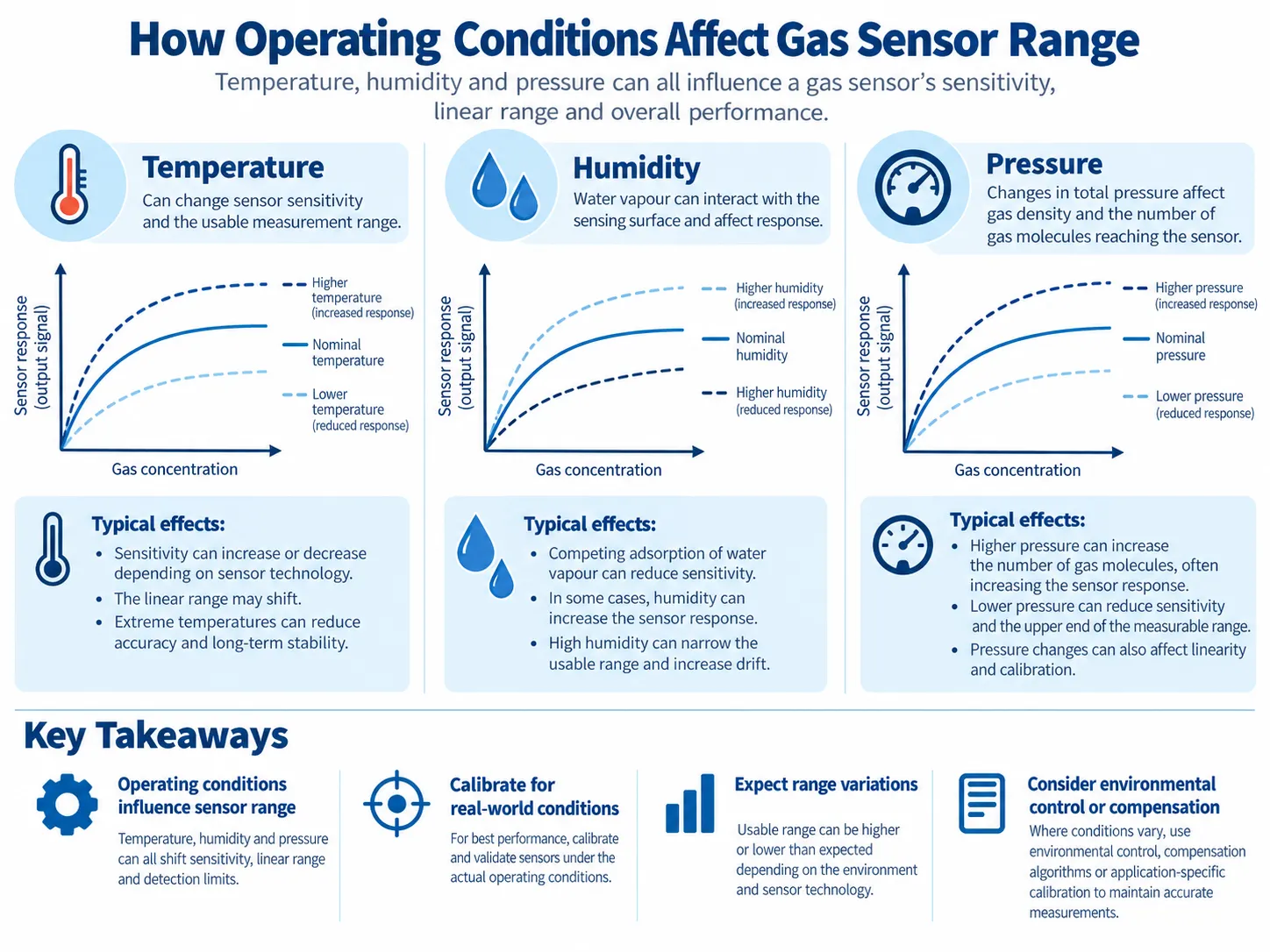
Temperature, humidity, and pressure can influence sensor response. The curves are conceptual and should not be interpreted as universal correction factors.
Temperature
Temperature can affect reaction rates, diffusion, material properties, and electronic components.
Depending on the sensor, temperature changes may influence sensitivity, baseline output, response time, zero stability, calibration, and the usable operating range.
Check the specified operating temperature and any temperature-compensation requirements.
Humidity
Water vapor can influence gas transport and sensing chemistry. Condensation may obstruct diffusion paths or affect sensor materials.
A humidity specification may distinguish between non-condensing operation and conditions where condensation is possible.
See How Humidity Affects Gas Sensors.
Pressure
Pressure changes can affect gas density, partial pressure, and the number of gas molecules reaching a sensing element. Some sensor designs may also show transient responses to rapid pressure changes.
Check whether the datasheet specifies an operating pressure range and whether pressure compensation is required.
Gas flow and sampling conditions
For diffusion sensors, the surrounding gas must reach the sensing surface through the sensor’s diffusion path. For pumped instruments, flow rate, tubing, filters, and sample-line design can affect the measurement.
A datasheet’s performance may be based on a defined flow condition. Do not assume the same performance under substantially different sampling conditions.
8. Why Two Gas Sensors Can Have Different Measurement Ranges
Two sensors designed to detect the same gas may have very different measurement ranges and performance characteristics.
One may be optimized for low-concentration monitoring, while another is designed for a higher-concentration industrial process.
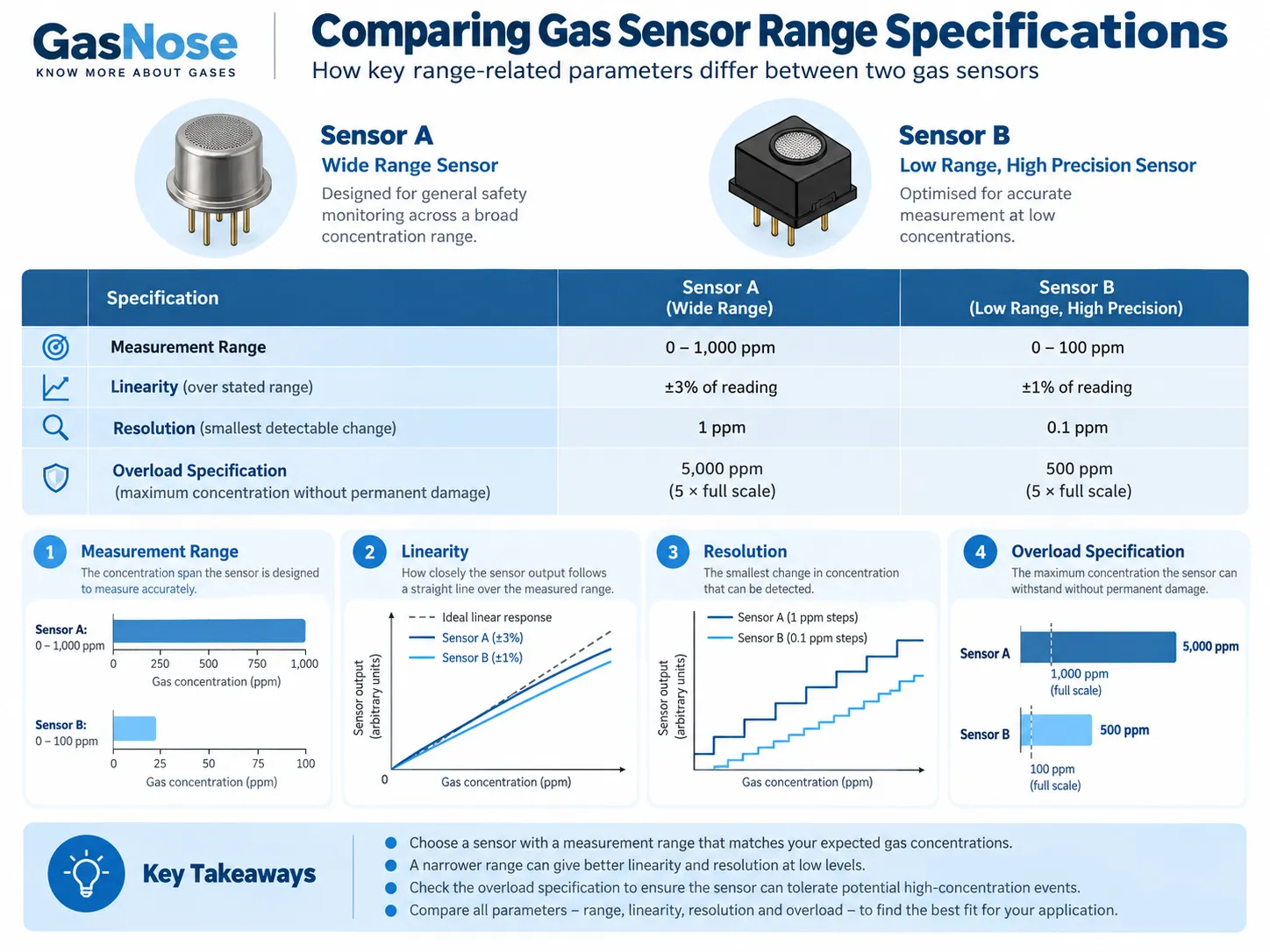
Illustrative comparison of two hypothetical sensors. The values are examples only and do not represent real product specifications.
Differences can result from:
Sensing technology
Electrochemical, semiconductor, catalytic, infrared, and photoionization sensors use different physical or chemical mechanisms. Their sensitivity, response behavior, and usable concentration ranges are therefore different.
Sensor construction
Electrode design, catalyst formulation, diffusion barriers, optical path length, sensing-material composition, and packaging can influence the range and response.
Intended application
A sensor for indoor air-quality monitoring may prioritize low-concentration detection. A sensor for an industrial process may need to cover much higher concentrations.
Signal conditioning and electronics
The analog front end, ADC, firmware, and calibration model can affect the usable range of the complete instrument.
Calibration and performance requirements
A wider range is not automatically better. The right choice depends on the required concentration interval, accuracy, resolution, response time, and operating conditions.
9. How to Choose the Correct Gas Sensor Measurement Range
Choosing a sensor by its maximum concentration alone is not sufficient. A practical selection process should consider both normal operation and credible high-concentration events.
Step 1: Identify the target gas
Confirm the exact gas to be measured. Do not assume that sensors for chemically related gases have interchangeable ranges or cross-sensitivity characteristics.
Step 2: Estimate the normal concentration
Determine the concentration expected during routine operation.
For example, a workplace monitoring application may normally operate at low ppm levels, while a process monitoring application may involve much higher concentrations.
Step 3: Identify credible peak concentrations
Consider process upsets, leaks, ventilation failures, and other realistic scenarios.
The selected measurement range should be appropriate for the concentrations that the instrument is expected to quantify. Do not use maximum overload as a substitute for a suitable measurement range.
Step 4: Confirm the required linearity and accuracy
If the application requires quantitative reporting, check whether the expected operating concentrations fall within the range for which the manufacturer specifies the required linearity and accuracy.
Step 5: Check resolution and detection limit
For low-concentration applications, confirm that the sensor can distinguish the required concentration changes. A wide measurement range may not provide the low-level performance needed by the application.
Step 6: Review maximum overload
Check the manufacturer’s overload definition, exposure conditions, and instructions for recovery or replacement after high-concentration exposure.
Step 7: Check environmental conditions
Confirm that temperature, humidity, pressure, and sampling conditions fall within the specified operating limits.
Step 8: Evaluate the complete instrument
If the sensor is being integrated into a gas detector or monitoring system, verify the electronics, calibration, display range, alarm settings, and communication output.
Step 9: Confirm maintenance and calibration requirements
Review calibration intervals, expected drift, response-time requirements, and the manufacturer’s replacement criteria.
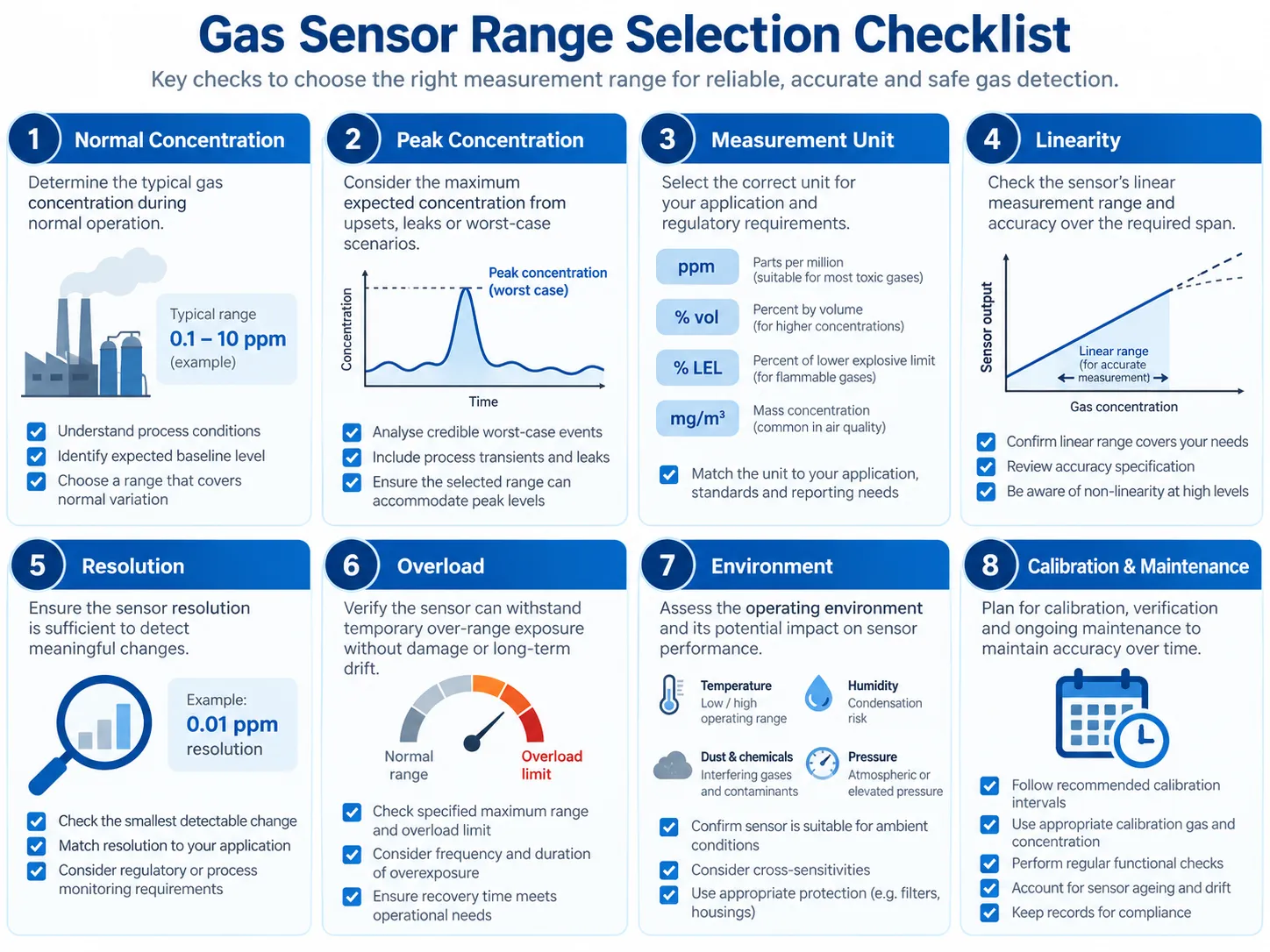
Use this checklist to compare datasheet parameters before selecting a gas sensor for an application.
10. Common Mistakes When Reading Gas Sensor Range Specifications
- Treating maximum overload as an extended measurement range. Maximum overload is not an additional range of guaranteed accurate measurements.
- Assuming linear range and measurement range are always identical. Some datasheets specify the same span for both, while others distinguish them.
- Assuming a wider range is always better. A wider range may not provide the low-concentration sensitivity or resolution required by an application.
- Confusing resolution with accuracy. A small display increment does not prove that the measurement is accurate to the same increment.
- Ignoring the lower measurement limit. A sensor with a high upper range may not be suitable for an application requiring reliable measurements near very low concentrations.
- Comparing %LEL directly with %vol. These units describe different quantities. %LEL is relative to the lower explosive limit of a particular gas, while %vol expresses the gas fraction by volume.
- Ignoring environmental test conditions. A datasheet specification may apply only under stated temperature, humidity, pressure, and flow conditions.
- Comparing sensor-element range with instrument range. The complete detector may have different limits from the sensing element.
- Assuming the overload value guarantees survival under every exposure. Exposure duration, gas composition, environmental conditions, and manufacturer-specific definitions all matter.
- Selecting a sensor based only on one datasheet number. A suitable sensor must meet the application’s requirements for range, linearity, accuracy, resolution, response time, environmental conditions, and overload tolerance.
11. Frequently Asked Questions
What is the difference between measurement range and linear range?
Measurement range is the concentration interval specified for measurement. Linear range is the interval over which the sensor output meets the manufacturer’s stated linearity criterion. They may be the same or different, depending on the sensor specification.
Is linear range always smaller than measurement range?
No. Some manufacturers specify linearity across the full measurement range. Others specify a narrower linear region. Always check the exact datasheet.
What does maximum overload mean on a gas sensor?
Maximum overload is a manufacturer-defined high-exposure parameter outside normal measurement operation. It should not be treated as an extension of the measurement range.
Can a gas sensor measure above its specified measurement range?
The sensor may still produce an output above its specified range, but that output should not be assumed to provide an accurate quantitative measurement. Follow the manufacturer’s instructions for over-range conditions.
Does maximum overload mean the sensor will not be damaged?
Not universally. The meaning depends on the manufacturer’s definition and specified exposure conditions. Some manufacturers define the maximum-overload limit as a level beyond which permanent damage is likely.
What happens when gas concentration exceeds the measurement range?
The output may become nonlinear, readings may become erroneous, recovery may take longer, or the instrument may indicate over-range. The result depends on the sensing technology, instrument design, and exposure conditions.
How do resolution and accuracy differ from measurement range?
Measurement range defines the concentration interval. Resolution describes the smallest distinguishable or reportable increment under specified conditions. Accuracy describes how close the result is to the reference value.
How do I choose the correct measurement range for a gas sensor?
Start with the target gas and expected concentration profile. Then check the required linearity, accuracy, resolution, detection limit, environmental conditions, response time, and overload specification.
Can a sensor have a wide measurement range but poor low-concentration performance?
Yes. A wide range does not automatically guarantee good sensitivity, resolution, or accuracy near the lower end. Review the complete performance specification.
Is the sensor’s measurement range always the same as the gas detector’s display range?
No. The detector’s electronics, firmware, calibration, and display configuration may impose different limits. Check the complete instrument specifications.
Conclusion
Measurement range, linear range, and maximum overload are related, but they describe different aspects of gas sensor performance.
- Measurement range identifies the concentration interval covered by the measurement specification.
- Linear range identifies where the output meets the manufacturer’s linearity criterion.
- Maximum overload describes a manufacturer-defined high-exposure limit outside normal measurement operation.
A wider measurement range does not automatically mean better performance, and a higher maximum-overload value does not mean that the sensor can accurately measure at that concentration.
For reliable sensor selection, compare the complete datasheet: measurement range, linearity, accuracy, resolution, detection limit, response time, environmental conditions, and overload specifications.
The right gas sensor is not simply the one with the highest range. It is the one whose validated measurement performance matches the actual application.
References and Further Reading
Manufacturer references
- SGX Sensortech — PS1/PS4-CL2-5 Chlorine Sensor Datasheet
- Honeywell — Technical Note TN-114: Sensor Specifications and Cross-Sensitivities
