



A gas sensor is designed to measure gas concentration within a specified range. When the actual concentration exceeds that range, the sensor may display a maximum value, report an over-range condition, recover slowly, or suffer performance degradation. The outcome depends on the sensing technology, target gas, instrument design, and exposure conditions.
Three terms are especially important:
- Over-range: The gas concentration or measured signal exceeds the instrument’s specified measurement range.
- Saturation: The sensor or another part of the measurement chain can no longer produce a normal increase in output as the input increases.
- Maximum overload: A manufacturer-defined high-exposure parameter outside normal measurement operation. Its exact meaning depends on the datasheet.
A sensor can go over-range without being permanently damaged. However, an over-range indication does not reveal the actual concentration above the measurement limit, and a normal-looking reading after exposure does not prove that the sensor has recovered.
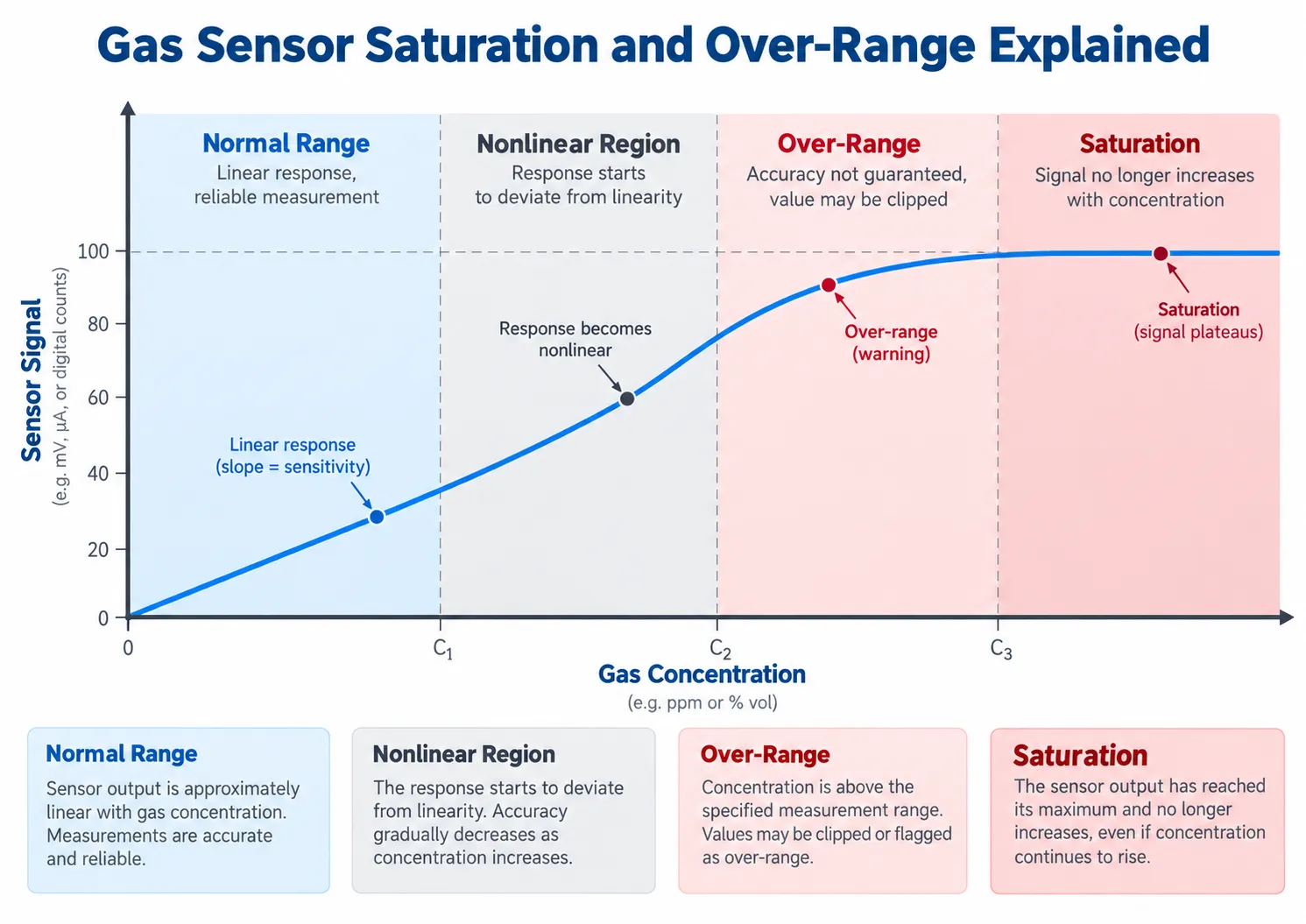
Illustration: Normal response, nonlinear operation, over-range and output saturation. The boundaries are conceptual and depend on the sensor and instrument.
1. Measurement Range vs Linear Range vs Over-Range
| Term | Meaning | Can the reading be trusted quantitatively? |
|---|---|---|
| Measurement range | Concentration interval covered by the stated measurement specifications | Yes, within the stated performance and operating conditions |
| Linear range | Region in which the response meets the specified linearity criterion | Subject to the datasheet’s other accuracy specifications |
| Nonlinear region | Output no longer follows the expected concentration relationship closely enough to meet the linearity criterion | Depends on the specified performance and calibration model |
| Over-range | Concentration or signal exceeds the specified measurement range | Do not assume the displayed value is accurate |
| Saturation | Output approaches a limit and changes very little as the input continues to increase | Generally unsuitable for quantitative measurement beyond the validated region |
| Maximum overload | Manufacturer-defined high-exposure limit | Do not treat it as a valid measurement range |
These limits can differ. A sensor may become nonlinear before reaching its maximum output, and an instrument may indicate over-range before the sensing element reaches physical saturation.
For more on the normal response region, see Gas Sensor Linearity and Linear Range Explained.
A real datasheet example
The SGX PS1-CL2-5 chlorine sensor lists the following parameters in its official datasheet:
| Parameter | Published specification |
|---|---|
| Measurement range | 0–5 ppm |
| Linear range | 5 ppm |
| Maximum overload | 10 ppm |
| T90 response time | Less than 60 seconds |
| The maximum-overload value is listed separately from the measurement and linear ranges. It does not establish that 10 ppm is an accurate quantitative measurement point. |
Honeywell’s Technical Note TN-114 explains that measurements outside a sensor’s normal range can be erroneous and recovery can take longer. Its definition of maximum overload describes a concentration beyond which erroneous readings and permanent damage are likely. Other manufacturers may define or use the term differently.
Therefore:
- Do not assume every sensor will survive its stated overload indefinitely. – Do not assume a sensor is accurate at its maximum-overload concentration. – Check the manufacturer’s conditions, exposure duration, recovery guidance and post-exposure test requirements.
Maximum overload is not an extension of the normal measurement range.
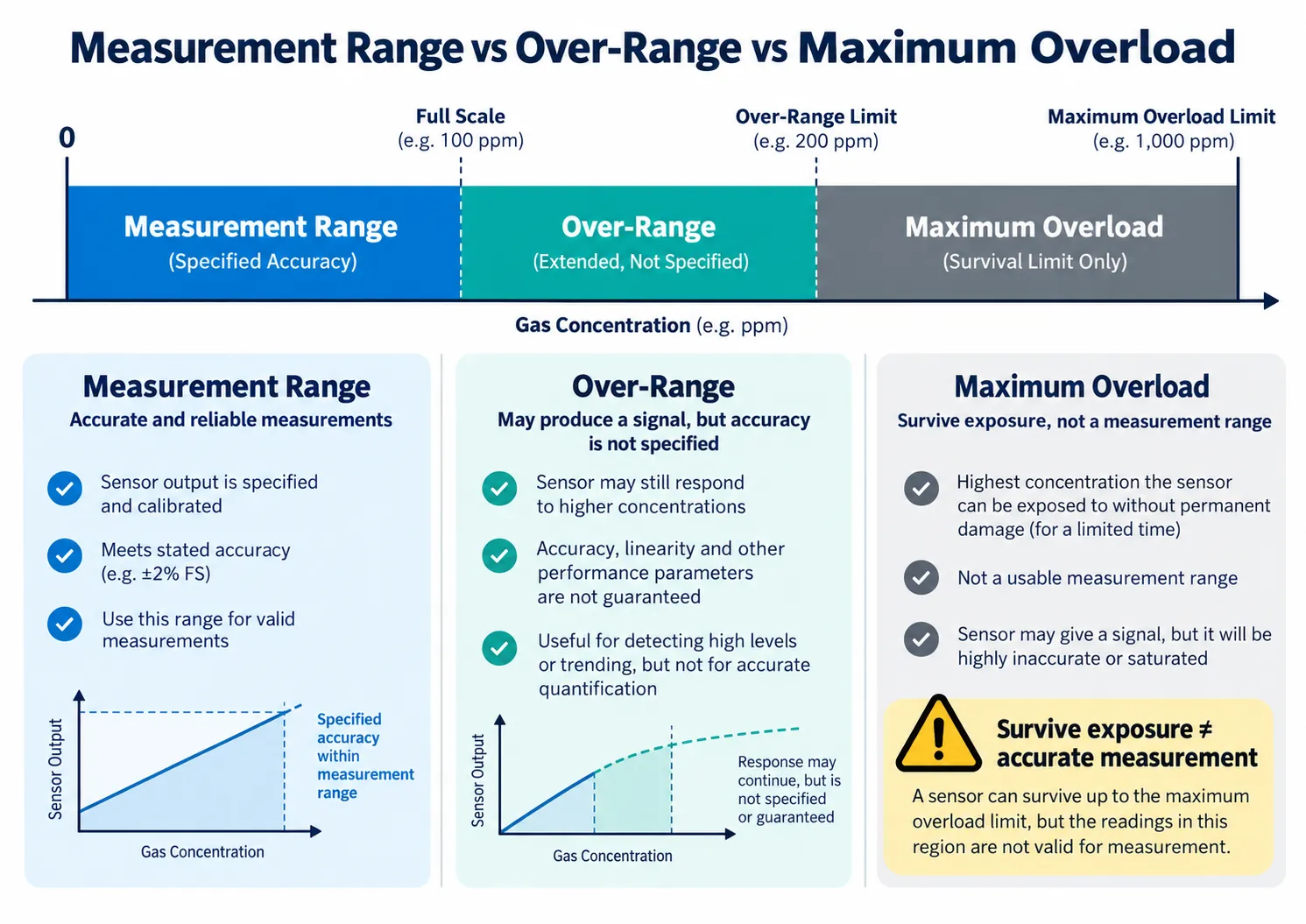
Illustration: Measurement range, over-range and a manufacturer-defined overload limit. The boundaries are illustrative, not universal specifications.
2. What Is Gas Sensor Saturation?
Saturation occurs when increasing gas concentration no longer produces the expected increase in output.
In a normal linear region:
Gas concentration increases
          ↓
Sensor output increases proportionally
Near saturation:
Gas concentration increases
          ↓
Output increases more slowly
          ↓
Output approaches a plateau
At or near the plateau, a substantial increase in concentration may produce almost no change in output.
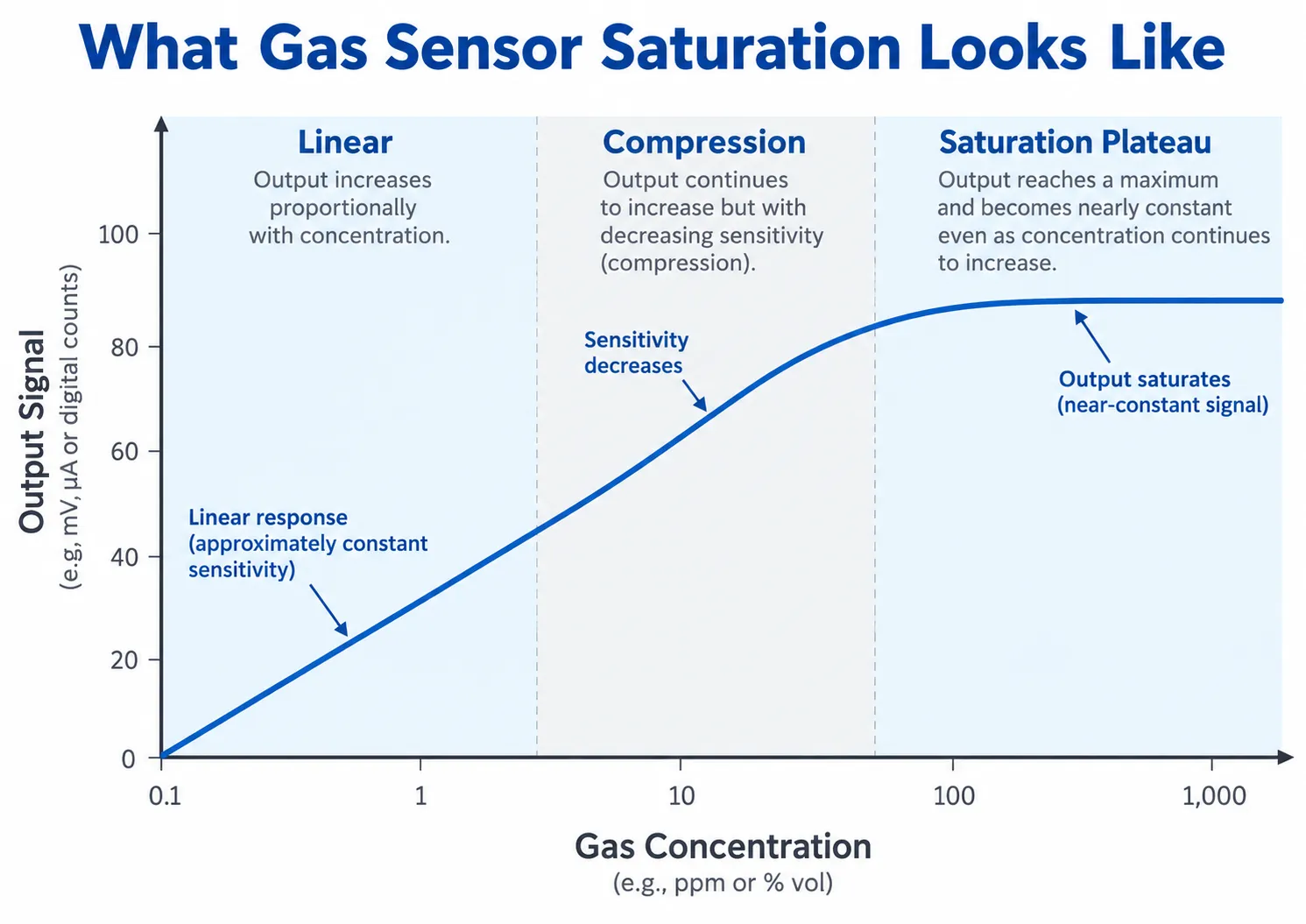
Illustration: A conceptual response curve showing linear response, nonlinear compression and a saturation plateau.
The slope of a response curve represents how much output changes for a change in concentration. When the slope decreases, incremental sensitivity is decreasing. When the output becomes nearly constant, the system may no longer distinguish meaningfully between concentrations in that region.
For example, if a detector’s display limit is 100 ppm, the actual concentration might rise from 120 ppm to 300 ppm while the display remains capped or shows an over-range warning. The display alone cannot determine the actual concentration.
Keep these distinctions clear:
- Saturation describes a response limitation.
- Over-range describes operation beyond a specified range.
- Damage means required sensor or instrument performance has been lost.
These conditions can occur together, but one does not automatically prove the others.
3. Saturation Can Occur at Different Stages of a Measurement System
A gas detection system may contain a sensing element, analog electronics, an analog-to-digital converter (ADC), firmware and a display. Any stage can limit the final reading.
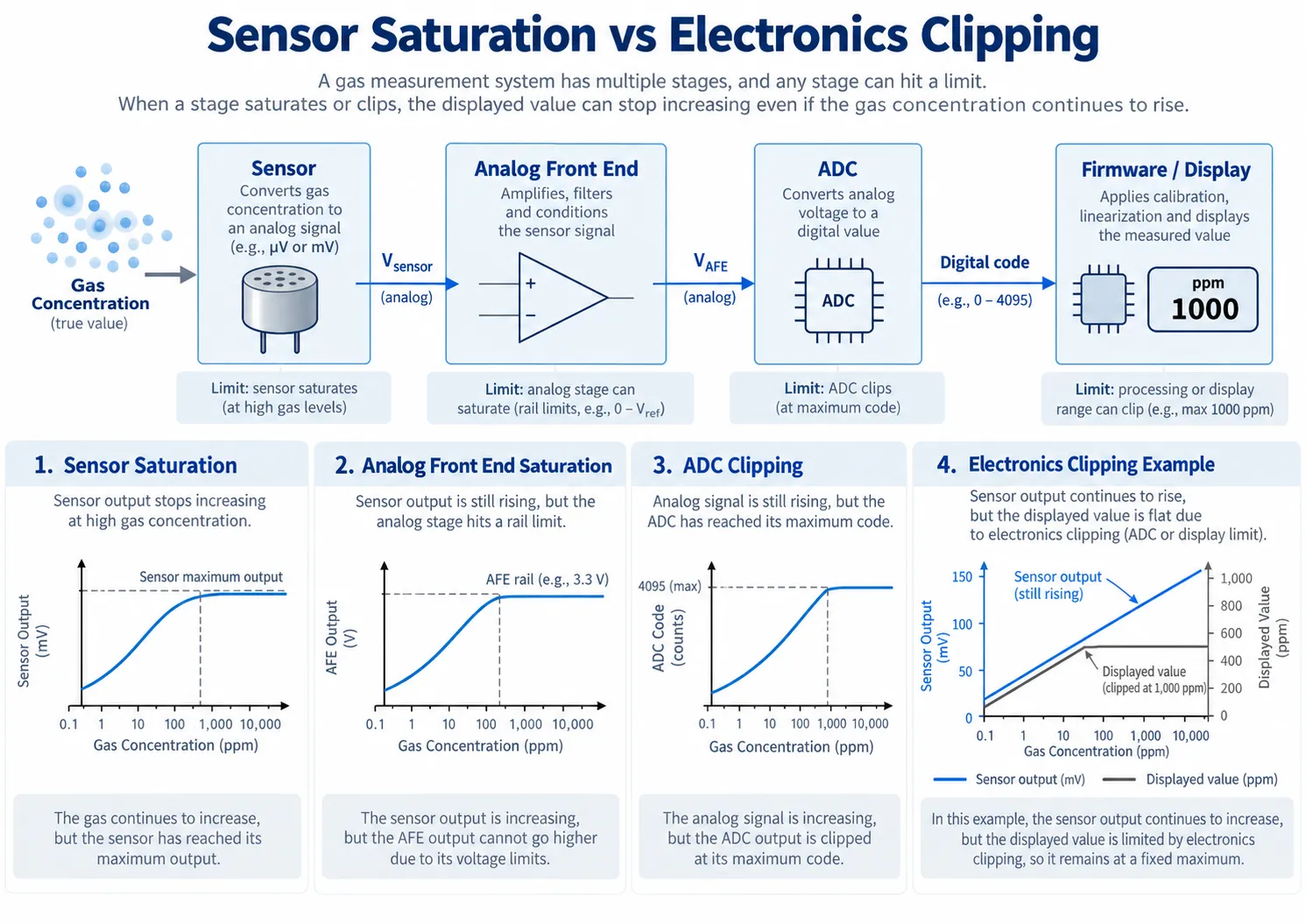
Sensor-level saturation
The sensing element itself may become nonlinear or reach a physical or chemical response limit. Possible mechanisms include limited gas transport through a diffusion barrier, changes in electrochemical reaction behavior, surface adsorption approaching a limiting condition, or optical signal limitations at high absorbance. The mechanism depends on the technology.
Analog front-end saturation
An analog front end amplifies or conditions the sensor signal. If the signal exceeds the circuit’s available voltage range, the amplifier output can reach a rail. The sensing element may still be generating a changing signal, but the electronics cannot represent it correctly.
ADC clipping
An ADC converts an analog signal into a digital value. A 12-bit ADC, for example, has codes from 0 to 4095. Once the input reaches full scale, a larger analog input cannot be represented by a higher code.
Firmware or display limiting
An instrument may impose a software or display ceiling. Whether it clips the value, flags over-range, or shows another indication depends on the design.
A flat displayed reading does not prove that the sensing element itself is saturated.
Engineers should check the full signal chain before deciding whether the sensor, electronics, firmware or calibration model is responsible.
4. What Does OL or Over-Range Mean on a Gas Detector?
Portable and fixed gas detectors may show OL, OVER, an upward arrow, a flashing high-concentration warning, or a latched alarm. The exact meaning depends on the instrument manual.
In general, an over-range indication means that the instrument cannot provide a normal quantitative reading under the current conditions. It does not mean that the concentration equals the display maximum.
If a detector measures up to 100 ppm, an over-range event could involve a concentration slightly above 100 ppm or substantially higher. The indication alone cannot distinguish between these possibilities.
A capped reading can create a false sense of certainty. If the actual concentration is above the measuring range, treating the displayed value as accurate could underestimate the hazard. Follow the detector’s instructions and site procedures; for safety-critical events, verify the atmosphere using equipment suitable for the expected gas and concentration.
5. How Electrochemical Gas Sensors Behave During Over-Range Exposure
Electrochemical sensors are commonly used to detect toxic gases such as CO, H₂S, SO₂, NO₂ and Cl₂. Within the specified range, the cell’s current can be calibrated to estimate concentration. At high concentrations, the relationship between concentration and output may no longer follow the expected calibration.
Potential contributors include:
- Gas transport through the diffusion barrier – Electrochemical reaction behavior – Electrode and electrolyte characteristics – Sensor-specific response limits – Analog circuitry and signal processing
Not every electrochemical sensor behaves identically, and high concentration does not automatically mean permanent damage.
Why recovery can take longer after a high-concentration event
After exposure outside the specified range, the reading may remain elevated, drift or stabilize more slowly than expected. Sensitivity or response time may also change.
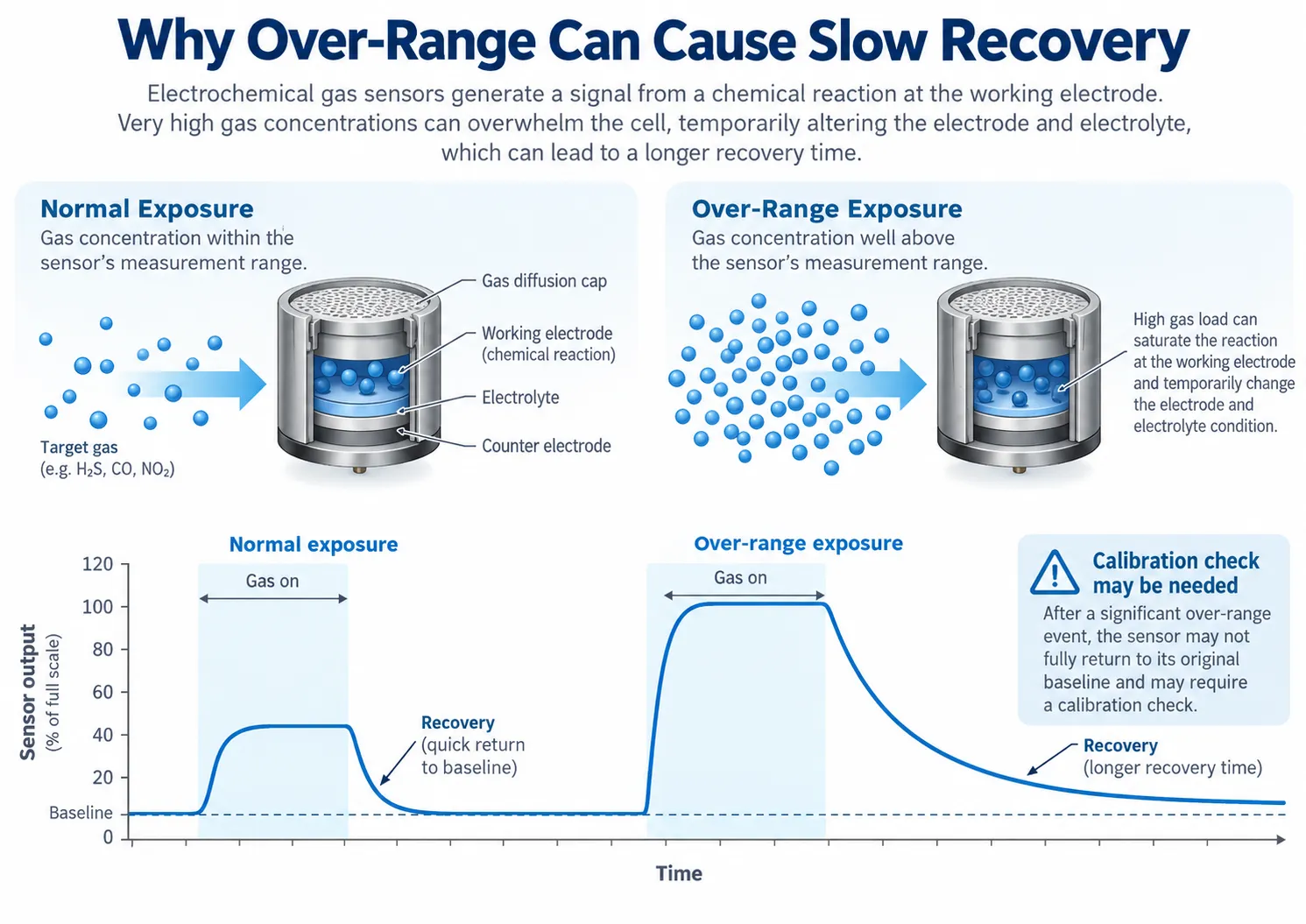
Illustration: A conceptual comparison between normal exposure and high-concentration exposure followed by slower recovery. Actual behavior depends on the sensor model and exposure conditions.
High-concentration exposure
          ↓
Gas concentration falls
          ↓
Sensor output begins to recover
          ↓
Baseline and response stabilize
          ↓
Performance verification, if required
A return to zero on the display does not prove that the sensor can still measure accurately.
See Gas Sensor Response Time: T50 vs T90 Explained and Gas Sensor Response Time vs Recovery Time.
Overload tolerance varies by gas, sensing chemistry, construction and model. Honeywell’s TN-114 notes that some ammonia sensors can fail after exposure above approximately 200–300 ppm. This is a manufacturer-specific example, not a universal threshold. Always check the exact model’s datasheet.
6. Why Catalytic LEL Sensors Need Special Attention
Catalytic bead sensors, often called pellistors, are widely used to measure combustible gases. Their output depends on oxidation of combustible gas at a heated sensing element. Under suitable conditions, the resulting temperature change produces a signal related to concentration.
A catalytic sensor does not necessarily continue to provide reliable measurements as combustible-gas concentration rises beyond its specified range.
100% LEL does not mean 100% gas by volume
- %LEL expresses concentration relative to the lower explosive limit of a combustible gas.
- %vol expresses the fraction of the gas mixture occupied by the measured gas.
Therefore:
[ 100%\text{ LEL}{=tex} \ne 100{=tex}%\text{ vol}{=tex} ]
A reading of 100% LEL means the concentration has reached the defined lower explosive limit for the relevant gas and calibration basis. It does not mean the atmosphere contains 100% combustible gas. The conversion between %LEL and %vol depends on the gas and applicable LEL definition.
Why very high combustible-gas concentrations can be problematic
Catalytic sensors depend on combustion-related reactions. If the atmosphere becomes oxygen-deficient, the sensor may no longer measure reliably. Dräger’s X-am technical manual warns that a CatEx sensor may display incorrect values in oxygen-deficient atmospheres below 12 vol.% O₂.
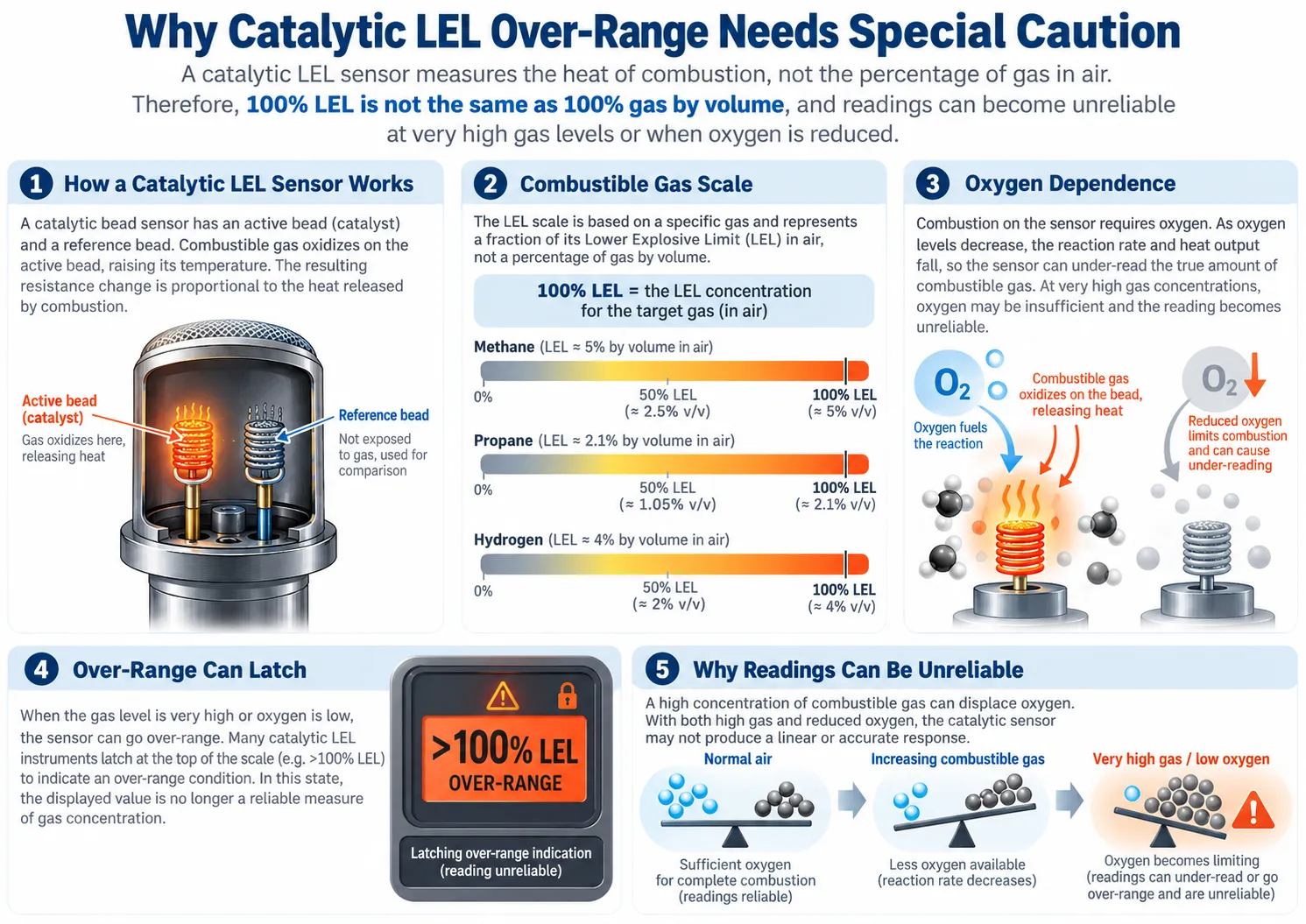
Illustration: Why an LEL over-range event requires caution, particularly when oxygen availability may affect catalytic measurement.
Do not assume that a declining display means the atmosphere is safe. Follow the instrument manufacturer’s over-range procedure and site emergency response requirements. Where necessary, verify the atmosphere with equipment suitable for the expected concentration. Do not bypass latching or blocking alarms simply because they are inconvenient.
For related background, see Catalytic Gas Sensor Poisoning and Inhibition Explained.
7. Saturation in MOS, NDIR and PID Gas Sensors
Different technologies can reach measurement limits through different mechanisms. These are general engineering considerations, not universal failure descriptions.
MOS / semiconductor gas sensors
Metal-oxide semiconductor (MOS) sensors detect gases through changes in the electrical behavior of a sensing material. At higher concentrations, the relationship between concentration and resistance may become nonlinear. Surface interactions, adsorption and operating conditions influence the response.
A sensor may continue responding while its sensitivity decreases, or its output may approach a plateau. Evaluate saturation using the actual resistance-to-concentration relationship and validated operating range.
See Semiconductor Gas Sensors.
NDIR gas sensors
Non-dispersive infrared (NDIR) sensors estimate gas concentration from infrared absorption. At higher absorbance, less infrared radiation may reach the detector. Optical design, detector dynamic range, signal-to-noise ratio and the calibration model determine the usable concentration range.
Do not assume all NDIR sensors saturate at the same concentration or that every nonlinear response indicates damage.
See NDIR Gas Sensors.
PID VOC detectors
Photoionization detectors (PIDs) measure ionizable volatile organic compounds (VOCs). Their usable range depends on the instrument, target compound, lamp, electronics and calibration. An over-range PID reading should not be interpreted as a reliable estimate of how far the concentration exceeds the specified limit.
PID readings are compound-dependent, so a numerical limit for one calibration gas should not automatically be applied to every VOC.
See PID vs LEL Gas Detector: What’s the Difference?.
8. Over-Range vs Poisoning vs Sensor End of Life
| Condition | What it describes | Does it necessarily mean permanent damage? |
|---|---|---|
| Over-range | Concentration or signal exceeds the specified measurement range | No |
| Saturation | Output reaches a response limitation | No |
| Poisoning | Exposure degrades sensing capability through a poisoning mechanism | It may cause persistent or permanent degradation |
| Drift | Output changes over time under comparable conditions | No |
| End of life | Sensor no longer meets required performance or service criteria | Replacement may be required |
An electrochemical sensor may temporarily over-range and then recover. Another sensor may experience an exposure that causes persistent sensitivity loss. Over-range is not synonymous with poisoning.
See Gas Sensor Poisoning vs Cross-Sensitivity.
Can a sensor return to zero and still be damaged?
Yes. A sensor can display a plausible zero while its sensitivity, response time or calibration has deteriorated. A zero reading alone does not demonstrate that it will correctly measure a subsequent gas exposure.
Does over-range mean the sensor has reached end of life?
Not necessarily. The decision depends on whether the sensor can recover and meet the manufacturer’s performance requirements. If it cannot be calibrated, has insufficient sensitivity, responds too slowly or produces unstable results, replacement may be necessary.
See Gas Sensor Lifetime: What Determines Sensor End of Life?.
9. What to Check After a Gas Sensor Goes Over Range
The correct response depends on the gas, instrument, exposure conditions and application. For safety-critical detectors, follow the manufacturer’s procedure and applicable site requirements.
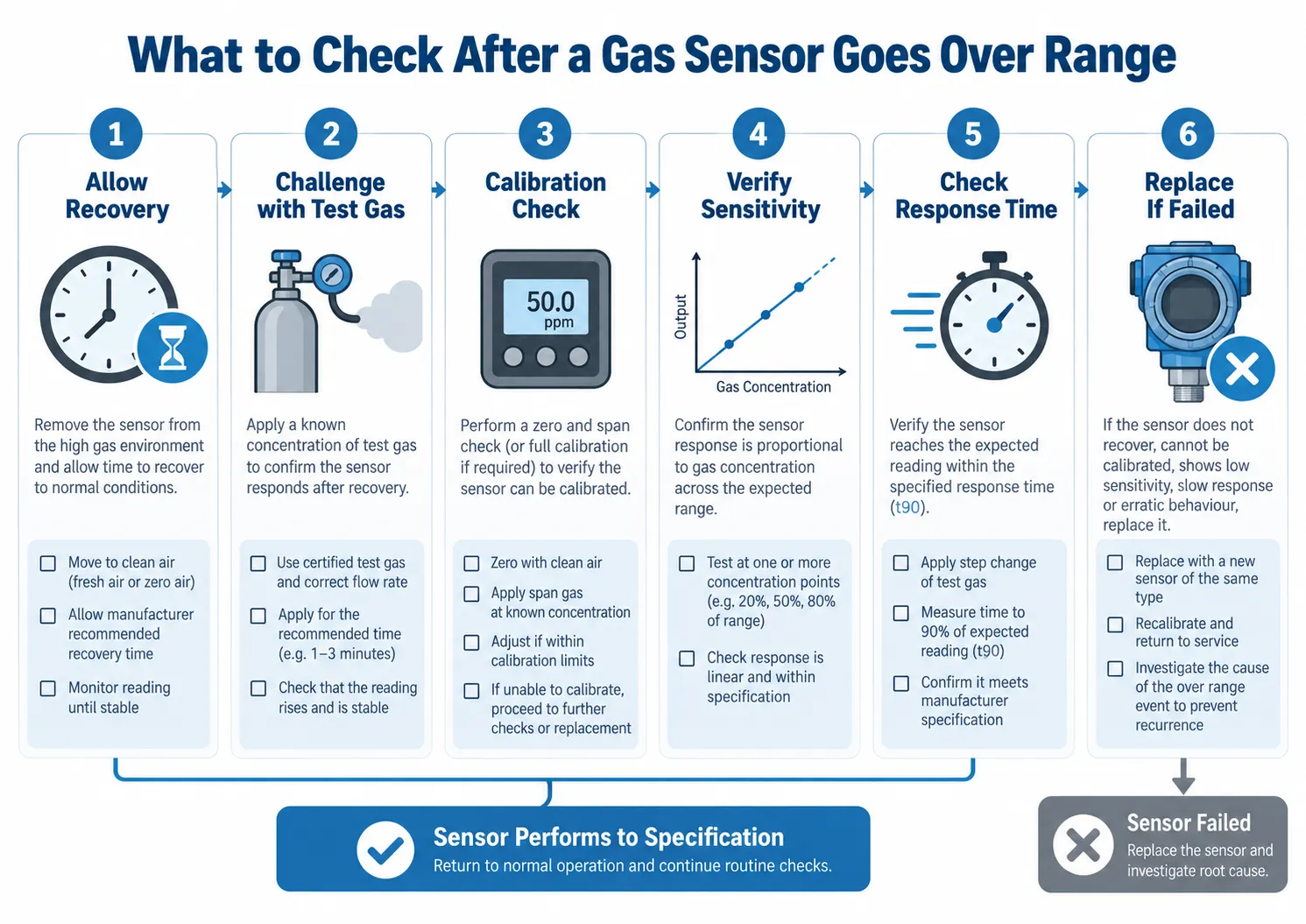
Illustration: A general post-over-range verification workflow. Actual recovery time and testing must follow the sensor or instrument manufacturer’s instructions.
Step 1: Treat the atmosphere as potentially hazardous
Do not use a capped reading as an accurate concentration measurement. Follow site safety procedures, including evacuation or isolation where required.
Step 2: Remove the detector from hazardous exposure when safe
Follow the instrument’s operating instructions. Do not enter or remain in a hazardous area merely to investigate a reading.
Step 3: Allow the sensor to recover
Some sensors need time to return to stable operation after high-concentration exposure. There is no universal recovery time; it depends on the model, target gas, concentration, exposure duration and environment.
Step 4: Check the zero or baseline
Once the instrument is in an appropriate clean environment and has stabilized according to its instructions, check whether the baseline is within specification. A normal zero is useful information, but it does not prove full performance.
Step 5: Apply the appropriate challenge gas
Use the certified test gas, concentration, flow and application method specified by the manufacturer. Confirm that the sensor responds as expected.
Step 6: Check calibration and sensitivity
Perform a calibration check or full calibration as required. Do not compensate for a seriously degraded sensor by repeatedly increasing the calibration adjustment. If it cannot meet specification, investigate and replace it when required.
Step 7: Verify response time
A sensor that reaches the correct final value may still respond too slowly. Where required by the application, check the specified response time, such as T90, against the manufacturer’s limits.
Step 8: Document the event
Record, where available:
- Target gas and estimated exposure – Duration of exposure – Over-range indication or alarm – Recovery conditions and stabilization time – Zero and span verification results – Response-time results, if required – Calibration or replacement action
This history helps distinguish a temporary over-range event from persistent performance degradation.
Why a bump test alone may not be enough
A bump test can establish that a detector responds to test gas and may activate its alarm. It does not necessarily establish that quantitative accuracy and full performance remain within specification. Following a significant over-range event, additional verification or calibration may be necessary.
See Gas Detector Bump Test vs Calibration.
10. How to Read Overload Information in a Gas Sensor Datasheet
When selecting a sensor, review more than the nominal measurement range.
| Datasheet item | What to check |
|---|---|
| Measurement range | Concentration covered by stated measurement specifications |
| Linear range | Range over which response meets the manufacturer’s linearity criterion |
| Maximum overload | Manufacturer’s definition of the specified high-exposure limit |
| Exposure duration | Whether the condition applies to short exposure or continuous operation |
| Recovery behavior | Whether a recovery period is specified after high exposure |
| Calibration requirements | Whether a calibration check or full calibration is required after an event |
| Response time | Whether response-time performance remains within specification |
| Environmental conditions | Temperature, humidity, pressure and other specified conditions |
| Output and interface limits | Whether sensor, analog electronics, ADC or software can limit the displayed value |
| Replacement criteria | Conditions under which the manufacturer requires replacement |
Consider two hypothetical datasheets:
Sensor A
Measurement range: 0–100 ppm
Maximum overload: 200 ppm
Sensor B
Measurement range: 0–100 ppm
Maximum overload: 200 ppm
Even though the numbers match, the sensors may not have identical overload behavior, recovery characteristics or damage thresholds. Sensing chemistry, exposure conditions, construction and manufacturer definitions may differ.
A complete engineering assessment requires more than a single maximum-overload number.
11. Common Gas Sensor Saturation and Over-Range Mistakes
- Assuming maximum overload is an extended measurement range. It is not an additional range of guaranteed accurate measurements.
- Assuming every over-range event damages the sensor. Some sensors recover; others may suffer persistent degradation.
- Assuming saturation always means permanent damage. Saturation describes a response limitation, not necessarily permanent physical damage.
- Treating the displayed maximum as the actual concentration. A capped display may conceal a substantially higher concentration.
- Assuming a return to zero proves full recovery. Sensitivity or response time may remain degraded.
- Assuming only the sensing element can saturate. The analog front end, ADC, firmware or display can impose limits.
- Assuming all technologies have the same overload behavior. Electrochemical, catalytic, MOS, NDIR and PID instruments have different mechanisms and limitations.
- Ignoring response time after an over-range event. An acceptable final reading does not establish acceptable dynamic performance.
- Assuming a successful bump test proves complete recovery. It does not necessarily establish full accuracy or all required performance parameters.
- Assuming all manufacturers define maximum overload identically. Use the exact model’s datasheet and operating instructions.
12. Frequently Asked Questions
What does over-range mean on a gas detector?
Over-range generally means the gas concentration or measured signal exceeds the instrument’s specified measurement range. The detector may display a warning rather than a valid quantitative reading.
What does OL mean on a gas detector?
OL commonly means over limit or over range, but the exact meaning depends on the instrument. Consult its manual to determine whether it indicates a measurement limit, alarm state or another condition.
What is gas sensor saturation?
Gas sensor saturation occurs when increasing gas concentration produces little or no additional output. The sensor or another stage of the measurement system may have reached a response limit.
Is saturation the same as over-range?
No. Over-range describes operation beyond a specified measurement range. Saturation describes a limitation in the output response. An instrument may indicate over-range before the sensing element saturates.
What is maximum overload on a gas sensor datasheet?
It is a manufacturer-defined high-exposure parameter outside normal measurement operation. Its precise meaning and implications must be taken from the relevant datasheet.
Can an over-range event permanently damage a gas sensor?
Yes, depending on the sensor, target gas, concentration, exposure duration and manufacturer specifications. An over-range event does not automatically mean permanent damage has occurred.
Does a gas sensor recover after over-range exposure?
Some sensors recover after the concentration returns to an appropriate level and the sensor stabilizes. Others may experience persistent degradation. Follow the manufacturer’s recovery and verification procedures.
How long does recovery take after a gas sensor goes over range?
There is no universal recovery time. It depends on the sensor technology, target gas, exposure conditions and model. Use manufacturer-specified guidance.
Should I recalibrate after an over-range event?
A calibration check or full calibration may be required, depending on the instrument and exposure. Follow the manufacturer’s instructions and replace the sensor if it cannot meet specification.
Can an electrochemical gas sensor saturate?
Yes. Its response may become nonlinear or limited at high concentrations. Recovery and damage behavior depend on the sensor design and exposure.
Can catalytic LEL sensors go over range?
Yes. A combustible-gas detector can encounter concentrations beyond its specified range. Oxygen deficiency can also make some catalytic sensors unreliable, so an over-range event requires careful interpretation.
Does 100% LEL mean 100% gas?
No. It means the concentration has reached the defined lower explosive limit on the relevant calibration basis. It is not equivalent to 100% gas by volume.
Can MOS gas sensors saturate?
Yes. MOS sensors can exhibit nonlinear responses and output plateaus as concentration increases. Behavior depends on the sensing material, target gas, operating conditions and electronics.
Can NDIR sensors saturate?
An NDIR measurement system can reach optical or electronic limits at high absorbance or concentration. Its usable range depends on the optical design, detector and calibration model.
Can electronics saturate before the sensor?
Yes. An analog amplifier, ADC or software limit can clip the output even when the sensing element continues to respond.
Is a sensor still safe to use if the reading returns to normal?
Not necessarily. Verify its performance according to the manufacturer’s instructions, particularly after significant high-concentration exposure in a safety-critical application.
Conclusion
Gas sensor saturation and over-range are related concepts, but they describe different aspects of measurement performance.
- Measurement range: Where the instrument’s stated measurement performance applies.
- Over-range: The measurement or signal exceeds the specified range.
- Saturation: The output can no longer increase normally with the input.
- Maximum overload: A manufacturer-defined high-exposure parameter whose meaning must be verified for the specific model.
A high-concentration event does not automatically mean a sensor is permanently damaged. Equally, a return to zero or a plausible displayed value does not prove that the sensor has recovered fully.
For reliable gas detection, engineers should understand the sensor’s specified limits, identify where the measurement chain may saturate, and verify performance after over-range exposure whenever required.
The most important rule is simple: never confuse the ability to tolerate an exposure with the ability to measure that concentration accurately.
References and Further Reading
Manufacturer references
- Honeywell — Technical Note TN-114: Sensor Specifications and Cross-Sensitivities
- SGX Sensortech — PS1/PS4-CL2-5 Chlorine Sensor Datasheet
- Dräger — X-am 5000 Technical Manual
Related GasNose articles
- Gas Sensor Linearity and Linear Range Explained
- Gas Sensor Detection Limit: LOD vs Resolution vs Accuracy
- Gas Sensor Response Time: T50 vs T90 Explained
- Gas Sensor Response Time vs Recovery Time
- Gas Sensor Lifetime: What Determines Sensor End of Life?
- Gas Sensor Poisoning vs Cross-Sensitivity
- Catalytic Gas Sensor Poisoning and Inhibition Explained
- Gas Detector Bump Test vs Calibration
- Semiconductor Gas Sensors
- NDIR Gas Sensors
