




Catalytic bead sensors, also called pellistors, are still one of the most common ways to detect combustible gases in %LEL applications. They are widely used in fixed gas detection systems, portable multi-gas detectors, process areas, and confined-space work because they can respond to a broad range of flammable gases and vapors.
But catalytic sensors have one well-known weakness: their response can be reduced by certain chemicals.
In practice, engineers and safety users usually describe this problem with two related terms:
- poisoning
- inhibition
These two terms are often mixed together, but they do not mean exactly the same thing.
A practical summary is:
Poisoning usually means persistent loss of catalytic activity. Inhibition usually means temporary suppression of response.
That distinction matters because the troubleshooting logic is different. If the sensor is only inhibited, its response may recover after the interfering compound is removed. If the sensor is poisoned, sensitivity may remain low and the sensor may no longer be safe to use.
This article focuses specifically on catalytic combustible gas sensors, not electrochemical toxic-gas cells. If you want the broader glossary-level difference between poisoning, inhibition, and cross-interference across gas sensor technologies, see Gas Sensor Poisoning vs Cross-Sensitivity.
Why This Topic Matters
A catalytic sensor can appear normal in clean air:
- the detector powers on
- the display looks normal
- the fresh-air reading is 0% LEL
- alarms and electronics may still work
Yet when real methane or another combustible test gas is applied, the sensor may respond weakly.
That is the danger.
A poisoned catalytic sensor can create a falsely low combustible-gas reading, which is more dangerous than a nuisance alarm because it can hide a real flammable atmosphere.
How a Catalytic Bead Sensor Works
To understand poisoning and inhibition, first recall the basic pellistor principle.
A catalytic bead sensor detects combustible gas through oxidation on a heated catalyst surface:
Combustible gas
↓
Gas reaches catalytic bead
↓
Catalyst promotes oxidation
↓
Heat is released
↓
Bead temperature changes
↓
Resistance changes
↓
Bridge output changes
↓
Signal is converted to %LEL
As long as the catalyst surface is active and oxygen is available, the sensor can produce a usable signal proportional to combustible gas concentration over its intended operating range.
For a full technology overview, see Catalytic Bead Gas Sensors: Pellistor Working Principle, %LEL, Poisoning & Selection Guide.
What Is Catalytic Sensor Poisoning?
Catalytic sensor poisoning means that chemicals interact with the catalyst surface in a way that reduces its long-term activity.
That can lead to:
- reduced sensitivity
- weaker %LEL signal
- failed bump tests
- failed calibration checks
- slower or incomplete response
- persistent under-reading of combustible gas
A simplified sequence looks like this:
Normal sensor
↓
Exposure to catalyst poison
↓
Catalytic activity is reduced
↓
Same combustible gas concentration now produces less heat
↓
Sensor output becomes smaller
↓
Displayed %LEL becomes falsely low
In other words, the atmosphere may still be dangerous, but the sensor no longer reacts as strongly as it should.
How Catalytic Bead Poisoning Reduces Sensitivity
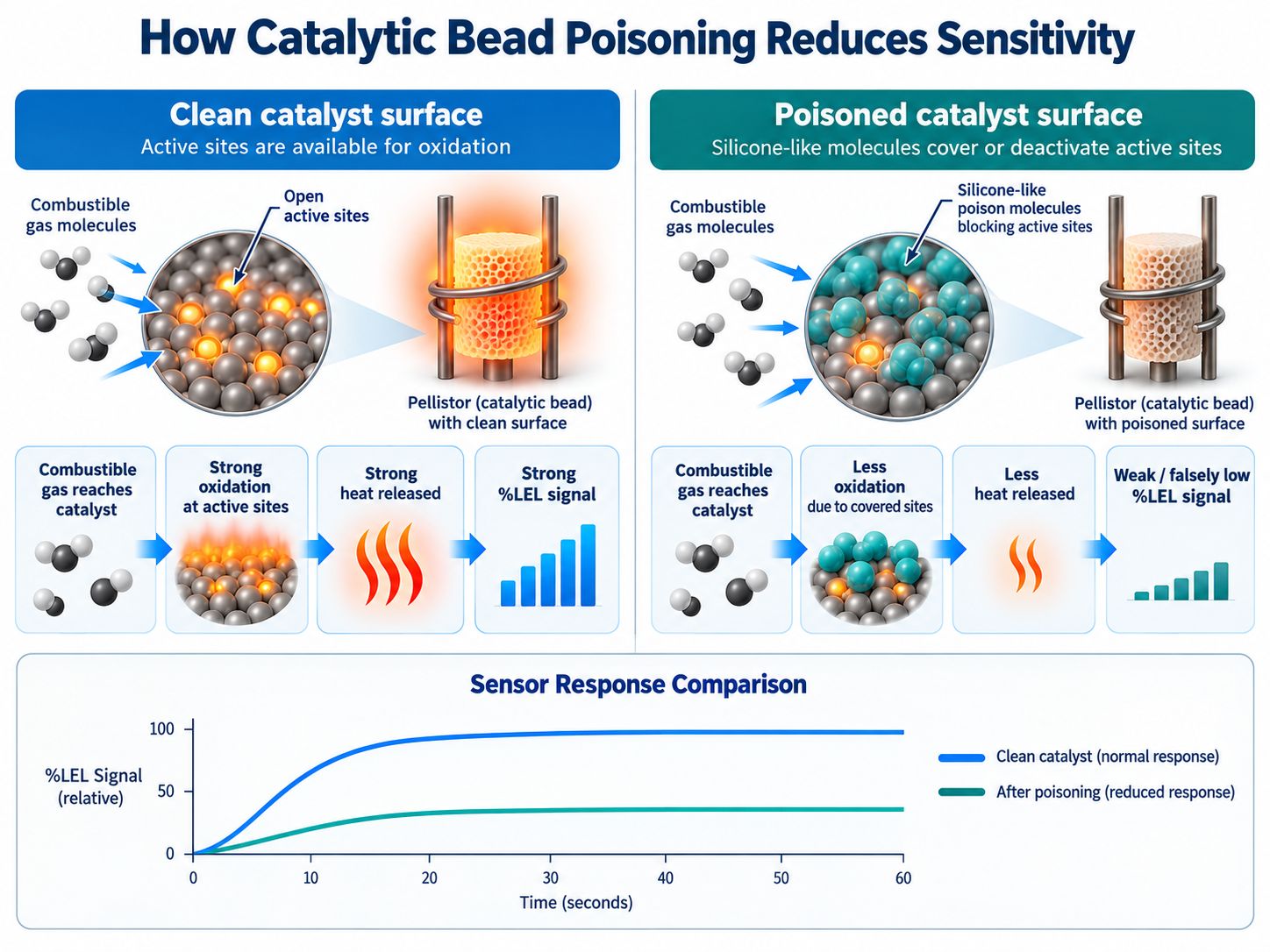
The problem is easiest to visualize by comparing a clean catalyst with a contaminated one.
Clean catalyst surface
Combustible gas reaches active sites
↓
Strong oxidation occurs
↓
More heat is generated
↓
Strong %LEL signal
Poisoned catalyst surface
Poison compounds cover or deactivate active sites
↓
Less oxidation occurs
↓
Less heat is generated
↓
Weak / falsely low %LEL signal
This is why poisoning is so serious in flammable-gas detection: the sensor is not merely noisy or unstable. It may be systematically less sensitive to the hazard you actually need to detect.
What Is Catalytic Sensor Inhibition?
Inhibition is related, but different.
In inhibition, a compound temporarily suppresses the sensor’s response. The catalyst is still affected, but the effect may be reversible after the interfering gas or vapor is removed and the sensor spends time in clean air.
A simplified sequence is:
Normal response
↓
Exposure to inhibitor
↓
Sensor response drops
↓
Inhibitor is removed
↓
Sensor is exposed to clean air
↓
Response partly or fully recovers
That is why many users summarize the difference as:
- Poisoning = persistent
- Inhibition = often recoverable
This is a good working rule, but not an absolute one. Real behavior depends on:
- the chemical involved
- the concentration
- the exposure duration
- the catalyst design
- sensor age and condition
Poisoning vs Inhibition: Quick Comparison
| Parameter | Poisoning | Inhibition |
|---|---|---|
| Main effect | Persistent loss of catalytic activity | Temporary suppression of catalytic response |
| Typical recovery in clean air | Often incomplete or absent | Often partial or full |
| Effect on future target-gas tests | Response remains low | Response may recover |
| Calibration outcome | May fail or require replacement | May return to normal after recovery |
| Practical risk | Long-term false-low %LEL readings | Short-term false-low readings during/after exposure |
| Typical action | Verify with test gas, calibrate if allowed, replace if necessary | Remove exposure, allow recovery, verify with test gas |
The boundary is not perfectly sharp. Some exposures look temporary at first and leave lasting damage later. Others reduce sensitivity for some time and then recover.
So the safe engineering rule is:
Never assume recovery. Always verify with real test gas.
Common Pellistor Poisons and Inhibitors
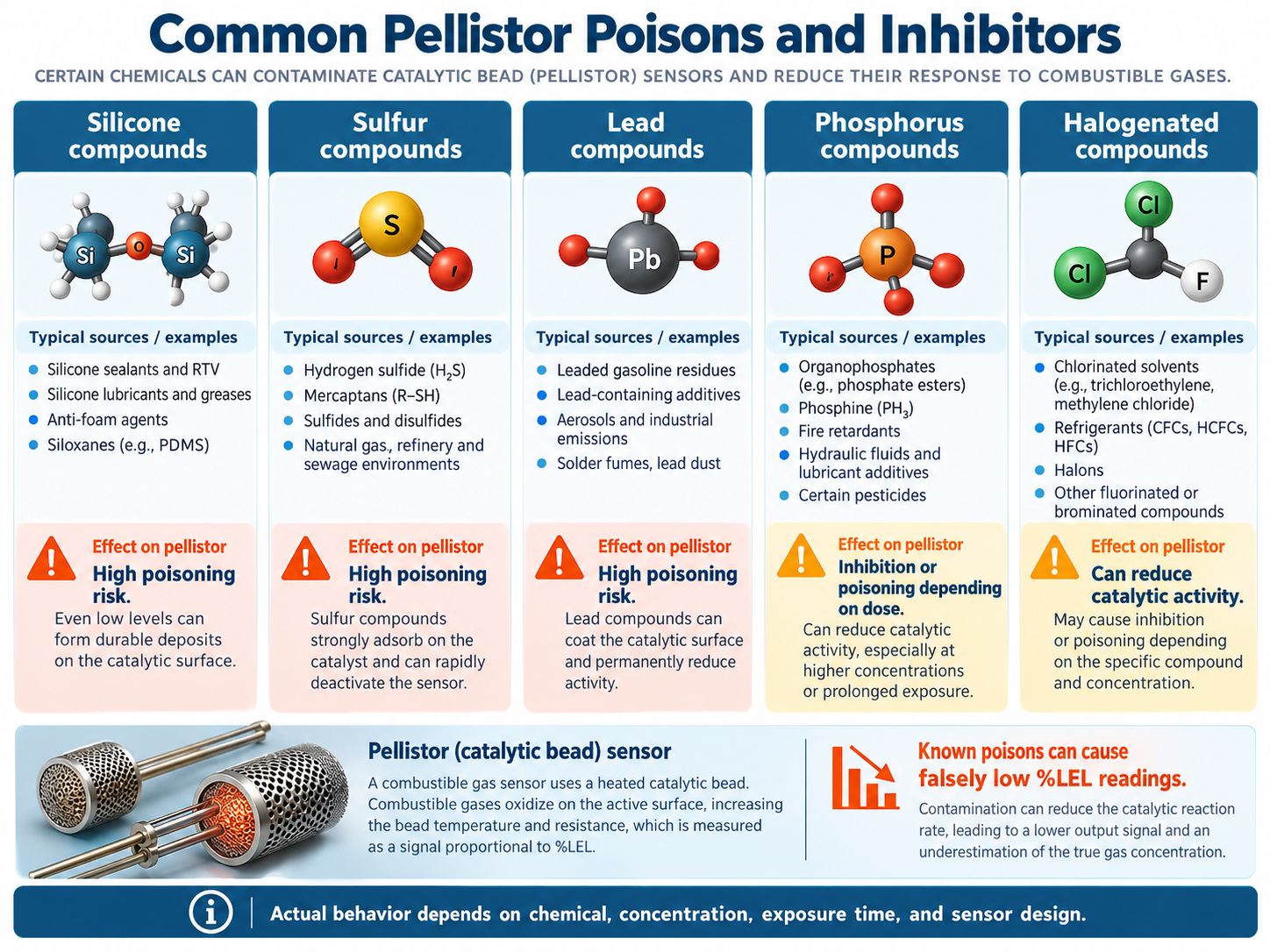
The exact behavior depends on the sensor design, but several chemical families are widely recognized as problematic for catalytic bead sensors.
Silicone compounds
These are among the best-known catalytic poisons.
Typical sources include:
- silicone sealants
- RTV products
- silicone lubricants
- greases
- mold-release agents
- anti-foam agents
- siloxane-containing products
Even low-level exposure can be a problem because silicone-related compounds may form deposits on the catalyst surface.
Sulfur compounds
Common examples include:
- hydrogen sulfide (H₂S)
- mercaptans
- sulfides
- disulfides
Some sulfur compounds are often described as inhibitors, but sufficiently severe exposure can produce longer-lasting degradation.
Lead compounds
Lead residues and lead-containing compounds can reduce catalyst activity and are well known as pellistor poisons.
Phosphorus compounds
Certain phosphorus-containing chemicals can inhibit or poison catalytic activity, especially with repeated or high-dose exposure.
Halogenated compounds
Some halogenated hydrocarbons and chlorinated solvents can reduce catalytic performance and may also create corrosive or degrading effects at the hot bead surface.
The key point is not to memorize a perfect blacklist. The key point is:
If your process environment contains known catalyst poisons, you must treat sensor selection and maintenance more carefully.
Why Silicone Is Especially Dangerous
Among all categories, silicone compounds deserve special attention because they appear in many everyday industrial activities:
- sealing
- maintenance
- lubrication
- assembly
- cleaning
- mold release
- protective coatings
A typical real-world scenario looks like this:
Technician uses silicone sealant near a detector
↓
Silicone vapors migrate toward the sensor
↓
Catalytic surface becomes contaminated
↓
Fresh-air zero still looks normal
↓
Methane sensitivity becomes weak
That last step is what makes the risk easy to miss.
The detector may not obviously “look broken.” It simply becomes less capable of detecting combustible gas correctly.
Poisoning Is About Dose, Not Concentration Alone
One common mistake is assuming that only very high concentrations matter.
In reality, poisoning risk depends on dose, which can be thought of as:
Dose
≈ concentration × exposure time × sensor susceptibility
That means both of the following can be risky:
- high concentration for a short time
- lower concentration for a long time
This is why chronic background exposure can matter in process plants, wastewater areas, refineries, compressor rooms, and maintenance zones.
Acute vs Chronic Exposure
It helps to think in two patterns.
Acute exposure
A strong, short event such as:
- heavy silicone vapor
- direct solvent exposure
- concentrated process upset
- accidental contamination during maintenance
Chronic exposure
Long-term repeated exposure such as:
- low-level siloxanes
- sulfur-containing process chemicals
- recurring maintenance products
- contaminated sampling environment
Both can degrade sensor performance.
Poisoning vs Inhibition Recovery Behavior
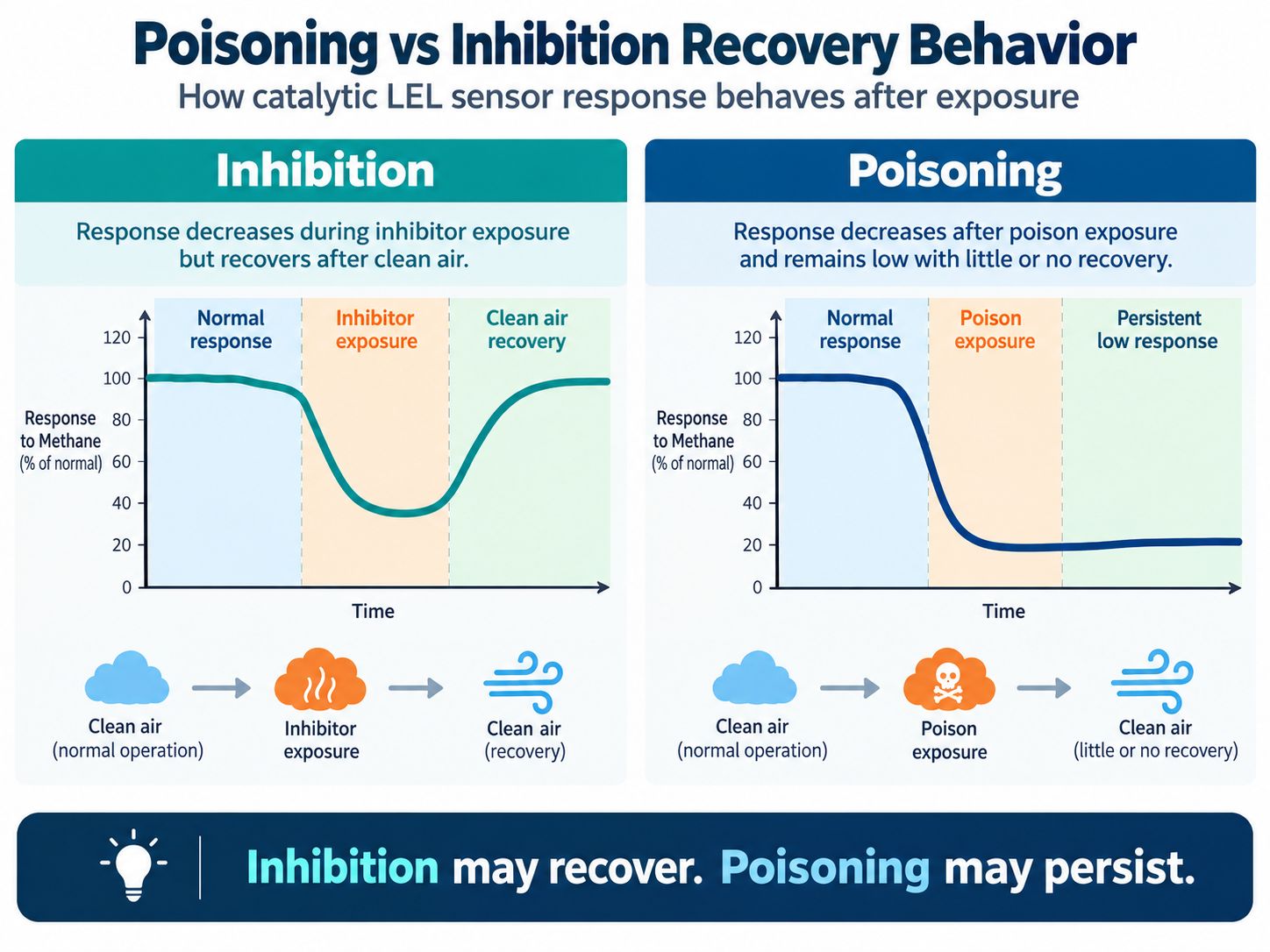
A helpful mental model is to compare the response curve over time.
Inhibition behavior
Normal response
↓
Exposure to inhibitor
↓
Target-gas response drops
↓
Clean air recovery
↓
Response improves again
Poisoning behavior
Normal response
↓
Exposure to poison
↓
Target-gas response drops
↓
Clean air recovery period
↓
Response remains low or only recovers slightly
This is why a weak response immediately after exposure is not enough to diagnose poisoning. You need to see what happens after recovery time and, most importantly, after a proper test-gas challenge.
Why a Poisoned LEL Sensor Can Still Read Zero
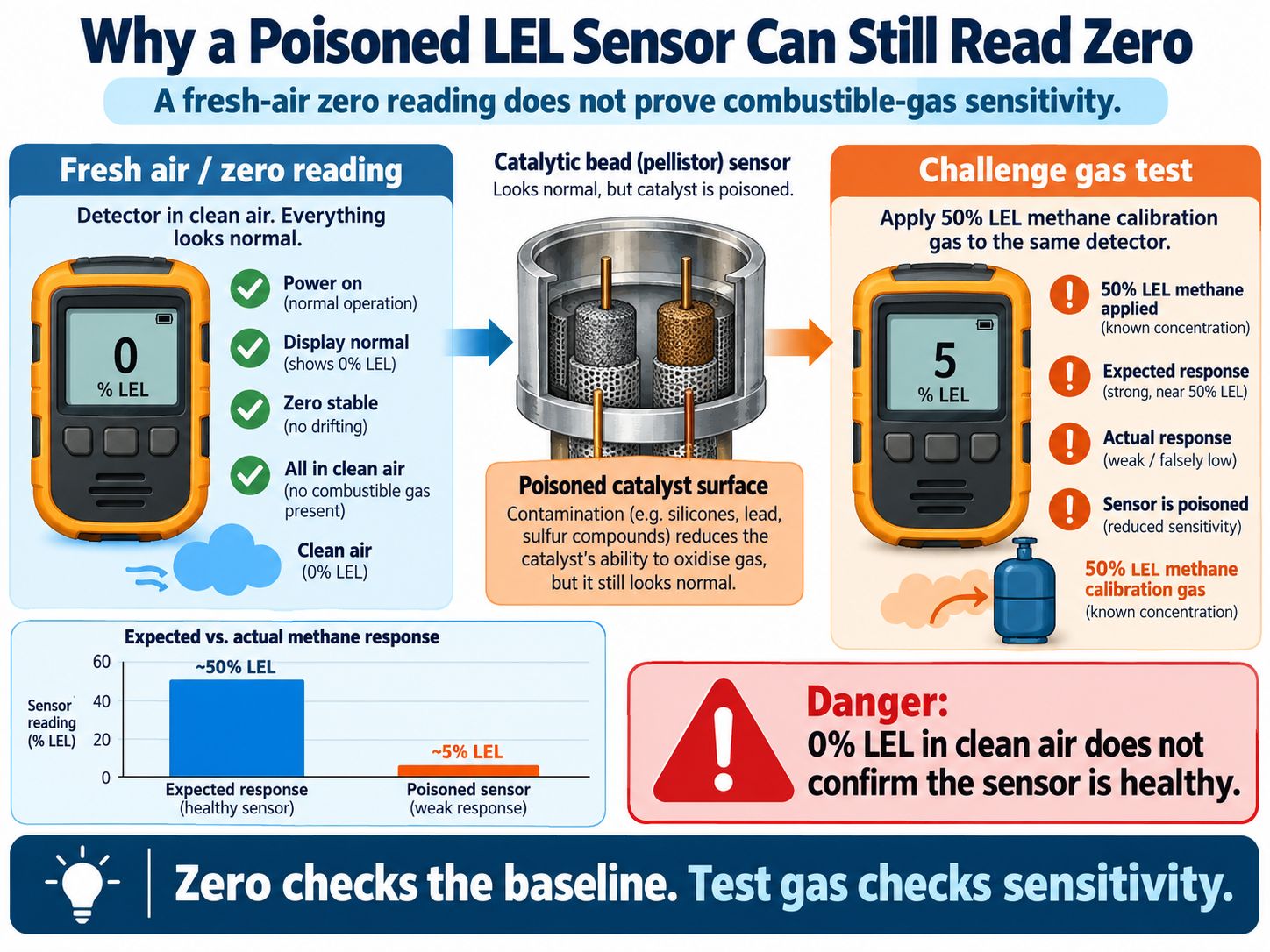
This is one of the most misunderstood points in flammable-gas detection.
A catalytic sensor in clean air may show:
0% LELThat tells you the baseline is near zero.
It does not prove the sensor can still react properly to methane or another combustible gas.
Think of it this way:
- Zero check asks whether the baseline looks normal in clean air.
- Test gas asks whether the catalyst still converts combustible gas into a strong enough signal.
A poisoned sensor can fail the second question while still appearing normal on the first.
So the correct engineering rule is:
Zero checks the baseline. Test gas checks sensitivity.
Why Electronic Self-Test Is Not Enough
Many detectors run startup diagnostics that check:
- battery
- display
- alarm circuits
- processor
- sensor connection
- internal electronics
These tests are useful, but they do not necessarily confirm that the catalytic bead still has proper chemical activity.
The electrical system can be healthy while the catalyst surface is contaminated.
That is why field verification with actual combustible test gas remains essential.
Do Not Confuse Poisoning With Low Oxygen
Catalytic sensors need oxygen to oxidize combustible gas.
If oxygen is too low, the catalytic reaction becomes weaker, and the flammable-gas reading can also become falsely low.
So a weak methane response is not automatically poisoning.
Possible causes include:
- poisoning
- inhibition
- low oxygen
- blocked inlet or filter
- damaged pump or tubing
- sensor aging
- wrong calibration gas
- incorrect flow or calibration setup
This is especially important in confined spaces and process enclosures. If you want the broader gas-entry perspective, see Confined Space Gas Monitoring: What Gases Should You Test Before Entry?.
Do Not Confuse Poisoning With Blockage
A catalytic sensor can also under-respond because gas is not reaching it correctly.
Examples include:
- clogged sinter
- dirty filter
- water or oil on the inlet
- blocked tubing
- contaminated calibration cap
- weak pump flow
In that case, the issue is not reduced catalyst activity. The issue is reduced gas transport.
A useful distinction is:
- Poisoning reduces chemical activity at the bead.
- Blockage reduces gas delivery to the bead.
Both can produce a weak %LEL reading.
Catalytic Sensor Poisoning Troubleshooting
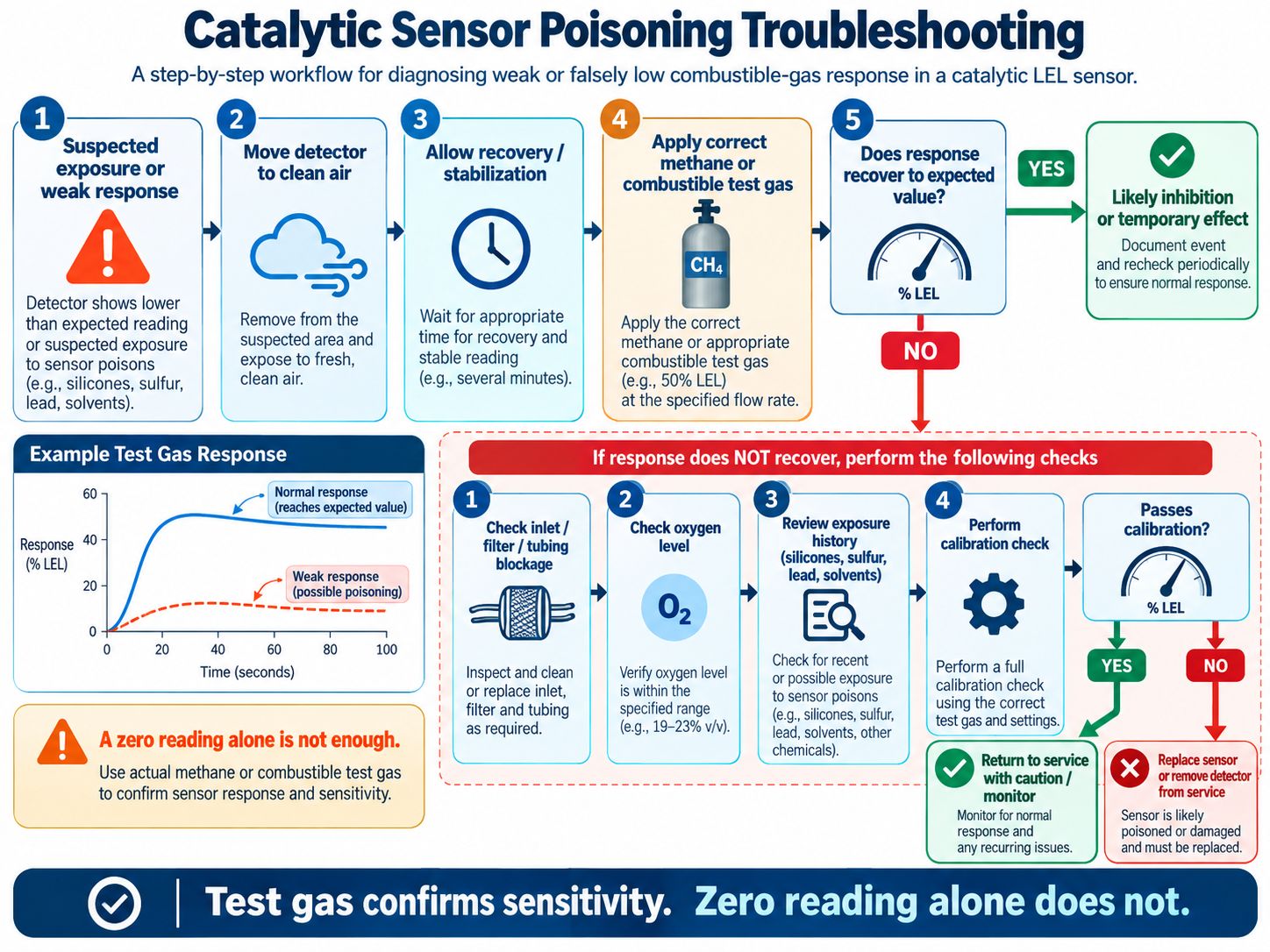
When you suspect poisoning or inhibition, do not jump directly to replacement. Follow a structured workflow.
Step 1 — Move the detector to clean air
Remove the instrument from the suspect environment if safe to do so.
Step 2 — Allow recovery / stabilization
Give the sensor the recovery time recommended by the manufacturer.
Step 3 — Apply the correct combustible test gas
Use the approved gas concentration, regulator, flow rate, and procedure.
Step 4 — Compare response with the expected value
If the response recovers to an acceptable value, inhibition or temporary interference is more likely.
If the response remains low, continue investigating.
Step 5 — Check the sampling path
Inspect:
- inlet
- filter
- sinter
- tubing
- pump
- gas cap
- flow path
Step 6 — Check oxygen conditions
Make sure oxygen deficiency is not reducing catalytic response.
Step 7 — Review exposure history
Ask whether the sensor was recently exposed to:
- silicones
- sulfur compounds
- lead
- solvents
- maintenance chemicals
- unusual process gases
Step 8 — Perform a calibration check
If the sensor cannot reach acceptable performance, remove it from service and follow the manufacturer’s replacement criteria.
Bump Test vs Calibration Check
This distinction matters a lot for catalytic sensors.
Bump test
A bump test asks:
Does the detector respond to gas and activate alarms?
It is a quick functional check.
Calibration check / full calibration
A calibration check asks:
Does the detector read the correct value, within the acceptable tolerance, when exposed to known test gas?
That is much more informative for diagnosing partial sensitivity loss.
A sensor may still respond enough to alarm at some level, yet still be significantly under-reading relative to the true %LEL value.
For the full maintenance distinction, see Gas Detector Bump Test vs Calibration.
Can a Poisoned Catalytic Sensor Be Recalibrated?
Sometimes a mild sensitivity loss can still be corrected within the manufacturer’s calibration limits.
But it is important to state this clearly:
Calibration does not restore poisoned catalyst activity.
Calibration only adjusts how electronics interpret the available signal.
If the bead has lost too much activity, then:
- the signal may be too weak
- noise becomes more important
- reserve sensitivity is lower
- long-term reliability is worse
- future failure is more likely
So if the instrument cannot pass the manufacturer’s required calibration procedure or target-gas response criteria, it should be removed from service.
Can an Inhibited Sensor Recover?
Yes, it may recover, but there is no universal recovery time.
Recovery depends on:
- the inhibitor
- the exposure level
- the duration
- temperature
- humidity
- sensor construction
- instrument design
This is why you should never assume:
Inhibition = immediate recoveryInstead, the rule is:
Possible inhibition
↓
Allow recovery
↓
Verify with approved test gas
Only the final test-gas response confirms whether the sensor is actually usable again.
When Should a Catalytic Sensor Be Replaced?
The exact replacement threshold depends on the detector and sensor manufacturer, but common triggers include:
- cannot pass bump or function criteria
- cannot pass calibration check
- cannot reach expected span response
- response remains too low after recovery
- response becomes unstable
- known severe poison exposure
- sensor age or condition already near end of service life
Do not keep a catalytic sensor in service just because it still powers on.
Should You Consider Another Technology?
Catalytic bead sensors remain widely useful, but poison-prone environments may justify considering another sensing approach.
Catalytic bead
Best known for broad combustible-gas coverage and widespread use in %LEL detection.
NDIR
An infrared combustible sensor does not depend on catalytic oxidation, so it is not vulnerable to classic catalyst poisoning in the same way.
That can be a major advantage where pellistor poisons are common.
However, NDIR is not automatically the best answer for every application. You still need to consider:
- target gas
- gas mixture
- optical contamination
- condensation
- response requirements
- certification
- installation conditions
See NDIR Gas Sensors.
Other poison-resistant options
Some combustible-gas detector designs use more poison-resistant sensing approaches, but “poison-resistant” never means “poison-proof.”
It means the sensor may tolerate certain exposures better, not that verification testing can be skipped.
For methane-specific selection logic, see Catalytic vs NDIR vs TDLAS Methane Sensors.
How to Protect Catalytic Gas Sensors From Poisons
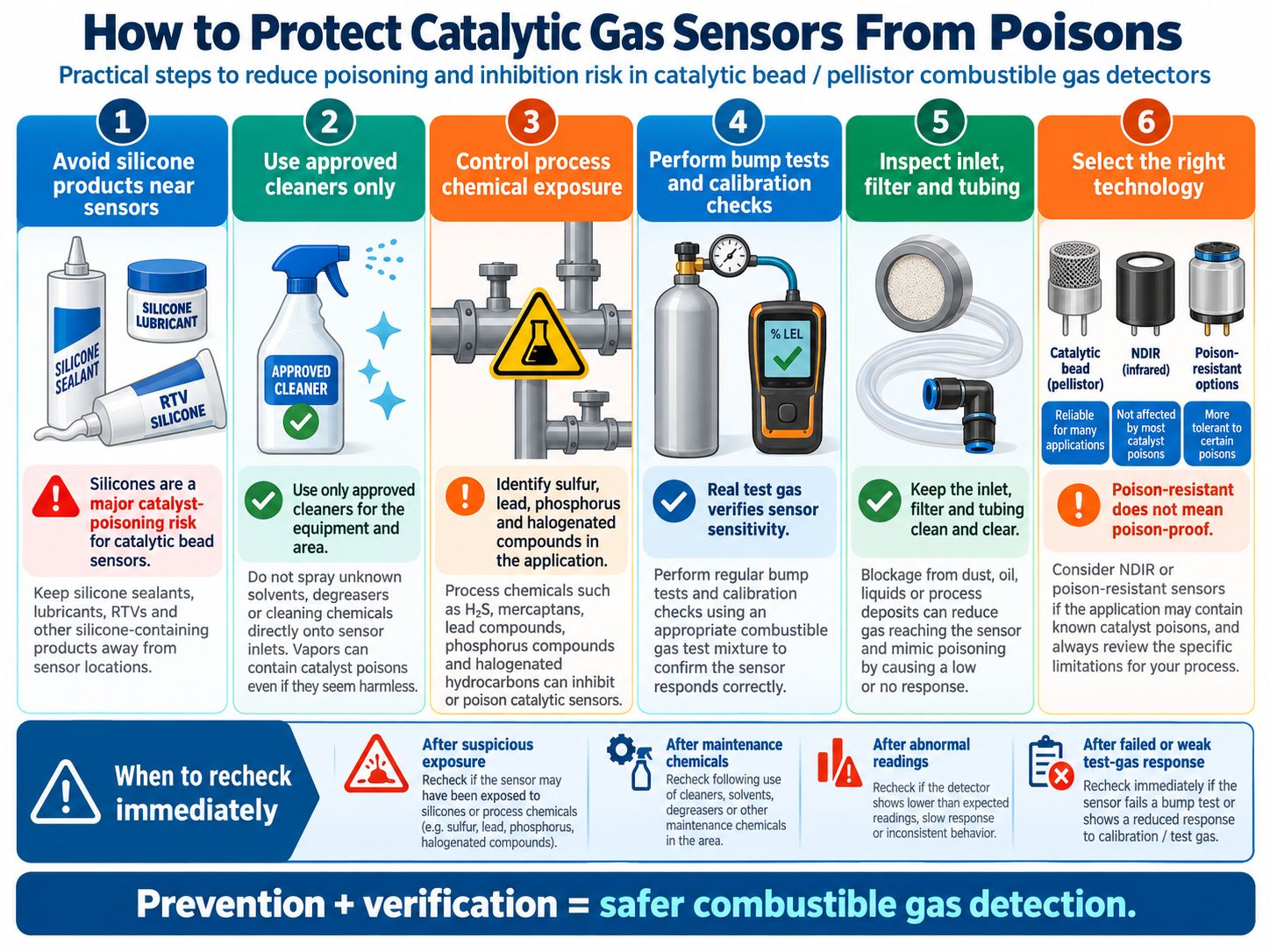
Prevention is always better than troubleshooting after the fact.
1. Avoid silicone products near sensors
Keep silicone sealants, RTV, silicone lubricants, and other silicone-containing chemicals away from catalytic detector locations whenever possible.
2. Use approved cleaners only
Do not spray unknown solvents or cleaners around exposed sensor inlets.
3. Review process chemicals
Know whether the environment contains:
- sulfur
- lead
- phosphorus compounds
- halogenated compounds
- siloxanes
- catalyst-deactivating vapors
4. Perform regular bump tests and calibration checks
Real gas testing is the most direct way to verify continued sensitivity.
5. Inspect inlets, filters, and tubing
Blockage can mimic poisoning and should be ruled out quickly.
6. Recheck immediately after suspicious exposure
Do not wait until the next scheduled maintenance interval if the instrument may have been exposed to a catalyst poison.
7. Choose the right technology for the application
If catalyst poisons are unavoidable, evaluate whether a different sensor technology is more suitable.
Practical Troubleshooting Checklist
Use this field checklist after suspected poisoning or inhibition:
- Move the detector to clean air
- Allow stabilization / recovery time
- Check oxygen level if relevant
- Apply the correct combustible test gas
- Compare response to expected value
- Inspect inlet, filter, tubing, and flow path
- Review recent maintenance chemicals
- Ask whether silicones, sulfur, or solvents were present
- Perform a calibration check
- Remove from service if performance remains unacceptable
Frequently Asked Questions
What is catalytic sensor poisoning?
Catalytic sensor poisoning is persistent loss of catalytic activity caused by contaminating chemicals, leading to reduced response to combustible gases and falsely low %LEL readings.
What is catalytic sensor inhibition?
Catalytic sensor inhibition is temporary suppression of response, often followed by partial or full recovery after the inhibitor is removed and the sensor is allowed to recover in clean air.
Is poisoning always permanent?
In practical safety language, poisoning usually refers to persistent or irreversible degradation. However, real-world exposures do not always fit perfectly clean categories, so target-gas verification is still required.
Is inhibition always temporary?
It is usually treated as temporary, but recovery time varies, and severe exposure may still leave lasting performance loss. Always verify with test gas.
Why are silicones dangerous to catalytic sensors?
Silicone-containing compounds can contaminate or deactivate the catalyst surface, reducing combustible-gas oxidation and lowering the %LEL signal.
Can a poisoned sensor still read zero?
Yes. A fresh-air zero reading only checks the baseline. It does not prove the sensor still has good combustible-gas sensitivity.
Can calibration fix poisoning?
Calibration may compensate for limited sensitivity change if the sensor still meets the manufacturer’s acceptable performance range. It does not restore a chemically damaged catalyst.
How do I know if a catalytic sensor is poisoned?
The practical way is to expose it to the correct test gas after recovery and compare the response to the expected value. A weak or failed response after proper testing suggests poisoning, severe inhibition, blockage, or another serious fault.
What chemicals commonly affect catalytic bead sensors?
Common problem groups include silicone compounds, sulfur compounds, lead compounds, phosphorus compounds, and some halogenated chemicals.
Should I replace the sensor immediately after suspected poison exposure?
Not always immediately, but you should remove guesswork. Move to clean air, allow recovery, test with approved gas, inspect the sampling path, and follow the manufacturer’s replacement criteria if performance remains unacceptable.
Final Takeaway
Catalytic bead sensors are powerful and widely used, but they are not chemically invulnerable.
The most important rules are:
Poisoning
=
persistent loss of catalytic sensitivity
Inhibition
=
temporary suppression of catalytic response0% LEL in clean air
≠
proof of healthy combustible-gas sensitivityActual test gas
=
the best way to confirm performanceIf a catalytic sensor may have been exposed to harmful chemicals, do not rely on appearance, startup electronics, or a clean-air zero alone.
Use a proper troubleshooting process:
Suspected exposure
↓
Move to clean air
↓
Allow recovery
↓
Apply correct combustible test gas
↓
Check inlet / oxygen / exposure history
↓
Perform calibration check
↓
Replace if sensor performance is not acceptable
That leads to the core message of this article:
A catalytic sensor that still reads zero may not still read combustible gas correctly. Zero verifies baseline. Test gas verifies sensitivity.
