




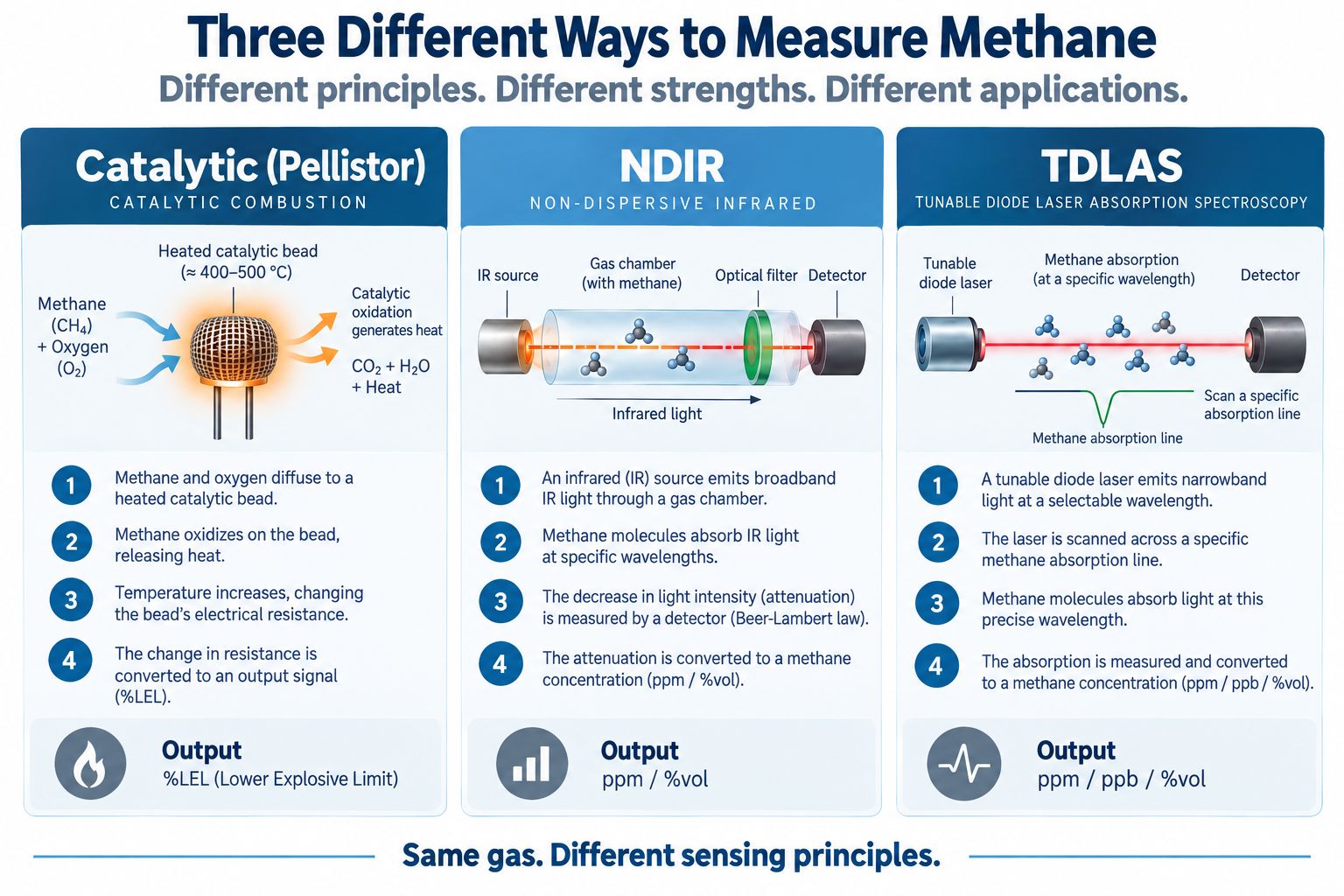
Methane can be measured using several fundamentally different sensing technologies.
Three of the most important are:
- Catalytic combustion / pellistor
- NDIR — Non-Dispersive Infrared
- TDLAS — Tunable Diode Laser Absorption Spectroscopy
There is no universal ranking where:
TDLAS > NDIR > Catalytic
and the newest or most expensive technology is automatically the best.
They solve different measurement problems.
A catalytic sensor can be an excellent choice for a portable %LEL combustible-gas detector. NDIR may be better when methane needs to be measured selectively without relying on oxygen. TDLAS becomes particularly attractive when the application requires high selectivity, low detection limits, fast optical measurement, or remote/open-path methane detection.
The better question is therefore:
What methane measurement problem are you trying to solve?
That means defining whether the application is concerned with:
- explosion safety
- methane concentration
- low-level leakage
- environmental emissions
- process control
- open-path monitoring
- remote leak inspection
before selecting the sensor principle.
Quick Comparison: Catalytic vs NDIR vs TDLAS
| Feature | Catalytic / Pellistor | NDIR | TDLAS |
|---|---|---|---|
| Basic principle | Catalytic oxidation | Infrared absorption | Tunable laser absorption |
| Typical target | Combustible gases including CH₄ | Methane / selected IR-active gases | Highly selective methane |
| Typical measurement | %LEL | ppm, %LEL or %vol depending design | ppm, ppb, %vol or path-integrated measurement |
| Methane selectivity | Low to moderate | Good to high | Very high |
| Requires oxygen | Usually yes | No | No |
| Catalyst poisoning | Possible | No | No |
| Optical path | No | Yes | Yes |
| Low-level CH₄ capability | Limited | Design-dependent | Strong in suitable systems |
| Broad combustible response | Major strength | Usually gas-specific | Highly gas-specific |
| Remote/open-path use | No | Possible in some systems | Major application |
| System complexity | Relatively low | Medium | Usually higher |
| Typical initial cost | Lower | Medium | Higher |
These are typical characteristics, not universal specifications. Actual performance depends on sensor design, optical path, wavelength, electronics, calibration, environment and required certification.
Start With the Measurement Task, Not the Technology
The same methane molecule can create several very different measurement requirements.
Explosion Safety
The engineering question is:
How close is the atmosphere to methane’s flammable range?
The detector may therefore display:
%LEL
Catalytic and infrared combustible-gas sensors are common options.
For the relationship between gas concentration and LEL, see What Is a Safe LEL Level?.
Methane Concentration
A process system may instead need:
%vol CH₄
Examples include:
- biogas
- landfill gas
- gas processing
- methane-rich process streams
Here, methane-selective optical measurement such as NDIR can be more appropriate.
Low-Level Leak Detection
If the objective is detecting methane at:
- ppm
- low ppm
- environmental background levels
then the priorities change toward:
- sensitivity
- selectivity
- drift
- optical path length
- background compensation
TDLAS becomes particularly attractive for many of these applications.
Remote Methane Detection
A pipeline inspection, open process area or inaccessible location may require measurement without placing the sensing element directly inside the gas cloud.
This is a fundamentally different problem from a conventional point detector.
TDLAS is especially useful here because the laser beam itself can form the measurement path.

How Does a Catalytic Methane Sensor Work?
Catalytic methane sensors are also commonly called:
- pellistors
- catalytic bead sensors
- catalytic combustion sensors
The sensing element is heated to a temperature where combustible gas can oxidize on its catalytic surface.
A simplified sequence is:
CH₄ + O₂
↓
heated catalytic bead
↓
catalytic oxidation
↓
heat generation
↓
temperature and resistance change
↓
electrical measurement
The sensor normally contains an active catalytic element and a reference or compensating element.
The difference between their electrical responses can then be converted into a combustible-gas measurement.
Why Catalytic Sensors Are Still Widely Used
Catalytic sensing is mature but certainly not obsolete.
It offers several useful advantages.
Broad Combustible-Gas Response
A catalytic sensor does not have to be highly methane-selective.
That can actually be an advantage when the application asks:
Is there a combustible atmosphere?
rather than:
Is this gas specifically methane?
Natural Fit for %LEL Safety
Pellistors have a long history in:
- portable multi-gas detectors
- industrial combustible detectors
- mining
- confined spaces
- general workplace safety
Relatively Simple Architecture
Compared with precision optical systems, the sensing and signal-processing architecture can be comparatively straightforward.
Cost
Catalytic sensors can provide an economical solution for large-volume industrial safety applications.
Does a Catalytic Methane Sensor Need Oxygen?
Usually, yes.
Catalytic sensing depends on oxidation of the combustible gas.
If there is insufficient oxygen, the catalytic reaction may not proceed normally.
This matters in applications such as:
- nitrogen purging
- inert process vessels
- high methane concentrations
- severely oxygen-deficient confined spaces
A catalytic detector may therefore not be the best technology when methane must be measured accurately in an oxygen-deficient atmosphere.
NDIR and TDLAS do not require oxygen for their optical methane measurement.
What Is Catalyst Poisoning?
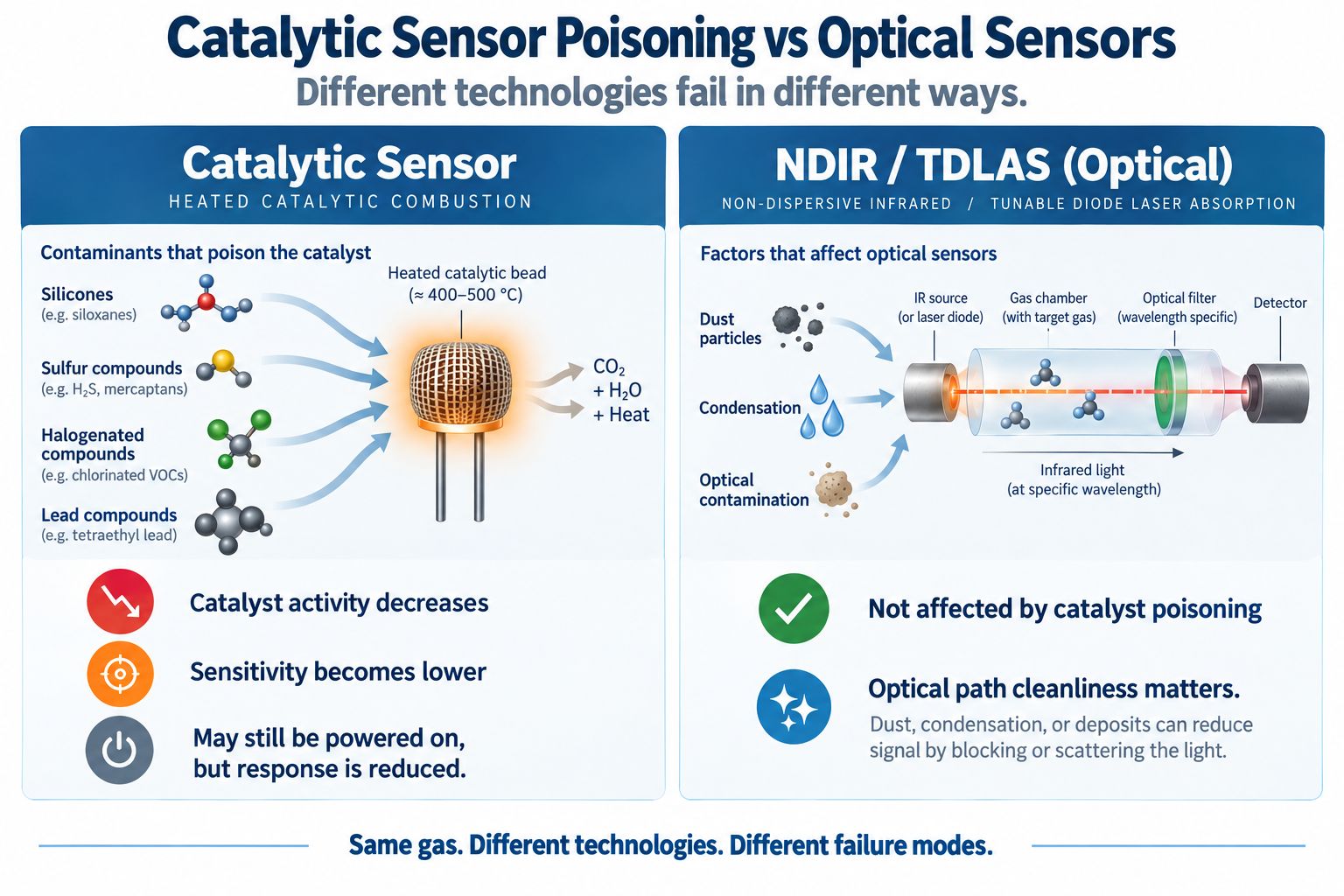
One of the most important limitations of catalytic sensors is catalyst poisoning.
Certain contaminants can reduce the activity of the catalytic surface.
Possible poisons or inhibitors include substances associated with:
- silicones / siloxanes
- sulfur compounds
- halogenated compounds
- some heavy-metal compounds
- other catalyst contaminants
The dangerous part is that poisoning does not necessarily look like a complete electrical failure.
The sensor may still:
- receive power
- produce an output
- appear operational
while its combustible-gas sensitivity has become lower.
That is one reason combustible-gas instruments require appropriate:
- bump testing
- calibration
- maintenance
- application review
Optical methane sensors do not use a catalytic reaction, so they are not subject to catalyst poisoning in the same way.
But optical technologies have their own failure mechanisms.
Dust, condensation or deposits can interfere with the optical path.
So the correct conclusion is not:
Optical sensors cannot be contaminated.
It is:
Different technologies fail in different ways.
How Does an NDIR Methane Sensor Work?
NDIR means:
Non-Dispersive Infrared
Methane absorbs infrared radiation at characteristic wavelengths.
A typical NDIR sensor contains:
- infrared source
- optical chamber
- wavelength-selective optical filter
- detector
- signal-processing electronics
The process is approximately:
IR source
↓
light passes through methane-containing gas
↓
CH₄ absorbs part of the infrared light
↓
detector measures transmitted intensity
↓
absorption is converted into concentration
The underlying relationship is commonly described using the Beer-Lambert law.
Unlike a catalytic sensor:
NDIR does not need to burn methane in order to detect it.
Why NDIR Is Popular for Methane Measurement
No Oxygen Requirement
The optical absorption mechanism does not depend on O₂.
This can be useful in:
- inert atmospheres
- nitrogen-purged systems
- high-methane environments
- process measurements
Better Methane Selectivity
A general catalytic sensor intentionally responds to multiple combustibles.
A methane-specific NDIR design can instead use methane’s optical absorption characteristics to achieve much better selectivity.
No Catalyst Poisoning
Silicones or sulfur compounds do not deactivate an optical catalyst because there is no catalytic bead.
Long-Term Measurement
NDIR is widely used where long sensor life and stable methane concentration measurement are important.
Wide Concentration Possibilities
Depending on optical design, NDIR can be configured for applications ranging from lower concentrations through %LEL and high %vol methane measurement.
However, one NDIR sensor does not automatically cover every range.
Optical path length and system design must match the measurement objective.
What Are the Limitations of NDIR Methane Sensors?
NDIR still has practical engineering limitations.
Optical Contamination
Dust, oil mist and deposits can reduce transmitted light.
Condensation
Water droplets inside the optical chamber can interfere with optical measurements.
Temperature Effects
Optical source output, detector response, gas density and electronics can vary with temperature.
Pressure Effects
Gas absorption behavior and gas density can change with pressure.
Spectral Interference
Other gases may absorb in nearby infrared regions.
Good wavelength selection and compensation therefore remain important.
More Complex Components
NDIR typically requires:
- optical source
- optical chamber
- filters
- detector
- compensation algorithms
which may result in greater component cost than a basic catalytic sensor.
How Does TDLAS Methane Detection Work?
TDLAS stands for:
Tunable Diode Laser Absorption Spectroscopy
It is also an optical absorption technique, but instead of using a broad infrared source and optical filter, TDLAS uses a narrow-linewidth laser whose wavelength can be tuned across a specific molecular absorption line.
A simplified system contains:
tunable diode laser
↓
methane measurement path
↓
photodetector
↓
spectral signal processing
The laser wavelength is scanned around a selected methane absorption feature.
When the laser reaches a wavelength absorbed by CH₄, the detector observes a reduction in transmitted light.
Analyzing that absorption feature allows the system to estimate methane concentration.
The narrow spectral width of the laser is one of the reasons TDLAS can achieve high gas selectivity.
Why Does TDLAS Use a Laser Diode?
This is one of the fundamental differences between NDIR and TDLAS.
TDLAS requires a light source that can provide:
- narrow spectral output
- controllable wavelength
- wavelength tuning
- stable optical power
- fast electrical modulation
Semiconductor laser diodes can provide these characteristics in compact packages.
DFB laser diodes are especially important in many gas-spectroscopy applications because their grating structure can strongly favor a single longitudinal mode and provide the narrow spectral behavior needed to scan a selected absorption line.
If you want to understand the upstream optical component itself, LumiLaserChip’s What Is a Laser Diode? explains how semiconductor laser diodes generate coherent light, how the optical cavity works, why DFB and Fabry-Pérot lasers behave differently, and how wavelength is controlled.
That laser is not the methane sensor by itself.
It is one of the core optical components inside the spectroscopy system.
What Wavelength Is Used for Methane TDLAS?
One widely used near-infrared methane region is approximately:
1.65 μm
or:
1650 nm
Methane has absorption features in this region that can be addressed using telecom-style near-IR laser technology.
Many practical methane TDLAS systems use DFB laser diodes around this wavelength region.
Methane also has much stronger fundamental absorption bands in the mid-infrared, including around 3.3 μm, and other laser technologies can access these bands.
Therefore:
There is no single wavelength used by every methane TDLAS instrument.
The wavelength is selected according to:
- target absorption line
- interfering gases
- laser availability
- required detection limit
- optical path
- cost
- operating environment
Recent methane-sensor reviews continue to identify approximately 1.65 μm as an important near-IR region for TDLAS methane detection.
NDIR vs TDLAS: Aren’t They Both Infrared Sensors?

Yes.
Both technologies use methane’s interaction with infrared light.
But their light sources and spectral resolution are very different.
| Feature | NDIR | TDLAS |
|---|---|---|
| Light source | Broadband IR source | Narrow-linewidth laser |
| Wavelength selection | Optical filtering | Tunable laser wavelength |
| Spectral resolution | Lower | Very high |
| Methane selectivity | Good | Very high |
| Signal processing | Optical attenuation | Absorption-line spectroscopy |
| Complexity | Moderate | Higher |
| Typical point sensing | Very common | Possible |
| Remote/open-path sensing | Possible | Major strength |
| Very low-level methane | Design-dependent | Major strength of suitable systems |
The diagram above is conceptual. Actual NDIR and TDLAS instruments can operate at different methane absorption bands depending on design.
A common practical distinction is:
NDIR asks how much selected infrared light has been absorbed.
while:
TDLAS examines a specific methane absorption line with a narrow tunable laser.
Why TDLAS Can Achieve High Selectivity
Gas molecules have characteristic absorption spectra.
Instead of observing a relatively broad optical band, TDLAS can scan across a narrow methane absorption feature.
This provides useful discrimination between:
- methane
- background optical loss
- neighboring gas absorption
- source intensity changes
Advanced signal processing techniques can further improve detection performance.
This is one reason TDLAS is used in applications where false responses and low-level methane detection matter.
How Sensitive Is TDLAS?
Some TDLAS systems can reach:
- ppm
- sub-ppm
- ppb
methane measurement levels.
But this should not be generalized into:
Every TDLAS methane sensor detects ppb methane.
Detection limit depends strongly on:
- optical path length
- absorption line
- laser linewidth
- laser power
- detector noise
- modulation technique
- environmental conditions
- pressure
- temperature
- signal-processing architecture
Multipass cells and long open optical paths can greatly increase the effective interaction between methane and the laser beam.
What Are the Limitations of TDLAS?
TDLAS offers powerful performance, but it is not automatically the most practical methane detector.
Cost
Laser source, drive electronics, optical components and signal processing can increase system cost.
Optical Alignment
The laser beam must reach the detector correctly.
Alignment can become especially important in long open-path systems.
Optical Contamination
Dust, fog, condensation or dirty optical windows can attenuate the beam.
Line of Sight
Many remote and open-path systems require an unobstructed optical path.
Temperature and Pressure Compensation
Absorption-line properties depend on operating conditions.
System Complexity
A high-performance TDLAS instrument may require:
- precise laser current control
- temperature control
- wavelength modulation
- photodetection
- lock-in or equivalent signal processing
- calibration algorithms
For simple %LEL workplace safety, that complexity may provide little practical advantage over a well-designed catalytic or NDIR solution.
Catalytic vs Optical Methane Detection
The three technologies can first be divided into two broad categories.
Catalytic
Methane participates in a chemical reaction.
CH₄ → catalytic oxidation → heat → electrical signal
Optical
Methane absorbs light.
CH₄ → optical absorption → detector signal
This fundamental difference explains many practical differences.
| Issue | Catalytic | NDIR / TDLAS |
|---|---|---|
| Oxygen needed | Usually yes | No |
| Catalyst poison | Relevant | Not relevant |
| Optical contamination | Not primary mechanism | Important |
| Gas consumption | Reaction occurs at catalyst | Non-consuming optical measurement |
| Selectivity | Broad combustible response | Generally higher |
| Power | Heated bead | Optical/electronic dependent |
Which Technology Works Better in Oxygen-Deficient Atmospheres?
If methane needs to be measured when little or no oxygen is available:
Catalytic
May not provide a valid response because the oxidation reaction needs oxygen.
NDIR
Can continue measuring methane optically.
TDLAS
Can also measure methane without oxygen.
This can make optical sensing more appropriate for:
- nitrogen-purged vessels
- inert gas systems
- high-concentration methane streams
- selected process measurements
Point vs Open-Path Methane Detection

Another major selection factor is measurement geometry.
Point Detector
A point detector answers:
What is the methane concentration at this location?
Catalytic and NDIR sensors are commonly used this way.
Point detection is appropriate when gas is expected near:
- valves
- compressors
- equipment
- confined areas
- fixed leak points
Open-Path Detector
An open-path system asks:
How much methane is present along this optical path?
A laser beam may travel:
- across an industrial area
- along a pipeline corridor
- between transmitter and receiver
- toward a remote reflective target
TDLAS is particularly suited to these measurement architectures.
Open-path measurements can be reported in path-integrated units such as:
ppm·m
This is not the same as a conventional point concentration in ppm.
The result depends on both:
gas concentration × optical path length
Which Methane Sensor Is Best for Coal Mines?
There is no single answer.
Portable Combustible Safety
Catalytic sensing remains useful where the main objective is combustible-gas / %LEL safety and approved instruments are required.
Fixed Methane Measurement
NDIR can offer advantages including:
- methane selectivity
- no oxygen dependence
- resistance to catalytic poisons
Remote Inspection
TDLAS can be attractive for:
- inaccessible mine areas
- remote methane surveys
- robotic inspection
- laser methane detection
Mining approval and intrinsic-safety requirements remain critical regardless of sensing principle.
For the wider application, see Gas Detection in Underground Mines.
Which Methane Sensor Is Best for Oil and Gas?
Different stages of oil and gas operations create different measurement tasks.
Fixed Combustible Safety
Possible starting technologies:
- catalytic
- infrared
Methane-Specific Fixed Monitoring
NDIR can provide methane-specific optical measurement.
Fugitive Emissions
TDLAS becomes attractive where:
- low-level methane matters
- measurement must occur remotely
- large areas need scanning
Pipeline Inspection
Laser methane technologies are particularly useful where personnel, vehicles, drones or robotic systems must detect methane without placing a point sensor directly at every potential leak.
Which Methane Sensor Is Best for Biogas?
Biogas commonly contains high concentrations of:
- methane
- carbon dioxide
and may also contain:
- H₂S
- water vapor
- other contaminants
If the objective is determining:
CH₄ %vol
NDIR is a common and practical technology.
Catalytic sensing is generally better suited to combustible safety than high-concentration gas-composition measurement.
TDLAS may be used where higher selectivity, precision or specialized process analysis is required.
Which Methane Sensor Is Best for Landfills?
Again, it depends on the question.
Explosion Safety
Possible technologies:
Catalytic / infrared combustible sensing
Methane Concentration
A methane-specific NDIR system can be appropriate.
Fugitive Emissions and Remote Leak Survey
TDLAS can offer advantages for remote and path-based methane measurement.
The same landfill may therefore use several technologies for completely different tasks.
Different Technologies Fail in Different Ways
This is one of the most important engineering lessons.
Catalytic
Watch for:
- poisoning
- inhibition
- low oxygen
- aging
- loss of sensitivity
NDIR
Watch for:
- optical contamination
- condensation
- source degradation
- detector drift
- environmental compensation
TDLAS
Watch for:
- optical alignment
- path blockage
- window contamination
- laser wavelength control
- temperature / pressure effects
A technology should not be chosen only from its best-case detection limit.
Failure modes under real operating conditions matter equally.
Which Technology Is Cheapest?
As a general starting point:
Catalytic
often has the lowest component and system entry cost.
NDIR
usually involves higher optical component cost.
TDLAS
often involves the greatest system complexity and higher initial cost.
But initial purchase price is only one part of the lifecycle cost.
A catalytic system may require consideration of:
- sensor poisoning
- bump testing
- more frequent replacement in harsh environments
An optical system may have:
- higher upfront cost
- longer sensing-element life
- different maintenance requirements
TDLAS may justify higher system cost where remote monitoring or very high selectivity avoids the need for many point sensors or manual inspection.
Therefore:
Lowest sensor price does not always mean lowest total cost of ownership.
Which Methane Sensor Technology Should You Choose?

A practical starting guide is:
| Requirement | Technology to Consider First |
|---|---|
| Low-cost combustible / %LEL safety | Catalytic |
| Broad combustible-gas response | Catalytic |
| Methane-specific fixed measurement | NDIR |
| Oxygen-deficient methane measurement | NDIR |
| High %vol methane measurement | NDIR |
| Long-life fixed methane sensing | NDIR |
| Very high methane selectivity | TDLAS |
| Low-level methane detection | TDLAS |
| Remote leak survey | TDLAS |
| Open-path methane monitoring | TDLAS |
| General portable combustible detector | Catalytic / IR depending gas profile |
| Biogas CH₄ concentration | NDIR |
| Fugitive methane emissions | TDLAS |
These recommendations are starting points—not automatic design rules.
Final Methane Sensor Selection Checklist
Before choosing a methane sensing technology, confirm:
- Is the target methane specifically or general combustible gas?
- Is the required unit ppm, ppb, %LEL or %vol?
- What is the required detection limit?
- What is the maximum methane concentration?
- Will oxygen always be present?
- Are catalytic poisons possible?
- Is dust or condensation expected?
- Is this a point measurement or remote measurement?
- What response time is required?
- What is the available power budget?
- What temperature and pressure range is expected?
- What certification is required?
- What calibration procedure is practical?
- What lifetime is expected?
- What total cost of ownership is acceptable?
GasNose also provides a Gas Sensor Product Finder for comparing sensing technologies and available sensor categories.
Frequently Asked Questions
What is the best sensor for detecting methane?
There is no universally best methane sensor.
Catalytic sensors are strong choices for many %LEL safety applications, NDIR is useful for selective methane concentration measurement, and TDLAS is particularly attractive for highly selective, low-level or remote methane monitoring.
Is NDIR better than a catalytic methane sensor?
Not always.
NDIR offers advantages such as methane selectivity, no oxygen requirement and immunity to catalyst poisoning.
Catalytic sensors can be less expensive and provide broad combustible-gas response, which may be preferable in general safety detectors.
What is the difference between NDIR and TDLAS?
Both use infrared absorption.
NDIR normally uses a broadband infrared source and wavelength-selective filtering.
TDLAS uses a narrow-linewidth tunable laser to scan a specific methane absorption line.
TDLAS therefore generally offers higher spectral resolution and selectivity.
Does a catalytic methane sensor need oxygen?
Usually yes.
The sensing mechanism depends on catalytic oxidation of methane or another combustible gas.
Very low oxygen can reduce or invalidate the response.
Can NDIR detect methane in nitrogen?
Yes, an appropriately designed NDIR methane sensor can measure methane in nitrogen because the optical absorption mechanism does not require oxygen.
The actual range and accuracy still depend on sensor design and gas conditions.
Why does TDLAS use a laser?
A tunable laser can provide narrow spectral output and scan across a specific molecular absorption line.
This enables highly selective measurement and can improve low-level detection performance.
What wavelength is used for methane TDLAS?
Approximately 1.65 μm is a widely used near-infrared methane region, particularly for DFB diode-laser systems.
Other methane absorption bands are also used, especially in the mid-infrared.
Can TDLAS detect methane remotely?
Yes.
Remote and open-path methane detection is one of the major strengths of laser-based sensing.
The laser can interrogate gas along a path rather than requiring every measurement to occur inside a small sensor chamber.
Which methane sensor has the longest life?
There is no universal lifetime ranking because environment and product design matter.
Optical technologies avoid catalyst consumption or poisoning, which can provide advantages for long-term operation, but optical components still require clean paths and appropriate environmental protection.
Which methane sensor is cheapest?
Catalytic sensing is generally the lowest-cost starting technology.
NDIR usually costs more, while precision TDLAS systems are commonly more expensive.
Total lifecycle cost may differ from purchase price.
Which methane sensor is best for %LEL measurement?
Catalytic sensing is widely used for %LEL combustible-gas detection.
Infrared combustible sensors can also be appropriate, especially where oxygen deficiency or catalyst poisoning is a concern.
Which methane sensor is best for biogas?
NDIR is commonly well suited to methane concentration measurement in biogas because it can measure CH₄ selectively at high concentrations without consuming oxygen.
Which methane technology is best for remote leak detection?
TDLAS is one of the strongest technologies for remote methane leak detection because the laser can measure methane along an optical path or toward a remote target.
Final Takeaway
Catalytic, NDIR and TDLAS sensors all detect methane, but they approach the problem in fundamentally different ways.
Catalytic sensing
measures the heat released when methane or another combustible gas oxidizes on a heated catalyst.
NDIR
measures how methane absorbs selected infrared radiation.
TDLAS
uses a tunable narrow-linewidth laser to measure a specific methane absorption line with high spectral selectivity.
The most useful selection rule is therefore:
Choose by measurement task—not by technology age.
If you need:
general combustible %LEL safety
start by evaluating catalytic or suitable infrared technology.
If you need:
methane-specific concentration measurement without oxygen dependence
NDIR deserves serious consideration.
If you need:
low-level, highly selective, remote or open-path methane measurement
TDLAS may provide the strongest technical advantages.
The same gas can require completely different sensors because:
Same methane. Different measurement problem.
References and Further Reading
- Recent Advances in Methane Sensors: Mechanisms, Materials, and Applications — TrAC Trends in Analytical Chemistry, 2026
- Advances in Methane Sensor Development: From Fundamentals to Field Deployment — Chemical Engineering Journal, 2026
- Endress+Hauser — Principles of Tunable Diode Laser Absorption Spectroscopy
- LumiLaserChip — What Is a Laser Diode?
- GasNose — What Is a Safe LEL Level?
- GasNose — Gas Detection in Underground Mines
- GasNose — Multi-Gas Detector Gas Selection
- GasNose — Gas Sensor Product Finder
