




A gas detector can have an excellent sensing element and still become unreliable if its enclosure is unsuitable for the installation. Corroded fasteners, damaged seals, blocked gas inlets, water inside electronics, and incompatible cleaning chemicals can all compromise a monitoring system.
For most industrial gas detector enclosures, stainless steel, coated aluminum, and engineering plastics are the principal material families to evaluate. The best choice is not automatically the most expensive one: it depends on the corrosive atmosphere, installation location, hazardous-area requirements, sensor gas path, thermal conditions, maintenance practices, and total installed cost.
Quick answer: 304 stainless steel is often appropriate for general industrial service with moderate corrosion exposure; 316 or 316L is frequently preferred where chloride-containing moisture, coastal exposure, or demanding washdown conditions are present. Coated aluminum can provide a robust, lighter enclosure for many fixed detectors. A compatible engineering polymer may be suitable for certain non-hazardous or specially certified applications. None of these materials is intrinsically IP66, IP67, or explosion-proof. Those properties depend on the complete tested enclosure or equipment design.
Industrial gas detection reliability depends on both the sensing system and the enclosure that protects it.
Why Does the Enclosure Material Matter?
The housing performs several jobs beyond giving a gas detector its external shape:
- Environmental protection: prevents unacceptable water and dust ingress into protected electronics.
- Corrosion control: resists atmospheric contaminants, salt deposits, condensate and site cleaning agents.
- Mechanical integrity: supports the instrument, withstands vibration and impact within its design limits, and maintains cable-entry and gasket interfaces.
- Electrical and thermal performance: influences heat dissipation, grounding, electromagnetic shielding and static-charge behavior.
- Inspection and maintenance: determines whether covers, screws, threads and fasteners can be serviced after years in the field.
- Hazardous-area suitability: forms part of the assessed equipment design where Ex protection is required.
There is also a gas-detection-specific concern: the housing must protect the electronics without stopping the target gas from reaching the sensing element. A sealed electronics compartment and an exposed, carefully engineered sensor inlet can coexist in the same detector. A high enclosure rating does not justify covering or blocking the sensing aperture.
This distinction matters especially for electrochemical toxic-gas sensors, catalytic combustible-gas sensors, optical detectors and pumped sampling systems, all of which have different gas-access and maintenance requirements.
Stainless Steel vs Aluminum vs Plastic Gas Detector Housings
An enclosure material comparison should consider the actual assembly rather than ranking each material by a single property.
| Selection factor | 304 stainless steel | 316 / 316L stainless steel | Coated aluminum alloy | Engineering plastic / composite |
|---|---|---|---|---|
| General atmospheric corrosion resistance | Good | Good to very good, depending on exposure | Good when alloy and coating suit the site | No red rust, but chemical and UV compatibility vary |
| Chloride-rich outdoor exposure | Requires caution | Often preferable to 304; not immune to attack | Coating integrity and galvanic couples need attention | Depends strongly on polymer and seals |
| Weight | Relatively heavy | Relatively heavy | Relatively light | Usually light |
| Heat conduction | Lower than aluminum | Lower than aluminum | Usually favorable | Generally limited |
| Forming / machining | Work-hardens; fabrication planning matters | Similar challenges; grade and tooling matter | Often easier to machine or cast | Depends on molding and design |
| Typical application | General industrial sheet-metal cabinets, covers | Marine or demanding chemical-site housings and cabinets | Fixed detector transmitter bodies, industrial instruments | Selected indoor, non-hazardous or specifically approved instruments |
| Primary caution | Pitting / crevice attack in chloride deposits | Greater cost; still vulnerable in sufficiently aggressive conditions | Coating damage, incompatible chemicals, dissimilar-metal contact | UV aging, temperature limits, impact and chemical compatibility |
These are qualitative engineering tendencies, not universal performance rankings. The specific grade, casting alloy, polymer formulation, wall thickness, finish, seal design and certification can change the result.
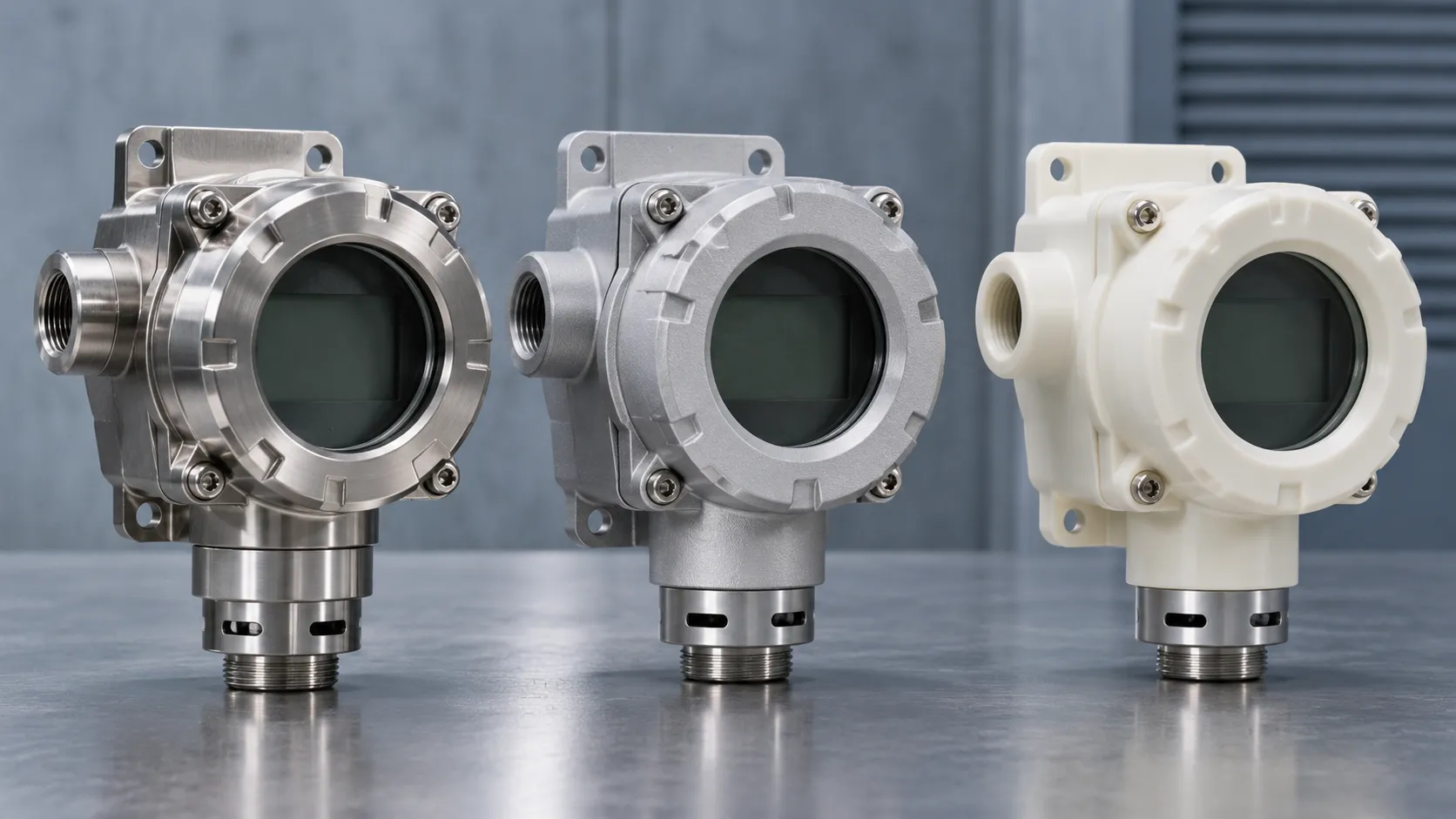
When stainless steel makes sense
Stainless steel is a strong candidate where long-term exposure to wet or corrosive atmospheres makes coating damage and maintenance difficult. It is used for fabricated control cabinets, protective covers, junction boxes and some complete detector housings. Its extra mass and fabrication cost may be justified in offshore, coastal, wastewater and demanding process installations.
When coated aluminum makes sense
Aluminum can provide useful weight reduction, machinability and thermal conduction. For example, Honeywell’s Sensepoint XCD RTD specifies an epoxy-painted aluminum alloy or 316 stainless steel enclosure, illustrating that legitimate industrial detector platforms can offer more than one material option.
Surface treatment and environmental exposure remain critical. A scratched coating, incompatible cleaning chemical or poorly designed junction with stainless fasteners may create a localized corrosion problem.
When plastics or composites make sense
Engineering polymers can avoid metallic corrosion and reduce enclosure weight. But plastic is not automatically chemical-proof, weatherproof or suitable for explosive atmospheres. Check the exact resin, UV stabilization, temperature rating, impact properties, electrostatic requirements and certifications of the finished device. Some aggressive chemicals can attack one polymer while leaving another relatively unaffected.
304 vs 316 vs 316L Stainless Steel: What Actually Changes?
For gas detector housings, the key alloy question is often not simply “stainless or not?” but which stainless grade is justified by the exposure?
| Property | 304 | 316 | 316L |
|---|---|---|---|
| General alloy family | Austenitic chromium-nickel | Austenitic chromium-nickel-molybdenum | Low-carbon version of 316 |
| Molybdenum for improved localized corrosion resistance | Normally not intentionally added | Yes | Yes |
| Chloride pitting / crevice corrosion resistance | Generally lower than 316 family | Generally better than 304 | Similar to 316 with comparable composition and condition |
| Carbon restriction | Standard grade limit | Standard grade limit | Lower maximum carbon content |
| Welded fabrication | Requires appropriate welding / finishing practice | Requires appropriate welding / finishing practice | Often preferred when minimizing weld sensitization risk is important |
| Typical decision | General industrial environments | More demanding chloride exposure | More demanding exposure plus welded fabrication or specification preference |
304 stainless steel is widely used in general industrial fabrication. It has good formability and broad resistance to ordinary atmospheric corrosion, but deposits containing chlorides can cause pitting or crevice corrosion, especially when moisture remains trapped around joints and fasteners.
316 stainless steel contains molybdenum, which generally improves resistance to localized attack by chlorides compared with 304. This is a major reason the 316 family appears in offshore and chemical-process equipment specifications.
316L stainless steel has a lower maximum carbon content than conventional 316. The benefit is particularly relevant to welded assemblies because it helps reduce susceptibility to sensitization and associated intergranular corrosion. 316L should not be advertised as categorically more resistant to every corrosive atmosphere than 316; their general corrosion behavior may be very similar when their composition and processing are otherwise comparable.
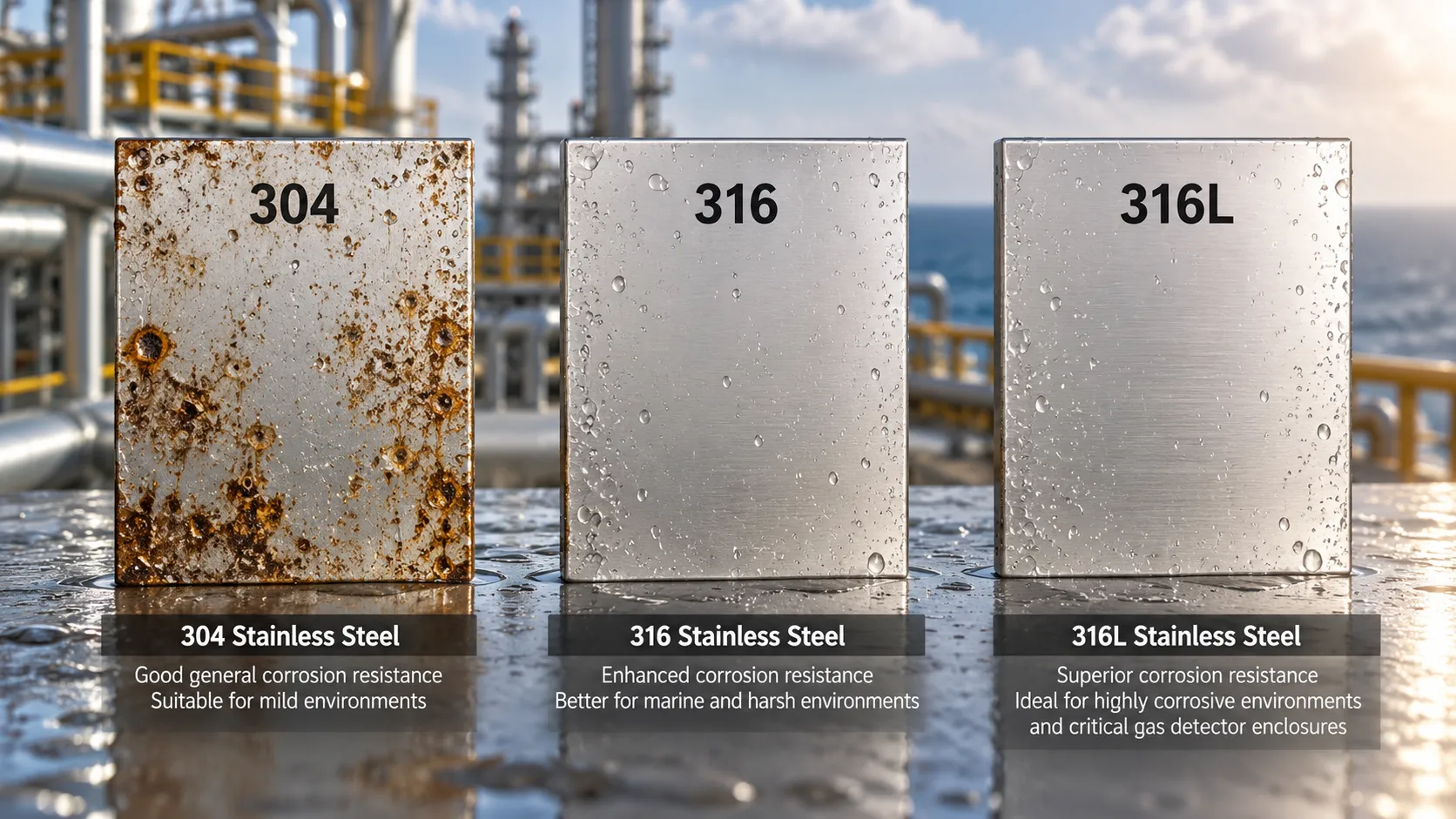
Illustrative comparison, not a controlled corrosion test. Visible rust or the absence of rust in an illustration cannot establish a grade’s quantitative corrosion performance.
Can 316L still corrode?
Yes. Stainless steel relies on a passive surface film; it is corrosion-resistant, not corrosion-proof. Pitting, crevice attack and other degradation can occur in sufficiently aggressive chloride, acidic, elevated-temperature or stagnant conditions. Deposits beneath clamps and seals can create localized environments unlike the open surface.
Do not specify 316L merely because the installation contains a corrosive gas. Assess whether the housing is actually exposed to dry gas, humid gas, liquid condensate, salt spray, cleaning solutions or a combination of these. For very aggressive service, a higher-alloy metal, a compatible polymer/composite or additional design protection may be needed.
Corrosive Environments: Offshore, Chemical Plants and Wastewater
A good enclosure specification starts with the environment outside the detector and the substances that may contact seals and gas-path components.
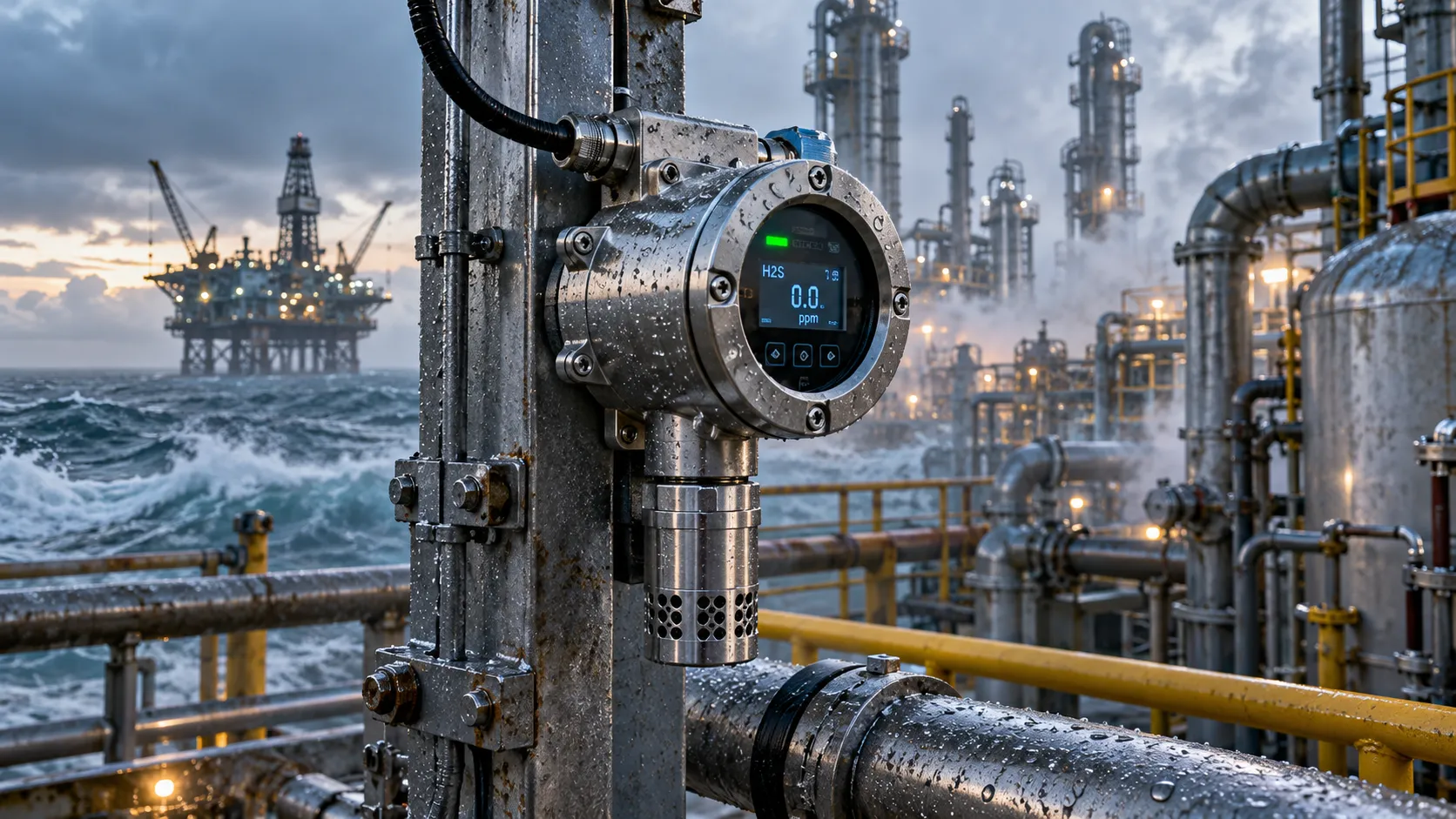
Offshore and coastal oil-and-gas sites
Salt spray, wet-dry cycling, wind-driven rain and chloride deposits create demanding conditions for instrument housings, brackets, fasteners and cable glands. A 316-family enclosure may be appropriate, but its complete installation must also address crevices, dissimilar-metal junctions, external coating where needed, mounting geometry and inspection access.
Chemical plants and chlorine-handling areas
Chemical exposure is highly site-specific. Chlorine-related areas can be aggressive when moisture and compatible reaction products are present, but the material response depends on concentration, moisture, temperature and other contaminants. Never assume that choosing 316L solves every chlorine-service problem.
For sensing considerations involving the reactive gas itself, see the GasNose guide to chlorine gas sensors. The sensor’s inlet, membrane, filter and sampling arrangement deserve separate compatibility checks.
Wastewater treatment and H₂S monitoring
Wet wells, sludge treatment, biogas and pumping stations can expose equipment to humidity, splash, condensation and hydrogen sulfide. Depending on moisture and other substances, corrosive deposits or condensates may affect metallic parts and connections.
A corrosion-resistant enclosure helps protect the assembly, but does not resolve electrochemical sensor response, overload, humidity behavior or gas transport. Those requirements should be reviewed alongside hydrogen sulfide sensor selection and how humidity affects gas sensors.
Food processing and washdown areas
Frequent washdown raises additional questions: what cleaning chemistry is used, how powerful are the jets, will hot and cold cycles create condensation, and are cables and connectors also protected? A smooth, cleanable surface is useful, but the complete instrument assembly must withstand the site procedure.
Does Stainless Steel Improve Gas Sensor Accuracy?
Not by itself. Enclosure material can influence the reliability of the instrument system, but it does not inherently improve the selectivity, calibration accuracy or detection limit of the sensing element.
Three pathways should be considered separately:
- Ambient protection: corrosion and water ingress can damage electronics, wiring or calibration interfaces.
- Gas transport: inlet geometry, sinters, membranes, filters, splash guards and tubing determine how the target gas reaches the sensor.
- Sensor behavior: temperature, humidity, cross-sensitivity, aging and measurement principle govern how the element responds.
A robust enclosure may avoid failures in the first category while creating a problem in the second if an unsuitable accessory slows diffusion or traps condensation. For example, a splash guard can be useful outdoors, but its effect on response time and calibration must be checked for the particular detector.
Likewise, corrosion-resistant metal does not make an electrochemical cell immune to humidity effects or a catalytic sensor immune to poisoning. If a detector reads unexpectedly low, investigate the full gas path and test the detector with the procedure specified by its manufacturer.
For installation context, see fixed gas detector placement: gas must actually reach the detector before its materials and electronics can help.
How Stainless Steel Coil Becomes a Fabricated Gas Detection Enclosure
A critical manufacturing distinction is often overlooked in generic material guides: not every stainless steel gas detector body is fabricated from coil.
Compact certified flameproof transmitters may use cast, forged or machined components. By contrast, larger instrument cabinets, junction boxes, monitoring control panels, mounting accessories and protective sheet-metal covers can be manufactured from stainless sheet obtained from coil stock.
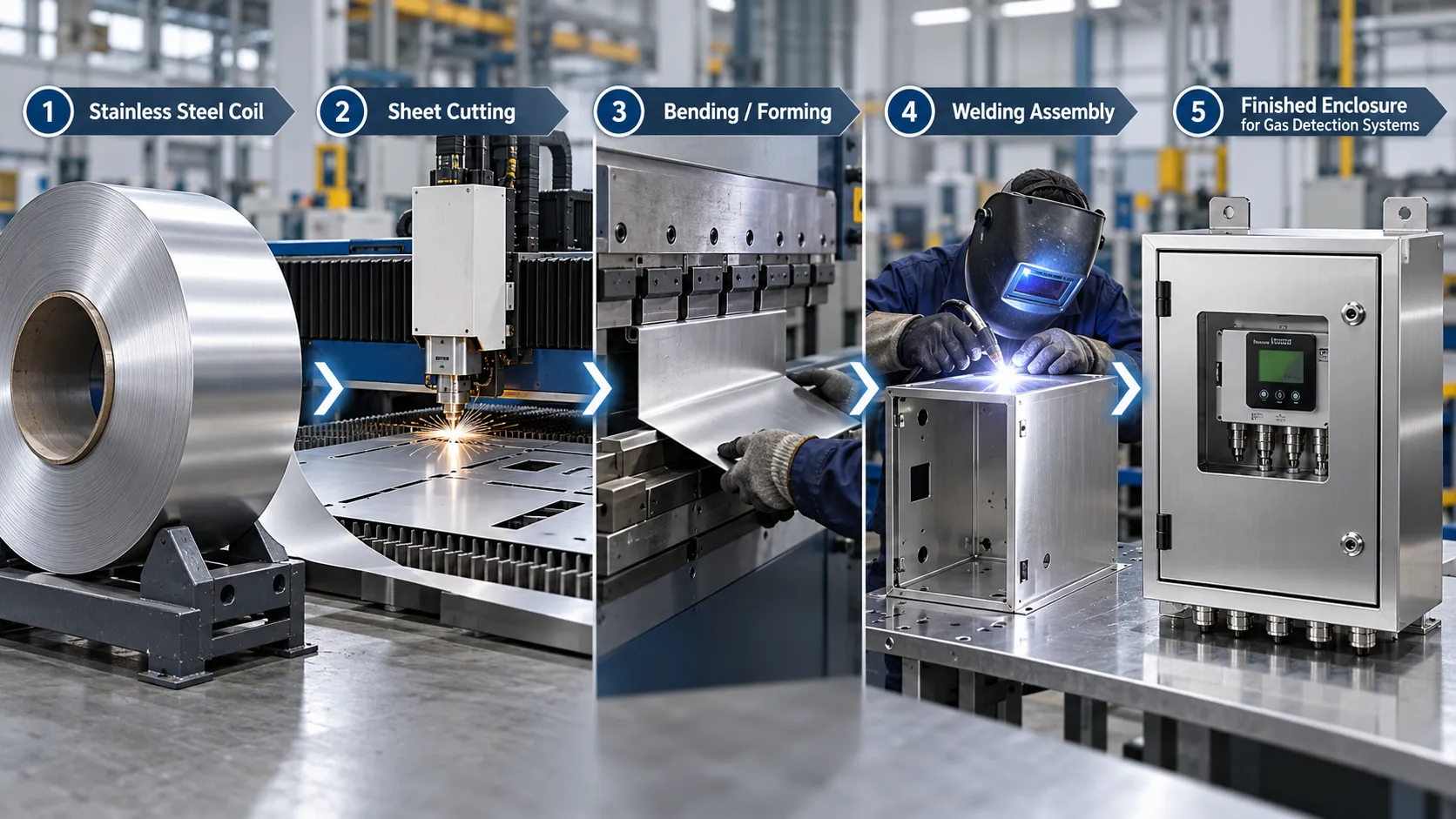
A typical sheet-metal cabinet process is:
- Specify the coil material. Choose the grade, thickness, applicable material standard, surface condition, flatness and any material traceability requirements.
- Cut or slit and blank. Convert coil into sheet blanks of the size required for the enclosure design.
- Punch and form. Create mounting holes, cable features, flanges, bends and reinforcing details while controlling bend radii and dimensional tolerances.
- Weld and assemble. Join corners, brackets and seams using a procedure suitable for the stainless grade and desired finish.
- Clean and finish. Remove fabrication contamination and heat tint where relevant; perform appropriate surface restoration or passivation according to the design and process specification.
- Fit seals and hardware. Add gaskets, hinges, locks, fasteners and cable entries selected for environmental and mechanical compatibility.
- Validate the assembly. Verify fit, ingress protection, electrical bonding, structural requirements and any necessary equipment-level approvals.
During sourcing, engineers may compare the available grades, dimensions and surface finishes of stainless steel coil before confirming a sheet-metal enclosure fabrication specification. Grade selection alone is not enough: bendability, edge quality, weld practice, finish and documentation must match the intended manufacturing process.
2B, BA and No. 4: does the finish matter?
Surface finish can affect cleaning, appearance, fabrication handling and corrosion performance. A common 2B finish is widely used for general sheet-metal fabrication; BA provides a brighter annealed appearance; and No. 4 gives a directional brushed appearance. The best finish should be selected for the actual service and post-fabrication treatment, not simply by which one looks most polished.
For demanding exposure, small design details can be as important as the mill finish: avoid water-trapping crevices, specify compatible fasteners and clean weld discoloration where the fabrication procedure requires it.
IP66, IP67, NEMA 4X and ATEX/IECEx Are Not the Same Thing
Material choice and equipment certification are related design constraints, but they answer different questions. A manufacturer may offer stainless steel and aluminum variants with different certification packages. Always read the actual nameplate and certificate for the exact model and configuration.
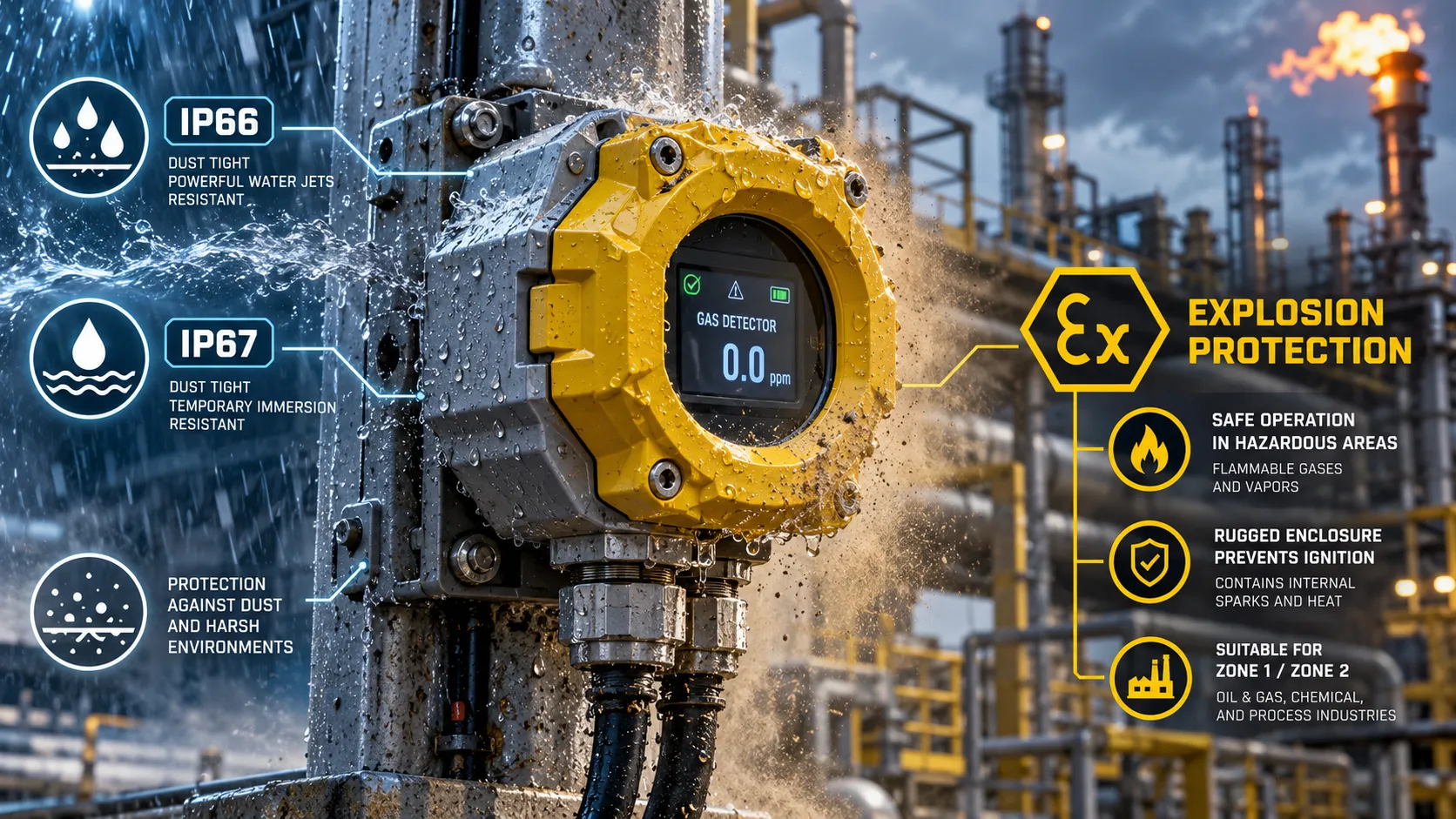
The image illustrates protection concepts; it is not evidence that the pictured equipment holds any particular certification.
| Marking / scheme | What it addresses | What it does not establish |
|---|---|---|
| IP66 | Dust-tight enclosure and protection against powerful water jets under defined tests | Corrosion resistance or explosion protection |
| IP67 | Dust-tight enclosure and protection against temporary immersion under defined tests | Automatic compliance with every water-jet requirement or Ex certification |
| NEMA Type 4X | Defined outdoor/indoor environmental enclosure protection, including additional corrosion resistance requirements | A one-to-one interchangeable IP or hazardous-area certification |
| ATEX | European regulatory framework for equipment intended for potentially explosive atmospheres | That any stainless-steel box is automatically safe for a hazardous zone |
| IECEx | International certification scheme based on relevant Ex equipment standards | That an uncertified material substitution or enclosure modification is acceptable |
IP classifications are defined under the IEC 60529 system. If a project needs both powerful water-jet and temporary-immersion performance, verify that the actual product documentation covers both requirements; do not infer one test from the other.
NEMA Type 4X includes additional corrosion-related criteria and is not simply another spelling of IP66. Consult the relevant NEMA enclosure-type definitions and the manufacturer’s tested rating.
For an explosive atmosphere, the full approved equipment design matters: the protection concept (such as Ex d flameproof construction or Ex i intrinsic safety), equipment group, gas group, temperature class, equipment protection level, cable entries and installation instructions. IECEx lists the applicable IEC 60079 standards, including IEC 60079-1 for flameproof enclosures.
As a real-world example, Dynament’s FGD10B is offered in aluminum or 316 stainless steel configurations with specific protection and certification information. That illustrates why material selection and approved equipment configuration must be evaluated together.
Never drill, weld, replace cable entries or substitute enclosure parts on certified Ex equipment without manufacturer approval and the required conformity assessment. Doing so can defeat the protection concept even if the replacement material appears stronger.
Choosing the Right Housing for a Real Installation
Start with the exposure conditions and the detector’s actual approved options. The following table gives screening guidance, not a substitute for a formal materials or hazardous-area assessment.
| Installation scenario | Material to evaluate first | Main engineering checks |
|---|---|---|
| Indoor general-purpose machinery room | Coated aluminum, 304 stainless or approved polymer | Dust, humidity, cleaning chemicals, impact and ambient temperature |
| Outdoor industrial plant, ordinary atmosphere | Coated aluminum or 304 stainless | Coating damage, water ingress, UV exposure, mounting and cable glands |
| Coastal plant or offshore skid | 316 / 316L stainless and other proven options | Chloride deposits, crevice corrosion, galvanic interfaces, maintenance access |
| Wastewater pump station or sludge area | 316-family steel or compatible nonmetallic solution | Condensation, H₂S-related exposure, washdown and gas inlet protection |
| Chemical dosing / chlorine handling room | Material selected from specific chemical compatibility review | Moisture, concentrations, condensates, seal materials and gas transport |
| Hazardous-area refinery | Only the appropriately certified equipment configuration | ATEX/IECEx or applicable local approval, Ex marking, installation constraints |
| Large gas monitoring control cabinet | Fabricated stainless sheet or suitably coated cabinet | Coil/sheet grade, forming, welding, gaskets, ingress and bonding |
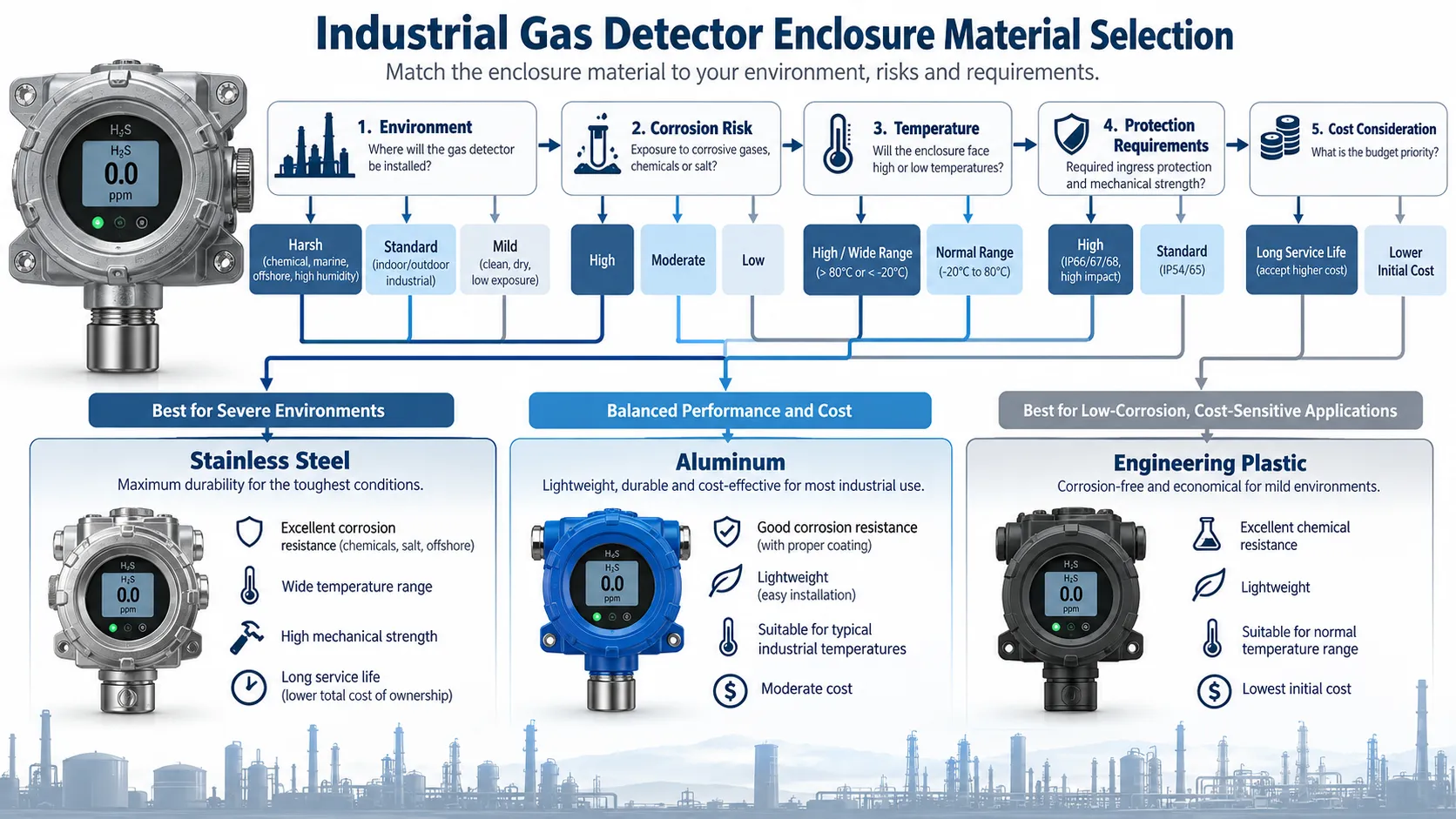
A conceptual decision aid: the final material and protection ratings must be confirmed for the actual service environment and the certified detector model.
Seven questions for the specification sheet
Before signing off the enclosure material, document:
- What reaches the outer surface? Fresh air, salt spray, rain, dust, acid mist, washdown or corrosive condensate?
- Which surfaces contact the target gas? Outer enclosure, sinter, membrane, sampling tube, pump head or wetted sensor chamber?
- What is the real temperature range? Include solar heating, cleaning cycles, condensation and cold starts.
- What enclosure protection is necessary? Specify the appropriate tested IP/NEMA ratings, not a material-based assumption.
- Is the site classified as hazardous? Match the exact equipment certificate and marking to the applicable area classification.
- How will it be serviced? Check fastener seizure, calibration access, replacement parts, gasket aging and washdown procedures.
- What is the total cost of ownership? Include weight, mounting, installation, inspection, downtime and expected replacement interval—not material price alone.
This is particularly important when comparing fixed and portable gas detectors: a permanently mounted coastal detector and a handheld monitor have different mechanical and environmental priorities.
Common Enclosure Selection Mistakes
Mistake 1: Choosing 316L for every industrial detector. Some indoor installations do not need the additional alloy cost; others may be too aggressive even for 316L. Determine exposure first.
Mistake 2: Treating “stainless steel” as a complete specification. Specify grade, production form, thickness, finish, joining methods and relevant material documentation.
Mistake 3: Equating IP67 with explosion-proof. Water ingress protection and ignition protection are different engineering questions.
Mistake 4: Protecting electronics by obstructing the sensor. Covers, filters and weather guards must be compatible with the gas detection and calibration method.
Mistake 5: Ignoring the weakest component. Stainless housings can still fail at unsuitable gaskets, glands, display windows, dissimilar fasteners and damaged seals.
Mistake 6: Using a fabricated cabinet specification for a certified transmitter body. A sheet-metal enclosure is not interchangeable with a tested flameproof transmitter housing.
Mistake 7: Assuming a normal zero reading proves the device is healthy. Verify gas response and measurement performance according to the manufacturer. See bump testing vs calibration.
Frequently Asked Questions
Which metal is best for an industrial gas detector enclosure?
There is no universal winner. Coated aluminum is widely used in industrial fixed detector bodies; 304 stainless suits many moderate exposures; and 316 or 316L is often selected where chloride-laden moisture or demanding washdown conditions make corrosion more challenging. The correct choice is the qualified material and complete detector design for the site.
Is 316L always better than 316 for gas detector housings?
No. 316L has lower carbon and is especially attractive for welded fabrication where limiting sensitization matters. The two grades can provide similar general corrosion resistance when their alloy composition, processing and exposure are comparable.
Can 304 stainless steel be used outdoors?
Yes, in suitable atmospheric conditions. However, chloride deposits, trapped moisture and aggressive cleaning agents can increase the likelihood of localized attack. Outdoor location alone does not determine the required grade; exposure does.
Is a stainless steel enclosure automatically explosion-proof?
No. Explosion protection depends on the certified construction and its markings, not on stainless steel as a raw material. Always use equipment approved for the site’s hazardous-area classification.
Is IP67 better than IP66 for gas detectors?
Neither designation universally replaces the other. IP66 describes powerful water-jet protection; IP67 describes temporary immersion protection under specified conditions. Verify the testing and ratings that correspond to the actual installation hazards.
Does a sealed housing slow the gas detector’s response?
It can if gas-access paths are poorly designed or obstructed. The electronics compartment may be sealed while the sensing element has a controlled diffusion or sample inlet. Inlet accessories must be evaluated for response time, humidity and calibration compatibility.
Can stainless steel coil be used to manufacture an explosion-proof gas detector?
Coil-derived sheet can be used for suitable fabricated cabinets, covers and related assemblies. It does not follow that a sheet-metal box can replace a certified flameproof detector body. Any Ex-rated product must be designed, tested and approved as the required equipment configuration.
What is the best material for an H₂S detector near wastewater?
Start by characterizing humidity, condensate, chemical contamination and cleaning practice. A 316-family enclosure may be appropriate for some installations, while others require different materials or protective arrangements. Independently confirm the H₂S sensing technology, gas inlet design and maintenance requirements.
Final Engineering Takeaway
The best gas detector enclosure is the one that survives the installation while allowing the detector to measure its target gas reliably. For a sound selection, separate five decisions:
Exposure environment → Material compatibility → Sensor gas path → Ingress and hazardous-area requirements → Whole-life maintainability.
Use 304, 316/316L, aluminum and engineering polymers as material candidates—not universal answers. In many projects, the small details that determine field reliability are the cable gland, gasket, weld, mounting bracket, gas inlet or maintenance procedure rather than the alloy grade alone.
For a broader understanding of detector technologies and applications, explore the GasNose gas sensor guides.
References and Further Reading
- Honeywell — Sensepoint XCD RTD fixed gas detector. Manufacturer information on enclosure material options and environmental ratings.
- Sensidyne — SensAir fixed-point gas detector. Manufacturer example of aluminum and 316 stainless configurations.
- Dynament — FGD10B flameproof fixed gas detector. Enclosure materials and protection certification example.
- IECEx — Standards for certified equipment. Overview of relevant explosive-atmosphere standards.
- Nidec — NEMA Enclosure Types. Industrial enclosure type definitions, including Type 4X.
