




One of the most common questions in fixed gas detection is:
How high should I install the gas detector?
That is important—but it is not the first question an engineer should ask.
The better starting point is:
Where can the gas leak, and where will that release actually travel under real operating conditions?
A fixed detector can only detect gas that reaches its sensing element or, in the case of an open-path detector, intersects its optical path.
Detector placement therefore needs to consider more than molecular weight.
A practical fixed gas detector location is usually determined by several factors working together:
- credible leak sources
- release pressure and direction
- gas or vapor properties
- temperature
- ventilation
- natural airflow
- process equipment
- walls and obstructions
- pits and roof pockets
- worker locations
- ignition sources
- detector technology
- environmental conditions
- maintenance access
The most useful rule is:
Install the detector where hazardous gas is most likely to reach it early—not simply “high for light gases and low for heavy gases.”
For the broader difference between permanent and mobile monitoring, see Fixed vs Portable Gas Detectors: Which Do You Need?.
Quick Answer: What Determines Fixed Gas Detector Placement?
| Question | Why It Matters |
|---|---|
| Where can gas leak? | Defines the most credible detector locations |
| How is it released? | A high-pressure jet behaves differently from a slow leak |
| Is it gas or vapor? | Initial release behavior can differ |
| Is the release hot or cold? | Temperature changes buoyancy and dispersion |
| How does ventilation move air? | Gas may follow airflow rather than simple density behavior |
| Where can gas collect? | Pits, roofs, trenches and enclosed pockets can retain gas |
| Where are workers? | Personnel protection may require additional locations |
| Where are ignition sources? | Important for flammable-gas detection |
| Point or open-path detector? | The two technologies use different placement strategies |
| Can the detector be maintained? | Calibration and functional testing must remain practical |
This leads to the central principle of fixed gas detection:
Detector placement should be based on credible release scenarios—not a mounting-height table alone.
Step 1: Identify the Most Credible Gas Leak Sources
The first task is to identify where gas is most likely to escape.
Common potential release points include:
- valves
- flanges
- pumps
- compressor seals
- flexible hoses
- regulators
- pipe joints
- cylinder manifolds
- pressure relief devices
- process connections
- loading points
- refrigeration machinery
- battery enclosures
- gas cabinets
If a compressor seal is the dominant methane leak source, installing the detector close to the expected release path generally provides more useful early detection than positioning it at an arbitrary point in the room.
Likewise, if an ammonia system contains several valves and compressors in one machinery room, detector placement should begin with those release scenarios rather than simply dividing the floor area into equal squares.
Known leak source beats arbitrary spacing.
Step 2: Understand How the Gas Is Released
Not every gas leak behaves like a slowly rising or sinking cloud.
The release mechanism can initially dominate the behavior.
Slow Diffusive Leak
A relatively slow leak may gradually mix with the surrounding atmosphere.
Its movement may then be influenced strongly by:
- gas density
- natural convection
- room airflow
- ventilation
High-Pressure Jet
A pressurized leak has momentum.
The gas may initially travel:
- horizontally
- downward
- across the room
- toward a wall or obstacle
even if the pure gas is lighter than air.
The release may only begin behaving according to buoyancy after it loses momentum and mixes with surrounding air.
Hot Gas Release
A gas or vapor released from a hot process can rise because of thermal buoyancy, even if the pure vapor is normally heavier than air.
Cold or Liquefied-Gas Release
Liquefied or rapidly expanding gases can cool significantly.
That can initially create a denser cloud that behaves differently from what would be predicted from the molecular weight of the gas at normal ambient conditions.
For example, LPG vapor is normally heavier than air, but actual release behavior also depends on:
- pressure
- phase change
- temperature
- airflow
- obstacles
Therefore:
Gas density describes one physical property. It does not predict the entire gas plume.
Gas Density Matters—but It Is Only One Part of the Decision
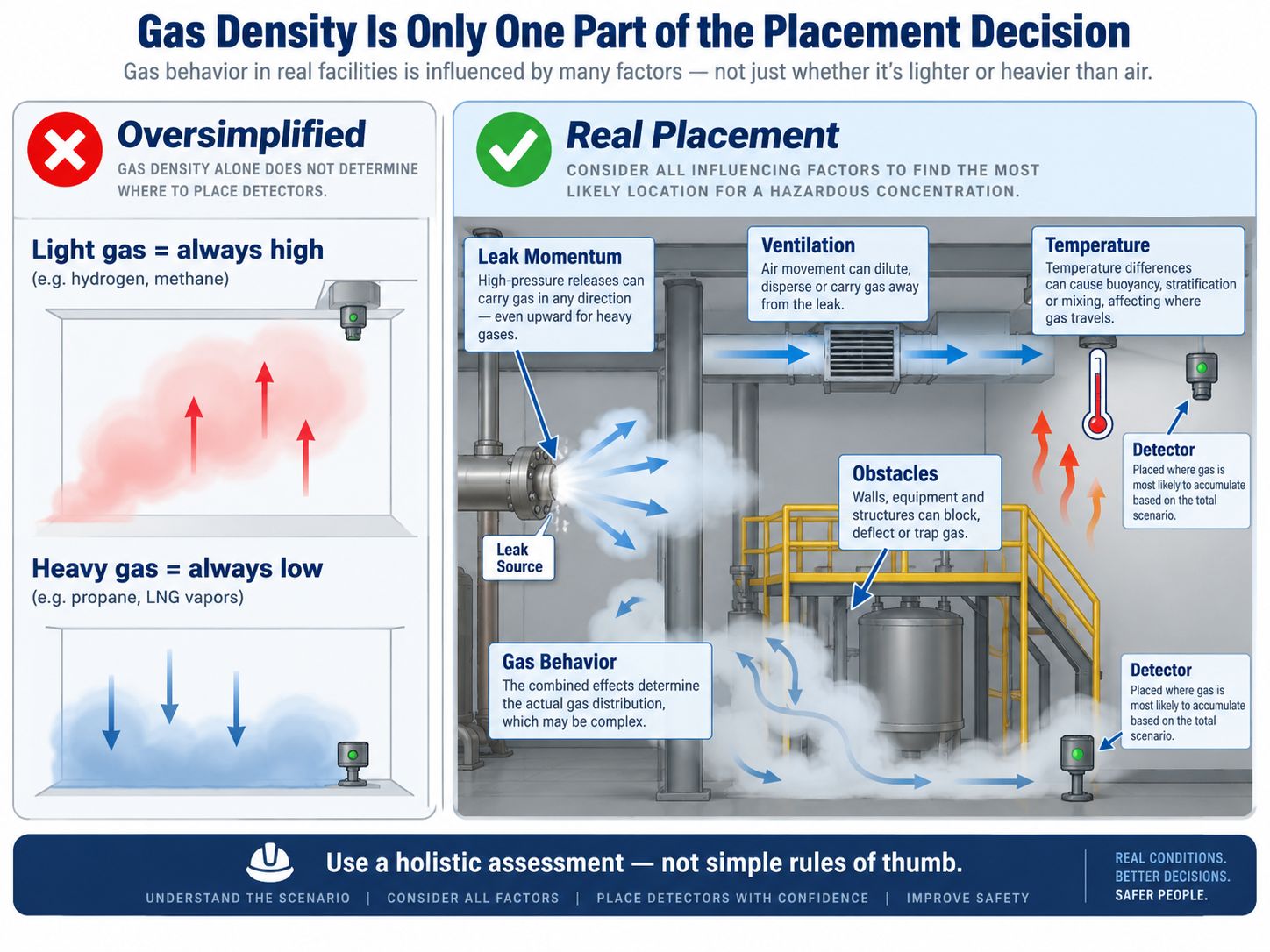
Gas density is still useful.
It simply should not be used alone.
Significantly Lighter-Than-Air Gases
Examples include:
- hydrogen
- methane
- ammonia
In relatively calm conditions, these gases often have an upward buoyancy tendency.
Potential detector locations may therefore include:
- above the leak source
- roof spaces
- ceiling pockets
- high-level ventilation paths
Heavier-Than-Air Gases and Vapors
Examples include:
- carbon dioxide
- propane
- butane
- many solvent vapors
Potential accumulation areas may include:
- floor level
- pits
- trenches
- drains
- sumps
- cellars
- bunded areas
But this remains only a starting point.
Why “H₂S Is Heavy, So Put the Detector Near the Floor” Is Too Simple
Hydrogen sulfide is heavier than air as a pure gas.
That fact often leads to a rule such as:
Always mount H₂S detectors close to the floor.
That can be misleading.
Industrial toxic-gas detection commonly occurs at:
- 5 ppm
- 10 ppm
- tens of ppm
At those concentrations, H₂S represents only a tiny fraction of the total air mixture.
The atmosphere is not behaving like a layer of pure H₂S lying underneath a layer of clean air.
At low gas concentrations, dispersion can be strongly influenced by:
- ventilation
- temperature
- convection
- local airflow
- equipment
- open doors
- extraction systems
For personnel-protection applications, detector placement may therefore need to consider:
likely H₂S source + air movement + worker exposure location
rather than molecular weight alone.
The same principle applies to many toxic gases measured in the ppm range.
What About Carbon Monoxide?
Carbon monoxide has a density very close to air.
Trying to place a CO detector simply according to whether CO is slightly lighter or heavier than air is therefore not very useful.
More important questions include:
- Where is CO produced?
- Where does ventilation carry it?
- Where are workers exposed?
- Is combustion occurring in an enclosed room?
- Are there stagnant areas?
For workplace fixed CO monitoring, source location and airflow are often more useful than a simple high/low mounting rule.
Step 3: Understand Ventilation and Airflow
Ventilation can dominate gas movement.
Before selecting fixed detector positions indoors, understand:
Supply Air
Where does fresh air enter?
Exhaust Air
Where does contaminated air leave?
Local Extraction
Is gas deliberately pulled toward a specific hood or duct?
Fans
Do process or HVAC fans create strong directional airflow?
Doors and Openings
Does opening a door completely change the room airflow?
Heat Sources
Do motors, compressors, furnaces or other equipment create thermal convection?
Emergency Ventilation
Does emergency ventilation operate differently from normal HVAC?
A useful detector location may be:
between the credible leak source and the direction the gas is expected to travel.
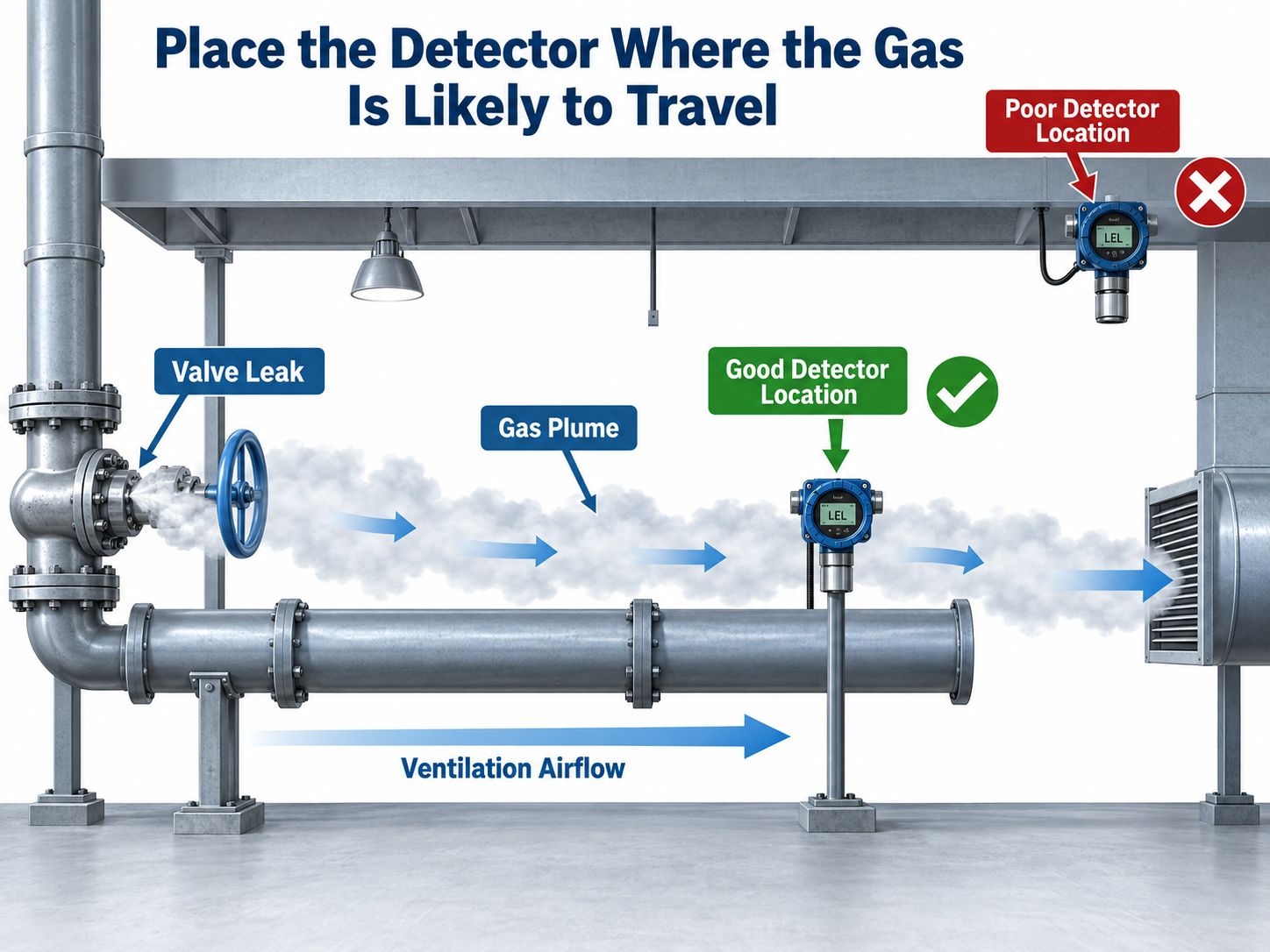
In the illustration above, the detector positioned in the expected gas plume is more likely to provide early warning than one placed outside the airflow path.
That does not mean every system has one obvious “correct” point.
Changing operating modes can create different gas paths.
Avoid Blindly Installing Detectors in Fresh-Air Supply
Suppose the detector is installed directly in a strong fresh-air supply.
The incoming clean air may:
- dilute the leak
- push the gas away
- reduce the concentration reaching the sensor
- delay alarm activation
This does not mean detectors should never be positioned near ventilation.
Sometimes the correct location is:
- near an extraction outlet
- inside a duct
- along a defined air path
The goal is to understand what the airflow is doing.
Ask:
Will this location expose the detector to the gas early, or continuously dilute the gas before it reaches the sensor?
Step 4: Look for Gas Accumulation Pockets
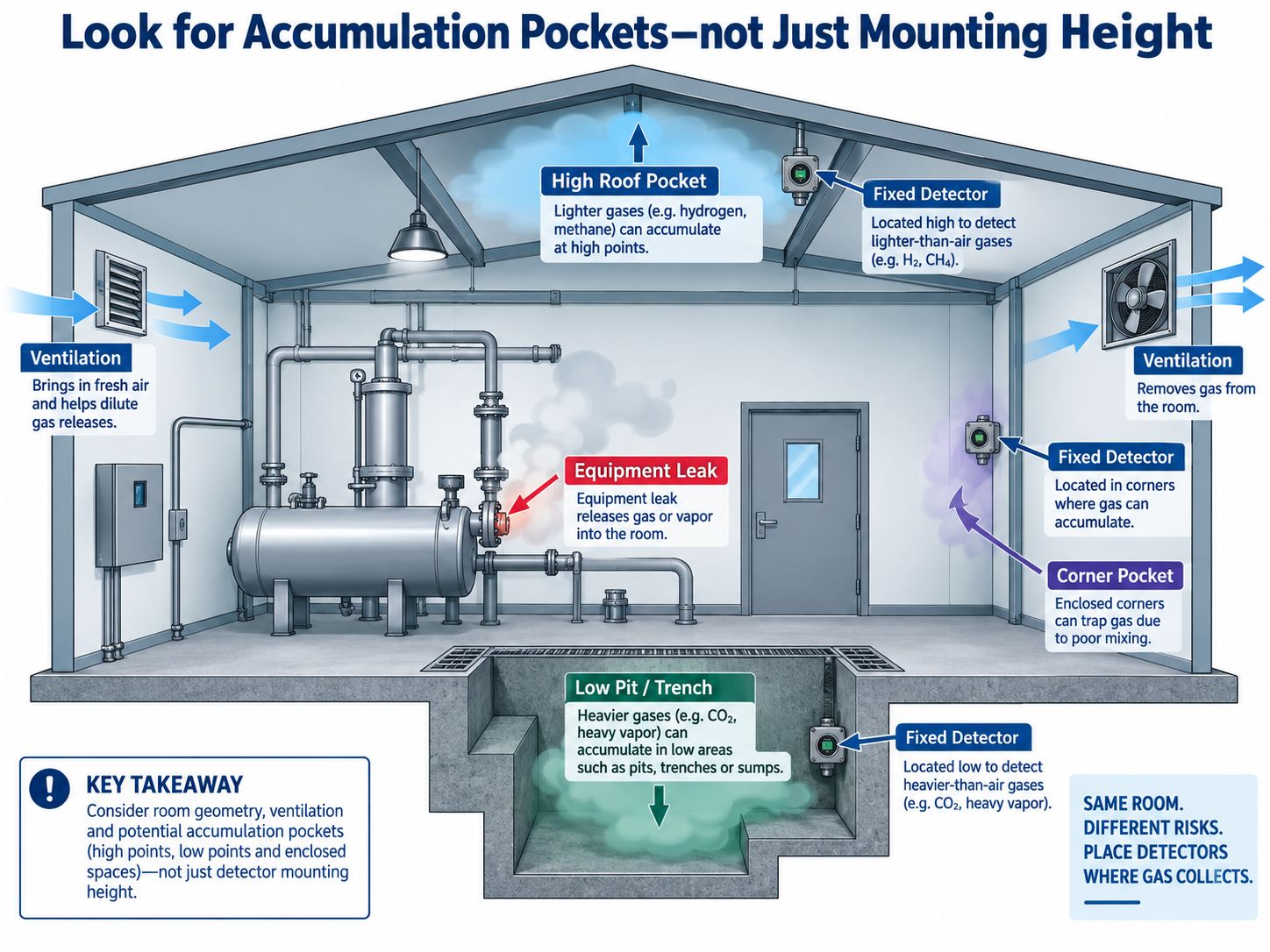
Industrial rooms are rarely empty rectangular boxes.
Gas can become trapped by:
- roof beams
- equipment
- walls
- trenches
- service pits
- cable ducts
- enclosures
- dead corners
- partial partitions
High-Level Pockets
Lighter gases may collect in:
- roof voids
- ceiling cavities
- high equipment enclosures
- spaces between structural beams
Hydrogen detection is a particularly important example.
Low-Level Pockets
Heavy vapors or CO₂ may accumulate in:
- pits
- trenches
- sumps
- drains
- well cellars
- basement spaces
Poorly Ventilated Corners
A gas does not need to be extremely light or heavy to accumulate in a stagnant pocket.
The better question is:
Where can gas accumulate faster than ventilation removes it?
This is often more useful than asking only:
How high should the detector be mounted?
Step 5: Consider Personnel Exposure Locations
The best detector position for finding a leak is not always the same as the best position for protecting workers.
Consider:
- permanent workstations
- operator routes
- access doors
- maintenance platforms
- stairways
- control areas
- escape routes
For a toxic gas, you may decide that one detector should monitor the likely release source while another protects an occupied area or airflow path.
This is one reason detector quantity cannot be calculated from floor area alone.
A gas detection system may need to satisfy several objectives simultaneously:
Leak Detection
Personnel Protection
Process Protection
Emergency Control
Step 6: Consider Ignition Sources for Flammable Gases
For methane, hydrogen, LPG and other combustible gases, the consequences of a release depend partly on whether the cloud reaches an ignition source.
Possible ignition sources include:
- electrical equipment
- motors
- burners
- hot surfaces
- furnaces
- process heaters
A detector may therefore be useful:
between a likely release point and a credible ignition source
when the gas dispersion scenario supports that placement.
This is particularly relevant for:
- oil and gas
- hydrogen systems
- LNG/LPG
- chemical plants
- compressor rooms
The objective is to detect the developing flammable atmosphere before it reaches a critical consequence point.
How High Should a Fixed Gas Detector Be Installed?
There is no single mounting height that applies to every gas detector.
A useful starting framework is:
| Gas / Vapor | General Tendency | Placement Considerations |
|---|---|---|
| Hydrogen | Strongly lighter than air | Leak source, ceiling pockets, roof geometry, exhaust path |
| Methane | Lighter than air | Above source, high points, ventilation |
| Ammonia | Lighter than air | Source, machinery layout, high-level airflow |
| CO₂ | Heavier than air | Low points, pits, trenches, cellars |
| LPG vapor | Heavier than air | Floor level, drains, pits, release temperature |
| H₂S | Pure gas heavier than air | Source + airflow + worker exposure; ppm clouds should not be treated as a pure gas layer |
| CO | Similar density to air | Source, airflow and personnel exposure more important |
This table should be treated as:
a starting clue—not an installation specification.
The final location depends on the complete release scenario.
How Far Can One Fixed Gas Detector Cover?
This is one of the most important questions in fixed gas detection.
The answer is:
A point gas detector does not have a universal coverage radius.
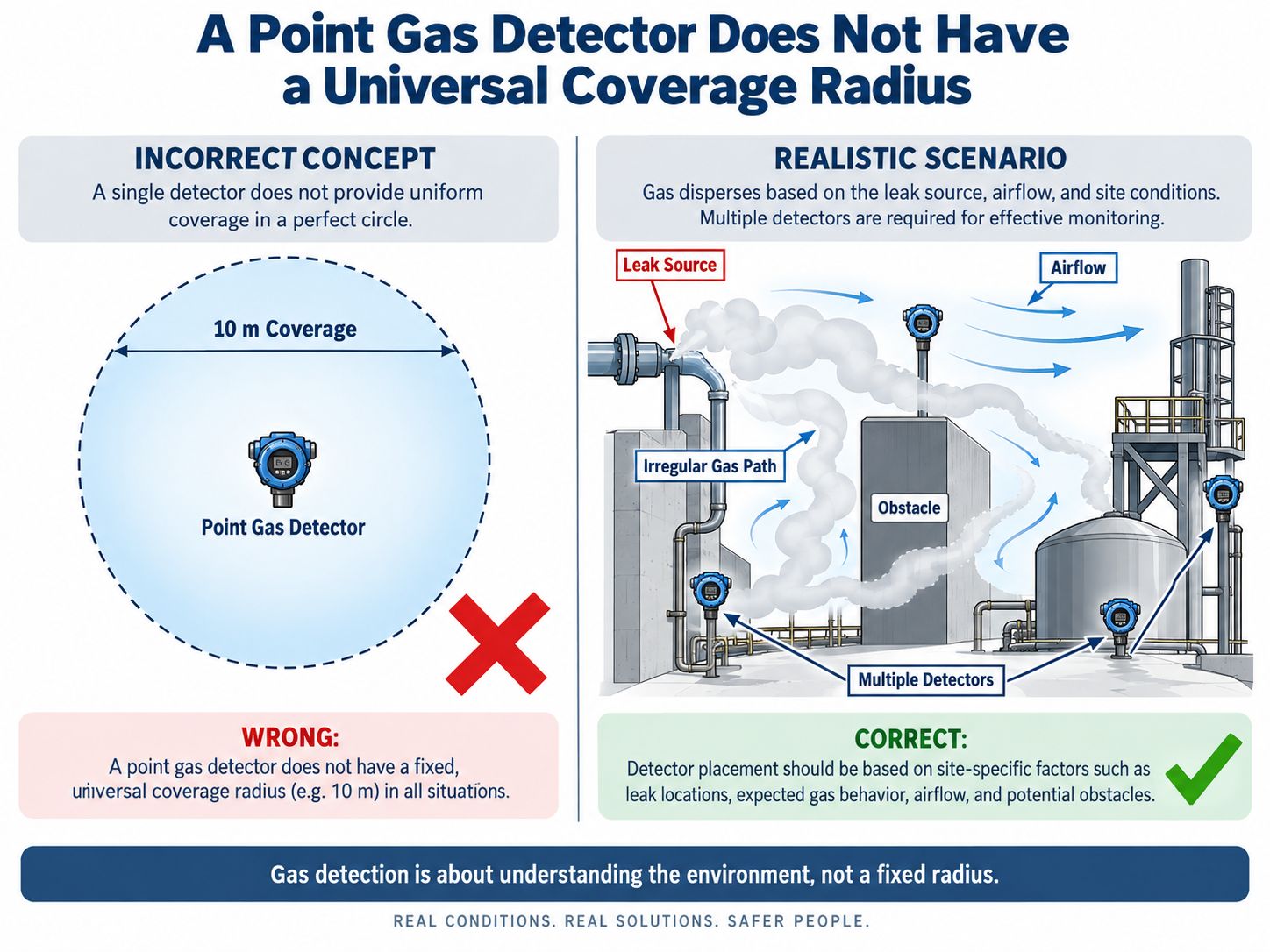
A point detector only measures gas when the gas physically reaches the sensing element.
It is not like a wireless access point transmitting evenly in a perfect circle.
The gas cloud may:
- move around the detector
- pass above it
- remain trapped behind equipment
- follow ventilation
- accumulate in another part of the room
Two detectors installed the same distance apart can provide very different protection depending on the environment.
The diagram above illustrates the principle that a simple circular coverage assumption is unreliable.
It should not be interpreted as saying that every real installation automatically requires several detectors.
The actual quantity still depends on:
- release scenarios
- risk targets
- equipment layout
- detector technology
- required response time
Why “One Detector Every X Meters” Is Not a Universal Design Rule
Consider two rooms with exactly the same dimensions.
Room A
Contains:
- one compressor
- one known gas source
- predictable mechanical ventilation
Room B
Contains:
- multiple pumps
- valves
- pipe racks
- walls
- trenches
- different airflow patterns
The floor areas are identical.
The required detection systems may be completely different.
Therefore:
Detector count follows hazard scenarios—not floor area alone.
Some detector manufacturers and engineering organizations provide rules of thumb for preliminary planning.
These can be useful during early design.
But they should not replace:
- hazard assessment
- process knowledge
- gas dispersion analysis
- applicable standards
- specialist engineering review
Point Detector vs Open-Path Detector Placement
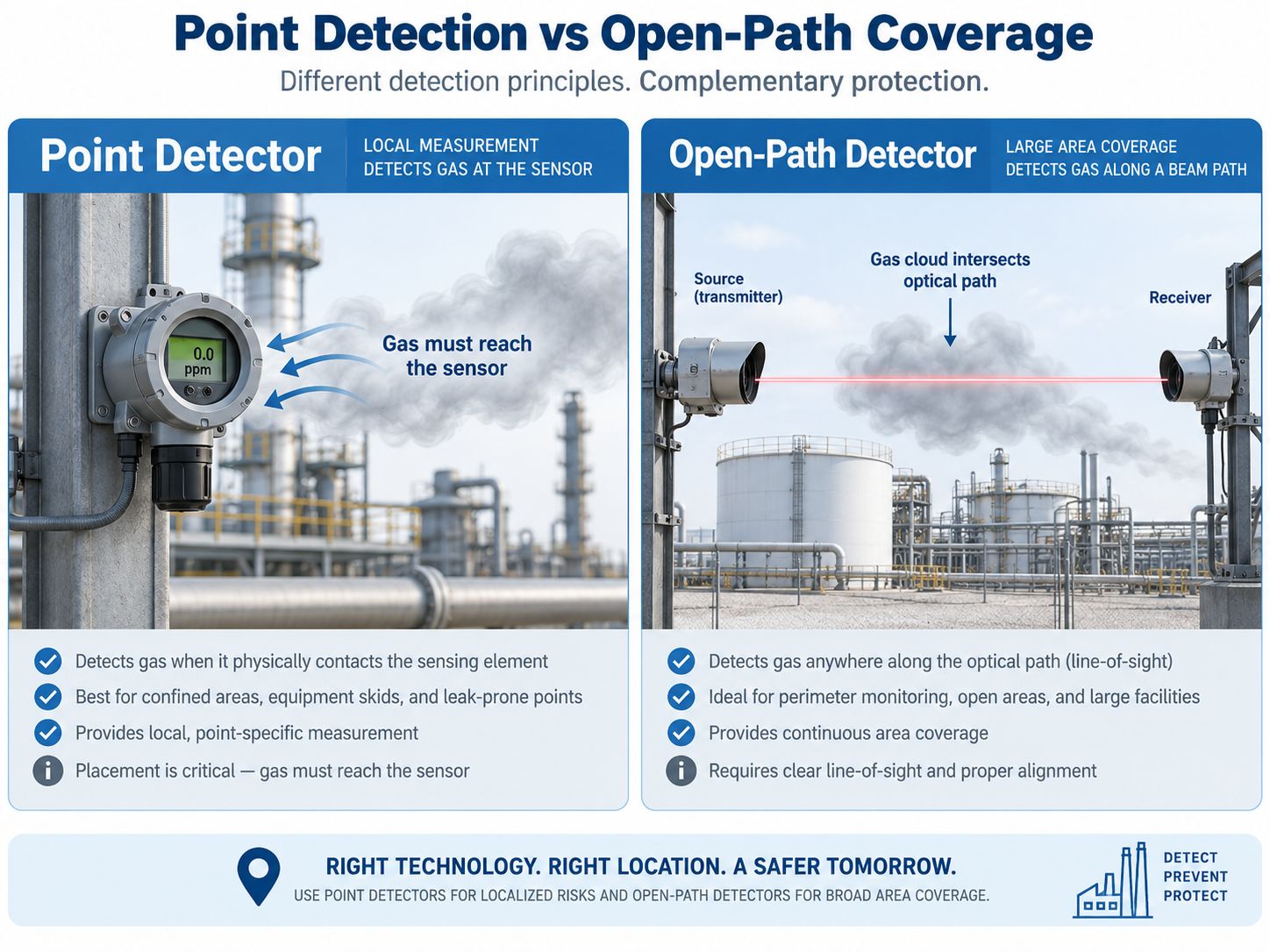
Fixed gas detection does not always mean installing individual point sensors.
Two important architectures are:
Point Gas Detector
A point detector answers:
What gas concentration is present at this specific location?
The gas needs to physically reach the sensor.
Point detectors are particularly useful near:
- valves
- compressors
- enclosed rooms
- equipment skids
- pits
- local leak sources
Open-Path Gas Detector
An open-path optical detector sends light across a defined path.
If a target gas cloud intersects the optical beam, the system detects absorption along that path.
This can be valuable for:
- large process areas
- perimeters
- gas migration corridors
- outdoor facilities
The output is often path-integrated concentration, not simply a conventional point ppm reading.
Open-path placement therefore needs to consider:
- likely leak trajectory
- prevailing wind
- beam height
- clear line of sight
- structural movement
- equipment obstruction
- vehicles
- maintenance access
Open-path detection does not automatically mean the entire facility is covered.
The gas cloud still needs to intersect the optical beam.
Indoor vs Outdoor Fixed Detector Placement
Indoor Installations
Indoor placement is strongly influenced by:
- ventilation
- roof geometry
- floor pits
- walls
- equipment heat
- recirculation
- doors
- enclosed accumulation zones
Because airflow can be more predictable indoors, it is often possible to trace likely transport paths.
Outdoor Installations
Outdoor gas dispersion can be influenced by:
- prevailing wind
- changing wind direction
- atmospheric turbulence
- pressurized releases
- equipment congestion
- structures
- weather
- temperature
Outdoor detector design therefore becomes more difficult to reduce to simple mounting-height rules.
Multiple wind scenarios may need to be evaluated.
Application Example: Hydrogen Detection
Hydrogen is much lighter than air.
Potential fixed detector locations often include:
- above electrolyzers
- above hydrogen piping
- ceiling spaces
- roof pockets
- near high-level exhaust points
But even hydrogen does not justify blindly installing every detector at the highest possible location.
Consider:
- high-pressure leak momentum
- mechanical ventilation
- roof beam pockets
- heat-driven airflow
- gas mixtures
The correct question remains:
Where will hydrogen travel and accumulate in this actual enclosure?
Application Example: Methane Detection
Methane is lighter than air.
In relatively calm indoor spaces it commonly migrates upward.
Potential locations include:
- above compressors
- above valves
- roof pockets
- ventilation exhaust paths
But mine ventilation, natural-gas pressure, process airflow and outdoor wind can completely change the plume.
For methane sensing technologies, see Catalytic vs NDIR vs TDLAS Methane Sensors.
Application Example: CO₂ Detection
CO₂ is substantially heavier than air.
Potential accumulation areas include:
- pits
- trenches
- basements
- cellars
- low machinery spaces
- low-level process enclosures
This is especially relevant in:
- CO₂ refrigeration
- beverage facilities
- fermentation
- CCUS
- dry ice handling
But airflow must still be evaluated.
A pit may be a credible accumulation zone even if the main room has good ventilation.
That can justify a dedicated low-level detector rather than assuming a wall-mounted room detector covers everything.
Application Example: Wastewater H₂S
Wastewater applications may release H₂S from:
- wet wells
- sewers
- sludge
- pump stations
- treatment tanks
Pure H₂S is heavier than air.
But industrial H₂S alarms often involve ppm-level concentrations.
Detector design should therefore consider:
- source
- ventilation
- openings
- local extraction
- worker access
- breathing-zone exposure
- pits or confined pockets
Simply placing every H₂S transmitter close to the floor can miss the actual worker exposure pathway.
Application Example: Ammonia Refrigeration
Ammonia is lighter than air.
Potential leak points include:
- compressors
- valves
- receivers
- evaporators
- machinery
High-level placement may therefore be appropriate in many refrigeration applications.
But system design also needs to consider:
- machinery-room ventilation
- local exhaust
- equipment arrangement
- detector function
- alarm setpoints
- emergency shutdown logic
A detector intended to trigger ventilation may even serve a different purpose from one used for lower-level personnel warning.
Detector location and alarm function should therefore be designed together.
Should Detectors Be Installed Near Ventilation Exhaust?
Sometimes.
If the ventilation path reliably carries gas toward an exhaust:
placing a detector along that path can provide useful monitoring.
But there are two different objectives.
Source Detection
You want to detect a leak as early as possible near the equipment.
Room / Exhaust Monitoring
You want to detect gas being transported through the ventilation system.
A facility may require:
both
rather than choosing one location.
The important point is to understand what each detector is supposed to achieve.
Detector Orientation Matters Too
Selecting the right coordinates is not enough.
The detector must also be installed according to the manufacturer’s required orientation.
Possible issues include:
- rain
- wash water
- dust
- condensate
- debris
Some fixed detectors are installed with the sensor opening facing downward to reduce contamination.
Depending on the environment, accessories may include:
- weather guard
- splash guard
- sun shield
- dust filter
- collecting cone
- flow adapter
Do not add accessories without checking their effect on:
- response time
- gas transport
- calibration procedure
Keep the Detector Accessible for Testing and Calibration
A detector positioned perfectly for gas dispersion but impossible to reach safely creates a maintenance problem.
Fixed detectors need periodic:
- inspection
- functional testing
- calibration
- cleaning
- sensor replacement
Therefore placement should consider:
Detection Performance
and:
Maintainability
at the same time.
Avoid locations where routine work requires:
- unnecessary scaffolding
- dangerous access
- process shutdown
- removal of large equipment
unless the hazard scenario clearly justifies that position and an appropriate maintenance strategy exists.
For maintenance principles, see Gas Detector Bump Test vs Calibration.
Environmental Protection Matters
Detector reliability can also be affected by:
Rain
Outdoor transmitters may require weather protection.
Washdown
Food, wastewater and industrial facilities may expose detectors to high-pressure cleaning.
Direct Sunlight
Strong solar heating can affect equipment temperature.
Dust
Dust can obstruct diffusion paths or optical surfaces.
Condensation
Water can interfere with optical and electrochemical systems.
Vibration
Mounting on vibrating equipment can shorten instrument life or affect optical alignment.
Mechanical Impact
Forklifts, tools or maintenance activities can damage exposed transmitters.
Detector placement therefore needs to balance:
best gas location + survivable installation location.
Hazardous-Area Classification Must Be Considered
A detector may be positioned inside an area classified for explosive gas.
The detector and installation method must therefore be suitable for the relevant hazardous-area requirements.
Depending on jurisdiction and project, this can involve concepts such as:
- ATEX
- IECEx
- NEC / Class-Division
- Zone classification
- local certification requirements
Do not solve a certification problem by moving the detector far away from the credible leak source and destroying detection performance.
If the electronics cannot be installed directly at the ideal sensing point, some systems allow:
- remote sensor heads
- sampling systems
- separated electronics
The final solution still needs to comply with the manufacturer’s approval conditions.
Detector Placement and Alarm Settings Are Connected
Imagine two detectors.
Detector A is:
close to the leak source
Detector B is:
farther away in the occupied area
Their functions may be different.
Detector A might provide:
early process leak warning
while Detector B provides:
personnel protection
The alarm setpoints and response logic should be designed with those purposes in mind.
For more on alarm strategy, see Gas Detector Alarm Settings: Low, High, STEL & TWA Explained.
When Should You Use Gas Mapping?
For simple applications, experienced engineering judgment may be sufficient.
For complex facilities, a formal fire and gas mapping study can be valuable.
Examples include:
- refineries
- LNG facilities
- offshore platforms
- hydrogen production
- chemical plants
- large compressor installations
Gas mapping can evaluate multiple:
release scenarios
against:
detector locations
and identify possible coverage gaps.
The analysis can help answer:
- How many detectors are needed?
- Which leak scenarios are detected?
- Which areas remain poorly covered?
- Are point detectors sufficient?
- Would open-path detection improve coverage?
Modern gas mapping can use:
- CAD models
- 3D geometry
- process hazard information
- detector response assumptions
The goal is not simply to maximize detector quantity.
It is to achieve the required protection with a technically justified layout.
When Is CFD Useful?
CFD means:
Computational Fluid Dynamics
It can be useful when gas dispersion is strongly affected by:
- complex equipment
- forced ventilation
- buildings
- high-pressure release
- thermal effects
- outdoor wind
A CFD study can model how gas may:
- disperse
- dilute
- rise
- fall
- follow ventilation
- become trapped
This can help validate detector positioning in applications where simple rules of thumb are not sufficient.
CFD is not necessary for every small installation.
But in high-consequence projects, it can provide much stronger engineering justification than simply saying:
“Methane is lighter than air, so we installed the detectors at the ceiling.”
Common Fixed Gas Detector Placement Mistakes
Mistake 1 — Using Gas Density as the Only Rule
Density is useful but does not account for:
- pressure
- temperature
- ventilation
- obstacles
Mistake 2 — Installing Detectors at Equal Distances
Uniform spacing does not necessarily correspond to actual release hazards.
Mistake 3 — Ignoring Ventilation
A correctly selected mounting height can still be ineffective if the gas plume moves in another direction.
Mistake 4 — Installing Too Far From the Leak Source
The detector may not alarm until a significant gas cloud has already formed.
Mistake 5 — Installing Directly in Strong Fresh-Air Dilution
The detector may experience a lower concentration than the surrounding hazard area.
Mistake 6 — Missing Pits and Roof Pockets
The main room may be clear while gas accumulates in a local pocket.
Mistake 7 — Monitoring Equipment but Not People
Leak detection and worker exposure are not always the same problem.
Mistake 8 — Forgetting Maintenance Access
A detector that cannot be tested reliably will eventually become a system-performance problem.
Mistake 9 — Assuming One Outdoor Wind Direction
Prevailing wind is important, but wind direction changes.
Mistake 10 — Assuming a Fixed Coverage Radius
Point detectors detect gas that physically reaches them.
There is no universal circular detection radius.
Fixed Gas Detector Placement Workflow
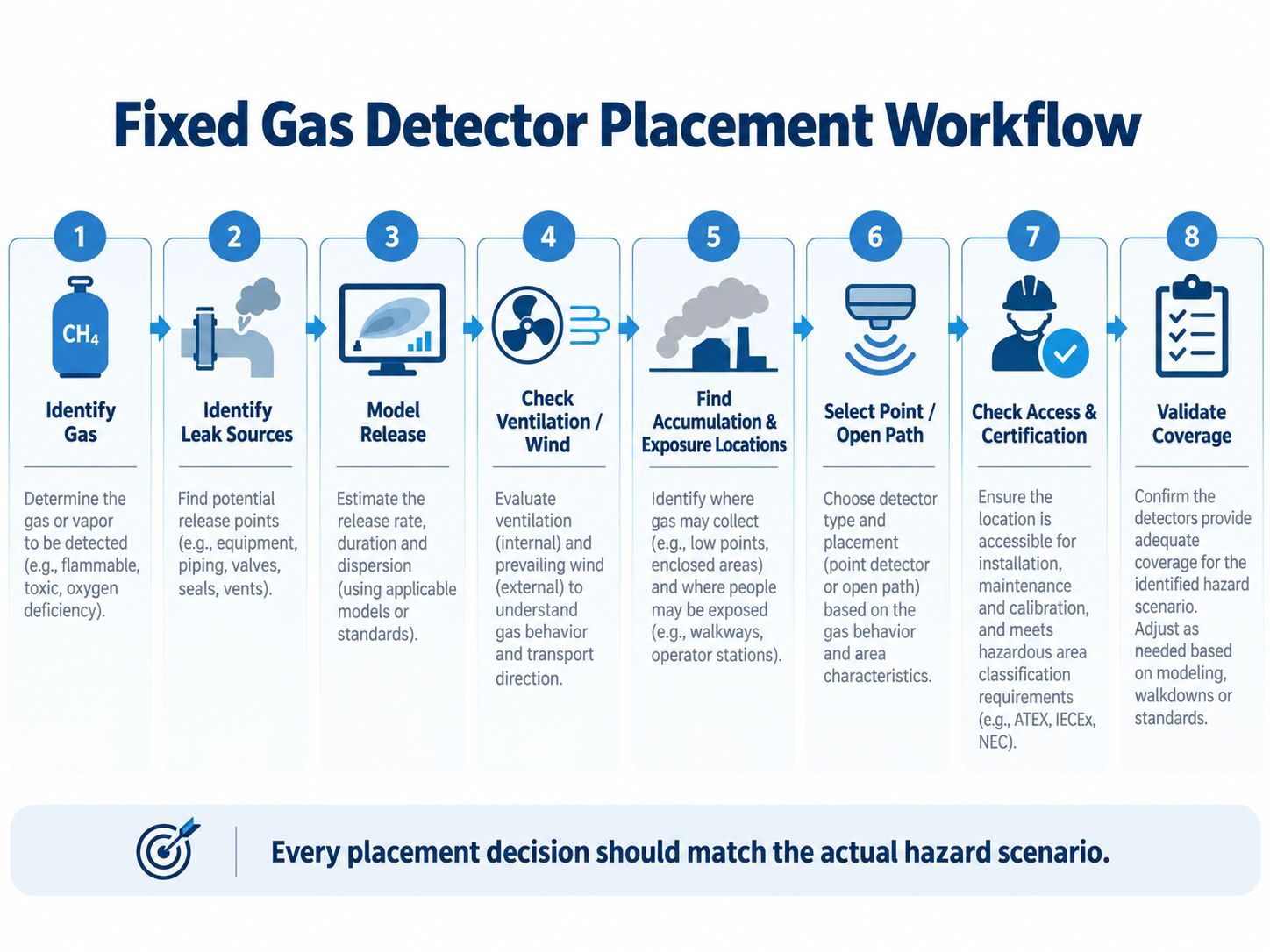
A practical placement process is:
Step 1 — Identify the Target Gas
Determine whether the hazard is:
- flammable
- toxic
- oxygen deficiency
- oxygen enrichment
Step 2 — Identify Credible Leak Sources
Review:
- piping
- valves
- compressors
- seals
- tanks
- process equipment
Step 3 — Understand the Release
Consider:
- release pressure
- flow rate
- temperature
- phase
- direction
Step 4 — Evaluate Ventilation and Wind
Map:
- supply
- exhaust
- natural airflow
- prevailing wind
- thermal convection
Step 5 — Find Accumulation and Exposure Locations
Identify:
- pits
- roof pockets
- enclosed areas
- worker locations
- ignition sources
Step 6 — Select Detector Technology
Choose between:
- point detection
- open-path detection
- sampling system
- appropriate sensing principle
Step 7 — Check Installation Constraints
Confirm:
- hazardous-area certification
- environmental protection
- maintenance access
- mounting orientation
Step 8 — Validate Coverage
For more complex systems, use:
- site survey
- hazard review
- gas mapping
- dispersion modeling
- CFD where justified
And finally:
Document why each detector is installed where it is.
Fixed Gas Detector Placement Checklist
Before finalizing the detector layout, confirm:
- Target gas identified
- Measurement objective defined
- Credible leak sources identified
- Release pressure considered
- Release temperature considered
- Gas/vapor phase considered
- Indoor/outdoor conditions reviewed
- Ventilation supply identified
- Exhaust path identified
- Prevailing wind reviewed
- Thermal airflow considered
- Pits/trenches reviewed
- Roof pockets reviewed
- Personnel locations identified
- Escape routes considered
- Ignition sources considered
- Point/open-path technology selected
- Environmental protection selected
- Hazardous-area certification checked
- Maintenance access confirmed
- Functional testing method planned
- Detector quantity justified
- Coverage validated
- Placement rationale documented
Frequently Asked Questions
How high should a fixed gas detector be installed?
There is no universal installation height.
Start with the likely leak source, gas behavior, ventilation and potential accumulation locations.
Gas density can guide the initial placement, but it should not be the only factor.
Should methane detectors be mounted high?
Methane is lighter than air, so high-level placement is common in indoor applications.
However, leak pressure, ventilation, roof geometry and equipment can change where methane travels.
The detector should be positioned where methane is expected to reach it early.
Where should hydrogen detectors be installed?
Hydrogen has strong upward buoyancy, so ceiling or high-point locations are often important.
Pay particular attention to:
- roof pockets
- beam spaces
- high-level ventilation
- hydrogen equipment
But also consider pressurized releases and mechanical ventilation.
Should H₂S detectors always be installed near the floor?
No.
Pure H₂S is heavier than air, but ppm-level toxic concentrations are highly influenced by airflow and mixing.
Consider the actual H₂S source, ventilation and personnel exposure location.
Where should CO₂ detectors be installed?
CO₂ can accumulate in low areas.
Potential locations include:
- pits
- trenches
- cellars
- basements
- low enclosed spaces
The final placement should also consider ventilation and leak sources.
Where should carbon monoxide detectors be installed?
CO has a density close to air.
Source location, ventilation and worker exposure are therefore generally more useful than simply choosing the highest or lowest mounting point.
How far apart should fixed gas detectors be?
There is no universal spacing that applies to all industrial fixed gas detection systems.
Detector quantity and spacing should be based on credible release scenarios, gas movement, process layout and required coverage.
How much area does one point gas detector cover?
A point gas detector does not have a universal fixed coverage radius.
Gas must physically reach its sensing element.
Site-specific gas dispersion determines how effective the location is.
Should a detector be installed close to the leak source?
Often yes, because closer placement can improve early detection.
However, a high-pressure jet may pass directly by a sensor positioned too close to the release point, so the actual release behavior must also be considered.
Should gas detectors be installed near ventilation?
Sometimes.
A detector may be useful along a known exhaust path, but placing it directly in strong clean-air dilution may delay detection.
The airflow direction and monitoring objective should determine the location.
What is the difference between point and open-path detector placement?
A point detector measures gas at one location.
An open-path detector monitors gas absorption along an optical beam.
Point detectors should be positioned where gas is expected to reach the sensor.
Open-path systems should be aligned so likely gas clouds intersect the beam.
Does an open-path detector cover the entire area between transmitter and receiver?
It detects target gas that intersects the optical beam.
It does not mean every cubic meter of the surrounding facility is directly monitored.
Can a gas detector be installed outside a hazardous area?
Sometimes, but only if the selected location still provides the required detection performance.
Do not move the detector away from the hazard solely to avoid certification requirements.
Use appropriately certified equipment or an approved remote-sensing architecture where necessary.
How many fixed gas detectors do I need?
There is no universal formula based only on floor area.
The number depends on:
- leak sources
- consequence
- gas dispersion
- ventilation
- detector technology
- required detection coverage
Complex facilities may benefit from formal gas mapping.
Can CFD be used to determine detector placement?
Yes.
Computational fluid dynamics can model release and dispersion under defined operating conditions.
It can be useful for complex or high-consequence facilities where ventilation, equipment and gas behavior make simple placement rules inadequate.
Final Takeaway
Fixed gas detector placement is not primarily a question of:
High or low?
It is a question of:
Where will the hazardous gas actually go?
Gas density is useful.
But the real detector-placement problem includes:
Leak Source
Release Pressure
Temperature
Gas Properties
Ventilation
Obstacles
Accumulation Zones
Personnel
Detector Technology
A hydrogen detector may need to monitor a roof pocket.
A CO₂ detector may need to monitor a pit.
An H₂S detector may need to follow the wastewater airflow rather than simply sit at floor level.
A methane detector may need to sit along a mechanical ventilation path.
And a point detector only works when the gas reaches it.
That gives us the most important rule:
Place the detector where the credible gas release is likely to travel—not where a generic mounting-height chart tells you to put it.
For simple installations, this can be determined from process knowledge, airflow and hazard assessment.
For complex or high-consequence facilities, detector placement should be validated through a more formal engineering process such as:
- gas mapping
- dispersion analysis
- CFD
- specialist fixed gas detection design
A good detector installed in the wrong location can provide very little protection.
A well-designed gas detection system therefore begins with the hazard scenario—not the hardware.
References and Further Reading
- IEC 60079-29-2:2015 — Gas detectors: selection, installation, use and maintenance for flammable gases and oxygen
- IEC 62990-2:2021 — Gas detectors: selection, installation, use and maintenance for toxic gases and vapours
- IEC 60079-29-3 — Functional safety of fixed gas detection systems
- Dräger — Introduction to Gas Detection Systems and Sensor Positioning
- Honeywell — Gas Detection Handbook / Gas Book
- Crowcon — Fixed Systems Installation and Gas Detector Coverage Assessment
- GasNose — Fixed vs Portable Gas Detectors
- GasNose — Gas Detector Alarm Settings
- GasNose — Gas Detector Bump Test vs Calibration
- GasNose — What Is a Safe LEL Level?
- GasNose — Catalytic vs NDIR vs TDLAS Methane Sensors
- GasNose — Confined Space Gas Monitoring
