




A safe LEL level should be as close to 0% LEL as reasonably achievable. In many industrial and confined-space programs, 10% LEL is treated as an action or hazardous-atmosphere threshold, not as a target operating level.
The most important point is that a reading below 10% LEL is not automatically safe. A gas may be toxic long before it becomes flammable, oxygen may be deficient, the concentration may be increasing, or the detector may respond differently to the actual gas than to its calibration gas. OSHA specifically notes that atmospheres below 10% LEL are not necessarily safe.[^1]
Quick answer: Aim for 0% LEL during normal operation. Investigate any sustained or rising reading. Treat 10% LEL or higher as a serious warning and follow the site-specific response plan. Many systems use a low alarm near 10% LEL and a high alarm around 20–25% LEL, but alarm settings must be based on the gas, process, regulations, and risk assessment.
What Does LEL Mean?
LEL stands for Lower Explosive Limit, also called the Lower Flammable Limit (LFL). It is the minimum concentration of a combustible gas or vapor in air that can propagate a flame when an ignition source is present.[^2]
Below the LEL, the mixture is generally described as too lean to burn. At and above the LEL, the mixture may ignite if sufficient oxygen and an ignition source are present. The upper boundary is called the Upper Explosive Limit (UEL). Between the LEL and UEL is the flammable range.
A gas detector usually displays the result as %LEL, not as the actual percentage of gas in air.
For example, methane has an LEL of approximately 5% by volume in air. Therefore:
- 100% LEL methane = approximately 5% methane by volume
- 10% LEL methane = approximately 0.5% methane by volume
- 10% LEL methane = approximately 5,000 ppm methane
This distinction matters because 10% LEL does not mean the air contains 10% gas. It means the measured concentration has reached one-tenth of the concentration required to reach the gas’s lower explosive limit.
For a deeper explanation of the flammable range, see LEL vs. UEL: What Is the Difference?.
Is 10% LEL Considered Safe?
It is more accurate to describe 10% LEL as a common intervention threshold than as a universally safe level.
Under OSHA’s permit-required confined-space definition, a flammable gas, vapor, or mist above 10% of its lower flammable limit is a hazardous atmosphere.[^3] OSHA’s shipyard rules are stricter in wording: employees generally may not enter a space where flammable gases or vapors are at or above 10% LEL, except under tightly controlled emergency or ventilation-installation conditions.[^4]
However, this does not mean that 9% LEL is automatically acceptable. The correct interpretation is:
- 0% LEL is the preferred normal reading.
- Any detectable or rising LEL reading deserves attention.
- 10% LEL is a widely used point for alarms, work restrictions, ventilation, investigation, or evacuation.
- The site procedure, detector manual, applicable regulation, and gas-specific hazards take priority over a generic table.
Practical LEL Levels and Typical Actions
The following table is a conservative planning guide. It is not a substitute for a site-specific hazard assessment or emergency procedure.
| Detector reading | Practical interpretation | Typical response |
|---|---|---|
| 0% LEL | No combustible gas response above the instrument’s current resolution | Continue monitoring; maintain ventilation and normal controls |
| 1–5% LEL | Detectable accumulation or background response | Check the trend, confirm the gas source, inspect ventilation and nearby leak points |
| 5–10% LEL | Elevated concentration approaching a common alarm threshold | Stop and investigate; increase ventilation if safe; restrict ignition sources according to site rules |
| 10–20% LEL | Hazardous or alarm condition in many confined-space programs | Stop nonessential work, warn personnel, control access, ventilate, isolate the source, and follow the emergency plan |
| 20–25% LEL and above | Common high-alarm range; rapidly diminishing safety margin | Evacuate or withdraw as required, isolate energy and fuel sources remotely if possible, and use trained emergency personnel |
| 100% LEL | The gas has reached its lower flammable limit under the stated conditions | An ignition-capable atmosphere may exist; do not enter or operate ordinary electrical equipment |
The detector’s alarm setpoints are not permission to continue working until the alarm sounds. They are last-line warning thresholds within a broader system of ventilation, leak prevention, maintenance, safe equipment, and operating procedures.
How to Convert %LEL to Gas Concentration
Use this formula when the gas is known:
Actual gas concentration (% by volume)
= (%LEL reading ÷ 100) × gas LEL (% by volume)
To convert percent by volume to ppm:
ppm = % by volume × 10,000Example: 12% LEL methane
Methane LEL is approximately 5% by volume.
(12 ÷ 100) × 5% = 0.6% methane by volume
0.6 × 10,000 = 6,000 ppm methane
Therefore, a detector reading of 12% LEL methane represents approximately 0.6% methane by volume, or 6,000 ppm.
Common gas examples
| Gas or vapor | Approximate LEL in air | Gas concentration at 10% LEL | Equivalent ppm at 10% LEL |
|---|---|---|---|
| Methane | 5.0% vol | 0.50% vol | 5,000 ppm |
| Propane | 2.1% vol | 0.21% vol | 2,100 ppm |
| n-Butane | 1.6% vol | 0.16% vol | 1,600 ppm |
| Hydrogen | 4.0% vol | 0.40% vol | 4,000 ppm |
| Gasoline vapor | 1.4% vol | 0.14% vol | 1,400 ppm |
These values are approximate and may vary with temperature, pressure, gas composition, and the reference method. OSHA and NIOSH publish gas-specific LEL data for substances such as propane, gasoline, and butane.[^5][^6]
Learn more about gas-specific monitoring in the methane gas detection guide.
Why a Reading Below 10% LEL May Still Be Unsafe
1. Toxicity may become dangerous first
LEL only describes flammability. It does not determine whether the air is safe to breathe.
Hydrogen sulfide is a clear example. Its flammable limit is measured in percent by volume, but serious health hazards occur at concentrations measured in only a few parts per million. A combustible-gas channel could therefore display a very low %LEL while workers are already exposed to a dangerous toxic concentration. OSHA recommends monitoring hydrogen sulfide with the correct gas-specific equipment rather than relying on smell or an LEL channel.[^7]
The same principle applies to carbon monoxide, benzene, many solvents, and other toxic vapors. A complete gas assessment may require separate sensors for:
- Oxygen
- Carbon monoxide
- Hydrogen sulfide
- Volatile organic compounds
- Ammonia, chlorine, sulfur dioxide, or other process-specific gases
2. Oxygen may be too low or too high
A space can show a low LEL reading and still be unsafe because of oxygen deficiency. OSHA defines an oxygen concentration below 19.5% as hazardous in permit-required confined spaces.[^3]
Oxygen also affects detector performance. Traditional catalytic-bead combustible sensors need sufficient oxygen for the sensing reaction. In inerted vessels or oxygen-deficient atmospheres, they may under-read or fail to respond properly. An infrared combustible-gas sensor may be more appropriate for many hydrocarbons in oxygen-deficient conditions, but it cannot detect every combustible gas, including hydrogen in typical hydrocarbon IR configurations.
3. Gas concentrations are not uniform
A single reading does not prove that the entire space is safe. Gas can form layers, pockets, or moving clouds.
- Methane and hydrogen tend to rise.
- Propane, butane, and many solvent vapors tend to collect near floors, pits, drains, or low points.
- Temperature, ventilation direction, process pressure, and obstructions can change the distribution.
Confined spaces should be sampled at multiple heights and locations, with continuous monitoring when conditions can change.
4. The reading may be increasing
A stable reading of 2% LEL and a rapidly rising reading that has just passed 2% LEL are not the same risk. The trend can be more important than the current number.
A rising LEL reading may indicate:
- An active leak
- Ventilation failure
- A process upset
- Product entering a vessel or drain
- Vapor release caused by heating, mixing, or pressure reduction
Do not wait for the low alarm if the trend shows that the atmosphere is deteriorating.
5. Calibration gas and cross-sensitivity matter
Many catalytic LEL detectors are calibrated with methane, pentane, propane, or another reference gas. Their response to a different vapor may be higher or lower. Without the correct correction factor, a display of 10% LEL may not represent 10% of the actual gas’s LEL.
This is especially important for mixed solvents, heavier hydrocarbons, fuels, and unknown atmospheres. The detector manufacturer should provide response factors, supported gases, sensor limitations, and calibration instructions.
Recommended LEL Alarm Settings
There is no single alarm configuration that is correct for every facility. A typical two-level configuration is:
| Alarm stage | Common example | Purpose |
|---|---|---|
| Low alarm | 10% LEL | Early warning, investigation, ventilation, work interruption, source control |
| High alarm | 20–25% LEL | Escalated response, evacuation or withdrawal, shutdown, isolation, emergency action |
Some applications use lower thresholds. Other regulated systems may use different values. HSE guidance, for example, references 25% LEL in certain fixed gas-detection and industry-specific contexts, illustrating why the correct setpoint depends on the application rather than a universal number.[^8]
Alarm settings should consider:
- The target gas and its LEL
- Whether the gas is also toxic
- Possible release rate and ventilation rate
- Detector response time and placement
- Worker escape time
- Automatic shutdown or ventilation logic
- Local codes and industry standards
- Sensor accuracy, drift, and cross-sensitivity
- Normal process background levels
- Whether hot work, vessel entry, or other high-risk work is involved
For equipment selection, see how combustible gas detectors work.
What Should You Do When an LEL Alarm Sounds?
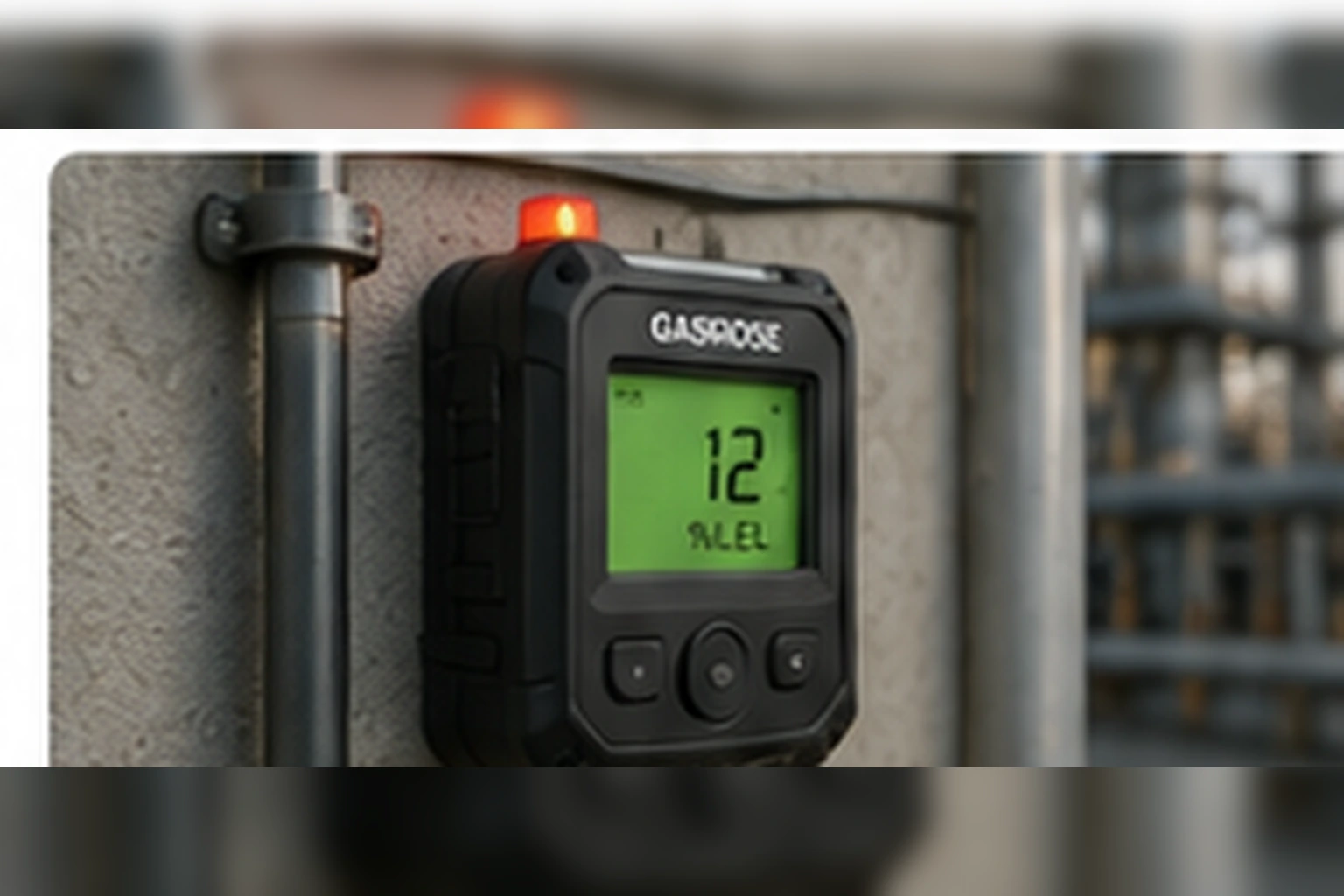
Follow the site’s written procedure. A typical response sequence is:
- Stop the task. Do not continue because the reading is still below 100% LEL.
- Warn personnel and control access. Move upwind or to a designated safe area.
- Eliminate ignition sources only when this can be done safely. Do not operate non-rated switches or equipment inside a potentially flammable area.
- Ventilate from a safe location. Use suitable explosion-protected equipment where required.
- Isolate the source. Shut valves or processes remotely when possible.
- Continue monitoring. Check multiple heights and locations, not only the original sampling point.
- Do not re-enter until authorized. The atmosphere should meet the site’s re-entry criteria for flammability, oxygen, and toxic gases.
- Investigate and document the cause. Correct the leak or process failure before returning to normal operation.
Choosing the Right LEL Detection Technology
| Sensor technology | Main advantages | Important limitations | Common applications |
|---|---|---|---|
| Catalytic bead (pellistor) | Broad response to many combustible gases; proven technology; direct %LEL measurement | Requires oxygen; can be poisoned or inhibited; response varies by gas | Portable four-gas meters, general industrial combustible-gas monitoring |
| Infrared (NDIR) | Does not consume oxygen; resistant to catalytic poisons; stable for many hydrocarbons | Usually cannot detect hydrogen; not suitable for every gas; higher initial cost | Oil and gas, petrochemical facilities, enclosed or inert-prone hydrocarbon applications |
| Metal oxide semiconductor | Low cost; compact; high sensitivity to many gases | Cross-sensitivity, humidity and temperature influence, less direct quantitative LEL performance | Domestic alarms, leakage indication, embedded products |
| Photoionization detector (PID) | Very sensitive to many VOCs at ppm or ppb levels | Does not directly measure all combustible gases or replace an LEL sensor; response depends on ionization energy | Solvent exposure, VOC leak surveys, industrial hygiene |
A detector should be selected for the actual gas, not merely because its display includes a %LEL scale.
Calibration and Bump Testing Are Part of LEL Safety
A correct alarm setting is useless if the instrument cannot detect the gas accurately.
OSHA emphasizes that direct-reading monitors need proper calibration and testing to provide reliable warnings. Calibration adjusts the instrument using a known gas concentration, while a bump test confirms that gas reaches the sensor and that the alarms operate.[^9]
A sound program should include:
- A fresh-air or zero check before use
- A bump test according to the manufacturer and site policy
- Full calibration at the required interval
- Correct, in-date calibration gas
- Inspection of tubing, filters, pumps, and sample probes
- Records of tests, calibration, failures, and repairs
- Immediate removal from service when the instrument fails a test
Never zero a detector in an atmosphere that may already contain combustible gas. Doing so can create a false zero and cause dangerous under-reading.
Read the GasNose guide to gas detector calibration for a complete maintenance workflow.
Confined-Space LEL Checklist
Before entry:
- Identify every possible gas, vapor, and oxygen hazard.
- Confirm that the detector is suitable for those gases.
- Perform a bump test and verify calibration status.
- Test remotely before opening or entering when possible.
- Sample the top, middle, and bottom of the space.
- Test oxygen first, then combustible gases, then toxic gases, following the instrument manufacturer’s instructions.
- Establish ventilation and isolation controls.
- Define low alarm, high alarm, evacuation, and re-entry criteria.
- Continue monitoring throughout the work.
See the confined-space gas detection guide for detector placement and sampling procedures.
Frequently Asked Questions
Is 0% LEL completely safe?
A 0% LEL display is the preferred normal result, but it only means the detector reports no combustible-gas response above its present resolution. It does not rule out toxic gases, oxygen deficiency, an unsuitable sensor, blocked tubing, incorrect calibration, or gas pockets elsewhere.
Is 5% LEL safe?
Five percent LEL is below the common 10% alarm threshold, but it is still a detectable combustible-gas concentration. Check the trend, investigate the source, confirm ventilation, and follow the site procedure rather than treating it as automatically safe.
Is 10% LEL dangerous?
Yes, it should be treated seriously. Around 10% LEL is the hazardous-atmosphere or action threshold used by many confined-space programs and detector configurations. Stop, investigate, control the source, and follow the emergency plan.
What does 20% LEL mean?
It means the combustible-gas concentration has reached one-fifth of the lower explosive limit. It does not mean that the atmosphere contains 20% gas by volume. Many detectors use 20% or 25% LEL as a high alarm, although the correct setpoint is application-specific.
Can an atmosphere explode below 100% LEL?
Under the exact test conditions used to define the LEL, a homogeneous mixture below 100% LEL is too lean to propagate a flame. Real workplaces are not perfectly homogeneous, however. Local pockets may be above the LEL even when the sampling point reads lower, and instrument or sampling errors can reduce the safety margin.
Can an atmosphere above the UEL be considered safe?
No. A mixture above the UEL may be too rich to burn at that moment, but dilution with fresh air can move it through the flammable range. Opening a vessel, starting ventilation, or changing the process can therefore create an ignitable mixture.
Does a four-gas monitor detect every combustible gas?
No. The LEL channel has a defined sensor type, calibration gas, response curve, and list of limitations. Some gases may produce a weak response or no response. Confirm compatibility with the target gas and use correction factors when approved by the manufacturer.
What is the safest LEL alarm setting?
The safest setting is the one established by a competent risk assessment, applicable regulations, and the detector manufacturer. A low alarm of 10% LEL and high alarm of 20–25% LEL are common starting points, but more conservative settings may be required for fast releases, confined spaces, toxic flammables, hot work, or limited escape routes.
Key Takeaway
The safest practical approach is not to operate “just below” the explosive limit. Maintain combustible gas readings as close to 0% LEL as possible, investigate any persistent or rising concentration, and treat 10% LEL as a major action threshold rather than a safe target.
LEL monitoring must be combined with oxygen and toxic-gas testing, proper detector selection, ventilation, leak control, calibration, training, and a written response plan. When regulations, site procedures, or the detector manufacturer specify a stricter limit, always follow the stricter requirement.
Authoritative References
[^1]: OSHA, 1915 Subpart B Appendix A — Flammable atmospheres below 10% LEL are not necessarily safe.
[^2]: OSHA, 1915.11 — Definition of Lower Explosive Limit.
[^3]: OSHA, 29 CFR 1910.146 — Permit-Required Confined Spaces.
[^4]: OSHA, 1915.12 — Precautions and Testing Before Entering Confined and Enclosed Spaces.
[^5]: OSHA, Propane Chemical Data; OSHA, Gasoline Chemical Data.
[^6]: NIOSH, Pocket Guide to Chemical Hazards — n-Butane and LPG.
[^7]: OSHA, Hydrogen Sulfide: Evaluating and Controlling Exposure and Hydrogen Sulfide Hazards.
[^8]: UK Health and Safety Executive, Leak and Gas Detection and Fire and Explosion Risks in Printing.
[^9]: OSHA, Calibrating and Testing Direct-Reading Portable Gas Monitors.
