




A gas detector can turn on normally, display zero in fresh air and still fail to respond correctly when hazardous gas reaches the sensor.
That is why portable gas detectors need more than a visual inspection or startup self-test.
Two terms appear repeatedly in gas detector maintenance:
Bump test
and
Calibration
They are related, but they do not answer the same question.
A bump test asks:
Will the detector respond to gas and activate its alarms?
A calibration check asks:
Is the detector reading close enough to a known gas concentration?
A full calibration goes one step further:
Can the instrument’s response be adjusted so the reading agrees with a known reference gas?
The simplest way to remember the difference is:
Bump test checks function. Calibration checks or restores measurement accuracy.
This distinction matters because a detector can pass a bump test while still producing an inaccurate numerical reading.
Bump Test vs Calibration Check vs Full Calibration

Many discussions compare only “bump test” and “calibration.”
For engineering and maintenance purposes, it is more useful to separate three procedures.
| Procedure | Main Question | Checks Gas Response | Checks Accuracy | Adjusts Sensor Response |
|---|---|---|---|---|
| Bump Test | Will it respond and alarm? | Yes | No | No |
| Calibration Check | Is the reading within acceptable tolerance? | Yes | Yes | No |
| Full Calibration | Can the response be aligned with the reference gas? | Yes | Yes | Yes |
All three procedures normally involve exposing the detector to a known test gas.
The important difference is what you do with the response.
OSHA describes a bump test as a qualitative function check. Gas is applied at a concentration and for enough time to activate the instrument’s alarms.
A calibration check, by contrast, compares the detector reading with the concentration stated on the test-gas cylinder.
If that reading falls outside the manufacturer’s allowable range, a full calibration is required.
Official guidance: OSHA — Calibrating and Testing Direct-Reading Portable Gas Monitors
What Is a Gas Detector Bump Test?
A bump test exposes the detector sensors to a known gas mixture and confirms that the instrument responds.
A typical sequence is:
Apply challenge gas
↓
Gas reaches sensor
↓
Sensor output changes
↓
Displayed concentration increases
↓
Alarm threshold is crossed
↓
Audible / visual / vibration alarms activate
A bump test therefore helps verify the complete functional path—not merely the electronic display.
Depending on the instrument, it may confirm:
- gas can reach the sensor
- sensor responds
- concentration display changes
- audible alarm works
- visual alarm works
- vibration alarm works
- alarm logic operates
But there is one thing a conventional qualitative bump test does not prove:
It does not prove the numerical reading is accurate.
Why Isn’t a Bump Test an Accuracy Test?
Consider a CO detector with:
Low alarm = 20 ppm CO
Now apply:
50 ppm certified CO test gas
Suppose the detector displays:
30 ppm CO
The detector still crosses its 20 ppm alarm threshold.
So:
Alarm activates → bump test function appears to pass
But the applied gas is 50 ppm and the detector only reports 30 ppm.
Its measurement error is significant.

This example demonstrates the fundamental difference:
Bump Test
Question:
Did the detector respond and alarm?
Answer:
Yes.
Calibration Check
Question:
Is 30 ppm an acceptable response to a certified 50 ppm gas?
Answer:
Not if it is outside the manufacturer’s allowable tolerance.
So:
Alarm works ≠ reading is accurate.
That is one of the most important concepts in portable gas detection.
What Is a Calibration Check?
A calibration check is a quantitative verification.
Instead of simply asking whether the detector alarms, you compare its indicated value with the known concentration of the reference gas.
For example:
Reference gas
50 ppm CO
↓
Detector reading
48 ppm CO
↓
Compare with manufacturer tolerance
↓
PASS or FAIL
OSHA notes that acceptable ranges are often around ±10–20% of the test-gas concentration, but this is not a universal tolerance specification.
The correct tolerance is the value specified by the detector manufacturer.
Before the calibration check, the instrument normally needs to be correctly zeroed according to the manufacturer’s procedure.
If the calibration check passes:
No adjustment is required.
If it fails:
Perform a full calibration before using the instrument.
What Is a Full Calibration?
A full calibration does not simply observe the detector’s response.
It adjusts the instrument’s reference response.
A simplified procedure has two main stages.
Zero Calibration
The detector establishes its zero or baseline reference.
Depending on the instrument and environment, this may use:
- clean ambient air
- synthetic zero air
- nitrogen or another specified zero gas
Always follow the instrument instructions.
Span Calibration
A certified gas containing a known concentration is applied.
For example:
50 ppm CO
If the detector initially reads:
43 ppm
the calibration procedure adjusts the instrument’s response so that its reference corresponds to the known gas concentration.
Modern portable detectors often perform this adjustment automatically after the operator begins the calibration routine.
The principle remains:
Calibration aligns the measurement with a known reference.
A Full Calibration Is Not Just a Longer Bump Test
Both procedures may use the same gas cylinder.
Both may use the same:
- regulator
- tubing
- calibration cap
But their purposes are different.
A bump test says:
The detector responds.
A full calibration says:
The detector’s response has been referenced and adjusted against a known concentration.
That distinction becomes particularly important when sensor sensitivity gradually changes with age or environmental exposure.
How Often Should You Bump Test a Gas Detector?
This is one of the most common gas detector maintenance questions.
There is no single rule that should be blindly applied to every detector in every country.
For portable gas monitors, OSHA’s current guidance incorporates the International Safety Equipment Association recommendation that:
A bump test or calibration check should be conducted before each day’s use, in accordance with the manufacturer’s instructions.
Some manufacturers recommend bump testing even more frequently, such as before each use.
The correct frequency therefore depends on:
- manufacturer instructions
- applicable regulations
- company procedures
- detector design
- application risk
- detector history
Do not convert a general recommendation into a statement such as:
“Every gas detector worldwide is legally required to be bump tested once every 24 hours.”
That is not accurate.
A better practical rule is:
Verify portable detector functionality before relying on it for hazardous-atmosphere work, using the frequency and procedure required by the manufacturer, site and applicable regulation.
How Often Should a Gas Detector Be Fully Calibrated?
There is also no universal answer such as:
every 30 days
or:
every six months
for every gas detector.
Calibration intervals vary between instruments.
Manufacturers may specify different schedules based on:
- sensor technology
- gas
- detector design
- use conditions
- regulatory requirements
In addition to scheduled calibration, full calibration should normally be performed when a calibration check or bump test indicates that the instrument is not operating correctly.
The maintenance program should therefore distinguish:
Frequent Function Verification
Bump test / calibration check.
Periodic Accuracy Adjustment
Scheduled full calibration according to the manufacturer and site procedure.
Event-Driven Re-Verification
After abnormal events that could affect the detector.
When Should a Gas Detector Be Rechecked Immediately?
Do not wait for the next scheduled calibration date when something has happened that could affect detector performance.
Examples include:
| Event | Why It Matters |
|---|---|
| Failed bump test | Sensor or alarm path may not operate correctly |
| Failed calibration check | Reading is outside allowed tolerance |
| Sensor replacement | New sensor needs proper reference |
| Detector repair | Measurement system may have changed |
| Detector dropped | Physical shock can damage sensors or components |
| Very high gas exposure | Sensor can become saturated or damaged |
| Catalyst poison exposure | Combustible sensitivity may fall |
| Extreme temperature | Sensor response can change |
| Extreme humidity | Sensor or optical response may change |
| Long storage period | Sensor condition may have changed |
| Unstable or suspicious reading | Accuracy cannot be assumed |
The detector manufacturer’s instructions should determine the appropriate response after each event.
Why Do Gas Sensors Drift?
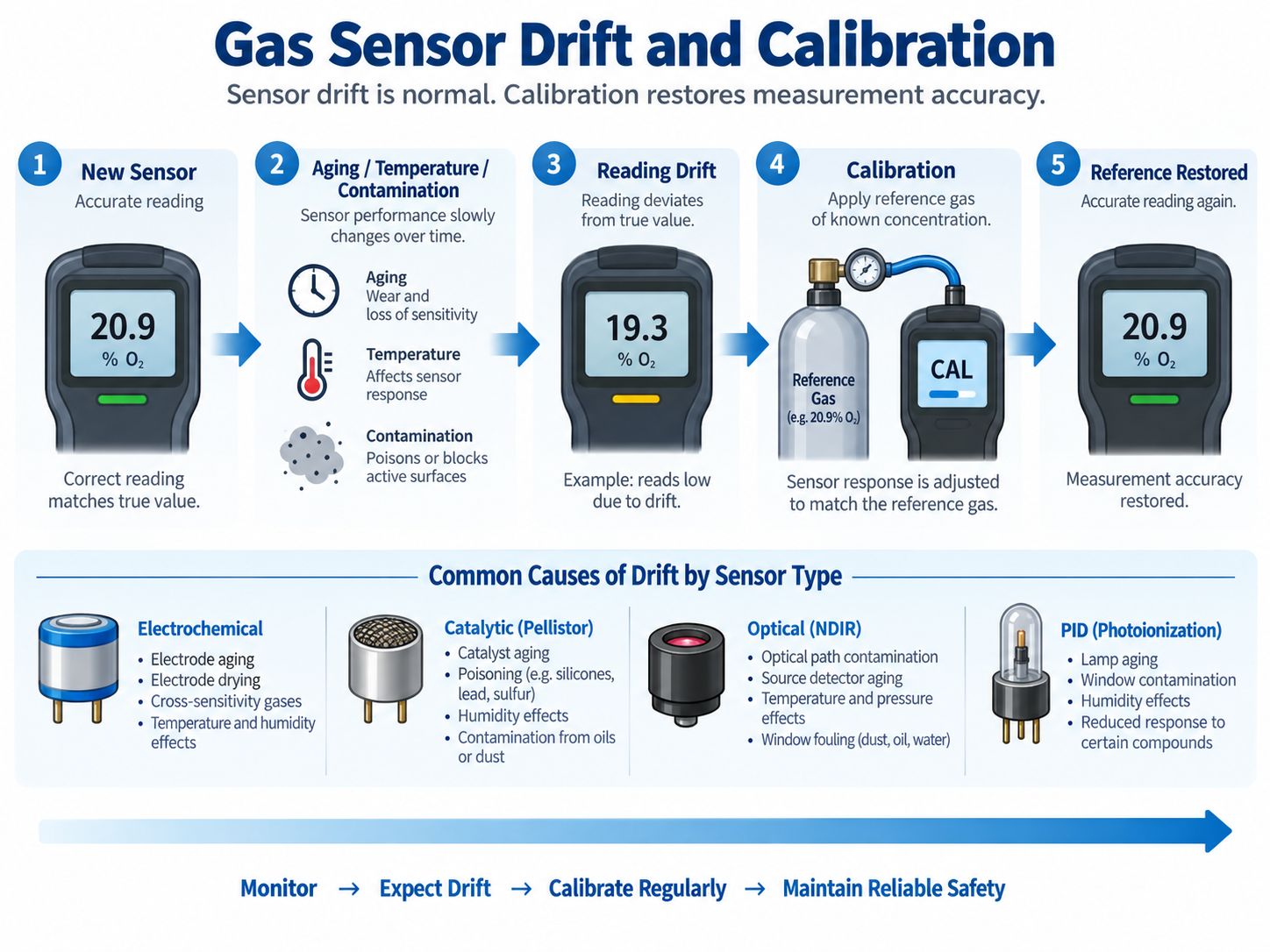
Gas sensors are physical measurement devices.
Their response is not perfectly constant forever.
The gradual movement of sensor response away from its original reference is commonly called:
sensor drift
or:
calibration drift
Possible causes differ by sensing technology.
Electrochemical Sensors
Potential influences include:
- electrode aging
- electrolyte changes
- temperature
- humidity
- long-term chemical exposure
- cross-sensitive gases
Electrochemical sensors also have a finite operating life.
Catalytic / Pellistor Sensors
Potential problems include:
- catalyst aging
- silicone poisoning
- sulfur compounds
- lead-containing contaminants
- inhibitors
- dust or oil contamination
- extreme combustible-gas exposure
For combustible detection, poisoning is especially important because the sensor can remain electrically operational while its sensitivity to combustible gas decreases.
Infrared / Optical Sensors
Potential influences include:
- dirty optical windows
- condensation
- dust
- oil
- source aging
- detector aging
- temperature changes
- pressure changes
Optical sensing avoids catalytic poisoning, but it does not eliminate maintenance.
PID Sensors
Photoionization detectors may be affected by:
- UV lamp contamination
- lamp aging
- electrode contamination
- humidity
- deposits on optical surfaces
For more about PID measurement, see PID vs LEL Gas Detector: What’s the Difference?.
The important principle is:
Drift does not automatically mean the detector is defective. Some drift is a normal characteristic of real measurement systems.
Calibration compensates for acceptable drift.
If the sensor can no longer be calibrated successfully, it may need repair or replacement.
What Gas Should Be Used for Bump Testing?
Use a challenge gas specified or approved for the detector configuration.
The gas must be suitable for:
- installed sensors
- alarm thresholds
- instrument calibration settings
- manufacturer’s bump-test procedure
A common portable four-gas monitor might require a multi-component test gas containing gases such as:
- CO
- H₂S
- methane or another combustible calibration gas
- a defined oxygen concentration
But the exact mixture varies.
Do not assume that every cylinder labelled:
4-Gas Calibration Gas
works with every four-gas detector.
Check:
- gas components
- concentrations
- combustible calibration basis
- oxygen concentration
- cylinder balance gas
- regulator requirement
against the instrument manual.
What Gas Should Be Used for Calibration?
Calibration requires more than simply exposing the detector to something that makes it respond.
OSHA recommends using a certified, traceable test gas.
The concentration printed on the cylinder becomes the reference against which the instrument is checked or adjusted.
Important information includes:
- gas identity
- concentration
- accuracy/certification
- cylinder lot
- expiration date
- balance gas
The calibration can only be as reliable as the reference gas.
Why Calibration Gas Expiration Matters
Calibration gas does not remain valid forever.
This is especially important for reactive gases.
OSHA specifically highlights gases such as:
- hydrogen sulfide
- chlorine
because their certified concentration may only remain stable for a limited period.
Reactive gas molecules can interact with:
- cylinder surfaces
- valves
- regulators
- tubing
over time.
Therefore:
Never assume an expired calibration cylinder still contains exactly the concentration stated on its label.
Using inaccurate reference gas can produce an apparently successful calibration while actually introducing measurement error.
Always verify the cylinder’s expiration date before use.
The Calibration Gas Cylinder Is Only the Beginning

A proper calibration setup is a complete gas-delivery chain:
Certified gas cylinder
↓
Regulator
↓
Tubing
↓
Calibration adapter / cap
↓
Detector sensor
A problem anywhere in that chain can affect the test.
Regulator
The regulator controls test-gas delivery.
Using the wrong regulator can result in:
- excessive flow
- insufficient flow
- pressure problems
- incorrect detector response
Use the flow rate specified for the instrument.
Tubing
Inspect tubing for:
- leaks
- cracks
- blockages
- contamination
- incorrect material
Some reactive gases can adsorb onto unsuitable tubing materials.
Calibration Cap
The calibration adapter must correctly deliver the gas to the detector’s sensor inlet.
A poor fit or incorrect cap can allow:
- dilution with ambient air
- gas leakage
- incomplete delivery to some sensors
Detector Gas Inlet
Check that:
- filters are clean
- sensor openings are unobstructed
- pump works where applicable
- water or dirt has not blocked the inlet
A detector cannot respond correctly if the reference gas never reaches the sensor.
Calibration accuracy depends on the entire gas path—not only the gas cylinder.
Reactive Gases Require Extra Attention
Some gases are more difficult to deliver accurately than others.
Examples can include:
- Cl₂
- NH₃
- H₂S
- SO₂
- other reactive or easily adsorbed compounds
Depending on gas and concentration, the wrong:
- regulator
- tubing
- fittings
- calibration cap
can reduce the amount of gas actually reaching the sensor.
Suppose the cylinder contains:
10 ppm target gas
but part of that gas is adsorbed along the delivery path.
The sensor may receive a significantly lower concentration.
The operator may incorrectly conclude:
The sensor has lost sensitivity.
when the actual problem is the gas-delivery setup.
Always follow the manufacturer’s recommendations for materials and calibration accessories, especially for reactive gases.
Can You Bump Test a Multi-Gas Detector With One Cylinder?
Often, yes.
Multi-component calibration gas is commonly used for portable multi-gas monitors.
But only when the mixture matches the instrument.
Check whether:
- every required sensor receives an appropriate challenge
- gas concentrations are sufficient for the intended test
- the combustible gas matches the instrument configuration
- the oxygen concentration produces the expected response
- the mixture is chemically stable
- the manufacturer approves the procedure
A standard cylinder should not be treated as universal simply because the detector has the same number of channels.
For selecting gas channels in the first place, see How to Choose Gases for a Multi-Gas Detector.
Is Fresh-Air Zeroing the Same as a Bump Test?
No.
This is another important misunderstanding.
When you turn a detector on in clean air, the instrument may perform:
Fresh Air Setup
or:
Zero Adjustment
That establishes a baseline.
Typical readings might become:
- CO = 0 ppm
- H₂S = 0 ppm
- combustible = 0% LEL
- O₂ ≈ ambient oxygen concentration
But this does not prove that the sensors will respond when hazardous gas reaches them.
A detector with a blocked gas inlet could still display a normal zero.
A poisoned catalytic sensor could still display:
0% LEL
in fresh air.
Therefore:
Zeroing confirms the baseline. Applying test gas confirms response.
They are not substitutes.
Is a Startup Self-Test the Same as a Bump Test?
Usually not.
A typical startup self-test may verify:
- LCD / display
- LED
- buzzer
- vibration motor
- battery
- electronics
You may see:
lights flash
and hear:
alarm sound
That confirms those components can operate.
It does not automatically confirm that:
gas → sensor → electrical response
works correctly.
A traditional bump test physically applies challenge gas to the sensing system.
Some modern instruments incorporate validated sensor self-test technologies, so always follow the manufacturer’s specific procedure.
But for a conventional gas detector:
Electronic startup test ≠ gas-response test.
Manual Bump Testing vs Docking Stations
Bump testing and calibration can be performed manually or through an automated station.
Manual Bump Test
Typical equipment:
- calibration gas cylinder
- regulator
- tubing
- test cap
- detector
Advantages:
- simple
- low initial equipment cost
- practical for small detector fleets
Challenges:
- operator consistency
- manual records
- cylinder management
- more labor for large fleets
Automated Bump / Docking Station
A docking system may automate:
- bump testing
- calibration
- charging
- event-log download
- instrument status
- failed-test records
- fleet documentation
This becomes increasingly useful when a facility manages:
tens, hundreds or thousands of portable detectors.
Instead of relying on operators to record every test manually, a docking system can help standardize the workflow.
This is one reason calibration infrastructure should be considered when purchasing a portable detector fleet—not only after the instruments arrive.
What Should You Do If a Bump Test Fails?

Do not ignore a failed bump test and take the detector into a hazardous area.
A practical process is:
Step 1 — Stop and Investigate
Check:
- test gas
- expiration date
- cylinder pressure
- regulator
- flow
- tubing
- fittings
- calibration cap
- detector filters
- pump
- detector configuration
Step 2 — Follow the Manufacturer’s Troubleshooting Procedure
Correct any obvious setup problem.
Step 3 — Perform a Full Calibration When Required
OSHA guidance states that if an instrument fails a bump test or calibration check, it should receive a full calibration before use.
Step 4 — Did the Calibration Pass?
If yes:
the detector can return to service according to the applicable procedure.
If no:
Remove the instrument from service.
It may require:
- sensor replacement
- repair
- manufacturer service
- further troubleshooting
Do not repeatedly force calibration in an attempt to make an end-of-life sensor pass.
What If Only One Channel Fails?
A multi-gas detector may contain several independent sensing channels.
For example:
- O₂
- LEL
- CO
- H₂S
If only the H₂S sensor fails, that does not necessarily mean the CO sensor has failed.
But the instrument configuration as required for the job is no longer complete.
If the hazard assessment requires H₂S monitoring:
Do not use the detector for that job until the failed channel has been restored according to the manufacturer procedure.
A partially functional four-gas monitor should not quietly become a three-gas monitor.
Can a Gas Detector Be Used Immediately After a High-Gas Exposure?
Not automatically.
Very high gas concentrations can affect sensors differently.
Possible effects include:
- sensor saturation
- slow recovery
- catalytic damage
- poisoning
- temporary baseline shift
- electrochemical overload
- PID contamination
After an over-range or unusually severe exposure:
- Move the detector to a safe atmosphere as required.
- Follow the manufacturer’s recovery procedure.
- Recheck detector performance.
- Bump test or calibrate if required.
- Do not use it if response remains abnormal.
The detector display returning to zero does not by itself prove that sensitivity has fully recovered.
Bump Testing and Confined-Space Entry
Detector readiness becomes especially important before confined-space work.
Imagine performing a detailed atmospheric test for:
- oxygen
- combustible gas
- H₂S
- CO
with an instrument whose combustible sensor has been poisoned.
The atmospheric testing procedure may look correct.
But the measurement itself is unreliable.
Therefore confined-space gas monitoring has two separate questions:
Is the instrument ready?
then:
Is the atmosphere safe according to the applicable criteria?
For the second part, see Confined Space Gas Monitoring: What Gases Should You Test Before Entry?.
A sophisticated entry procedure cannot compensate for an instrument that does not respond properly.
What About Fixed Gas Detectors?
Fixed detectors also require:
- functional testing
- calibration
- inspection
- maintenance
But the procedure and frequency can differ significantly from portable instruments.
A fixed system may include:
Sensor / Transmitter
↓
Controller
↓
Alarm
↓
Ventilation / Shutdown
Testing may therefore need to verify more than the sensor itself.
Depending on the maintenance strategy, this can include:
- detector response
- transmitter output
- controller input
- alarm
- relays
- ventilation
- valve closure
- shutdown functions
For the difference between the two system types, see Fixed vs Portable Gas Detectors: Which Do You Need?.
Do not automatically apply a portable monitor’s daily bump-test schedule to every fixed installation.
Follow:
- fixed-detector manufacturer instructions
- system design documentation
- applicable standards
- site maintenance procedures
Do You Need to Keep Bump-Test and Calibration Records?
For industrial fleets, good records are extremely valuable.
Possible records include:
- instrument ID
- serial number
- sensor configuration
- test date
- test time
- operator
- calibration gas
- gas concentration
- cylinder lot
- cylinder expiration
- bump result
- calibration result
- channel failure
- sensor replacement
- repair history
OSHA’s guidance recommends documented calibration procedures and retaining calibration records for the life of the instrument.
Why?
Because historical data can reveal patterns such as:
CO sensor frequently drifting
or:
LEL channel repeatedly failing bump tests
or:
one instrument requiring excessive repair
Records can therefore support:
- compliance
- traceability
- maintenance planning
- sensor replacement decisions
- detector fleet management
A Practical Portable Gas Detector Readiness Workflow
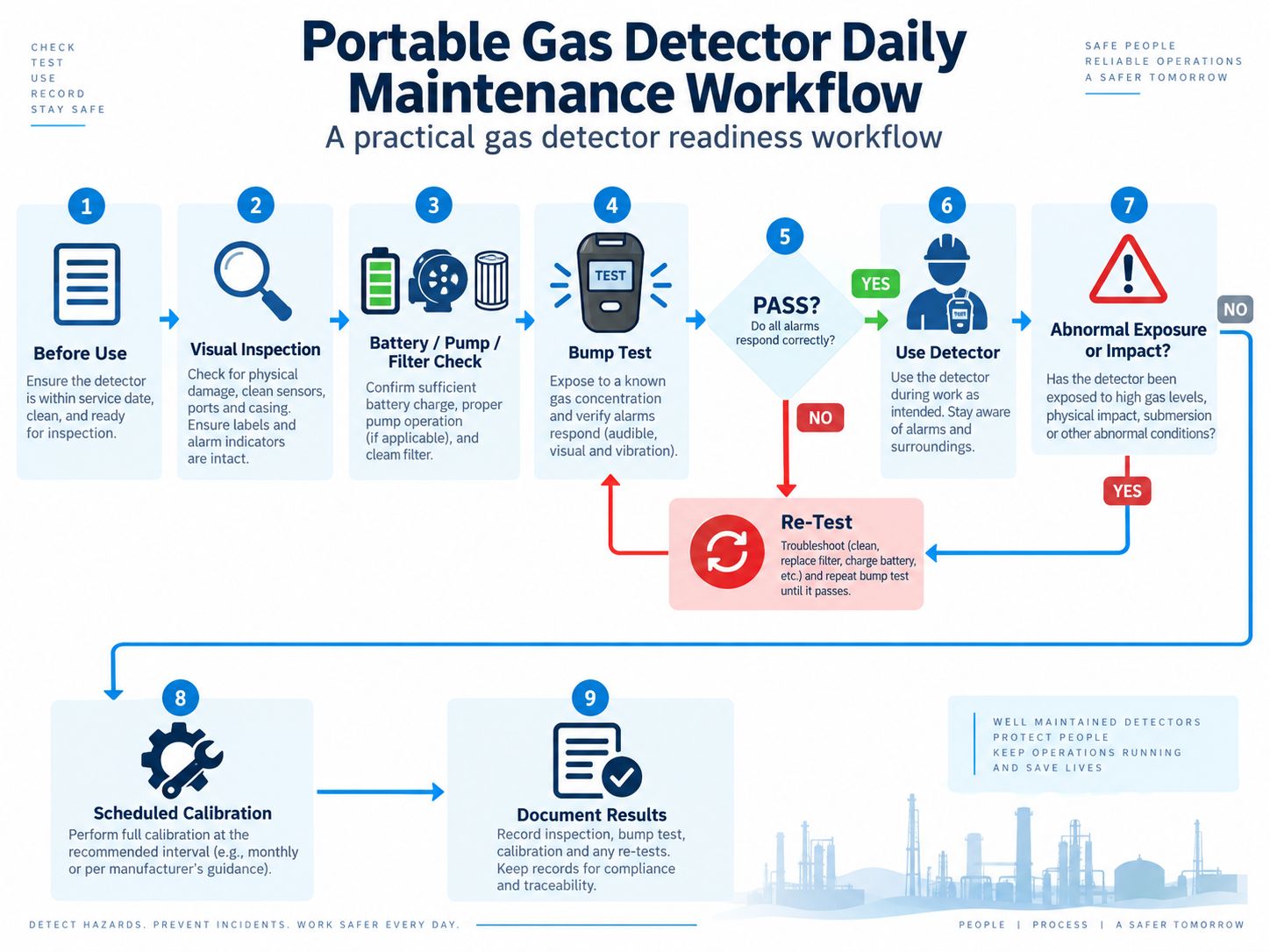
A practical workflow can look like this:
Before Use
Inspect the detector.
Check:
- physical condition
- sensor openings
- filters
- battery
- pump where applicable
Perform the Required Functional Verification
According to manufacturer and site requirements:
Bump test
or:
Calibration check
Did It Pass?
If yes:
Use the detector.
If no:
Investigate → calibrate as required → remove from service if calibration fails.
During the Job
Pay attention to:
- unusual readings
- over-range conditions
- physical impacts
- water exposure
- contamination
After an Abnormal Event
Recheck the instrument before relying on it again.
Perform Scheduled Calibration
Follow the interval required by:
- manufacturer
- company policy
- applicable regulation
The interval shown in any maintenance diagram should be treated as illustrative, not as a universal monthly or six-month requirement.
Document the Result
Maintain traceable records where required.
Common Gas Detector Testing Mistakes
Mistake 1 — Turning It On and Calling That a Bump Test
A startup electronic self-test does not normally prove sensor response to gas.
Mistake 2 — Zeroing in Fresh Air and Assuming the Detector Works
Zero does not prove sensitivity.
Mistake 3 — Assuming an Alarm Means the Reading Is Accurate
A detector can alarm and still have significant measurement drift.
Mistake 4 — Using Expired Calibration Gas
The reference may no longer be valid.
Mistake 5 — Ignoring Tubing and Regulator Problems
The cylinder concentration is irrelevant if the correct gas concentration never reaches the sensor.
Mistake 6 — Using the Wrong Gas Mixture
Not every multi-gas cylinder matches every detector.
Mistake 7 — Repeatedly Calibrating a Failed Sensor
An end-of-life or damaged sensor may need replacement.
Mistake 8 — Treating One Calibration Interval as Universal
Different gases, sensors, instruments and regulations require different maintenance schedules.
Mistake 9 — Ignoring a Detector After It Has Been Dropped
Physical damage may not be visible.
Mistake 10 — Assuming Fixed and Portable Detectors Have the Same Maintenance Procedure
They serve different roles and may require different system-level testing.
Frequently Asked Questions
What is the difference between a gas detector bump test and calibration?
A bump test checks whether test gas reaches the sensor and whether the detector responds and activates its alarms.
Calibration verifies or adjusts the detector’s measurement against a known reference gas.
Does a bump test check gas detector accuracy?
A qualitative bump test does not verify numerical accuracy.
Use a calibration check to compare the detector reading with a known test-gas concentration.
How often should you bump test a portable gas detector?
OSHA’s current guidance incorporates the ISEA recommendation that a bump test or calibration check be conducted before each day’s use according to the manufacturer’s instructions.
Some manufacturers specify testing before each use.
Always follow the actual detector manual, site procedure and applicable regulation.
Does OSHA legally require every gas detector to be bump tested every day?
Do not interpret OSHA’s Safety and Health Information Bulletin as a universal daily bump-test regulation.
The bulletin is guidance and incorporates ISEA recommendations for portable gas monitors.
Specific OSHA standards may require gas monitoring in particular applications, while the detector testing procedure and frequency also depend on manufacturer instructions and applicable requirements.
How often should a gas detector be calibrated?
There is no universal calibration interval for every gas detector.
Follow the manufacturer, company procedure and applicable regulations.
Full calibration should also be performed when required after a failed bump test or calibration check.
What is the difference between a calibration check and full calibration?
A calibration check verifies whether the reading is within the manufacturer’s acceptable tolerance.
A full calibration adjusts the instrument response to match a known reference gas.
Can a detector pass a bump test but fail calibration?
Yes.
For example, a detector exposed to 50 ppm CO might read 30 ppm but still activate a 20 ppm alarm.
The alarm works, but the numerical reading is inaccurate.
What happens if a bump test fails?
Check the gas cylinder, regulator, tubing, calibration adapter, detector inlet and configuration.
Follow the manufacturer’s procedure.
If required, perform a full calibration.
If the instrument cannot pass full calibration, remove it from service.
Can expired calibration gas be used?
No.
Reference gas should be used within its certified shelf life.
Reactive gases such as H₂S and Cl₂ require particular attention because their concentrations can change over time.
Can I bump test a four-gas monitor with one gas cylinder?
Often yes if the approved multi-component gas mixture correctly challenges all required channels.
Verify the gas composition and concentration against the detector manufacturer’s instructions.
Is fresh-air zeroing the same as a bump test?
No.
Zeroing establishes the instrument baseline.
A bump test applies challenge gas to verify sensor response and alarm operation.
Is the startup self-test the same as a bump test?
Usually not.
A startup self-test may verify electronics, buzzer, LEDs and vibration, but a conventional bump test confirms that actual gas reaches and activates the sensors.
Do fixed gas detectors need calibration?
Yes.
Fixed gas detectors also require appropriate functional testing, calibration and maintenance.
The required procedure and interval should follow the fixed-system manufacturer, site maintenance program and applicable standards.
What calibration gas should I use?
Use the gas identity, concentration, mixture and accessories specified for your detector and sensor configuration.
Calibration gas should be certified and within its expiration period.
Why does calibration gas flow rate matter?
Too much or too little flow can change the concentration and pressure conditions at the detector or allow dilution with ambient air.
Use the regulator and flow specified by the instrument manufacturer.
Does calibration repair a bad sensor?
Not necessarily.
Calibration can compensate for acceptable sensor drift.
It cannot restore a sensor that is severely damaged, poisoned or at the end of its useful life.
Final Takeaway
A bump test and calibration are not two names for the same maintenance procedure.
They answer different questions.
Bump test:
Will the detector respond?
Calibration check:
Can I trust the number?
Full calibration:
Can the instrument’s response be adjusted back to the reference?
That distinction matters because:
A detector can alarm correctly and still display the wrong concentration.
For portable gas monitors, frequent functional verification helps identify:
- blocked sensors
- failed alarms
- sensor degradation
- calibration drift
- equipment damage
before a worker relies on the instrument in a hazardous atmosphere.
But reliable testing depends on more than the detector itself.
The complete chain matters:
Certified gas
↓
Correct regulator
↓
Correct tubing
↓
Correct adapter
↓
Functional sensor
↓
Correct procedure
↓
Documented result
The practical rule is simple:
Never assume a gas detector works because it powers on. Challenge it with the right gas, verify its response, and calibrate it according to the manufacturer and applicable safety requirements.
References and Further Reading
- OSHA — Calibrating and Testing Direct-Reading Portable Gas Monitors
- OSHA — Direct-Reading Instruments
- Dräger — Bump Testing Gas Monitors
- Dräger — Calibration and Bump Testing
- International Safety Equipment Association — Portable Gas Detection Resources
- GasNose — Fixed vs Portable Gas Detectors
- GasNose — Confined Space Gas Monitoring
- GasNose — How to Choose Gases for a Multi-Gas Detector
- GasNose — PID vs LEL Gas Detector
