




Before entering a confined space, atmospheric testing should answer three fundamental questions:
- Is there enough oxygen—and not too much?
- Is there a combustible gas or vapor that could create a fire or explosion hazard?
- Are toxic gases or vapors present at dangerous concentrations?
This is why a common industrial test sequence focuses on:
Oxygen → Combustible gases → Toxic gases
A portable monitor configured for O₂ + %LEL + H₂S + CO is widely used because those four channels cover several common confined-space hazards.
But that combination should be treated as a starting point, not a universal gas list.
A chemical vessel that previously contained chlorine does not have the same atmospheric hazards as a sewer, oil tank, grain silo, refrigeration system, or wastewater wet well.
The correct detector configuration must come from the hazard assessment, previous contents, current work activity, surrounding process, possible decomposition products, and applicable exposure limits.
For a basic explanation of the common four-channel configuration, see What Does a 4-Gas Monitor Detect?.
Quick Answer: What Gases Should Be Tested Before Confined-Space Entry?

| Hazard Group | What to Test | Why |
|---|---|---|
| Oxygen | O₂ % volume | Detect oxygen deficiency or enrichment |
| Fire / explosion | Combustible gas or vapor as %LEL | Detect potentially ignitable atmosphere |
| Common toxic gases | H₂S, CO where credible | Detect acute toxic exposure |
| Process-specific toxic gases | NH₃, Cl₂, SO₂, HCN, NO₂, VOCs, etc. | Depends on process and previous contents |
| Other asphyxiants | CO₂ or application-specific gas | May create exposure risk or displace oxygen |
The most important principle is:
Hazard assessment determines the final gas list—not the number of channels on the detector.
Why Confined-Space Atmospheres Can Be Dangerous
A space does not need to contain an obvious chemical spill to develop a hazardous atmosphere.
Dangerous conditions can result from normal physical, chemical, or biological processes.
Common causes include:
- inadequate natural ventilation
- residual process chemicals
- fermentation or decomposition
- sewage and sludge
- corrosion and oxidation
- inert-gas purging
- combustion
- welding and hot work
- solvent cleaning
- painting and coating
- process leakage
- gases entering from connected pipes
- adjacent equipment or engines
- displacement of oxygen
A tank may test safe when first opened but become dangerous after work begins.
For example, welding can consume oxygen or generate fumes. Cleaning chemicals may release vapors. Disturbing sludge can suddenly release H₂S or methane. A ventilation system can fail.
The UK’s Health and Safety Executive emphasizes this same principle: a confined space that is safe under one set of conditions may become unsafe when the work activity changes.
That is why confined-space monitoring is not simply a matter of taking one reading at the entrance and proceeding with the job.
Test 1: Oxygen Concentration
Oxygen is normally one of the first atmospheric parameters checked.
Ambient air contains approximately 20.9% oxygen by volume.
The concern is not only low oxygen.
Both oxygen deficiency and oxygen enrichment can be hazardous.
What Causes Oxygen Deficiency?
Oxygen can decrease because it is:
- displaced by nitrogen during purging
- displaced by CO₂, methane, or other gases
- consumed by rusting and oxidation
- consumed by combustion
- consumed by biological activity
- absorbed or consumed by stored materials
- displaced by a process leak
An important point is that an oxygen reading tells you the oxygen concentration—it does not identify what displaced the oxygen.
For example, an O₂ reading below normal may indicate that another gas is accumulating, but you still need appropriate sensing technology if that gas itself creates a toxic or process hazard.
For a deeper explanation, see Oxygen Deficiency and Enrichment.
What About Oxygen Enrichment?
Too much oxygen can significantly increase fire risk.
Materials that normally burn slowly may ignite more easily or burn much more intensely in an oxygen-enriched atmosphere.
Oxygen enrichment can occur around:
- oxygen systems
- leaking oxygen hoses
- oxy-fuel equipment
- oxygen-generating processes
Example Regulatory Oxygen Criteria
Different jurisdictions define their requirements separately.
| Jurisdiction | Example Oxygen Criterion |
|---|---|
| U.S. OSHA | Below 19.5% deficient; above 23.5% enriched |
| Singapore | 19.5–23.5% for confined-space entry permit conditions |
| Canada federal | 19.5–23% under relevant hazardous confined-space provisions |
| Australia Model Code | 19.5–23.5% described as a safe oxygen level |
These values should not be assumed to override local, sector-specific, mine, marine, or company requirements.
Why Is Oxygen Tested First?
For U.S. OSHA permit-required confined spaces, atmospheric hazards are tested in this order:
1. Oxygen
2. Combustible gases and vapors
3. Toxic gases and vapors
There is an engineering reason for this sequence.
Many traditional catalytic combustible-gas sensors depend on oxygen for their sensing reaction.
In a severely oxygen-deficient atmosphere, the combustible channel may therefore produce an unreliable or unexpectedly low response.
Testing oxygen first gives the operator important context before interpreting combustible-gas readings.
Test 2: Combustible Gases and Vapors
After oxygen, the next major question is whether the atmosphere could ignite or explode.
Portable monitors commonly display this as:
%LEL
where LEL means Lower Explosive Limit.
For example:
10% LEL
does not mean that 10% of the atmosphere is combustible gas.
It means the detector response has reached 10% of the lower explosive limit reference for the gas and calibration involved.
For a more detailed explanation, see What Is a Safe LEL Level?.
Common Sources of Combustible Atmospheres
Confined-space combustible hazards may come from:
- methane
- propane
- butane
- gasoline vapor
- solvents
- fuel residues
- petroleum products
- fermentation
- sewer gas
- process chemicals
- coatings or adhesives
A %LEL Reading Does Not Necessarily Identify the Gas
This matters.
A general-purpose combustible sensor may respond to several combustible gases.
If the monitor shows:
25% LEL
you know there is a potentially serious combustible-gas condition.
You do not necessarily know whether the gas is methane, propane, hexane vapor, or another combustible.
The actual response also depends on:
- sensor technology
- calibration gas
- correction factor
- target gas
- oxygen concentration
- sensor condition
Catalytic vs Infrared Combustible Detection
Two common approaches are catalytic and infrared sensing.
Catalytic sensors can provide broad combustible-gas coverage but may be affected by oxygen deficiency, poisoning, or inhibitors.
Infrared sensors do not depend on oxygen for the sensing mechanism and can be highly useful for many hydrocarbon applications, but conventional hydrocarbon IR sensors do not provide universal coverage—for example, hydrogen requires a different detection approach.
This is why the hazard assessment should identify the likely combustible gas rather than merely specifying “one LEL channel.”
Test 3: Toxic Gases and Vapors
The third category is often the most application-specific.
There is no universal list of two toxic gases that covers every confined space.
H₂S and CO are common because they occur in many industrial environments, but other spaces may require completely different toxic-gas channels.
Hydrogen Sulfide — H₂S
H₂S is particularly important in:
- sewers
- wastewater treatment
- sludge systems
- manure pits
- oil and gas
- sour hydrocarbon environments
- decomposition processes
- some underground operations
It is highly toxic, and smell should never be relied on as the warning method.
For sensing technologies and selection, see the Hydrogen Sulfide Sensor Guide.
Carbon Monoxide — CO
CO is commonly associated with:
- generators
- gasoline engines
- diesel equipment
- forklifts
- heaters
- combustion
- fires
- hot work
Poor ventilation makes enclosed spaces especially vulnerable to accumulation.
For sensor technologies and selection, see the Carbon Monoxide Sensor Guide.
What Other Toxic Gases Might Need to Be Tested?
Depending on the site, additional channels may include:
- ammonia
- chlorine
- sulfur dioxide
- hydrogen cyanide
- nitrogen dioxide
- carbon dioxide
- VOCs
- benzene
- refrigerants
- fumigants
- process-specific toxic gases
OSHA’s atmospheric testing approach is fundamentally hazard-based: contaminants identified during evaluation should be tested using equipment capable of measuring them.
So the right question is not:
“Which toxic gases are normally on a four-gas detector?”
It is:
“Which toxic gases could realistically exist in this particular space?”
Is O₂ + LEL + H₂S + CO Enough?
Sometimes.
But not always.
| Confined Space | Common Starting Channels | Additional Hazards to Evaluate |
|---|---|---|
| Sewer / manhole | O₂, LEL, H₂S, CO | CH₄-specific, NH₃, CO₂ |
| Wastewater tank | O₂, LEL, H₂S, CO | NH₃, CO₂, VOCs |
| Crude / oil tank | O₂, LEL, H₂S, CO | VOCs, benzene |
| Chemical vessel | O₂, LEL | Previous/process-specific chemicals |
| Refrigeration space | O₂ | NH₃, CO₂, refrigerant-specific gas |
| Grain silo | O₂, combustible hazard | CO₂, fumigants, other process hazards |
| Underground mine | Application-specific | CH₄, CO, O₂, NO₂ and mine-specific gases |
This is why choosing a detector simply because it is marketed as a confined-space four-gas monitor can be inadequate.
The instrument must match the atmosphere.
Test the Whole Space — Not Just the Opening

One of the most common mistakes in confined-space gas testing is placing the detector at the opening, waiting for a normal reading, and assuming the whole space is safe.
Confined-space atmospheres can be stratified.
Gas concentration may vary:
- from top to bottom
- from side to side
- around residues
- near connected pipes
- close to process equipment
- in dead zones with poor ventilation
Safe Work Australia’s confined-space guidance recommends initial testing from outside the space and sampling enough locations to represent the areas workers may access, including side-to-side and top-to-bottom testing where appropriate.
Why Can Gases Form Layers?
Gas density can influence distribution.
For example:
- methane is lighter than air
- H₂S is heavier than air
- many hydrocarbon vapors are heavier than air
But density is not the only factor.
Real gas distribution is affected by:
- ventilation
- temperature
- gas release velocity
- convection
- geometry
- connected pipes
- worker activity
- mixing
Therefore, avoid using a simplistic rule such as:
“Methane is always at the top and H₂S is always at the bottom.”
A better rule is:
Sample representative locations throughout the space.
OSHA’s Approximately 4-Foot Stratified-Atmosphere Guidance
OSHA provides an especially useful detail in Appendix B to its permit-required confined-space standard.
When entry involves descent into an atmosphere that may be stratified, the atmospheric envelope should be tested approximately 4 feet (1.22 m) in the direction of travel and to each side.
If a sampling probe is used, the entrant’s progress also needs to account for:
- sampling speed
- detector response time
This reinforces an important principle:
The monitor needs time to detect the atmosphere before the worker reaches it.
Pumped vs Diffusion Gas Monitoring

Both pumped and diffusion monitors are useful, but they serve different purposes.
Pumped Monitor
A pumped instrument actively draws the gas sample through:
- tubing
- probe
- sample line
This makes it particularly useful for:
- pre-entry testing
- remote sampling
- tanks
- manholes
- vessels
- pits
- vertical profiling
The worker can remain outside while the sample is taken.
Diffusion Monitor
A diffusion instrument allows gas to reach the sensors naturally.
It is commonly worn in the worker’s breathing zone for:
- personal protection
- continuous monitoring
- alarm notification during work
The UK HSE also recommends, where practicable, positioning a sample probe inside a confined space while the operator remains outside and testing multiple points to account for vapor pockets and stratification.
Which One Should You Use?
Often the answer is:
both—but at different stages.
A typical approach may be:
Pumped monitor → pre-entry atmospheric assessment
then:
Personal diffusion monitor → continuous protection during entry
The appropriate procedure depends on the site and risk assessment.
How Long Should You Sample at Each Point?
There is no universal answer such as:
“Always wait 30 seconds.”
The correct sampling time depends on:
- detector response time
- pump flow
- tubing length
- gas properties
- sensor technology
OSHA Appendix B states that each atmospheric parameter should be measured for at least the minimum response time specified by the instrument manufacturer.
With a pumped detector, another factor appears:
sample transport time.
If a long hose is inserted 20 meters into a vessel, the new gas sample needs time to travel through the tubing before it even reaches the sensors.
Therefore:
Total practical sampling delay ≈ sample transport time + sensor response time
The actual procedure should follow the detector manufacturer’s instructions.
Pre-Entry Testing Does Not Replace Continuous Monitoring

A safe reading before entry only tells you that:
The sampled atmosphere met the defined conditions at that time.
It does not guarantee that conditions will remain safe.
Atmospheres can change because of:
- ventilation failure
- welding
- cutting
- cleaning chemicals
- leaks
- sludge disturbance
- biological gas generation
- combustion
- nearby process changes
- workers opening valves or lines
For U.S. construction permit-required confined spaces, OSHA generally requires atmospheric hazards to be continuously monitored unless the employer can demonstrate that continuous-monitoring equipment is not commercially available or that periodic monitoring is sufficiently frequent to ensure that hazards remain controlled.
General-industry OSHA rules likewise require testing or monitoring as necessary to determine that acceptable entry conditions are maintained.
The UK HSE also recommends continuous monitoring where forced ventilation is being used or the work activity could cause atmospheric conditions to change.
This leads to one of the most important confined-space rules:
Safe before entry does not mean safe for the entire job.
Personal Monitor vs Area Monitor
Confined-space monitoring can involve several layers.
Pre-Entry Monitor
Usually pumped.
Purpose:
- assess the atmosphere before entry
- identify hazards remotely
- verify permit conditions
Personal Monitor
Usually worn near the worker’s breathing zone.
Purpose:
- continuous individual protection
- immediate alarms
- follow the worker through the space
Area Monitor
Positioned in a work area.
Purpose:
- monitor larger zones
- protect multiple workers
- provide additional warning around changing conditions
Higher-risk work may use several of these approaches together.
It should not automatically be treated as an either/or decision.
Ventilation Does Not Eliminate the Need for Testing
Ventilation is a control measure.
It is not proof that the atmosphere is safe.
A common unsafe assumption is:
“The blower has been running, so entry must be safe.”
The safer process is:
Ventilate → Test → Verify → Monitor
Testing verifies whether the ventilation has actually achieved acceptable atmospheric conditions.
Conditions may still remain unsafe because of:
- insufficient airflow
- dead zones
- continuing gas generation
- incoming process gas
- blocked ducting
- poor ventilation placement
And if ventilation stops during the job, conditions can deteriorate rapidly.
Confined-Space Gas Monitoring Requirements: Examples by Jurisdiction
Different countries use different legal frameworks, so these values should be treated as examples rather than one global standard.
| Jurisdiction | Key Atmospheric Principle |
|---|---|
| United States — OSHA | Test O₂ → combustible → toxic; verify acceptable conditions and monitor during entry as necessary |
| Singapore | O₂ 19.5–23.5%; flammable gas <10% LEL for entry permit; toxic substances below applicable permissible exposure levels |
| Canada — federal | O₂ 19.5–23%; hazardous chemicals within applicable exposure requirements |
| Australia | Risk-based testing for oxygen, flammable contaminants and harmful airborne contaminants |
| United Kingdom | Risk-assessment-led atmospheric testing and ongoing monitoring where conditions may change |
United States
OSHA defines a hazardous atmosphere for general-industry permit spaces to include:
- flammable gas, vapor, or mist above 10% LFL
- oxygen below 19.5%
- oxygen above 23.5%
- relevant toxic contaminants above applicable limits
- other IDLH atmospheric conditions
OSHA also specifies the testing order:
oxygen → combustible → toxic
Singapore
Singapore’s current confined-space regulations define a hazardous atmosphere to include:
- O₂ outside 19.5–23.5%
- flammable gas or vapor at 10% LEL or more
- toxic substances exceeding applicable permissible exposure levels
For issuance of a confined-space entry permit, the corresponding acceptable conditions include oxygen within 19.5–23.5% and flammable gas below 10% LEL.
Canada
Under relevant Canadian federal confined-space provisions, oxygen must be at least 19.5% and not more than 23% at normal atmospheric pressure, while applicable chemical-agent and airborne-hazard requirements must also be satisfied.
Provincial, territorial, sector, marine, and other rules may differ.
Australia
Safe Work Australia’s current Model Code of Practice describes 19.5–23.5% O₂ as a safe oxygen level.
It also recommends atmospheric monitoring for:
- oxygen
- flammable contaminants
- potentially harmful airborne contaminants
and emphasizes using competent personnel and suitable, correctly calibrated instruments.
Because WHS regulation is implemented by Australian jurisdictions, users should confirm requirements with the relevant regulator.
United Kingdom
UK confined-space guidance places strong emphasis on risk assessment.
Atmospheric testing may need to address:
- oxygen
- toxic gases or fumes
- flammable/explosive atmosphere
and monitoring may need to continue where work activities or ventilation can change conditions.
Confined-Space Gas Selection by Application
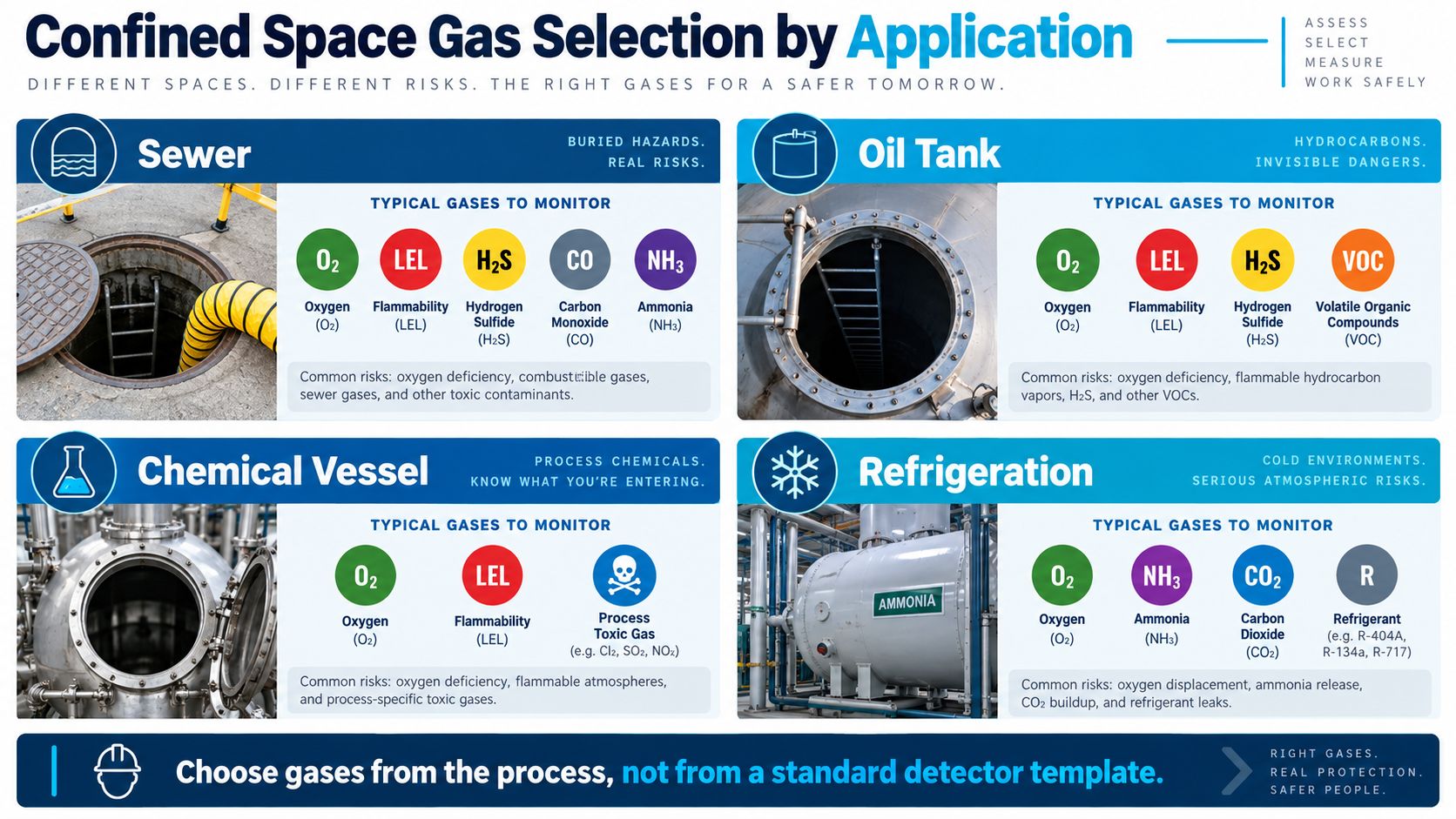
A detector should be configured around the specific process.
Sewer / Wastewater
Common concerns:
- oxygen deficiency
- H₂S
- methane / combustible gas
- CO
- NH₃
- CO₂
A standard four-gas monitor may provide a useful foundation, but the site assessment should determine whether additional gases matter.
Oil Tank
Potential hazards:
- oxygen deficiency
- hydrocarbons / LEL
- H₂S
- VOCs
- benzene
- residual process gases
A standard LEL sensor alone may not provide adequate toxic-VOC information.
Chemical Vessel
Previous contents matter enormously.
Possible hazards include:
- chlorine
- ammonia
- SO₂
- HCN
- solvents
- VOCs
- combustible vapors
- oxygen deficiency
Always review process records and SDS information.
Refrigeration Space
Possible hazards vary with refrigerant type.
Examples include:
- ammonia
- CO₂
- refrigerant-specific gases
- oxygen displacement
A conventional H₂S + CO four-gas monitor may therefore be the wrong detector for the application.
The principle remains:
Choose gases from the process—not from a standard detector template.
A Practical Pre-Entry Gas Testing Procedure
A useful workflow is:
Step 1 — Review the Hazard Assessment
Determine:
- what the space contained previously
- what process it connects to
- what work will be performed
- what gases can be generated
Step 2 — Select the Correct Detector Channels
Do not automatically default to four gases.
Match sensors to credible hazards.
Step 3 — Verify Detector Readiness
Follow the manufacturer’s procedures for:
- inspection
- bump testing
- calibration
- battery condition
- pump function
Step 4 — Keep the Worker Outside
Where practicable, use remote sampling before anyone enters.
Step 5 — Test Oxygen
Confirm the oxygen concentration against applicable entry criteria.
Step 6 — Test Combustible Gas
Measure combustible gas/vapor risk using an appropriate sensor and calibration.
Step 7 — Test Toxic Gases
Measure all toxic contaminants identified by the hazard assessment.
Step 8 — Test Representative Locations
Sample:
- top
- middle
- bottom
- side-to-side
- likely pockets
- areas entrants will reach
as appropriate to the space.
Step 9 — Allow Enough Sampling Time
Account for:
- hose transport delay
- pump rate
- sensor response
Step 10 — Record and Continue Monitoring
Document results according to the permit or site procedure and determine what monitoring is required during work.
Common Confined-Space Gas Testing Mistakes
Testing Only at the Opening
The atmosphere deeper in the vessel may be completely different.
Assuming Four Gases Cover Everything
H₂S and CO may be irrelevant while chlorine, ammonia, benzene, or another contaminant is the real hazard.
Reading Too Quickly
The sample may not have reached the sensor yet.
Ignoring Detector Response Time
A moving worker can enter the hazard before the instrument has fully responded.
Ignoring Oxygen Before LEL
Some combustible sensing technologies depend on adequate oxygen.
Assuming Ventilation Means Safe
Ventilation effectiveness needs to be verified.
Relying on Smell
Many hazardous atmospheres cannot be reliably detected by human senses.
Removing the Monitor After Entry
Atmospheric conditions can change during the work.
Frequently Asked Questions
What gases should be tested before entering a confined space?
Testing should normally address oxygen, combustible gases or vapors, and toxic contaminants that could realistically be present. H₂S and CO are common, but additional gases may be required by the process or hazard assessment.
What is the correct order for confined-space gas testing?
A commonly required sequence is:
Oxygen → combustible gases/vapors → toxic gases/vapors.
OSHA explicitly specifies this order for applicable permit-space testing.
Why is oxygen tested first?
One reason is that many traditional combustible gas meters depend on oxygen and may not produce reliable combustible-gas readings in severely oxygen-deficient atmospheres.
Is a four-gas monitor enough for confined-space entry?
Sometimes, but not always.
O₂ + LEL + H₂S + CO is a common industrial configuration, but a chemical vessel, refrigeration system, mine, or process tank may require completely different additional channels.
What oxygen level is safe in a confined space?
This depends on the applicable jurisdiction and procedure. U.S. OSHA uses 19.5% and 23.5% as the oxygen-deficiency and enrichment boundaries for permit-required confined-space purposes. Singapore uses 19.5–23.5% for the relevant entry-permit condition. Canada federal rules use 19.5–23% under the relevant provision.
What does 10% LEL mean?
It means the combustible-gas response has reached 10% of the lower explosive limit reference. It does not mean the atmosphere contains 10% gas by volume.
Where should you sample in a confined space?
Representative locations may include the top, middle, bottom, side-to-side, and areas the worker will travel through. The exact strategy depends on the geometry and likely hazards.
How long should you sample before taking a reading?
Follow the detector manufacturer’s required response and sampling time. For pumped sampling, also allow time for the gas sample to travel through the tubing.
Do you need continuous monitoring after entry?
Often yes when atmospheric hazards can change. Requirements depend on jurisdiction, entry procedure, hazard assessment, ventilation, and work activity.
Should I use a pumped or diffusion detector?
A pumped monitor is particularly useful for remote pre-entry sampling. A diffusion monitor is commonly used for personal continuous monitoring during entry. Some procedures use both.
Do you need to retest after ventilation?
Yes, ventilation should not be assumed to have created a safe atmosphere. Atmospheric testing is used to verify whether acceptable conditions have actually been achieved.
Can smell be used to determine whether a confined space is safe?
No.
Human senses are not a suitable substitute for atmospheric monitoring. Oxygen deficiency, CO, many flammable gases, and numerous toxic gases may provide little or no reliable sensory warning.
Final Takeaway
Confined-space gas monitoring should not begin with:
“Which four-gas detector should I buy?”
It should begin with:
“What can realistically be present in this space?”
A sound monitoring strategy generally evaluates:
Oxygen
↓
Combustible gases and vapors
↓
Credible toxic contaminants
But the work does not stop there.
Engineers and safety teams must also decide:
- where to sample
- how many locations to test
- how long to sample
- whether a pump is required
- whether the atmosphere can stratify
- whether work will change atmospheric conditions
- whether continuous monitoring is needed
The most important principle is simple:
Test the atmosphere the worker will actually encounter—not just the air at the entrance.
A confined space may be safe at the opening and hazardous two meters below it.
It may be safe before entry and hazardous twenty minutes later.
Effective gas monitoring therefore combines correct gas selection, representative sampling, proper instruments, sufficient response time, and ongoing monitoring when conditions can change.
References and Further Reading
- U.S. OSHA — 29 CFR 1910.146, Permit-Required Confined Spaces
- U.S. OSHA — Appendix B, Procedures for Atmospheric Testing
- U.S. OSHA — 29 CFR 1926 Subpart AA, Confined Spaces in Construction
- Safe Work Australia — Model Code of Practice: Confined Spaces, updated November 2024
- UK HSE — Safe Work in Confined Spaces, L101
- Singapore — Workplace Safety and Health (Confined Spaces) Regulations 2009
- Canada Occupational Health and Safety Regulations
- GasNose — What Does a 4-Gas Monitor Detect?
- GasNose — What Is a Safe LEL Level?
- GasNose — Oxygen Deficiency and Enrichment
- GasNose — Hydrogen Sulfide Sensors
- GasNose — Carbon Monoxide Sensors
