



A gas sensor does not always provide a reliable measurement immediately after power is applied. Depending on its sensing technology, design, storage history, and operating conditions, it may need time to initialize, establish a stable baseline, reach an operating temperature, or settle into its specified measurement state.
This period is commonly called gas sensor warm-up time. However, the term does not describe exactly the same process for every sensor. Some manufacturers use it for the instrument’s startup countdown, while others use it for the time required for the sensing element’s output to stabilize. A sensor may also become operational before it reaches its full accuracy specifications.
Understanding this distinction is important when commissioning fixed gas detectors, starting portable instruments, integrating sensor modules, or deciding when calibration can begin.
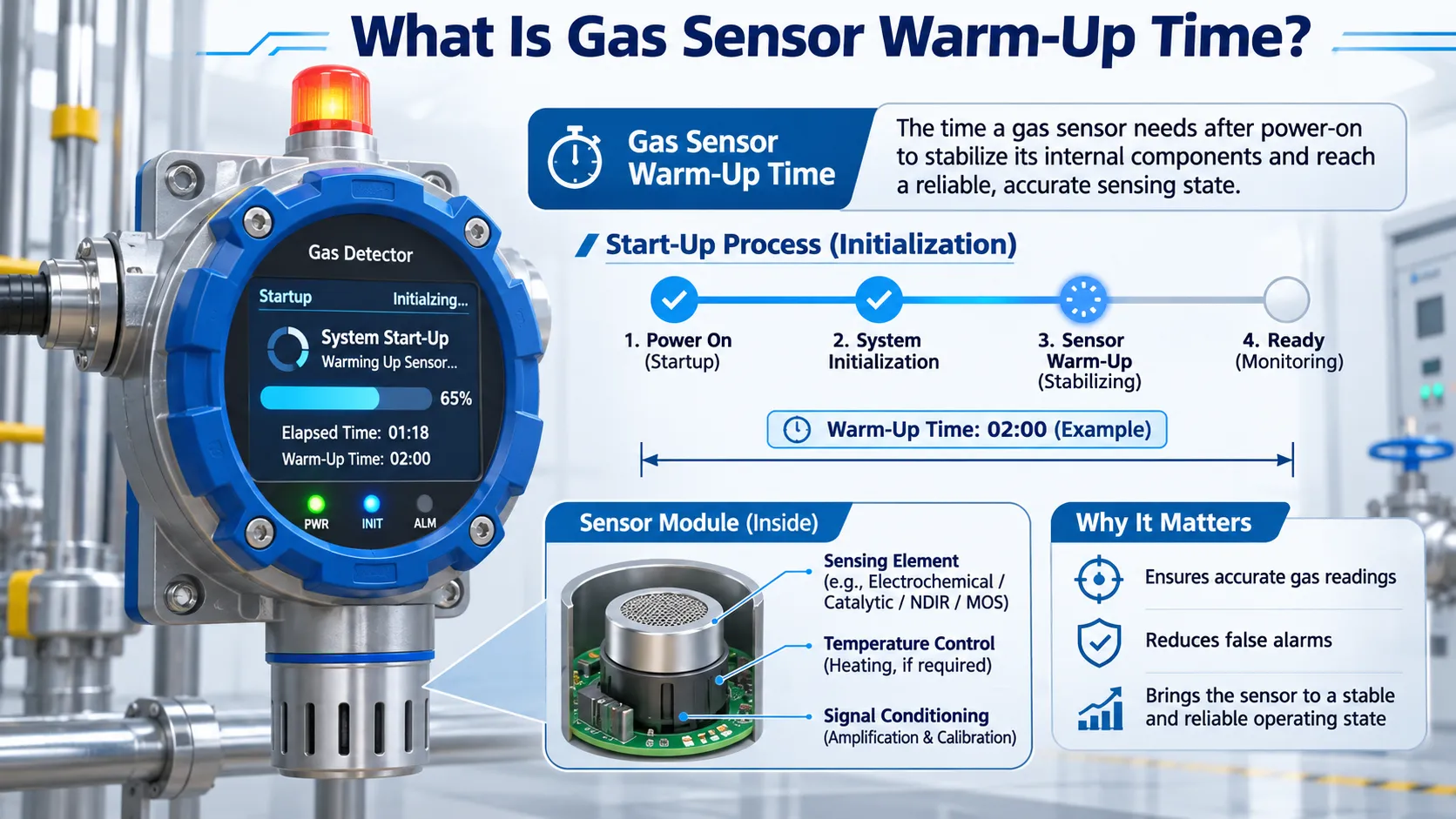
Gas detector startup may include electronics initialization, sensor conditioning, and output stabilization. The sequence and required time depend on the instrument and sensor model.
1. What Is Gas Sensor Warm-Up Time?
Gas sensor warm-up time is the period after startup or another defined preparation event during which a gas sensor or gas detection instrument reaches the operating state specified by its manufacturer.
Depending on the product, this process may involve powering and initializing the detector electronics, establishing the required bias voltage in an electrochemical sensor, heating a semiconductor sensing element, allowing an infrared source and optical assembly to reach thermal equilibrium, or allowing the sensor baseline to settle within a specified stability limit.
Warm-up time is therefore not a universal fixed duration. A sensor may need only seconds to complete its electronic startup routine, while another may require minutes or hours for its baseline or internal temperature to stabilize.
It is also important to distinguish operational readiness from full-specification performance. A detector may begin displaying readings after its startup routine, but its accuracy, repeatability, or baseline stability may continue to improve.
Warm-Up Time vs Stabilization Time vs Response Time
| Term | What it describes | Typical starting point |
|---|---|---|
| Warm-up time | Time required after power-on or preparation to reach the manufacturer’s defined operating state | Power-on or start of the specified preparation procedure |
| Stabilization time | Time required for the sensor output or baseline to settle within a defined stability condition | Installation, power-on, or end of initial warm-up, depending on the manufacturer |
| Response time | Time required for the output to reach a specified percentage of its final response after gas concentration changes | Application of a gas concentration step |
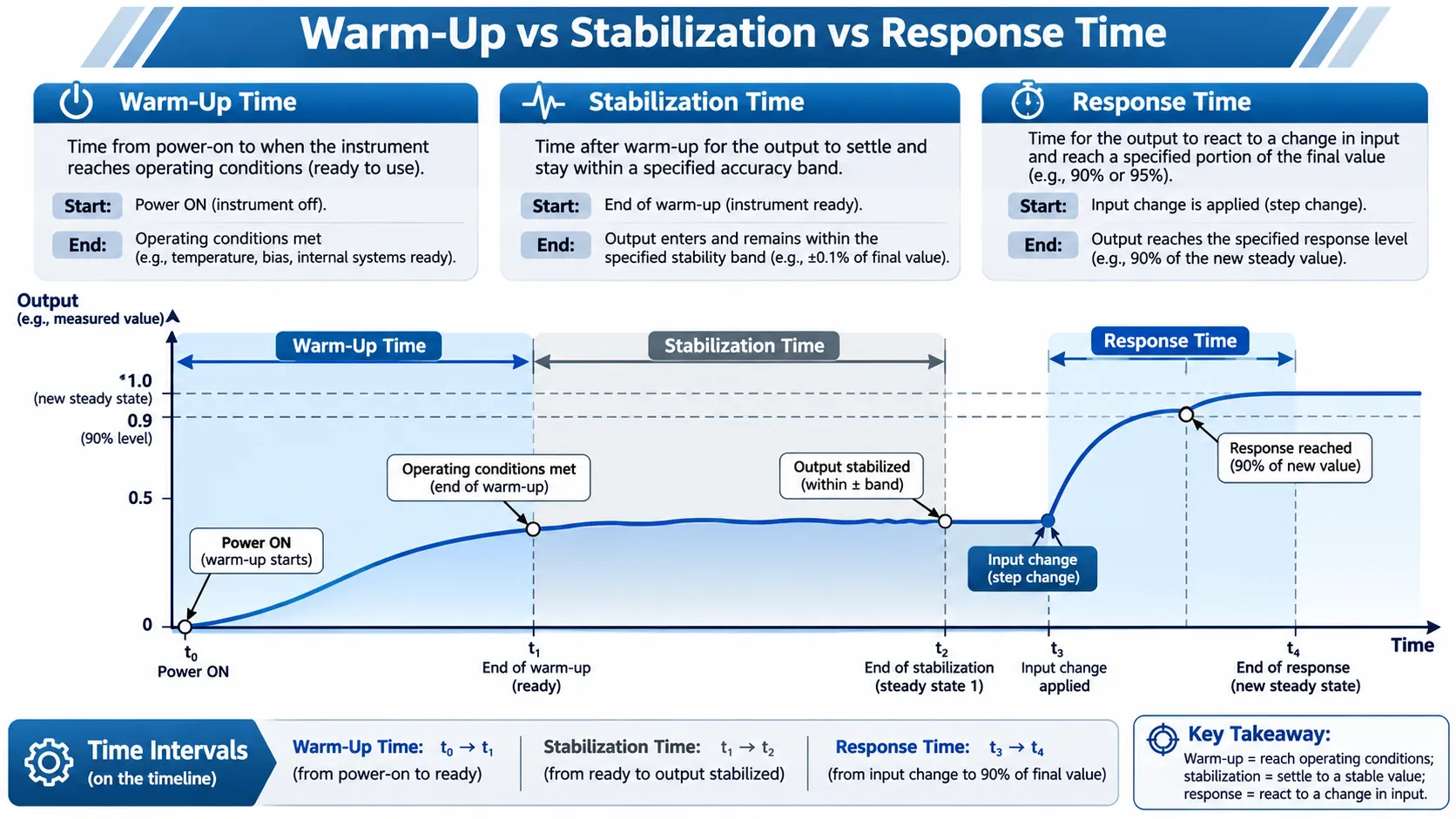
Conceptual timeline distinguishing startup, output stabilization, and response to a change in gas concentration. Actual definitions and acceptance limits are model-specific.
For gas sensors, response time is often expressed as T50 or T90. T90 usually refers to the time needed to reach 90% of the final response after a defined gas step. It is not the time required for a detector to become ready after power-on.
See Gas Sensor Response Time: T50 vs T90 Explained and Gas Sensor Response Time vs Recovery Time.
Manufacturers may use “warm-up” and “stabilization” differently. Always follow the definition and test conditions in the documentation for the specific model.
2. Why Do Gas Sensors Need Warm-Up Time?
The reason for warm-up depends on the sensing principle. In some products, the main requirement is electronic initialization. In others, the sensing material, electrode system, optical assembly, or internal temperature must reach a stable condition.
Electronic initialization
A gas detector may need to initialize its microcontroller, analog front end, ADC, display, communication interface, alarm logic, and self-diagnostic functions. During this stage, the instrument may show a startup message, countdown, maintenance state, or fault status. A displayed value during initialization should not automatically be treated as a valid measurement.
Baseline stabilization
A sensor’s zero-air output may change after storage, installation, or a power interruption. The instrument may need time for the baseline to settle before zero calibration or quantitative measurement.
Baseline changes can also occur over longer periods during normal operation. These longer-term changes are related to sensor drift, not simply startup warm-up. See What Is Gas Sensor Drift?.
Thermal stabilization
Some sensing technologies rely on a controlled operating temperature. The heater, infrared source, detector, and associated electronics may generate heat after power-on. Their output can change while the internal temperature is moving toward equilibrium.
Electrochemical conditioning
Electrochemical sensors use electrodes and an electrolyte. Depending on the design, electrode potential, bias voltage, stored electrical charge, and previous storage conditions can influence how long it takes for the baseline to stabilize.
Surface equilibrium in metal oxide sensors
Metal oxide semiconductor (MOS) sensors operate with a heated sensing layer. Gas adsorption and desorption at the surface affect the sensing resistance. The layer needs to reach its intended operating condition before the output can be interpreted consistently.
3. Gas Sensor Warm-Up Time by Sensing Technology
Different sensing technologies have different startup requirements. Even sensors based on the same principle can have different warm-up times because of their construction, electronics, operating temperature, and manufacturer-defined readiness criteria.
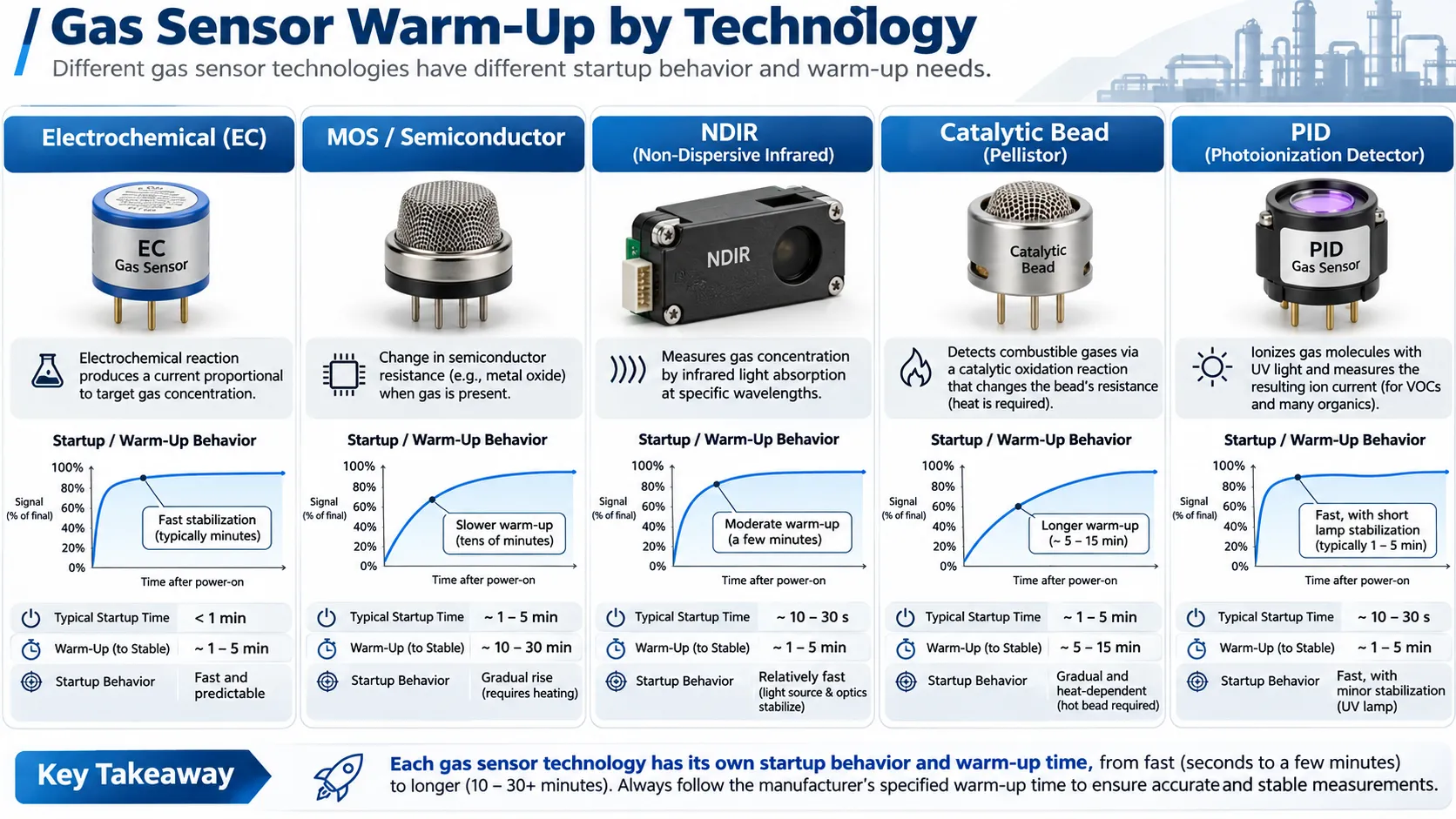
Different gas sensing technologies have different startup mechanisms. The illustration is conceptual and does not establish universal warm-up times.
Electrochemical gas sensors
Electrochemical gas sensors detect target gases through reactions at the working electrode and produce an electrical signal related to gas concentration.
Their startup and stabilization requirements can depend on whether the sensor is biased or unbiased, whether it is new or has been unused for an extended period, the target gas and electrode chemistry, whether the required bias voltage was maintained during shutdown, and storage conditions.
SemeaTech explains that some electrochemical sensors need time for electrical charges and electrode conditions to settle. Its guidance gives approximately 10 minutes for the baseline of certain unbiased sensors to stabilize after installation, while certain biased sensors may require about 6 hours or longer if the correct bias voltage was not maintained. These are manufacturer-specific instructions, not a universal rule.
See SemeaTech’s electrochemical sensor FAQ.
MOS / semiconductor gas sensors
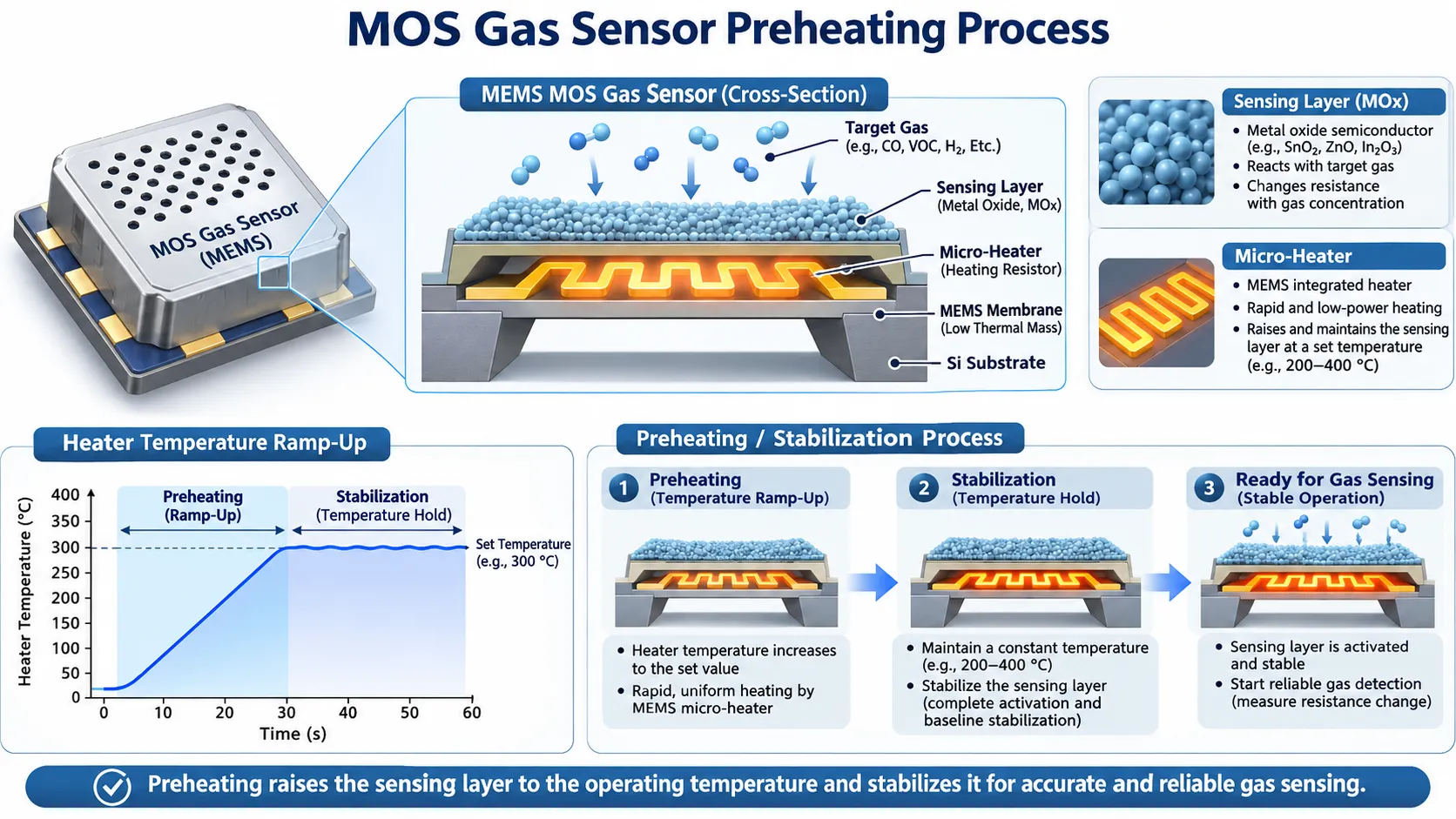
Conceptual MEMS metal oxide sensor cross-section showing the micro-heater, sensing layer, and controlled preheating process.
MOS gas sensors use a heated metal oxide sensing layer. The heater brings the material to its operating temperature, where surface reactions with the target gas produce measurable resistance changes.
SGX Sensortech’s application note explains that the sensor needs time to establish chemical equilibrium as compounds are adsorbed or desorbed from the sensing surface. The note gives a specific NO2 sensor example: normal operation at 40 mW, with preheating at 80 mW for 30 seconds before use. This is an example for the described sensor, not a recommended power sequence for other MOS devices.
Never increase heater voltage or power unless the sensor datasheet explicitly permits that procedure.
NDIR gas sensors
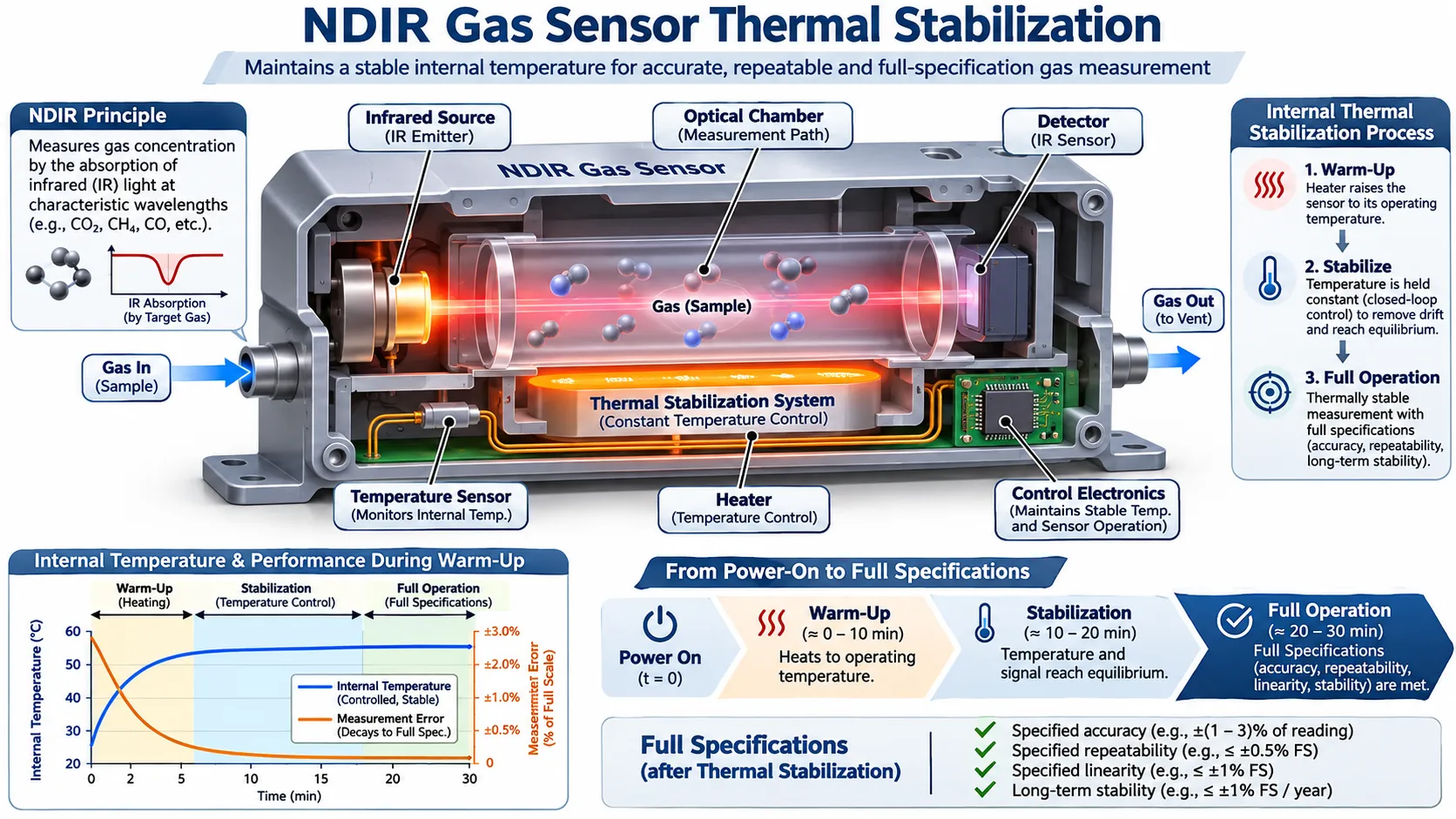
Conceptual NDIR assembly showing the infrared source, optical chamber, detector, and internal thermal stabilization.
Non-dispersive infrared (NDIR) sensors measure gas concentration through infrared absorption at selected wavelengths. Their startup behavior can involve initial electronics and self-check routines, stabilization of the infrared source, internal temperature changes, and thermal equilibrium of the optical and detector assembly.
N.E.T. describes a product-specific distinction for its NDIR sensors: approximately 60 seconds to reach full operation at 25°C, but at least 30 minutes to reach full specifications. The longer period allows the internal temperature to stabilize.
This demonstrates why “the sensor is operating” and “the sensor is operating within all stated specifications” are not necessarily the same condition.
Catalytic bead sensors
Catalytic bead, or pellistor, sensors use a heated sensing element to detect combustible gases through catalytic oxidation. The detector electronics and heated elements must reach the operating state defined by the instrument manufacturer.
For example, MSA lists a warm-up time of no more than 5 minutes for the catalytic bead sensor in its TG5000 documentation. This is a specification for that product configuration, not a general value for every catalytic sensor.
PID gas sensors
Photoionization detectors use an ultraviolet lamp to ionize compounds with suitable ionization potentials. Startup readiness may depend on the lamp, detector electronics, contamination condition, and instrument design.
There is no single warm-up time that applies to all PID instruments. Use the instrument manual to determine when the lamp and detector are ready, and follow its cleaning, maintenance, and calibration instructions.
4. Electrochemical Gas Sensor Warm-Up: Biased vs Unbiased Sensors
Electrochemical sensor warm-up is particularly important because electrode configuration and bias requirements can affect the time needed to obtain a stable baseline.
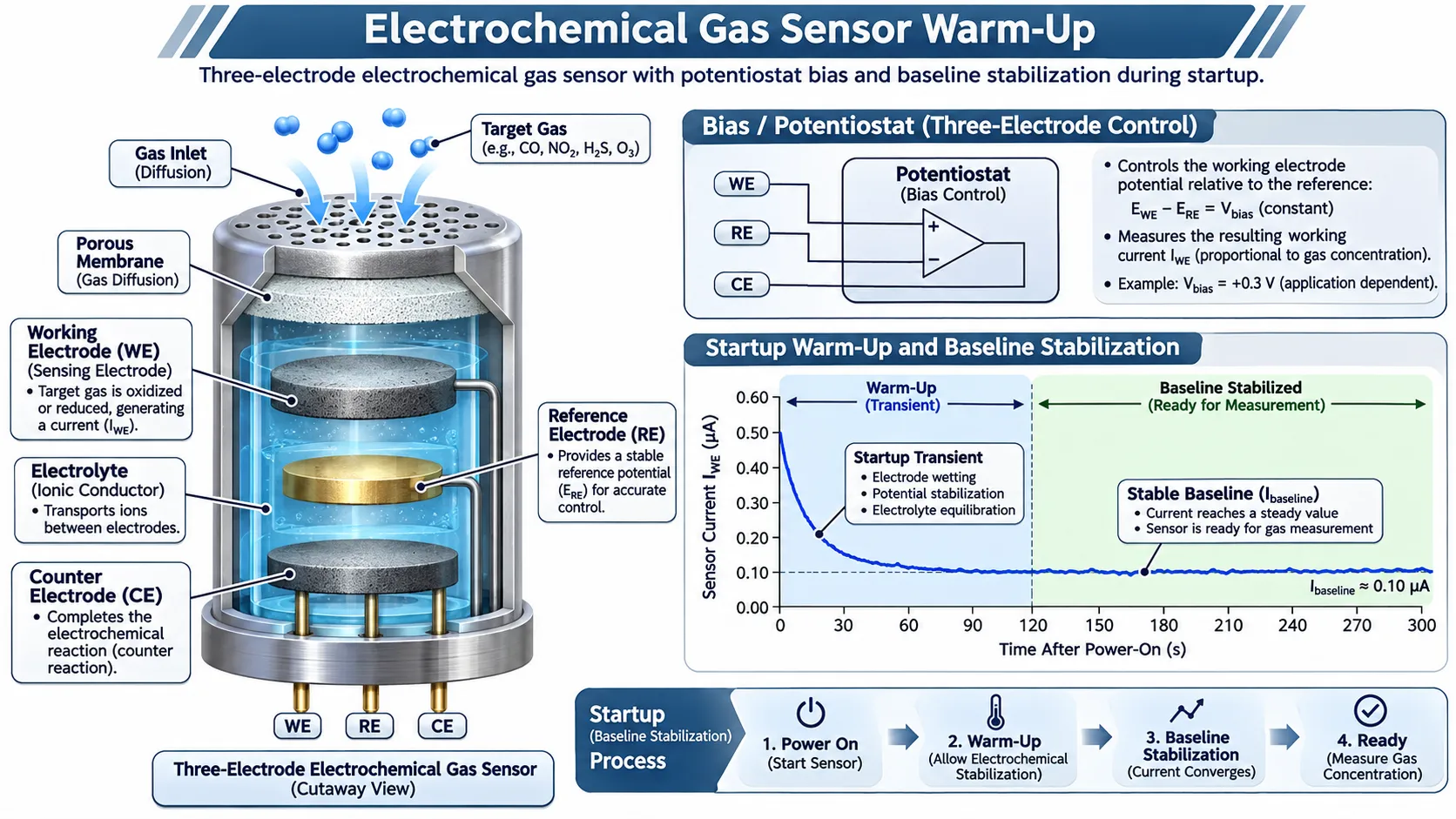
Conceptual three-electrode electrochemical sensor showing the working electrode (WE), reference electrode (RE), counter electrode (CE), potentiostat, and baseline stabilization. Electrode arrangements vary by sensor design.
Unbiased electrochemical sensors
An unbiased sensor does not require a continuously applied bias voltage between the working and reference electrodes during normal storage.
SemeaTech explains that certain unbiased sensors are shipped with a shorting spring connecting specified electrodes. The spring must be removed when the sensor is installed in the monitoring instrument, following the manufacturer’s instructions.
For the SemeaTech sensors covered by its FAQ, the baseline may take approximately 10 minutes to stabilize before initial calibration and testing. This procedure is specific to the sensor design. Do not assume that all electrochemical sensors use a shorting spring or the same installation process.
Biased electrochemical sensors
Some electrochemical sensors require a specified bias voltage to maintain the electrode conditions needed for the target-gas reaction.
If the bias voltage is removed, the electrode system may need several hours to stabilize after power is restored. SemeaTech states that certain biased sensors may require about 6 hours or longer before the baseline is sufficiently stable for initial calibration and testing.
For designs that require continuous bias, the instrument may be designed to maintain the correct bias voltage even when the main device is switched off. This can reduce the need for a long stabilization period at the next startup.
Important: Never short the electrodes of a biased sensor unless the manufacturer explicitly instructs you to do so. SemeaTech warns that applying a shorting spring to the specified electrodes of its biased sensors can permanently damage them.
New or long-unused sensors vs temporarily unused sensors
SemeaTech also publishes stabilization guidance by gas type. For example, its FAQ lists approximately 2 hours for new or long-unused CO and H2S sensors, compared with approximately 10 minutes for temporarily unused sensors in the covered product range.
These figures are not interchangeable with the separate biased/unbiased installation guidance. They describe different sensor conditions and preparation cases. The exact model, storage history, bias configuration, and current datasheet should determine the procedure.
5. Real Manufacturer Examples: How Long Do Gas Sensors Need to Warm Up?
The following examples show why engineers should not assume one standard warm-up time for all gas detectors.
MSA TG5000 sensor warm-up times
MSA publishes the following warm-up values for sensors used with its TG5000 gas monitor:
| Sensor type | Published warm-up time |
|---|---|
| XIR PLUS | ≤ 5 minutes |
| H2S | ≤ 5 minutes |
| SO2 | ≤ 5 minutes |
| Cl2 | ≤ 10 minutes |
| NH3 | ≤ 5 minutes |
| Catalytic bead | ≤ 5 minutes |
| CO | 30 minutes |
| O2 | 30 minutes |
These are values from the MSA TG5000 documentation. MSA also states that sensors should be allowed to acclimate to application conditions for 24 hours before initial calibration. Acclimation is a separate requirement from the startup warm-up countdown.
MSA further notes that certain CO sensor gas codes may need longer warm-up after extended periods without power. For those specific sensors, the required time depends on how long the detector has been unpowered and the reading level being considered.
Source: MSA TG5000 — Sensor Warm-Up Times.
SemeaTech electrochemical sensor stabilization
SemeaTech’s FAQ lists different stabilization times for new or long-unused sensors and temporarily unused sensors. Examples include:
| Gas type | New or long-unused sensor | Temporarily unused sensor |
|---|---|---|
| CO | 2 hours | 10 minutes |
| H2S | 2 hours | 10 minutes |
| O2-LF | 2 hours | 15 minutes |
| H2 | 2 hours | 10 minutes |
| NO2 | 2 hours | 10 minutes |
| NH3 | 2 hours | 10 minutes |
These figures apply to the product guidance published by SemeaTech. They should not be generalized to all electrochemical sensors.
Source: SemeaTech — FAQs of Electrochemical Gas Sensors.
SGX MOS sensor preheating example
SGX Sensortech’s AN-0172 application note describes a metal oxide sensor that normally operates at 40 mW and is preheated at 80 mW for 30 seconds before use.
The note explains that higher initial operating temperature can accelerate stabilization of the sensing surface. The specified procedure is model-specific and must not be copied to another sensor without its manufacturer’s approval.
Source: SGX Sensortech — Metal Oxide Gas Sensors: How to Use Them and How They Perform (AN-0172).
N.E.T. NDIR full operation vs full specifications
N.E.T. explains that its NDIR sensors can reach full operation after approximately 60 seconds at 25°C, while reaching full specifications requires at least 30 minutes.
The difference is related to internal self-heating. The infrared source and electronics raise the sensor’s internal temperature, and measurement performance approaches its specified condition as the temperature stabilizes.
Source: N.E.T. — NDIR Sensor Warm-Up Time: Full Operation vs. Full Specifications.
These manufacturer examples are model-specific references, not a universal sensor comparison chart.
6. Initial Startup vs Restart After Power Loss
A sensor’s startup time can change depending on whether it is being used for the first time, restarted after a short interruption, or powered up after a long period in storage.
| Startup condition | What may affect the required time |
|---|---|
| New sensor installation | Storage history, electrode condition, sensor preparation, and manufacturer instructions |
| Short power interruption | Whether bias voltage or heater power was maintained |
| Several hours without power | Changes in electrode potential, baseline, or internal temperature |
| Long-term shutdown | Sensor chemistry, storage conditions, and time needed to re-establish stable operation |
| Restart after environmental change | Temperature, humidity, pressure, and gas exposure history |
MSA provides a useful example for certain CO sensor gas codes in its TG5000 monitor. Its table shows that warm-up time can increase as the time without power increases, particularly when a low reading level is required.
| Time unpowered | Warm-up for reading below 10 ppm | Warm-up for reading below 1 ppm |
|---|---|---|
| 1 minute | < 5 minutes | < 5 minutes |
| 8 hours | < 30 minutes | < 30 minutes |
| 5 days | < 30 minutes | 2–4 hours |
| 1 month | < 2 hours | 6–10 hours |
This table applies to the specific CO sensor gas codes and conditions described in the MSA manual. It is not a general restart-time calculator for other CO sensors.
A detector that is switched off and on every day may therefore behave differently from a detector that remains continuously powered. For biased electrochemical sensors, maintaining the specified bias voltage may be particularly important.
7. What Happens If You Measure Before Warm-Up Is Complete?
Using a sensor before it reaches its specified operating state can produce misleading results. The exact symptoms depend on the sensing technology and the instrument’s startup logic.
Unstable baseline
The zero-air output may continue to change after startup. A detector may show a fluctuating reading even when the target gas concentration is not changing.
Zero offset
If the baseline has not stabilized, the detector may report a positive or negative offset. This can affect low-concentration measurements and zero calibration.
False alarms or incorrect readings
An unstable signal can be interpreted as a gas concentration change. Some instruments may enter a maintenance or fault state during startup, while others may display a value that is not yet within the full measurement specification.
Inconsistent calibration
Calibrating before the sensor has reached the manufacturer’s required condition can produce an unreliable zero or span adjustment. The calibration result may change after the sensor stabilizes.
Delayed or inconsistent response
If the sensing element has not reached its intended operating condition, its response characteristics may not match the specified performance. This can make readings difficult to compare with later measurements.
For a related explanation of baseline changes over time, see What Is Gas Sensor Drift?.
8. How to Know When a Gas Sensor Is Ready for Measurement
Do not decide that a sensor is ready simply because the display has turned on or a number is visible. Use the instrument’s status indicators and the manufacturer’s acceptance criteria.
A practical startup verification process includes:
- Confirm startup completion. Check that the instrument has completed its self-test and no startup fault or maintenance status remains.
- Follow the specified warm-up period. Use the exact model’s manual rather than a generic time copied from another detector.
- Check baseline stability. Where the manufacturer specifies a stability criterion, confirm that the output has settled within that limit.
- Confirm environmental conditions. Check that temperature, humidity, pressure, and sampling conditions are within the product specifications.
- Complete required acclimation. If the manufacturer specifies an acclimation period before initial calibration, treat it separately from power-on warm-up.
- Perform calibration when required. Follow the manufacturer’s zero and span calibration procedure only after the sensor is ready.
- Verify the response. Use the specified functional test or bump-test procedure to confirm that the detector responds to the target gas and that alarms and outputs work correctly.
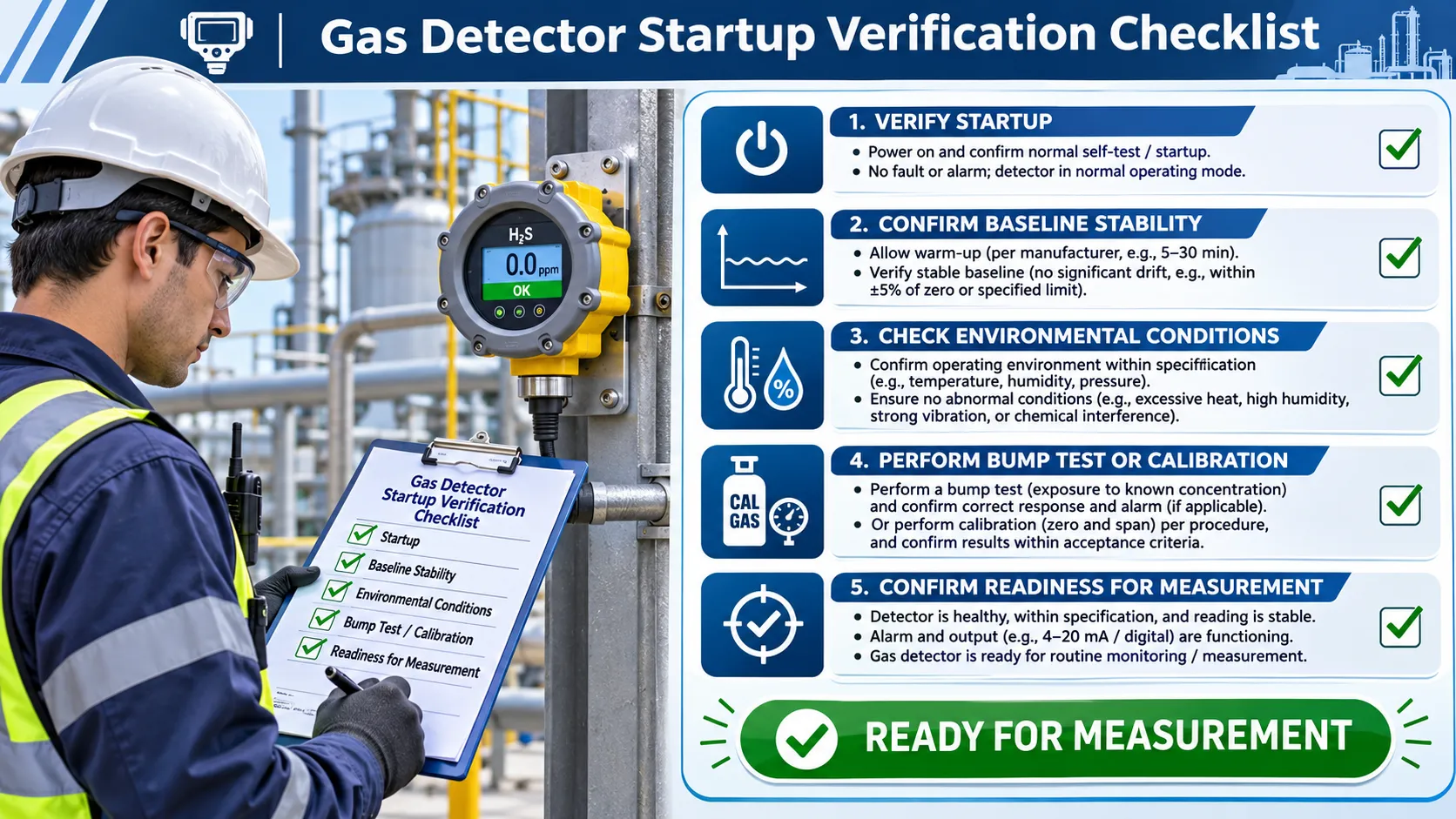
Startup verification checklist for commissioning and routine use. The exact warm-up, calibration, and bump-test procedures must follow the instrument manufacturer’s instructions.
A warm-up countdown alone does not prove that the complete gas detection system is correctly calibrated or functioning as required. Startup readiness, calibration, and functional verification are separate checks.
9. How Can Engineers Reduce Gas Sensor Warm-Up Time?
Warm-up time is determined by the sensor design and the operating conditions specified by the manufacturer. Engineers should not try to shorten it by changing heater voltage, bias voltage, or calibration settings without an approved procedure.
Maintain the required bias voltage
For biased electrochemical sensors that require continuous bias, design the instrument to maintain the specified voltage during shutdown if the manufacturer recommends this approach.
Avoid unnecessary power cycling
If the application permits continuous operation, maintaining power may avoid repeated startup and stabilization cycles. This is particularly relevant for sensors whose baseline or internal temperature changes after power loss.
Use the specified heater control
For MOS sensors, use the manufacturer’s recommended heater voltage, power, and preheating sequence. Do not assume that a higher heater setting will safely shorten warm-up.
Allow thermal conditions to settle
For NDIR instruments, avoid taking full-specification measurements before the required internal thermal stabilization period has elapsed.
Follow the correct storage and installation procedure
Protect sensors from unsuitable storage conditions, contaminants, and incorrect handling. Install the sensor according to the manufacturer’s instructions, including any shorting spring removal or bias configuration requirements.
Use instrument-level readiness logic
When designing a gas detector, firmware can use the manufacturer’s startup time, sensor status, temperature information, or baseline stability criteria to determine when measurement outputs should be treated as valid.
10. Common Gas Sensor Warm-Up Mistakes
- Assuming every gas sensor needs the same warm-up time. Different sensing principles and product designs have different startup requirements.
- Confusing warm-up time with response time. Warm-up begins at startup or preparation; response time is measured after a gas concentration change.
- Treating the first displayed value as a valid measurement. A visible reading does not prove that the sensor has reached its specified operating condition.
- Ignoring storage history. A new or long-unused sensor may need more stabilization time than one that was only briefly powered off.
- Ignoring bias requirements. Incorrect handling of biased electrochemical sensors can delay stabilization or damage the sensor.
- Applying an unapproved preheating procedure. Increasing heater voltage or power can damage a sensing element.
- Calibrating too early. Zero and span calibration should follow the manufacturer’s startup and acclimation requirements.
- Confusing acclimation with warm-up. Allowing a sensor to adapt to application conditions before initial calibration may take much longer than the instrument’s power-on countdown.
- Using a generic time from another model. Manufacturer instructions for a specific sensor and detector should take priority.
- Ignoring startup status and fault indications. A detector should not be treated as ready if it reports a fault, maintenance condition, or incomplete startup.
11. Frequently Asked Questions
How long does a gas sensor need to warm up?
There is no universal duration. Some instruments become operational in seconds, while others require minutes or hours for the baseline or internal temperature to stabilize. The correct time depends on the sensor model, sensing technology, storage history, and manufacturer-defined readiness condition.
Do all gas sensors need warm-up time?
Most gas detection instruments have some form of startup or initialization process, but the time and physical reason vary. Some require electronic initialization, some need thermal stabilization, and some need electrode or sensing-surface conditioning.
Why do electrochemical gas sensors need warm-up?
Their electrode potentials, bias voltage, stored electrical charge, and baseline may need to stabilize after installation or a period without use. The required time depends on the sensor’s electrode configuration and manufacturer instructions.
Does an NDIR gas sensor need to warm up?
It can. Some NDIR sensors become operational after a short startup routine but need additional time for the infrared source, electronics, and internal temperature to stabilize before reaching full specifications.
Why do MOS gas sensors require preheating?
MOS sensors use a heated metal oxide sensing layer. Preheating brings the layer to its operating condition and supports the surface reactions needed for gas detection. The exact heater sequence and time are model-specific.
Does turning off a gas detector reset its warm-up time?
It may. The effect depends on the sensor technology and whether critical conditions, such as bias voltage or heater power, were maintained. Some sensors restart quickly after a short interruption but require longer stabilization after extended shutdown.
Can a gas detector measure accurately immediately after startup?
Not necessarily. The detector may display a value before it reaches full specifications. Follow the startup status and measurement-readiness instructions in the product manual.
What is the difference between warm-up time and stabilization time?
Warm-up time generally describes the period required to reach a defined operating state after startup or preparation. Stabilization time describes how long the output or baseline takes to settle within a specified stability condition. Some manufacturers use these terms differently, so check the product documentation.
Should a gas sensor be calibrated immediately after startup?
Only if the manufacturer’s procedure permits it. Some products require a defined warm-up period, environmental acclimation, or baseline stabilization before calibration. Follow the specific model’s instructions.
How can I tell when a gas sensor is ready?
Check the instrument’s startup status, fault indicators, baseline stability, environmental conditions, and any manufacturer-defined readiness criteria. Complete required calibration and functional verification before placing the detector into service.
Conclusion
Gas sensor warm-up time is not a single fixed value shared by all gas detection technologies. It depends on the sensing principle, sensor construction, electronics, storage history, power interruption, and the manufacturer’s definition of operational readiness.
The key distinctions are:
- Warm-up time is the time needed to reach a defined operating state after startup or preparation.
- Stabilization time is the time needed for the sensor output or baseline to settle within a specified condition.
- Response time is the time needed to respond to a change in gas concentration.
A detector may become operational before it reaches full measurement specifications. Electrochemical sensors may need electrode or bias stabilization, MOS sensors require controlled heating of the sensing layer, and NDIR sensors may need additional time for internal thermal equilibrium.
For reliable gas detection, always follow the warm-up, acclimation, calibration, and functional-test procedures for the exact sensor and instrument model.
References and Further Reading
Manufacturer technical references
- MSA — TG5000 Sensor Warm-Up Times
- MSA — TG5000 Initial Startup
- SemeaTech — FAQs of Electrochemical Gas Sensors
- SGX Sensortech — Metal Oxide Gas Sensors: How to Use Them and How They Perform (AN-0172)
- N.E.T. — NDIR Sensor Warm-Up Time: Full Operation vs. Full Specifications
