




A gas sensor can respond to a gas in 20 seconds and still take more than a minute to return close to zero after the gas is removed.
That does not automatically mean the sensor is defective.
Response time and recovery time describe two different parts of the sensing cycle.
Response time asks:
How quickly does the sensor react after the gas concentration changes?
Recovery time asks:
How quickly does the sensor return toward its original baseline after the gas is removed?
The distinction matters because gas sensing is not always a perfectly reversible process.
Gas molecules may:
- diffuse into a sensor
- adsorb onto a sensing surface
- dissolve in an electrolyte
- react at an electrode
- accumulate in tubing
- remain trapped in filters or housing materials
Removing the gas from the surrounding atmosphere does not necessarily remove it instantly from the entire sensing system.
That is why:
A fast response does not guarantee a fast recovery.
Response Time vs Recovery Time: Quick Answer
| Parameter | What Is Happening? | Common Definition |
|---|---|---|
| Response Time | Sensor moves from baseline toward the gas-exposed response | Often T90 |
| Recovery Time | Sensor returns from the gas-exposed response toward baseline | Often T10, or 90% recovery |
| Response Trigger | Target gas introduced or concentration increased | Gas ON |
| Recovery Trigger | Target gas removed or concentration reduced | Gas OFF |
| Main Question | How quickly can the sensor detect the change? | Speed of detection |
| Main Question for Recovery | How quickly can the next measurement start from a reliable baseline? | Reusability / reversibility |
A typical sensing cycle is:
Baseline
↓
Gas ON
↓
Sensor responds
↓
T90
↓
Stable exposure
↓
Gas OFF
↓
Sensor recovers
↓
T10
↓
Baseline
Response and recovery are related, but they are not necessarily symmetrical.
What Is Gas Sensor Response Time?
Response time describes how quickly the sensor output changes after the target gas reaches the sensing system.
Suppose a sensor is initially in clean air.
The gas concentration suddenly changes from:
0 ppm
to:
50 ppm
The sensor normally does not jump instantly from zero to its final reading.
Instead:
0
↓
10
↓
25
↓
40
↓
45
↓
50 ppm
A commonly used response-time parameter is:
T90
T90 is the time required for the sensor output to reach 90% of its defined final response.
For a detailed explanation of T50, T90 and complete detector response, see Gas Sensor Response Time: T50 vs T90 Explained.
What Is Gas Sensor Recovery Time?
Recovery begins when the target gas concentration decreases or the test gas is removed.
Suppose the sensor has stabilized at a full response.
After the gas is removed:
100% response
↓
70%
↓
40%
↓
20%
↓
10%
↓
Baseline
Recovery time describes how long this return process takes.
A common convention defines recovery using the point where the remaining signal has dropped to approximately:
10% of the original gas-induced response
This is commonly called:
T10 recovery
ScienceDirect’s gas-sensor reference material describes response time as commonly reaching 90% of final response, while recovery is commonly measured when the remaining response falls to 10%.
T90 Response vs T10 Recovery
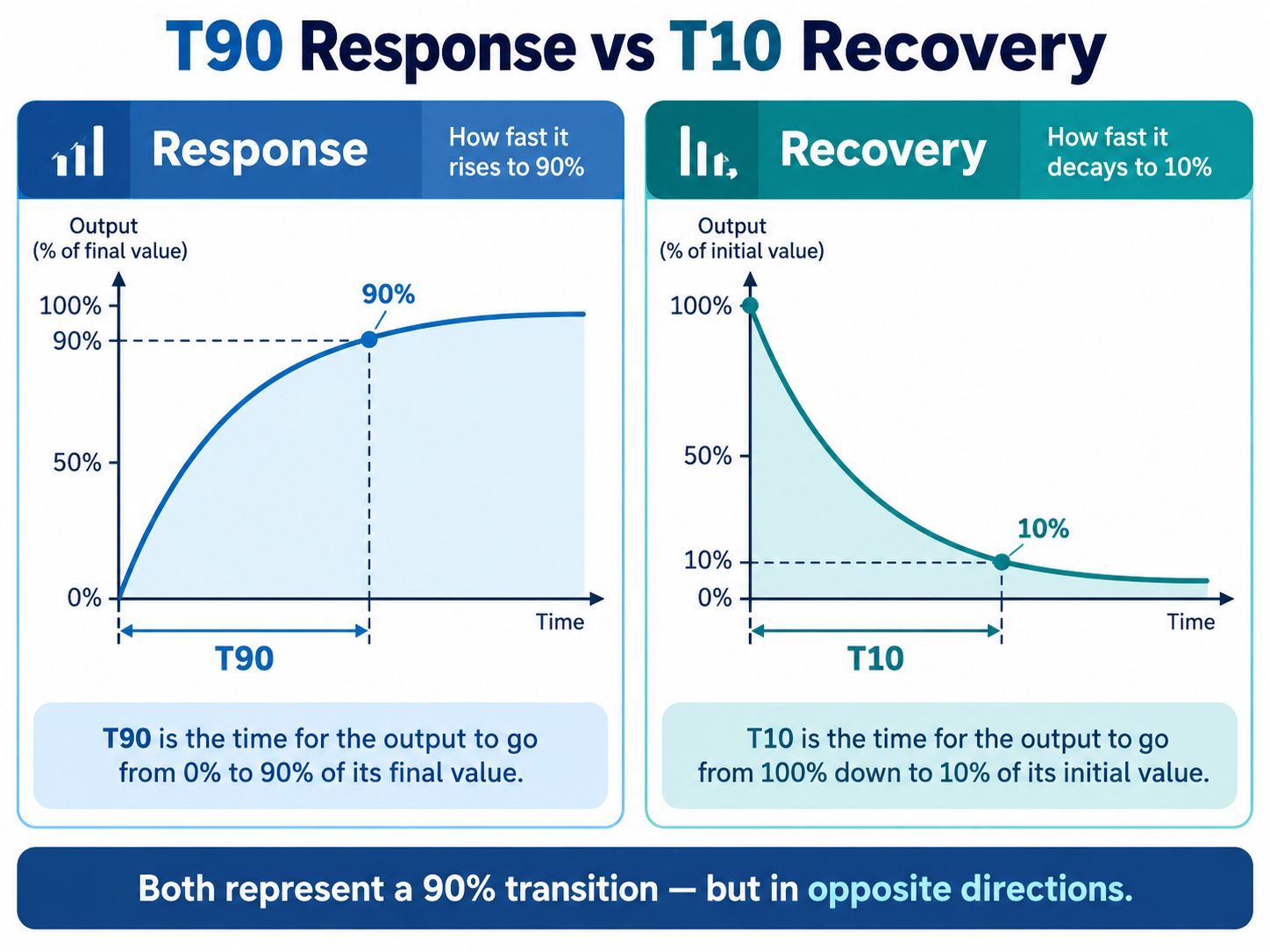
This terminology is easy to misunderstand.
During Response
Initial response:
0%
Final response:
100%
T90 occurs at:
90%
During Recovery
Initial gas-exposed response:
100%
Baseline:
0%
T10 occurs when the remaining signal reaches:
10%
So both can represent approximately a 90% transition, but in opposite directions.
T90 response means the sensor has completed about 90% of its upward transition. T10 recovery means it has completed about 90% of its return toward baseline.
Not Every Datasheet Uses the Same Recovery Definition
This is important when comparing sensors.
A datasheet or research paper may define recovery as:
- T10
- T50
- 90% recovery
- return to 10% of peak response
- return to 90% of the original baseline
- return within a specified zero tolerance
These descriptions can represent slightly different calculations.
Therefore:
Never compare two recovery-time specifications until you know exactly how the endpoint was defined.
The same principle applies to T50 and T90 response specifications.
Response and Recovery Are Not Mirror Images
It is tempting to imagine a perfect sensor response like this:
Gas ON
0 → 100

Gas OFF
100 → 0
with both transitions taking exactly the same amount of time.
Real gas sensing is often more complicated.
A sensor could have:
Response T90 = 20 s
and:
Recovery T10 = 90 s
or the opposite.
The reason is that different physical processes may dominate the two directions.
During response, gas molecules may need to:
- diffuse to the sensing element
- adsorb onto a surface
- react chemically
- alter resistance or current
During recovery, they may need to:
- desorb from surfaces
- diffuse back out
- leave an electrolyte
- be flushed from dead volumes
- be removed from tubing or filters
- allow the sensing material to return to equilibrium
These processes can occur at very different rates.
Why Can Recovery Be Slower Than Response?
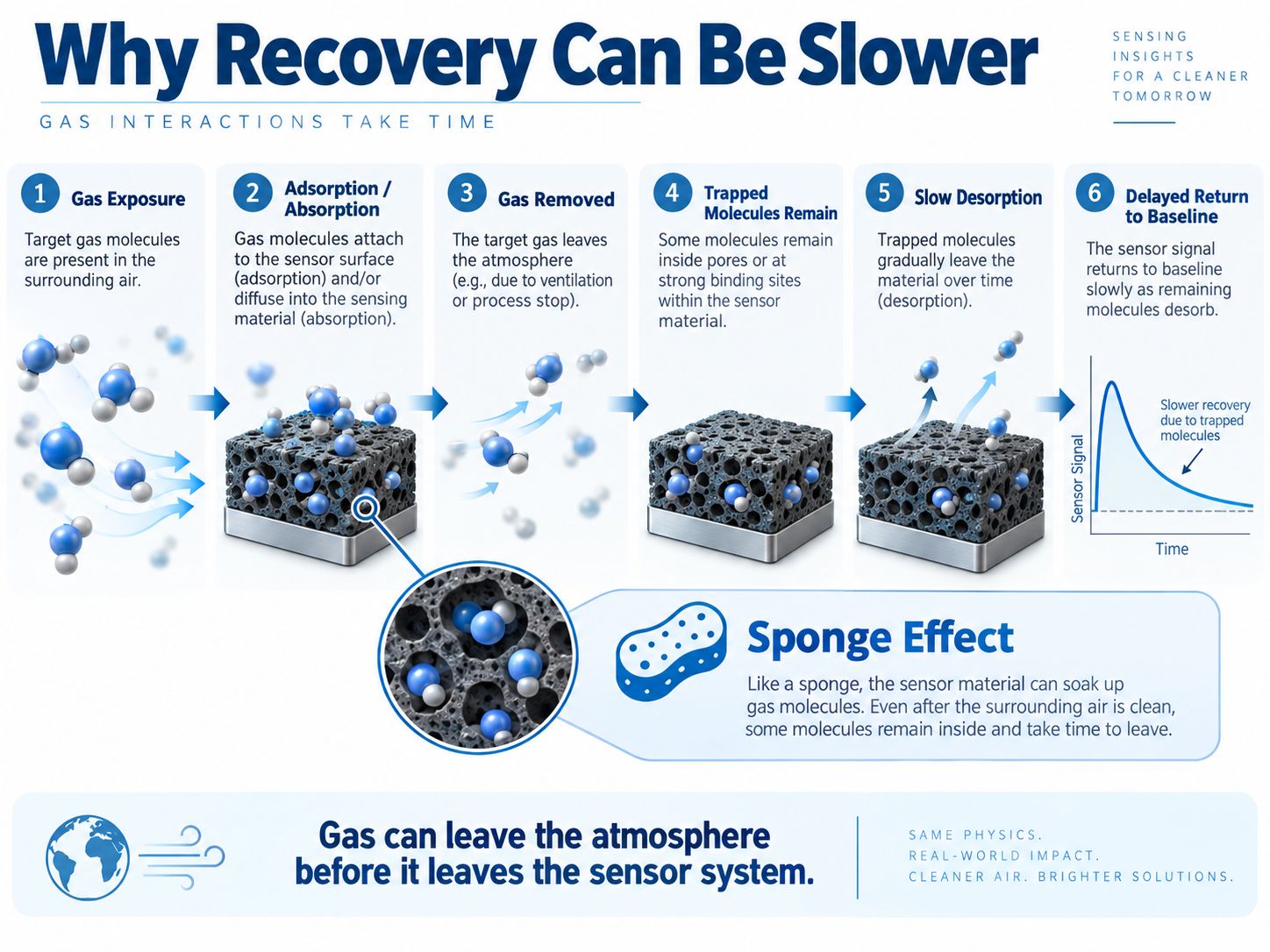
One of the main reasons is:
adsorption and desorption are not necessarily equally fast.
During exposure:
Gas molecules
↓
Reach sensing material
↓
Adsorb / react
↓
Sensor signal changes
After the gas is removed:
Fresh air returns
↓
Some molecules remain attached
↓
Slow desorption
↓
Residual signal persists
↓
Sensor gradually returns to baseline
The external atmosphere may therefore already be clean while the sensor system still contains traces of the previous gas.
This can happen inside:
- sensing material
- housing
- membrane
- filter
- sample tubing
- electrolyte
- measurement chamber
What Is the “Sponge Effect”?
The sponge effect is a particularly useful example of slow recovery.
Some VOCs can be absorbed or adsorbed by materials in or around the sensor.
Those materials effectively behave like a sponge:
During Exposure
They absorb some of the vapor.
After Exposure
The external gas disappears.
But the absorbed material slowly releases the vapor again.
The sensor therefore continues seeing traces of the gas.
MEMBRAPOR specifically describes this behavior in its VOC sensor application note. It states that some VOCs strongly adsorb onto sensor housing and are slowly released afterward, creating a “sponge-effect” associated with slow recovery and baseline shift.
This leads to a useful rule:
Gas can leave the atmosphere before it leaves the sensing system.
Slow Recovery Does Not Automatically Mean Sensor Failure
Suppose a detector does not immediately return to zero after exposure.
Possible explanations include:
Normal Sensor Recovery
The target gas simply has slow desorption or reaction kinetics.
Residual Gas in the Sampling System
Gas may remain inside:
- chamber
- tubing
- probe
- manifold
Filter or Housing Adsorption
The gas may still be released from materials surrounding the sensing element.
Temperature or Humidity Change
Environmental conditions may shift the sensor baseline.
High-Concentration Exposure
The sensor may have been saturated or overloaded.
Baseline Drift
The sensor may no longer be returning to its original zero.
Contamination or Poisoning
The sensing chemistry may have been altered.
Therefore:
Slow recovery is a symptom—not a diagnosis.
The full system needs to be checked before concluding that the sensor has failed.
Recovery Time vs Gas Sensor Drift
Recovery and drift can look similar if you only watch the display.
Imagine a 50 ppm exposure.
The gas is removed.
Scenario A
Reading:
50
↓
30
↓
15
↓
5
↓
1
↓
0 ppm
The sensor eventually returns to its original baseline.
That is primarily a recovery process.
Scenario B
Reading:
50
↓
30
↓
15
↓
8
↓
5 ppm
and then remains near 5 ppm for a long time.
Possible causes now include:
- baseline shift
- zero drift
- contamination
- unresolved environmental influence
Recovery time alone may no longer explain the behavior.
For this distinction, see What Is Gas Sensor Drift? Zero Drift, Span Drift & Baseline Drift Explained.
Recovery Time vs Saturation and Over-Range
A normal response/recovery specification is usually measured under defined test conditions.
That does not tell you how the sensor will behave after extreme exposure.
For example:
A sensor designed for:
0–100 ppm
may be exposed to:
1,000 ppm
The sensing element or associated materials may become heavily loaded.
Possible effects include:
- saturation
- prolonged recovery
- large baseline disturbance
- temporary sensitivity change
- permanent damage
Therefore a very slow return after a major gas release may be an over-range recovery problem, not the normal recovery time listed in the datasheet.
This will be covered separately in:
https://www.gasnose.com/knowledge/gas-sensor-saturation-over-range/
Electrochemical Gas Sensor Response and Recovery
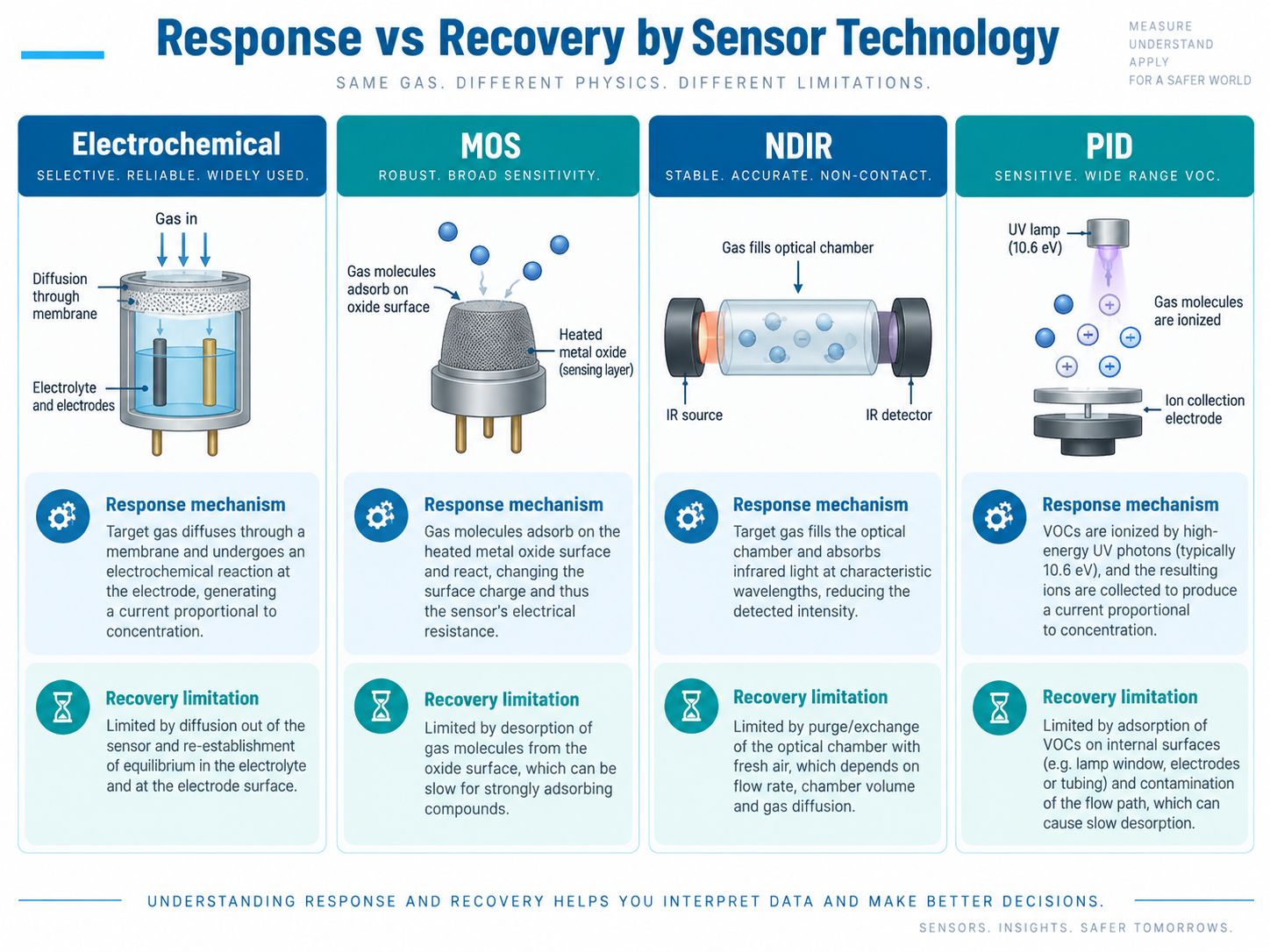
An electrochemical gas sensor typically operates through:
Target gas
↓
Diffusion through inlet / capillary
↓
Electrode reaction
↓
Electrical current
MEMBRAPOR describes its amperometric sensors as producing current when target gas diffuses through the capillary and is oxidized or reduced at the sensing electrode.
Recovery then requires the system to return toward its pre-exposure electrochemical equilibrium.
Recovery behavior can depend on:
- target gas
- diffusion barrier
- electrode chemistry
- electrolyte
- bias voltage
- gas solubility
- housing material
Some gases or reaction products may partially dissolve in the electrolyte, which can further delay baseline recovery. MEMBRAPOR specifically identifies this mechanism in its VOC sensor documentation.
A Real Example: Faster Response Can Produce Slower Recovery
This is one of the strongest examples of why response and recovery should be evaluated independently.
MEMBRAPOR publishes typical formaldehyde response and recovery values for the same VOC electrochemical sensor operated at different bias voltages.
At:
300 mV bias
the listed values include:
Response: <30 s
Recovery: <15 s
At:
450 mV bias
the listed values become:
Response: <20 s
Recovery: <120 s
The higher-bias operating condition produces a faster listed response but a dramatically slower listed recovery in this particular test.
That is an excellent demonstration of the principle:
Optimizing response time does not automatically optimize recovery time.
Bias Voltage Can Change Response and Recovery
Electrochemical bias voltage changes electrode reaction conditions.
As a result, it can affect:
- sensitivity
- response time
- recovery time
- selectivity
MEMBRAPOR explicitly identifies these performance parameters as being influenced by bias voltage.
For an OEM engineer, this means bias voltage should not be selected using only:
“Which setting gives the fastest response?”
The complete trade-off may include:
Sensitivity
Response
Recovery
Selectivity
Baseline stability
We will cover this in more detail in the planned article:
https://www.gasnose.com/knowledge/electrochemical-gas-sensor-bias-voltage/
MOS Sensor Response and Recovery
Metal-oxide semiconductor sensors are particularly useful for understanding response/recovery dynamics because their sensing mechanism depends strongly on surface interactions.
A MOX sensor contains a heated metal-oxide surface.
Sensirion describes its MOX principle as oxygen species forming on the heated surface, with oxidizing and reducing gases changing surface chemistry and therefore the electrical resistance of the sensing layer.
During exposure:
Gas arrives
↓
Surface interaction
↓
Electrical resistance changes
During recovery:
Gas removed
↓
Adsorbed species leave / surface state changes
↓
Original surface equilibrium returns
↓
Resistance approaches baseline
Recovery can therefore depend strongly on:
- desorption rate
- operating temperature
- humidity
- target gas
- sensing material
Why Heating Can Improve MOS Recovery
Increasing sensing temperature can accelerate:
- surface reactions
- desorption
- material regeneration
This can shorten recovery under some conditions.
However, higher temperature can also alter:
- sensitivity
- selectivity
- power consumption
- sensor lifetime
So:
Higher temperature is not automatically better.
MOX heater conditions are usually optimized as part of the entire sensing strategy.
NDIR Response and Recovery
NDIR uses a fundamentally different mechanism.
The gas does not need to react chemically with an electrode or sensing surface.
Instead:
Gas enters optical chamber
↓
Infrared light passes through gas
↓
Target molecules absorb specific wavelengths
↓
Detector measures reduced IR intensity
Sensirion describes the NDIR principle as deriving gas concentration from the amount of infrared light transmitted through a measurement cell compared with reference intensity.
Because the optical measurement itself can be fast, real response and recovery may depend heavily on:
- chamber volume
- gas exchange
- flow rate
- diffusion
- purge efficiency
- dead volume
For NDIR, slow recovery can therefore be more of a:
gas-exchange problem
than a chemical surface-recovery problem.
PID Response and Recovery
PID detectors use UV radiation to ionize detectable compounds.
The ionization process itself is rapid once the gas reaches the lamp chamber.
But the complete system may still show slow recovery because of:
- sticky VOCs
- sample tubing
- filters
- internal surfaces
- lamp-window contamination
- sampling dead volume
This is especially important when measuring heavier or more strongly adsorbing VOCs.
A PID calibrated with isobutylene may therefore show different dynamic behavior when exposed to another vapor.
For the wider PID measurement problem, see PID vs LEL Gas Detector: What’s the Difference?.
The Target Gas Matters
Response and recovery belong not only to the sensor—they also depend on the gas.
A single sensor may recover rapidly after:
Gas A
but much more slowly after:
Gas B
because molecules differ in:
- polarity
- adsorption strength
- solubility
- diffusion
- chemical reactivity
- reaction products
The MEMBRAPOR VOC data provide a clear example.
At 300 mV bias, the application note lists different response and recovery characteristics for:
- formaldehyde
- isopropanol
- xylene
under their respective test concentrations.
Therefore:
Do not assume a recovery-time result measured with one gas automatically applies to every gas the sensor can detect.
Exposure Concentration Matters
A sensor exposed to:
10 ppm for 30 seconds
may recover differently from the same sensor exposed to:
500 ppm for 10 minutes
Higher concentration can increase:
- surface coverage
- absorption into materials
- dissolved gas
- reaction products
That can prolong recovery.
This is another reason datasheet values should be understood as performance under defined test conditions, not universal guarantees for every exposure scenario.
Exposure Duration Matters Too
Concentration is only half of the story.
Consider:
Exposure A
100 ppm for:
10 seconds
Exposure B
100 ppm for:
30 minutes
The peak concentration is identical.
But Exposure B may allow much more gas to:
- diffuse into materials
- adsorb on surfaces
- dissolve in electrolyte
- accumulate in tubing or filters
So recovery can be considerably slower.
Temperature Can Affect Both Response and Recovery
Temperature changes:
- diffusion
- chemical reaction rates
- adsorption
- desorption
- electrolyte kinetics
- surface chemistry
For some sensors, higher temperature can accelerate recovery.
For others, temperature changes may shift baseline or sensitivity.
Therefore a datasheet recovery time measured at:
25°C
should not automatically be assumed to remain identical at:
-20°C
or:
50°C
This will be covered more deeply in:
https://www.gasnose.com/knowledge/temperature-effects-on-gas-sensors/
Humidity Can Affect Recovery
Humidity can influence several technologies.
Electrochemical
Humidity changes can alter electrolyte water balance.
MOS
Water molecules interact with the sensing surface and may change adsorption behavior.
PID
Humidity can influence VOC measurements and sampling behavior.
Sampling System
Water condensation can dramatically alter gas transport.
So an unexpectedly slow recovery should always be evaluated together with:
- temperature
- relative humidity
- condensation
not just sensor age.
Sensor Recovery Time vs System Purge Time
This distinction is extremely important.
Sensor Recovery Time
The sensing element itself returns toward its baseline.
System Purge Time
Gas is physically removed from:
- tubing
- chamber
- probe
- manifold
- housing
- filters
In a complete detector:
Observed recovery can include both sensor recovery and gas-system purge effects.
Suppose a sensor could recover in:
20 seconds
but gas remains inside a sampling tube for:
40 seconds
The display may appear to recover slowly even though the sensing element itself is relatively fast.
Tubing Can Cause Slow Recovery
Sampling tubes can retain certain vapors through:
- adsorption
- absorption
- condensation
Gas can then continue entering the detector even after the external source is removed.
This is particularly relevant for:
- VOCs
- solvents
- sticky compounds
- long pumped sample lines
It also connects directly with the previous article on T90, where sampling transport can significantly affect complete-system response time.
For the full explanation, see Gas Sensor Response Time: T50 vs T90 Explained.
Recovery Time Is Especially Important in Cyclic Measurements
Imagine a measurement system operating like this:
Gas sample
↓
Clean air
↓
Gas sample
↓
Clean air
↓
Gas sample
If the sensor has not recovered before the next measurement:
the next cycle starts from the wrong baseline.
For example:
True new exposure:
20 ppm
Residual equivalent signal:
5 ppm
The apparent peak could become:
25 ppm
depending on the sensor and processing algorithm.
Slow recovery can therefore harm:
- repeatability
- cycle time
- peak accuracy
- pattern recognition
This is particularly important for:
- process control
- breath analysis
- electronic noses
- laboratory gas analysis
- repeated leak testing
Electronic Noses Need Good Recovery Too
Electronic noses often rely on patterns from multiple partially selective sensors.
If one sensor remains influenced by the previous sample while another has fully recovered, the next sensor-array fingerprint may be distorted.
This can cause:
- classification error
- baseline shift
- poor repeatability
So e-nose design must consider not just sensitivity and pattern recognition, but also:
- purge time
- recovery
- baseline stabilization
- sample sequencing
Recovery Time and Alarm Reset Are Not the Same
Suppose a toxic gas detector has:
Alarm threshold = 20 ppm
Gas rises to:
50 ppm
The gas is then removed.
As concentration falls, the detector may reset its alarm when the signal drops below:
15–20 ppm
depending on configured logic.
At that moment the sensor may still be far from zero.
Therefore:
Alarm reset time is not the same as sensor recovery time.
Alarm behavior may also include:
- hysteresis
- latching
- time delays
- manual reset
For alarm terminology, see Gas Detector Alarm Settings: Low, High, STEL & TWA Explained.
What Is a “Good” Recovery Time?
There is no universal number.
The acceptable value depends on what the instrument must do.
Personal Gas Safety
Rapid response may be more important than returning instantly to zero after the worker leaves the gas cloud.
But excessively slow recovery can still affect:
- subsequent alarms
- instrument interpretation
- re-entry decisions
Continuous Fixed Detection
A somewhat slower recovery may be acceptable if the system continuously monitors one area.
Process Control
Fast recovery can be essential because concentration changes repeatedly.
Electronic Nose
Baseline restoration between samples may be critical.
Leak Testing
A long recovery can greatly reduce testing throughput.
So:
A good recovery time is one that lets the sensor return to a reliable reference state before the next measurement decision must be made.
Slow Recovery Troubleshooting
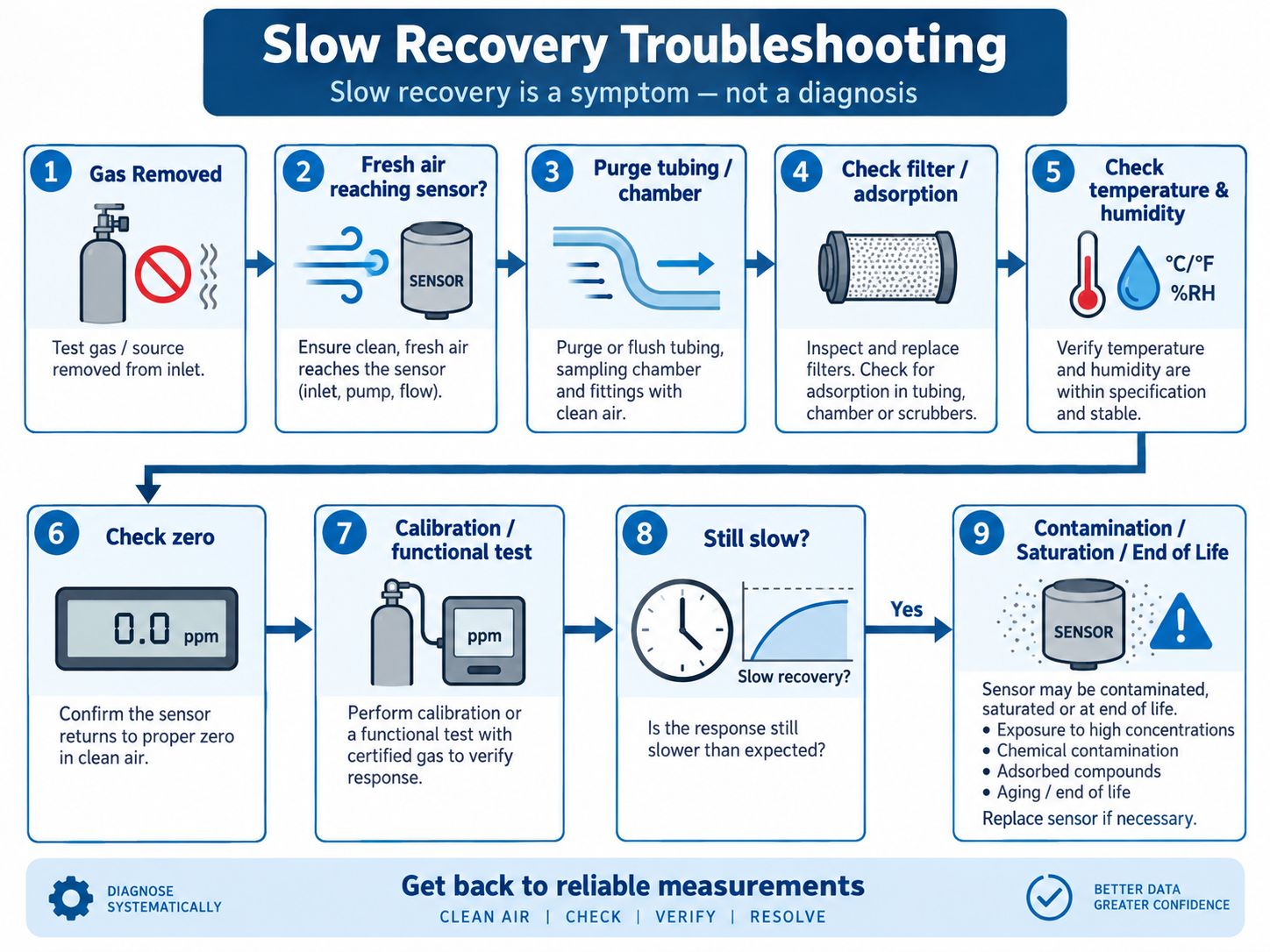
If a gas sensor does not return toward baseline as expected, troubleshoot systematically.
Step 1 — Remove the Gas Source
Confirm that:
- calibration gas is closed
- process leak has stopped
- test adapter is removed where appropriate
Step 2 — Confirm Fresh Air Reaches the Sensor
Check:
- airflow
- pump
- detector inlet
- ventilation
Step 3 — Purge Tubing and Chambers
For a pumped system, flush:
- probe
- tubing
- chamber
- fittings
with appropriate clean gas or air.
Step 4 — Check Filters and Adsorbing Materials
Look for:
- contaminated filters
- unsuitable tubing
- wet membranes
- VOC adsorption
Step 5 — Check Temperature and Humidity
Compare conditions with the instrument specification.
Step 6 — Check Zero
After sufficient purge and stabilization, confirm whether the sensor actually returns to the expected zero.
Step 7 — Perform the Appropriate Functional Test
Depending on the instrument:
- bump test
- zero calibration
- span calibration
may be required.
For the distinction, see Gas Detector Bump Test vs Calibration.
Step 8 — Still Recovering Slowly?
Investigate:
- over-range exposure
- contamination
- poisoning
- sensor saturation
- aging
Step 9 — Consider Sensor Replacement
If the sensor can no longer:
- return to baseline
- hold calibration
- meet response requirements
it may have reached the end of its useful life.
Slow Recovery vs Cross-Sensitivity
An interfering gas can sometimes look like slow recovery.
For example:
Target gas removed.
But another gas remains present.
The sensor continues to produce a response.
An operator may think:
“The sensor hasn’t recovered.”
In reality:
the sensor may still be responding to an interferent.
This is why mixed-gas environments require careful troubleshooting.
See Gas Sensor Cross-Sensitivity Explained.
Slow Recovery vs Poisoning
Poisoning is another different problem.
A poisoned sensor may show:
- reduced sensitivity
- abnormal baseline
- slow or incomplete recovery
But poisoning can persist even after the contaminant is removed.
Normal recovery should eventually return the sensor toward its expected state.
Poisoning may not.
This distinction will be covered in:
https://www.gasnose.com/knowledge/gas-sensor-poisoning-vs-cross-sensitivity/
How to Compare Recovery-Time Datasheets
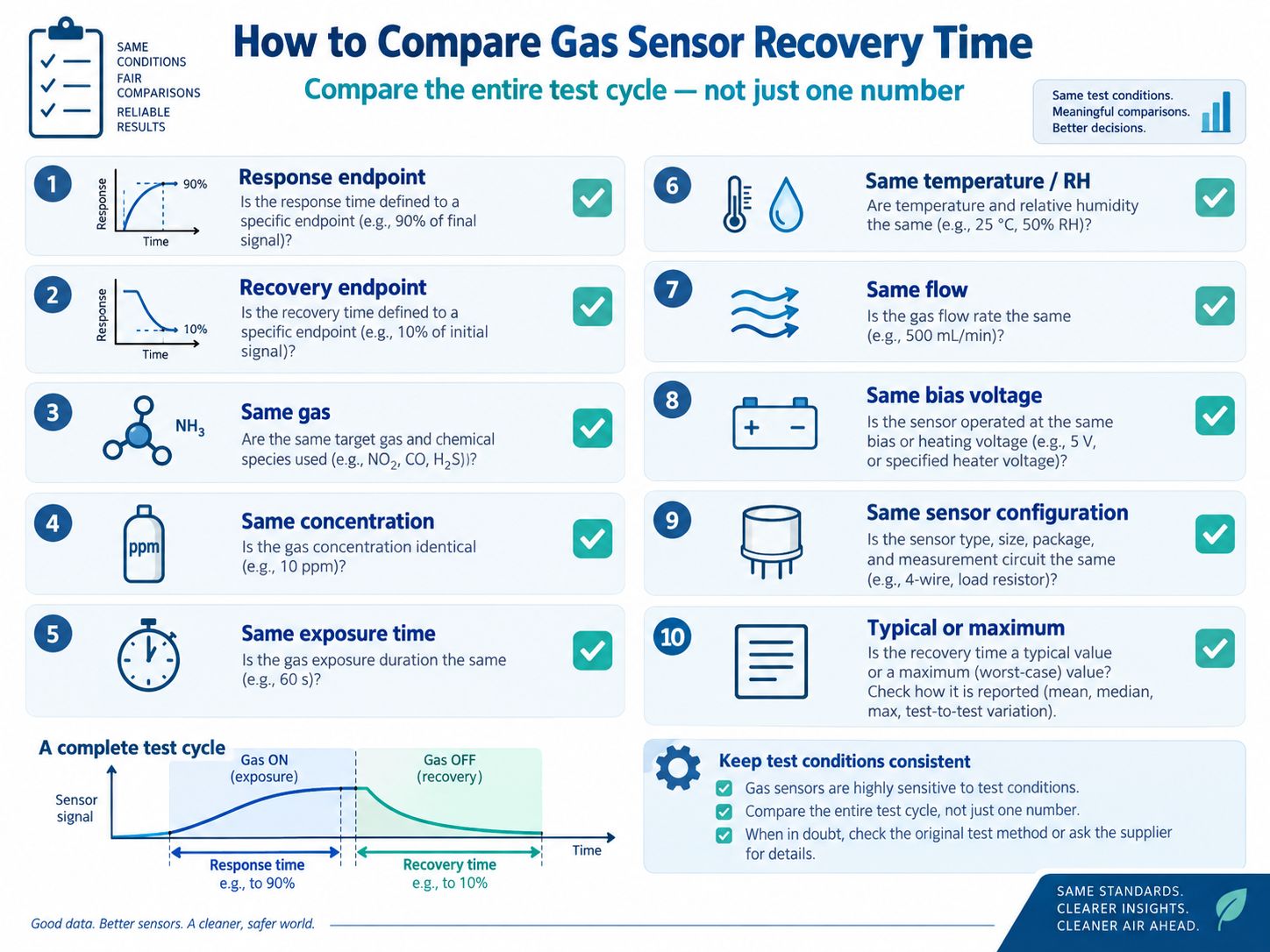
Before deciding that one sensor has better recovery than another, check the entire test method.
1. What Is the Response Endpoint?
T50?
T90?
Another definition?
2. What Is the Recovery Endpoint?
T10?
T50?
90% recovery?
Return to a zero tolerance?
3. Same Gas?
Formaldehyde recovery cannot automatically be compared with xylene recovery.
4. Same Concentration?
Higher exposure may change recovery behavior.
5. Same Exposure Duration?
Ten seconds and ten minutes are not equivalent.
6. Same Temperature and Humidity?
Environmental conditions affect sensing behavior.
7. Same Gas Flow?
Chamber flushing rate can influence the apparent recovery.
8. Same Bias Voltage?
Especially important for electrochemical VOC sensors.
9. Same Sensor Configuration?
Compare:
- package
- filter
- membrane
- electronics
10. Typical or Maximum?
Typical recovery = 20 s
does not mean the same thing as:
Recovery <60 s
11. Bare Sensor or Complete Instrument?
Sampling systems can dominate measured recovery.
Compare the entire exposure-and-purge cycle—not just one recovery number.
Common Response and Recovery Mistakes
Mistake 1 — Assuming Response and Recovery Are Equal
They often are not.
Mistake 2 — Assuming T90 and T10 Are the Same Metric
They describe opposite portions of the sensing cycle.
Mistake 3 — Comparing Different Recovery Definitions
Always check the endpoint.
Mistake 4 — Blaming the Sensor Before Purging the Sampling System
Residual gas may still be reaching the sensor.
Mistake 5 — Ignoring Gas Type
Different gases adsorb and react differently.
Mistake 6 — Ignoring Exposure Duration
Long exposure can produce longer recovery.
Mistake 7 — Ignoring Bias Voltage
In electrochemical sensing, operating potential can materially change dynamic performance.
Mistake 8 — Treating Slow Recovery as Drift
A slowly recovering sensor may still return to the correct baseline.
Mistake 9 — Treating Alarm Reset as Full Recovery
The alarm can clear before the sensor returns to zero.
Mistake 10 — Assuming Faster Recovery Is Always Better
Recovery is only one parameter.
Also evaluate:
- sensitivity
- selectivity
- stability
- range
- lifetime
- accuracy
Response and Recovery Selection Checklist
When evaluating a gas sensor, ask:
- What is the response-time definition?
- What is the recovery-time definition?
- What target gas was tested?
- At what concentration?
- How long was the exposure?
- What temperature was used?
- What humidity was used?
- What was the test flow rate?
- Was the sensor diffusion-based or pumped?
- Was tubing included?
- Were filters installed?
- What bias voltage was used?
- Was the sensor bare or installed in a detector?
- Is the specification typical or maximum?
- Does the application require rapid repeated measurements?
Frequently Asked Questions
What is gas sensor response time?
Response time describes how long a sensor takes to move toward its new output after the target-gas concentration changes.
T90 is a commonly used response-time definition.
What is gas sensor recovery time?
Recovery time describes how long the sensor takes to return toward its original baseline after the target gas is removed or reduced.
What is the difference between response time and recovery time?
Response describes:
baseline → gas response
Recovery describes:
gas response → baseline
They are different physical processes and do not need to take the same amount of time.
What is T90 response time?
T90 is the time required for the output to reach 90% of its defined final response.
What is T10 recovery time?
T10 commonly refers to the time required for the remaining gas-induced signal to fall to 10% of its original response.
That represents approximately 90% recovery.
Why does a gas sensor recover more slowly than it responds?
Possible reasons include:
- strong adsorption
- slow desorption
- gas dissolving in electrolyte
- residual gas in tubing
- chamber purge time
- material absorption
Can recovery time be longer than response time?
Yes.
It can be much longer.
The MEMBRAPOR VOC example discussed above shows one operating condition with response below 20 seconds and recovery below 120 seconds.
Can recovery be faster than response?
Yes.
Response and recovery are not required to follow the same kinetics.
Why doesn’t my gas detector return to zero?
Possible causes include:
- normal recovery
- residual gas
- tubing adsorption
- temperature / humidity
- baseline drift
- saturation
- contamination
- poisoning
Do not assume sensor failure before checking the complete sampling system.
Does slow recovery mean the sensor is damaged?
Not necessarily.
Slow recovery can be normal for a particular gas or operating condition.
Persistent zero shift or inability to recover after adequate purge requires further investigation.
Does gas concentration affect recovery time?
It can.
Higher concentrations may load more gas into sensing materials or sampling-system surfaces.
Does exposure duration affect recovery?
Yes.
Longer exposure can increase adsorption, absorption or dissolved gas and therefore increase recovery time.
Does sample tubing affect recovery?
Yes.
Some gases can adsorb onto or absorb into tubing materials and be released afterward.
Can VOCs cause slow recovery?
Yes.
Some VOCs strongly interact with sensor housings, tubing and sensing materials.
What is the sponge effect?
It describes gas being absorbed or adsorbed by sensor-system materials and then slowly released after the external gas has disappeared.
Does temperature affect recovery?
Yes.
Temperature influences adsorption, desorption, reaction kinetics and diffusion.
Does humidity affect recovery time?
It can.
The effect depends on sensor technology and target gas.
Is alarm reset time the same as sensor recovery time?
No.
An alarm can reset when the reading falls below the reset threshold even though the sensor has not fully returned to baseline.
Can poisoning cause slow recovery?
Poisoning can alter sensitivity or baseline and may resemble abnormal recovery.
Unlike normal recovery, poisoning may continue affecting the sensor after the contaminant is gone.
Final Takeaway
Response time and recovery time describe two different sides of gas sensor dynamics.
Response Time
asks:
How quickly does the sensor react when gas appears?
Recovery Time
asks:
How quickly does the sensor return toward baseline when gas disappears?
A common pair of definitions is:
T90 response
= time to reach 90% of final response
and:
T10 recovery
= time for the remaining response to fall to 10%
But always check how the manufacturer defines the endpoints.
More importantly:
Response and recovery do not need to be symmetrical.
Gas may adsorb quickly and desorb slowly.
A VOC may remain in sensor housing or tubing after the surrounding air is clean.
Electrochemical bias may improve response while making recovery slower.
NDIR recovery may be controlled more by chamber flushing than sensing chemistry.
That leads to the most useful engineering rule:
Do not evaluate a gas sensor only by how fast it responds. Ask how quickly, reproducibly and completely it returns to a trustworthy baseline afterward.
For continuous safety monitoring this affects detector readiness.
For cyclic measurement it affects repeatability.
For electronic noses it affects the next gas fingerprint.
And for troubleshooting, it helps distinguish a normal dynamic response from:
- drift
- saturation
- contamination
- poisoning
- sensor end of life
References and Further Reading
- ScienceDirect — Gas Sensor: Response Time and Recovery Time
- MEMBRAPOR — VOC Sensor Application Note MEM9
- Sensirion — What Is a Metal Oxide (MOX) Sensor?
- Sensirion — Gas Sensing Technology
- GasNose — Gas Sensor Response Time: T50 vs T90 Explained
- GasNose — What Is Gas Sensor Drift?
- GasNose — Gas Sensor Cross-Sensitivity
- GasNose — Gas Detector Bump Test vs Calibration
- GasNose — PID vs LEL Gas Detector
- GasNose — Gas Detector Alarm Settings
