




Portable gas detectors often show several different alarm settings:
- Low
- High
- STEL
- TWA
These alarms do not all mean the same thing.
A useful way to understand them is:
Low and High alarms usually tell you what is happening now. STEL and TWA tell you how much toxic-gas exposure has accumulated over time.
That distinction is important.
A worker could be exposed to a moderate concentration that never reaches the High alarm, yet still accumulate enough exposure to trigger a TWA alarm.
A worker could also leave a high-gas area and see the current reading return to zero while the STEL value remains elevated because the detector still remembers the previous exposure period.
Gas detector alarm settings therefore should not be treated as four arbitrary numbers.
They represent different safety decisions.
And there is another important rule:
Factory alarm settings are not universal occupational exposure limits.
The correct alarm configuration depends on:
- target gas
- measurement unit
- sensor range
- applicable regulation
- occupational exposure limits
- company safety policy
- application
- detector calculation method
- required worker response
Low vs High vs STEL vs TWA: Quick Comparison

| Alarm | Primarily Based On | Main Question | Typical Purpose |
|---|---|---|---|
| Low | Current gas concentration | Has the first alarm threshold been reached? | Early warning / action point |
| High | Current gas concentration | Has a more serious concentration been reached? | Escalated or emergency action |
| STEL | Short-period average exposure | Has short-term toxic exposure become excessive? | Short-term exposure control |
| TWA | Longer-period average exposure | Has accumulated exposure become excessive? | Work-shift exposure control |
This gives us two fundamentally different alarm concepts.
Current Concentration
Low
and
High
Exposure Over Time
STEL
and
TWA
Different alarms answer different questions.
What Is a Low Gas Alarm?
The Low alarm is normally the first concentration threshold that triggers a warning.
For a toxic gas channel, the detector may behave conceptually like this:
Gas concentration rises
↓
Low setpoint reached
↓
Audible / visual / vibration alarm
The purpose is to give the worker an early warning that the atmospheric condition has reached a defined action level.
But the word Low can be misleading.
It does not mean:
“The concentration is low, so it is safe to keep working.”
It means:
The first configured alarm threshold has been reached.
The required action may include:
- stop work
- leave the area
- investigate the source
- notify a supervisor
- increase ventilation
- follow an emergency procedure
The correct response depends on the gas and site procedure.
An alarm setpoint without a defined response is incomplete.
What Is a High Gas Alarm?
The High alarm is normally a higher instantaneous concentration threshold than the Low alarm.
A simplified sequence is:
Normal
↓
Low alarm
↓
High alarm
The High alarm generally indicates that a more serious atmospheric condition has developed.
The required response may become more urgent, for example:
- immediate withdrawal
- emergency response
- process isolation
- ventilation escalation
- equipment shutdown
But High alarm should not automatically be interpreted as:
IDLH
or:
a universal evacuation concentration
Those are separate concepts.
The High setpoint is an instrument configuration selected according to the application’s safety strategy.
Low and High should represent defined actions—not simply two convenient numbers.
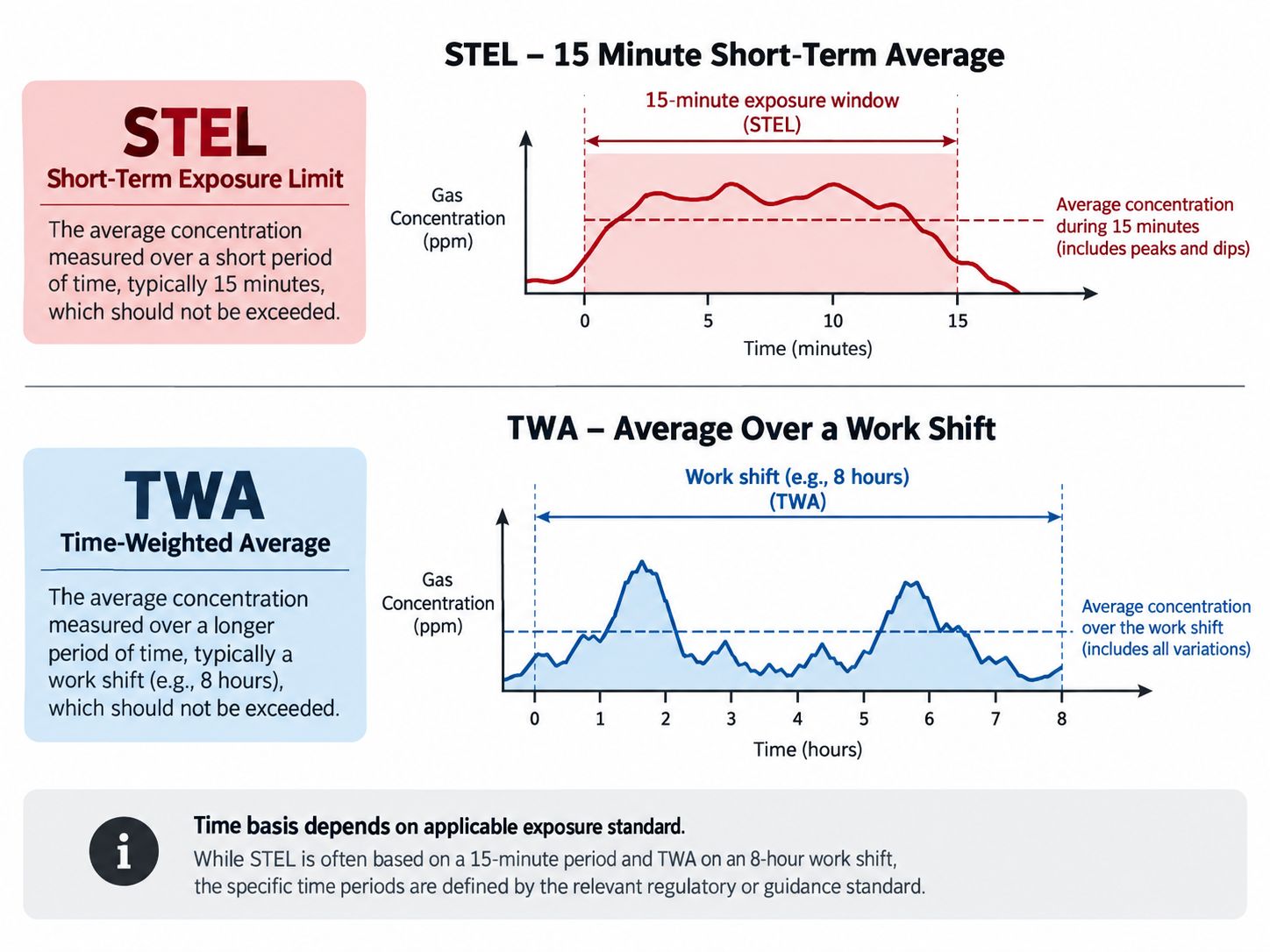
What Is STEL?
STEL means:
Short-Term Exposure Limit
It is used primarily for toxic gases and vapors.
For many occupational exposure frameworks, a STEL is based on a relatively short averaging period.
For example, NIOSH generally defines its STEL as a 15-minute time-weighted average unless otherwise specified.
Many portable gas detectors therefore calculate STEL using a 15-minute exposure window.
However:
Do not assume every chemical, regulation or detector uses exactly the same STEL definition.
Always check the applicable occupational exposure standard and detector documentation.
How Does a Detector Calculate STEL?
Consider a simple 15-minute example.
A worker experiences:
10 minutes at 35 ppm
and:
5 minutes at 5 ppm
The average is:
(10 × 35) + (5 × 5)
---------------------
        15

= 25 ppm
The detector’s STEL value would therefore be 25 ppm under that calculation method.
This illustrates an important point:
STEL is not simply the highest gas reading during the period.
It represents average exposure across the defined short-term window.
Why Can a STEL Alarm Remain After You Enter Fresh Air?
This is a common source of confusion.
Imagine a worker has just spent several minutes in elevated H₂S.
They leave the area.
The current detector reading falls to:
0 ppm
But the previous high exposure is still included in the detector’s STEL calculation window.
So the monitor may show:
Current Gas: 0 ppm
while:
STEL remains elevated
That does not necessarily mean the sensor is malfunctioning.
It means:
Current concentration and accumulated short-term exposure are two different measurements.
As the previous exposure moves outside the relevant calculation period—or according to the detector’s configured algorithm—the STEL value changes.
What Is TWA?
TWA means:
Time-Weighted Average
It represents exposure averaged over a longer period.
In U.S. OSHA occupational exposure standards, many permissible exposure limits are based on an:
8-hour TWA
for an 8-hour work shift.
NIOSH REL terminology is different: unless otherwise specified, a NIOSH TWA may apply to up to a 10-hour workday during a 40-hour workweek.
Therefore:
TWA does not universally mean exactly eight hours in every occupational exposure framework.
Many portable monitors are configured around an 8-hour TWA because that matches common occupational hygiene practice and particular standards.
But the detector configuration and applicable exposure standard must agree.
How Is TWA Calculated?
For a simplified 8-hour example:
A worker is exposed to:
- 2 hours at 20 ppm
- 4 hours at 5 ppm
- 2 hours at 0 ppm
The 8-hour average would be:
(2 × 20) + (4 × 5) + (2 × 0)
--------------------------------
                8

= 7.5 ppm
The detector compares the calculated exposure value with the configured TWA alarm setpoint.
This means a worker can accumulate significant exposure without ever experiencing one very high instantaneous concentration.
STEL vs TWA: What’s the Difference?
| Feature | STEL | TWA |
|---|---|---|
| Full name | Short-Term Exposure Limit | Time-Weighted Average |
| Main purpose | Control shorter high exposures | Control accumulated longer-term exposure |
| Typical time basis | Often 15 minutes | Commonly 8 hours for OSHA PELs; other frameworks differ |
| Based only on current reading? | No | No |
| Usually relevant to toxic gases? | Yes | Yes |
| Normally used for O₂? | No | No |
| Normally used for %LEL? | No | No |
A worker can potentially trigger:
STEL but not TWA
after a relatively short high exposure.
Or:
TWA without ever reaching the High alarm
after sustained moderate exposure.
That is why all four alarms serve different purposes.
Low/High vs STEL/TWA: Two Different Safety Questions
The distinction can be summarized like this.
Low / High
Ask:
What is the atmospheric concentration right now?
STEL / TWA
Ask:
How much exposure has the worker accumulated?
This difference is especially important for:
- CO
- H₂S
- SO₂
- NO₂
- NH₃
- Cl₂
- VOCs
- other toxic gases
A gas detector can therefore display a perfectly ordinary current concentration while still maintaining an elevated exposure-history value.
Why STEL and TWA Are Mainly Used for Toxic Gases
A typical four-gas detector may contain:
- O₂
- combustible / %LEL
- H₂S
- CO
But these four channels do not normally use identical alarm logic.
Oxygen
Usually:
Low + High
Combustible Gas / %LEL
Usually:
Low + High
Toxic Gas
May use:
Low + High + STEL + TWA
Current MSA ALTAIR 4XR documentation, for example, enables STEL and TWA alarm configuration for toxic sensor channels rather than O₂ and LEL channels.
That makes sense because STEL and TWA represent occupational exposure dose over time, not oxygen deficiency or proximity to a combustible limit.
Oxygen Alarm Settings Work Differently
Normal atmospheric oxygen is approximately:
20.9% by volume
Oxygen can become hazardous in both directions.
Oxygen Deficiency
O₂ falls too low.
Oxygen Enrichment
O₂ rises too high.
That is why an oxygen channel typically has:
Low O₂ alarm
and:
High O₂ alarm
rather than STEL and TWA.
In many U.S. workplace contexts:
19.5% O₂
is an important oxygen-deficiency threshold.
You will also commonly encounter 23.5% O₂ as an oxygen-enrichment reference in U.S. safety rules and guidance.
However, this does not mean every portable detector must use exactly:
19.5 / 23.5
as its factory alarm settings.
For example, one current MSA ALTAIR 4XR factory configuration lists:
Low O₂: 19.5%
and:
High O₂: 23.0%
while explicitly stating that exact alarm levels vary according to national or corporate regulations.
That difference illustrates the broader lesson:
Regulatory reference point ≠ universal factory alarm setting.
LEL Alarm Settings Also Work Differently
A combustible-gas channel commonly displays:
%LEL
LEL means:
Lower Explosive Limit
The detector may have:
- Low %LEL alarm
- High %LEL alarm
One common manufacturer configuration is:
10% LEL Low
and:
20% LEL High
But these numbers should not be interpreted as universal safe limits for every application.
They are action thresholds related primarily to:
flammability and explosion risk
not occupational toxicity.
For a detailed explanation, see What Is a Safe LEL Level?.
This distinction is particularly important for VOCs.
A solvent can create a significant toxic exposure at a concentration far below the level required to trigger a %LEL alarm.
See PID vs LEL Gas Detector: What’s the Difference?.
Alarm Setpoint Is Not the Same as an Exposure Limit
This is one of the most important points in alarm configuration.
Several numbers may exist for the same gas:
Occupational Exposure Limit
Examples include:
- OSHA PEL
- NIOSH REL
- jurisdiction-specific OEL
- company occupational exposure limit
Detector Low Alarm
The first configured instrument action point.
Detector High Alarm
A second, more serious action point.
STEL Alarm
Short-term accumulated exposure threshold.
TWA Alarm
Longer-term accumulated exposure threshold.
These values are related to the safety program, but they are not automatically interchangeable.
So:
OEL ≠ Low alarm ≠ High alarm by default.
A safety professional may intentionally configure an alarm below a regulatory exposure limit to provide earlier warning.
Another site may use different values because:
- its jurisdiction is different
- its corporate standard is stricter
- its process risk is different
- its detector algorithm is different
OSHA, NIOSH and Company Limits Are Not the Same Thing
OSHA PEL
A U.S. regulatory permissible exposure limit where the applicable OSHA standard applies.
Many OSHA PELs are expressed as:
8-hour TWA
although ceilings and other exposure structures also exist.
NIOSH REL
A recommended occupational exposure limit.
NIOSH may define both:
- TWA
- STEL
- ceiling
depending on the substance.
Its standard TWA terminology can differ from OSHA’s 8-hour basis.
Company Limits
Companies may adopt:
- stricter internal OELs
- global corporate limits
- jurisdiction-specific values
- task-specific action levels
Therefore, alarm settings copied from an American product manual should not automatically be used in:
- Europe
- Australia
- Japan
- another U.S. company
- a mine
- a chemical plant
- a refinery
without checking the applicable requirements.
Factory Default Alarm Settings Are Not Universal

One of the most dangerous shortcuts is:
“This detector came from the factory with these values, so these must be the correct safety limits.”
That is not necessarily true.
MSA’s current ALTAIR 4XR documentation provides this example configuration:
| Channel | Low | High | STEL | TWA |
|---|---|---|---|---|
| %LEL | 10% LEL | 20% LEL | — | — |
| O₂ | 19.5%vol | 23.0%vol | — | — |
| H₂S | 10 ppm | 15 ppm | 15 ppm | 10 ppm |
| CO | 25 ppm | 100 ppm | 100 ppm | 25 ppm |
But the same manual explicitly tells users to check the detector or calibration certificate because alarm levels can vary with:
national or corporate regulations.
This table is therefore:
a manufacturer configuration example—not a universal recommended alarm table.
That is exactly how such values should be presented.
Sensor Range Is Not the Same as Alarm Setting
Suppose a CO sensor can measure:
0–1,000 ppm
That does not mean:
High alarm = 1,000 ppm
The three concepts are different.
Sensor Range
What the instrument is designed to measure.
Alarm Setpoint
The concentration where a defined action occurs.
Exposure Limit
A health or regulatory exposure criterion.
Therefore:
Range ≠ alarm ≠ exposure limit.
The same sensor range may be used with different alarm settings in different applications.
Why You Should Not Raise an Alarm Just to Stop Nuisance Alarms
Suppose a detector frequently alarms at 20 ppm.
A poor response is:
“Change it to 50 ppm so it stops alarming.”
Before changing a safety setpoint, investigate why the alarm occurs.
Possible causes include:
- real gas release
- poor ventilation
- process emissions
- cross-sensitivity
- sensor drift
- calibration error
- incorrect detector configuration
- inappropriate alarm criteria
If the detector is producing suspicious readings, verify its performance first.
See Gas Detector Bump Test vs Calibration.
Changing the alarm should never be a substitute for investigating the hazard.
Why Factory Settings Need an Approval Process
Alarm values should ideally come from a defined hierarchy.
For example:
Gas
↓
Measurement Unit
↓
Applicable Regulation / OEL
↓
Risk Assessment
↓
Company Safety Policy
↓
Detector Capability
↓
Alarm Response Procedure
↓
Approved Setpoint
A number should not appear in the detector simply because:
- it came from another site
- it was found online
- it was the previous instrument’s default
- it prevents nuisance alarms
How Should Gas Detector Alarm Settings Be Selected?

A practical process is:
Step 1 — Identify the Gas
Examples:
- CO
- H₂S
- CH₄
- NH₃
- Cl₂
- O₂
Step 2 — Confirm the Measurement Unit
For example:
- ppm
- ppb
- %vol
- %LEL
Do not confuse a %LEL alarm with a ppm occupational exposure limit.
Step 3 — Identify the Applicable Exposure or Safety Criteria
Review:
- national regulations
- workplace exposure limits
- industry requirements
- company rules
Step 4 — Define the Low Alarm Response
Determine what should happen when Low activates.
Do not choose the number before understanding the response.
Step 5 — Define the High Alarm Response
Determine what stronger action is required.
Step 6 — Configure STEL and TWA Where Applicable
For toxic channels, verify:
- STEL definition
- TWA time basis
- detector algorithm
- applicable exposure criteria
Step 7 — Review Detector Capabilities
Confirm:
- permitted alarm range
- sensor range
- alarm type
- latching options
- data logging
- reset behavior
Step 8 — Approve and Document
Alarm changes should be controlled rather than casually changed in the field.
Step 9 — Train Workers
Workers need to know:
What does this alarm mean, and what am I expected to do?
A perfect alarm setting provides little protection if the user does not know how to respond.
Every Alarm Should Have an Action
Consider:
Low H₂S alarm
What happens?
If nobody knows, the number alone provides limited safety value.
The site procedure should answer questions such as:
- stop work?
- leave immediately?
- move upwind?
- notify control room?
- start ventilation?
- wear respiratory protection?
- initiate emergency response?
The same applies to:
- High
- STEL
- TWA
- O₂ deficiency
- O₂ enrichment
- %LEL
The important rule is:
Every alarm setpoint should correspond to a defined action.
What Should You Do When the Low Alarm Activates?
There is no universal response that applies to every gas and every workplace.
Follow the approved procedure.
But one point is important:
Do not interpret Low as permission to remain until High activates.
Low has already been configured as an action point.
Depending on the application, the correct action could include:
- stop work
- withdraw
- investigate
- notify supervision
- improve ventilation
- isolate the source
Workers should know this before entering the hazardous area.
What Should You Do When the High Alarm Activates?
A High alarm normally represents a more serious current concentration.
The required response may include:
- immediate withdrawal
- emergency notification
- process shutdown
- evacuation
- isolation
- emergency PPE procedures
Again:
follow the approved site procedure.
Do not improvise a response after the alarm has already activated.
What Should You Do When STEL or TWA Activates?
STEL and TWA alarms indicate accumulated toxic exposure.
They should not be treated like nuisance alarms that can simply be reset.
For example, current MSA ALTAIR 4XR instructions warn the user to leave the contaminated area if its STEL or TWA alarm activates.
The broader rule is:
Follow the site’s occupational-exposure response procedure and do not reset exposure history simply to silence the alarm.
Resetting a number does not erase the exposure the worker has already received.
Can TWA Alarm Even If the High Alarm Never Activated?
Yes.
Suppose a detector has:
High = 100 ppm
but the worker remains exposed to a lower concentration for a long period.
The instantaneous reading never reaches:
100 ppm
so the High alarm never activates.
But the accumulated average may eventually exceed the configured:
TWA limit
and trigger the TWA alarm.
This is exactly why High and TWA exist separately.
One protects primarily against a higher current concentration.
The other helps track accumulated exposure.
Can STEL Trigger Without a High Alarm?
Yes.
A short but sustained concentration can raise the average exposure sufficiently to exceed a STEL even when the High threshold was never reached.
Whether this happens depends on:
- Low/High setpoints
- STEL value
- concentration history
- detector calculation method
Again:
Instantaneous concentration and exposure dose are different safety variables.
Why Detector Assignment Matters for TWA
TWA is intended to represent exposure history.
Now imagine:
Worker A
uses a monitor for four hours.
Then:
Worker B
takes the same monitor and uses it for another four hours without resetting or managing assignment correctly.
The stored exposure history no longer cleanly represents either worker’s personal shift exposure.
This is why fleet programs should consider:
- detector assignment
- user ID
- shift start
- clock/date accuracy
- TWA reset policy
- docking stations
- data logging
Exposure-history features are most useful when the detector’s history actually follows the worker being assessed.
Does Turning a Gas Detector Off Reset STEL or TWA?
It depends on the instrument.
Some gas detectors reset certain exposure calculations when:
- powered off
- manually reset
- assigned to a new shift
Other connected systems may handle exposure data differently.
For example, current MSA instruments document specific reset behavior and calculation methods that vary by model.
Therefore:
Do not assume power cycling has the same STEL/TWA behavior on every detector.
Check the device manual and company exposure-recording procedure.
What Is a Latching Gas Alarm?
Alarm behavior is another configurable feature.
Non-Latching Alarm
When concentration falls below the required threshold:
alarm clears automatically
depending on detector configuration.
Latching Alarm
Even after concentration falls:
alarm remains active
until the user acknowledges or resets it.
Latching can help ensure that a serious event is not missed simply because the worker later moves into clean air.
Current MSA ALTAIR 4XR documentation, for example, lists its factory High alarms as latching.
The correct configuration depends on:
- risk
- operating procedure
- detector capability
- company policy
Example Alarm Logic for a Typical Four-Gas Monitor
A four-gas monitor commonly uses these alarm types:
| Channel | Low | High | STEL | TWA |
|---|---|---|---|---|
| O₂ | ✓ | ✓ | — | — |
| %LEL | ✓ | ✓ | — | — |
| H₂S | ✓ | ✓ | ✓ | ✓ |
| CO | ✓ | ✓ | ✓ | ✓ |
Why?
O₂
The concern is whether oxygen concentration is currently:
too low
or:
too high
LEL
The concern is whether combustible concentration is currently approaching a dangerous fraction of the LEL.
H₂S / CO
These are toxic gases where both:
- current concentration
- accumulated exposure
can matter.
This is more useful than assuming every sensor channel needs the same four alarm types.
How Alarm Settings Relate to a Multi-Gas Detector
A multi-gas detector should be configured around actual hazards.
That means first deciding:
Which gases should the instrument contain?
and then:
How should each channel behave?
For example, a confined-space detector may contain:
- O₂
- LEL
- H₂S
- CO
while another application may need:
- O₂
- LEL
- NH₃
- PID VOC
The alarm logic should follow the properties of those channels and the workplace requirements.
See How to Choose Gases for a Multi-Gas Detector.
Alarm Configuration Checklist
Before approving gas detector alarm settings, confirm:
- Target gases are correct
- Measurement units are correct
- Sensor ranges are appropriate
- Applicable regulatory source is identified
- Occupational exposure limits are reviewed
- Low alarm setpoint is approved
- Low alarm response is defined
- High alarm setpoint is approved
- High alarm response is defined
- STEL is configured where applicable
- STEL time basis is confirmed
- TWA is configured where applicable
- TWA time basis and algorithm are confirmed
- O₂ low/high logic is correct
- %LEL calibration basis is understood
- Latching behavior is defined
- Audible alarm is tested
- Visual alarm is tested
- Vibration alarm is tested
- Detector clock/date is correct
- User/shift assignment is managed
- Alarm changes are documented
- Workers understand the required response
Frequently Asked Questions
What is the difference between Low and High gas alarms?
Low is normally the first configured current-concentration alarm threshold.
High is a higher current-concentration threshold associated with a more serious response.
The actual values and actions depend on the gas, application and safety program.
What is a STEL alarm?
STEL means Short-Term Exposure Limit.
A detector’s STEL alarm warns when calculated toxic-gas exposure over the configured short-term period exceeds its STEL setpoint.
Many occupational frameworks and portable detectors use a 15-minute basis, but always verify the applicable definition.
What is a TWA alarm?
TWA means Time-Weighted Average.
It tracks average toxic-gas exposure over a longer defined period.
Many U.S. OSHA exposure limits are based on an 8-hour TWA, while other occupational exposure frameworks may use different definitions.
What is the difference between STEL and TWA?
STEL focuses on shorter-term exposure.
TWA focuses on accumulated longer-term exposure.
Both differ from Low and High alarms, which generally respond to current gas concentration.
Is STEL always 15 minutes?
No.
Fifteen minutes is a very common STEL period and is the default NIOSH definition unless otherwise specified, but chemical-specific standards can differ.
Always verify the actual exposure standard.
Is TWA always eight hours?
No.
Many OSHA PELs use an 8-hour TWA.
NIOSH TWA REL terminology generally applies to up to a 10-hour workday during a 40-hour workweek unless otherwise specified.
Detector algorithms may also differ.
Why is my STEL alarm still elevated after I enter clean air?
Because STEL includes previous exposure during its averaging period.
A current reading of zero does not instantly erase the gas concentration experienced several minutes earlier.
Can TWA alarm without High alarm?
Yes.
A worker can remain below the High threshold but experience a moderate concentration long enough for accumulated average exposure to exceed the TWA setpoint.
Can STEL alarm without High alarm?
Yes.
Short-term average exposure can exceed the STEL even if the instantaneous High alarm threshold was never reached.
What should oxygen alarm settings be?
Do not copy a universal number without checking the applicable requirements and detector configuration.
19.5% O₂ is an important U.S. oxygen-deficiency reference, and oxygen-enrichment rules frequently reference values around 23–23.5%, but exact instrument setpoints and regulatory contexts vary.
What should LEL alarms be set at?
Common instrument defaults such as 10% LEL Low and 20% LEL High exist, but they are not universal requirements.
Follow the applicable regulation, industry requirements, risk assessment and company safety procedure.
Why don’t oxygen sensors normally use STEL and TWA?
Oxygen deficiency and enrichment are primarily managed as current atmospheric conditions rather than accumulated toxic dose.
Why don’t LEL channels normally use STEL and TWA?
%LEL represents combustible-gas concentration relative to the lower explosive limit.
It addresses fire and explosion risk rather than occupational toxic exposure averaging.
Can gas detector alarm settings be changed?
Many detectors allow authorized users or fleet administrators to change alarm setpoints.
Changes should be controlled, approved and documented rather than made simply to suppress alarms.
Are factory gas detector alarm settings safe to use?
Factory settings are starting configurations, not universal recommendations.
Manufacturers themselves may supply different settings depending on country, company requirements and product configuration.
Verify them before deployment.
Is detector measurement range the same as the alarm limit?
No.
The measurement range defines what the sensor can measure.
The alarm setpoint defines when a safety action should occur.
What is a latching alarm?
A latching alarm remains active after the measured concentration drops below the alarm threshold until it is acknowledged or reset according to the instrument design.
Should I increase the alarm setting if my detector alarms frequently?
Not simply to stop the alarms.
First determine whether the alarms are caused by:
- real gas
- ventilation problems
- process conditions
- sensor interference
- drift
- incorrect configuration
Verify the instrument and hazard before changing the setpoint.
Final Takeaway
Low, High, STEL and TWA are not four interchangeable alarm levels.
They represent two different views of atmospheric risk.
Low / High
ask:
What is happening now?
STEL / TWA
ask:
How much toxic exposure has accumulated over time?
Oxygen and combustible-gas channels commonly rely mainly on current concentration alarms.
Toxic-gas channels may need both instantaneous and accumulated-exposure alarms.
But the numbers themselves should never be copied blindly from:
- another detector
- another company
- another country
- an online alarm table
The correct process is:
Identify the gas
↓
Confirm the units
↓
Check the applicable exposure/safety criteria
↓
Define Low response
↓
Define High response
↓
Configure STEL/TWA where applicable
↓
Approve and document
↓
Train the worker
The most important rule is:
Every alarm setpoint should have a defined action.
A detector alarm is valuable only when the person hearing it understands what it means and what to do next.
References and Further Reading
- OSHA — Air Contaminants, 29 CFR 1910.1000
- NIOSH — Pocket Guide to Chemical Hazards: Introduction
- MSA — ALTAIR 4XR Factory Alarm Thresholds
- MSA — ALTAIR 4XR STEL and TWA Calculations
- GasNose — Gas Detector Bump Test vs Calibration
- GasNose — PID vs LEL Gas Detector
- GasNose — What Is a Safe LEL Level?
- GasNose — How to Choose Gases for a Multi-Gas Detector
- GasNose — Confined Space Gas Monitoring
- GasNose — Fixed vs Portable Gas Detectors
