




A gas sensor is calibrated today.
It reads:
0 ppm in clean air
and:
50 ppm when exposed to a 50 ppm reference gas.
Months later, the same sensor may show:
3 ppm in clean air
or:
44 ppm when exposed to the same 50 ppm gas.
The gas concentration has not changed.
The sensor has.
That gradual change is broadly described as sensor drift.
Gas sensor drift can affect the sensor’s:
- zero point
- baseline
- sensitivity
- calibration curve
- long-term measurement accuracy
The most important distinction is:
Zero drift changes where the sensor starts. Span drift changes how strongly the sensor responds. Baseline drift describes a gradual movement in the sensor’s underlying no-gas or reference response.
These terms are related, but they are not always interchangeable.
Understanding the difference matters because the correct response may be:
- zero calibration
- span calibration
- environmental correction
- cleaning
- troubleshooting
- or sensor replacement
—not simply “recalibrate everything.”
Gas Sensor Drift: Quick Definition
Gas sensor drift is a gradual change in sensor output or sensitivity over time that is not caused by a corresponding change in the actual target-gas concentration.
A sensor can drift because of:
- normal aging
- electrode or sensing-layer changes
- electrolyte changes
- temperature
- humidity
- contamination
- repeated high-gas exposure
- optical aging
- lamp aging
- poisoning
- changes in the electronic signal chain
Chemical sensors are inherently subject to long-term changes in response. A review published in Frontiers in Chemistry notes that gradual changes in sensor characteristics during operation are a common problem and one reason chemical sensing systems require periodic calibration and calibration updates.
See: Calibration Update and Drift Correction for Electronic Noses and Tongues
Zero Drift vs Span Drift vs Baseline Drift
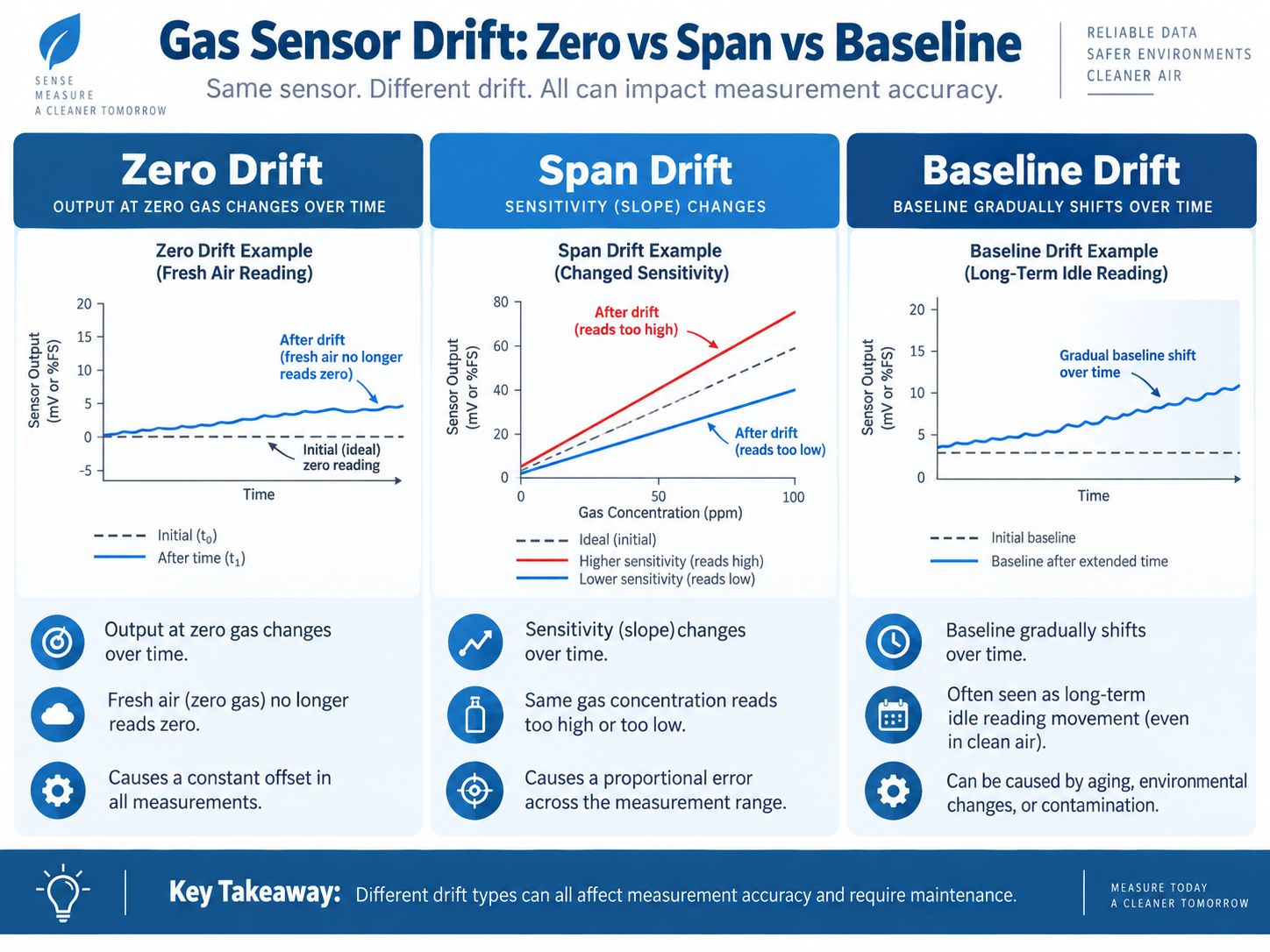
The three terms describe different ways a gas sensor can change.
| Drift Type | What Changes? | Typical Symptom | Typical Check |
|---|---|---|---|
| Zero drift | Output at zero target gas | Clean air no longer reads near zero | Zero / fresh-air check |
| Span drift | Sensitivity or slope | Known gas reads too high or too low | Span-gas calibration |
| Baseline drift | Underlying reference / idle response | No-gas reading gradually moves over time | Trend analysis and zero verification |
A sensor can experience more than one type at the same time.
For example, an aging electrochemical sensor can develop:
- a changed zero current
- reduced sensitivity
So both the zero and the span may move.
What Is Zero Drift?
Zero drift occurs when the sensor’s output at zero target-gas concentration changes over time.
Suppose a CO detector originally reads:
Clean air = 0 ppm CO
After extended service, the same instrument may read:
Clean air = +3 ppm CO
even when no CO is present.
That is a zero offset.
A negative shift can also occur:
Clean air = -2 ppm equivalent sensor output
although the instrument firmware may prevent a negative concentration from being displayed to the user.
The important point is:
The reference point has moved.
What Causes Zero Drift?
Possible causes include:
- sensor aging
- zero-current changes
- temperature changes
- humidity changes
- electrolyte changes
- contamination
- electronics offset
- long-term material changes
For electrochemical sensors, zero current is particularly important because the sensor can generate a small output even without target gas.
If that background current changes, the calculated gas reading can shift.
Riken Keiki notes that high temperature can promote electrolyte evaporation and contribute to shifts in the zero baseline of electrochemical gas sensors.
See: Riken Keiki — Understanding Electrochemical Sensors
What Is Span Drift?
Span drift is different.
The zero point may still be correct, but the sensor’s sensitivity changes.
Imagine a sensor originally calibrated so that:
50 ppm reference gas
→ 50 ppm reading
Later:
50 ppm reference gas
→ 42 ppm reading
The sensor still detects the gas.
But its response per unit concentration has decreased.
This is span or sensitivity drift.
A sensor can also drift in the opposite direction and produce a reading that is too high.
The important distinction is:
Zero drift changes the offset. Span drift changes the slope.
Why Span Drift Matters
Span drift can be particularly difficult to notice during normal operation.
A detector may still:
- power on normally
- display zero in clean air
- respond when exposed to gas
and yet significantly under-report the actual concentration.
This is why a clean-air zero check alone cannot prove that the sensor’s sensitivity is still correct.
A known concentration of target gas is needed to verify span response.
Analog Devices notes that electrochemical gas sensors naturally age and drift during their operating life, and that sensor manufacturers may specify sensitivity drift as high as approximately 20% per year for some sensor types.
That is not a universal specification for every electrochemical sensor, but it illustrates why long-term sensitivity must be verified rather than assumed.
See: Analog Devices — Overcoming the Technical Challenges of Electrochemical Gas Sensing
What Is Baseline Drift?
Baseline drift is a broader term.
It describes a gradual change in the sensor’s underlying reference output over time.
For example, a MOS gas sensor may have a baseline resistance in clean air.
After:
- weeks
- months
- temperature cycles
- humidity exposure
- aging
that clean-air resistance may gradually change.
This can alter how later gas responses are interpreted.
Baseline drift is especially common terminology in:
- MOS sensors
- electronic noses
- sensor arrays
- pattern-recognition systems
because their algorithms often depend on a stable baseline before evaluating a gas-induced change.
Is Baseline Drift the Same as Zero Drift?
Not always.
They overlap, but the terminology depends on sensor technology and application.
Zero Drift
Usually emphasizes:
error at the zero-concentration reference point
Common in:
- calibrated gas detectors
- electrochemical sensing
- analytical instruments
Baseline Drift
Usually emphasizes:
long-term change in the sensor’s underlying reference state
Common in:
- MOS sensors
- sensor arrays
- electronic noses
In a real gas detector, baseline drift may eventually appear to the user as zero drift.
But the physical cause may be more complicated than a simple electronic offset.
A useful engineering distinction is:
Zero drift describes the measurement error. Baseline drift often describes the underlying sensor behavior that produces it.
Drift Is Not the Same as Noise
This distinction is important.
Sensor Drift
Usually:
- gradual
- directional
- time-dependent
- persistent
Example:
0 → 1 → 2 → 3 → 4 ppm
over several weeks
Sensor Noise
Usually:
- fast
- random
- fluctuating
Example:
0.2 → -0.3 → 0.4 → 0.1 → -0.2 ppm
within seconds
A sensor can have both.
For example:
a slowly moving baseline may have small random noise superimposed on it.
Later in this terminology series, this deserves its own comparison because drift compensation and noise filtering are completely different engineering problems.
Drift Is Not the Same as Cross-Sensitivity
Cross-sensitivity occurs when another gas produces a response in a sensor intended for a different target gas.
For example:
a CO sensor may respond partly to hydrogen.
That is not automatically drift.
If the hydrogen disappears and the sensor returns to normal, the sensor may be working exactly as designed—it simply has an interference response.
By contrast:
drift persists over time even when the gas environment returns to its reference condition.
For a detailed explanation, see Gas Sensor Cross-Sensitivity Explained.
Drift Is Not the Same as Poisoning
Poisoning can cause drift-like symptoms, but it is a different mechanism.
A contaminant may permanently or semi-permanently reduce sensor activity.
For example, catalytic combustible sensors can be affected by certain:
- silicones
- sulfur compounds
- lead-containing compounds
- other catalyst poisons
After poisoning, the sensor may show:
reduced span response
which looks like sensitivity drift.
But the underlying cause is not simply normal aging.
That distinction matters because:
Calibration can compensate for some drift, but it cannot necessarily restore a chemically damaged sensor.
How Drift Differs Across Gas Sensor Technologies
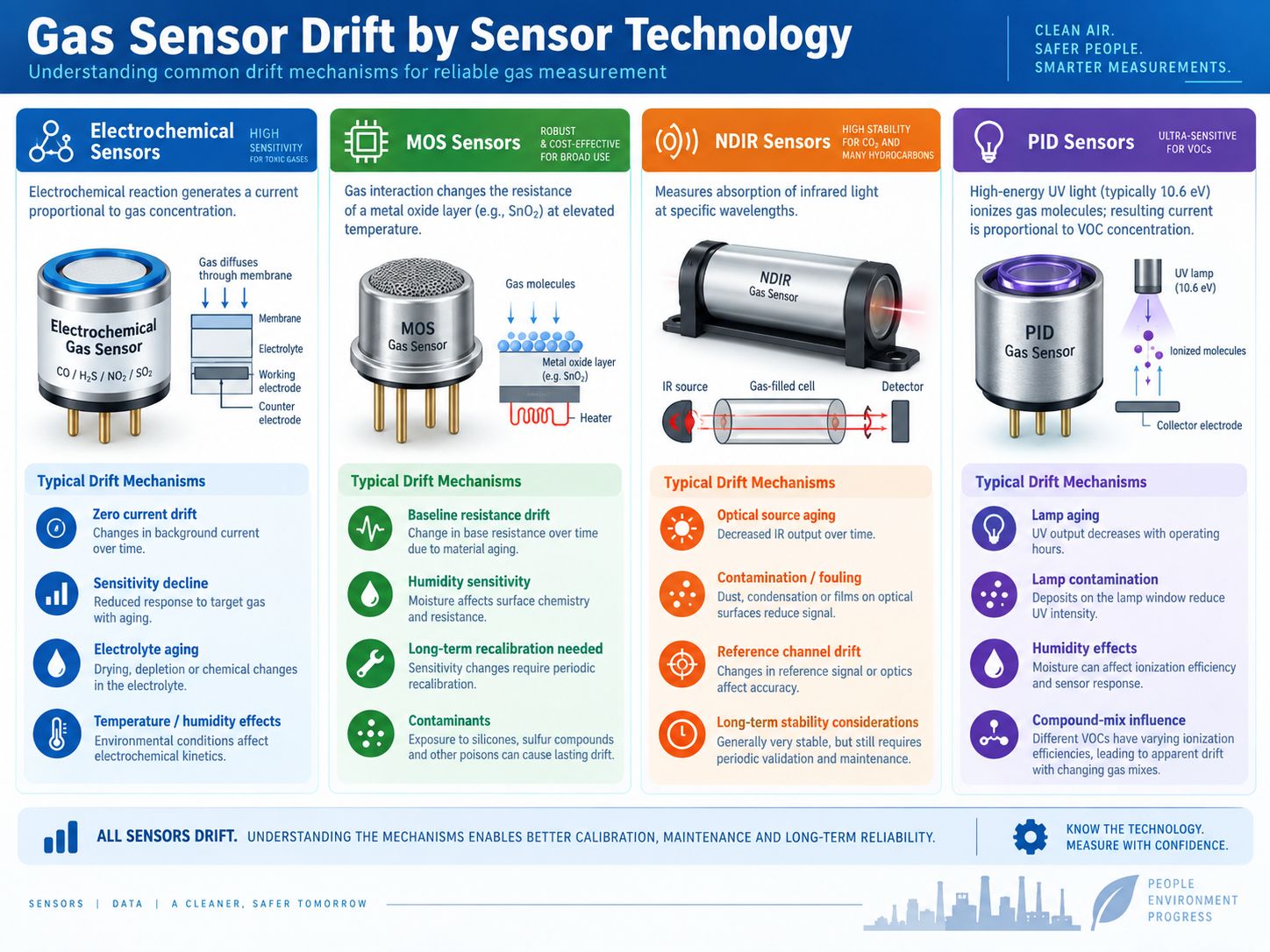
There is no single universal gas-sensor drift mechanism.
Different sensing technologies drift for different reasons.
Electrochemical Sensor Drift
Electrochemical sensors produce an electrical current from a chemical reaction at the working electrode.
Over time, changes can occur in:
- electrode surfaces
- electrolyte
- diffusion barriers
- membranes
- internal chemistry
Typical effects include:
Zero-current drift
The background current changes.
Sensitivity drift
The same gas concentration produces a different current.
Response-time change
Aging or electrolyte changes can slow gas diffusion and electrochemical response.
Analog Devices identifies:
- sensor aging
- excessive temperature
- humidity
- high gas concentration
- electrode poisoning
as contributors to deterioration in electrochemical sensor performance.
MOS Sensor Drift
Metal oxide semiconductor sensors work by measuring changes in electrical resistance as gases interact with a heated sensing material.
Their baseline can be strongly influenced by:
- temperature
- humidity
- sensing-layer aging
- contaminants
- heater conditions
This makes baseline drift a particularly important issue in long-term MOS applications.
In simple threshold detection, this may create false shifts.
In electronic-nose systems, baseline drift can be even more problematic because pattern-recognition algorithms may interpret a changed baseline as a change in gas composition.
NDIR Sensor Drift
NDIR sensors infer gas concentration by measuring infrared absorption.
They do not have an electrolyte or catalytic bead, but they are not completely immune to long-term change.
Potential contributors include:
- IR source aging
- detector aging
- contamination on optical surfaces
- condensation
- optical path changes
- reference-channel changes
Well-designed NDIR systems often use:
- reference channels
- optical compensation
- temperature compensation
- automatic baseline algorithms
to improve long-term stability.
However, compensation must match the application.
An automatic baseline assumption that works well in an occupied building CO₂ application may be inappropriate for a process where the gas concentration never returns to a known baseline.
PID Sensor Drift
Photoionization detectors use ultraviolet light to ionize detectable compounds.
Long-term response can be affected by:
- lamp aging
- lamp-window contamination
- humidity
- dirty sampling systems
- changing gas mixtures
A reduced PID reading is therefore not automatically proof of permanent sensor drift.
The instrument may need:
- lamp cleaning
- filter replacement
- recalibration
- inspection of the sampling path
before the sensor itself is blamed.
Temperature Can Look Like Drift
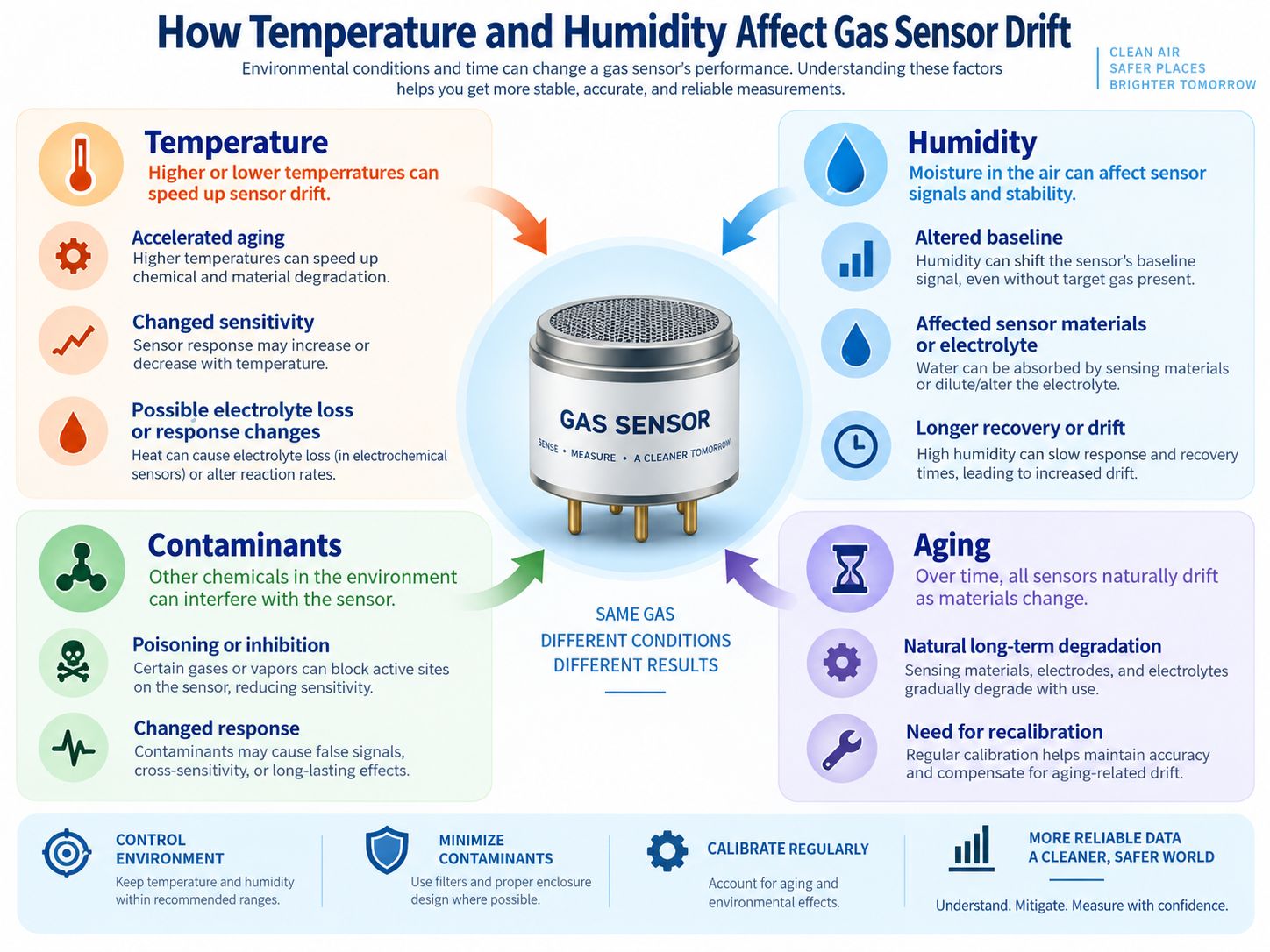
Not every slow reading change is caused by irreversible aging.
Temperature can change a gas sensor’s:
- baseline
- sensitivity
- reaction kinetics
- diffusion rate
- electronics
This means an instrument installed in a location that cycles between:
5°C at night
and:
35°C in the afternoon
may show repeatable changes even if gas concentration remains constant.
Good sensor systems use temperature compensation.
But compensation has limits.
Repeated operation outside the rated temperature range may cause permanent degradation.
Humidity Can Affect the Baseline
Humidity is particularly important for electrochemical and MOS sensors.
For electrochemical cells, moisture balance affects the electrolyte.
Analog Devices describes low humidity as a condition that can promote electrolyte loss and high humidity as a condition that can lead to water absorption and changes in sensor characteristics.
Riken Keiki similarly identifies humidity as an important influence on electrochemical sensor life and sensitivity.
That means:
A temporary humidity response should not automatically be classified as permanent drift.
The first troubleshooting question should be:
Did the environment change?
Aging Creates Long-Term Drift
Even under good operating conditions, sensing materials age.
Examples include:
- electrode changes
- catalyst degradation
- electrolyte depletion
- membrane aging
- heater aging
- optical-source aging
- UV-lamp aging
This is why calibration does not make a sensor immortal.
Eventually, the amount or speed of compensation required becomes unacceptable.
At that point, the sensor has reached its practical end of life.
High Gas Exposure Can Change Sensor Behavior
Gas sensors are designed for a specified concentration range.
Exposure well above that range can result in:
- temporary saturation
- prolonged recovery
- baseline disturbance
- sensitivity loss
- irreversible damage
If a detector starts behaving strangely after a major leak or over-range event, the event history is important.
Do not treat the problem as normal long-term drift until over-range exposure has been considered.
For concentration terminology, see Gas Detector Measurement Units: ppm vs ppb vs %LEL vs %Vol.
How Do You Check Whether a Gas Sensor Is Drifting?
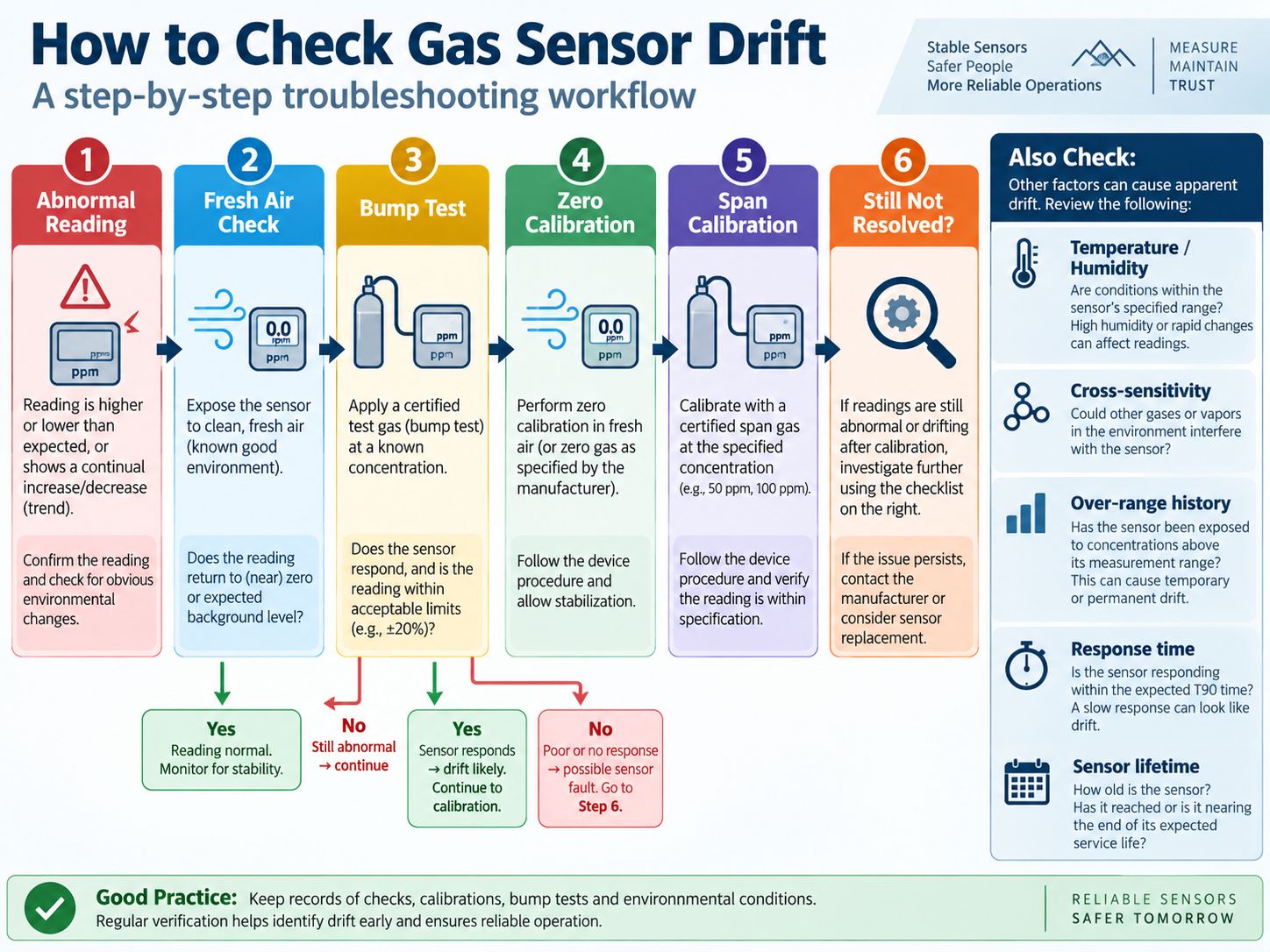
A practical troubleshooting process is:
Step 1 — Confirm the Abnormal Reading
Do not assume the instrument is wrong.
First verify whether:
- process conditions changed
- ventilation changed
- another gas is present
- humidity or temperature changed
The detected gas may be real.
Step 2 — Check the Zero Condition
Expose the sensor to the correct zero environment.
Depending on the instrument, that may be:
- certified zero air
- clean fresh air
- nitrogen
- another manufacturer-specified zero gas
Check whether the detector returns to its expected zero reading.
If not:
zero drift or contamination may be present.
Step 3 — Perform a Bump Test
Apply a known test gas.
The goal is to confirm that the detector:
- responds
- produces an alarm where applicable
- responds within an acceptable time
A bump test is primarily a functional test, not a full accuracy adjustment.
For the distinction, see Gas Detector Bump Test vs Calibration.
Step 4 — Perform Zero Calibration if Required
If the baseline is offset but the sensor is otherwise healthy, zero calibration may correct the reference point.
However:
Zero calibration cannot correct lost sensitivity.
Step 5 — Perform Span Calibration
Apply a known concentration of target gas.
If the sensor reads:
42 ppm
when it should read:
50 ppm
span calibration can adjust the concentration-response relationship.
Step 6 — Verify Again
A calibration is not the end of the diagnosis.
Check whether the sensor:
- holds zero
- responds correctly
- recovers properly
- remains stable
If the reading quickly drifts again, calibration may only be hiding a deeper problem.
Can Calibration Fix Gas Sensor Drift?
Sometimes.
But the answer depends on the cause.
Zero Calibration Can Correct
- moderate zero offset
- expected baseline shift
- certain environmental compensation errors
Span Calibration Can Correct
- moderate sensitivity drift
- changes in conversion slope
Calibration May Not Fix
- severe poisoning
- damaged membrane
- major electrolyte loss
- optical fouling beyond compensation
- failed electronics
- severe aging
- end-of-life sensor response
A useful rule is:
Calibration corrects the measurement relationship. It does not repair damaged sensing chemistry.
Why Repeated Calibration Can Hide Sensor Aging
Imagine a sensor loses sensitivity every month.
Each time it is recalibrated, the output is corrected.
The instrument may continue to read correctly for a while.
But if sensitivity continues to decline rapidly, the calibration interval becomes shorter and shorter.
At some point, the real problem is no longer:
“When should I calibrate?”
It becomes:
“Why can this sensor no longer maintain calibration?”
That is an important end-of-life signal.
When Should a Drifting Gas Sensor Be Replaced?
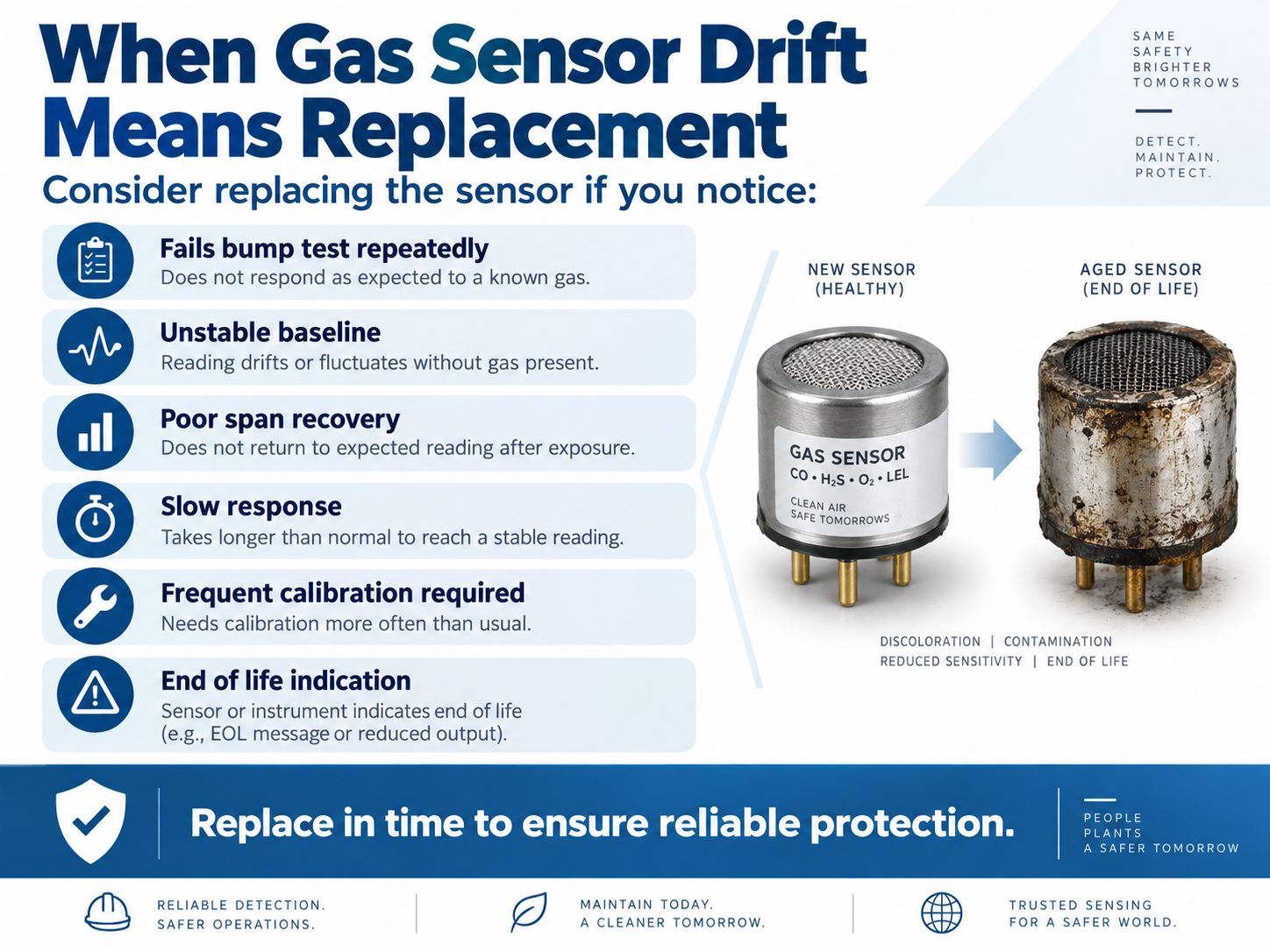
Replacement should be considered when the sensor can no longer reliably meet the required performance.
Warning signs include:
Repeated bump-test failure
The detector no longer produces the expected response to known gas.
Unstable baseline
The zero reading continually moves even after proper stabilization.
Poor span recovery
Calibration temporarily restores sensitivity, but the error quickly returns.
Slow response
The sensor takes significantly longer than expected to reach a stable reading.
Frequent recalibration
Calibration is required increasingly often.
End-of-life indication
The sensor or instrument diagnostics identify deterioration beyond the acceptable range.
The exact replacement criteria should come from:
- the sensor manufacturer
- detector documentation
- site maintenance procedure
- application requirements
—not from a universal calendar interval.
Is Sensor Drift Always Predictable?
No.
Long-term aging may produce a gradual trend.
But real installations can include:
- temperature shocks
- humidity events
- chemical contamination
- high-gas exposure
- poisoning
that suddenly accelerate deterioration.
Two sensors installed on the same date may therefore age differently.
This is one reason maintenance should be based on:
actual performance
rather than installation date alone.
Can Software Compensate for Drift?
Yes, within limits.
Drift compensation methods can include:
- baseline correction
- temperature compensation
- humidity compensation
- reference channels
- automatic baseline correction
- calibration models
- sensor-array algorithms
In electronic noses, researchers also use methods such as:
- PCA
- PLS
- domain adaptation
- machine learning
to reduce the impact of sensor-array drift.
However, software compensation works only while the sensor still contains useful information.
If sensitivity is effectively gone, software cannot reconstruct a signal that the sensing element no longer produces.
Does Automatic Baseline Correction Eliminate Drift?
No.
Automatic baseline correction can be useful when the application contains reliable periods where the true gas concentration is known or expected.
But the algorithm needs a valid assumption.
For example, if a CO₂ sensor assumes that the building periodically returns to outdoor-background concentration, the algorithm may gradually correct baseline offset.
That assumption may fail in:
- continuously occupied spaces
- greenhouses
- process vessels
- high-background environments
So:
Automatic drift correction is an application-dependent compensation technique—not proof that the sensor itself does not drift.
How Can Gas Sensor Drift Be Reduced?
Drift cannot always be eliminated, but it can often be controlled.
Keep Sensors Within Rated Conditions
Respect specified:
- temperature
- humidity
- pressure
- concentration range
Avoid Contaminants
Protect sensors from materials known to cause:
- poisoning
- fouling
- condensation
- electrolyte damage
Avoid Unnecessary Over-Range Exposure
Very high concentrations can stress sensing elements.
Perform Regular Functional Checks
Use bump tests according to the device, application and site procedure.
Calibrate When Required
Calibration compensates for manageable zero and span changes.
Record Calibration History
Trend:
- zero corrections
- span corrections
- response time
- failed tests
A growing correction requirement can reveal aging before complete failure.
Replace Sensors That Cannot Maintain Performance
Do not repeatedly recalibrate a sensor that has clearly reached end of life.
Gas Sensor Drift vs Commonly Confused Problems
| Problem | What Happens? | Does It Persist After Gas Is Removed? |
|---|---|---|
| Drift | Baseline or sensitivity changes over time | Usually yes |
| Noise | Random short-term fluctuations | Continually fluctuates |
| Cross-sensitivity | Another gas causes a response | Usually disappears when interferent is removed |
| Poisoning | Contaminant damages or suppresses sensing response | May persist |
| Saturation | Excessive gas overwhelms measurement range | May recover slowly |
| Calibration error | Instrument conversion is incorrect | Persists until corrected |
This distinction matters because each problem requires a different solution.
Why Drift Matters for Safety Alarms
Suppose a CO detector has:
Low alarm = 35 ppm
If the sensor develops a negative span drift and reads:
28 ppm
when the actual concentration is:
35 ppm
the detector may respond later than intended.
Conversely, positive zero drift can create unnecessary alarms.
The alarm setting itself may be correct.
The problem is that the sensor no longer measures the concentration accurately.
This is why alarm engineering and sensor maintenance must be treated separately.
For alarm logic, see Gas Detector Alarm Settings: Low, High, STEL & TWA Explained.
Frequently Asked Questions
What is gas sensor drift?
Gas sensor drift is a gradual change in sensor baseline, sensitivity or output over time that is not caused by an equivalent change in actual target-gas concentration.
What is zero drift?
Zero drift occurs when the detector’s output changes at zero target-gas concentration.
A sensor that once read 0 ppm in clean air may later show a non-zero reading.
What is span drift?
Span drift occurs when sensor sensitivity changes.
The same concentration of calibration gas then produces a different response.
What is baseline drift?
Baseline drift is the gradual movement of the sensor’s underlying reference or idle signal.
The term is particularly common in MOS sensors and electronic-nose systems.
Is baseline drift the same as zero drift?
They overlap but are not always identical.
Zero drift describes an error at the zero reference point, while baseline drift often describes the underlying movement of the sensor’s reference state.
What causes gas sensor drift?
Common causes include:
- aging
- temperature
- humidity
- electrolyte changes
- electrode changes
- contaminants
- high gas exposure
- optical aging
- lamp aging
The dominant mechanism depends on sensor technology.
Do electrochemical gas sensors drift?
Yes.
Electrochemical sensors can experience both zero-current drift and sensitivity drift as they age.
Can temperature cause sensor drift?
Yes.
Temperature can change baseline, sensitivity, diffusion and reaction rates.
Long-term exposure to excessive temperature can also accelerate permanent aging.
Can humidity cause gas sensor drift?
Yes.
Humidity can affect electrochemical electrolytes and MOS surface chemistry, producing both temporary environmental response and long-term performance changes.
Can calibration fix sensor drift?
Calibration can compensate for moderate zero and span drift.
It cannot necessarily repair physical or chemical damage such as poisoning, severe aging or electrolyte loss.
What is the difference between drift and cross-sensitivity?
Drift is a time-dependent change in sensor behavior.
Cross-sensitivity is a response to another gas.
See Gas Sensor Cross-Sensitivity Explained.
How do I know if a sensor is drifting or failing?
Check:
- zero stability
- response to known gas
- calibration correction required
- response time
- recent environmental history
- over-range exposure
- manufacturer diagnostics
A sensor that cannot hold calibration or repeatedly fails functional testing may be approaching end of life.
How often should a drifting gas sensor be calibrated?
There is no single universal interval for every sensor and application.
Follow:
- manufacturer guidance
- applicable standards
- site procedures
- previous calibration history
- environmental conditions
Sensors showing rapid drift may require investigation rather than simply shorter and shorter calibration intervals.
Final Takeaway
Gas sensor drift is not one specific failure mode.
It is a broad description for long-term changes in sensor behavior.
The three most useful concepts are:
Zero Drift
The zero point moves.
Span Drift
The sensitivity changes.
Baseline Drift
The sensor’s underlying reference signal gradually shifts.
Knowing which one is occurring determines what to do next.
A zero offset may require:
zero calibration.
A sensitivity change may require:
span calibration.
Repeated instability may indicate:
environmental stress, poisoning, excessive aging or sensor end of life.
The key maintenance principle is simple:
Do not ask only whether the sensor still responds. Ask whether it still responds correctly, consistently and within the required specification.
That is why drift monitoring, calibration history and functional testing are essential parts of reliable gas detection.
References and Further Reading
- Analog Devices — Overcoming the Technical Challenges of Electrochemical Gas Sensing
- Frontiers in Chemistry — Calibration Update and Drift Correction for Electronic Noses and Tongues
- Riken Keiki — Understanding Electrochemical Sensors
- GasNose — Gas Sensor Cross-Sensitivity Explained
- GasNose — Gas Detector Bump Test vs Calibration
- GasNose — Gas Detector Measurement Units
- GasNose — Gas Detector Alarm Settings
