




Gas detector specifications are full of units:
- ppb
- ppm
- %LEL
- %Vol
A CO detector may measure 0–500 ppm.
A VOC instrument may measure down into ppb.
A combustible gas monitor may display 0–100% LEL.
An oxygen or process-gas analyzer may display %Vol.
These units are related, but they do not all describe gas concentration in the same way.
The most important distinction is:
ppb, ppm and %Vol express actual gas concentration at different scales. %LEL expresses a combustible gas concentration relative to that gas’s lower explosive limit.
This is why:
10% LEL does not mean 10% gas by volume.
For methane, a detector showing 10% LEL may correspond to approximately 0.44–0.50%Vol methane, depending on which methane LEL reference the instrument uses.
Understanding these units is therefore not just a mathematical exercise. It affects:
- detector selection
- measurement range
- alarm interpretation
- calibration
- combustible-gas safety
- process monitoring
ppm vs ppb vs %LEL vs %Vol: Quick Comparison
| Unit | Meaning | What It Describes | Typical Applications |
|---|---|---|---|
| ppb | Parts per billion | Very low actual concentration | Trace VOCs, environmental monitoring |
| ppm | Parts per million | Low actual concentration | CO, H₂S, NH₃, Cl₂, VOCs |
| %Vol | Percent by volume | Higher actual concentration | O₂, CO₂, process gases, biogas |
| %LEL | Percent of Lower Explosive Limit | Relative flammability level | Methane, hydrogen, propane and combustible gases |
A useful shortcut is:
ppb = trace concentration
ppm = low concentration
%Vol = higher absolute concentration
%LEL = combustible-gas safety scale
But the correct unit depends on the measurement objective, not simply the gas name.
ppm, ppb and %Vol Are Different Scales of Concentration
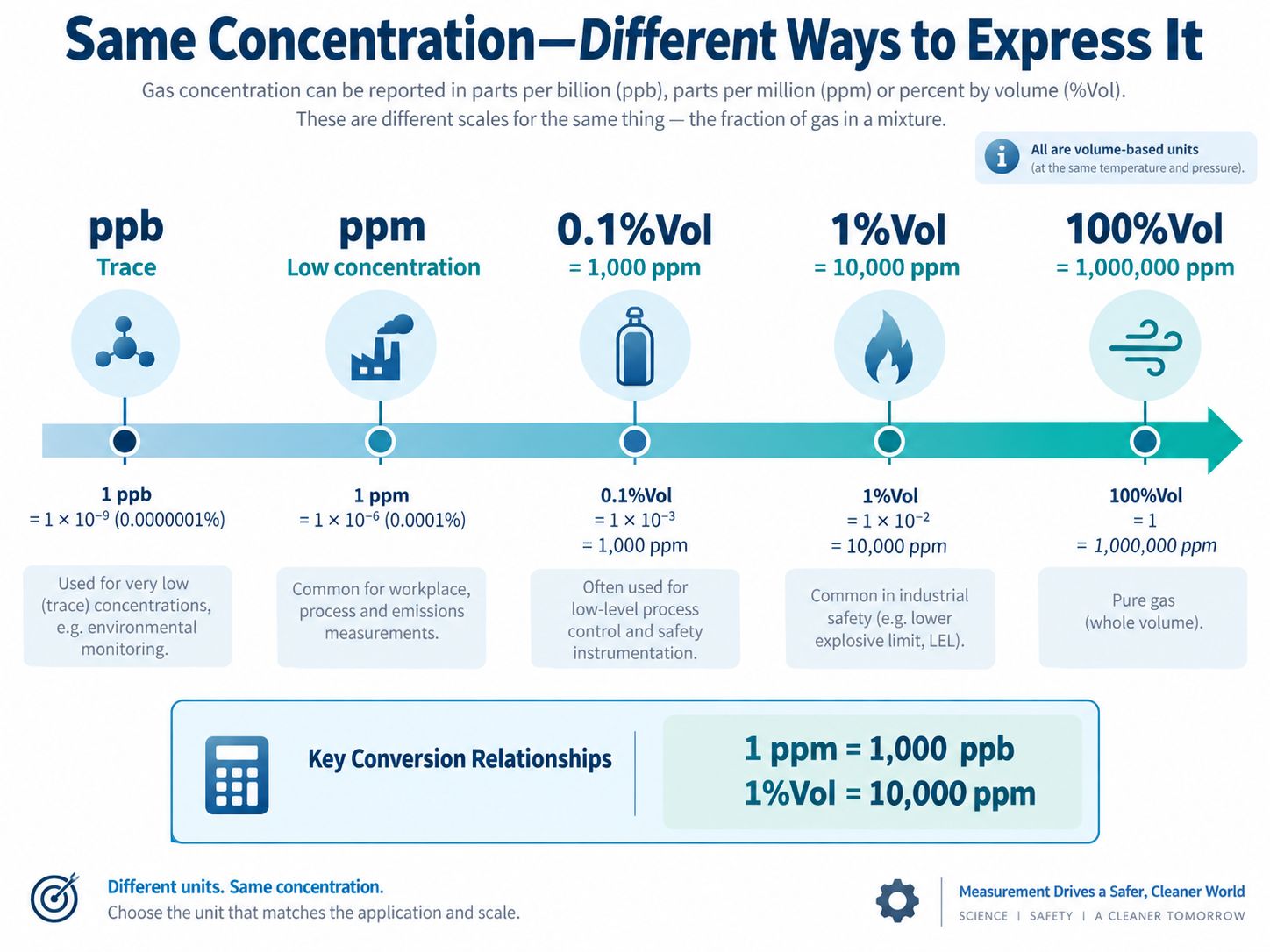
For gases, instruments normally use ppm and ppb as volumetric or molar-fraction concentration units, even though the display often simply says ppm rather than ppmv.
The core relationships are simple:
1 ppm = 1,000 ppb
and:
1%Vol = 10,000 ppm
Therefore:
1%Vol
= 10,000 ppm
= 10,000,000 ppb
Industrial Scientific’s current gas-detection glossary uses the same relationship: 1 percent by volume = 10,000 ppm, while 100% volume corresponds to 1,000,000 ppm.
See: Industrial Scientific Gas Detection Glossary
What Does ppm Mean in Gas Detection?
ppm means:
parts per million
One ppm represents one part of the target gas in one million parts of the gas mixture.
For volume concentration:
1 ppm = 0.0001%Vol
Examples:
| ppm | %Vol |
|---|---|
| 1 ppm | 0.0001% |
| 10 ppm | 0.001% |
| 100 ppm | 0.01% |
| 1,000 ppm | 0.1% |
| 5,000 ppm | 0.5% |
| 10,000 ppm | 1% |
ppm is convenient when the hazardous or relevant concentration is too small to express clearly as a percentage.
For example:
25 ppm CO
is much easier to understand than:
0.0025%Vol CO
Why Are Toxic Gases Commonly Measured in ppm?
Many toxic gases can become important at concentrations far below one percent by volume.
Examples include:
- carbon monoxide — CO
- hydrogen sulfide — H₂S
- ammonia — NH₃
- chlorine — Cl₂
- sulfur dioxide — SO₂
- nitrogen dioxide — NO₂
That makes ppm a practical display scale.
This does not mean:
ppm is inherently more accurate than %Vol.
It simply matches the concentration range better.
A toxic-gas detector might have a range such as:
0–100 ppm
while a process analyzer for another application could measure the same gas at a much higher concentration using %Vol.
The unit should make the relevant concentration range easy to interpret.
What Does ppb Mean?
ppb means:
parts per billion
It is one thousand times smaller than ppm.
1 ppm = 1,000 ppb
Therefore:
1 ppb = 0.001 ppm
Examples:
| ppb | ppm |
|---|---|
| 1 ppb | 0.001 ppm |
| 10 ppb | 0.01 ppm |
| 100 ppb | 0.1 ppm |
| 1,000 ppb | 1 ppm |
| 10,000 ppb | 10 ppm |
ppb is particularly useful for:
- trace VOC monitoring
- environmental monitoring
- semiconductor contamination
- ultra-low toxic-gas measurement
- high-sensitivity PID applications
- analytical instrumentation
Is ppb More Accurate Than ppm?
No.
This is an important misunderstanding.
A smaller display unit does not automatically mean a better instrument.
Consider two hypothetical sensors:
Sensor A
Range:
0–100 ppm
Resolution:
0.1 ppm
Sensor B
Range:
0–5,000 ppb
Resolution:
100 ppb
Sensor B uses ppb, but that alone tells you nothing about whether it is:
- more accurate
- more stable
- more selective
- faster
You still need to evaluate:
- accuracy
- resolution
- detection limit
- repeatability
- drift
- cross-sensitivity
So:
Smaller unit ≠ better sensor.
What Does %Vol Mean?
%Vol means:
percent by volume
If methane concentration is:
1%Vol
then methane makes up approximately 1 volume unit for every 100 volume units of the mixture.
The conversion is:
ppm = %Vol × 10,000
and:
%Vol = ppm ÷ 10,000
Examples:
0.01%Vol = 100 ppm
0.1%Vol = 1,000 ppm
0.5%Vol = 5,000 ppm
1%Vol = 10,000 ppm
5%Vol = 50,000 ppm
This relationship is straightforward because ppm and %Vol are simply two scales for expressing volume fraction.
Why Is Oxygen Usually Displayed in %Vol?
Normal atmospheric oxygen is approximately:
20.9%Vol
It could mathematically be expressed as approximately:
209,000 ppm
but that would be unnecessarily awkward.
%Vol is simply a much more useful scale.
The same principle applies to high-concentration process gases.
Typical %Vol applications include:
- oxygen
- high-concentration CO₂
- methane in biogas
- hydrogen process gas
- pipeline purging
- inerting
- gas blending
RKI’s current technical FAQ similarly distinguishes %LEL as a combustible-safety scale and %Vol as an absolute concentration scale used for applications such as purging and inerting.
See: RKI — %LEL vs %Vol
%Vol Is an Absolute Concentration Scale
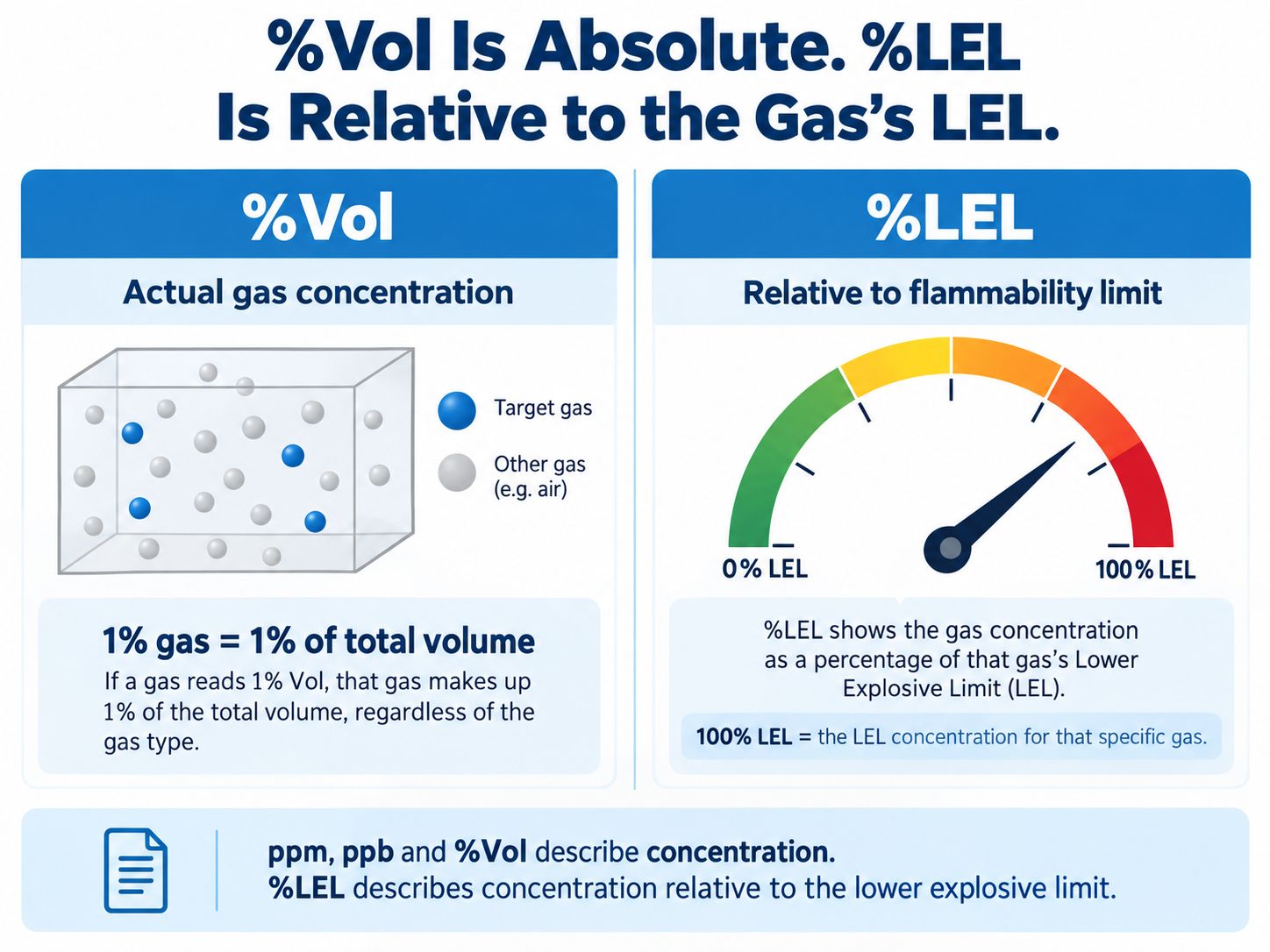
The easiest way to distinguish %Vol and %LEL is:
%Vol
asks:
How much gas is actually present?
%LEL
asks:
How close is the combustible gas concentration to its lower explosive limit?
This is a fundamental difference.
If a methane analyzer reads:
2%Vol CH₄
that means methane represents approximately 2% of the gas mixture by volume.
If a combustible monitor reads:
40% LEL
you still need to know the methane LEL reference used by that instrument before converting the reading to %Vol.
What Does %LEL Mean?
LEL means:
Lower Explosive Limit
It is also commonly called:
Lower Flammable Limit — LFL
Below this concentration, the fuel-air mixture is generally too lean to sustain flame propagation under the defined test conditions.
A combustible detector commonly displays:
0–100% LEL
This does not mean:
0–100% gas concentration.
Instead:
0% LEL
means the instrument is at the bottom of its %LEL combustible scale.
It should not be interpreted as proof that absolutely zero combustible gas molecules are present.
50% LEL
means the concentration is half of the applicable LEL reference.
100% LEL
means the gas concentration has reached the applicable lower explosive limit.
This is why:
100% LEL may represent only a few percent gas by volume.
The Biggest Mistake: 10% LEL Is Not 10%Vol
Suppose we use a methane LEL reference of:
5.0%Vol
Then:
100% LEL = 5.0%Vol methane
Therefore:
50% LEL = 2.5%Vol
20% LEL = 1.0%Vol
and:
10% LEL = 0.5%Vol
Since:
0.5%Vol = 5,000 ppm
we get:
10% LEL methane
= 0.5%Vol
= 5,000 ppm
But there is an important qualification.
5.0%Vol is not the only methane LEL reference used by gas detection instruments.
Why 10% LEL Methane Can Mean 4,400 ppm or 5,000 ppm
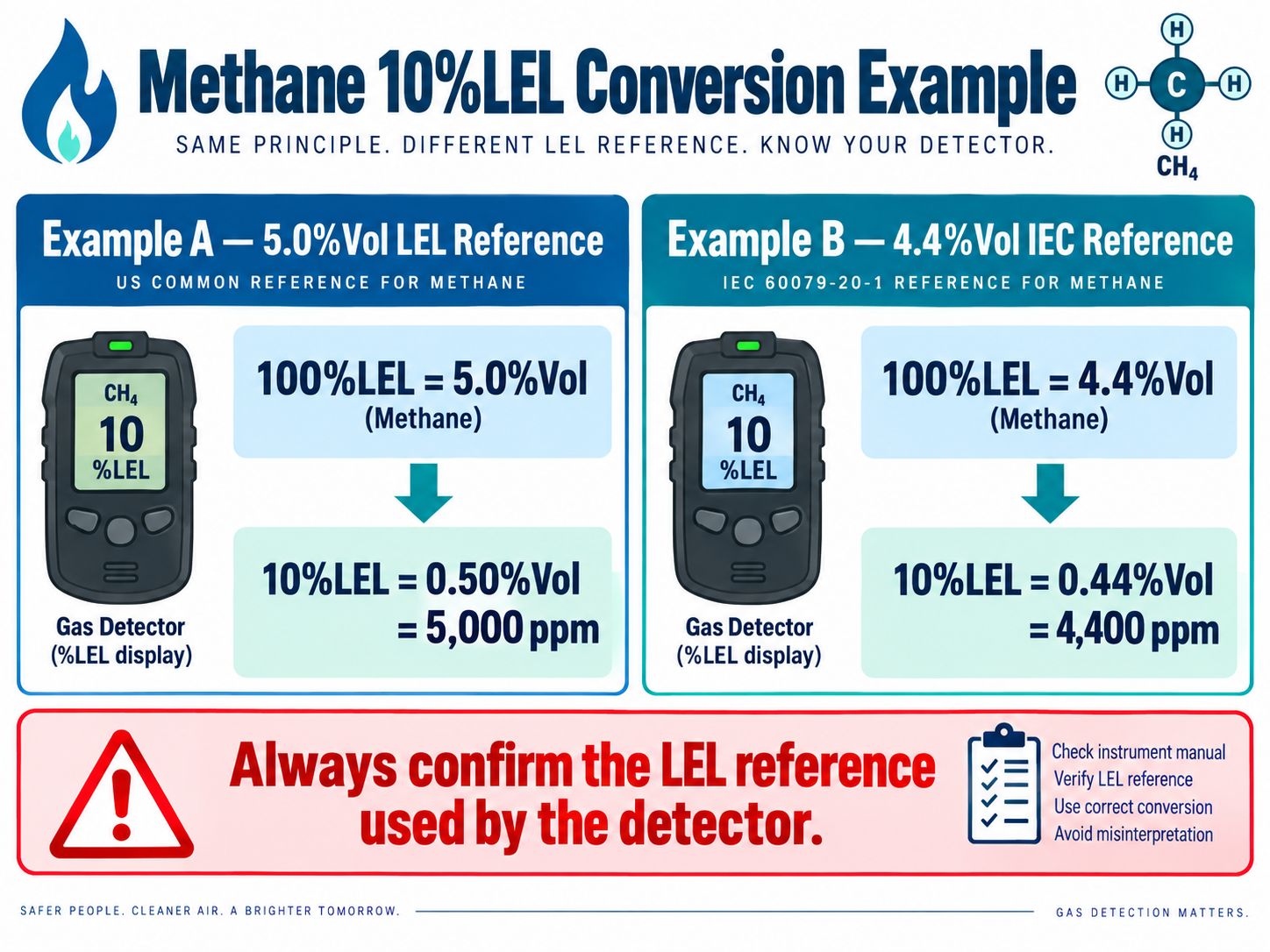
This is one of the most important details in combustible-gas measurement.
Dräger’s current PIR 7000 documentation supports different LEL calculation categories.
For methane it lists, among others:
NIOSH-Based Reference
Methane LEL = 5.0%Vol
Therefore:
10% LEL
= 0.50%Vol
= 5,000 ppm
IEC-Based Reference
Methane LEL = 4.4%Vol
Therefore:
10% LEL
= 0.44%Vol
= 4,400 ppm
Dräger’s current methane reference page likewise lists 4.4%Vol LEL while specifically noting that 5%Vol is commonly used in North America.
See:
This leads to a very important rule:
Never convert %LEL to ppm until you know the target gas and the LEL reference used by the detector.
The image above therefore shows two valid calculation examples, not two different physical methane concentrations for the same definition.
General Formula: %LEL to %Vol
Suppose:
L = gas LEL in %Vol
and:
X = detector reading in %LEL
Then:
Gas concentration (%Vol)
= (X ÷ 100) × L
For example:
Methane LEL reference:
5.0%Vol
Detector:
20% LEL
Then:
(20 ÷ 100) × 5.0
= 1.0%Vol
General Formula: %LEL to ppm
Once you know the %Vol concentration:
ppm
= %Vol × 10,000
So the combined equation is:
ppm
= (%LEL ÷ 100)
× LEL (%Vol)
× 10,000
Example:
Methane LEL = 5.0%Vol
Reading = 10% LEL
ppm
= 0.10 × 5.0 × 10,000
= 5,000 ppm
But again:
The calculation is only as correct as the LEL value you put into it.
How Do You Convert ppm Back to %LEL?
If the gas concentration is already known in ppm:
First:
%Vol = ppm ÷ 10,000
Then:
%LEL
= Gas concentration (%Vol)
÷ Gas LEL (%Vol)
× 100
For example, using a 5.0%Vol methane LEL:
5,000 ppm
= 0.5%Vol
Then:
0.5 ÷ 5.0 × 100
= 10% LEL
Why %LEL Is Gas-Specific
Different combustible gases have different lower explosive limits.
Therefore the same:
10% LEL
does not represent the same absolute concentration for every gas.
Conceptually:
Gas A
LEL = 4%Vol
10% LEL = 0.4%Vol
Gas B
LEL = 2%Vol
10% LEL = 0.2%Vol
Both are:
10% LEL
because each has reached 10% of its own flammable-limit reference.
This is the purpose of the unit.
%LEL normalizes different combustible gases to a flammability-risk scale.
Why Use %LEL Instead of ppm for Combustible Safety?
Suppose two gases are each present at:
5,000 ppm
Gas A may still be far below its LEL.
Gas B may be much closer to its LEL.
The ppm value tells you:
How much gas is present?
But %LEL tells you:
How far has the atmosphere progressed toward the gas’s flammable concentration?
That makes %LEL much more intuitive for combustible-gas safety.
This is why standard multi-gas safety monitors often show:
- O₂ → %Vol
- combustible gas → %LEL
- H₂S → ppm
- CO → ppm
For more on combustible risk, see What Is a Safe LEL Level?.
%LEL Does Not Measure Toxicity
This distinction is essential.
A gas can present a toxic exposure hazard long before it reaches a significant fraction of its LEL.
Benzene is a classic example.
A combustible-gas detector can correctly show a very low %LEL reading while occupational exposure is already significant.
Therefore:
%LEL describes flammability—not toxicity.
This is why industrial environments sometimes require both:
LEL monitoring
and:
ppm-level VOC monitoring
For a detailed example, see PID vs LEL Gas Detector: What’s the Difference?.
The Same Gas Can Be Measured in ppm, %LEL and %Vol
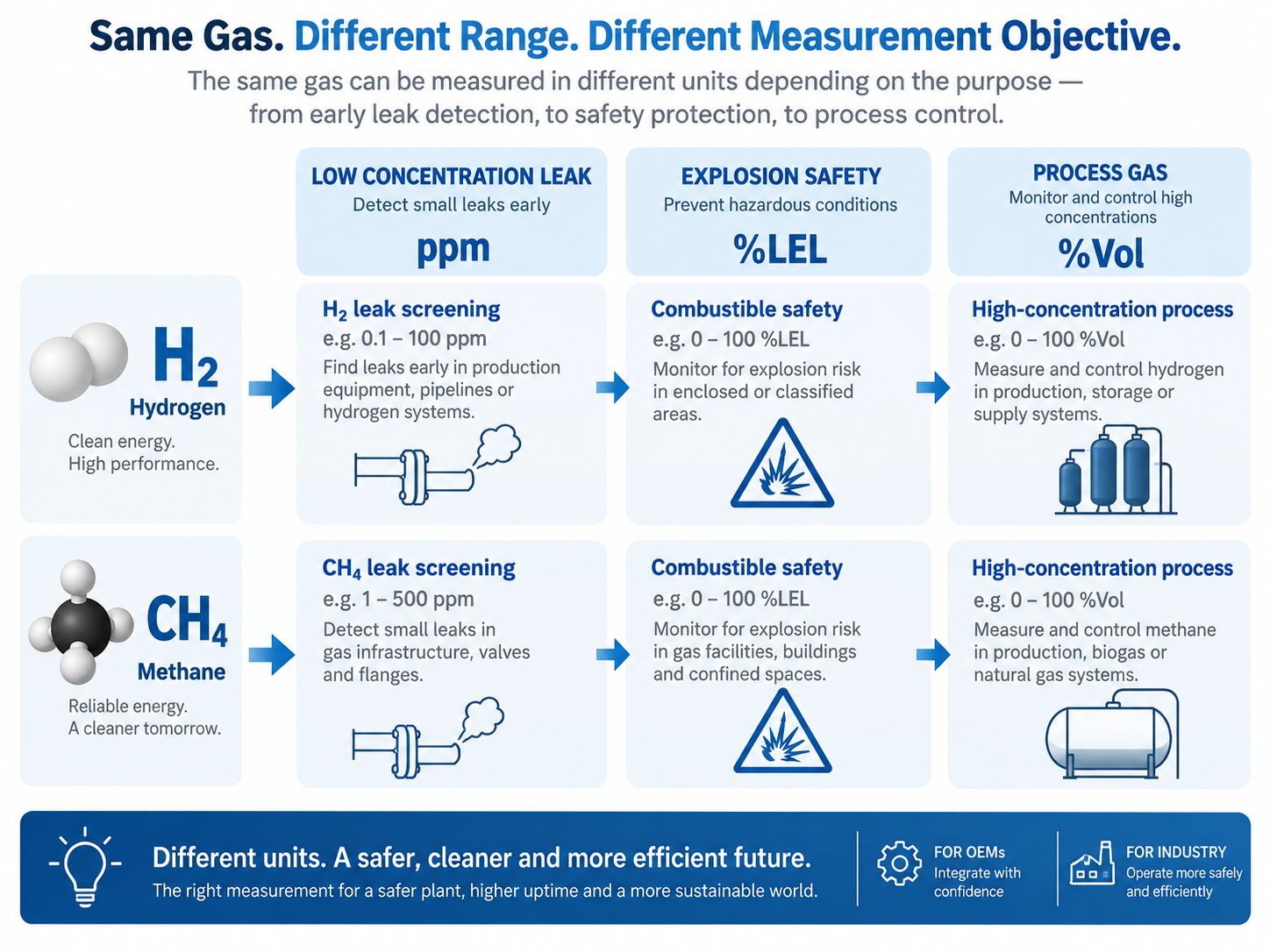
The unit is determined by the measurement objective.
Consider hydrogen.
Small Hydrogen Leak
Goal:
find an early low-concentration leak.
Possible unit:
ppm
Hydrogen Explosion Safety
Goal:
determine whether hydrogen is approaching a flammable concentration.
Unit:
%LEL
High-Concentration Hydrogen Process
Goal:
measure hydrogen as a major component of the gas mixture.
Unit:
%Vol
The same logic applies to methane.
Methane Leak Survey
May use:
ppm
Methane Safety Monitor
Typically uses:
%LEL
Biogas Analyzer
May use:
%Vol CH₄
So:
Same gas. Different range. Different measurement objective.
The ppm ranges shown in the illustration are conceptual examples only. Actual instrument ranges depend on sensor technology and application.
Why This Matters in Wastewater and Biogas
A wastewater facility provides a very good real-world example.
A portable worker-safety detector may monitor methane as:
0–100% LEL
But an anaerobic digester analyzer may measure:
CH₄ in tens of %Vol
These are not interchangeable instruments.
The first asks:
Is the surrounding atmosphere becoming flammable?
The second asks:
What fraction of the process biogas is methane?
For more, see Wastewater Gas Detection: What Gases Should Be Monitored?.
Why This Matters for Hydrogen Applications
The same issue appears in:
- electrolyzers
- hydrogen storage
- fuel cells
- battery rooms
A low-level hydrogen sensor may be selected for:
early leak detection
while a second detector or measurement range is used for:
%LEL safety
and process equipment may require:
%Vol hydrogen
Selecting a sensor simply because its datasheet says:
Target Gas: H₂
is therefore not enough.
You need:
Gas + Range + Unit + Measurement Objective
Unit Is Not the Same as Range
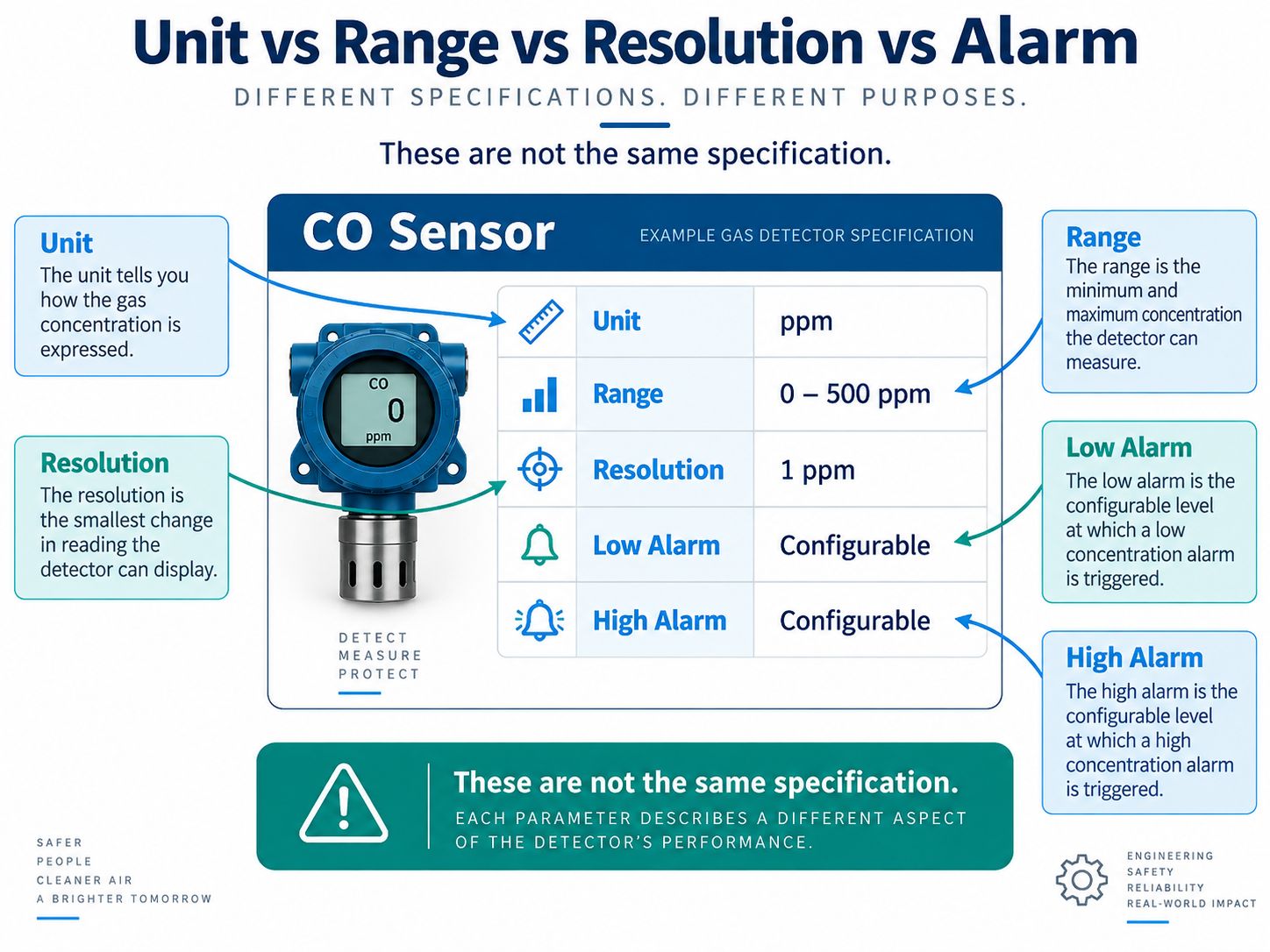
Consider a hypothetical CO detector:
Unit
ppm
This tells us how concentration is expressed.
Range
0–500 ppm
This tells us the minimum-to-maximum measuring span.
Resolution
1 ppm
This tells us the smallest display increment.
Low Alarm
Configurable
This is a safety action threshold.
High Alarm
Configurable
Another action threshold.
These specifications are completely different.
So:
Unit ≠ range ≠ resolution ≠ alarm.
Unit Is Not the Same as Accuracy
A detector may display:
1 ppm resolution
That does not mean its accuracy is:
±1 ppm
For example, an instrument could display:
38 ppm
39 ppm
40 ppm
while having a specified measurement accuracy larger than one ppm.
Resolution simply describes the smallest displayed or reported increment.
Always check:
- measuring range
- resolution
- accuracy
- repeatability
- response time
- lower detection limit
separately.
Unit Is Not the Same as Alarm Setting
A combustible detector might have:
Range: 0–100% LEL
but the Low alarm may be configured far below:
100% LEL
Likewise:
CO sensor range: 0–500 ppm
does not mean:
High alarm = 500 ppm
Alarm values are selected from:
- applicable exposure criteria
- risk assessment
- site procedure
- detector capability
For the complete explanation, see Gas Detector Alarm Settings: Low, High, STEL & TWA Explained.
Measurement Unit Is Not the Same as Sensor Technology
Another common mistake is assuming a unit automatically identifies the sensing principle.
For example:
Electrochemical
Commonly used with:
ppm
but that does not mean every ppm sensor is electrochemical.
Catalytic Bead
Commonly displays:
%LEL
NDIR
Depending on the design, may measure:
- ppm
- %LEL
- %Vol
PID
Commonly displays:
- ppm
- ppb
Thermal Conductivity
Often used for:
high-concentration %Vol
The current Dräger PIR 7000 platform is a good illustration: depending on configuration, the same infrared platform can use %LEL, %Vol or ppm measurement units.
So:
Unit describes the measurement result—not the sensor principle.
Can One Detector Automatically Switch From %LEL to %Vol?
Some specialized instruments can.
This is useful in applications where gas concentration can move from:
low combustible-safety range
into:
high process concentration
RKI, for example, describes dual-range instruments that use a catalytic sensor for %LEL and a thermal-conductivity sensor for high %Vol measurement.
This highlights an important point:
A detector that measures 0–100% LEL is not automatically capable of measuring 0–100%Vol.
Those ranges can require different sensing technology.
Why Calibration Gas Matters for %LEL
A combustible detector may be calibrated using:
- methane
- pentane
- propane
- another specified gas
But catalytic sensors do not necessarily respond equally to every combustible gas.
Suppose a sensor is calibrated with methane but is measuring another hydrocarbon.
Its actual response may differ.
Manufacturers may provide:
- correction factors
- correlation factors
- gas-specific calibration options
This means:
A mathematically correct %LEL conversion does not automatically guarantee a physically accurate measurement.
You still need to understand:
- calibration gas
- target gas
- sensor technology
- relative sensitivity
For calibration fundamentals, see Gas Detector Bump Test vs Calibration.
Can Any %LEL Reading Be Converted Directly to ppm?
Not responsibly unless you have enough information.
You need to know:
- What gas is being measured?
- What LEL value does the instrument use?
- What is the calibration gas?
- How does the sensor respond to the target gas?
- Is the atmosphere a single gas or an unknown mixture?
If the atmosphere contains an unknown hydrocarbon mixture, a simple conversion may produce a neat number without representing the real gas concentration accurately.
This leads to an important engineering principle:
Mathematical conversion is not the same thing as measurement accuracy.
What About ppm vs mg/m³?
Another concentration unit frequently encountered in occupational hygiene is:
mg/m³
ppm and mg/m³ are not related by one universal fixed factor.
Why?
Because:
ppm
describes a volume/molar fraction.
mg/m³
describes mass per volume.
Conversion therefore depends on:
- gas molecular weight
- temperature
- pressure
So unlike:
1%Vol = 10,000 ppm
you cannot say:
1 ppm = one universal mg/m³ value
for every gas.
CO, H₂S and chlorine all have different molecular weights and therefore different ppm-to-mass relationships.
Which Unit Should You Use?
A practical starting point is:
| Application | Typical Unit |
|---|---|
| Trace environmental gas | ppb |
| Ultra-low VOC monitoring | ppb / ppm |
| CO worker safety | ppm |
| H₂S worker safety | ppm |
| NH₃ / Cl₂ safety | ppm |
| PID VOC screening | ppm / ppb |
| Combustible-gas safety | %LEL |
| Oxygen | %Vol |
| High-concentration CO₂ | %Vol |
| Biogas methane composition | %Vol |
| Hydrogen process concentration | %Vol |
| Low-level H₂ leak | ppm |
| Hydrogen explosion protection | %LEL |
This is not a rigid rule.
It is a way to match the scale to the measurement problem.
Choose the unit from the concentration range and safety objective—not from the gas name alone.
Choosing the Correct Measurement Unit

A simple decision process is:
Step 1 — What Gas Are You Measuring?
Identify the target.
Step 2 — What Concentration Do You Expect?
Is it:
- trace
- low concentration
- near a flammable threshold
- a major component of the gas mixture?
Step 3 — What Is the Measurement Objective?
Trace Monitoring
Consider:
ppb
Toxic / Low-Level Measurement
Consider:
ppm
Combustible Safety
Consider:
%LEL
High Absolute Concentration
Consider:
%Vol
Step 4 — Select Sensor Technology
Choose a sensor that can reliably measure the required:
- gas
- range
- environment
Step 5 — Confirm Calibration Basis
Especially for combustible gases.
Step 6 — Configure Alarms
Alarm settings come after the correct measurement range and unit have been selected.
Measurement-Unit Selection Checklist
Before selecting a gas sensor or detector, confirm:
- Target gas
- Expected minimum concentration
- Expected maximum concentration
- Trace / toxic / combustible / process objective
- Appropriate unit
- Required measurement range
- Required resolution
- Accuracy requirement
- Sensor technology
- Target gas LEL where relevant
- LEL reference convention
- Calibration gas
- Relative gas response
- Alarm thresholds
- Cross-sensitivity
- Environmental conditions
For multi-gas instruments, see How to Choose Gases for a Multi-Gas Detector.
Frequently Asked Questions
What does ppm mean on a gas detector?
ppm means parts per million.
For gas detection it normally represents the volume or molar fraction of target gas in the surrounding gas mixture.
What does ppb mean?
ppb means parts per billion.
1 ppm equals 1,000 ppb.
How many ppm are in 1%Vol?
1%Vol = 10,000 ppm
Therefore:
0.1%Vol = 1,000 ppm
and:
0.01%Vol = 100 ppm
How many ppb are in 1 ppm?
1 ppm = 1,000 ppb
What does %LEL mean?
%LEL expresses combustible gas concentration as a percentage of the gas’s applicable lower explosive limit.
100% LEL means the concentration has reached that LEL reference—not that the atmosphere contains 100% gas.
Is 10% LEL the same as 10% gas by volume?
No.
For methane using a 5.0%Vol LEL reference:
10% LEL = 0.5%Vol methane
not:
10%Vol methane
What is 10% LEL methane in ppm?
It depends on the LEL reference.
Using:
5.0%Vol methane LEL
10% LEL = 5,000 ppm
Using:
4.4%Vol methane LEL
10% LEL = 4,400 ppm
Check the instrument configuration and applicable reference.
Why is methane LEL sometimes listed as 4.4% and sometimes 5%?
Different reference systems and historical test conventions use different values.
For example, current Dräger documentation supports a 5.0%Vol NIOSH-based methane reference and a 4.4%Vol IEC-based reference.
Can I convert %LEL directly to ppm?
Yes mathematically, but only after identifying the gas and applicable LEL value.
For practical detector interpretation, calibration gas and sensor response also matter.
What is the difference between %LEL and %Vol?
%Vol is an absolute concentration scale.
%LEL expresses a combustible gas concentration relative to that gas’s lower explosive limit.
Can the same gas be measured in ppm and %LEL?
Yes.
Hydrogen or methane can be measured in ppm for low-level leaks and %LEL for combustible safety.
The instrument range and sensor technology may be different.
Can methane be measured in %Vol?
Yes.
High-concentration methane measurements, such as biogas composition, are commonly expressed in %Vol.
Why is oxygen measured in %Vol?
Atmospheric oxygen exists at roughly 20.9% by volume, making %Vol a much more practical scale than ppm.
Why are toxic gases usually measured in ppm?
Many toxic gases become important at concentrations much lower than 1%Vol, so ppm provides a convenient scale.
When should ppb be used instead of ppm?
ppb is useful when the required concentration range is below the practical ppm scale, such as trace environmental or very low VOC measurements.
Is ppb more accurate than ppm?
No.
The unit does not determine accuracy.
Check the sensor’s stated range, accuracy, resolution and detection limit.
Is %LEL a toxicity measurement?
No.
%LEL describes flammability.
A substance may present a toxic exposure hazard at a concentration far below its LEL.
Is sensor range the same as measurement unit?
No.
For example:
ppm
may be the unit while:
0–500 ppm
is the range.
Is resolution the same as accuracy?
No.
Resolution is the smallest display increment.
Accuracy describes how closely the measured value represents the actual concentration.
Can ppm be converted directly to mg/m³?
Only after considering the specific gas and conditions such as molecular weight, temperature and pressure.
There is no universal ppm-to-mg/m³ factor for every gas.
Final Takeaway
The four common gas detector units answer different measurement needs.
ppb
Use when the concentration is extremely small.
ppm
Use for many low-level toxic and VOC measurements.
%Vol
Use when the gas forms a meaningful percentage of the mixture.
%LEL
Use when the question is:
How close is this combustible atmosphere to its lower explosive limit?
The key relationships are:
1 ppm = 1,000 ppb
1%Vol = 10,000 ppm
But:
%LEL ≠ %Vol
without knowing the gas-specific LEL.
That is the most important distinction.
A methane detector showing:
10% LEL
does not contain:
10% methane
and even the conversion to ppm depends on which methane LEL reference the instrument uses.
Therefore the most useful gas detector selection rule is:
Start with the gas, concentration range and measurement objective. Then choose the unit, sensor technology, calibration basis and alarms.
Do not select a gas sensor from the unit alone—and never interpret %LEL as if it were simply another name for %Vol.
References and Further Reading
- Industrial Scientific — Gas Detection Glossary
- RKI Instruments — %LEL vs %Vol
- RKI Instruments — Gas Detection Sensor Specifications
- Dräger — Methane CH₄ Reference Information
- Dräger — PIR 7000 / PIR 7200 Technical Documentation
- GasNose — What Is a Safe LEL Level?
- GasNose — PID vs LEL Gas Detector
- GasNose — Gas Detector Alarm Settings
- GasNose — Gas Detector Bump Test vs Calibration
- GasNose — How to Choose Gases for a Multi-Gas Detector
- GasNose — Catalytic vs NDIR vs TDLAS Methane Sensors
- GasNose — BESS Gas Detection
- GasNose — Wastewater Gas Detection
