



Lithium-ion battery energy storage systems can release gases and vapors before an event develops into visible smoke, sustained thermal runaway or fire.
That makes gas detection an important additional safety layer for:
- battery cabinets
- racks
- containers
- energy storage rooms
- utility-scale BESS installations
But there is no single universal answer to:
Which gas should every BESS monitor?
Depending on battery chemistry, state of charge, cell construction, failure mechanism and sensor location, a failing lithium-ion cell may release or generate different combinations of:
- electrolyte vapor / VOCs
- hydrogen — H₂
- carbon monoxide — CO
- carbon dioxide — CO₂
- methane — CH₄
- other hydrocarbons
- hydrogen fluoride — HF
- other chemistry-dependent gases
A better question is:
What stage of battery failure are you trying to detect, and what action should the alarm trigger?
For early warning, the best signal may be electrolyte vapor or a characteristic gas pattern close to the cell or rack.
For explosion prevention, the focus may shift toward combustible-gas accumulation.
For emergency response, toxic gases such as CO and HF can become increasingly important.
That means BESS gas detection should be designed around:
failure stage + detection objective + sensor location + battery chemistry
—not a generic gas list.
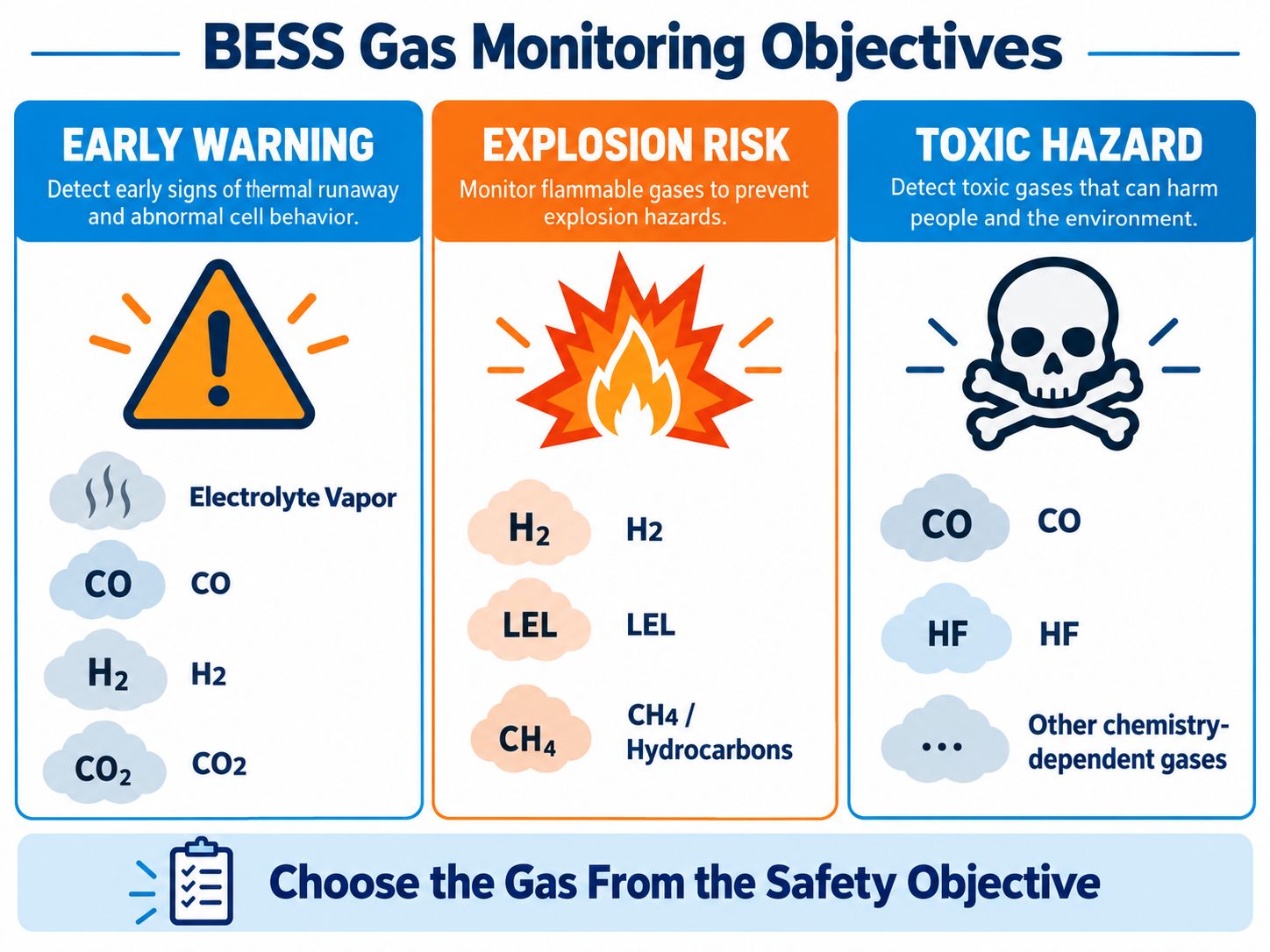
Quick Answer: Which Gases Should a BESS Monitor?
| Safety Objective | Gas / Signal to Evaluate | Main Purpose |
|---|---|---|
| Earliest off-gas warning | Electrolyte vapor / VOC signature | Detect initial venting |
| Early chemical abnormality | CO | Indicate decomposition / off-gassing |
| Early warning + flammability | H₂ | Detect off-gas and combustible accumulation |
| Venting / process indication | CO₂ | Detect decomposition where background allows |
| Explosion risk | H₂, CH₄, hydrocarbons, %LEL | Monitor flammable atmosphere |
| Toxic atmosphere | CO | Personnel / emergency hazard |
| Severe failure toxic hazard | HF and chemistry-dependent gases | Emergency / post-runaway hazard |
| Enclosure atmosphere | O₂ | Personnel / post-event safety |
| Complementary warning | Temperature, pressure, smoke, electrical data | Multi-signal confirmation |
The central rule is:
Choose the gas from the safety objective—not because one gas appears in every thermal-runaway study.
Why Gas Detection Matters in Battery Energy Storage Systems
A conventional battery management system monitors parameters such as:
- voltage
- current
- temperature
- state of charge
- electrical faults
These are essential.
But battery failure is also a chemical process.
Internal electrolyte decomposition and parasitic reactions may generate vapor and gases before a room-level smoke detector sees a developed fire condition.
A simplified progression can look like:
Abnormal cell condition
↓
internal chemical reactions
↓
gas / electrolyte vapor generation
↓
cell venting
↓
gas accumulation
↓
thermal runaway
↓
fire / deflagration
Gas sensing therefore adds information that electrical and temperature channels may not provide in exactly the same way.
A 2026 review in Sensors and Actuators A specifically organizes lithium-ion thermal-runaway monitoring into pre-venting and post-venting regimes and highlights gas, electrolyte vapor, cell/module placement and multimodal sensor fusion as major early-warning directions.
For deeper technical reading, see Advanced Sensing Strategies for Thermal Runaway Monitoring and Early Warning in Lithium-Ion Batteries.
Cell Venting and Thermal Runaway Are Not the Same Stage

A battery cell can vent before it reaches a fully developed thermal runaway event.
That distinction matters enormously for sensor selection.
Stage 1 — Abnormal Heating / Internal Failure
Possible causes include:
- overcharge
- internal short
- mechanical damage
- manufacturing defect
- aging
- external heating
Chemical reactions may already be changing inside the cell.
Stage 2 — Initial Venting
As pressure increases, a cell may release:
- electrolyte vapor
- VOCs
- CO₂
- CO
- H₂
depending on the battery design and failure conditions.
At this point there may still be:
- no visible flame
- little smoke
- limited external temperature rise
This is why off-gas sensing is attractive for early warning.
Stage 3 — Thermal Runaway
Once self-heating becomes uncontrolled, larger quantities of gases can be released.
Possible products include:
- H₂
- CO
- CO₂
- CH₄
- ethylene and other hydrocarbons
- HF
- other toxic decomposition products
Stage 4 — Fire / Deflagration
If enough combustible vent gas accumulates and finds an ignition source, the hazard can progress beyond the battery cell itself.
So:
The best sensor for first vent detection is not necessarily the same sensor used for explosion protection or emergency toxic-gas monitoring.
The sequence shown in the illustration is conceptual. Gas appearance and timing vary with chemistry, SOC, cell format and abuse mechanism.
Electrolyte Vapor and VOCs: An Important Early-Warning Signal
Lithium-ion cells typically contain organic electrolyte solvents.
During abnormal conditions, electrolyte vapor can be released when the cell vents.
That creates an opportunity to detect:
chemical failure before developed fire
Battery-specific electrolyte-vapor sensing has therefore attracted increasing attention.
For example, Honeywell’s current BES battery safety sensor is designed to detect electrolyte released during the first vent stage and also responds to H₂ and CO associated with later thermal-runaway conditions.
See the Honeywell BES battery electrolyte sensor overview.
This does not mean any general VOC sensor automatically becomes a validated BESS early-warning sensor.
A battery off-gas sensor needs to consider:
- target electrolyte chemistry
- background VOCs
- sensor poisoning
- humidity
- ventilation
- cross-sensitivity
- response speed
- installation location
A conventional PID, for example, is intentionally broad and may respond to many ionizable VOCs in the enclosure.
That can be useful for screening, but battery-specific early warning requires validation against the actual system.
Carbon Monoxide: A Useful Thermal-Runaway Marker
CO is frequently discussed as a useful lithium-ion battery off-gas marker.
Potential advantages include:
- mature electrochemical sensor technology
- ppm-level detection
- relatively easy integration
- compatibility with fixed monitoring systems
CO can therefore be useful as part of an early-warning architecture.
But avoid the statement:
CO is always the first gas released by a lithium-ion battery.
That is too absolute.
The timing and amount of CO can change with:
- cathode chemistry
- SOC
- electrolyte
- cell format
- aging
- triggering method
A 2026 review of gas-sensitive materials identifies H₂, electrolyte vapor, CO, CO₂ and CH₄ as useful thermal-runaway warning markers rather than selecting a single universal gas.
See A Review of Gas-Sensitive Materials for Lithium-Ion Battery Thermal Runaway Monitoring.
Hydrogen: Early Chemical Warning and Explosion Risk
Hydrogen is particularly important because it can serve two different monitoring objectives.
H₂ as an Off-Gas Indicator
Hydrogen can rise during abnormal battery reactions and thermal runaway.
Monitoring H₂ close to the rack or cabinet may therefore contribute to early detection.
H₂ as a Flammability Hazard
Hydrogen is highly combustible.
If released gases accumulate inside:
- cabinet
- container
- room
the concern changes from:
Is a cell failing?
to:
Could the atmosphere ignite?
This distinction is important.
A sensor may be useful for early chemical warning, explosion prevention, or both—but the alarm strategy and placement may be different.
For combustible-gas concepts, see What Is a Safe LEL Level?.
CO₂: Useful, but Background Concentration Matters
CO₂ is another common decomposition product.
Potential advantages include:
- mature NDIR technology
- high concentrations during some venting scenarios
- long sensor life
But BESS environments already contain ambient CO₂.
Room-level readings can change because of:
- personnel
- ventilation
- outdoor-air exchange
- adjacent equipment
So a simple rule such as:
Alarm whenever CO₂ exceeds X ppm
may not provide reliable early battery-failure detection across all installations.
A more useful strategy may involve:
- baseline monitoring
- rate-of-rise analysis
- sensor placement close to racks
- confirmation with other signals
In other words:
CO₂ may be a useful marker, but warning performance depends strongly on sensor location and dilution.
Methane and Other Hydrocarbons
Thermal runaway can also produce:
- methane
- ethylene
- ethane
- other combustible hydrocarbons
These gases matter particularly when evaluating:
flammable gas accumulation
But battery off-gas is a complex mixture.
Therefore BESS should not automatically be treated as a normal methane-detection application.
A methane sensor may detect part of the combustible mixture.
A broad LEL detector may provide another view.
But the exact solution should be chosen from:
- actual off-gas composition
- sensor response
- UL 9540A data
- enclosure ventilation
- explosion-control strategy
For methane sensing principles, see Catalytic vs NDIR vs TDLAS Methane Sensors.
What Is the Role of an LEL Detector in BESS?
An LEL detector primarily answers:
Has combustible gas accumulated to a significant fraction of its flammable range?
That is extremely important for:
- explosion prevention
- ventilation control
- emergency response
But an LEL sensor does not necessarily answer:
Has one battery cell just started venting?
Those are different detection objectives.
A small early vent may contain chemically meaningful gases while still being:
- highly diluted
- far below a combustible threshold
Therefore:
LEL monitoring can be important for explosion safety without being the earliest available battery-failure signal.
This is the same basic distinction discussed in PID vs LEL Gas Detector: a detector should be selected according to the hazard question it is meant to answer.
Hydrogen Fluoride: Important Toxic Hazard, Different Objective
HF is a major concern in lithium-ion battery failure because fluorinated electrolyte components can generate hydrogen fluoride and related compounds during severe decomposition.
HF is:
- highly toxic
- corrosive
- important for emergency-response planning
But that does not automatically make HF the best universal first-warning gas.
The concentration and timing of HF release vary with:
- chemistry
- electrolyte formulation
- SOC
- test method
- fire conditions
So it is useful to distinguish:
Early Failure Detection
Potential focus:
- electrolyte vapor
- CO
- H₂
- CO₂
- multi-gas patterns
Severe Failure / Toxic Hazard
Potential focus:
- CO
- HF
- other toxic decomposition products
An important toxic gas is not automatically the best earliest-warning gas.
Should a BESS Monitor Oxygen?
Oxygen is not normally treated as the primary chemical marker of battery thermal runaway.
But O₂ can still matter at:
- container level
- room level
- maintenance
- emergency entry
- post-event atmosphere assessment
Large quantities of released gases may alter the enclosure atmosphere.
So O₂ belongs more naturally in:
personnel / enclosure safety
than:
first-vent battery diagnosis
Early Warning, Explosion Risk and Toxic Hazard Are Three Different Problems
This distinction should drive the entire system design.
Early Warning
Question:
Has a cell started behaving abnormally?
Potential signals:
- electrolyte vapor
- CO
- H₂
- CO₂
- multi-gas patterns
Explosion Risk
Question:
Have combustible gases accumulated inside the enclosure?
Potential signals:
- H₂
- methane / hydrocarbons
- %LEL
Toxic Hazard
Question:
Does the atmosphere pose a danger to workers or responders?
Potential gases:
- CO
- HF
- other chemistry-dependent toxic products
One detector may contribute to multiple objectives.
But:
Do not assume one sensor and one alarm threshold can solve all three.
Pack, Rack and Container Detection Are Not Equivalent
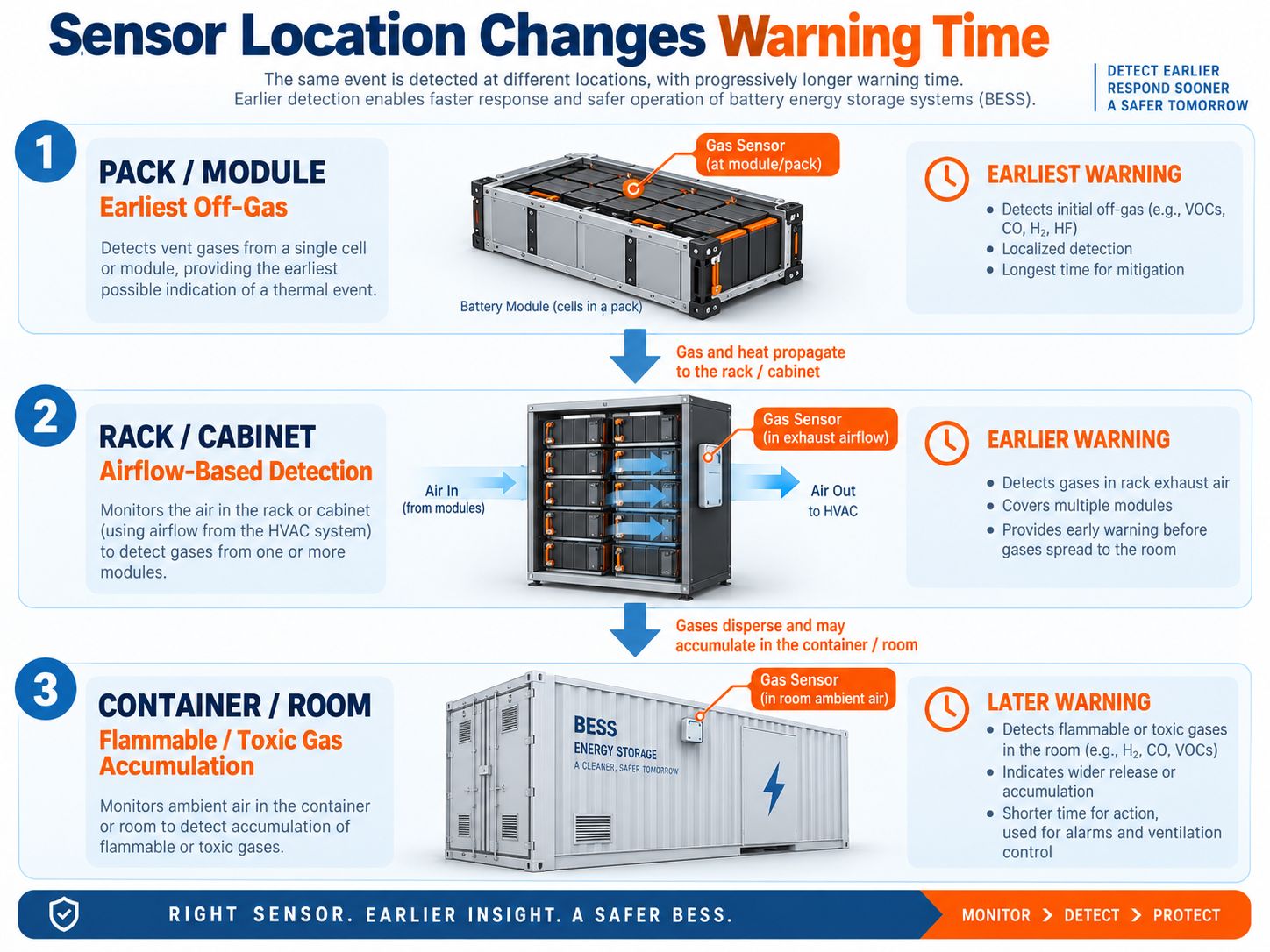
Sensor location can dramatically affect warning performance.
Pack / Module Level
Advantages:
- closest to the failing cell
- less dilution
- potentially earliest detection
Useful signals may include:
- electrolyte vapor
- VOC signature
- CO
- H₂
The challenge is:
- sensor cost
- packaging
- wiring
- lifetime
- environmental exposure
- large sensor count
Rack / Cabinet Level
This is often a practical compromise.
Gas released from multiple modules can be carried by the rack cooling airflow toward a common sensing location.
Advantages:
- earlier than room-level monitoring
- fewer sensors than cell-level architecture
- easier service
This architecture depends strongly on understanding:
actual airflow
Container / Room Level
A room-level detector can monitor:
- overall combustible gas accumulation
- toxic atmosphere
- larger system releases
But by the time a single cell’s off-gas reaches a large container sensor:
dilution has already occurred.
So:
A single room detector is not equivalent to pack- or rack-level early-warning sensing.
The right architecture may therefore use several layers.
Sensor Location Changes Warning Time
In general:
Closer to source
→ less dilution
→ potentially earlier warning
while:
Farther from source
→ more gas mixing
→ broader coverage
→ potentially later warning
But “closer” is not automatically better in every engineering design.
A pack-level sensor must survive:
- battery environment
- thermal conditions
- electrolyte exposure
- long service life
A room-level fixed detector may be easier to maintain and better suited to explosion monitoring.
This is why sensor architecture is a system trade-off.
Follow Rack Airflow—Not Gas Density Alone
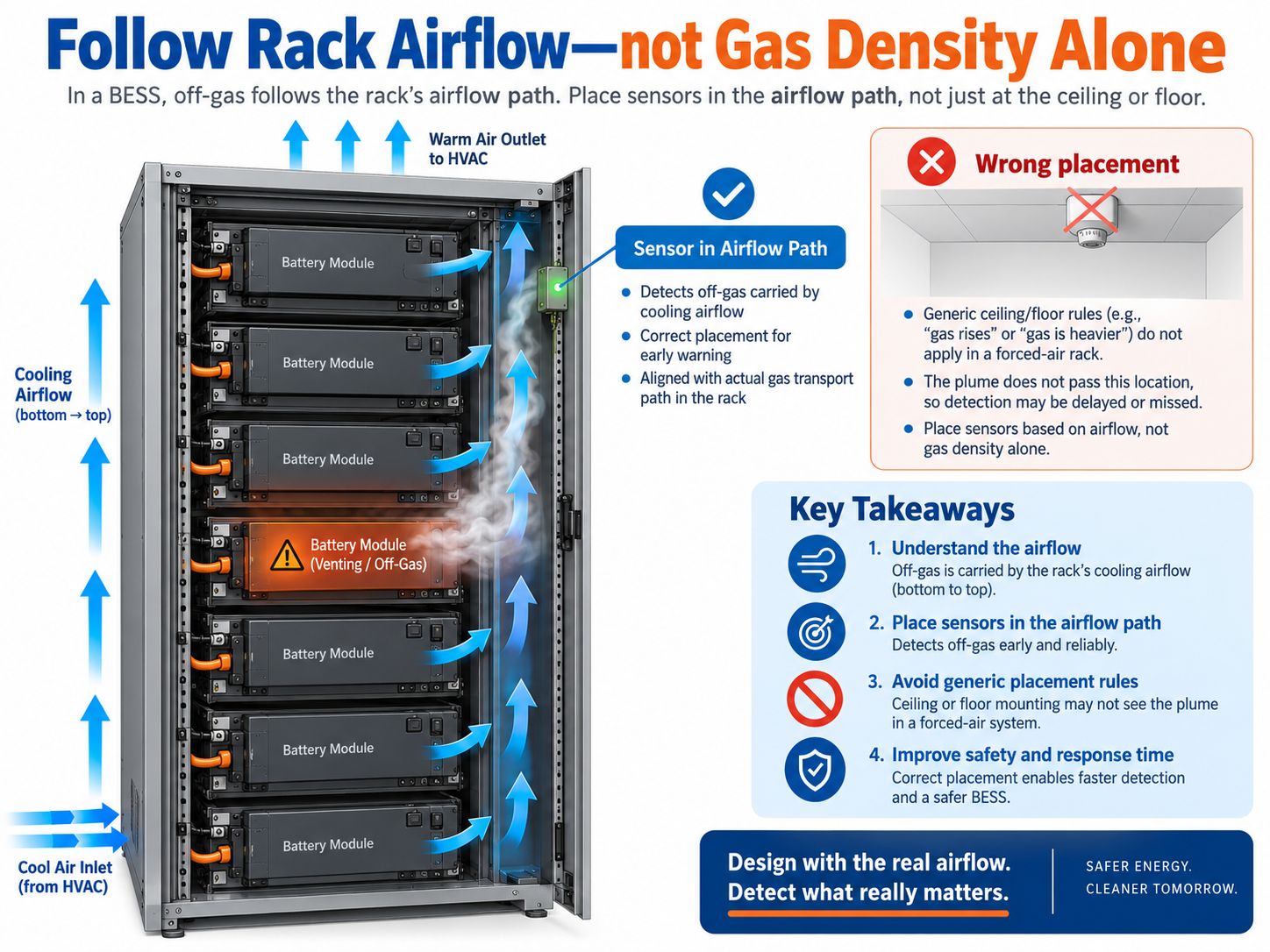
A common mistake is to think:
H₂ is light → sensor always goes at ceiling
or:
CO₂ is heavy → sensor always goes near floor
That is too simple for early BESS off-gas monitoring.
Inside a battery rack, the initial gas cloud can be influenced by:
- hot venting gas
- release momentum
- forced cooling airflow
- rack ducts
- fans
- cabinet geometry
If cooling air moves:
bottom → top
then a useful sensor may be placed in the rack’s exhaust airflow.
If another cabinet moves air differently, the ideal position may change.
Therefore:
BESS off-gas sensor placement should follow the actual gas transport path—not a generic gas-density chart.
The diagram above shows one illustrative airflow design, not a universal bottom-to-top requirement.
For the broader placement methodology, see Where Should Fixed Gas Detectors Be Installed?.
Can One Gas Detector Monitor an Entire BESS Container?
For some container-atmosphere objectives, one or a small number of fixed detectors may provide useful information.
But this does not mean one detector automatically gives:
cell-level early warning
A point gas detector only reacts when gas reaches the sensing element.
Performance depends on:
- sensor location
- ventilation
- rack arrangement
- release point
- gas transport
- enclosure volume
For early warning, local sensing may be more effective.
For explosion control, broader container-level monitoring may be appropriate.
The system objective must be defined first.
Gas Detection vs Smoke Detection

Gas detection and smoke detection should not be treated as competing technologies.
They look for different signals.
Gas / Electrolyte Sensor
May detect:
- chemical decomposition
- first vent
- off-gas
Smoke / Aspirating Smoke Detector
May detect:
- aerosols
- particles
- smoke
Temperature Sensor
Detects:
- cell heating
- module heating
- enclosure temperature rise
BMS
Monitors:
- voltage
- current
- temperature
- SOC
- electrical abnormalities
A robust architecture can combine these.
No single signal should carry the entire BESS safety strategy.
The warning sequence in the illustration is conceptual. Depending on failure mode and detector technology, electrical, gas, pressure, temperature and aerosol signals may appear in a different order.
Gas Detection Does Not Replace the BMS
The BMS is the core battery-management layer.
Gas sensing does not replace:
- voltage monitoring
- current monitoring
- cell temperature
- balancing
- SOC estimation
- fault diagnostics
Instead it adds another information domain:
BMS
electrical / thermal state
Gas Sensor
chemical state
A battery can sometimes show chemical decomposition that is difficult to understand from one electrical parameter alone.
This is why recent research increasingly emphasizes:
multi-signal fusion
rather than looking for one perfect sensor.
Why Multi-Signal Warning Is Stronger
A modern BESS can combine:
Electrical
Voltage / current / impedance
Thermal
Temperature / temperature rate
Chemical
Electrolyte vapor / CO / H₂ / CO₂
Physical
Pressure / aerosol / smoke
↓
BMS / EMS / fire controller
↓
validated mitigation response
The 2026 Sensors and Actuators A review specifically highlights multimodal fusion and edge intelligence as an important direction for improving thermal-runaway warning reliability.
This type of architecture can potentially reduce:
- missed events
- nuisance alarms
- over-reliance on one sensor
Cross-Sensitivity Matters in BESS Gas Detection
A battery failure produces a mixture, not one perfectly isolated gas.
That makes cross-sensitivity especially important.
Suppose a sensor is selected for:
CO
but the vent gas also contains:
- H₂
- electrolyte vapor
- hydrocarbons
A poorly selected CO sensor could respond partly to other gases.
Conversely, a VOC sensor could respond to:
- battery electrolyte
- cleaning solvents
- sealants
- maintenance chemicals
This can affect:
- false alarms
- baseline drift
- alarm thresholds
For the full engineering problem, see Gas Sensor Cross-Sensitivity Explained.
The BESS sensor should be selected for the complete off-gas matrix—not the target gas name alone.
LFP vs NMC: Do They Produce the Same Off-Gas?
No.
Battery gas generation is affected by:
- cathode chemistry
- electrolyte
- SOC
- cell size
- cell format
- aging
- thermal-runaway initiation method
Therefore:
LFP does not mean “no gas hazard.”
Nor should an alarm threshold established for one NMC system automatically be copied to an LFP BESS.
A 2025–2026 body of review literature repeatedly shows significant chemistry- and SOC-dependent differences in thermal-runaway gas composition.
This is one reason system-specific test data are so valuable.
What Does UL 9540A Have to Do With Gas Detection?
UL 9540A is not simply:
“a gas detector standard.”
It is the standardized thermal-runaway fire-propagation test method used to evaluate battery energy storage systems.
At cell level, UL describes testing that evaluates:
- thermal-runaway characteristics
- gas composition
- gas flammability
At module and larger levels, testing evaluates issues including:
- propagation
- heat release
- gas release
- ignition / deflagration behavior
The current UL overview is available here:
UL 9540A Test Method for Battery Energy Storage Systems
UL published the 6th Edition of UL 9540A on March 13, 2026. UL’s current guidance also explains that this edition strengthens installation-level large-scale fire testing and includes intentional ignition of vent gases in the large-scale scenario.
For a gas detection engineer, the most important idea is:
If representative UL 9540A off-gas data exist for the actual battery system, use them.
Do not ignore system-specific test data and select sensors only from a generic internet list.
What Does NFPA 855 Require?
NFPA 855 is the:
Standard for the Installation of Stationary Energy Storage Systems
The current 2026 edition addresses the broader BESS installation safety architecture, including:
- thermal runaway
- explosion control
- fire protection
- commissioning
- operation
- maintenance
The official 2026 edition can be viewed through NFPA 855.
UL explains that UL 9540A is the fire/explosion test method referenced by the 2026 edition of NFPA 855 for BESS evaluation.
But it is important not to overstate what this means.
Neither standard should be reduced to:
“Install a CO sensor and an H₂ sensor.”
The system needs to be engineered around:
- battery test data
- enclosure design
- ventilation
- explosion-control strategy
- fire protection
- occupancy
- AHJ requirements
UL 9540A Test Data Can Improve Sensor Selection
If cell-level test data show a significant release of:
- H₂
- CO
- CO₂
- hydrocarbons
you can begin evaluating:
- which gases appear early
- concentrations generated
- flammability
- sensor range
- expected dilution
Then compare those data with:
Rack Volume
Airflow
Container Volume
Ventilation Rate
to estimate the signal the installed sensor may actually see.
This is much stronger engineering than:
“A paper says batteries release hydrogen, so put an H₂ sensor on the ceiling.”
Gas Detection and Explosion Control
BESS vent gas can create a flammable mixture.
Explosion-control engineering may therefore involve:
- gas generation data
- ventilation
- concentration reduction
- deflagration venting
- enclosure design
UL currently explains that engineering assessments for NFPA 855 explosion prevention can use UL 9540A:
- gas composition data
- gas generation data
- BESS geometry
as inputs for CFD-based evaluation.
This reinforces an important principle:
Gas detection cannot be designed separately from the enclosure and ventilation strategy.
For a point-detector placement overview, see Where Should Fixed Gas Detectors Be Installed?.
What Should Happen After a BESS Off-Gas Alarm?
Early detection has limited value unless the system knows what to do next.
A possible architecture is:
Gas sensor
↓
Local controller / BMS / EMS
↓
Alarm logic
↓
operator notification
↓
charging response / isolation
↓
ventilation / fire strategy
↓
emergency response
But the exact sequence must be validated for the BESS design.
For example:
“CO detected → immediately start maximum ventilation”
should not be treated as a universal rule.
If a flammable mixture exists, ventilation strategy must be part of the engineered explosion-control system.
Possible responses may include:
- stop charging
- isolate affected rack
- notify control room
- modify ventilation
- restrict personnel access
- initiate emergency procedure
The response should be designed before the alarm occurs.
For general alarm philosophy, see Gas Detector Alarm Settings: Low, High, STEL & TWA Explained.
How Should BESS Gas Alarm Setpoints Be Selected?
Do not copy:
10 ppm CO
or:
X ppm H₂
from another project without understanding what the number means.
Possible alarm objectives include:
Early Warning
Detect abnormal battery behavior.
Confirmed Venting
Higher-confidence chemical event.
Flammable Gas Control
Trigger action before dangerous combustible accumulation.
Toxic Atmosphere
Protect workers / responders.
Each objective may require:
- different gas
- different concentration
- different sensor location
- different response
The alarm should therefore be based on:
- UL 9540A / representative test data
- sensor response
- background concentration
- cross-sensitivity
- airflow
- dilution
- system response time
- fire/explosion strategy
Fixed Gas Detection Is Usually the Primary Architecture
BESS equipment is stationary.
The hazard source is also relatively predictable.
That makes fixed gas detection particularly suitable for:
- rack monitoring
- cabinet monitoring
- container monitoring
- battery rooms
Fixed detectors can provide:
- 24/7 monitoring
- remote communication
- automatic alarm
- BMS / EMS integration
Portable gas detectors may still be useful for:
- maintenance
- commissioning
- post-event investigation
- emergency response
But they do not replace permanent early warning.
For the broader comparison, see Fixed vs Portable Gas Detectors.
What Sensor Technology Can Be Used?
Different gases require different sensing approaches.
Electrochemical
Common candidates:
- CO
- HF or other toxic gases where suitable sensors exist
Advantages:
- ppm sensitivity
- low power
- mature technology
Challenges:
- lifetime
- humidity
- cross-sensitivity
MOS / MOX
Useful for:
- electrolyte vapor
- broad VOC
- H₂
- mixed off-gas patterns
Advantages:
- compact
- fast
- broad sensitivity
Challenges:
- selectivity
- humidity
- baseline stability
NDIR
Possible targets:
- CO₂
- methane / hydrocarbons
Advantages:
- long life
- no catalyst consumption
Challenges:
- optical path
- gas-specific wavelength
- room-level dilution
Catalytic / Combustible Sensor
Useful for:
- broad combustible-gas / %LEL measurement
But remember:
flammability monitoring ≠ earliest off-gas detection.
Battery Off-Gas Sensor Placement Workflow

A practical design process is:
Step 1 — Identify Battery Chemistry
Examples:
- LFP
- NMC
- NCA
Also review:
- cell format
- electrolyte
- SOC
- rack design
Step 2 — Review Actual Test Data
Prefer:
- UL 9540A
- manufacturer abuse test
- cell vent-gas data
- representative system testing
Step 3 — Define the Detection Objective
Is the sensor for:
- earliest warning?
- confirmation?
- explosion prevention?
- toxic atmosphere?
- emergency response?
Step 4 — Select the Gas / Vapor Marker
Candidates may include:
- electrolyte vapor
- CO
- H₂
- CO₂
- CH₄
- hydrocarbons
- HF
Step 5 — Select Sensor Technology
Review:
- range
- resolution
- response time
- selectivity
- cross-sensitivity
- lifetime
Step 6 — Choose Placement Level
- pack
- rack
- cabinet
- container
- room
- exhaust path
Step 7 — Analyze Airflow
Determine where vent gas will actually travel.
Step 8 — Define Alarm and System Response
Connect the signal appropriately to:
- BMS
- EMS
- fire controller
- ventilation
- remote alarm
Step 9 — Validate
Use:
- testing
- simulated release
- system-level validation
- representative fire / vent-gas data
Common BESS Gas Detection Mistakes
Mistake 1 — Treating Smoke as the Earliest Possible Warning
Chemical off-gas can precede developed smoke in some failure scenarios.
Mistake 2 — Using Only an LEL Detector for Early Warning
LEL is valuable for flammability but may not provide the earliest cell-failure signal.
Mistake 3 — Assuming H₂ Is Always the First Gas
Gas timing varies.
Mistake 4 — Assuming CO Is Always the First Gas
The same problem applies.
Mistake 5 — Installing One Room Sensor and Calling It Cell-Level Early Warning
Container dilution matters.
Mistake 6 — Mounting Sensors Only From Gas Density
Forced rack airflow can dominate the early gas path.
Mistake 7 — Assuming LFP Has No Thermal-Runaway Gas Risk
LFP chemistry can still vent and release combustible/toxic gases.
Mistake 8 — Ignoring Cross-Sensitivity
Mixed battery off-gas can affect sensor response.
Mistake 9 — Having No Defined Alarm Response
Early warning is only useful if the system knows what action follows.
Mistake 10 — Ignoring Battery-Specific Test Data
Generic literature should not replace actual system data.
BESS Gas Detection Checklist
Before finalizing a BESS gas monitoring design, confirm:
- Battery chemistry identified
- Cell format identified
- SOC / operating conditions reviewed
- UL 9540A or representative test data reviewed
- Early-warning objective defined
- Explosion-risk objective defined
- Toxic-gas objective defined
- Electrolyte vapor evaluated
- CO evaluated
- H₂ evaluated
- CO₂ evaluated
- CH₄ / hydrocarbons evaluated
- HF evaluated where relevant
- Sensor cross-sensitivity reviewed
- Sensor range validated
- Pack/rack/container placement selected
- Cooling airflow mapped
- Ventilation strategy reviewed
- Alarm levels defined
- BMS / EMS integration defined
- Fire-system integration reviewed
- Maintenance and calibration planned
- System response validated
Frequently Asked Questions
What gases are released during lithium-ion battery thermal runaway?
Possible gases include:
- H₂
- CO
- CO₂
- CH₄
- other hydrocarbons
- HF
- electrolyte vapors
The composition varies with chemistry, SOC, cell design and failure mechanism.
What is the best gas for detecting battery thermal runaway?
There is no universally best gas.
Electrolyte vapor, H₂, CO, CO₂ and CH₄ can all provide useful information depending on the system and failure stage.
Is CO a good early-warning gas for BESS?
CO can be a useful thermal-runaway marker and is attractive because mature ppm-level sensors are available.
But it should not be assumed to be the first gas in every battery failure.
Is hydrogen released during battery thermal runaway?
Yes, hydrogen is an important component of many lithium-ion battery vent-gas mixtures.
It is relevant both as a failure indicator and as a flammability hazard.
Can VOC sensors detect battery venting?
Potentially.
Battery electrolyte vapor can provide an early chemical signal.
However, a general-purpose VOC detector should not automatically be assumed to be a validated battery electrolyte sensor.
Should BESS monitor CO or H₂?
Often the better question is whether both provide complementary information.
CO and H₂ can behave differently during battery failure and may support multi-gas detection strategies.
Is CO₂ useful for BESS early warning?
Yes in some architectures.
But ambient background and dilution can reduce sensitivity at room level, so placement and rate-of-change behavior matter.
Does BESS need an LEL detector?
LEL monitoring may be important where combustible vent gas can accumulate.
Whether it is required and where it should be installed depends on the system’s explosion-control design and applicable requirements.
Can an LEL detector detect thermal runaway early?
It can detect combustible-gas accumulation, but it should not automatically be considered the earliest possible cell-failure signal.
Is HF released during lithium-ion battery fires?
HF can be generated during severe lithium-ion battery failure and fire.
The amount varies substantially with battery chemistry and event conditions.
Do LFP batteries release gas?
Yes.
LFP batteries can still generate and vent gases during failure and thermal runaway.
Where should BESS gas detectors be installed?
Possible levels include:
- pack
- rack
- cabinet
- container
- room
Placement should follow the actual airflow and gas transport path.
Should sensors always be mounted high because hydrogen rises?
No.
For rack-level early off-gas detection, forced airflow and vent-gas momentum can matter more than a simple gas-density rule.
Can one gas detector protect an entire BESS container?
It may provide useful container-level monitoring, but it should not automatically be considered equivalent to local pack- or rack-level early-warning detection.
Is gas detection better than smoke detection?
They detect different phenomena.
A layered architecture may use:
- gas
- temperature
- pressure
- smoke / aerosol
- BMS data
together.
Does UL 9540A require a specific gas detector?
UL 9540A is a thermal-runaway fire-propagation test method, not a universal prescription that every BESS must use one specific gas sensor.
Its test data can help inform gas detection and explosion-control engineering.
How does gas detection integrate with the BMS?
Gas alarms can be communicated to control systems such as:
- BMS
- EMS
- fire controller
The response could include alarms, charging changes, isolation or other mitigation actions depending on the validated system design.
Final Takeaway
The wrong question is:
Should a BESS detect CO, H₂ or CO₂?
The better questions are:
What failure stage do we want to detect?
Where will the sensor be installed?
What does the actual battery release during failure?
What action should follow the alarm?
For very early chemical warning, evaluate:
electrolyte vapor + CO + H₂ + other relevant markers
For flammable atmosphere protection, evaluate:
H₂ + hydrocarbons + %LEL
For toxic post-failure hazards, evaluate:
CO + HF + chemistry-dependent gases
And then combine gas sensing with:
BMS
temperature
pressure
smoke / aerosol
The most useful BESS safety principle is therefore:
No single gas, sensor or signal should carry the entire safety strategy.
Use battery-specific data, place sensors where off-gas will actually travel, and connect each alarm to a validated response.
References and Further Reading
- UL Solutions — UL 9540A Test Method for Battery Energy Storage Systems
- NFPA — NFPA 855: Standard for the Installation of Stationary Energy Storage Systems, 2026 Edition
- UL Solutions — Understanding UL 9540A and NFPA 855
- Advanced Sensing Strategies for Thermal Runaway Monitoring and Early Warning in Lithium-Ion Batteries — Sensors and Actuators A, 2026
- A Review of Gas-Sensitive Materials for Lithium-Ion Battery Thermal Runaway Monitoring — Molecules, 2026
- Early Warning of Lithium-Ion Battery Thermal Runaway Based on Gas Sensors — eTransportation
- Honeywell — Battery Safety Electrolyte Sensor
- GasNose — Fixed Gas Detector Placement
- GasNose — Gas Sensor Cross-Sensitivity
- GasNose — Gas Detector Alarm Settings
- GasNose — Fixed vs Portable Gas Detectors
- GasNose — What Is a Safe LEL Level?
- GasNose — Catalytic vs NDIR vs TDLAS Methane Sensors
