




Wastewater treatment plants can contain several very different gas hazards.
Some gases are generated naturally as sewage and sludge decompose.
Others come from chemicals deliberately used for:
- disinfection
- pH control
- odor control
- nutrient removal
- other treatment processes
That means there is no universal wastewater gas detector configuration that is correct for every plant.
For many sewage collection and treatment applications, the first three hazards to evaluate are:
- hydrogen sulfide — H₂S
- methane / combustible gas — CH₄ / %LEL
- oxygen deficiency — O₂
But that is only the starting point.
Depending on the treatment process, a facility may also need to monitor:
- carbon dioxide — CO₂
- chlorine — Cl₂
- chlorine dioxide — ClO₂
- ozone — O₃
- ammonia — NH₃
- sulfur dioxide — SO₂
- volatile organic compounds — VOCs
- carbon monoxide — CO
The most useful rule is:
Monitor the process—not a generic gas list.
A wet well, anaerobic digester, chlorine room and industrial wastewater tank can all belong to the same wastewater facility while requiring completely different gas channels.
Quick Guide: Which Gases Matter in Wastewater Treatment?
| Gas | Main Hazard | Typical Locations / Processes |
|---|---|---|
| H₂S | Acute toxicity, flammability, corrosion | Sewers, wet wells, lift stations, sludge, headworks |
| CH₄ / %LEL | Fire and explosion | Digesters, wet wells, sewage systems, sludge processes |
| O₂ | Oxygen deficiency / enrichment | Confined spaces, tanks, wet wells, manholes |
| CO₂ | Asphyxiation, process gas | Digesters, biogas systems, low enclosed areas |
| Cl₂ | Acute toxicity, corrosivity | Gaseous chlorination systems |
| ClO₂ | Toxic oxidizing gas | Chlorine-dioxide generation and dosing areas |
| O₃ | Strong oxidizer, respiratory hazard | Ozone generation and disinfection |
| NH₃ | Toxic / irritating | Site-specific treatment or chemical systems |
| SO₂ | Toxic process gas | Certain dechlorination or chemical processes |
| VOCs | Toxicity / flammability varies | Industrial wastewater, solvents, refinery or chemical influent |
| CO | Toxic combustion gas | Engines, generators, combustion equipment |
This table is a hazard-screening guide, not a requirement that every wastewater facility install every sensor listed.
Where Do Wastewater Gas Hazards Come From?

Wastewater gas hazards can be divided into two broad categories.
Gases Generated by Wastewater and Sludge
Organic material decomposes biologically.
Depending on oxygen availability and process conditions, this can generate or contribute to:
- H₂S
- CH₄
- CO₂
- oxygen depletion
These hazards occur throughout sewage collection, pumping, sludge handling and anaerobic treatment.
Gases Used by the Treatment Process
A plant may also intentionally use chemicals such as:
- chlorine
- chlorine dioxide
- ozone
- ammonia-related chemicals
- sulfur-containing treatment chemicals
These create localized gas risks that do not necessarily exist elsewhere in the plant.
This difference is important.
A chlorine room should not have the same detector configuration as a wet well simply because both are inside a wastewater facility.
Hydrogen Sulfide: One of the Most Important Wastewater Gas Hazards
Hydrogen sulfide deserves particular attention in wastewater treatment.
H₂S can be produced when microorganisms break down sulfur-containing organic material under low-oxygen or anaerobic conditions.
Common H₂S locations include:
- sanitary sewers
- manholes
- wet wells
- lift stations
- force mains
- headworks
- sludge tanks
- thickeners
- dewatering systems
- pump stations
H₂S creates several problems simultaneously.
Toxicity
Hydrogen sulfide can cause serious health effects at relatively low concentrations, and high concentrations can rapidly incapacitate workers.
Flammability
H₂S is also combustible.
Corrosion
H₂S and its oxidation products contribute to corrosion in:
- concrete
- metals
- electrical equipment
- wastewater infrastructure
Odor Is Not a Reliable Safety Indicator
H₂S is associated with a characteristic rotten-egg odor at low concentrations.
But smell should never be used as the gas detection method.
The human sense of smell can become unreliable during exposure.
Therefore:
If H₂S is a credible wastewater hazard, use an instrument—not your nose.
Where Should H₂S Be Monitored in a Wastewater Facility?
Priority locations may include:
Wet Wells
Raw sewage can remain under oxygen-poor conditions, allowing H₂S to accumulate.
Lift Stations
Many lift stations are:
- enclosed
- intermittently occupied
- connected directly to raw sewage
This makes fixed H₂S detection particularly valuable.
Manholes and Sewers
These are classic confined-space applications.
Atmospheric conditions can change unexpectedly because of:
- sewage decomposition
- upstream activities
- ventilation
- industrial discharges
Headworks
Incoming wastewater can release dissolved H₂S when turbulence increases.
Sludge Handling
Thickening, storage and dewatering can release H₂S.
Enclosed Pump Rooms
Gas from connected sewage systems may migrate into the room.
The correct monitoring locations should follow actual gas release and airflow rather than simply assuming H₂S must always remain at floor level.
Methane: The Main Combustible Gas Concern
Methane is produced during anaerobic decomposition of organic matter.
It is especially important in:
- anaerobic digesters
- sludge systems
- wet wells
- enclosed sewage systems
- biogas equipment
The primary safety concern is:
fire and explosion
For personnel and facility safety, methane is commonly monitored as:
%LEL
LEL means:
Lower Explosive Limit
A detector configured for 0–100% LEL answers a safety question:
How close is the atmosphere to a combustible methane concentration?
That is different from measuring the percentage of methane in biogas.
Methane %LEL vs Methane %vol: They Are Not the Same Measurement
This distinction is especially important in wastewater treatment.
Safety Monitoring
Typical objective:
CH₄ / combustible gas in %LEL
Question:
Is methane approaching its flammable range in air?
Typical use:
- worker protection
- pump rooms
- wet wells
- confined spaces
- gas-leak safety
Digester Gas Analysis
Typical objective:
CH₄ in %vol
Question:
What percentage of the biogas is methane?
Typical use:
- process control
- energy-value assessment
- digester optimization
- engine / CHP feed
- biogas upgrading
A detector designed for:
0–100% LEL methane
is therefore not automatically the correct instrument for:
50–70%vol methane in biogas.
Same gas. Different measurement objective.
What Gases Are in Anaerobic Digester Biogas?
Anaerobic digestion creates a different gas-monitoring problem from a normal wet well.
Biogas commonly contains:
Methane — CH₄
The major combustible and energy-containing component.
Carbon Dioxide — CO₂
Another major component of biogas.
Hydrogen Sulfide — H₂S
Often present as a lower-concentration contaminant.
It matters because it is:
- toxic
- corrosive
- damaging to downstream equipment
Water Vapor
Important for gas conditioning and process equipment.
Trace Gases
Composition varies with feedstock and process.
Therefore a wastewater digester may need two different monitoring systems:
Safety gas detection
and:
process gas analysis
They should not be confused.
Why Oxygen Monitoring Matters in Wastewater Work
Wastewater spaces can become oxygen-deficient.
Possible causes include:
- microbial activity
- displacement by methane
- displacement by CO₂
- poor ventilation
- other process gases
This is especially important in:
- manholes
- tanks
- wet wells
- digesters
- pits
- enclosed pump stations
A dangerous atmosphere may therefore exist even if the toxic-gas channels are showing low readings.
Oxygen should be treated as its own hazard.
For confined-space entry, atmospheric testing typically considers:
- oxygen
- combustible gases / vapors
- potential toxic contaminants
A pumped portable detector is often used to test the space before anyone enters.
Oxygen Deficiency Does Not Tell You Which Gas Caused It
Suppose a detector shows:
17% O₂
That tells you there is an oxygen-deficiency problem.
But it does not tell you whether oxygen was displaced by:
- CO₂
- methane
- nitrogen
- another gas
This is an important distinction.
An O₂ sensor measures oxygen.
It is not a universal asphyxiant-gas analyzer.
If CO₂ itself is an important process or worker hazard, measure CO₂ directly.
Carbon Dioxide in Wastewater Treatment
CO₂ can be produced through biological activity and is a major component of anaerobic digester gas.
High CO₂ concentrations can:
- displace oxygen
- create an asphyxiation risk
- affect process operation
Because CO₂ is heavier than air under ordinary conditions, low areas such as:
- pits
- trenches
- cellars
can deserve special consideration.
But actual detector placement should still account for:
- ventilation
- leak source
- gas temperature
- release conditions
rather than gas density alone.
Wastewater Gas Monitoring by Area
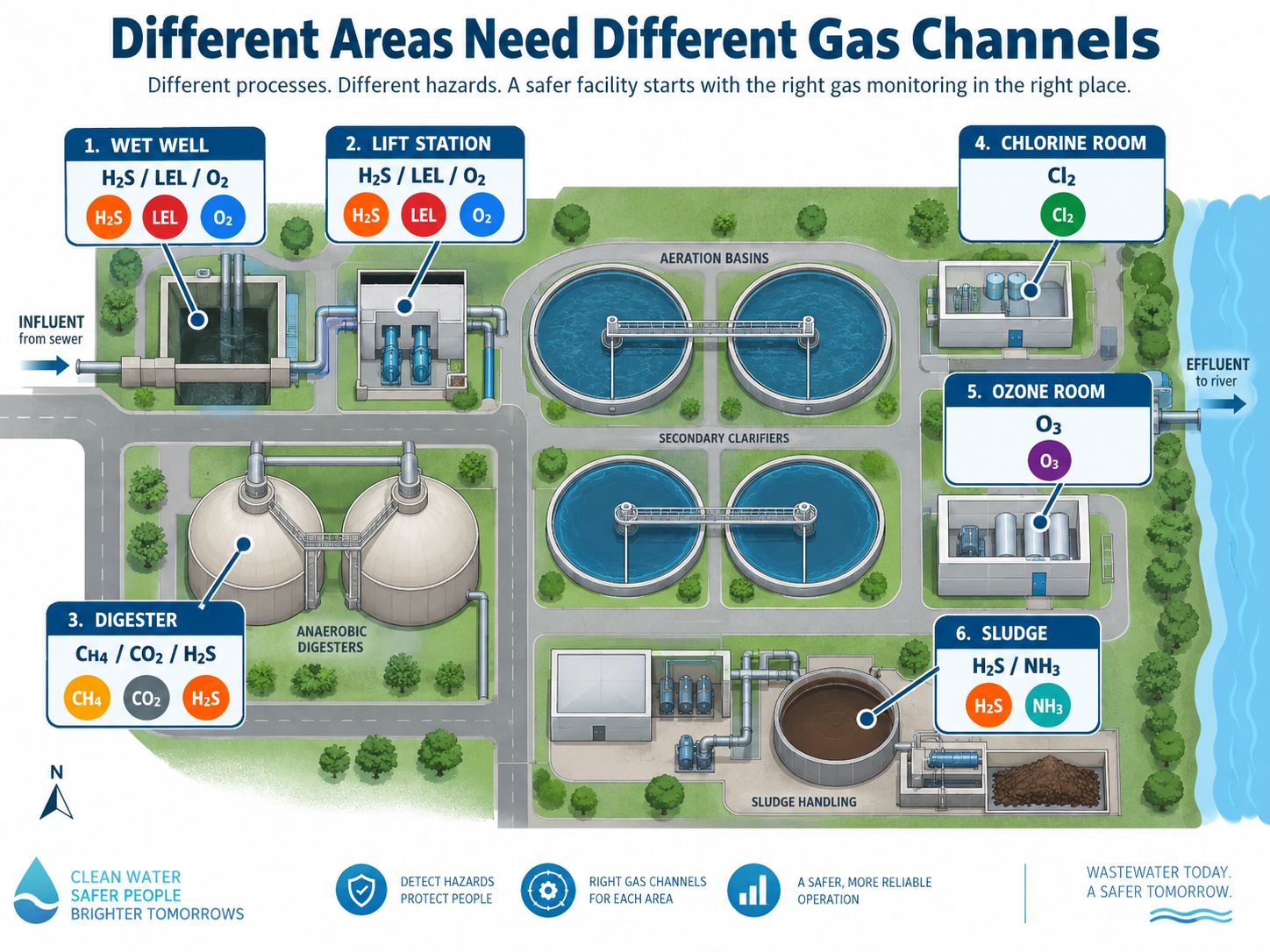
One of the best ways to select gas channels is to work area by area.
| Wastewater Area | Gases to Evaluate First |
|---|---|
| Sewer / manhole | H₂S, O₂, CH₄ / %LEL, other site-specific toxic gases |
| Wet well | H₂S, O₂, CH₄ / %LEL |
| Lift station | H₂S, CH₄ / %LEL, O₂ |
| Headworks | H₂S, O₂, CH₄ / %LEL |
| Pump room | H₂S, O₂, combustible gas where credible |
| Sludge thickening / storage | H₂S, CH₄, O₂; NH₃ where process-relevant |
| Sludge dewatering | H₂S and other process-specific gases |
| Anaerobic digester | CH₄, CO₂, H₂S; O₂ where process/safety strategy requires |
| Chlorine room | Cl₂ |
| Chlorine-dioxide system | ClO₂ |
| Ozone room | O₃ |
| Ammonia handling | NH₃ |
| Industrial wastewater | Core wastewater gases + VOC/process-specific toxic gases |
The principle is:
Gas selection should follow the unit process—not the facility name.
Is Carbon Monoxide a Core Wastewater Gas?
A standard portable four-gas monitor commonly contains:
- O₂
- %LEL
- H₂S
- CO
That can create the impression that CO is automatically one of the main gases produced by sewage.
That is misleading.
H₂S and methane are closely associated with decomposition and wastewater processes.
CO is more commonly associated with combustion sources such as:
- engines
- generators
- vehicles
- boilers
- heating equipment
CO may absolutely be relevant at a wastewater facility.
But:
CO should not automatically be described as a primary sewage-decomposition gas just because it is included in a standard four-gas monitor.
This distinction matters when selecting detectors rather than simply purchasing a default instrument configuration.
Chlorine Detection
Some wastewater facilities use gaseous chlorine for disinfection.
Where chlorine gas is actually:
- stored
- distributed
- injected
- generated
fixed Cl₂ detection can be highly important.
Potential monitoring areas include:
- chlorine cylinder storage
- chlorinator rooms
- feed equipment
- valve manifolds
Cl₂ is:
- highly toxic
- irritating
- corrosive
But many modern facilities use other disinfection chemicals instead.
Therefore:
Do not install a chlorine channel simply because the site treats wastewater. Install it because chlorine is a credible gas-release hazard in that process.
Chlorine Dioxide Is Not the Same as Chlorine
Chlorine dioxide:
ClO₂
is chemically different from:
Cl₂
If a plant generates or uses chlorine dioxide, the detector must be suitable for ClO₂.
Do not assume that:
chlorine sensor = chlorine-dioxide sensor
without checking the detector’s intended target gas and cross-sensitivity.
This is also where sensor cross-interference becomes important.
Ozone Detection
Ozone may be used for:
- disinfection
- oxidation
- advanced treatment
O₃ is a strong oxidizer and respiratory hazard.
Potential monitoring locations include:
- ozone generator rooms
- ozone contact systems
- destruct units
- piping areas
- enclosed process spaces
Ozone requires an appropriate ozone sensor.
A standard LEL sensor does not provide ozone monitoring.
Ammonia: Important Only Where the Process Justifies It
Ammonia may be relevant because of:
- specific wastewater chemistry
- sludge processes
- nutrient treatment
- chemical storage
- industrial influent
But NH₃ is not a universal fixed-gas requirement for every municipal wastewater plant.
The correct question is:
Can ammonia be generated, stored or released at this site at a concentration that creates a worker or process hazard?
If yes, include it in the hazard assessment.
If no, simply adding an NH₃ channel because another wastewater plant uses one provides little value.
What About VOCs in Industrial Wastewater?
Municipal sewage and industrial wastewater can have very different gas profiles.
Industrial wastewater may contain chemicals from:
- refineries
- paint and coating plants
- printing
- pharmaceutical production
- solvent processing
- petrochemical facilities
- chemical manufacturing
Potential volatile contaminants may include:
- aromatic hydrocarbons
- solvents
- fuels
- alcohols
- other VOCs
A standard:
O₂ + LEL + H₂S + CO
monitor may not adequately characterize low-level VOC exposure.
In these applications, monitoring may require:
- PID
- compound-specific sensor
- detector tubes
- process analyzer
- laboratory sampling
The detector should follow the actual influent chemistry.
LEL and PID Answer Different Questions
Suppose an industrial wastewater tank contains a flammable solvent vapor.
The LEL detector asks:
Is the vapor approaching a combustible concentration?
A PID may ask:
Are ionizable VOCs present at a lower ppm-level concentration?
Those are different hazards.
A VOC may create an occupational-exposure problem long before it creates an LEL alarm.
That is why some industrial wastewater applications need:
PID + LEL
rather than choosing one.
A Standard Four-Gas Monitor Is Not Always Enough
A conventional four-gas monitor usually measures:
- O₂
- %LEL
- H₂S
- CO
This is a useful configuration for many:
- sewer entries
- manholes
- wet wells
- maintenance activities
But it is not universally sufficient.
Chlorine Room
May require:
Cl₂
Ozone System
May require:
O₃
Chlorine-Dioxide System
May require:
ClO₂
Industrial Wastewater
May require:
PID / VOC-specific measurement
Anaerobic Digester Process Gas
May require:
CH₄ %vol + CO₂ %vol + H₂S
Therefore:
Four channels do not automatically mean the four correct gases.
Fixed vs Portable Wastewater Gas Detection

Wastewater treatment is a good example of why fixed and portable gas detection often work together.
Fixed Gas Detection
Fixed detectors are especially useful for permanent hazards such as:
- wet wells
- lift stations
- pump rooms
- digester buildings
- chlorine rooms
- ozone rooms
- chemical storage
Advantages include:
- continuous monitoring
- unattended operation
- remote alarms
- ventilation integration
- process shutdown integration
Many lift stations and pumping facilities operate with few or no workers continuously present.
That makes permanent detection particularly valuable.
Portable Gas Detection
Portable monitors are better suited to:
- manhole entry
- tank entry
- wet-well entry
- inspection
- maintenance
- leak investigation
- temporary work
The instrument moves with the worker.
Pumped Portable Detection
Before entering a confined wastewater space, a pumped monitor can draw gas through a sampling line.
This allows testing:
before the worker enters the atmosphere.
Once entry begins, a personal monitor can continue following the worker.
So:
Fixed protects the facility. Portable protects the worker.
Wastewater Confined Spaces Need Special Attention
Wastewater facilities contain many potential confined spaces.
Examples include:
- manholes
- sewers
- tanks
- pits
- wet wells
- digesters
- lift stations
Hazards may include:
- oxygen deficiency
- H₂S
- methane
- CO₂
- process chemicals
Atmospheric conditions can also vary vertically.
For example, measuring only at the opening of a manhole does not necessarily represent conditions deeper inside.
Where required, test different levels and locations according to the applicable confined-space procedure.
H₂S Odor Does Not Make a Manhole Safe to Enter
A worker may say:
“I don’t smell sewer gas.”
That should never be used as entry authorization.
H₂S can become dangerous rapidly.
In addition:
- olfactory response changes with exposure
- gas concentration can vary by depth
- ventilation conditions can change
- upstream operations can affect the sewer atmosphere
Use proper direct-reading instrumentation.
Where Should Fixed Wastewater Gas Detectors Be Installed?
Detector placement should begin with:
- gas source
- airflow
- ventilation
- accumulation zones
- worker locations
—not simply gas density.
H₂S
Consider:
- wet-well openings
- sewage release points
- headworks
- worker areas
- airflow path
Methane
Consider:
- digesters
- gas piping
- wet wells
- high accumulation areas
- ventilation
CO₂
Consider:
- digesters
- process gas systems
- pits
- low enclosed areas
Chlorine
Place according to:
- chlorine storage
- feed equipment
- credible release path
- ventilation design
A fixed point detector does not have a universal coverage radius.
The gas must reach its sensing element.
Wastewater Environments Are Hard on Gas Detectors
Wastewater facilities often combine:
- high humidity
- condensation
- corrosive gas
- splash
- washdown
- dirt
- dust
- biological contamination
These conditions affect detector design and maintenance.
Potential hardware considerations include:
- enclosure rating
- corrosion-resistant materials
- splash guards
- hydrophobic membranes
- sensor filters
- remote calibration access
A sensor with excellent laboratory performance can still perform poorly if the installation does not survive the real wastewater environment.
H₂S Can Also Damage the Facility
Wastewater H₂S is not only a worker-exposure problem.
Hydrogen sulfide can contribute to:
- odor complaints
- metal corrosion
- concrete deterioration
- electrical-system degradation
Therefore H₂S monitoring can support:
Personnel Safety
Process Reliability
Asset Protection
depending on the application.
Sensor Cross-Sensitivity Matters in Wastewater Too
Wastewater is a mixed-gas environment.
One sensor may be exposed simultaneously to:
- H₂S
- methane
- CO₂
- VOCs
- cleaning chemicals
- process gases
This makes sensor selectivity important.
For example:
- electrochemical sensors can respond to interfering gases
- PID responds broadly to many ionizable VOCs
- some optical sensors can have hydrocarbon interference
Do not select a gas sensor solely from the target-gas name.
Review the entire gas matrix.
Gas Detector Alarm Settings Should Match the Application
The same gas may require different alarm logic depending on whether the instrument is used for:
- personal exposure
- process alarm
- flammable-gas warning
- ventilation control
For example:
H₂S
May use:
- Low
- High
- STEL
- TWA
O₂
Usually:
- low oxygen alarm
- high oxygen alarm
%LEL
Usually:
- Low %LEL
- High %LEL
Do not copy alarm values blindly from another plant.
Calibration Is Especially Important in Wastewater Environments
Dirty and humid environments can affect detector response.
Maintenance planning should include:
- visual inspection
- functional testing
- bump testing where applicable
- calibration
- filter inspection
- sensor replacement
A fixed detector that has not been maintained is not reliable simply because it is still powered on.
For portable monitors used before confined-space entry, detector readiness should be verified before relying on the atmospheric test.
Wastewater Gas Monitoring Selection Workflow

A practical selection process is:
Step 1 — Identify the Treatment Area
Examples:
- sewer
- wet well
- lift station
- headworks
- digester
- sludge building
- chemical room
Step 2 — Identify Gases Generated by the Process
Ask:
- Is sewage decomposing anaerobically?
- Is biogas produced?
- Can H₂S form?
- Can oxygen become depleted?
Step 3 — Identify Chemicals Used or Stored
Examples:
- chlorine
- chlorine dioxide
- ozone
- ammonia-related chemicals
- industrial solvents
Step 4 — Identify Confined Spaces
Determine whether workers enter:
- manholes
- tanks
- pits
- wells
- enclosed structures
Step 5 — Decide Fixed, Portable or Both
Permanent unattended hazard:
fixed
Mobile worker / temporary task:
portable
Both conditions:
layered fixed + portable monitoring
Step 6 — Select Gas, Sensor Technology and Range
For example:
Methane safety
may require:
0–100% LEL
while:
digester gas composition
may require:
high-%vol methane analysis
Step 7 — Define Alarm and Control Actions
Possible actions include:
- worker withdrawal
- local alarm
- ventilation
- control-room notification
- shutdown
Step 8 — Plan Maintenance
Include:
- testing
- calibration
- sensor replacement
- records
The detector specification should follow this process—not the other way around.
Wastewater Gas Detection Checklist
Before selecting a system, confirm:
- Wastewater process reviewed
- H₂S evaluated
- CH₄ / combustible gas evaluated
- Oxygen deficiency evaluated
- CO₂ evaluated where relevant
- Chlorine process reviewed
- Chlorine dioxide process reviewed
- Ozone process reviewed
- NH₃ sources reviewed
- VOC / industrial influent reviewed
- Combustion-related CO sources reviewed
- Confined spaces identified
- Fixed monitoring locations identified
- Portable monitoring requirements identified
- Sensor ranges matched to measurement objective
- Cross-sensitivity reviewed
- Detector placement reviewed
- Alarm actions documented
- Calibration and maintenance planned
Frequently Asked Questions
What gases are commonly found in wastewater treatment plants?
Common hazards include H₂S, methane and oxygen deficiency.
CO₂ can also be important, particularly around anaerobic digestion.
Additional gases depend on the actual treatment process.
What is the most dangerous gas in a sewer?
H₂S is one of the most important acute toxic hazards because it can reach dangerous concentrations in sewers and manholes.
But oxygen deficiency and combustible gases can also be immediately dangerous.
There is no single gas that should be evaluated in isolation.
What gases should be monitored in a wet well?
A common starting assessment includes:
- H₂S
- O₂
- methane / combustible gas
Additional channels depend on site conditions.
What gases should be monitored at a lift station?
H₂S, combustible gas/methane and oxygen are common hazards to evaluate.
The exact configuration should follow the site’s sewage chemistry, ventilation and worker-access requirements.
Is methane present in wastewater treatment?
Yes.
Methane can form when organic material decomposes anaerobically and is a major component of digester biogas.
Why is H₂S common in wastewater?
Sulfur-containing material can be biologically converted to hydrogen sulfide under low-oxygen and anaerobic conditions.
Wastewater and sludge therefore provide environments where H₂S can form.
Do wastewater plants need oxygen monitoring?
Many wastewater confined-space and enclosed-area applications do.
Oxygen can be consumed or displaced by other gases.
Is CO₂ dangerous in wastewater plants?
Yes, at sufficiently high concentrations.
CO₂ can displace oxygen and create an asphyxiation hazard.
It is especially relevant around anaerobic digestion and biogas systems.
Is CO one of the main sewage gases?
Not in the same way as H₂S and methane.
CO is more commonly linked to combustion sources.
It may still be an important gas at a wastewater facility, especially around engines, generators or confined-space work.
Is a standard four-gas monitor enough for wastewater work?
Sometimes, but not always.
O₂ + LEL + H₂S + CO is a useful common configuration.
A chlorine, ozone, ammonia, VOC or other process-specific hazard may require additional sensors.
What gases should be monitored in an anaerobic digester?
Common gases to evaluate include:
- CH₄
- CO₂
- H₂S
O₂ can also be important depending on the safety and process-monitoring strategy.
Is a methane LEL detector suitable for measuring digester gas composition?
Not necessarily.
A %LEL detector is primarily intended for flammability safety in air.
Digester gas may contain methane at tens of percent by volume and often requires a different analyzer range.
Do chlorine rooms need fixed gas detection?
Where gaseous chlorine is stored or can be released, fixed chlorine detection is commonly an important safety measure.
The system should be designed around the actual chlorine process.
What detector is needed for ozone disinfection?
Use a detector specifically designed to measure ozone in the relevant concentration range.
A conventional LEL or four-gas detector does not provide ozone monitoring unless an ozone channel is specifically included.
Do all wastewater plants need ammonia detectors?
No.
NH₃ monitoring should be based on the actual process, chemical inventory and credible release scenarios.
Should wastewater gas detection be fixed or portable?
Many facilities need both.
Fixed detectors provide continuous facility protection.
Portable detectors support:
- workers
- maintenance
- confined-space pre-entry testing
- temporary operations
Final Takeaway
The question:
“What gases should a wastewater plant monitor?”
does not have one universal four-gas answer.
For many sewage collection and treatment applications, begin by evaluating:
H₂S
CH₄ / combustible gas
O₂
Then look at the actual unit process.
Anaerobic digestion may add:
CO₂ + high-%vol CH₄ analysis
A chlorine system may add:
Cl₂
An ozone process may add:
O₃
Industrial wastewater may add:
VOCs or compound-specific toxic gases
And combustion equipment may make:
CO
relevant even though CO is not a primary sewage-decomposition gas.
That gives us the most useful rule:
Monitor the process—not a generic gas list.
A wastewater gas detection system should be designed from:
Area
Process
Generated Gases
Stored Chemicals
Worker Tasks
Measurement Range
Fixed / Portable Strategy
Only then should the detector channels be selected.
