




How long does a gas sensor last?
The technically correct answer is:
There is no universal gas sensor lifetime. A sensor reaches end of life when its performance can no longer meet the required specification—not simply when a fixed number of calendar years has passed.
Some commercial gas sensors are specified for around two years. Others are rated for five, eight, ten, or even more years. That does not mean one sensing technology always lasts longer than another, and it does not mean a sensor works perfectly until a specific birthday and then suddenly dies.
Lifetime depends on:
- sensing technology
- target gas
- cell chemistry
- temperature and humidity
- exposure history
- poisoning and contamination
- over-range events
- storage conditions
- mechanical stress
- calibration history
- the manufacturer’s end-of-life criteria
This is why engineers should distinguish expected life, operating life, shelf life, warranty, replacement interval, and actual end of life.
Expected Life, Operating Life, Shelf Life and Warranty Are Not the Same
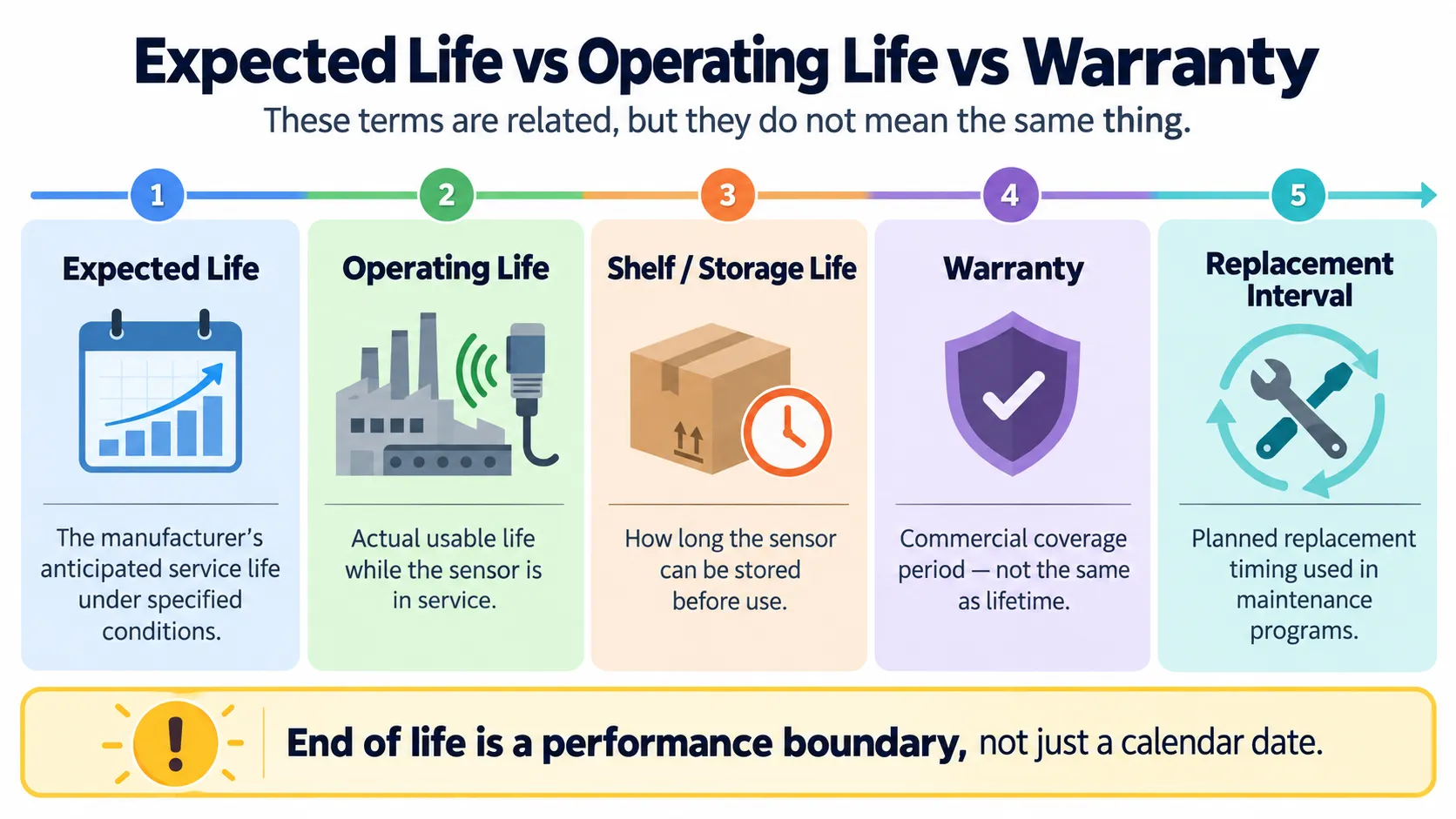
Several different time-related specifications may appear in a gas sensor datasheet.
Expected Life / Anticipated Life
This is the manufacturer’s anticipated usable service period under stated or assumed conditions.
It is generally based on:
- sensor design
- qualification testing
- field experience
- expected environmental conditions
- expected exposure profile
It is not a promise that every individual sensor will fail on the same date.
Operating Life
Operating life normally refers to how long the sensor is expected to remain functional while in service.
Some manufacturers define this more precisely.
For example, Alphasense currently defines the operating life of its NO2-AE electrochemical sensor as the number of months until the signal falls to 80% of the original value, and lists an operating life greater than 24 months.
See: Alphasense NO2-AE Datasheet
This is a useful example because it shows that lifetime can be tied to a performance threshold, not simply elapsed time.
Shelf / Storage Life
Shelf life concerns the period before the sensor is installed and used.
A sensor may still age during storage because its:
- electrolyte
- seals
- catalyst
- filter
- lamp
- membrane
can continue changing.
Storage temperature and humidity therefore matter.
Warranty
Warranty is a commercial commitment from the manufacturer.
It is not automatically the same as:
- physical sensor lifetime
- shelf life
- operating life
- replacement interval
For example, ION Science currently lists an expected MiniPID 2 sensor life of more than five years while the body/lamp warranty is much shorter.
See: ION Science MiniPID 2 PPM Datasheet
Replacement Interval
A replacement interval may be defined by:
- the detector manufacturer
- a safety standard
- a maintenance program
- a certification requirement
- an application-specific risk policy
A preventive replacement interval can be shorter than the theoretical physical lifetime.
End of Life
End of life is the point where the sensor can no longer provide performance that satisfies the required specification.
That may mean unacceptable:
- sensitivity
- zero stability
- accuracy
- repeatability
- response time
- noise
- calibration behavior
So:
End of life is fundamentally a performance decision, even when a manufacturer also uses a calendar-based replacement rule.
Gas Sensor End of Life Is Usually Not a Sudden Failure
A gas sensor does not necessarily move from:
healthyto:
deadin one instant.
A more realistic pattern for many sensors is:
Initial stabilization
↓
Long useful operating period
↓
Gradual performance change
↓
Accelerating deterioration
↓
Performance no longer meets requirement
A CoGDEM working group involving multiple gas-sensor manufacturers described this pattern for electrochemical sensors. Their work found that sensors can continue to respond to test gas even after performance has deteriorated to the point where the sensor is no longer reliable.
See: CoGDEM — What Is My Gas Sensor Lifetime?
This leads to an important rule:
“The sensor still responds to gas” does not automatically mean “the sensor is still within specification.”
For this reason, the aging curve should be treated as a conceptual model, not as a universal numeric curve. Different manufacturers define their own performance limits and end-of-life criteria.
What Does End of Life Actually Mean?
End of life may occur when one or more critical characteristics move outside allowable limits.
Sensitivity becomes too low
The same gas concentration produces less signal.
Zero becomes unstable
The baseline may shift or fluctuate excessively.
Response becomes too slow
The sensor still responds, but not within the required T90 or application timing.
See Gas Sensor Response Time: T50 vs T90 Explained.
Calibration can no longer restore acceptable performance
A span adjustment may reach its limit, or the sensor may fail the detector’s calibration acceptance criteria.
Noise becomes too high
A weakening signal combined with noise can make low-concentration measurements unreliable.
Drift becomes excessive
Zero or span drift may become too large between maintenance intervals.
See What Is Gas Sensor Drift? Zero Drift, Span Drift & Baseline Drift Explained.
Repeatability becomes poor
Repeated measurements under the same conditions may no longer agree sufficiently.
See Gas Sensor Repeatability vs Accuracy: What’s the Difference?.
A sensor therefore does not need to produce exactly zero output to be considered at end of life.
What Shortens Gas Sensor Lifetime?
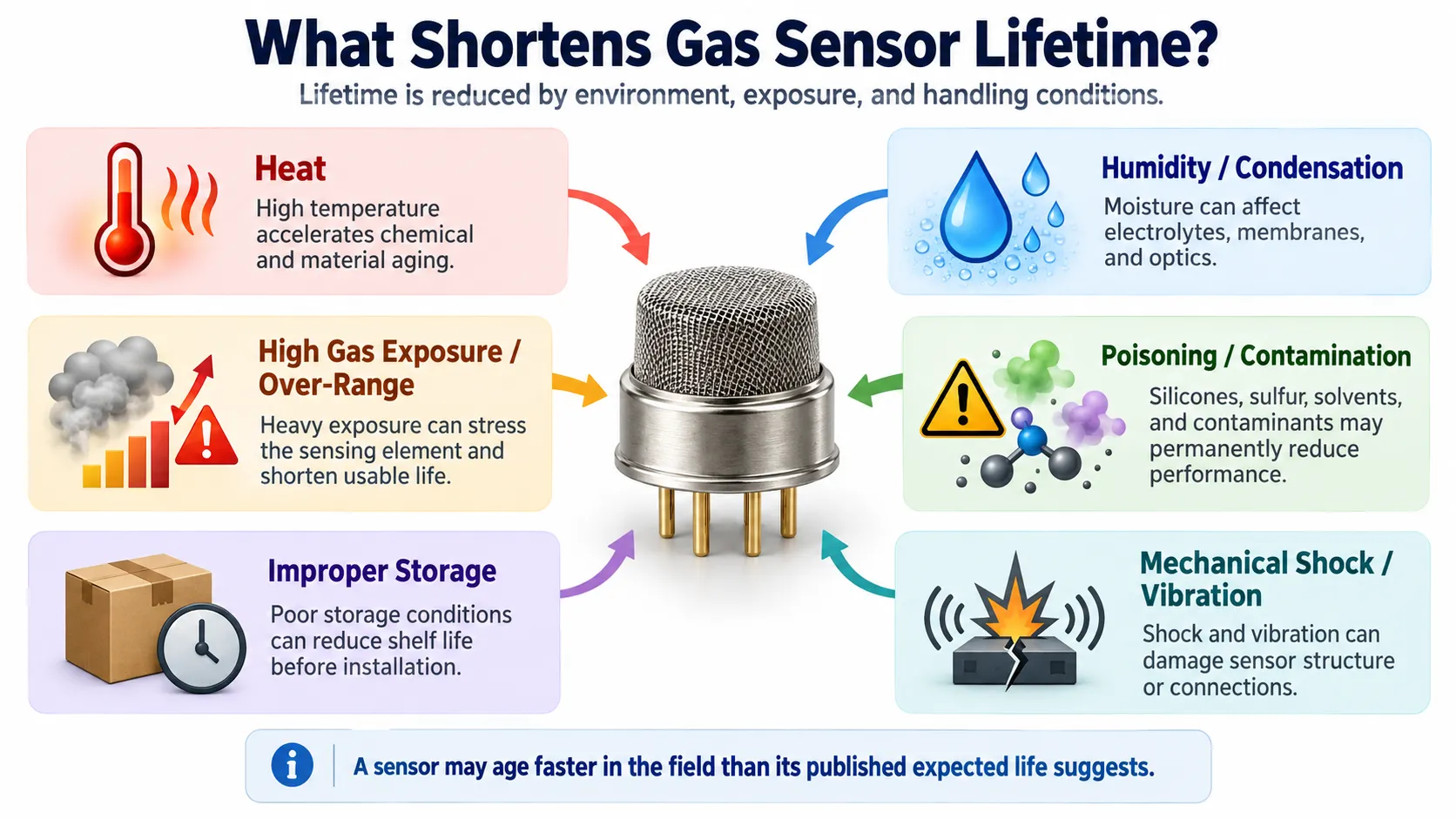
Gas sensor aging is affected by both normal service and abnormal stress.
High Temperature
High temperature can accelerate:
- chemical reactions
- electrolyte evaporation
- seal aging
- catalyst degradation
- lamp and electronic aging
Analog Devices notes that repeated high-temperature stress can accelerate irreversible deterioration in electrochemical gas sensors.
See: Analog Devices — Overcoming the Technical Challenges of Electrochemical Gas Sensing
Humidity and Condensation
Humidity can affect several technologies differently.
For electrochemical sensors, extreme humidity can alter electrolyte condition.
For optical sensors, condensation can affect the gas path or optical surfaces.
For MOS sensors, humidity can influence sensing-surface chemistry.
For a deeper explanation, see How Humidity Affects Gas Sensors.
High Gas Exposure and Over-Range Events
High concentrations can cause:
- temporary saturation
- long recovery
- electrolyte stress
- catalyst stress
- irreversible damage in some sensor types
But an over-range event is not automatically end of life.
The sensor may recover and still meet specification.
See Gas Sensor Saturation and Over-Range Explained.
Poisoning and Contamination
Known catalyst poisons can cause rapid loss of sensitivity in catalytic bead sensors.
Other contaminants can affect:
- electrochemical cells
- MOS surfaces
- PID lamps
- optical windows
See Gas Sensor Poisoning vs Cross-Sensitivity and Catalytic Sensor Poisoning and Inhibition Explained.
Improper Storage
Storage outside recommended temperature or humidity conditions can reduce shelf life before the sensor is even installed.
Mechanical Shock and Vibration
Mechanical stress can damage:
- electrodes
- internal connections
- beads
- membranes
- seals
Honeywell’s catalytic LEL sensor safety guidance specifically warns that excessive shock and vibration can cause mechanical breakage.
See: Honeywell / City Technology — LEL Sensor Instructions for Safe Use
Different Gas Sensor Technologies Age Differently
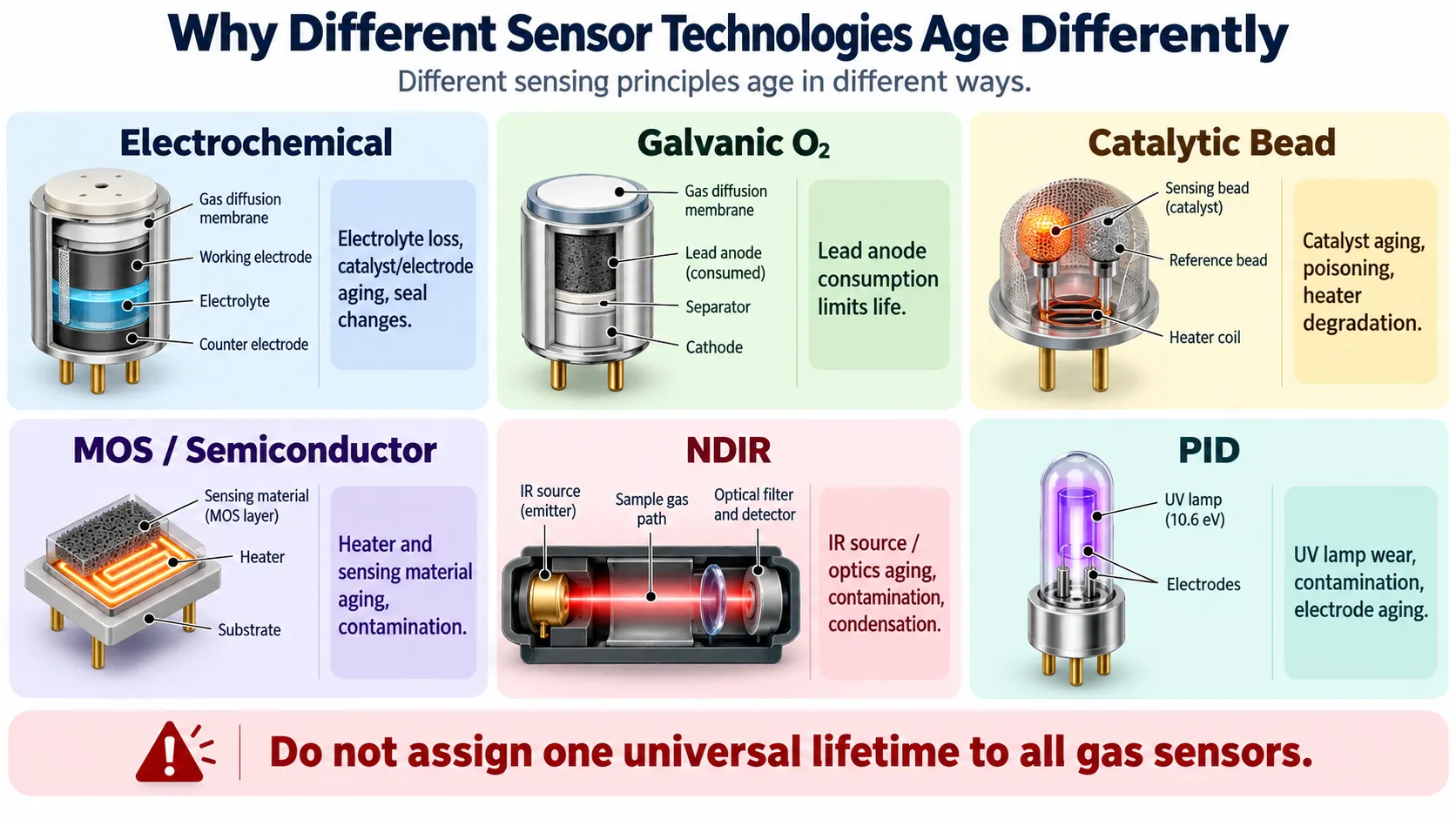
It is misleading to assign one lifetime to an entire gas-sensor category.
Different sensing principles have different aging mechanisms.
Electrochemical Toxic Gas Sensor Lifetime
Electrochemical sensors are widely used for gases such as:
- CO
- H₂S
- NO₂
- SO₂
- Cl₂
- NH₃
- H₂
- O₃
Their long-term behavior can be affected by:
- electrode aging
- catalyst degradation
- electrolyte loss or dilution
- membrane aging
- seal degradation
- contamination
- temperature
- humidity
- high gas exposure
Analog Devices describes electrochemical gas sensors as devices that naturally age and drift during operation, with harsh environmental conditions accelerating deterioration.
A CoGDEM manufacturer working group concluded that electrochemical lifetime failures are strongly associated with catalyst degradation and mechanical failure mechanisms.
So it is not technically correct to say:
All electrochemical gas sensors last 2 years.Actual commercial specifications vary substantially.
Real product examples
Winsen’s current ME2-CO specification lists:
Anticipated using life: 5 yearsSee: Winsen ME2-CO
Winsen’s MEu-2CO currently lists:
Expected service life: 8 years in airand separately lists its recommended storage conditions and storage period.
See: Winsen MEu-2CO
Alphasense NO2-AE lists:
Operating life: >24 monthsunder its defined test basis.
These are model-specific values, not universal ratings for all electrochemical sensors.
Why Target Gas Matters
Even sensors that use the same broad electrochemical principle can have very different lifetimes because their:
- electrode chemistry
- catalyst loading
- electrolyte
- target-gas reaction
- bias conditions
- filters
are different.
For example, a CO cell and an NH₃ cell should not be assumed to have identical aging mechanisms simply because both are electrochemical.
So:
Sensor technology is only the first level of classification. Lifetime must ultimately be checked at the individual model level.
Oxygen Sensor Lifetime Is a Special Case
Traditional galvanic oxygen sensors are particularly useful for explaining why lifetime depends on chemistry.
Many conventional O₂ sensors use a consumable anode.
Conceptually:
O₂ enters sensor
↓
Electrochemical reaction occurs
↓
Anode material is gradually consumed
↓
Available reactive material decreases
↓
Sensor eventually reaches end of useful life
This means oxygen exposure itself is part of the underlying consumption mechanism.
But even within oxygen sensors, designs differ.
Alphasense currently separates:
- lead-based oxygen sensors
- lead-free galvanic oxygen sensors
- long-life lead-free amperometric oxygen sensors
Its LFO2-A1 long-life lead-free amperometric sensor is currently specified at 5+ years.
See: Alphasense LFO2-A1
Its broader oxygen portfolio shows different lifetimes for different oxygen-sensor designs.
See: Alphasense Oxygen Sensors
This is an excellent reminder that:
Even sensors measuring the same gas can use different aging mechanisms and have different service-life expectations.
Catalytic Bead Sensor Lifetime
Catalytic bead sensors depend on a heated catalyst surface.
Their lifetime can be affected by:
- normal catalyst aging
- poisoning
- inhibition
- heater degradation
- mechanical damage
- thermal stress
- contaminated atmospheres
Honeywell notes that catalytic LEL sensitivity tends to decrease over time even without frequent combustible-VOC exposure, while poisoning can produce permanent degradation.
See: Honeywell — Extending Life of LEL Sensors in Field Conditions
So for catalytic sensors:
Exposure history can matter as much as calendar age.
A sensor exposed to silicone contamination may become unreliable much earlier than an identical sensor operating in clean conditions.
For the detailed mechanism, see Catalytic Sensor Poisoning and Inhibition Explained.
MOS / Semiconductor Gas Sensor Lifetime
MOS sensors generally use:
- a heated sensing material
- metal-oxide surface chemistry
- long-term resistance behavior
Aging can involve:
- sensing-material changes
- heater aging
- contamination
- baseline-resistance drift
- filter degradation
- surface chemistry changes
Some MOS sensors have long published service lives.
For example, Winsen’s current MQ-2 page lists:
Lifespan: 10 yearsSee: Winsen MQ-2
Figaro provides an especially useful example showing why a technology-wide number is inappropriate:
TGS2610 / TGS2611: 5 years
TGS6810 / TGS6812: 10 years
See: Figaro Combustible Gas Sensors
The products are all combustible-gas sensors, yet their expected lives are not identical.
NDIR Gas Sensor Lifetime
NDIR sensors use infrared absorption rather than a consumable electrochemical reaction or hot catalytic combustion.
That removes several common consumable-chemistry aging mechanisms.
But NDIR sensors still age.
Long-term factors can include:
- IR source aging
- photodetector aging
- optical filter aging
- dust
- condensation
- oil mist
- optical-path contamination
- electronics
Honeywell’s current CRIR CO₂ sensor lists:
Expected operating life: 10 yearsSee: Honeywell CRIR Series CO₂ Sensor
Honeywell’s current 4R NDIR hydrocarbon sensor is described as designed to operate for over ten years.
See: Honeywell 4R NDIR Gas Sensor
These examples show why NDIR is often associated with long service life.
But:
Non-consumptive sensing does not mean infinite lifetime.
For the technology itself, see NDIR Gas Sensors.
PID Sensor Lifetime: Sensor Life Is Not Lamp Life
Photoionization detectors are another good example of why one “lifetime” number can be misleading.
A PID sensor assembly may contain:
- UV lamp
- electrode stack
- electronic components
Each can age differently.
ION Science currently lists for MiniPID 2 PPM:
Sensor life: >5 years
Lamp life: 10,000 hours
These are separate specifications.
See: ION Science MiniPID 2 PPM Datasheet
This means:
A replaceable or serviceable component can reach its maintenance limit before the entire sensor assembly reaches end of life.
PID maintenance also depends heavily on contamination. Dirty lamp windows or electrode stacks can reduce response even if the rest of the sensor remains usable.
TDLAS Sensor Lifetime
TDLAS does not have one universal sensor-life number either.
A complete TDLAS system may age through:
- laser aging
- photodetector aging
- optical contamination
- alignment changes
- electronics
- window contamination
The sensing mechanism avoids many electrochemical or catalytic consumable mechanisms, but lifetime is highly system-specific.
See TDLAS Gas Sensors.
Published Lifetime Examples: Do Not Turn Them Into Technology Rules
The following examples illustrate how widely product-level specifications can vary.
| Example Product | Technology | Published Life |
|---|---|---|
| Alphasense NO2-AE | Electrochemical NO₂ | >24 months operating life |
| Winsen ME2-CO | Electrochemical CO | 5 years anticipated life |
| Winsen MEu-2CO | Electrochemical CO | 8 years in air |
| Alphasense LFO2-A1 | Lead-free amperometric O₂ | 5+ years |
| Figaro TGS2610 / TGS2611 | Semiconductor combustible | 5 years |
| Figaro TGS6810 / TGS6812 | Combustible sensor family | 10 years |
| Winsen MQ-2 | Semiconductor combustible | 10 years |
| Honeywell CRIR | NDIR CO₂ | 10 years |
| Honeywell 4R NDIR | NDIR hydrocarbon | >10 years design life |
| ION Science MiniPID 2 | PID | >5 years sensor; 10,000 h lamp |
Important: These values are examples for specific products under their manufacturers’ stated conditions. They are not general lifetime ratings for the entire sensing technology.
Expected Life vs Actual Field Life
Suppose a datasheet says:
Expected life: 5 yearsThat does not mean:
Day 1–1824: perfect
Day 1825: failed
Expected life is based on assumptions.
Actual field life can be shorter because of:
- high temperature
- extreme humidity
- poisoning
- corrosive exposure
- repeated over-range exposure
- poor storage
- contamination
- vibration
A sensor in favorable conditions may also continue to function beyond a nominal expectation.
But that does not automatically authorize continued use.
The correct decision depends on:
- manufacturer instructions
- detector certification
- maintenance policy
- actual sensor performance
- safety risk
Does a Gas Sensor Age While Sitting on the Shelf?
Yes, depending on the sensor.
Storage is not always a “pause button.”
During storage:
- electrolyte can change
- seals can age
- filters can age
- moisture can enter or leave
- materials can slowly react
This is why some manufacturers separately specify:
- storage temperature
- storage humidity
- storage period
- operating life
For example, Winsen’s MEu-2CO separately lists an eight-year expected service life in air and an original-package storage time limit.
See: Winsen MEu-2CO
Therefore:
Do not buy long-term spare inventory without checking shelf-life requirements.
Does More Gas Exposure Always Shorten Sensor Life?
No universal rule applies.
The effect depends on how the sensor works.
Galvanic oxygen sensors
Continuous oxygen reaction may consume anode material.
Electrochemical toxic-gas sensors
High concentration or prolonged exposure can stress:
- electrodes
- electrolyte
- catalyst
but the exact effect is model-specific.
Catalytic bead sensors
Normal combustible-gas measurement is not the same as simply “using up” the sensor, but poisoning and severe exposure can permanently reduce sensitivity.
MOS sensors
Exposure affects surface chemistry, but long-term aging depends on much more than total target-gas dose.
NDIR
Gas measurement itself does not depend on a consumable chemical reaction.
So:
“More gas exposure means shorter life” is true for some mechanisms, but should not be applied to every gas sensor.
Does High Concentration or Over-Range Exposure Reduce Lifetime?
It can.
A high-concentration event may cause:
- saturation
- slow recovery
- electrolyte stress
- catalyst stress
- temporary inhibition
- irreversible damage
But an over-range event does not automatically prove the sensor has reached end of life.
The correct workflow is:
Over-range exposure
↓
Allow proper recovery
↓
Apply correct test gas
↓
Check calibration
↓
Confirm sensitivity / response time
See Gas Sensor Saturation and Over-Range Explained.
Temperature and Humidity Can Change Both Performance and Lifetime
Environmental specifications deserve careful reading.
A sensor may operate across a wide temperature range, yet prolonged operation near the extremes can affect aging differently from operation under nominal conditions.
For electrochemical sensors, Analog Devices notes that:
- repeated high-temperature stress can accelerate electrolyte loss
- very low temperature can strongly reduce sensitivity and response speed
- humidity strongly affects electrolyte condition
This means:
Being inside the absolute operating range does not necessarily mean lifetime is completely unaffected.
See How Temperature Affects Gas Sensor Readings and How Humidity Affects Gas Sensors.
Poisoning vs Normal Aging
Normal aging is often gradual:
100%
↓
98%
↓
95%
↓
92%
↓
88%
Poisoning can be much more abrupt:
100%
↓
specific contaminant exposure
↓
60%
That distinction matters during troubleshooting.
If a sensor suddenly loses sensitivity after:
- silicone exposure
- sulfur exposure
- solvent exposure
- unusual maintenance work
normal aging may not be the main cause.
See Gas Sensor Poisoning vs Cross-Sensitivity.
Drift Is Not Automatically End of Life
Drift is a change in sensor output with time.
A sensor can drift and still remain usable if calibration restores acceptable performance.
For example:
Zero drift
↓
zero calibration
↓
baseline corrected
↓
sensor still meets sensitivity and response requirements
But if drift becomes too severe, calibration frequency increases, or sensitivity cannot be restored, the sensor may be approaching end of life.
See What Is Gas Sensor Drift?.
Calibration Does Not Reset Sensor Age
This is one of the most important ideas in the entire topic.
Calibration can correct:
- zero offset
- span coefficient
- measurement conversion
Calibration cannot:
- refill lost electrolyte
- replace a consumed anode
- regenerate a poisoned catalyst
- reverse mechanical damage
- make an aged PID lamp new
- clean an optical path automatically
Therefore:
Calibration resets the measurement reference, not the physical age of the sensor.
A sensor that can still be calibrated may remain usable if it meets all manufacturer limits.
But “calibration succeeded” does not mean:
sensor age = zeroFor maintenance fundamentals, see Gas Detector Bump Test vs Calibration.
Can a Sensor Still Work After Its Expected Lifetime?
Possibly—but that is not the same as saying it should remain in service.
A sensor may still:
- produce output
- respond to gas
- pass some checks
after its nominal expected life.
Whether continued use is allowed depends on:
- manufacturer instructions
- detector design
- certification
- maintenance policy
- application risk
- actual performance
Some devices use fixed calendar-based end-of-life logic.
Others use:
- calibration acceptance
- sensor-health diagnostics
- maintenance criteria
Emerson, for example, currently advertises a gas sensor end-of-life diagnostic in its Millennium II ST3 XChem toxic gas sensor system.
See: Emerson Net Safety Millennium II ST3 XChem
So:
An EOL warning may be a preventive health decision, not a statement that the sensor produces zero signal.
Can a Sensor Fail Before Its Rated Lifetime?
Absolutely.
Suppose:
Published expected life: 5 years
Actual service: 18 months
If the sensor has experienced:
- severe poisoning
- corrosive exposure
- flooding
- mechanical damage
- extreme temperature
- repeated calibration failure
then waiting another 3.5 years would be unsafe.
A published lifetime is not permission to keep using a sensor that fails its required checks.
When Should a Gas Sensor Be Replaced?
Do not rely on one indicator.
A practical replacement decision should consider several conditions.
Manufacturer-defined life or EOL requirement
If the manufacturer requires replacement at a specific interval, follow that requirement.
Bump / function test
Does the sensor respond to a known gas challenge?
Calibration
Can zero and span still be adjusted within the required limits?
Sensitivity
Does the sensor still produce sufficient response per unit concentration?
Response time
Does it still meet the required response specification?
Zero stability and drift
Is the baseline stable enough for the application?
Noise and repeatability
Are repeated measurements still usable?
Exposure history
Has the sensor been exposed to:
- poisons
- over-range concentrations
- corrosive chemicals
- extreme environments
Physical condition
Is there damage to:
- membrane
- filter
- optical path
- enclosure
- electrical contacts
The sensor should be removed from service if its performance cannot be verified against the manufacturer’s requirements.
A Practical End-of-Life Decision Workflow
A useful sequence is:
Manufacturer-mandated EOL reached?
↓
Follow required replacement rule
If no mandatory EOL has been reached:
Bump / function test acceptable?
↓
Calibration acceptable?
↓
Sensitivity acceptable?
↓
Response time acceptable?
↓
Zero / drift / noise acceptable?
↓
No damaging exposure history?
↓
Continue service according to maintenance plan
If any critical check fails:
Investigate
↓
Recover / clean / calibrate if permitted
↓
Retest
↓
Replace if required performance cannot be restored
The exact limits must come from the sensor or instrument manufacturer.
Can Sensor Diagnostics Predict End of Life?
Increasingly, yes.
Advanced sensor systems can use:
- impedance measurements
- calibration history
- sensitivity trends
- zero trends
- self-diagnostics
- operating history
to estimate sensor health.
Analog Devices describes electrochemical diagnostic techniques such as impedance spectroscopy that can correlate with sensitivity loss and help estimate remaining sensor lifetime.
See: Analog Devices CN0429 — Electrochemical Gas Measurement System With Sensor Diagnostics
This is important for OEM design because predictive diagnostics can reduce both:
- premature replacement
- dangerously late replacement
Gas Sensor Lifetime Selection Checklist
Before comparing two sensors based on “lifetime,” ask:
- What exact sensor model is being compared?
- What target gas?
- What sensing technology?
- Is the number expected life or guaranteed life?
- How does the manufacturer define end of life?
- Is shelf life specified separately?
- Is warranty being confused with lifetime?
- What temperature and humidity assumptions apply?
- What gas exposure assumptions apply?
- Are known poisons present?
- Is a consumable component involved?
- Does the instrument provide an EOL diagnostic?
- What maintenance interval is required?
- What replacement policy does the final instrument require?
Common Gas Sensor Lifetime Mistakes
Mistake 1 — All Electrochemical Sensors Last Two Years
False.
Published lifetimes vary widely by target gas, chemistry, and model.
Mistake 2 — Warranty Equals Lifetime
False.
Warranty is a commercial term.
Mistake 3 — A Sensor Is Good Until Its Rated Life Is Reached
False.
Poisoning, damage, or harsh conditions can cause earlier failure.
Mistake 4 — A Sensor Must Be Dead at End of Life
False.
A sensor may still respond to gas while no longer meeting required performance.
Mistake 5 — Calibration Makes the Sensor “New Again”
False.
Calibration changes measurement coefficients, not physical age.
Mistake 6 — Storage Does Not Count
False.
Some sensors continue aging during storage.
Mistake 7 — NDIR Has Infinite Life
False.
Optical sources, detectors, optics, and electronics still age.
Mistake 8 — PID Lamp Life Equals PID Sensor Life
False.
The lamp is one component of the PID sensor assembly.
Mistake 9 — A Stable Zero Means the Sensor Is Healthy
False.
Sensitivity may have deteriorated even if the baseline looks normal.
Mistake 10 — One Lifetime Number Can Represent an Entire Technology
False.
Always compare individual sensor models.
Frequently Asked Questions
How long do gas sensors last?
There is no universal value. Depending on the sensor technology, target gas and product design, published expected lives may range from a few years to ten years or more.
The correct value must come from the specific sensor datasheet.
What is gas sensor end of life?
End of life is the condition where sensor performance no longer satisfies the required specification or the manufacturer’s defined replacement criteria.
Does a gas sensor suddenly stop working at end of life?
Not necessarily.
It may still respond to gas while sensitivity, response time, stability, or accuracy has deteriorated beyond acceptable limits.
Do electrochemical gas sensors expire?
Yes.
Electrochemical sensors age due to mechanisms such as electrode/catalyst changes, electrolyte changes, seals, contamination, and environmental stress.
How long does a CO sensor last?
It depends on the model.
For example, Winsen currently lists five years for ME2-CO and eight years in air for MEu-2CO.
These examples should not be generalized to every CO sensor.
How long does an oxygen sensor last?
It depends strongly on the oxygen-sensor chemistry.
Traditional galvanic sensors may be limited by consumable electrode material, while some newer lead-free amperometric oxygen sensors are specified for 5+ years.
Does a gas sensor age while in storage?
It can.
That is why many manufacturers specify separate storage temperature, humidity, and shelf-life conditions.
Does high gas concentration reduce sensor life?
It can, depending on sensor chemistry.
High concentration may cause saturation, stress, contamination, or irreversible damage in some sensors.
Does calibration extend gas sensor life?
Calibration does not reverse physical aging.
It can compensate for acceptable zero or span changes and verify whether the sensor is still usable.
Can a sensor still detect gas after end of life?
Yes.
It may still generate a response even though that response is no longer accurate, fast, stable, or strong enough to meet specification.
Why does my gas detector show EOL?
An EOL warning may be based on:
- elapsed service time
- manufacturer replacement logic
- calibration history
- sensor-health diagnostics
- internal performance criteria
Consult the detector manual rather than assuming the sensor has completely stopped responding.
Can I use a sensor beyond its expected lifetime?
Only if the manufacturer and the instrument’s maintenance/certification requirements permit it.
Do not override a mandatory end-of-life rule just because the sensor still produces a signal.
Can a sensor fail before its expected lifetime?
Yes.
Poisoning, contamination, high temperature, humidity, over-range exposure, mechanical damage, or improper storage can shorten actual service life.
Which gas sensor technology lasts the longest?
There is no universal ranking.
Some optical and semiconductor sensors have long published service lives, but the correct comparison must be made at the individual product level and for the intended application.
Final Takeaway
Gas sensor lifetime is not one simple number.
The most useful distinctions are:
Expected Life
=
manufacturer's anticipated service period
Shelf Life
=
how long the sensor can remain stored under stated conditionsWarranty
=
commercial coverageEnd of Life
=
performance no longer meets required criteriaA sensor may fail early because of:
- harsh environment
- poisoning
- high exposure
- contamination
- physical damage
A sensor may also continue to produce a signal after its nominal end-of-life point.
That does not automatically make it safe or accurate.
And calibration does not reset physical sensor age.
The best replacement strategy combines:
- manufacturer lifetime requirements
- gas challenge testing
- calibration
- sensitivity
- response time
- zero/drift/noise
- exposure history
- sensor-health diagnostics
The core engineering rule is:
Do not ask only “How many years old is the sensor?” Ask “Does this sensor still meet the performance requirements of this application?”
References and Further Reading
- Alphasense — NO2-AE Datasheet
- Alphasense — Oxygen Sensors
- Alphasense — LFO2-A1 Lead-Free Oxygen Sensor
- Analog Devices — Overcoming the Technical Challenges of Electrochemical Gas Sensing
- Analog Devices — CN0429 Electrochemical Gas Measurement System With Sensor Diagnostics
- CoGDEM — What Is My Gas Sensor Lifetime?
- Winsen — ME2-CO
- Winsen — MEu-2CO
- Winsen — MQ-2
- Figaro — Combustible Gas Sensors
- Honeywell — CRIR Series CO₂ Sensor
- Honeywell — 4R NDIR Gas Sensor
- Honeywell — Extending Life of LEL Sensors in Field Conditions
- ION Science — MiniPID 2 PPM Datasheet
- Emerson — Net Safety Millennium II ST3 XChem
- GasNose — Gas Sensor Drift
- GasNose — Gas Sensor Repeatability vs Accuracy
- GasNose — Gas Sensor Poisoning vs Cross-Sensitivity
- GasNose — Catalytic Sensor Poisoning and Inhibition
- GasNose — Gas Detector Bump Test vs Calibration
- GasNose — Gas Sensor Response Time: T50 vs T90
- GasNose — Gas Sensor Saturation and Over-Range
- GasNose — Temperature Effects on Gas Sensors
- GasNose — Humidity Effects on Gas Sensors
