




A gas sensor can give nearly the same reading every time and still be wrong.
That is the key difference between repeatability and accuracy.
Suppose a certified reference gas contains:
100 ppmA sensor repeatedly reports:
110 ppm
110 ppm
109 ppm
111 ppm
110 ppm
Those readings are tightly grouped. The sensor is highly repeatable under those test conditions.
But the values are consistently about 10 ppm above the reference. The measurement is not very accurate.
Now consider another sensor:
96 ppm
104 ppm
99 ppm
102 ppm
100 ppm
Its readings are more scattered, but they are centered closer to the reference value.
This leads to the most useful distinction:
Repeatability is about consistency. Accuracy is about closeness to the reference value.
A reliable gas measurement system ideally needs both.
Repeatability vs Accuracy: Quick Comparison
| Parameter | Main Question |
|---|---|
| Repeatability | If I repeat the same measurement under the same conditions, will I get nearly the same result? |
| Accuracy | How close is the reported result to the accepted reference value? |
| Precision | How closely do repeated results agree under specified conditions? |
| Bias | Is the measurement systematically high or low? |
| Reproducibility | Do results remain consistent when relevant measurement conditions change? |
| Drift | Does the sensor response change over longer periods of time? |
NIST describes repeatability as the closeness of agreement between successive measurements of the same measurand under the same measurement conditions. Those conditions can include the same procedure, observer, measuring instrument, location and a short time interval.
See: NIST — Repeatability and Reproducibility Terminology
Four Ways a Gas Sensor Can Behave
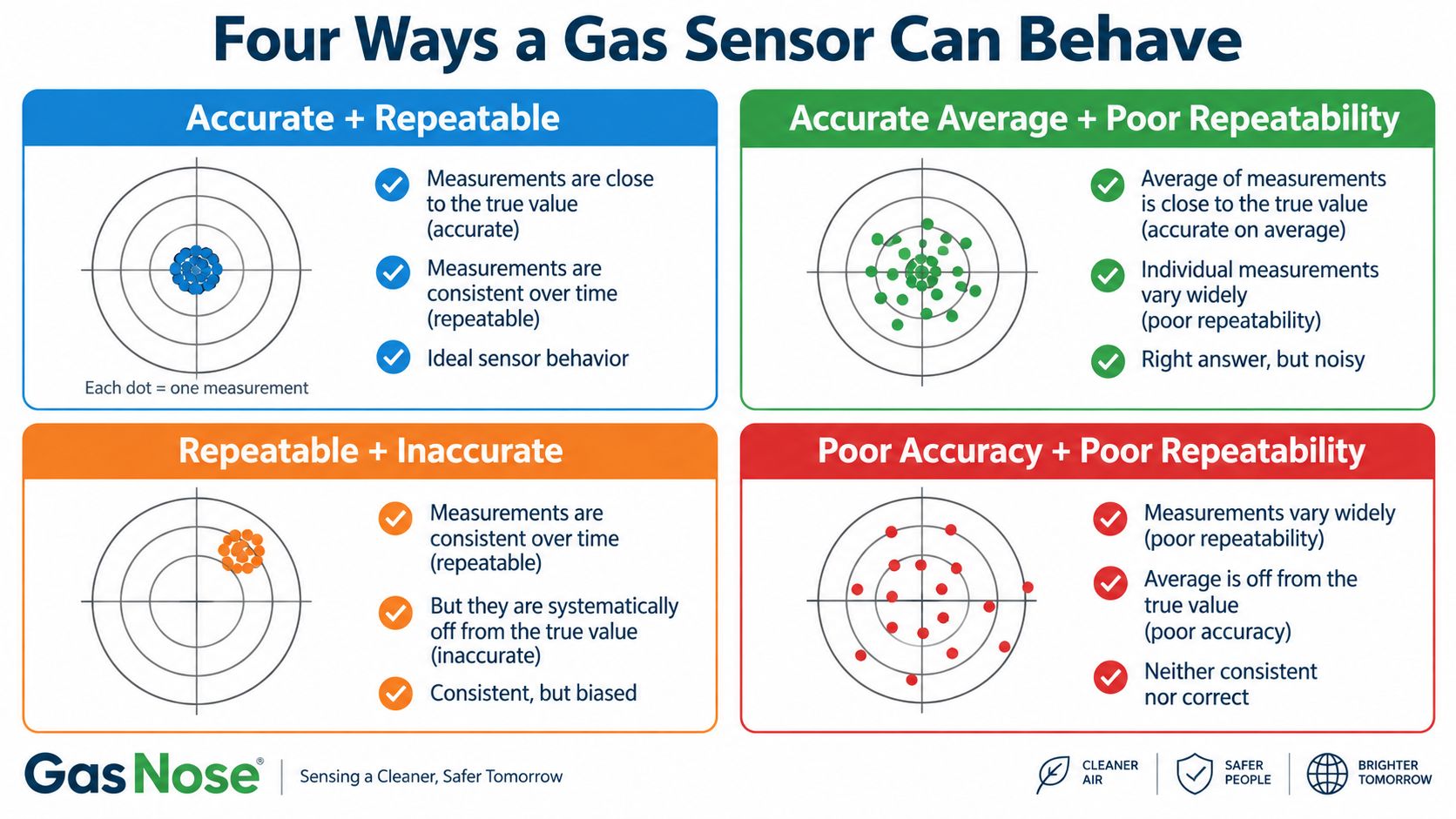
Repeatability and accuracy are independent enough that four common behaviors are possible.
Accurate and Repeatable
Example:
Reference = 100 ppm

Readings:
100
101
99
100
100 ppm
The readings are tightly grouped and close to the reference value.
This is the ideal case.
Accurate on Average but Poorly Repeatable
Example:
Reference = 100 ppm

Readings:
90
110
94
106
100 ppm
The average may be close to 100 ppm, but individual readings vary widely.
The sensor may look acceptable if only the average is considered, yet single measurements are unreliable.
Repeatable but Inaccurate
Example:
Reference = 100 ppm

Readings:
110
110
109
111
110 ppm
The readings are consistent but systematically high.
This often indicates a correctable bias, calibration error or compensation problem.
Poor Accuracy and Poor Repeatability
Example:
Reference = 100 ppm

Readings:
85
115
91
121
97 ppm
The results are both scattered and poorly centered on the reference.
This is the most difficult case because both systematic and random effects may be present.
A stable wrong answer and an unstable average-correct answer are different measurement problems.
What Is Gas Sensor Repeatability?
Repeatability describes how closely repeated measurements agree when the same measurement is performed again under tightly controlled conditions.
Typical repeatability conditions include:
- the same sensor
- the same test method
- the same target gas
- the same gas concentration
- the same flow
- the same chamber
- the same temperature
- the same humidity
- the same electronics
- a relatively short time interval
NIST explicitly treats repeatability as measurement precision under repeatability conditions.
The important phrase is:
under the same conditions
If temperature, gas concentration, flow, test fixture or measurement method changes, you may no longer be testing repeatability in the strict sense.
How Is Gas Sensor Repeatability Tested?
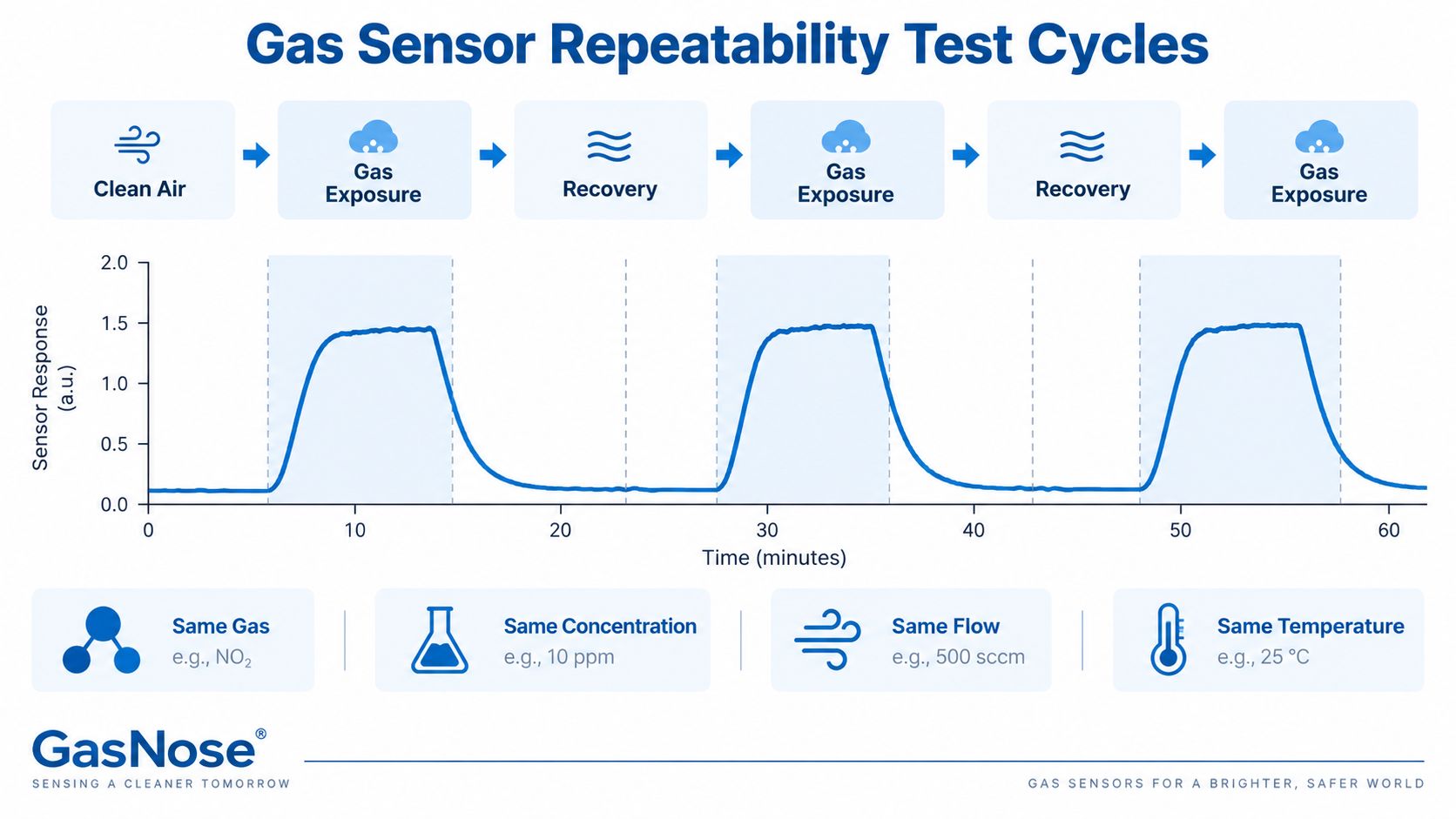
A common gas-sensor repeatability test uses repeated exposure and recovery cycles.
Conceptually:
Clean Air
↓
Known Gas
↓
Recovery
↓
Known Gas
↓
Recovery
↓
Known Gas
For each exposure, the test may compare:
- peak response
- steady-state response
- response ratio
- baseline before exposure
- recovery endpoint
A good repeatability test tries to make each cycle as similar as possible.
For example:
Same target gas
Same concentration
Same flow
Same exposure time
Same temperature
Same humidity
Same recovery condition
Figaro’s TGS2610 technical information uses repeated exposure to 1800 ppm isobutane to demonstrate repeatability. The response cycles show similar sensor behavior over repeated gas exposures.
See: Figaro TGS2610 Technical Information
Figaro’s TGS5141 electrochemical CO sensor documentation similarly shows repeated 400 ppm CO exposures at fixed intervals and reports output deviation of less than ±5% under the stated test.
See: Figaro TGS5141-P00 Technical Information
These examples show that repeatability is not merely a theoretical metrology term. It is directly relevant to commercial gas sensor qualification.
What Does Good Repeatability Look Like?
Suppose a 50 ppm certified test gas is repeatedly applied.
Sensor readings are:
50.2
49.9
50.1
50.0
49.8 ppm
The spread is very small.
That suggests good short-term repeatability.
But repeatability alone does not prove that the measurement is accurate.
If the reference concentration were actually:
45 ppmthe same tightly grouped results would be repeatable but inaccurate.
So any repeatability discussion must keep the reference value separate from the measurement spread.
What Is Gas Sensor Accuracy?
Accuracy describes how closely a measurement agrees with the accepted reference value.
Suppose the reference gas is:
100 ppm COSensor A reports:
101 ppmSensor B reports:
118 ppmSensor A is closer to the reference value.
In commercial sensor datasheets, accuracy is commonly expressed as a tolerance such as:
±X ppmor:
±X% of readingor a combination:
±(X ppm + Y% of reading)Strict metrology terminology is more careful: NIST treats accuracy as a qualitative concept describing closeness to the measurand value and recommends expressing quantitative performance using error or uncertainty measures rather than treating “accuracy” itself as a number.
In practical gas sensor datasheets, however, manufacturers routinely use “accuracy” as a specification heading. The important thing is to read the stated tolerance and test conditions.
A Sensor Can Be Highly Repeatable but Inaccurate
This is the most important practical lesson in the article.
Suppose:
Reference = 100 ppmand repeated sensor measurements are:
109.9
110.1
110.0
109.8
110.2 ppm
The spread is tiny.
The sensor clearly responds in a consistent way.
But the result is approximately:
+10 ppmhigh.
Possible causes include:
- zero calibration error
- span calibration error
- incorrect sensitivity coefficient
- reference-gas mismatch
- pressure compensation error
- temperature compensation error
- systematic electronics offset
The correct conclusion is:
Consistency does not prove correctness.
Can a Sensor Be Accurate on Average but Poorly Repeatable?
Yes.
Suppose:
Reference = 100 ppmand readings are:
90
110
95
105
100 ppm
The mean is:
100 ppmSo the average result is exactly equal to the reference.
But individual measurements vary by as much as ±10 ppm.
If a safety decision is based on one reading rather than a long average, this may be unacceptable.
This is why evaluating only the mean error can hide poor measurement consistency.
Repeatability vs Precision
Repeatability is related to precision but should not be treated as a perfect synonym in every context.
A useful hierarchy is:
Precision
A broad concept describing how closely repeated measurements agree under specified conditions.
Repeatability
Precision under tightly controlled, repeatability conditions.
Reproducibility
Precision when one or more important measurement conditions are intentionally changed.
NIST’s terminology explicitly treats repeatability and reproducibility as two different precision conditions.
So:
Repeatability is a type of precision, not another word for accuracy.
Repeatability vs Reproducibility
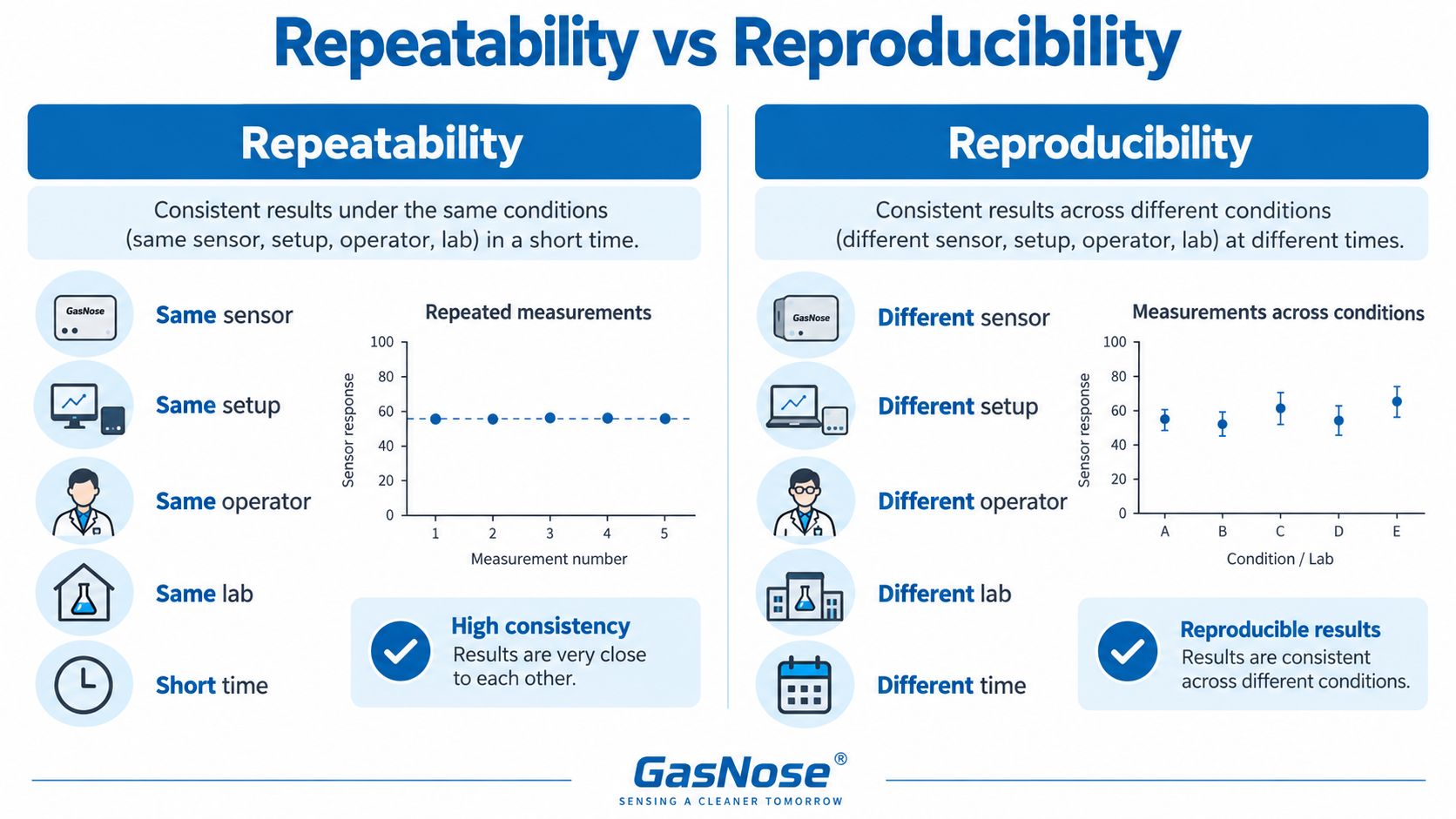
The difference is the measurement conditions.
Repeatability
Keep conditions as constant as possible:
- same sensor
- same test setup
- same method
- same location
- same operator or controlled procedure
- short time period
Reproducibility
Change one or more relevant conditions:
- different sensor
- different instrument
- different operator
- different laboratory
- different time
- different reference setup
NIST defines reproducibility as agreement between measurements of the same measurand under changed measurement conditions.
That difference matters for OEM qualification.
A sensor may have excellent repeatability in one laboratory but show larger variation:
- between production batches
- between different instruments
- between factories
- across calibration stations
Repeatability asks whether the same setup repeats itself. Reproducibility asks whether the result survives a meaningful change in conditions.
Repeatability vs Device-to-Device Variation
Device-to-device variation is also different.
Imagine Sensor A repeatedly produces:
100
101
100
99 ppm
while Sensor B repeatedly produces:
115
114
115
116 ppm
Both individual sensors are repeatable.
But their raw outputs differ substantially.
This can happen because manufacturing variation changes:
- sensitivity
- zero output
- resistance
- optical intensity
- electrode characteristics
For an OEM, this means:
Good repeatability of one sensor does not prove that every sensor in a production lot has the same raw response.
Calibration may still be needed to normalize device-to-device variation.
Repeatability vs Resolution
Resolution answers:
What is the smallest increment the measurement system can distinguish or report?
Repeatability answers:
How much do repeated measurements vary?
Suppose:
Resolution = 0.1 ppmbut repeated measurements of the same gas are:
10.1
11.4
9.5
10.9 ppm
The display has fine resolution.
The measurement repeatability is poor.
Therefore:
Fine numerical resolution does not guarantee stable repeated measurements.
For the wider distinction, see Gas Sensor Detection Limit: LOD vs Resolution vs Accuracy.
Repeatability vs Noise
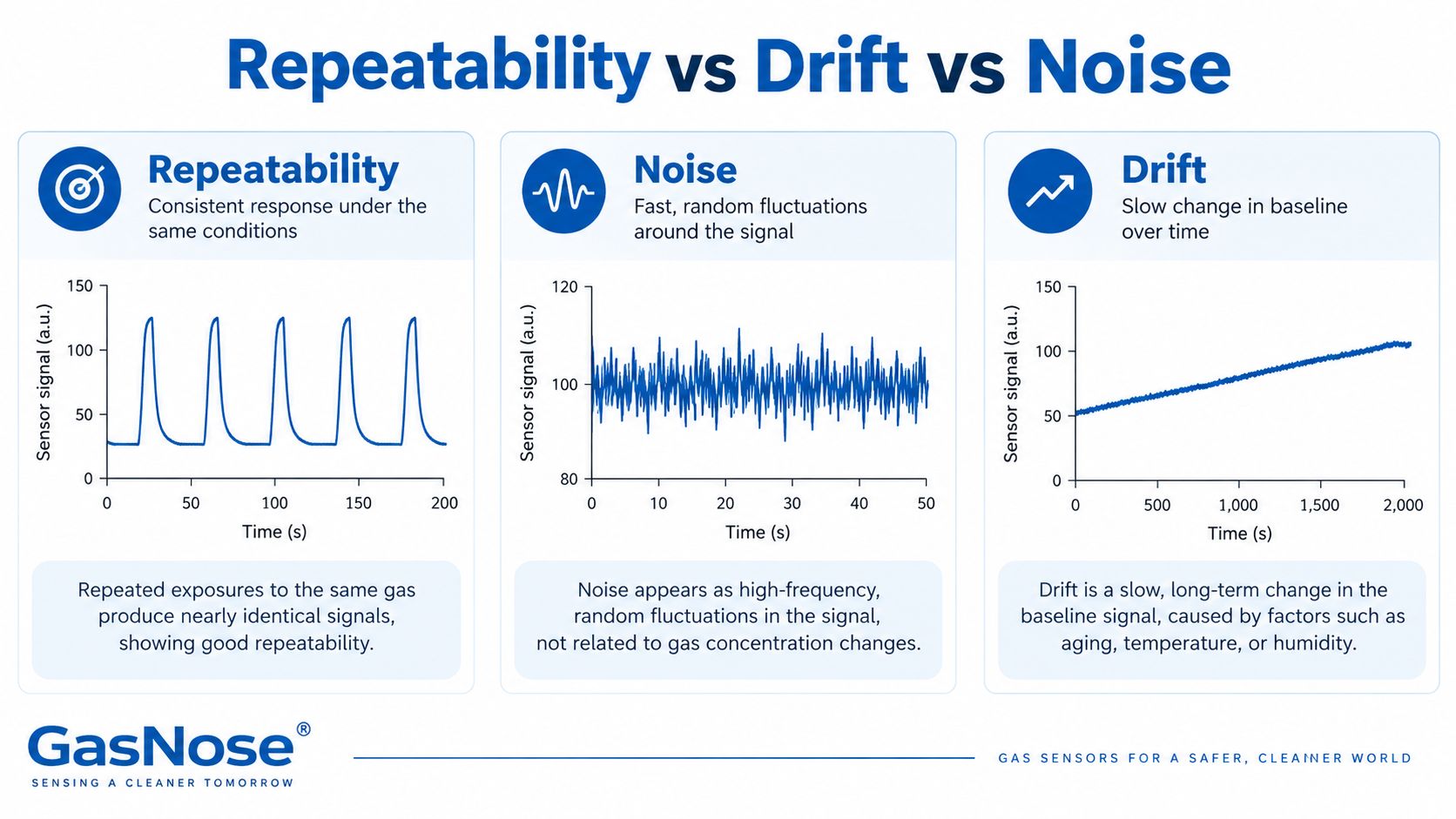
Noise can affect repeatability, but the two concepts are not identical.
Noise
Usually refers to rapid random fluctuation in the sensor output.
Repeatability
Looks at the agreement between repeated measurement results.
Poor repeatability may be caused by noise, but also by:
- changing gas flow
- incomplete recovery
- temperature change
- humidity change
- adsorption
- chamber contamination
- inconsistent timing
Sensirion’s SCD30 datasheet provides a useful real-world example. It defines repeatability as the RMS error of consecutive measurements at constant conditions, while accuracy is separately defined as deviation from a high-precision reference.
The same datasheet lists:
CO₂ Accuracy:
±(30 ppm + 3% of measured value)

CO₂ Repeatability:
±10 ppm
See: Sensirion SCD30 Datasheet
The repeatability number is not a replacement for the accuracy specification.
Repeatability vs Drift
Drift and repeatability operate on different time scales.
Repeatability
Usually considers short-term repeated measurements.
Example:
Cycle 1
Cycle 2
Cycle 3
Cycle 4
Cycle 5
Drift
Describes systematic change over longer periods.
Example:
Month 0
Month 6
Month 12
A sensor can have excellent repeatability today while its baseline or sensitivity slowly changes over months.
That means:
Good short-term repeatability does not prove good long-term stability.
For the long-term problem, see What Is Gas Sensor Drift? Zero Drift, Span Drift & Baseline Drift Explained.
Repeatability vs Stability
Stability is often used to describe how well the sensor maintains performance over time.
Repeatability is narrower.
A sensor can repeat very well over 30 minutes but drift over one year.
Conversely, a sensor can have excellent long-term average stability while individual short-term readings are noisy.
So when reading a datasheet, do not assume:
Repeatability
=
Long-term stability
They answer different questions.
Repeatability vs Hysteresis
Hysteresis occurs when sensor response depends on the direction or previous history of concentration change.
For example:
0 → 100 ppmmay produce one response, while:
200 → 100 ppmmay produce a slightly different response at the same 100 ppm concentration.
This can interfere with repeatability testing if the sensor does not start every cycle from the same condition.
See Gas Sensor Hysteresis Explained.
Response and Recovery Time Affect Repeatability Tests
A repeatability test is only meaningful if each cycle gives the sensor enough time to return to the defined starting condition.
Suppose:
Recovery time = 120 sbut the next test starts after:
30 sThe sensor may still retain residual response from the previous gas exposure.
The next cycle therefore begins from a different baseline.
Apparent poor repeatability may actually be caused by:
- insufficient purge
- slow desorption
- tubing adsorption
- sensor memory
For this reason, repeatability testing must be designed around actual response and recovery behavior.
See Gas Sensor Response Time vs Recovery Time.
Calibration Can Improve Accuracy but Not Necessarily Repeatability
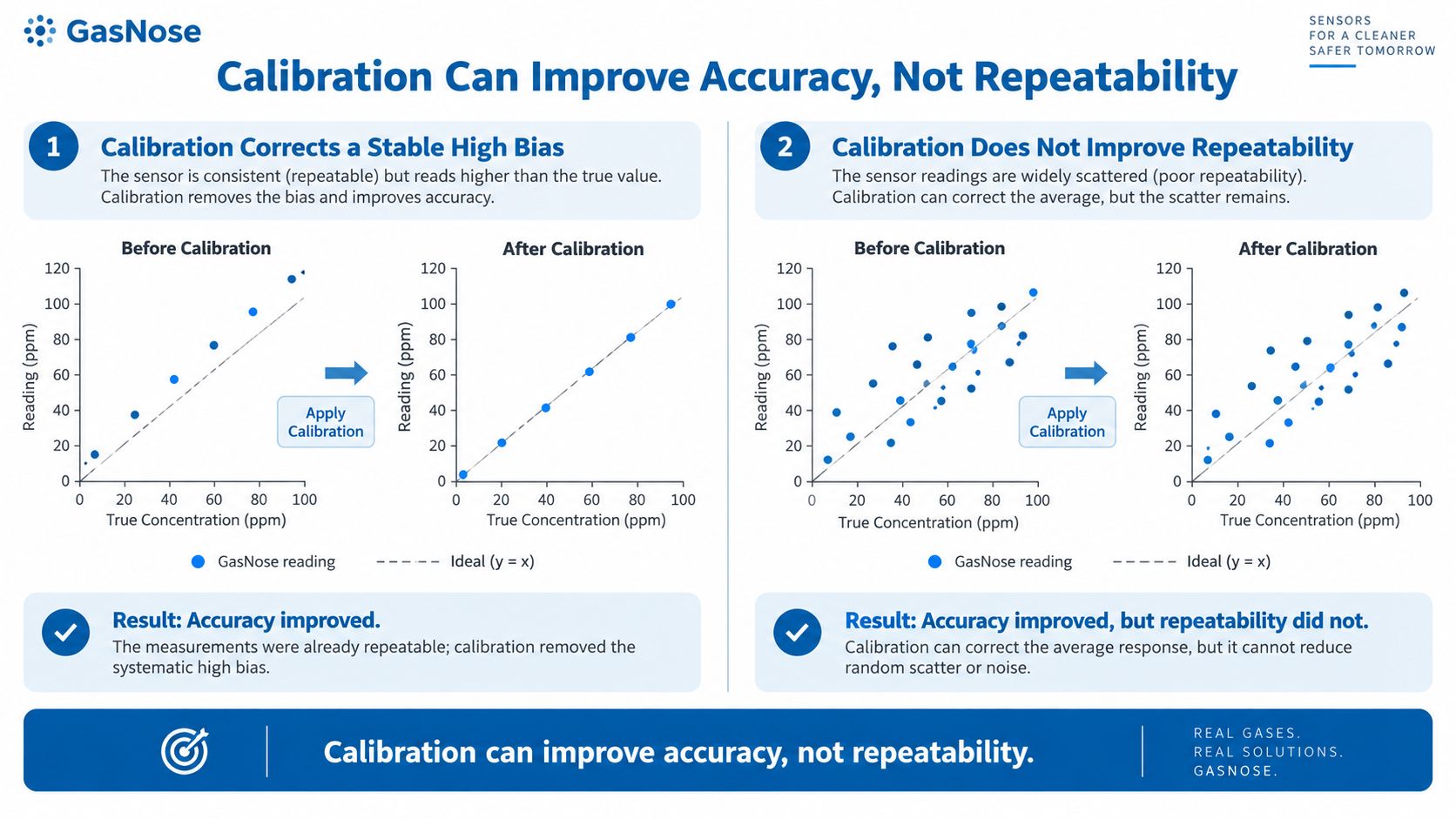
Consider a repeatable but biased sensor:
Reference = 100 ppm

Before calibration:
110
110
109
111 ppm
A correct calibration may shift the readings to:
100
100
99
101 ppm
The systematic error has been corrected.
Accuracy improves.
But the underlying measurement scatter was already small.
Now consider a poorly repeatable sensor:
80
120
95
110 ppm
A calibration can adjust the average, but it cannot automatically make those readings tightly grouped.
That leads to an important engineering rule:
Calibration can correct stable offset or slope error. It cannot automatically remove random measurement variation.
For calibration fundamentals, see Gas Detector Bump Test vs Calibration.
What Causes Poor Gas Sensor Repeatability?
Poor repeatability can come from the sensor, the gas-delivery system, the environment or the electronics.
Gas Concentration Variation
If test gas concentration changes between cycles, the result is not a clean repeatability test.
Flow Variation
Different flow rates can change:
- gas delivery
- diffusion
- chamber exchange
- sensor response
Incomplete Recovery
Residual gas from the previous cycle changes the next baseline.
Temperature Variation
Temperature can alter:
- sensitivity
- baseline
- electrochemical reaction rates
- semiconductor resistance
- optical behavior
Humidity Variation
Humidity can change:
- electrochemical baseline
- MOS surface response
- VOC adsorption
- PID behavior
Baseline Instability
A moving zero causes repeated measurements to begin from different starting points.
Electrical Noise
Noise increases the spread of repeated readings.
Adsorption and Memory Effects
Sticky VOCs can remain in:
- tubing
- filters
- chamber walls
- sensor housing
Sensor Aging
Sensitivity or baseline may change during the test period.
Test Fixture Variation
Differences in chamber volume, tubing position or pump performance can create apparent sensor inconsistency.
Electronics
ADC noise, amplifier offset or unstable power can increase measurement spread.
This is why repeatability is fundamentally a system test, even when the sensor element is the main item being evaluated.
How Is Repeatability Quantified?
There is no single universal metric used by every gas-sensor manufacturer.
Common approaches include:
Range
Range
=
Maximum result
-
Minimum result
Simple, but sensitive to extreme values.
Standard Deviation
σMeasures the dispersion around the mean.
RMS Error of Consecutive Measurements
Used in some commercial sensor specifications.
Relative Standard Deviation
RSD
=
Standard deviation
÷
Mean
×
100%
This is useful for expressing measurement spread as a percentage.
Coefficient of Variation
Closely related to RSD in many engineering contexts.
The correct method depends on:
- sensor technology
- concentration range
- test method
- manufacturer specification
- application requirements
Therefore:
There is no universal RSD or standard-deviation threshold that defines “good repeatability” for every gas sensor.
Repeatability in a Commercial CO₂ Sensor Datasheet
Sensirion provides a clear real-world example because it publishes repeatability and accuracy separately.
For the current SCD4x family, the datasheet lists typical CO₂ repeatability of:
±10 ppmwhile measurement accuracy is specified separately and depends on the model and concentration range.
For example, SCD43 measurement accuracy is specified as:
±(30 ppm + 3% of reading)from 400 to 5000 ppm under the stated conditions.
See: Sensirion SCD4x Datasheet
This demonstrates an important point:
Repeatability can be much tighter than total accuracy because repeatability describes only one component of overall measurement performance.
Electrochemical Gas Sensor Repeatability
Electrochemical repeatability can depend on:
- electrode stability
- zero current
- electrolyte condition
- target-gas delivery
- bias voltage
- temperature
- humidity
- recovery
Repeated gas pulses may produce similar peak or steady-state currents.
That demonstrates short-term response consistency.
But it does not prove that the current-to-ppm conversion is absolutely correct.
For low-level electrochemical baseline behavior, see What Is Zero Current in an Electrochemical Gas Sensor?.
MOS Gas Sensor Repeatability
MOS sensors are often tested through repeated:
Clean air
→ Gas
→ Clean air
cycles.
Key variables include:
- heater temperature
- warm-up
- humidity
- baseline resistance
- gas concentration
- exposure time
- recovery time
Figaro’s TGS2610 technical data show repeated isobutane exposures with similar response cycles, providing a direct visual demonstration of repeatability.
A MOS sensor can therefore be highly repeatable even though its concentration-response relationship is nonlinear.
For calibration behavior, see Gas Sensor Linearity and Linear Range Explained.
NDIR Gas Sensor Repeatability
NDIR repeatability can be affected by:
- optical source stability
- detector noise
- chamber gas exchange
- pressure
- temperature
- signal processing
Commercial CO₂ sensors can show repeatability specifications much tighter than total measurement accuracy.
Again, this is because accuracy also includes systematic factors that are not captured by short-term measurement spread alone.
PID Repeatability
PID repeatability depends strongly on keeping the sampling conditions consistent.
Important factors include:
- lamp condition
- humidity
- pump flow
- VOC response factor
- tubing
- adsorption
- contamination
If a sticky VOC remains in the sample line, the next measurement does not begin from the same initial condition.
That is not a valid repeatability cycle.
Why Repeatability Matters in Safety Gas Detection
Safety detectors depend on predictable response to known gas concentrations.
If the same 50 ppm test gas produces:
45 ppm today
58 ppm tomorrow
48 ppm next week
the system becomes difficult to interpret and maintain.
Good repeatability helps with:
- alarm confidence
- calibration verification
- maintenance
- functional testing
However, repeatability alone cannot guarantee alarm accuracy.
A detector can repeatedly alarm at the wrong concentration if it is systematically miscalibrated.
Why Repeatability Matters in OEM Modules
For OEM products, engineers care about at least two different questions:
Does one module repeat its own measurement?
This is repeatability.
Do many modules from production behave similarly?
This is device-to-device consistency or reproducibility-type performance, depending on the test design.
A well-designed OEM program may therefore evaluate:
- within-device repeatability
- between-device variation
- batch variation
- calibration yield
- long-term drift
These should not be collapsed into one specification.
Why Repeatability Matters in Process Control
In a stable industrial process, the same gas condition should produce a similar sensor output.
Poor repeatability can cause:
- unstable control loops
- unnecessary process adjustments
- false alarms
- noisy trend data
In many process applications, repeatability may be as important as absolute accuracy because the system often reacts to changes relative to a known operating state.
Why Repeatability Matters in Electronic Noses
Electronic noses rely on response patterns from multiple sensors.
For the same sample, the array should generate a sufficiently similar fingerprint each time.
Poor repeatability can make:
- classification unstable
- machine-learning models unreliable
- calibration transfer difficult
In an e-nose system, repeatability therefore applies not only to one sensor’s value but to the repeatability of the overall response pattern.
Systematic Error vs Random Error
The repeatability/accuracy distinction becomes easier to understand when measurement error is separated into two broad behaviors.
Systematic Error
Measurements are consistently shifted in one direction.
Example:
Reference = 100 ppm
Readings ≈ 110 ppm
This is bias-like behavior.
It may be reduced by:
- zero correction
- span calibration
- compensation
Random Variation
Measurements scatter unpredictably.
Example:
90
108
97
112
94 ppm
This reduces repeatability.
It may originate from:
- sensor noise
- flow instability
- environment
- electronics
Calibration is generally more effective against stable systematic error than against random scatter.
How to Test Gas Sensor Repeatability Properly
A useful repeatability procedure should control the full measurement system.
Step 1 — Stabilize the Sensor
Follow the manufacturer’s required:
- warm-up
- bias
- conditioning
requirements.
Step 2 — Control Environmental Conditions
Record and control:
- temperature
- humidity
- pressure
as appropriate.
Step 3 — Use the Same Test Gas
Use a stable, traceable or certified gas source when quantitative performance matters.
Step 4 — Control Flow
Keep:
- flow rate
- tubing
- chamber
- regulator
consistent.
Step 5 — Use the Same Exposure Duration
Each cycle should use the same timing or the same defined measurement endpoint.
Step 6 — Allow Adequate Recovery
Do not begin the next cycle before the sensor reaches the required starting condition.
Step 7 — Repeat Multiple Cycles
The number of cycles should be appropriate to the test plan and statistical confidence required.
There is no universal cycle count for every gas sensor.
Step 8 — Record the Same Response Metric
For example:
- stabilized reading
- peak response
- current
- resistance ratio
Do not mix metrics between cycles.
Step 9 — Calculate Dispersion
Depending on the specification, calculate:
- range
- standard deviation
- RMS error
- RSD
Step 10 — Compare With the Requirement
The acceptable repeatability depends on:
- application
- concentration
- sensor technology
- safety requirements
- manufacturer specification
How to Read Repeatability in a Gas Sensor Datasheet
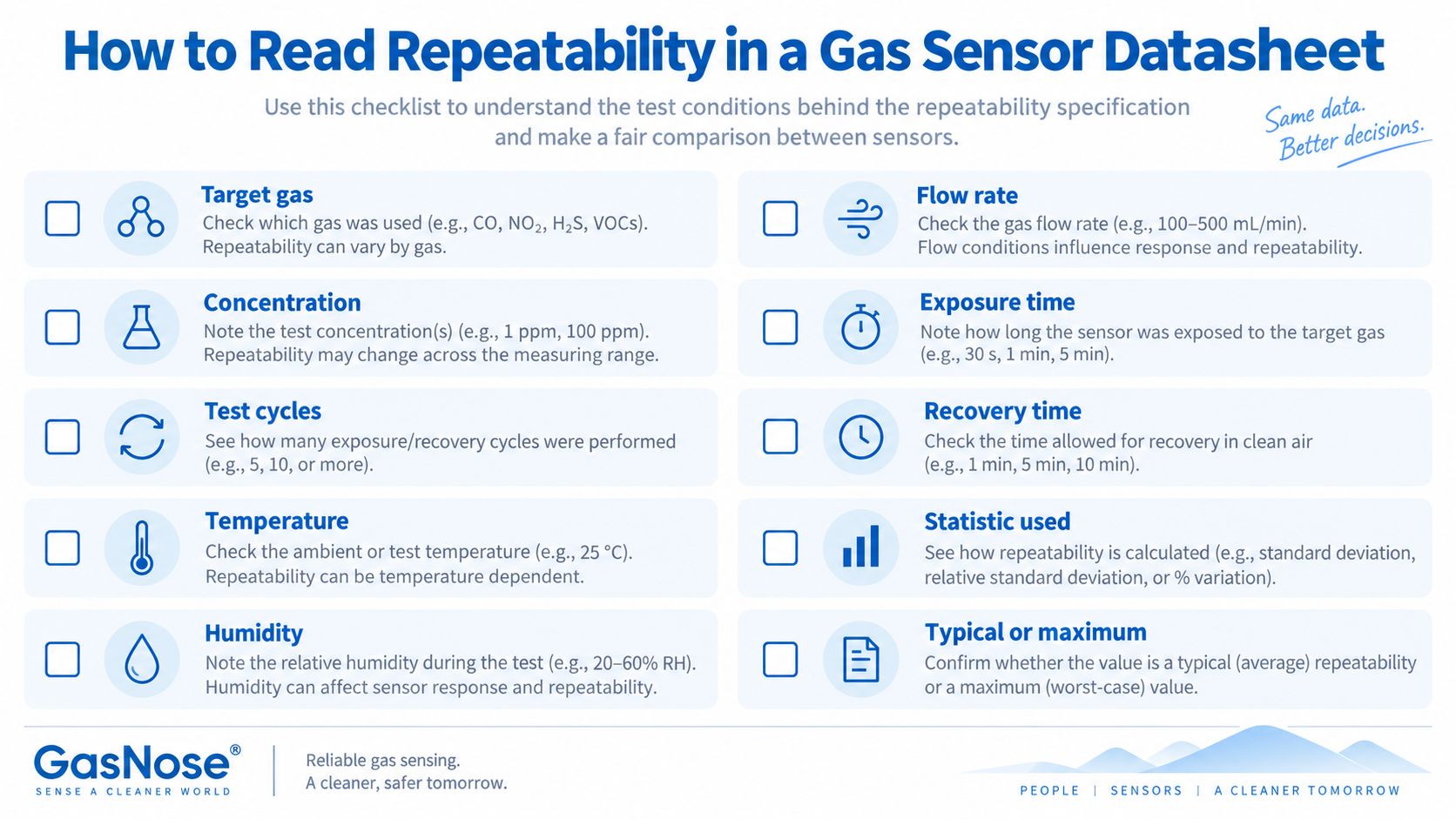
A repeatability number without test conditions is incomplete.
Check the following.
1. Target Gas
Repeatability for CO does not automatically describe H₂S, VOC or methane performance.
2. Gas Concentration
Repeatability can vary across the measurement range.
3. Number of Test Cycles
Was the value based on:
- 3 cycles
- 10 cycles
- hundreds of measurements?
4. Temperature
Was testing performed at:
25°Cor across a wider range?
5. Humidity
For many sensors, humidity directly affects output.
6. Flow Rate
Gas delivery must be consistent.
7. Exposure Time
Was each sensor given enough time to reach the same response endpoint?
8. Recovery Time
Was clean-air purge sufficient?
9. Statistical Definition
Is repeatability reported as:
- ±ppm
- standard deviation
- RMS error
- RSD
- % deviation
10. Typical or Maximum?
A typical value is not the same as a guaranteed worst-case limit.
11. Averaging or Filtering
Longer averaging can reduce apparent measurement scatter.
12. Sensor or Complete Instrument?
A module may include electronics and compensation that significantly change repeatability compared with the bare sensing element.
Always compare repeatability values using comparable test conditions and comparable statistical definitions.
Common Repeatability vs Accuracy Mistakes
Mistake 1 — Repeatable Means Accurate
False.
A sensor can consistently report the wrong value.
Mistake 2 — Accurate Average Means Good Repeatability
False.
A widely scattered set of readings can average to the correct value.
Mistake 3 — Repeatability Equals Reproducibility
False.
Repeatability keeps conditions the same; reproducibility evaluates changed conditions.
Mistake 4 — Repeatability Equals Device-to-Device Variation
False.
One sensor can repeat itself well while another sensor has a different calibration.
Mistake 5 — Resolution Equals Repeatability
False.
Fine display increments do not prove stable measurements.
Mistake 6 — Calibration Fixes Poor Repeatability
Not usually.
Calibration can correct stable bias or slope error but not random scatter.
Mistake 7 — Good Repeatability Means Good Long-Term Stability
False.
Drift occurs on a different time scale.
Mistake 8 — Ignoring Recovery Between Test Cycles
Residual response can make subsequent cycles incomparable.
Mistake 9 — Changing Temperature or Humidity During a Repeatability Test
If the environment changes significantly, the test is no longer strictly under the same conditions.
Mistake 10 — Comparing Datasheet Values Without Checking the Definition
±10 ppm, 3σ, RMS error and ±5% deviation are not automatically interchangeable specifications.
Repeatability and Accuracy Selection Checklist
Before selecting a gas sensor or module, confirm:
- Target gas
- Measurement range
- Accuracy specification
- Repeatability specification
- Repeatability test concentration
- Statistical definition
- Number of test cycles
- Temperature conditions
- Humidity conditions
- Flow conditions
- Exposure duration
- Recovery time
- Resolution
- Noise
- Linearity
- Drift
- Device-to-device variation
- Calibration requirements
Frequently Asked Questions
What is gas sensor repeatability?
Gas sensor repeatability describes how closely repeated measurements agree when the same measurement is performed under the same defined conditions over a relatively short period.
What is gas sensor accuracy?
Accuracy describes how closely the measured gas concentration agrees with an accepted reference value.
What is the difference between repeatability and accuracy?
Repeatability is about consistency.
Accuracy is about closeness to the reference value.
A sensor can have excellent repeatability but poor accuracy.
Can a gas sensor be repeatable but inaccurate?
Yes.
If a 100 ppm reference gas repeatedly produces readings around 110 ppm, the sensor is repeatable but biased high.
Can a gas sensor be accurate on average but poorly repeatable?
Yes.
A widely scattered group of readings may average to the reference value even though individual measurements are unstable.
Is repeatability the same as precision?
Repeatability is a form of precision under tightly controlled repeatability conditions.
Is repeatability the same as reproducibility?
No.
Repeatability keeps measurement conditions essentially the same.
Reproducibility evaluates agreement under changed measurement conditions.
Is repeatability the same as stability?
No.
Repeatability is normally a short-term consistency characteristic.
Stability concerns how performance is maintained over time.
How is gas sensor repeatability tested?
A common method repeatedly exposes the sensor to the same known gas concentration under controlled conditions, allows recovery between cycles, and compares the resulting responses.
How many cycles are needed for a repeatability test?
There is no universal number.
The test plan should provide enough repeated measurements for the intended statistical analysis and application requirement.
How is repeatability calculated?
Depending on the manufacturer or test method, repeatability may be expressed using:
- range
- standard deviation
- RMS error
- RSD
- percentage deviation
What is RSD in gas sensor testing?
RSD stands for relative standard deviation:
RSD
=
Standard deviation
÷
Mean
×
100%
It expresses measurement spread relative to the average response.
Does calibration improve repeatability?
Calibration can improve accuracy when error is systematic.
It does not automatically improve repeatability if the problem is random measurement variation.
Does temperature affect repeatability?
Yes.
If temperature changes between measurements, the sensor response may change even though the gas concentration stays the same.
Does humidity affect repeatability?
Yes.
The effect depends on sensor technology and target gas.
Does recovery time affect repeatability?
Yes.
If the sensor has not recovered before the next exposure, repeated cycles do not begin from the same condition.
Does drift affect repeatability?
Drift is different from repeatability, but if drift becomes significant during the test period it can increase apparent measurement spread.
Why can two sensors give different readings even if both are repeatable?
Repeatability describes consistency within each sensor.
Different sensors can still have different:
- sensitivity
- zero offset
- calibration
- manufacturing variation
Which is more important: repeatability or accuracy?
Neither is universally more important.
Most quantitative gas measurements require both.
A calibration system may tolerate stable repeatable bias because it can be corrected, while unpredictable random variation is more difficult to compensate.
Final Takeaway
Gas sensor repeatability and accuracy answer two different questions.
Repeatability
Will I get nearly the same result if I repeat the measurement under the same conditions?
Accuracy
How close is that result to the accepted reference concentration?
The ideal sensor has both.
But remember:
Highly repeatable
≠
necessarily accurate
and:
Accurate average
≠
necessarily repeatable
Calibration can often correct a stable bias.
It cannot automatically remove random variation.
Good repeatability today does not guarantee good long-term stability.
And repeatability of one sensor does not guarantee low device-to-device variation across production.
That leads to the most useful engineering rule:
Do not judge a gas sensor from one “accuracy” number. Evaluate repeatability, calibration bias, noise, drift, resolution, linearity, recovery behavior and test conditions together.
References and Further Reading
- NIST — Repeatability and Reproducibility Terminology
- Sensirion — SCD4x Datasheet
- Sensirion — SCD30 Datasheet
- Figaro — TGS2610 Technical Information
- Figaro — TGS5141-P00 Technical Information
- GasNose — Gas Sensor Detection Limit: LOD vs Resolution vs Accuracy
- GasNose — Gas Sensor Sensitivity vs Selectivity
- GasNose — Gas Sensor Linearity and Linear Range
- GasNose — Gas Sensor Drift
- GasNose — Gas Sensor Response Time vs Recovery Time
- GasNose — Gas Detector Bump Test vs Calibration
- GasNose — Gas Sensor Hysteresis
- GasNose — Signal-to-Noise Ratio in Gas Sensors
- GasNose — Temperature Effects on Gas Sensors
- GasNose — Humidity Effects on Gas Sensors
