



Solid Polymer Gas Sensors
In this guide, solid polymer gas sensors refer to solid polymer electrolyte (SPE) electrochemical gas sensors. These devices use a polymeric ion-conducting membrane instead of a bulk liquid electrolyte, enabling compact construction, low leakage risk and stable electrochemical sensing for portable, industrial and IoT applications.

Technology overview
What is a solid polymer gas sensor?
Where it fits in gas-sensor taxonomy
SPE sensors sit within the broader electrochemical category. The main difference from conventional liquid-electrolyte sensors is the electrolyte architecture—not the fact that the device measures an electrochemical reaction.
What the polymer actually does
- Provides an ionic pathway between electrodes
- Helps separate and organize the electrochemical interfaces
- Supports thin, compact mechanical construction
- Influences hydration, internal resistance and long-term stability
Related background: Electrochemical Gas Sensors.
With clean air and little target-gas flux, the working electrode produces minimal reaction current and the output remains near baseline.
Working principle
How does a solid polymer gas sensor work?
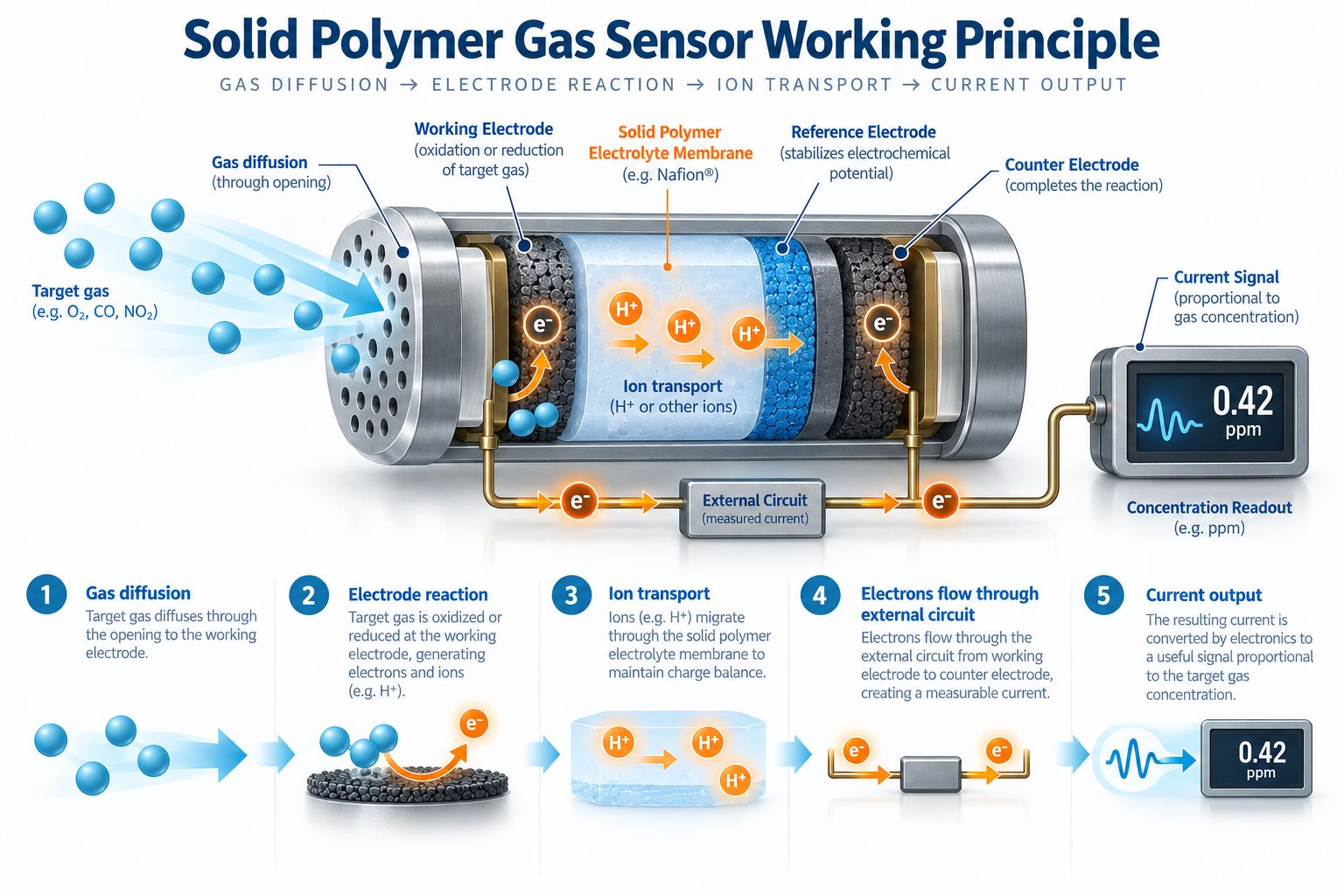
Five-step sensing chain
- 1. Gas diffusion: the target gas enters through the diffusion opening and reaches the working electrode.
- 2. Electrode reaction: the gas is oxidized or reduced at the working electrode, depending on the chemistry and bias condition.
- 3. Ion transport: ions generated by the reaction move through the solid polymer electrolyte to maintain charge balance.
- 4. External electron flow: electrons move through the external circuit from one electrode to another, creating a measurable current.
- 5. Signal output: the electronics convert the tiny electrochemical current into a useful concentration reading.
Sensor construction
Inside the SPE architecture: working, reference and counter electrodes
Gas diffusion opening
Controls access of the target gas to the sensing region and helps define diffusion-limited behavior.
Working electrode (WE)
The main sensing electrode where the target gas is oxidized or reduced.
Reference electrode (RE)
Provides a stable electrochemical potential so the sensing electrode can be controlled accurately.
Counter electrode (CE)
Completes the electrochemical circuit and balances the reaction occurring at the working electrode.
Solid polymer electrolyte
Conducts ions while helping maintain physical separation and compact cell architecture.
Signal-conditioning electronics
Amplify, filter and digitize the tiny current signal from the sensing cell.
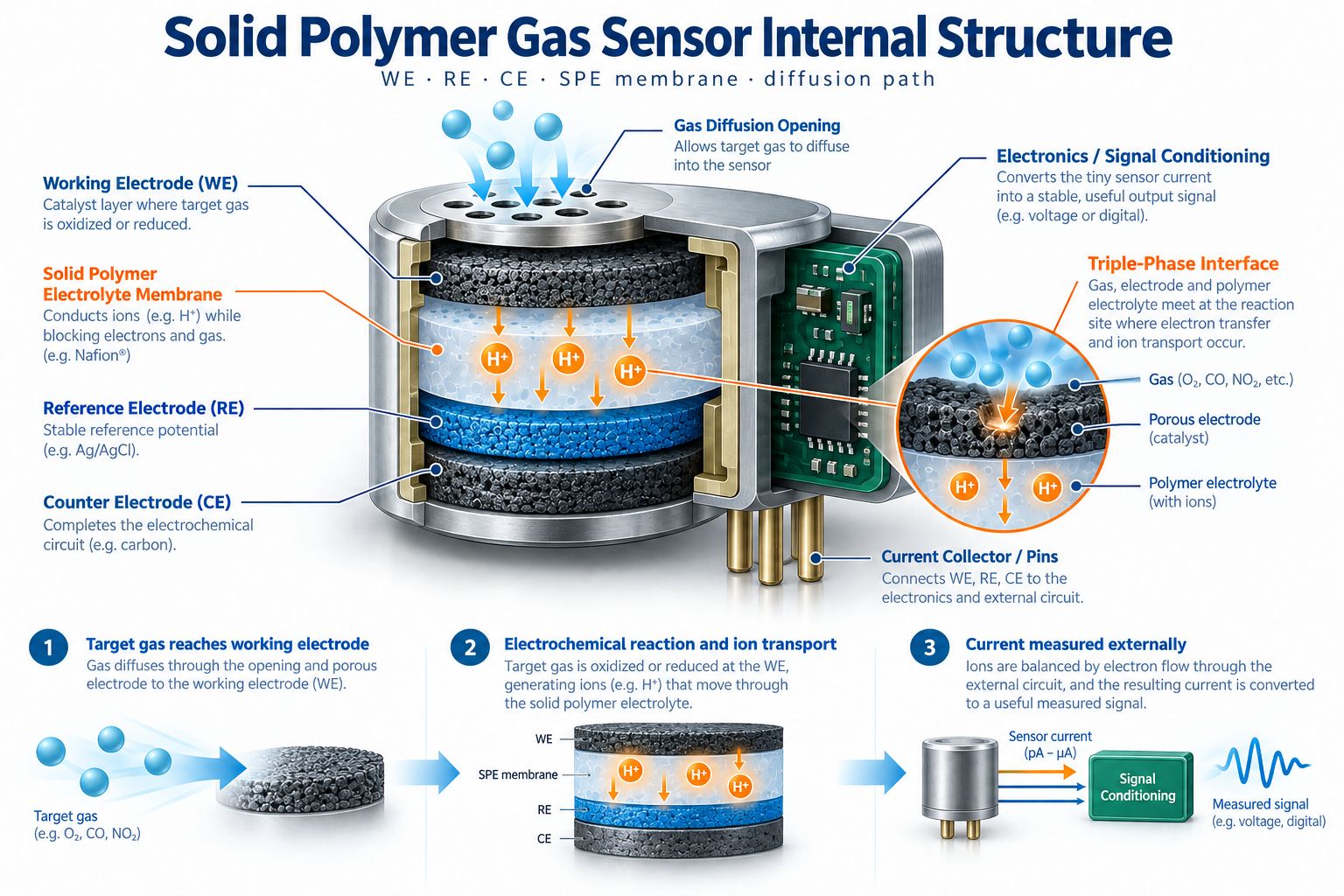
For a broader introduction to the three-electrode model, see Electrochemical Gas Sensors.
Electrolyte physics
What does the solid polymer electrolyte actually do?
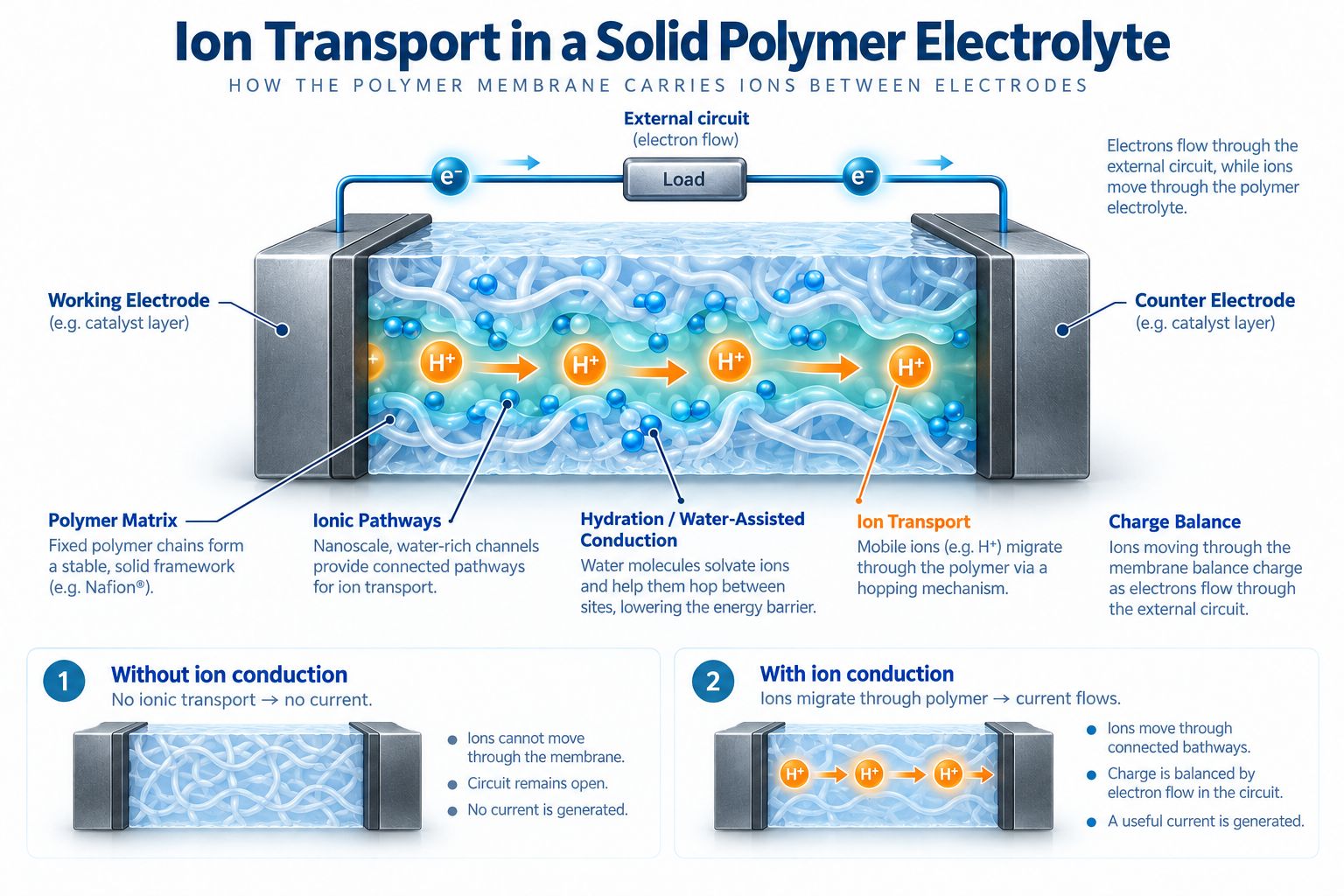
Main functions of the SPE membrane
- Ionic conduction: provides a route for H+ or other ions to move through the sensor.
- Electrode separation: helps define the electrochemical stack and avoid internal shorting.
- Mechanical support: supports thin, compact and leak-resistant structures.
- Water management: many polymer systems rely on hydration for optimal ionic conductivity.
Materials and examples
Nafion is the best-known example in solid polymer electrolyte discussions, but SPE gas sensors can also use other polymer systems, including hybrid and quasi-solid formulations tailored for specific gases, ranges and environmental conditions.
Architecture comparison
Solid polymer vs liquid electrolyte gas sensors
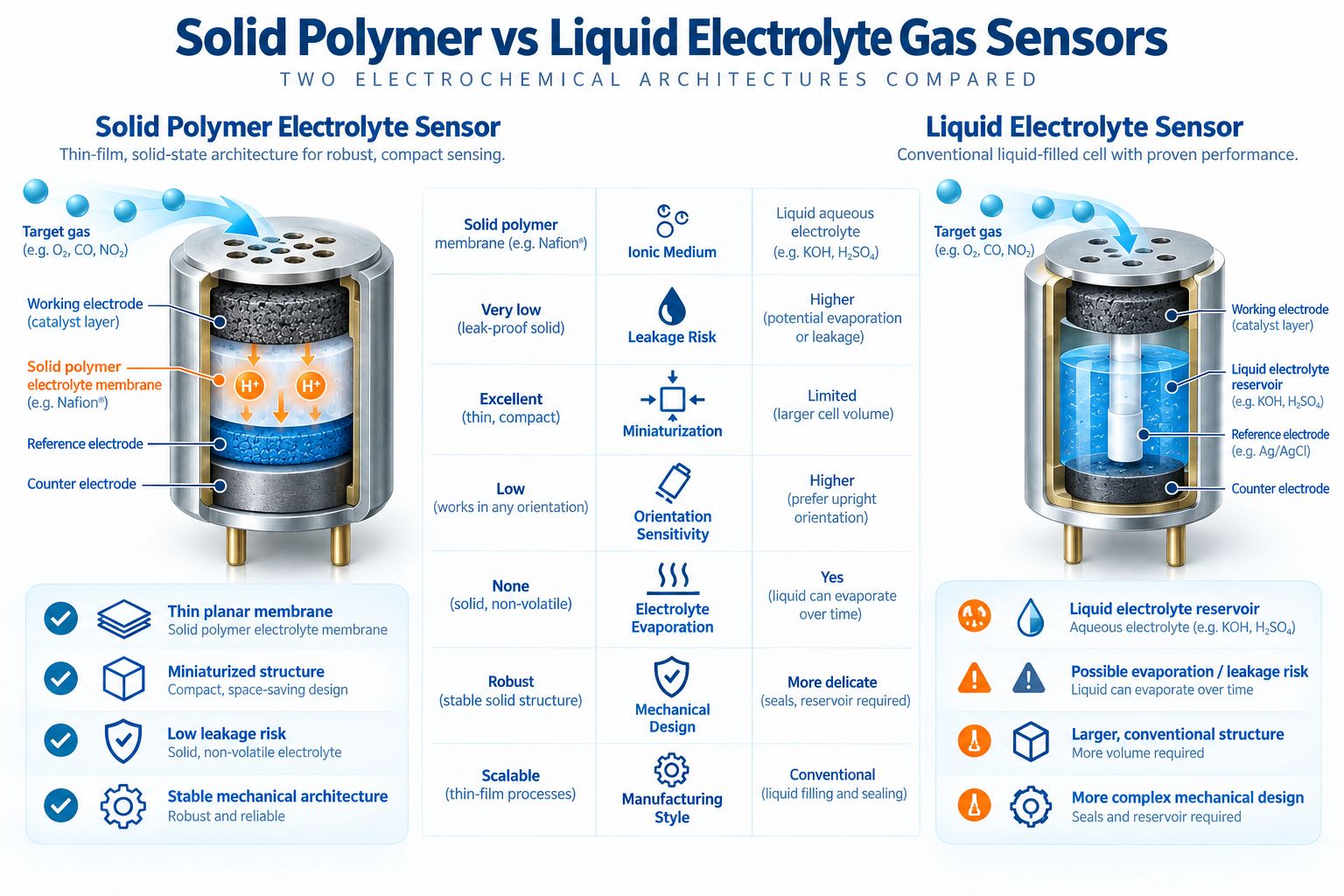
| Factor | Solid polymer electrolyte | Traditional liquid electrolyte |
|---|---|---|
| Ionic medium | Polymer / polymer-ion phase | Liquid electrolyte |
| Leakage risk | Very low as no bulk liquid reservoir is used | Higher, depending on seals and long-term retention |
| Miniaturization | Excellent; thin and planar structures are practical | More constrained by reservoir and seal design |
| Mechanical construction | Compact, robust solid-state stack | Conventional liquid-filled architecture |
| Orientation sensitivity | Often reduced | Can be more design-dependent |
| Electrolyte evaporation | Greatly reduced compared with bulk liquids | An important lifetime factor |
| Humidity dependence | Still important; polymer hydration affects conductivity | Also important, but with different mechanisms |
| Typical power | Very low | Very low |
Environmental effects
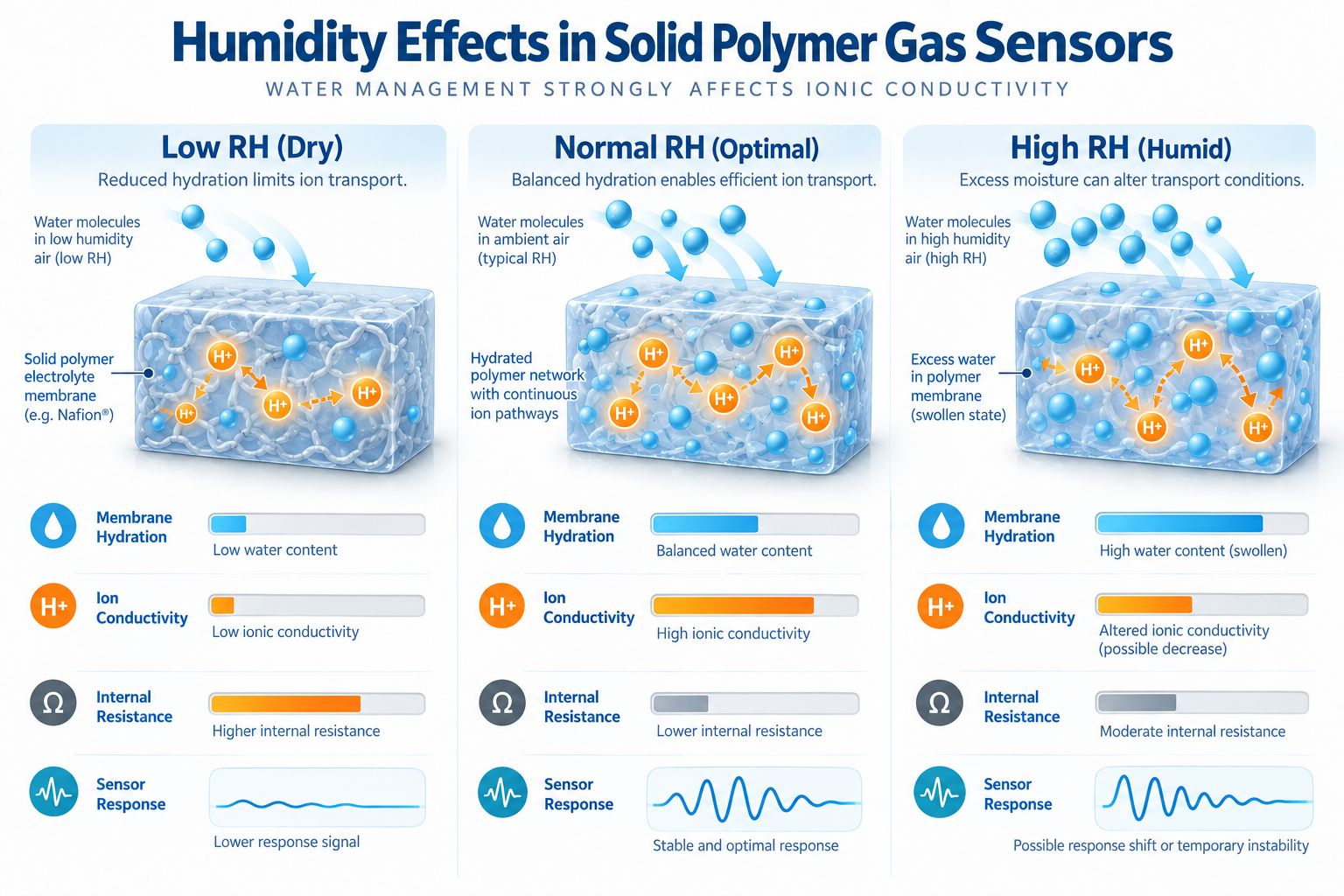
Humidity strongly affects SPE performance
Typical humidity behavior
- Very low RH: insufficient hydration can reduce ionic conductivity and increase internal resistance.
- Normal RH: balanced hydration often supports the best conduction and stable output.
- High RH: excess moisture can alter transport conditions, cause temporary signal shifts or change diffusion behavior.
From gas to current
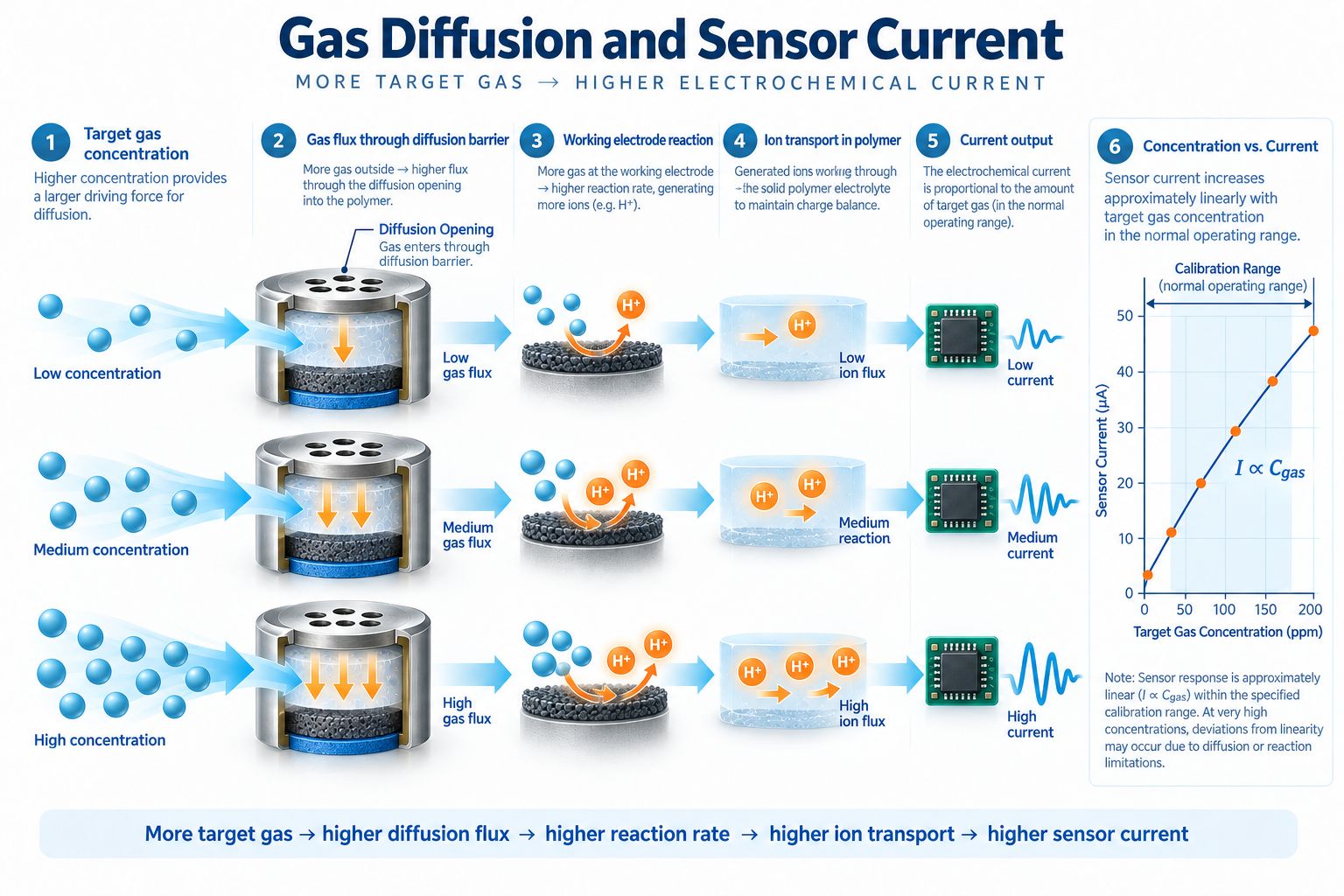
Gas diffusion, electrochemical reaction and sensor current
Why the current increases with gas concentration
Within the calibrated operating range, the sensor current typically increases with the amount of target gas reaching the working electrode. More gas flux drives a greater electrochemical reaction rate, which produces more ions in the polymer and more electron flow through the external circuit.
- Concentration increases → stronger diffusion driving force
- Gas flux increases → more molecules reach the working electrode
- Reaction rate increases → more ionic charge is generated
- Measured current increases → electronics convert current to ppm or ppb
Common confusion
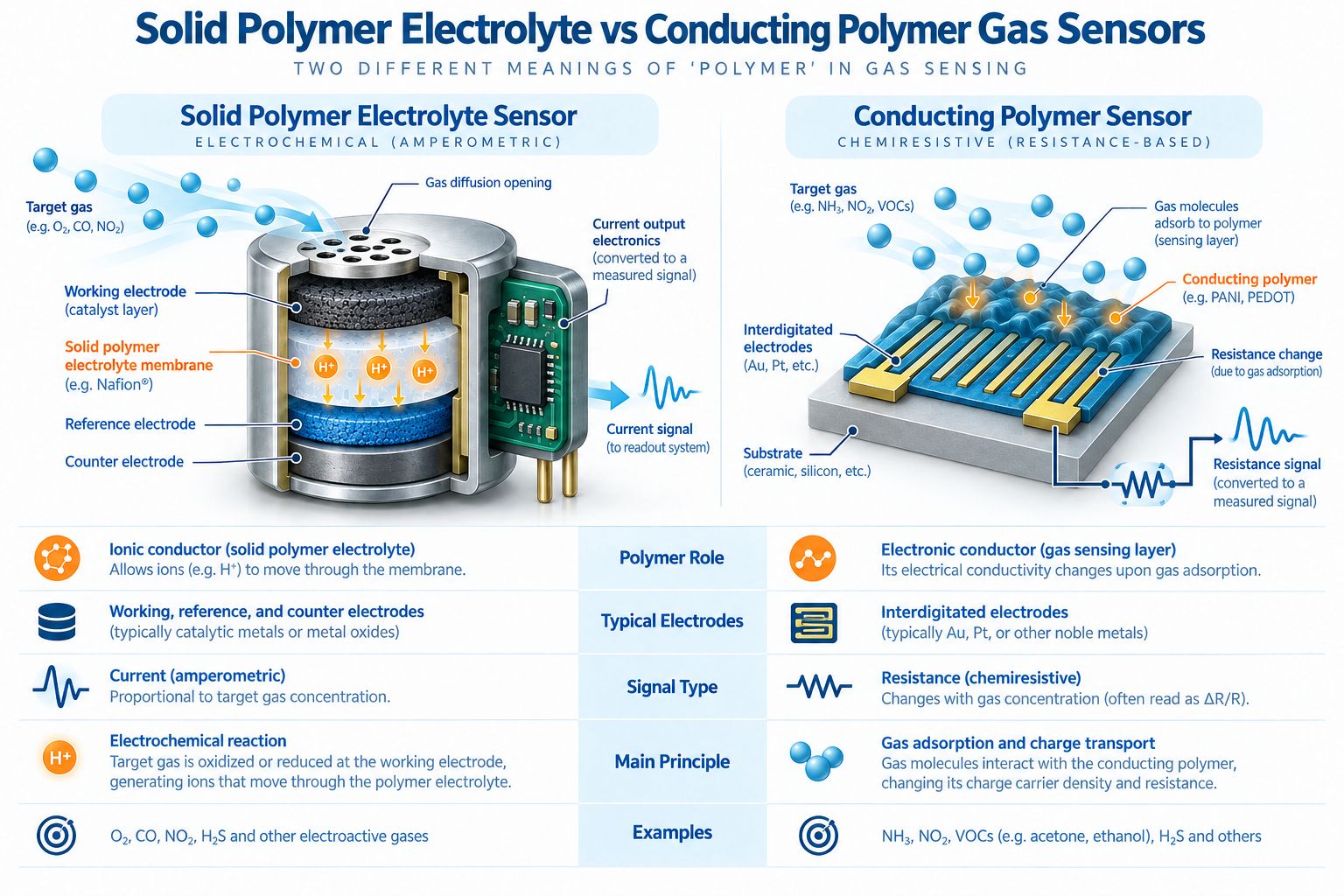
Solid polymer electrolyte vs conducting polymer gas sensors
| Factor | Solid polymer electrolyte sensor | Conducting polymer sensor |
|---|---|---|
| Polymer role | Ion conductor / electrolyte | Sensing material whose electrical properties change |
| Typical principle | Electrochemical / amperometric | Chemiresistive in many implementations |
| Signal type | Current or electrochemical potential | Resistance / conductivity change |
| Electrodes | WE / RE / CE are common | Interdigitated electrodes are common |
| Main gas interaction | Redox reaction at electrode interfaces | Adsorption or charge-transfer interaction with polymer layer |
| Examples | SPE cell with Nafion-like membrane | PANI, PPy, PEDOT and related conducting-polymer films |
Engineering trade-offs
Advantages and limitations of solid polymer gas sensors
Advantages
- No bulk liquid electrolyte reservoir
- Reduced leakage risk
- Compact and miniaturizable construction
- Very low-power sensor cell
- Good fit for portable and IoT devices
- Potential for planar and scalable manufacturing
- Robust mechanical architecture
- Room-temperature electrochemical sensing
Limitations
- Humidity and hydration management can remain critical
- Polymer/electrode interface aging affects long-term stability
- Cross-sensitivity and selectivity still depend on the full electrochemical design
- Temperature affects diffusion and reaction kinetics
- Signal-conditioning electronics are still required
- Overload recovery and calibration drift must be managed
- Not every target gas is equally suitable for every SPE chemistry
Applications
Where solid polymer gas sensors are used
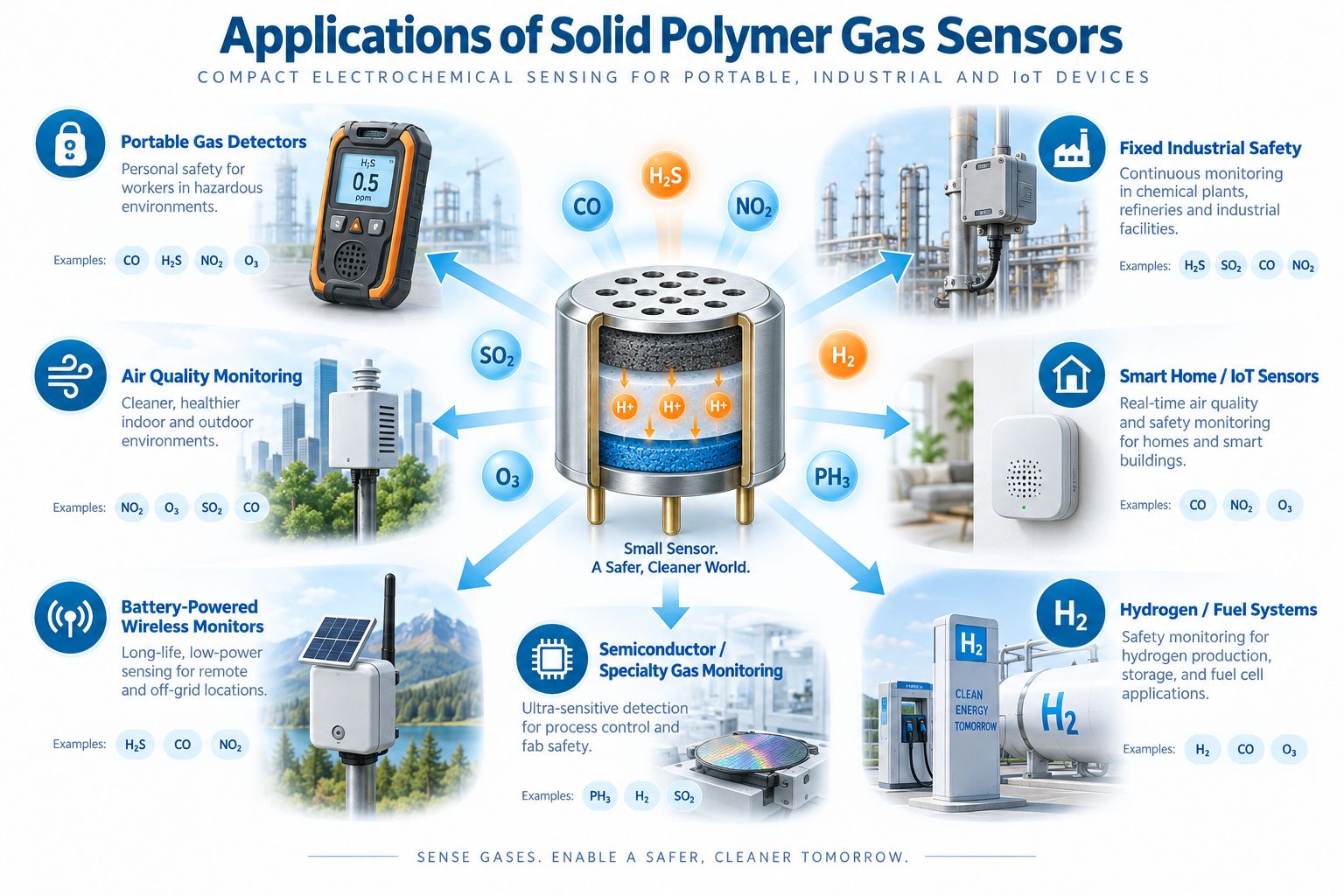
Portable gas detectors
Personal safety instruments for toxic gases such as CO, H₂S, NO₂ and SO₂.
Fixed industrial safety
Continuous monitoring in chemical plants, refineries, process areas and utility rooms.
Air-quality monitoring
Compact nodes for indoor and outdoor air monitoring where low power is important.
Smart home / IoT
Connected devices for air-quality and safety monitoring in homes and buildings.
Battery-powered wireless monitors
Remote installations benefit from the low-power nature of the sensing cell.
Hydrogen and specialty gas systems
Selected SPE architectures are used for hydrogen, semiconductor or specialty-gas safety tasks.
Selection workflow
How to choose a solid polymer gas sensor architecture
1. Define the gas
Start with the target gas, detection range and expected interferents.
2. Review the electrochemistry
Match the working-electrode catalyst, potential and diffusion control to the target gas.
3. Evaluate the polymer system
Check hydration dependence, internal resistance and environmental robustness.
4. Validate the application
Consider temperature, humidity, response time, power budget and maintenance needs.
Before design freeze
- Target gas and concentration range
- Cross-sensitivity and filter needs
- Working / reference / counter electrode strategy
- Polymer hydration sensitivity
- Low-RH and high-RH behavior
- Response time target and diffusion path
- Baseline drift and overload recovery
- Power budget and signal electronics
- Calibration interval and field service model
- Mechanical packaging and orientation constraints
SPE OEM checklist
Solid polymer electrolyte sensing works best when the electrochemical stack, membrane hydration and electronics are designed together rather than treated as separate subsystems.
- Validate the target gas reaction mechanism
- Match the polymer to the humidity envelope
- Measure internal resistance over RH and temperature
- Check long-term membrane/electrode stability
- Confirm diffusion-limited range and overload recovery
- Design low-noise current readout electronics
- Characterize cross-sensitivity under real conditions
- Plan calibration and end-of-life criteria
Useful related guide: Electrochemical Gas Sensors.
FAQ
Solid polymer gas sensor FAQ
What is a solid polymer gas sensor?
A solid polymer gas sensor is typically an electrochemical sensor that uses a solid polymer electrolyte to conduct ions between electrodes instead of relying on a conventional bulk liquid electrolyte.
Is a solid polymer gas sensor an electrochemical sensor?
Yes. In most engineering usage, solid polymer gas sensors belong to the electrochemical gas sensor family. The main difference is the electrolyte architecture, not the fact that the sensor uses electrochemical reactions.
What does the solid polymer electrolyte do?
The solid polymer electrolyte provides ionic conduction, helps separate the electrochemical interfaces, supports compact mechanical design and strongly influences hydration behavior, internal resistance and stability.
How does the sensor generate a signal?
The target gas diffuses to the working electrode and is oxidized or reduced. Ions move through the polymer electrolyte, electrons flow through the external circuit, and the resulting current is measured by the electronics.
What is the difference between solid polymer and liquid electrolyte gas sensors?
Both are electrochemical sensors, but SPE designs replace the bulk liquid reservoir with a polymeric ion-conducting membrane. This often reduces leakage risk and improves miniaturization, though humidity effects can still be important.
Do solid polymer gas sensors need power?
The sensing cell usually needs no heater, but the overall detector still requires electronics such as a potentiostat or amplifier, ADC, MCU and readout or communication circuitry.
Does humidity affect solid polymer gas sensors?
Yes. In many SPE systems, membrane hydration affects ionic conductivity and internal resistance, so very low or very high humidity can change response level, speed or stability.
Are solid polymer gas sensors the same as conducting polymer gas sensors?
No. In SPE sensors the polymer is mainly the ion-conducting electrolyte. In conducting-polymer sensors the polymer is usually the gas-sensitive material whose electrical resistance or conductivity changes.
What gases can solid polymer sensors detect?
Depending on the cell chemistry, SPE sensors can be designed for gases such as CO, H₂S, NO₂, SO₂, O₃, hydrogen and other electroactive species used in safety, industrial and air-quality monitoring.
Why are solid polymer gas sensors useful for portable devices?
The sensor cell is compact, low power and mechanically robust, with reduced leakage risk compared with liquid-filled architectures, which makes it attractive for portable and battery-powered devices.
What limits long-term performance?
Long-term performance can be limited by membrane dehydration or overhydration, electrode/interface aging, contamination, baseline drift, cross-sensitivity, overload exposure and electronics stability.
What should be checked during sensor selection?
Evaluate target gas compatibility, humidity dependence, temperature range, cross-sensitivity, response time, power budget, calibration interval, overload recovery and the behavior of the electrode/polymer system over life.
Need to evaluate a solid polymer electrolyte sensing architecture?
Start with the gas reaction and the application environment, then evaluate the polymer hydration window, diffusion control, electrode stack and low-noise current readout. SPE performance depends on the whole electrochemical system—not just the membrane material.