




If you work with toxic gas detection, air-quality instruments, or electrochemical sensor integration, you will eventually face a common question:
Should I use a 3-electrode sensor or a 4-electrode sensor?
The short answer is:
A 3-electrode electrochemical gas sensor normally uses a working electrode (WE), reference electrode (RE), and counter electrode (CE).
A 4-electrode electrochemical gas sensor adds another functional electrode to this basic architecture.
But there is an important detail:
The fourth electrode does not always have the same function.
In some sensors, it is an auxiliary electrode (AE) used for baseline or interference compensation.
In other sensors, it is a second working electrode used for dual-gas measurement.
In other designs, the additional electrode may support diagnostics or another application-specific function.
That means a 4-electrode sensor should not automatically be considered “better” than a 3-electrode sensor.
The real engineering question is:
What measurement problem is the fourth electrode designed to solve?
For related gas-specific selection information, see the GasNose Carbon Monoxide Sensor Guide and Hydrogen Sulfide Sensor Guide.
Quick Comparison: 3-Electrode vs 4-Electrode EC Sensors
| Feature | 3-Electrode EC Sensor | 4-Electrode with Auxiliary Electrode | 4-Electrode with Dual Working Electrodes |
|---|---|---|---|
| Core electrodes | WE + RE + CE | WE + AE + RE + CE | WE1 + WE2 + RE + CE |
| Main purpose | Standard gas measurement | Baseline / interference compensation | Two sensing channels |
| Typical use | Portable and fixed ppm gas detection | Low-level air quality and compensated sensing | Dual-gas instruments |
| Main outputs | One primary sensing current | WE signal + auxiliary signal | Two working-electrode signals |
| Electronics | Standard potentiostat + TIA | Additional sensing channel + compensation | Separate WE1 and WE2 channels |
| Key benefit | Simpler and mature architecture | Additional information for correction | Two gas responses in one cell |
| Main limitation | Limited direct compensation data | More calibration and signal processing | Greater circuit complexity |
This table is a useful starting point, but it should not be treated as a universal rule.
Manufacturers use 4-electrode architectures in different ways. Honeywell, Membrapor, SGX Sensortech, and Analog Devices all document different applications for the additional electrode.
How Does a 3-Electrode Electrochemical Gas Sensor Work?
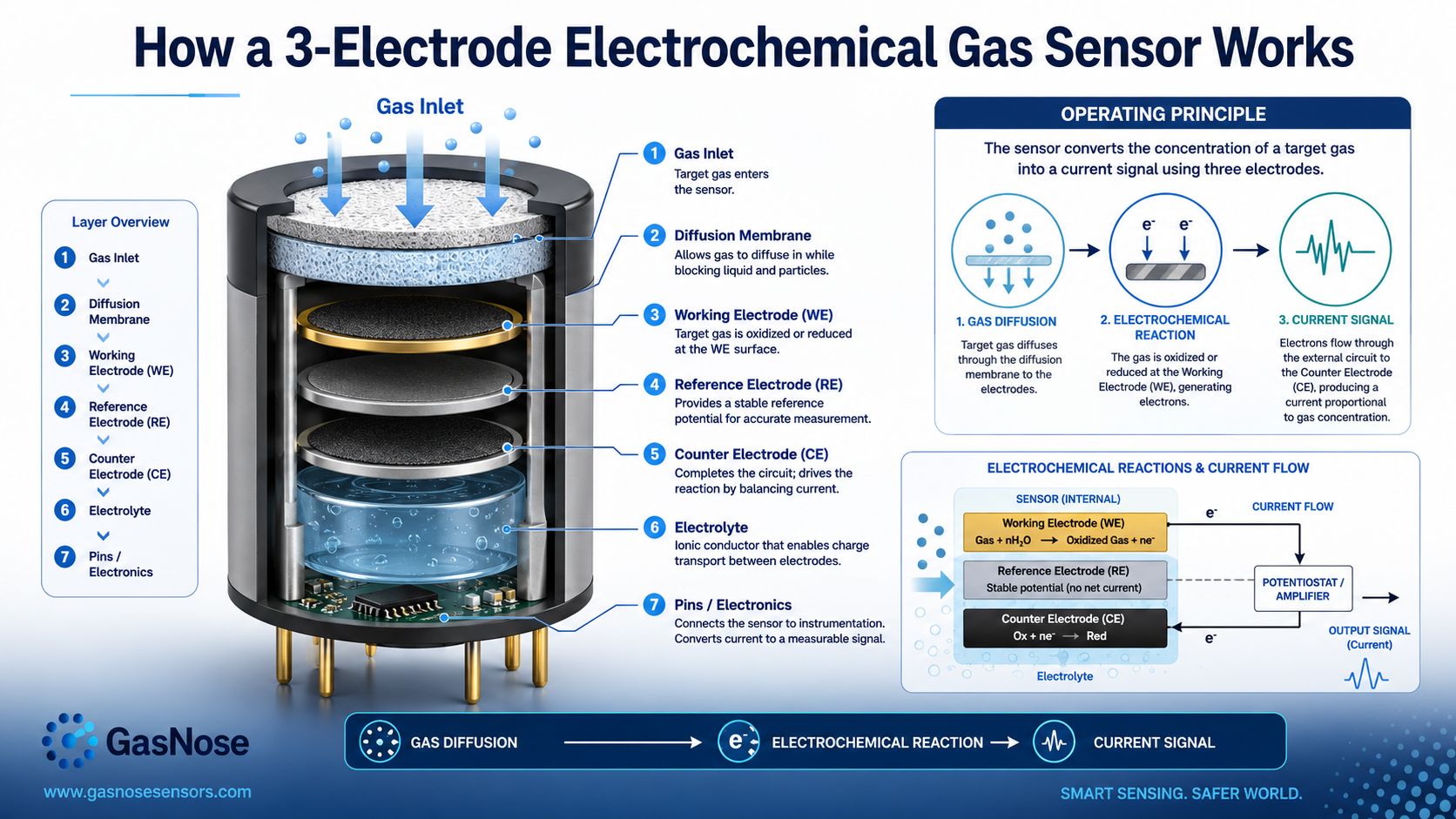
A conventional electrochemical gas sensor usually contains three functional electrodes:
- Working Electrode (WE)
- Reference Electrode (RE)
- Counter Electrode (CE)
The basic measurement process is:
Gas diffusion → electrochemical reaction → current signal → analog front end → gas concentration
Working Electrode (WE)
The working electrode is the main sensing electrode.
Target gas diffuses through the sensor’s gas inlet and diffusion barrier before reaching the working electrode.
At the electrode surface, the gas undergoes an oxidation or reduction reaction.
The resulting current is typically related to the amount of target gas reaching the electrode.
Reference Electrode (RE)
The reference electrode is often misunderstood.
It is not simply another gas-sensing electrode.
Its primary role is to provide a stable electrochemical reference so that the working electrode can be maintained at the correct operating potential.
This is essential because the electrochemical reaction at the working electrode depends strongly on electrode potential.
Counter Electrode (CE)
The counter electrode completes the electrochemical circuit.
It supports the balancing reaction required to maintain charge transfer inside the cell while the working electrode reacts with the target gas.
Together, the WE, RE, and CE form the standard 3-electrode electrochemical sensing structure used in many toxic-gas sensors.
For more background on electrochemical sensor construction, see Membrapor’s Basics of Electrochemical Gas Sensor application note.
What Does the Fourth Electrode Actually Do?
This is the most important part of the comparison.
There is no single universal definition of the fourth electrode.
Its function depends on the sensor design.
Type 1: Auxiliary Electrode for Baseline Compensation

A common 4-electrode architecture is:
WE + AE + RE + CE
Here, the fourth electrode is the Auxiliary Electrode (AE).
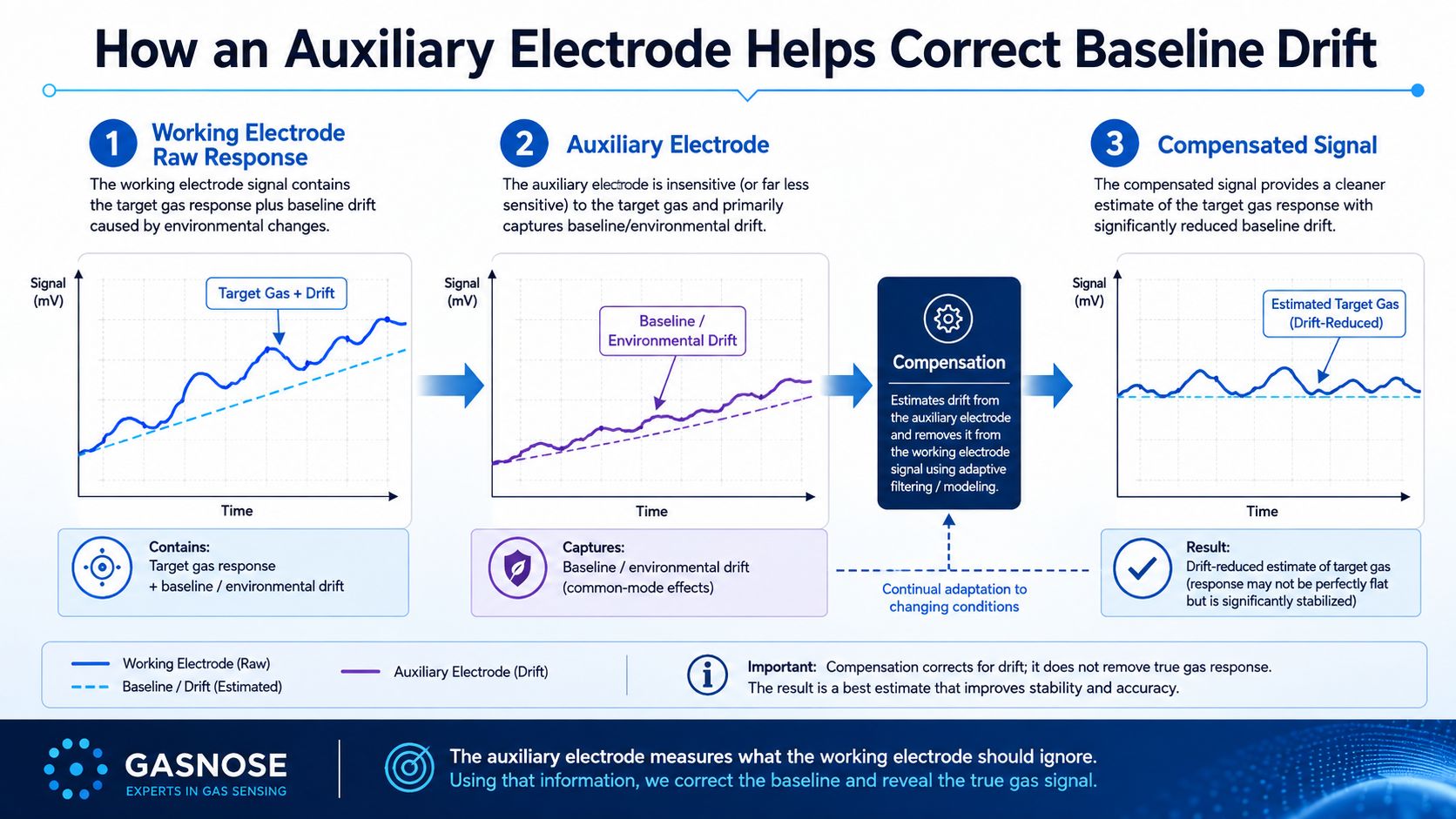
The working electrode responds to the target gas but may also contain baseline movement caused by environmental changes.
The auxiliary electrode provides another signal that can help characterize:
- baseline drift
- temperature-related zero changes
- background current
- certain interference effects
The instrument can then use information from both channels to improve the final gas estimate.
Honeywell’s technical documentation for 4-electrode toxic gas sensors describes how baseline shifts on the sensing electrode can also appear on the auxiliary electrode. When target gas reaches the sensing electrode, the working-electrode signal changes while the auxiliary channel can remain closer to baseline, allowing the electronics to compensate for the shift.
See: Honeywell / City Technology – Electrochemical 4-Electrode Toxic Sensors
Type 2: Dual Working Electrodes for Dual-Gas Detection
Not every 4-electrode sensor uses an auxiliary electrode.
Another architecture is:
WE1 + WE2 + RE + CE
In this design, the fourth electrode is a second working electrode.
Each working electrode can be optimized for a different electrochemical response.
Analog Devices provides a practical example using a combined CO and H₂S electrochemical sensor.
One working electrode responds to carbon monoxide.
The second working electrode responds to hydrogen sulfide.
Both share the same reference and counter electrodes.
See: Analog Devices CN0396 – Dual Electrochemical Gas Sensor with Temperature Compensation
This is still a 4-electrode sensor, but its purpose is very different from a baseline-compensation AE design.
Type 3: Interference Compensation
Some 4-electrode sensors use the extra electrode to help compensate for an interfering gas.
One important example is CO measurement in the presence of hydrogen.
Hydrogen can interfere with certain electrochemical CO sensors.
In some 4-electrode architectures, the main sensing electrode responds to both CO and H₂, while the auxiliary electrode provides additional information about the hydrogen component.
The instrument can then use both signals to calculate a better estimate of the actual CO concentration.
Membrapor describes this approach in its hydrogen-compensated 4-electrode CO sensors for flue-gas and stack-gas monitoring.
See: Membrapor – Basics of Electrochemical Gas Sensor
Type 4: Diagnostics or Other Special Functions
Some sensor architectures use the additional electrode for diagnostics or other special purposes.
Analog Devices notes that some 4-lead electrochemical sensors can use the fourth electrode as a diagnostics electrode, while other sensors use it as an additional working electrode.
See: Analog Devices CN0429 – Electrochemical Gas Measurement System with Sensor Diagnostics
This is why an engineer should never assume the function of a 4-electrode sensor based only on the number of pins or electrodes.
Two Types of 4-Electrode Gas Sensors

For practical selection, it is helpful to separate two major 4-electrode categories.
Auxiliary-Electrode Design
Typical structure:
WE + AE + RE + CE
Typical goals:
- baseline correction
- low-concentration measurement
- temperature-related zero correction
- interference compensation
Dual-Working-Electrode Design
Typical structure:
WE1 + WE2 + RE + CE
Typical goals:
- two gas measurements
- two electrochemical responses
- multifunction sensing in one cell
The takeaway is simple:
The fourth electrode does not always have the same function.
How an Auxiliary Electrode Helps Correct Baseline Drift
Baseline drift becomes especially important when the target concentration is very low.
For example, in standard industrial safety monitoring, a small baseline change may be insignificant compared with a ppm-level gas signal.
But in low-ppb or low-ppm environmental monitoring, the baseline movement itself may become comparable to the target-gas signal.
This is one reason 4-electrode electrochemical sensors are often considered for air-quality applications.
SGX Sensortech states that its 4-electrode air-quality sensors are intended for very low concentration outdoor air-quality monitoring and that the additional electrode structure improves baseline-versus-temperature performance.
See: SGX Sensortech SGX-7NO-AQ-25
The general concept is:
Working Electrode Signal
contains:
Target Gas Response + Baseline / Environmental Effects
while the:
Auxiliary Electrode Signal
provides additional information about:
Baseline / Environmental Behavior
The signal-processing system then uses both inputs to create a more stable estimate of the target gas.
However, compensation should not be oversimplified.
It is not always:
Corrected Signal = WE − AE
Real compensation can depend on:
- sensor-specific coefficients
- temperature
- zero-current behavior
- calibration data
- sensor aging
- manufacturer recommendations
- interference characteristics
- firmware algorithms
The auxiliary electrode provides additional information, not automatic accuracy.
Does a 4-Electrode Sensor Have Better Accuracy?
Not automatically.
This is one of the most common misunderstandings.
A 4-electrode sensor provides another measurement channel, but total system performance still depends on:
- sensor sensitivity
- baseline stability
- noise
- temperature effects
- humidity effects
- cross-sensitivity
- interfering gases
- calibration
- analog electronics
- digital compensation
- sensor aging
A properly designed 3-electrode instrument can perform better than a poorly designed 4-electrode instrument.
The real advantage of the 4-electrode structure appears when the additional electrode captures information that materially improves the measurement.
Examples include:
- low-level baseline correction
- hydrogen compensation in CO measurement
- dual-gas detection
- sensor diagnostics
So the right way to think about 4-electrode sensors is:
More measurement information, not automatically more accuracy.
3-Electrode vs 4-Electrode Readout Electronics
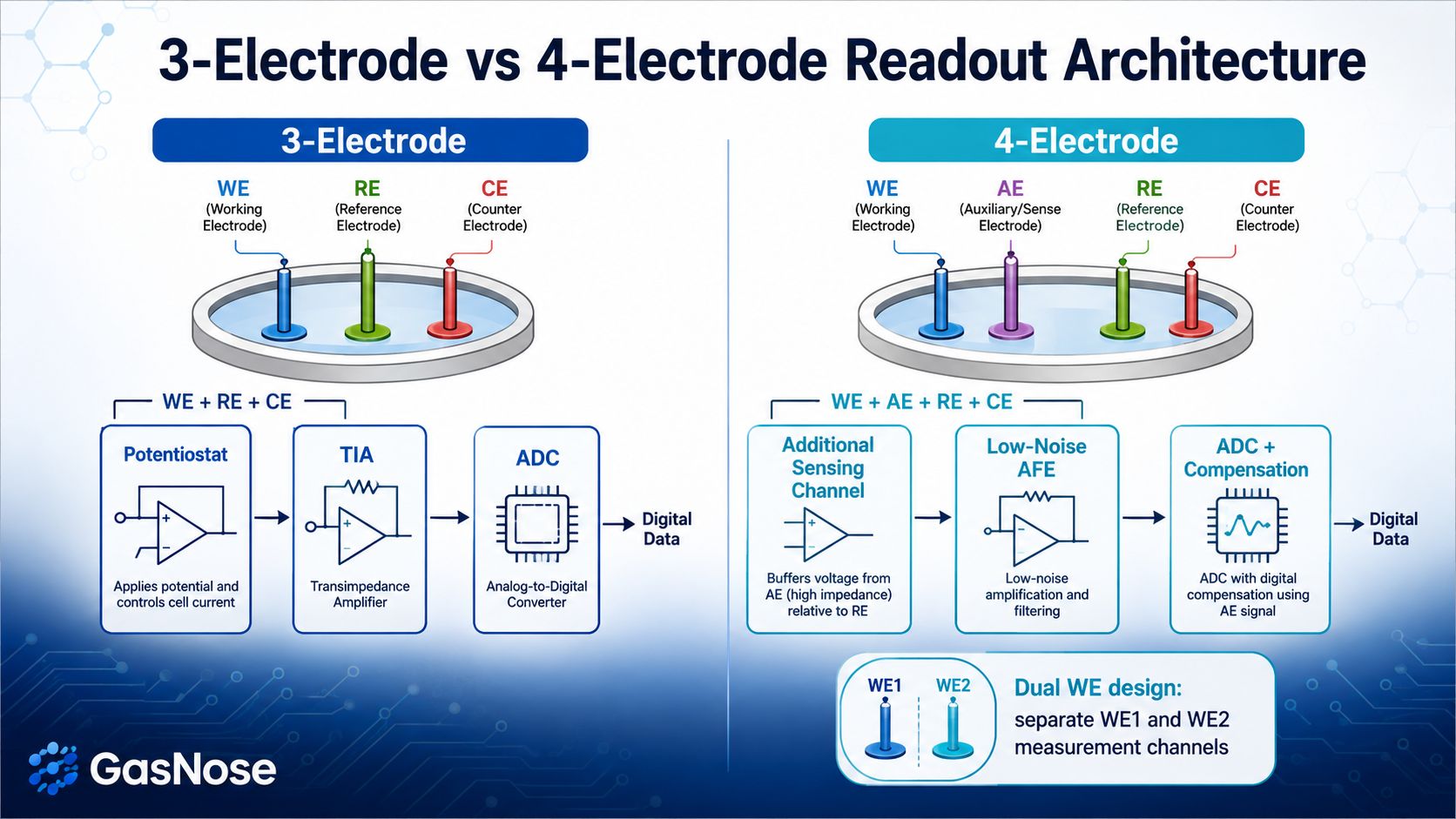
The number and function of electrodes directly affect the analog front end.
Typical 3-Electrode Readout
A 3-electrode electrochemical sensor commonly requires:
- potentiostat
- transimpedance amplifier
- ADC
- temperature compensation
- calibration logic
Typical signal chain:
WE + RE + CE → Potentiostat → TIA → ADC → Digital Gas Reading
Typical 4-Electrode Auxiliary-Electrode Readout
A 4-electrode AE sensor requires another measurement channel.
Typical architecture:
WE + AE + RE + CE
↓
Main WE channel + Auxiliary channel
↓
Low-noise analog front end
↓
ADC
↓
Compensation algorithm
Dual Working Electrode Readout
A dual-WE sensor may require:
WE1 measurement channel
plus
WE2 measurement channel
while sharing the same RE and CE.
Analog Devices’ CN0396 is a useful example because it shows separate electrochemical signal processing for CO and H₂S in a combined sensor.
This leads to an important OEM design point:
Choosing a 4-electrode sensor can change both the sensor BOM and the entire analog front-end architecture.
When Is a 3-Electrode Sensor the Better Choice?
A 3-electrode electrochemical sensor is usually a strong choice when the application requires:
- standard ppm toxic-gas monitoring
- portable safety detection
- fixed industrial gas detection
- one main target gas
- mature calibration methods
- lower circuit complexity
- lower BOM cost
- lower design risk
Examples include conventional CO and H₂S safety detectors.
For these applications, adding another electrode may provide little benefit if the measurement problem is already well defined.
When Is a 4-Electrode Sensor Worth Considering?
A 4-electrode sensor becomes more attractive when the application requires additional information.
Low-Level Air-Quality Monitoring
Typical examples include:
- CO
- H₂S
- NO
- NO₂
- O₃
- SO₂
At low concentrations, baseline and environmental behavior become increasingly important.
Fenceline and Environmental Monitoring
Outdoor monitoring systems may experience wide temperature swings and changing environmental conditions.
An auxiliary electrode can provide valuable background information for compensation.
Dual-Gas Portable Instruments
A dual-working-electrode sensor may allow two gases to be measured in one electrochemical cell.
A common example is:
CO + H₂S
Hydrogen-Rich Environments
Flue-gas or combustion applications can contain hydrogen that interferes with conventional CO electrochemical sensors.
A dedicated 4-electrode hydrogen-compensated architecture may be preferable.
Sensor Diagnostics
Some advanced instrument architectures use the additional electrode as part of sensor health or diagnostics functions.
Application Examples by Gas
| Gas / Application | Common Starting Architecture | Why a 4-Electrode Design May Help |
|---|---|---|
| CO portable safety | 3-electrode | Standard ppm measurement usually sufficient |
| CO in flue / stack gas | Application-specific 4-electrode | H₂ interference compensation |
| H₂S industrial safety | 3-electrode | Mature ppm toxic-gas detection |
| CO + H₂S | Dual-WE 4-electrode | Two gases in one sensor |
| NO / NO₂ / O₃ / SO₂ ambient air | 4-electrode often considered | Baseline and low-level measurement improvement |
| Fenceline monitoring | 4-electrode often considered | Additional environmental correction information |
Electrode count should never be used alone to infer:
- accuracy
- detection limit
- selectivity
- measurement range
- response time
Always check the specific sensor datasheet and application note.
Don’t Confuse Electrodes, Pins, and Measurement Channels
A sensor with four visible electrical contacts is not automatically the same as every other “4-electrode” sensor.
Engineers should distinguish between:
- functional electrochemical electrodes
- housing pins
- electrical terminals
- duplicate connections
- working-electrode channels
- auxiliary-electrode channels
- diagnostics connections
Similarly, terms such as 4-wire, 4-lead, and 4-electrode can appear in technical literature with slightly different meanings depending on the sensor and readout architecture.
Always verify the manufacturer’s electrode assignment.
How to Choose: 3-Electrode or 4-Electrode?
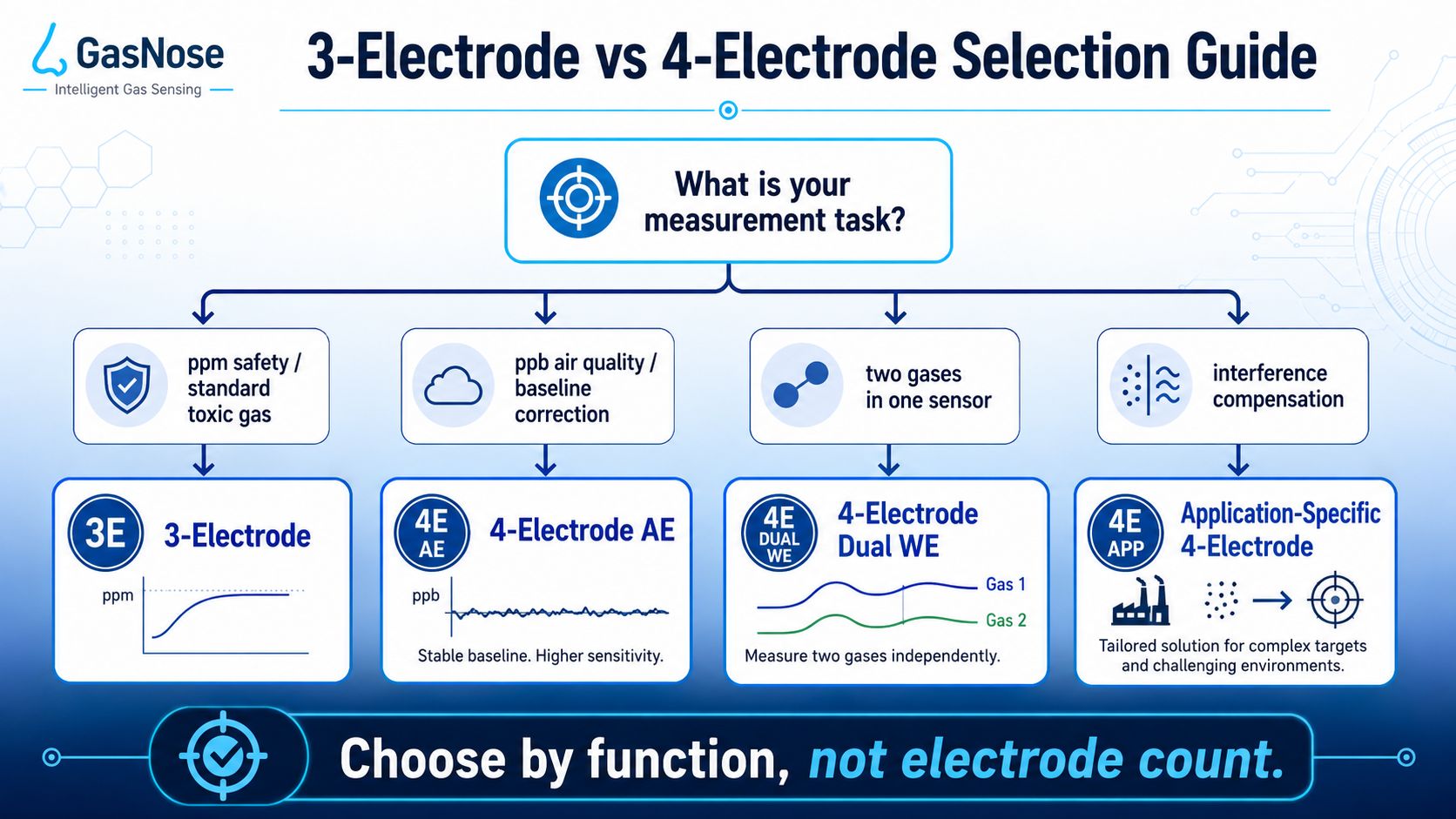
Use the following questions during sensor selection.
1. What gas are you measuring?
Is it one target gas or more than one?
2. What concentration range matters?
Are you measuring:
- tens or hundreds of ppm?
- low ppm?
- ppb-level ambient concentrations?
3. Is baseline drift important?
If the expected target signal is small, baseline correction may become critical.
4. Are interfering gases present?
For example:
Does hydrogen interfere with your CO measurement?
5. Do you need two gases in one sensor?
If yes, a dual-working-electrode design may be appropriate.
6. Can your electronics support another sensing channel?
A 4-electrode sensor generally requires more analog and digital processing.
7. Does the manufacturer provide compensation data?
The fourth electrode is only useful if its behavior is properly characterized.
8. What exactly does the fourth electrode do?
This is the most important question.
3-Electrode vs 4-Electrode Selection Summary
| Requirement | Usually Start With |
|---|---|
| Standard ppm toxic gas detection | 3-electrode |
| Portable gas detector | 3-electrode |
| Fixed industrial safety detector | 3-electrode |
| Low-level air-quality measurement | 4-electrode with AE |
| Baseline correction | 4-electrode with AE |
| CO + H₂S in one sensor | Dual-WE 4-electrode |
| H₂ compensation in CO sensing | Application-specific 4-electrode |
| Lowest circuit complexity | 3-electrode |
| Sensor diagnostics | Application-specific 4-electrode |
Frequently Asked Questions
What are the three electrodes in an electrochemical gas sensor?
The three standard electrodes are the working electrode (WE), reference electrode (RE), and counter electrode (CE).
The working electrode performs the target-gas electrochemical reaction, the reference electrode provides a stable potential reference, and the counter electrode supports the balancing reaction.
What is the fourth electrode in a gas sensor?
It depends on the design.
The fourth electrode may be:
- an auxiliary electrode
- a second working electrode
- a diagnostics electrode
- an application-specific compensation electrode
Is the auxiliary electrode the same as the reference electrode?
No.
The reference electrode provides a stable electrochemical reference potential.
The auxiliary electrode is an additional sensing or compensation channel.
Their functions are different.
Is a 4-electrode gas sensor more accurate than a 3-electrode sensor?
Not automatically.
A 4-electrode sensor provides more information, but final accuracy still depends on sensor chemistry, calibration, environmental compensation, electronics, noise, drift, and signal-processing quality.
Why are 4-electrode sensors used for ppb air-quality monitoring?
Because at very low concentrations, baseline drift and environmental changes can become a large part of the measurement error.
An auxiliary electrode can provide additional information that helps compensate for these effects.
Does every 4-electrode sensor detect two gases?
No.
Some use an auxiliary electrode for baseline or interference compensation.
Others use two working electrodes for dual-gas measurement.
What is a dual working-electrode gas sensor?
It is a 4-electrode sensor with:
WE1 + WE2 + RE + CE
Each working electrode can be designed to respond to a different gas or electrochemical reaction.
Can a 4-electrode CO sensor compensate for hydrogen?
Some dedicated designs can.
In certain hydrogen-compensated CO sensors, the auxiliary electrode provides additional information about the H₂ contribution so that the instrument can estimate CO more accurately.
Do 4-electrode sensors require different electronics?
Usually yes.
They often require another measurement channel and additional compensation or signal-processing logic.
Should I choose a 3-electrode or 4-electrode gas sensor?
Choose based on the measurement requirement.
For standard ppm toxic-gas sensing, a 3-electrode sensor is often the most practical choice.
For low-level air-quality monitoring, dual-gas sensing, interference compensation, or diagnostics, a 4-electrode architecture may provide clear advantages.
Final Takeaway
The difference between 3-electrode and 4-electrode electrochemical gas sensors is not simply:
three electrodes versus four electrodes.
The real difference is the measurement information available to the system.
A 3-electrode sensor provides the proven WE + RE + CE architecture used in a large range of industrial gas detectors.
A 4-electrode sensor adds another functional channel.
That channel may be used to:
- correct baseline drift
- compensate for interference
- improve low-level measurement
- detect another gas
- monitor sensor health
The best selection rule is therefore:
Choose by function, not electrode count.
References and Further Reading
- Honeywell / City Technology – Electrochemical 4-Electrode Toxic Sensors
- Analog Devices CN0396 – Dual Electrochemical Gas Sensor with Temperature Compensation
- Analog Devices CN0429 – Electrochemical Gas Measurement System with Sensor Diagnostics
- SGX Sensortech – SGX-7NO-AQ-25 Air Quality Electrochemical Sensor
- Membrapor – Basics of Electrochemical Gas Sensor
