




A 4-gas monitor is a portable multi-gas detector commonly configured to monitor four major atmospheric hazards at the same time:
- Oxygen (O₂)
- Combustible gases or vapors as %LEL
- Hydrogen sulfide (H₂S)
- Carbon monoxide (CO)
Together, these four channels address several of the most common atmospheric hazards encountered in confined spaces and general industrial work: oxygen deficiency or enrichment, fire and explosion, acute H₂S toxicity, and CO exposure from combustion.
This O₂ + LEL + H₂S + CO combination has become so common that it is often referred to simply as the standard four-gas configuration.
However, there is an important distinction:
A standard 4-gas monitor is an industry-common configuration, not a universal legal requirement for every workplace, confined space, mine, or country.
The gases that actually need to be monitored should be selected from a site-specific hazard assessment, work process, expected contaminants, and applicable regulations or occupational exposure limits.
If you are new to the instrument category itself, Otywell Safety’s guide to what a 4-gas monitor is provides another practical overview of the four-channel concept and portable detector selection. For actual deployment, however, the gas configuration still needs to match the real hazards of the site.
The Four Gas Channels at a Glance
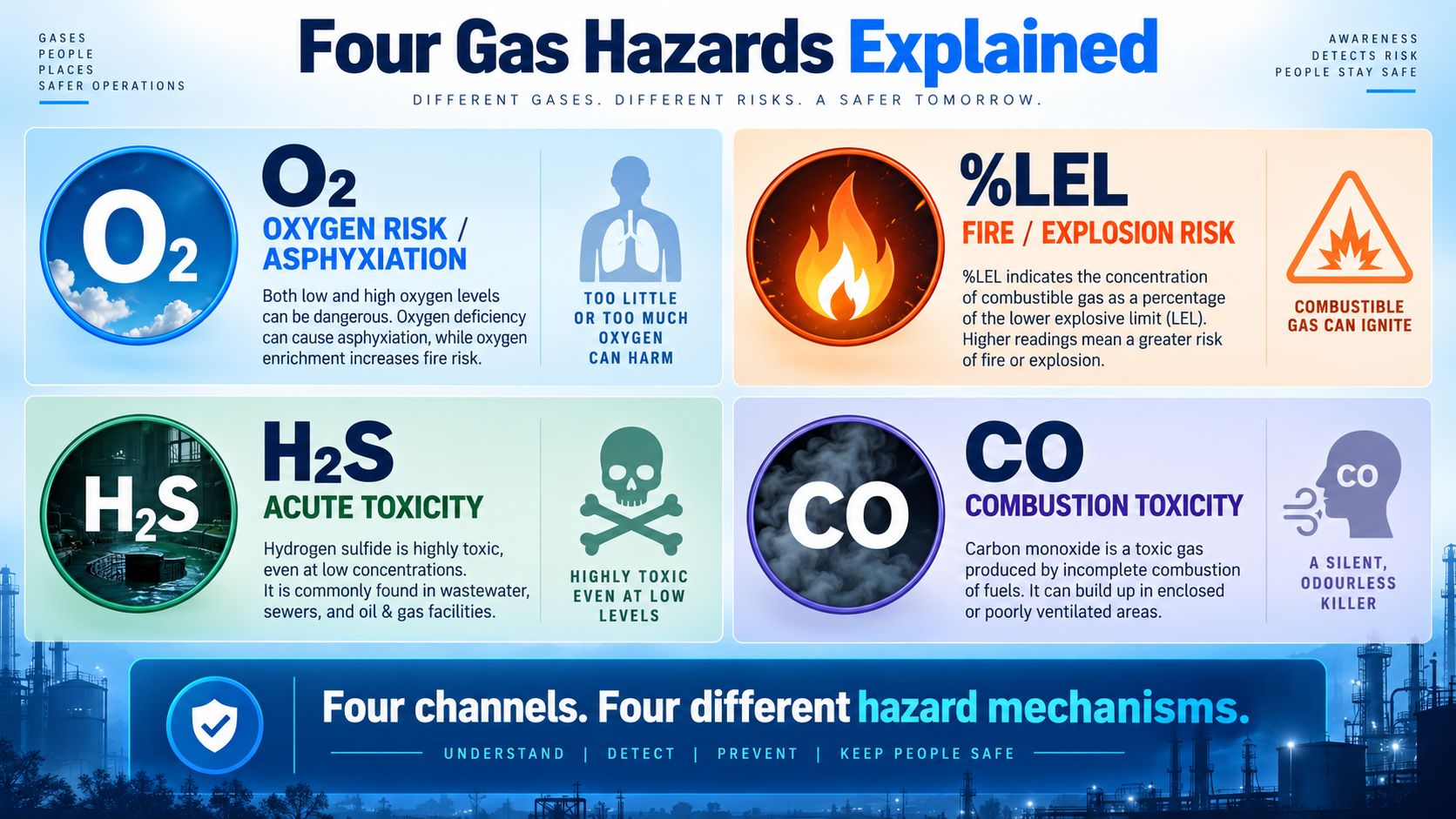
| Channel | Typical Display | Main Hazard | Common Sources / Scenarios |
|---|---|---|---|
| Oxygen | % vol O₂ | Oxygen deficiency or enrichment | Inert-gas displacement, corrosion, combustion, biological activity |
| Combustible gas | %LEL | Fire and explosion | Methane, propane, hydrocarbons, solvents, fuel vapors |
| H₂S | ppm | Acute toxic exposure | Sewers, wastewater, oil and gas, manure, decomposition |
| CO | ppm | Toxic exposure | Engines, generators, heaters, forklifts, fires, incomplete combustion |
The important point is that these channels do not represent four versions of the same hazard.
They cover four different atmospheric problems.
A useful way to think about the standard configuration is:
O₂ → Can people safely breathe the atmosphere?
%LEL → Can the atmosphere ignite or explode?
H₂S → Is a common acute toxic gas present?
CO → Is toxic combustion gas present?
Why Are O₂, LEL, H₂S and CO Commonly Combined?
The standard four-gas configuration works well across many industrial applications because it combines several broad hazard categories in a single portable instrument.
Oxygen Risk
A space can become dangerous without any toxic gas exceeding an exposure limit.
Nitrogen, carbon dioxide, argon, methane, or another gas can displace oxygen and create an oxygen-deficient atmosphere.
Conversely, oxygen enrichment can increase combustion risk.
Combustible Gas Risk
Many industrial environments contain methane, hydrocarbons, solvents, fuels, or other combustible gases and vapors.
A combustible channel warns when the concentration approaches the Lower Explosive Limit (LEL).
Hydrogen Sulfide Toxicity
H₂S is particularly relevant in wastewater, sewage, oil and gas, manure handling, decomposition processes, and some underground environments.
Carbon Monoxide Toxicity
CO is generated by incomplete combustion and can accumulate around engines, generators, heaters, forklifts, fires, and other combustion processes.
Together, these channels provide broad coverage of:
Asphyxiation + Fire/Explosion + Toxic Gas + Combustion Hazard
That is the engineering logic behind the common four-gas configuration.
Channel 1: Oxygen — O₂
Normal atmospheric air contains approximately 20.9% oxygen by volume.
A multi-gas monitor typically displays O₂ directly as percent volume.
Two conditions matter:
Oxygen Deficiency
Low oxygen can occur through:
- displacement by nitrogen or other inert gases
- methane or CO₂ accumulation
- oxidation or corrosion
- combustion
- fermentation
- decomposition
- purging operations
- poor ventilation
Oxygen-deficient atmospheres can cause impaired judgment, unconsciousness, and death without providing a reliable sensory warning.
Oxygen Enrichment
Too much oxygen also creates risk.
Oxygen enrichment does not itself make materials flammable, but it can make fires easier to start and more intense.
For a deeper explanation of both conditions, see the GasNose Oxygen Deficiency and Enrichment Guide.
Why O₂ Is Usually Tested First
Oxygen measurement also affects interpretation of other channels.
For example, many traditional catalytic-bead combustible sensors depend on sufficient oxygen for the catalytic oxidation reaction used to measure combustible gas.
This is one reason atmospheric testing procedures commonly place oxygen first.
Channel 2: Combustible Gas — %LEL
A standard four-gas instrument normally reports combustible gas as %LEL.
LEL means Lower Explosive Limit: the minimum concentration of a combustible gas or vapor in air at which ignition can propagate under specified conditions.
A reading of:
10% LEL
does not mean the atmosphere contains 10% gas by volume.
It means the combustible concentration has reached 10% of the concentration associated with the lower explosive limit for the gas or calibration basis involved.
That distinction is critical.
For a deeper explanation, see What Is a Safe LEL Level?.
Does the LEL Channel Tell You Which Gas Is Present?
Usually not.
A general combustible sensor may respond to multiple flammable gases and vapors.
The instrument can warn that a combustible atmosphere is developing, but it does not necessarily identify whether the source is:
- methane
- propane
- butane
- gasoline vapor
- solvent vapor
- another hydrocarbon
Sensor technology and calibration gas also affect response.
Catalytic vs Infrared LEL Sensors
Portable multi-gas instruments commonly use either:
Catalytic-bead sensors
or
Infrared combustible sensors
Catalytic sensors can respond to a broad range of combustible gases, but their performance can be affected by:
- low oxygen
- catalyst poisoning
- inhibitors
Infrared sensors can provide important advantages for many hydrocarbon applications and do not depend on oxygen for the sensing reaction, but they are not universal combustible-gas sensors. For example, conventional hydrocarbon IR designs generally do not detect hydrogen.
This is another reason detector selection should be based on the actual gas hazard rather than simply specifying “LEL.”
Channel 3: Hydrogen Sulfide — H₂S
Hydrogen sulfide is a highly toxic gas associated with biological decomposition and many industrial processes.
Common environments include:
- sewers
- wastewater treatment
- sludge tanks
- manure pits
- oil and gas production
- sour crude and sour gas
- pulp and paper
- some mining and underground operations
One dangerous characteristic of H₂S is that odor should never be relied upon as the safety warning.
Portable monitors therefore commonly use an electrochemical H₂S sensor to provide a direct ppm reading and audible, visual, or vibration alarms.
For sensor technologies, ranges, cross-sensitivity, and selection, see the GasNose Hydrogen Sulfide Sensor Guide.
Channel 4: Carbon Monoxide — CO
Carbon monoxide is a colorless toxic gas produced by incomplete combustion.
Common sources include:
- gasoline and diesel engines
- generators
- forklifts
- heaters
- boilers
- furnaces
- fires
- welding and hot-work related combustion
- poorly ventilated combustion equipment
CO becomes especially important in enclosed or poorly ventilated areas because concentrations can build without workers being able to see or smell the gas.
For sensor selection and electrochemical CO detection, see the GasNose Carbon Monoxide Sensor Guide.
Why Are 4-Gas Monitors Common in Confined Spaces?
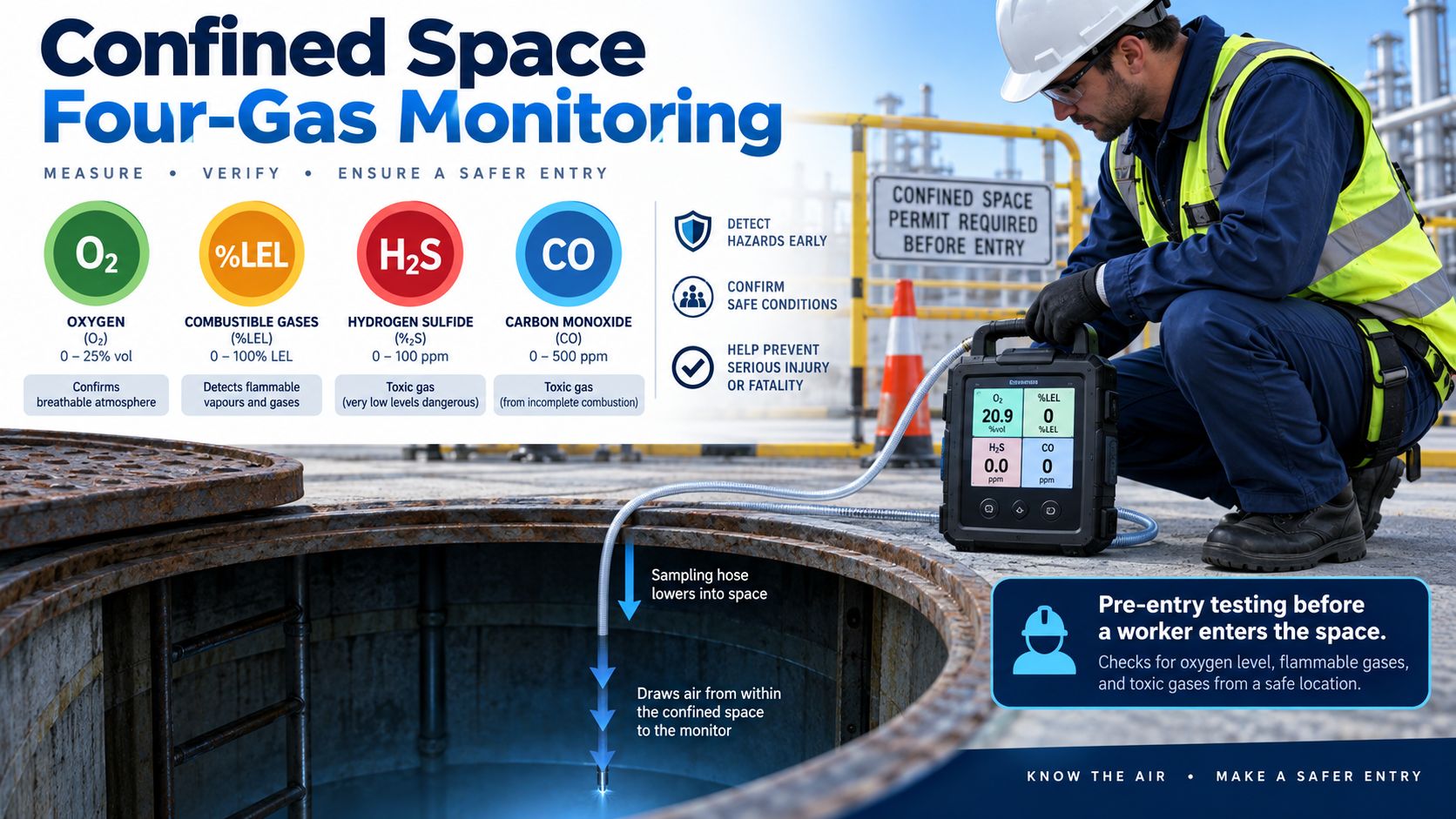
Confined spaces are one of the most common applications for portable multi-gas monitors.
Examples can include:
- tanks
- vessels
- reactors
- pits
- manholes
- sewers
- silos
- shafts
- tunnels
- pipelines
- wet wells
- storage compartments
Atmospheric hazards may develop because the space has limited ventilation, contains process residues, connects to other equipment, or undergoes chemical or biological activity.
Before a worker enters, a pumped detector and sampling hose can be used to test the atmosphere from outside the space.
During entry, personal monitors may then provide continuous protection in the worker’s breathing zone.
The standard O₂ + LEL + H₂S + CO combination is useful because many confined-space incidents involve one or more of these hazard categories.
But it should be treated as a starting configuration, not a substitute for hazard assessment.
In What Order Should a Confined Space Be Tested?
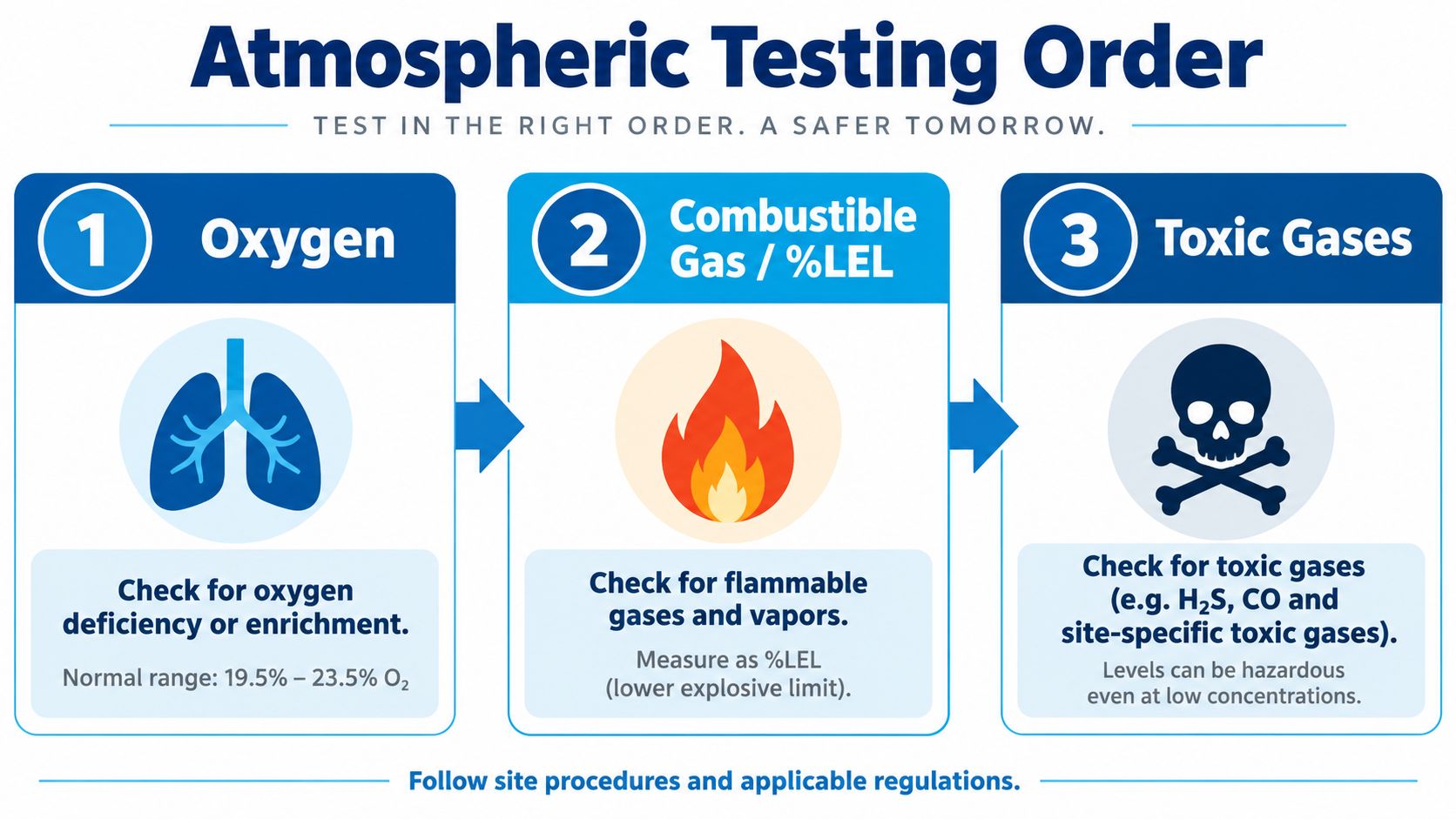
A widely used atmospheric testing sequence is:
1. Oxygen
Test for oxygen deficiency or enrichment.
2. Combustible Gases and Vapors
Test for a potential flammable or explosive atmosphere.
3. Toxic Gases and Vapors
Test for H₂S, CO, or any other toxic contaminant identified by the hazard assessment.
In the United States, OSHA’s permit-required confined-space standard explicitly requires this order for applicable pre-entry testing:
oxygen → flammable gases and vapors → potential toxic air contaminants
OSHA also explains that oxygen is tested first partly because many combustible-gas meters depend on oxygen and may not give reliable readings in an oxygen-deficient atmosphere.
See the official OSHA Permit-Required Confined Spaces Standard.
The important practical lesson is:
Do not only look at the four numbers. Use a defined atmospheric testing procedure and understand what each channel can and cannot tell you.
Is a 4-Gas Monitor Legally Required?
Not universally.
There is no single international regulation stating that every confined space must be monitored specifically for:
O₂ + LEL + H₂S + CO
Instead, most regulatory systems require employers to assess atmospheric hazards and monitor the gases or contaminants that can realistically be present.
This distinction matters when selecting instruments.
United States: OSHA Confined-Space Requirements
For permit-required confined spaces, OSHA defines an oxygen-deficient atmosphere as below 19.5% O₂ and an oxygen-enriched atmosphere as above 23.5% O₂.
OSHA requires applicable pre-entry testing for:
- oxygen content
- flammable gases and vapors
- potential toxic air contaminants
in that order.
OSHA also requires permit-space conditions to be tested or monitored as necessary to confirm that acceptable conditions are maintained during entry.
That does not mean OSHA specifically mandates H₂S and CO for every confined space.
If chlorine is the credible toxic hazard, chlorine may need to be monitored.
If ammonia is the hazard, ammonia may need to be monitored.
If benzene or another VOC is relevant, a different measurement strategy may be necessary.
The correct gas list comes from the hazard assessment.
Official source: OSHA 29 CFR 1910.146
Singapore: Confined-Space Requirements
Singapore provides one of the clearest regulatory examples.
Under the Workplace Safety and Health (Confined Spaces) Regulations, a hazardous atmosphere includes conditions where:
- oxygen is outside 19.5% to 23.5% by volume
- flammable gas or vapor reaches 10% or more of the LEL
- toxic substances exceed the applicable permissible exposure levels
For issuance of a confined-space entry permit, the atmosphere must meet the corresponding acceptable conditions, including oxygen within 19.5–23.5% and flammable gas or vapor below 10% LEL.
Official source: Singapore Workplace Safety and Health (Confined Spaces) Regulations
Again, the law is hazard-based.
It does not say that H₂S and CO are the only toxic gases that matter.
Canada: Hazard-Based Confined-Space Monitoring
Canadian federal occupational health and safety regulations similarly focus on atmospheric conditions rather than a universal four-gas list.
For hazardous confined spaces under the Canada Occupational Health and Safety Regulations, applicable requirements include testing and, when necessary, continuous monitoring of atmospheric conditions. The federal rules specify oxygen between 19.5% and 23% by volume under the relevant provision and require chemical-agent concentrations to remain within applicable limits.
Official source: Canada Occupational Health and Safety Regulations
Canadian requirements can vary by jurisdiction and sector, so users should also check provincial, territorial, maritime, offshore, or industry-specific rules where applicable.
Australia: Safe Oxygen and Contaminant Monitoring
Safe Work Australia’s current Model Code of Practice for confined spaces treats unsafe oxygen, fire/explosion contaminants, harmful airborne contaminants, and engulfment as major confined-space hazards.
It identifies 19.5–23.5% O₂ as the safe oxygen range in the model guidance.
The Code also emphasizes air monitoring when there is uncertainty about whether airborne contaminants may exceed applicable exposure standards.
Official source: Safe Work Australia Model Code of Practice: Confined Spaces
Australia’s Commonwealth, states, and territories regulate and enforce WHS laws, so the legal status and detailed requirements should be checked with the relevant local regulator.
United Kingdom: Risk Assessment Comes First
The UK Health and Safety Executive emphasizes that confined-space risks can include:
- harmful fumes
- reduced oxygen
- fire
- explosion
- loss of consciousness
- asphyxiation
The key requirement is to identify and assess the specific risks of the confined space and control them appropriately.
Official guidance: HSE – Working in Confined Spaces
This again supports hazard-based gas selection rather than assuming that one four-gas configuration fits every job.
European Union: Chemical Risk and Explosive Atmospheres
At EU level, workplace chemical safety is largely framework-based.
Directive 98/24/EC requires employers to determine whether hazardous chemical agents are present and assess the risk based on factors such as:
- hazardous properties
- exposure level and duration
- work conditions
- occupational exposure limits
- combined exposure to multiple chemical agents
See: EU Directive 98/24/EC on Chemical Agents at Work
Where explosive atmospheres may occur, the ATEX workplace framework also becomes relevant.
See: Directive 1999/92/EC on Explosive Atmospheres
The EU framework therefore supports the same basic principle:
identify the hazards first, then select appropriate detection and control measures.
Mining Is Different: Don’t Assume the Standard 4-Gas Combination
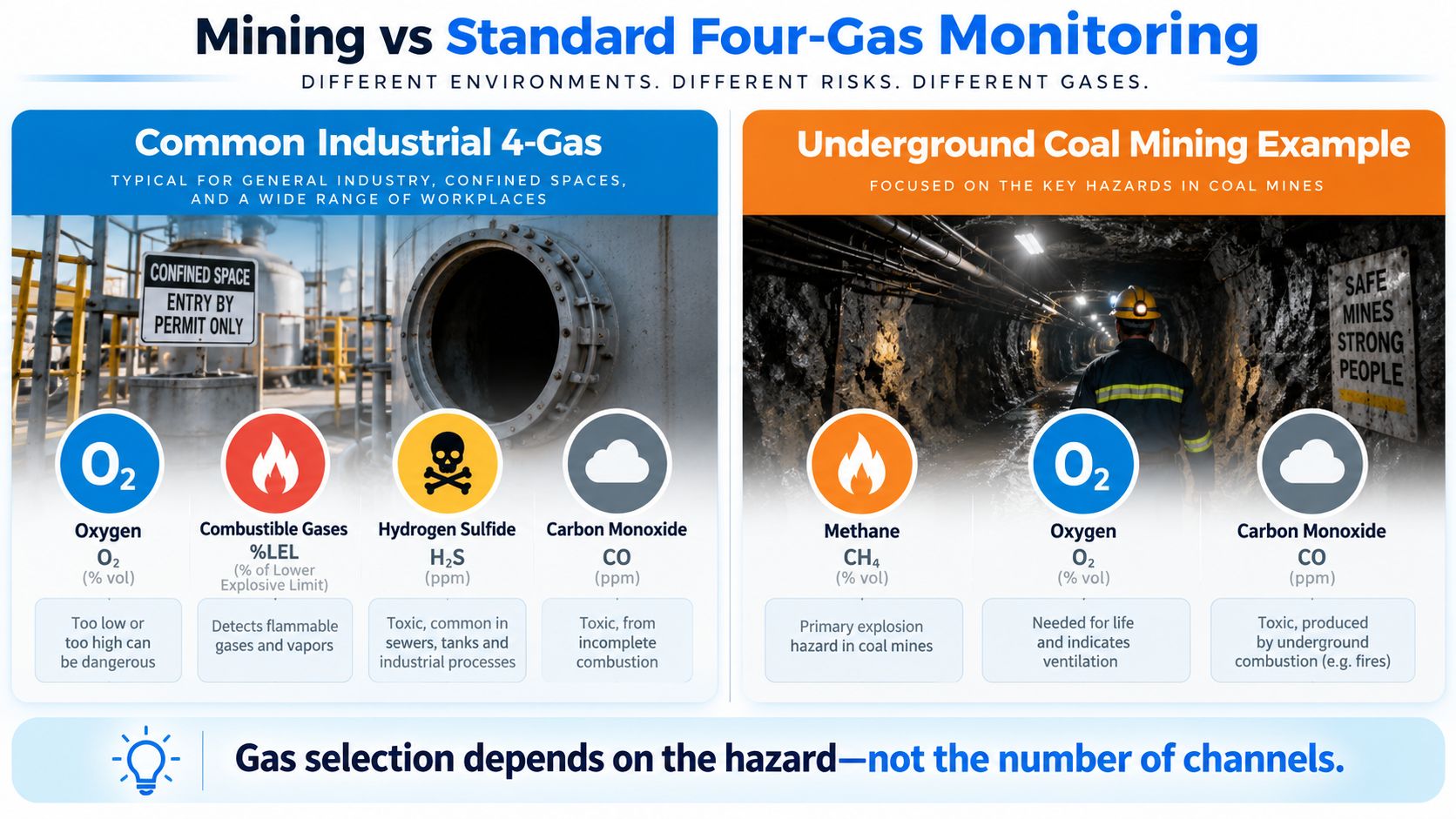
Mining is an excellent example of why the phrase standard four-gas monitor can be misleading.
Mining operations may need to monitor:
- methane
- oxygen
- carbon monoxide
- carbon dioxide
- hydrogen sulfide
- nitrogen dioxide
- other blasting or diesel-related gases
depending on the mine type and operation.
U.S. Underground Coal Mines
For U.S. underground coal mining, MSHA rules provide a very specific example.
Mine operators must provide an approved handheld multi-gas detector capable of measuring:
- methane
- oxygen
- carbon monoxide
to applicable underground miner groups and persons working alone.
Notice what is different:
There is no requirement in this rule that the detector must be the standard industrial LEL + O₂ + H₂S + CO configuration.
Methane is specifically central to underground coal-mine explosion risk.
This illustrates an important principle:
The best multi-gas configuration depends on the industry and hazard—not on whether the detector has four channels.
When a Standard 4-Gas Monitor Is Not Enough
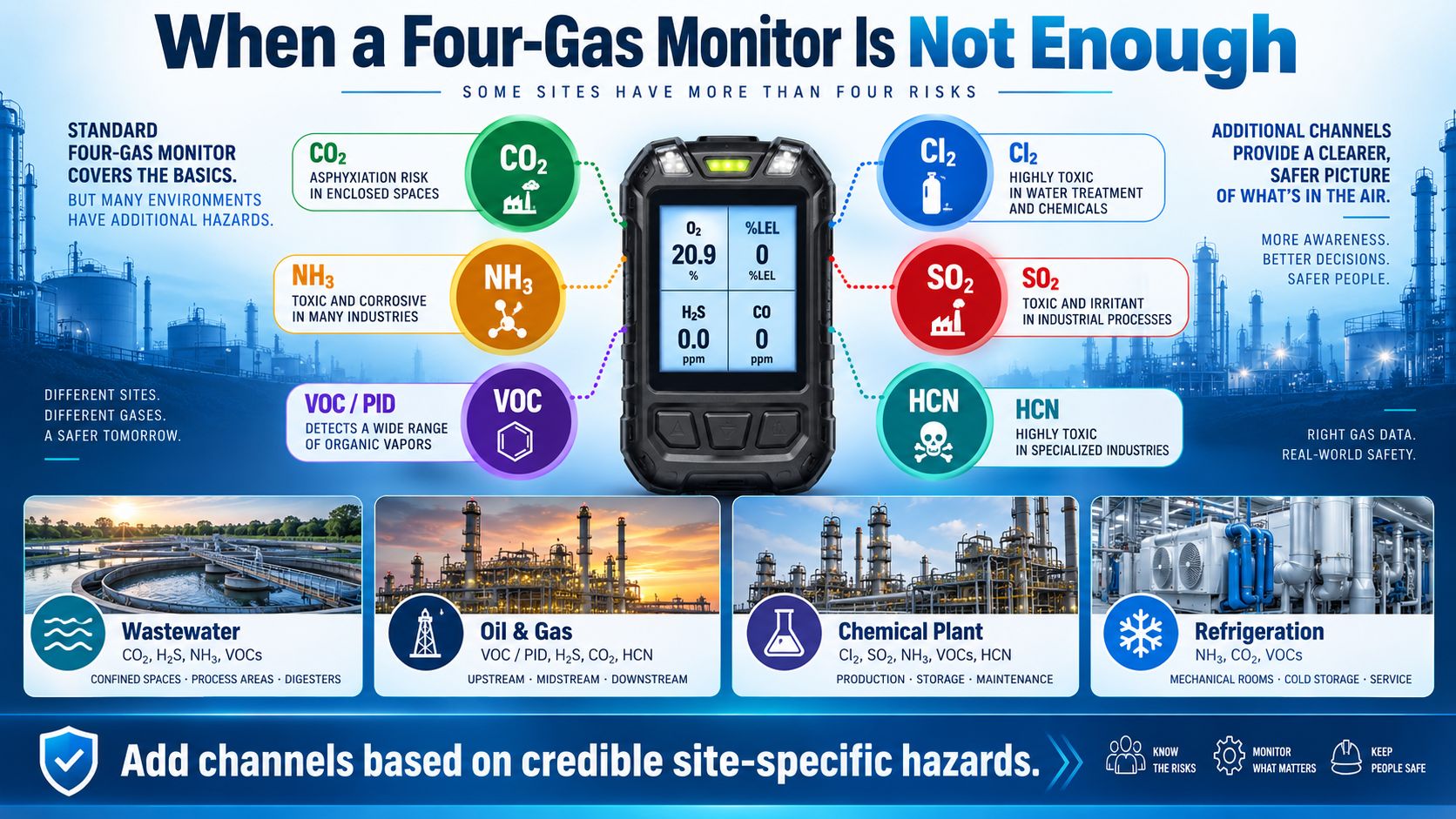
A four-gas detector only monitors the gases supported by its installed sensor channels.
It cannot warn against every atmospheric hazard.
Depending on the application, additional gases may include:
- CO₂
- NH₃
- VOCs
- benzene
- chlorine
- sulfur dioxide
- hydrogen cyanide
- nitrogen dioxide
- refrigerants
- hydrogen
- specialty process gases
Wastewater and Sewer Work
A standard four-gas detector is often highly relevant because H₂S, methane/combustible gas, oxygen deficiency, and sometimes CO can be concerns.
But some locations may also require consideration of:
- NH₃
- CO₂
- VOCs
Oil and Gas
Typical hazards can extend beyond the standard four channels to include:
- VOCs
- benzene
- SO₂
- CO₂
- hydrocarbon-specific measurement
Chemical Plants
The correct detector may need dedicated channels for gases such as:
- Cl₂
- NH₃
- SO₂
- HCN
- VOCs
depending on process chemicals and maintenance activities.
Refrigeration
A standard four-gas monitor cannot be assumed to provide adequate coverage for a refrigeration plant.
Possible hazards may include:
- ammonia
- CO₂
- refrigerant-specific leaks
- oxygen displacement
depending on the refrigerant system.
Semiconductor Manufacturing
Semiconductor gas detection is even more application-specific.
Potential gases can include:
- silane
- phosphine
- arsine
- hydrogen
- hydrogen fluoride
- solvent vapors
- other specialty gases
A conventional four-gas monitor is not a substitute for dedicated semiconductor toxic and pyrophoric gas detection.
4-Gas vs 5-Gas vs 6-Gas Monitor
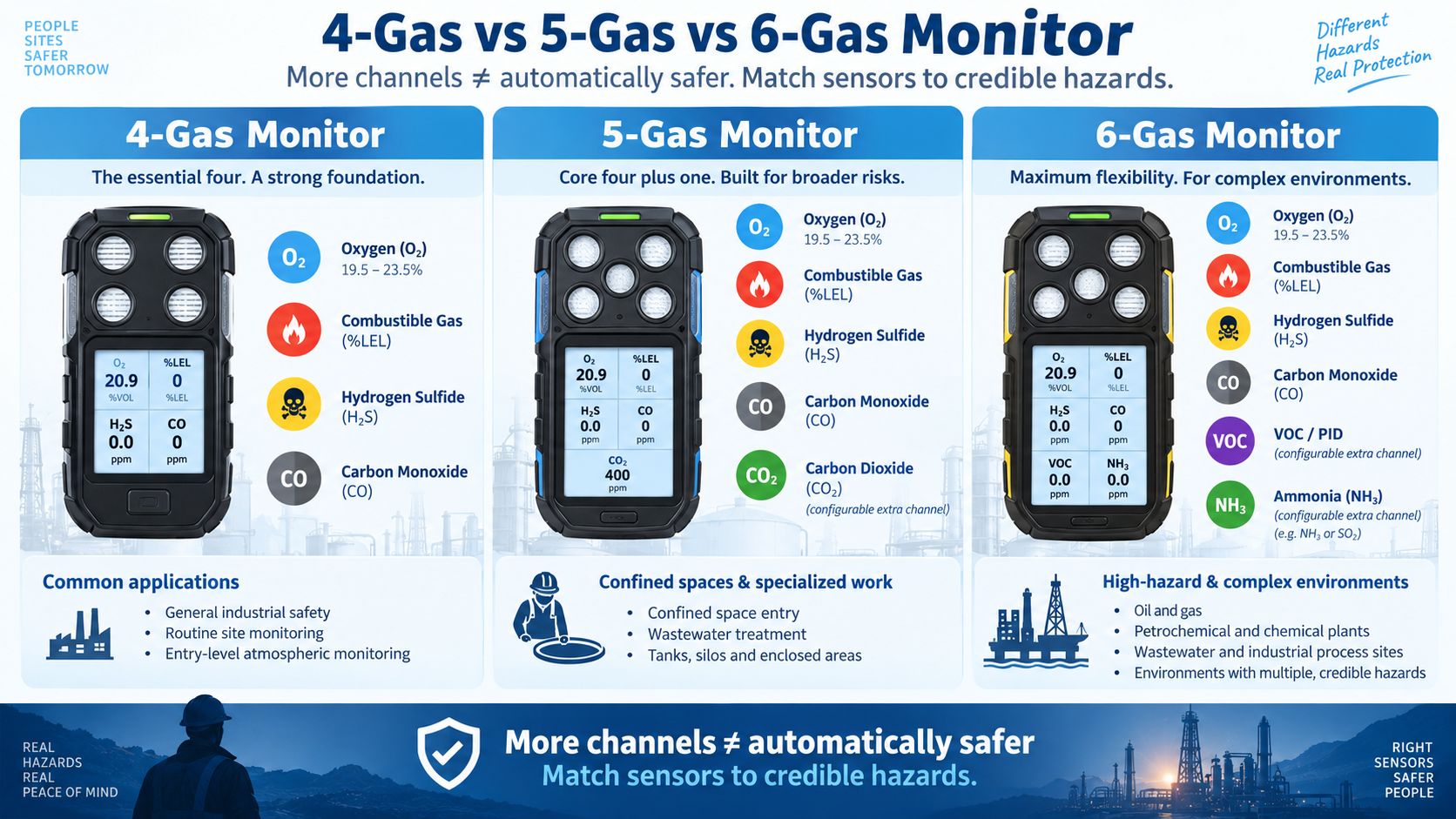
More channels can provide broader coverage, but:
More channels do not automatically mean greater safety.
The correct channels matter more than the number.
Typical 4-Gas Monitor
Common configuration:
- O₂
- %LEL
- H₂S
- CO
Suitable as a starting point for many general industrial and confined-space applications.
5-Gas Monitor
A fifth channel may add:
- CO₂
- VOC/PID
- NH₃
- SO₂
- another toxic gas
depending on the application.
6-Gas Monitor
A six-gas instrument may combine multiple toxic or process-specific channels with the conventional four.
For example:
O₂ + LEL + H₂S + CO + VOC + CO₂
or another configuration appropriate to the site.
The extra channels should come from a credible hazard—not from a desire to buy the detector with the largest number on the specification sheet.
Pumped vs Diffusion Multi-Gas Monitors
Multi-gas detectors can also differ in how gas reaches the sensors.
Diffusion Detector
Gas reaches the sensor naturally.
This configuration is well suited to:
- personal monitoring
- breathing-zone monitoring
- continuous worker protection
Pumped Detector
An internal pump draws the sample through tubing.
This is especially useful for:
- pre-entry testing
- manholes
- tanks
- vessels
- remote sampling
- checking areas before exposure
For confined-space entry, a pump allows the atmosphere to be sampled while the worker remains outside the space.
This does not eliminate the need to understand:
- tubing length
- instrument response time
- sampling time
- gas adsorption
- stratified atmospheres
- sampling position
OSHA specifically notes that when atmospheres may be stratified, testing needs to account for the space ahead of the entrant and the sampling speed and response time of the instrument.
Do You Need Continuous Gas Monitoring?
Pre-entry testing only tells you what the atmosphere was when the sample was taken.
Conditions can change.
Examples include:
- sludge disturbance
- welding or hot work
- solvents being introduced
- chemical cleaning
- ventilation failure
- process leakage
- nitrogen ingress
- worker movement into another part of the space
- biological gas generation
Where atmospheric conditions can change, continuous or repeated monitoring may be necessary.
OSHA requires permit-space conditions to be tested or monitored as necessary to determine whether acceptable entry conditions are being maintained.
Canadian federal confined-space rules similarly include tests and continuous monitoring under relevant hazardous-space conditions.
The practical rule is:
If the hazard can change during the job, monitoring should be designed to detect that change before it harms the worker.
Bump Test vs Calibration
A gas detector only protects workers if the sensors and alarms are functioning correctly.
Two terms are often confused.
Bump Test
A bump test exposes the instrument to gas to confirm that:
- sensors respond
- alarms activate
- audible / visual / vibration functions operate
- the sample path works as expected
It is primarily a functional check.
Calibration
Calibration exposes the sensor to a known reference concentration and adjusts or verifies the measurement response according to the manufacturer’s procedure.
It addresses measurement accuracy, not just whether the detector reacts.
Testing, calibration, maintenance, and replacement schedules should follow the detector manufacturer’s instructions and applicable site procedures or regulations.
How to Select Gases for a Multi-Gas Detector

Instead of starting with:
“Do I need a 4-gas or 6-gas detector?”
start with the hazards.
Step 1 — Define the Application
Where will the monitor be used?
Examples:
- confined space
- mine
- sewer
- wastewater plant
- chemical plant
- refinery
- tank
- ship
- refrigeration room
Step 2 — Identify Credible Gases
Review:
- process chemicals
- safety data sheets
- fuels
- raw materials
- decomposition products
- cleaning chemicals
- maintenance activities
- abnormal operating conditions
Step 3 — Assess Oxygen Risk
Could oxygen be displaced?
Could oxygen enrichment occur?
Step 4 — Assess Combustible Risk
Could the environment contain:
- methane
- hydrogen
- hydrocarbons
- solvents
- combustible vapors?
If yes, determine whether the proposed sensor technology is suitable for those gases.
Step 5 — Identify Toxic Gases
Do not default only to H₂S and CO.
Ask which toxic substances can realistically be generated or released.
Step 6 — Check Regulations and Exposure Limits
Determine:
- local confined-space requirements
- occupational exposure limits
- industry-specific standards
- mine regulations
- hazardous-area requirements
- site alarm policies
Step 7 — Decide How the Detector Will Be Used
Do you need:
- personal diffusion monitoring?
- pumped pre-entry testing?
- both?
Step 8 — Select the Sensor Channels
Only now should the final detector configuration be chosen.
The most important rule is:
Choose sensors based on credible hazards, not habit.
Practical Gas Selection Examples
| Application | Common Core Channels | Additional Gases to Evaluate |
|---|---|---|
| General confined-space entry | O₂ + LEL + H₂S + CO | Site-specific toxic gases |
| Sewer / wastewater | O₂ + LEL + H₂S + CO | NH₃, CO₂, VOC |
| Underground coal mining | CH₄ + O₂ + CO | Other mine-specific hazards |
| Oil and gas tank entry | O₂ + LEL + H₂S + CO | VOC/PID, benzene, SO₂, CO₂ |
| Chemical plant | Application-specific | Cl₂, NH₃, SO₂, HCN, VOC, others |
| Refrigeration room | Application-specific | NH₃, CO₂, refrigerant-specific gas |
| Battery / energy storage | Application-specific | H₂, CO, VOCs and other failure gases |
| Semiconductor manufacturing | Application-specific | PH₃, AsH₃, SiH₄, HF, H₂ and others |
Frequently Asked Questions
What four gases does a 4-gas monitor usually detect?
The most common industrial configuration is:
O₂ + combustible gas as %LEL + H₂S + CO.
However, some manufacturers offer different configurations.
Why are these four gases used?
Together they cover four common atmospheric hazard categories: oxygen problems, combustible-gas risk, hydrogen sulfide toxicity, and carbon monoxide toxicity.
Is a 4-gas monitor required for every confined space?
No.
Confined-space regulations generally require atmospheric hazards to be assessed and appropriate gases or contaminants to be tested. A standard four-gas detector is useful in many environments, but it is not universally sufficient or universally mandated.
What oxygen level is considered deficient?
In OSHA’s U.S. permit-required confined-space standard, oxygen below 19.5% by volume is considered oxygen deficient.
Other jurisdictions should be checked separately.
What does %LEL mean?
%LEL expresses combustible-gas concentration as a percentage of the lower explosive limit.
A reading of 10% LEL means the measured combustible response has reached one-tenth of the LEL reference—not that the air contains 10% combustible gas by volume.
Does a four-gas monitor identify methane?
It depends on the combustible sensor and detector configuration.
A standard %LEL sensor may respond to methane and other combustibles but generally does not identify which gas produced the response.
A methane-specific instrument may be preferable where methane itself is the regulated or operational target.
Why is H₂S included?
H₂S is a common acute toxic hazard in sewers, wastewater, oil and gas, manure handling, decomposition processes, and other industrial environments.
Why is CO included?
CO is common around incomplete combustion, including engines, generators, heaters, forklifts, fires, and other combustion sources.
What is the difference between a 4-gas and 5-gas detector?
A 5-gas monitor normally adds another sensing channel to the core configuration. That channel could be CO₂, VOC/PID, NH₃, SO₂, or another gas depending on the application.
Is a 6-gas detector safer than a 4-gas detector?
Not automatically.
A six-channel detector with the wrong sensors can be less useful than a four-channel detector correctly matched to the hazards.
What gases should be tested before entering a confined space?
At minimum, the testing strategy should address oxygen, combustible atmospheres, and toxic contaminants that can credibly be present. The exact gases depend on the space, process, materials, work activity, and applicable regulations.
Should I use a pumped or diffusion detector for confined-space entry?
A pumped monitor is especially useful for testing the space before entry because a sample can be drawn remotely. A diffusion monitor is commonly used for personal continuous monitoring. Some work procedures use both.
Final Takeaway
A 4-gas monitor is one of the most useful portable safety instruments in industrial gas detection because the common:
O₂ + %LEL + H₂S + CO
configuration covers several major atmospheric hazards in one device.
But the term standard four-gas monitor can create a dangerous assumption if it is interpreted as:
“These are the only four gases we ever need to measure.”
That is not how gas detection should be selected.
A sewer, coal mine, refinery, chemical plant, refrigeration room, semiconductor fab, and battery facility can have completely different atmospheric hazards.
The correct process is:
Identify the work environment
↓
Identify credible gases and oxygen risks
↓
Check regulations and exposure limits
↓
Choose suitable sensor technologies
↓
Select the detector channels
The number of channels comes last.
The right multi-gas detector is not the one that measures the most gases. It is the one that measures the gases that can actually harm people in that application.
Official References and Further Reading
- OSHA — Permit-Required Confined Spaces, 29 CFR 1910.146
- OSHA — Procedures for Atmospheric Testing
- MSHA — Underground Coal Mine Multi-Gas Detector Requirements
- Singapore — Workplace Safety and Health (Confined Spaces) Regulations
- Canada Occupational Health and Safety Regulations
- Safe Work Australia — Model Code of Practice: Confined Spaces
- UK HSE — Introduction to Working in Confined Spaces
- EU — Directive 98/24/EC on Chemical Agents at Work
- EU — Directive 1999/92/EC on Explosive Atmospheres
- GasNose — Oxygen Deficiency and Enrichment
- GasNose — What Is a Safe LEL Level?
- GasNose — Hydrogen Sulfide Sensors
- GasNose — Carbon Monoxide Sensors
