



Electrochemical Gas Sensors
Electrochemical gas sensors convert a gas-specific oxidation or reduction reaction into a small electrical current. They are one of the most established technologies for low-power detection of toxic gases such as CO, H₂S, SO₂, NO₂, Cl₂ and HCN—and they remain a core sensing platform in portable detectors, fixed transmitters and OEM gas modules.
Working principle
How does an electrochemical gas sensor work?
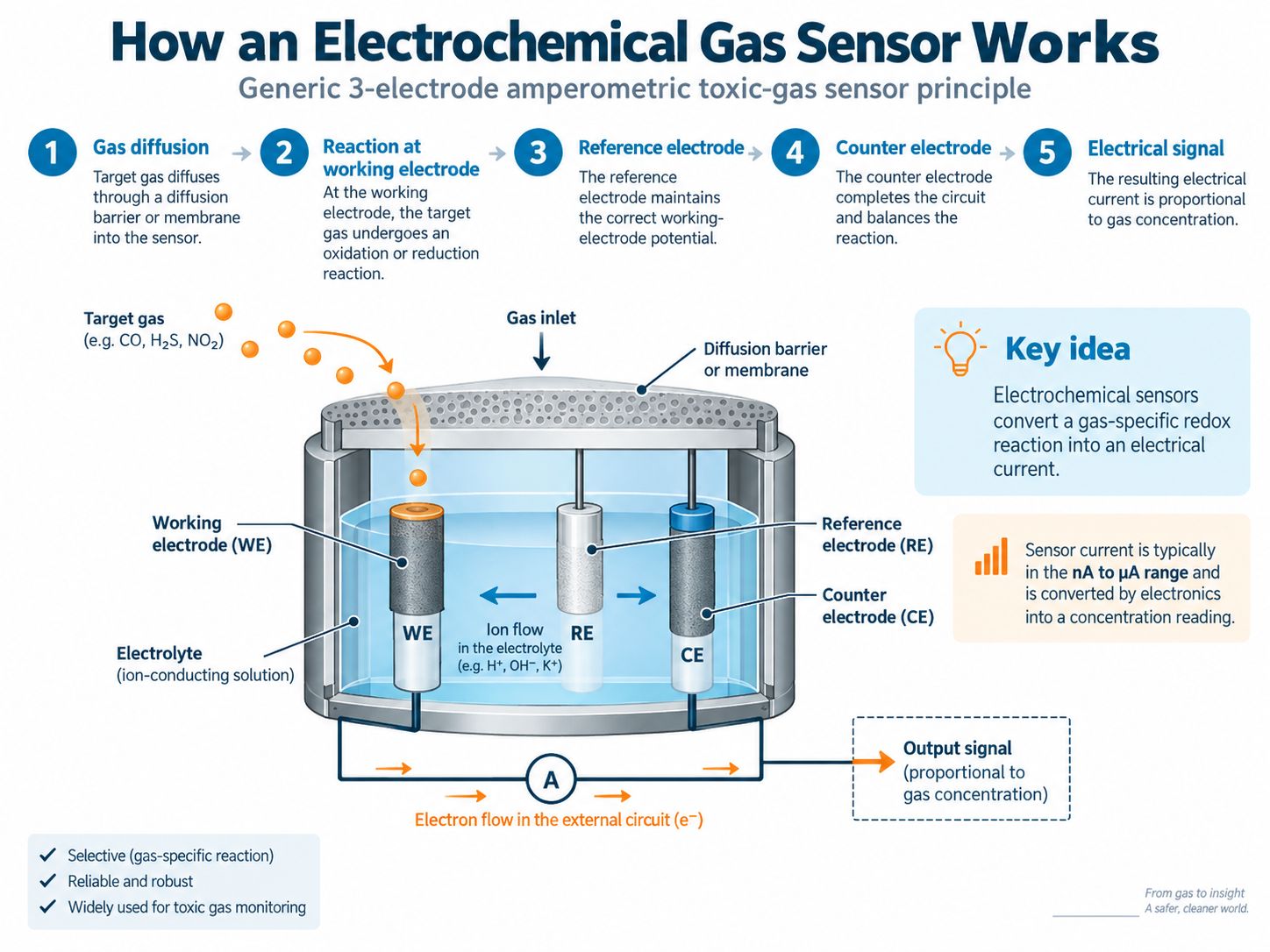
Gas diffusion
A membrane, capillary or diffusion barrier controls how quickly target gas reaches the electrochemical cell.
Redox reaction
The gas is oxidized or reduced at the working electrode. The reaction direction depends on the target gas and sensor chemistry.
Current generation
The electrochemical reaction transfers charge. Within the designed range, the resulting current is used as the measurement signal.
Signal conversion
External electronics maintain electrode potential, amplify the tiny current, digitize it, compensate the signal and calculate concentration.
For a deeper manufacturer explanation, Alphasense describes toxic-gas cells operating in amperometric mode, with a reference electrode anchoring the working-electrode potential. Read the Alphasense application note ↗
Target gas diffuses through the inlet barrier toward the working electrode.
Inside the cell
What is inside an electrochemical gas sensor?
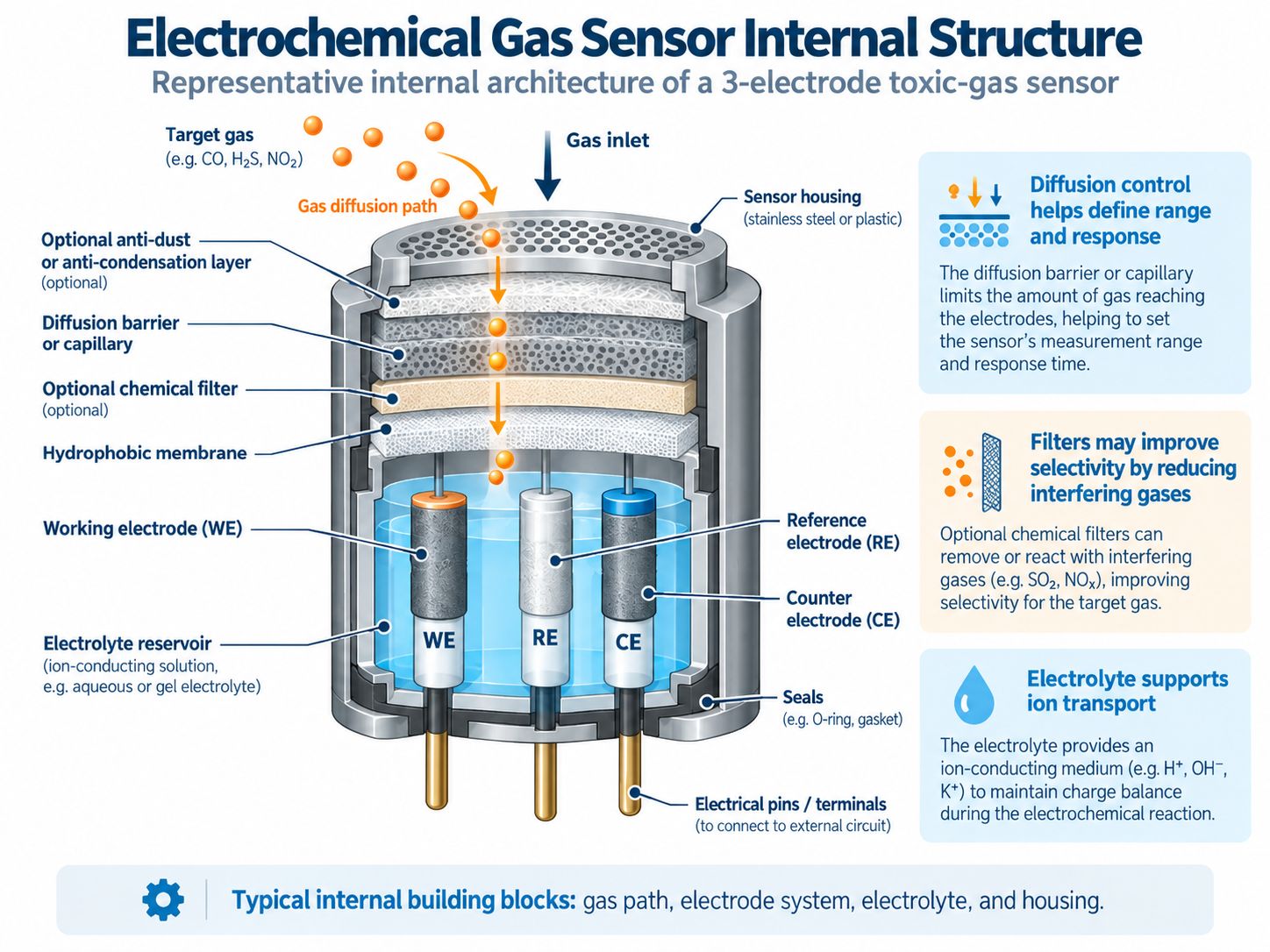
The external metal or plastic can is only the package. Internally, gas must follow a controlled path to the electrode system. Diffusion geometry, filters, hydrophobic barriers and electrolyte design all influence range, response, cross-sensitivity and environmental robustness.
Diffusion barrier or capillary
Controls gas transport toward the sensing electrode. Changing diffusion geometry is one way manufacturers design different ranges and response characteristics from related chemistries.
Membranes and chemical filters
Hydrophobic membranes help manage liquid water, while selected chemical filters can reduce certain interfering gases before they reach the sensing electrode.
Electrodes and electrolyte
The working, reference and counter electrodes operate through an ion-conducting electrolyte. Material choice and electrode potential strongly shape the final response.
Membrapor provides a useful overview of diffusion, electrode, electrolyte and filter functions in electrochemical sensor construction. Membrapor electrochemical sensor basics ↗
WE • RE • CE
Working, reference and counter electrodes do different jobs
The three electrodes should not be treated as three equivalent sensing surfaces. Each has a different electrochemical role, and stable measurement depends on the entire electrode system plus the external potentiostat.
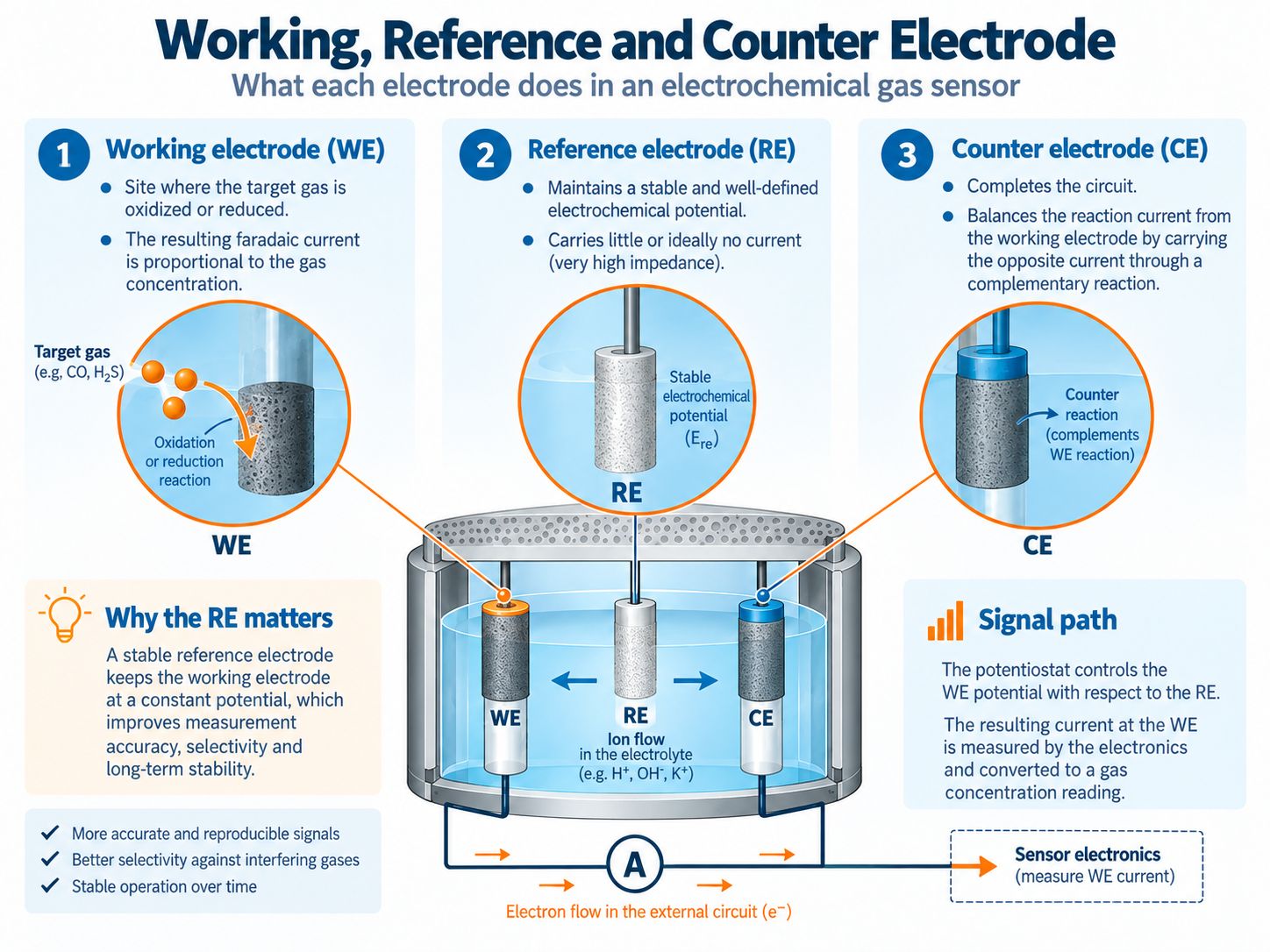
Working Electrode
The main gas-sensing electrode. Target gas undergoes oxidation or reduction here, producing the measurement current.
Reference Electrode
Provides a stable electrochemical reference. It should carry little or ideally no measurement current so the potentiostat can control WE potential reliably.
Counter Electrode
Carries the complementary reaction current required to balance charge while the working electrode responds to target gas.
Electronics
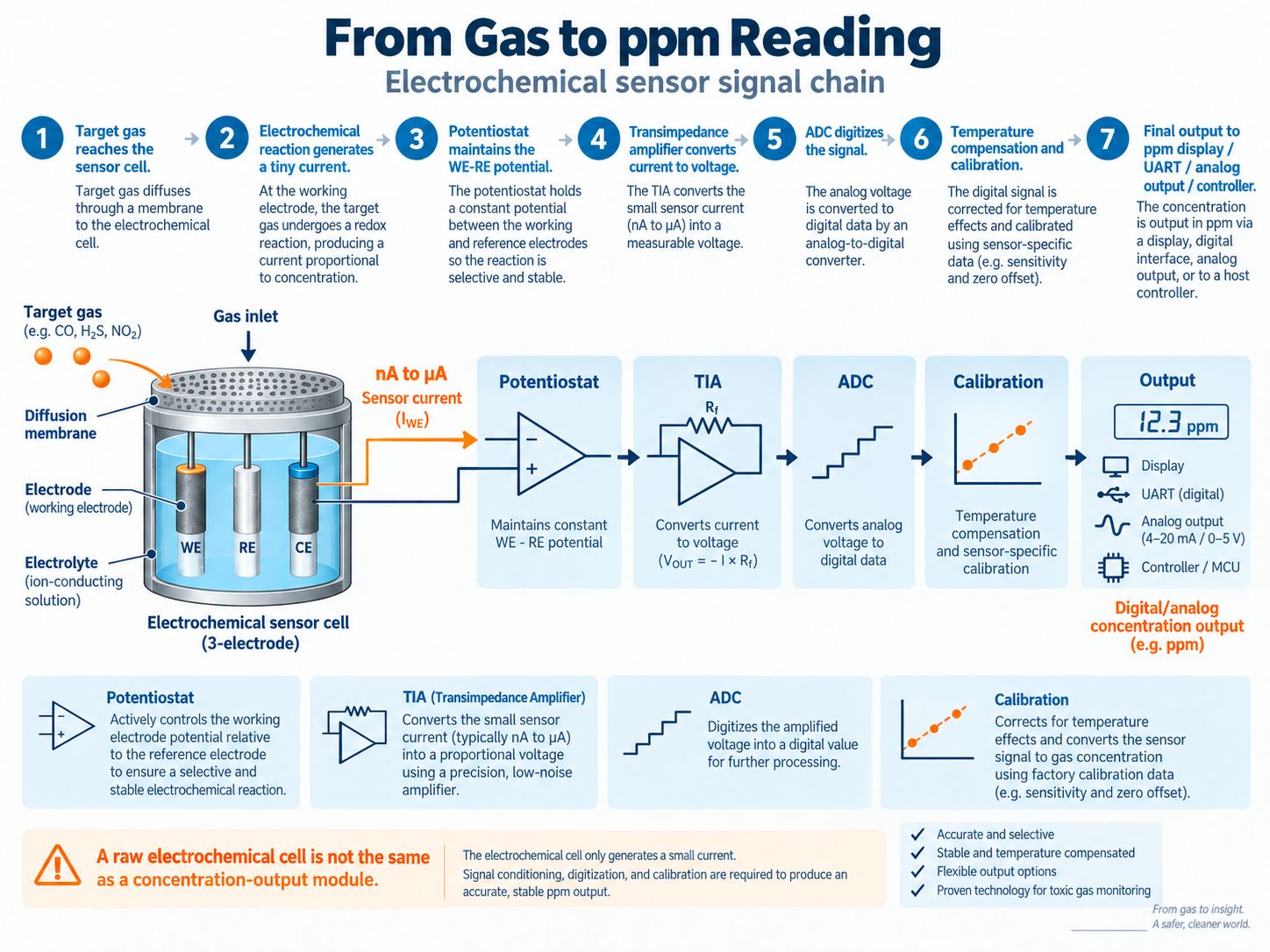
A raw electrochemical cell does not output ppm by itself
A raw cell typically produces a tiny current—often in the nA to µA range. The OEM electronics must maintain the correct sensor bias, convert current into voltage, digitize the result and apply calibration and environmental compensation before a stable concentration value is available.
Analog Devices reference designs show the same core architecture: the potentiostat controls electrode potential and the TIA converts small sensor current to voltage before ADC processing. Analog Devices CN0425 ↗
| Stage | What it does | Why it matters | Common engineering risk |
|---|---|---|---|
| Potentiostat | Controls the WE potential relative to RE by driving CE. | Keeps the sensing reaction in the intended operating region. | Wrong bias can change sensitivity, selectivity or stability. |
| TIA | Converts sensor current into a measurable voltage. | Allows very small sensor currents to be measured with low noise. | Input bias current, offset, noise and saturation can dominate low-level signals. |
| ADC | Digitizes the analog voltage. | Feeds calibration and compensation algorithms. | Resolution alone does not guarantee useful gas resolution. |
| Compensation | Adjusts for temperature, zero and other characterized influences. | Improves consistency over the operating envelope. | Generic correction without real sensor data can make readings worse. |
| Calibration | Maps signal to concentration using gas-specific data. | Creates the ppm/ppb value used by the application. | Calibration gas, flow, humidity and fixture can all influence results. |
Architecture
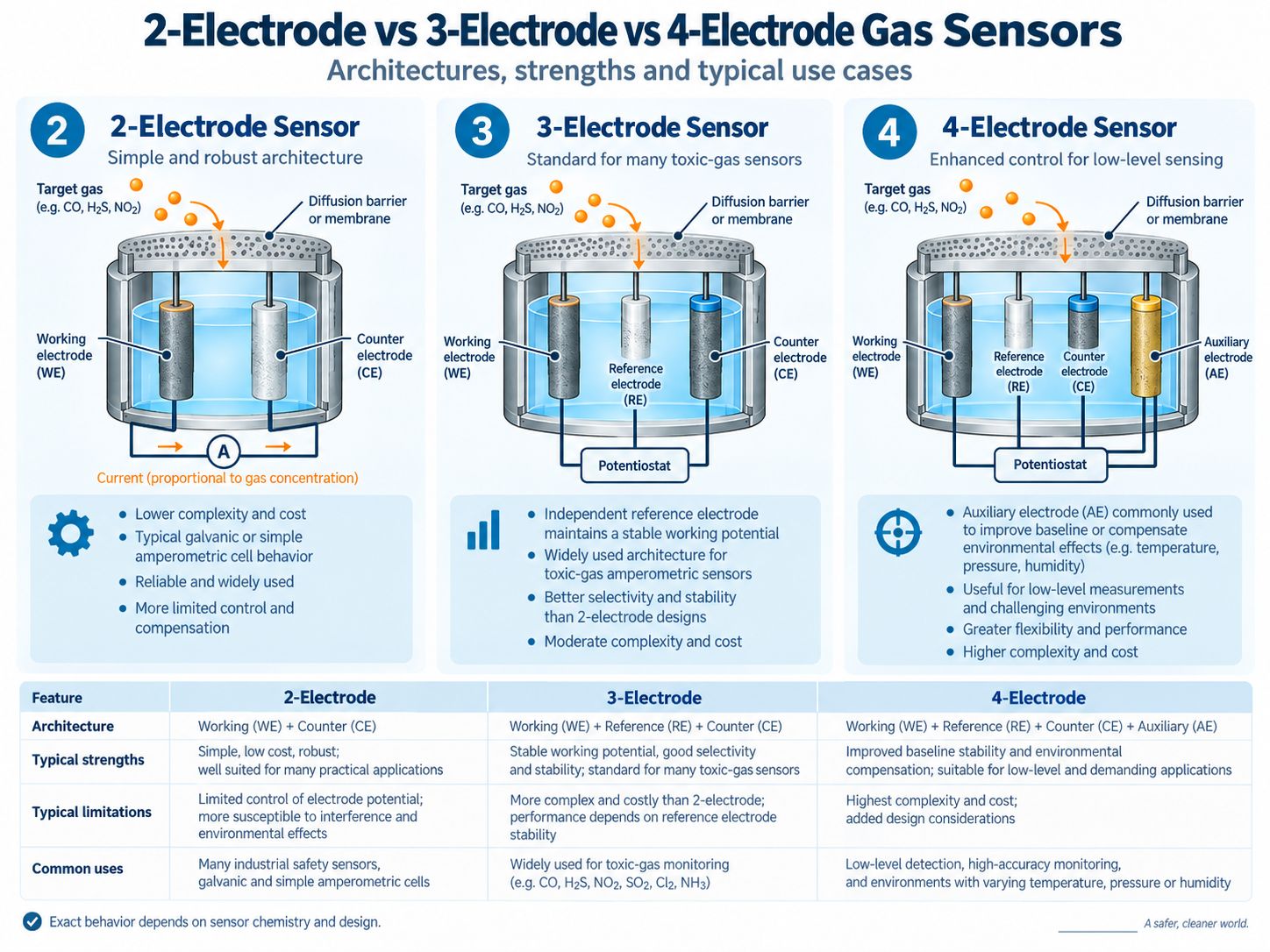
2-electrode vs 3-electrode vs 4-electrode gas sensors
Electrode count alone does not define quality. A fourth electrode may be an auxiliary baseline channel, a second working electrode, a diagnostic electrode or another application-specific function. Selection should follow the measurement problem rather than simply choosing the highest electrode count.
Gas suitability
Which gases are electrochemical sensors best suited for?
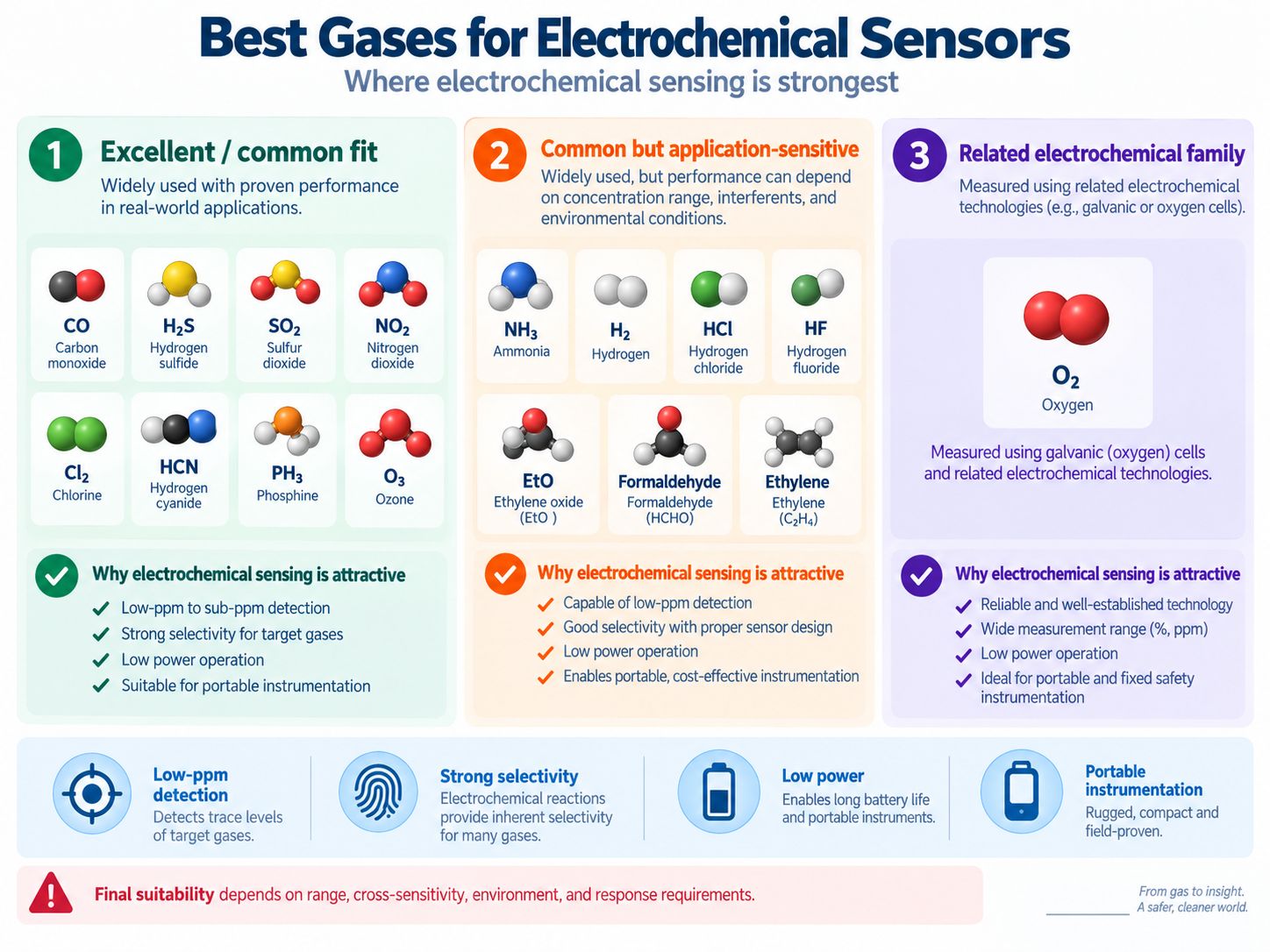
Electrochemical sensing is especially strong where the target gas can be measured through a selective electrode reaction at low concentration and low power. It is not the default answer for methane, CO₂ or broad VOC measurement, but it is a leading route for many toxic gases.
Engineering trade-offs
Why engineers choose electrochemical sensing—and where it needs care
Why electrochemical sensing works well
- Low power: excellent fit for portable multi-gas instruments and battery products.
- Low-concentration capability: many toxic-gas cells operate in ppm and selected ppb measurement ranges.
- Good linearity: many amperometric cells produce a signal approximately proportional to concentration across the rated range.
- Gas-specific chemistry: electrode material, potential, electrolyte and filters can provide strong selectivity.
- Mature ecosystem: raw cells, analog front ends, modules and finished detectors are widely available.
Where electrochemical sensors need engineering care
- Cross-sensitivity: selectivity is engineered, not absolute.
- Environmental effects: temperature, humidity, pressure and condensation can move zero, sensitivity or response.
- Finite life: electrolyte condition, electrode aging and chemical exposure can limit operating life.
- Overload recovery: high target or interfering gas exposure can produce long recovery or temporary saturation.
- Electronics matter: poor potentiostat/TIA design can erase the advantages of a good sensor cell.
Selectivity
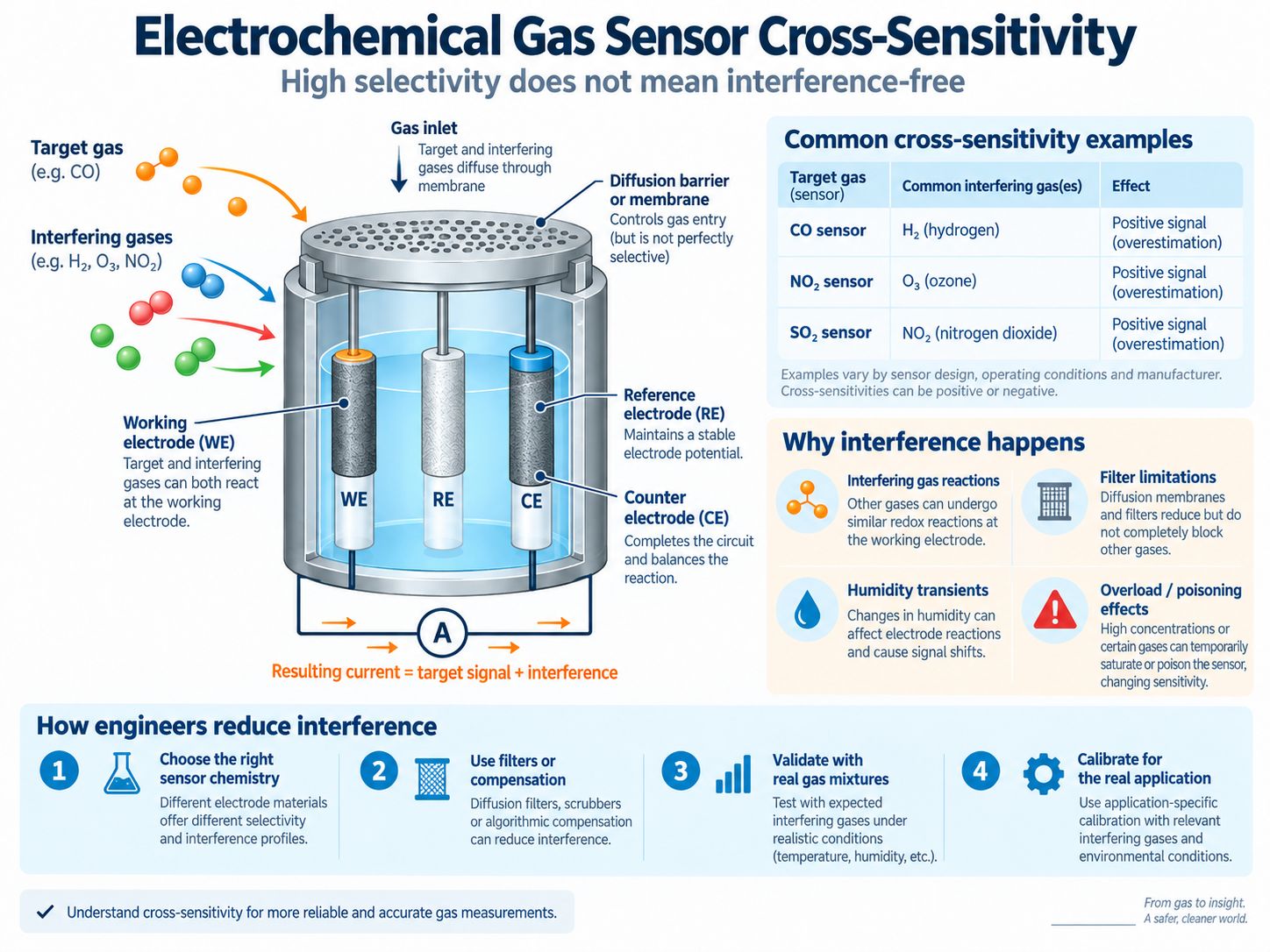
Cross-sensitivity is one of the most important electrochemical design risks
Electrochemical sensors can be highly selective, but another gas may still react at a similar electrode potential or influence the electrochemical environment. The size and direction of the response are sensor-model specific.
| Example | Why it matters | Possible engineering response |
|---|---|---|
| CO sensor + H₂ | Hydrogen can create a positive apparent CO response in some cells. | Low-H₂ chemistry, chemical filtering, auxiliary compensation or a dedicated H₂ measurement channel. |
| NO₂ sensor + O₃ | Both are strong oxidizing gases and can create overlapping responses. | Filter strategy, paired measurement or another technology depending on required selectivity. |
| SO₂ sensor + NO₂ | Some combinations can create opposite-sign responses and apparent under-reading. | Review the exact cross-sensitivity table and validate mixed-gas behavior. |
For a dedicated engineering treatment, see Gas Sensor Cross-Sensitivity Explained.
Environment
Temperature, humidity and pressure can change the measured signal
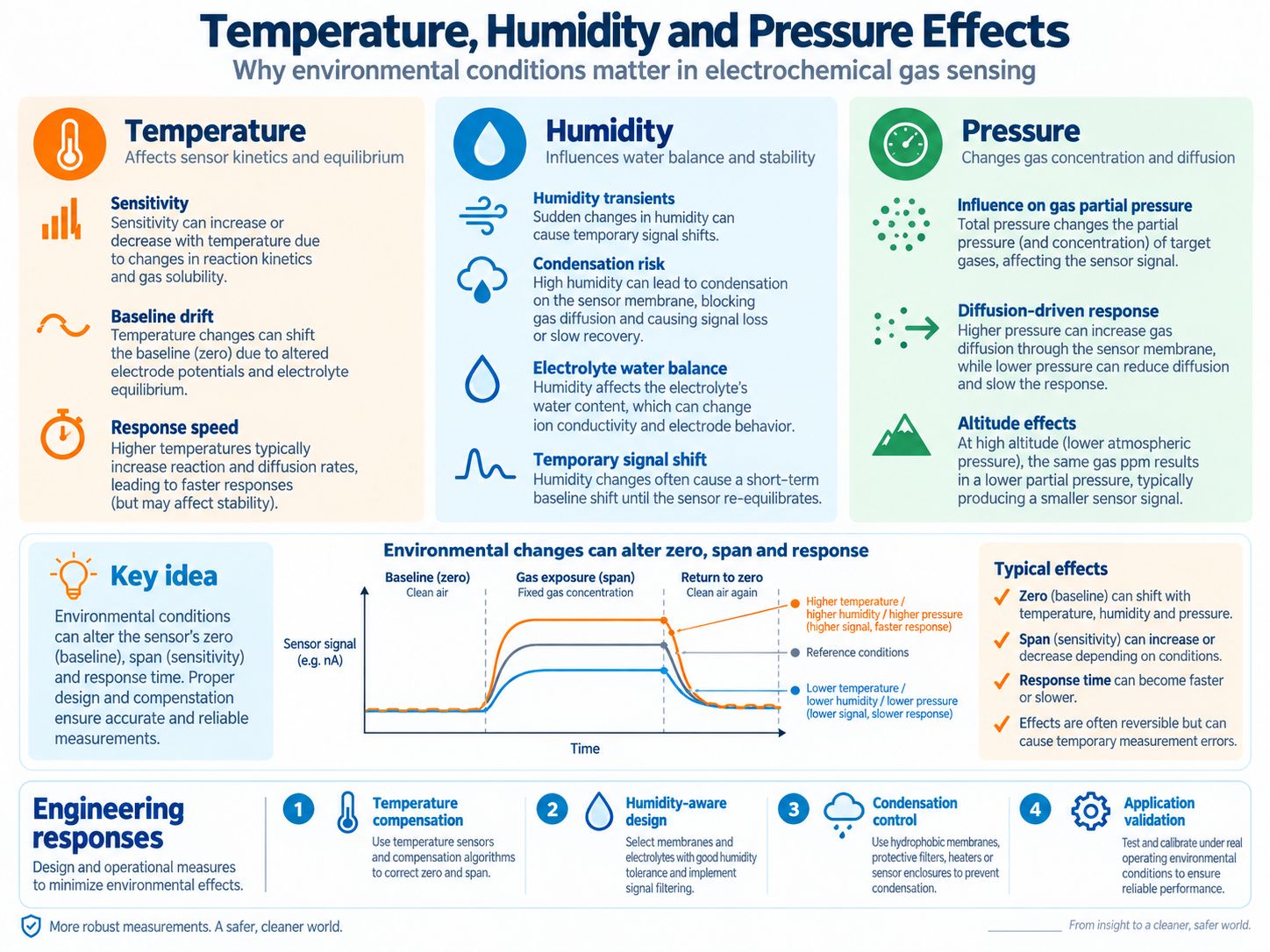
Electrochemical cells are chemical systems. Reaction kinetics, electrolyte water balance, gas diffusion and partial pressure all depend on environment. Good modules compensate for characterized effects, but compensation does not eliminate the need for application testing.
Zero, span and response
Temperature can change electrochemical kinetics, diffusion and electrode behavior. Sensitivity may increase or decrease depending on sensor chemistry.
Transient shifts and water balance
Rapid RH changes can cause temporary baseline movement, while condensation can physically block diffusion and delay recovery.
Partial pressure and diffusion
At the same ppm, changes in total pressure alter target-gas partial pressure. High-altitude and pressurized applications deserve separate validation.
Product format
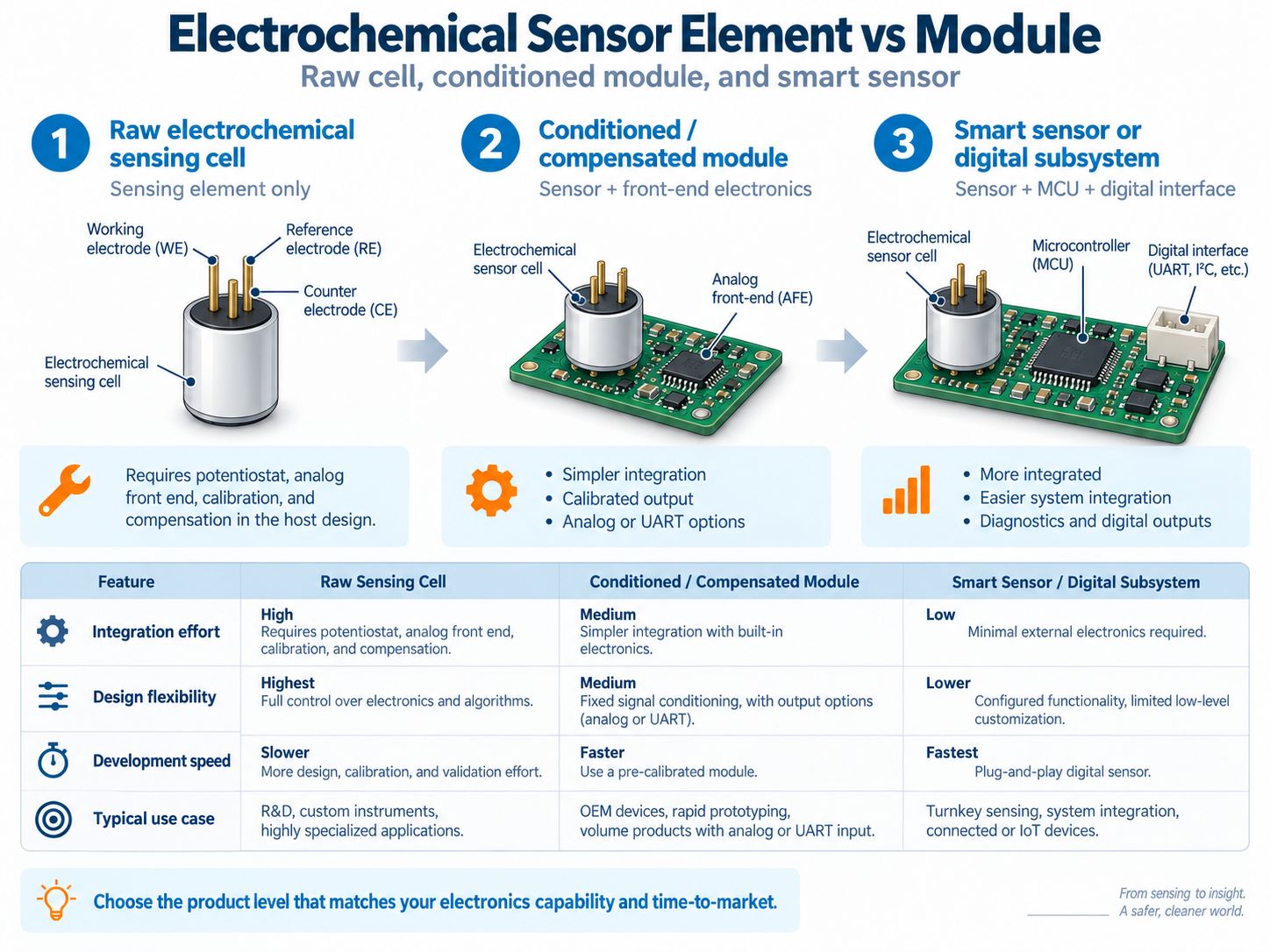
Sensor element vs conditioned module vs smart sensor
Electrochemical sensing can be purchased at very different integration levels. The right choice depends on your electronics capability, calibration infrastructure, development schedule and required production volume.
Maximum design control
You own the potentiostat, TIA, temperature measurement, calibration, compensation and diagnostics. Best for teams with strong analog and gas-calibration capability.
Faster OEM development
The sensor is combined with front-end electronics and usually calibrated analog or digital output. This reduces analog design and production calibration work.
Shortest integration path
MCU, digital interface and diagnostics can be included. The trade-off is less low-level control compared with a custom raw-cell design.
Gas Nose also covers this decision in the Sensor Element vs Sensor Module selection guide.
OEM examples
Representative electrochemical product formats
Product examples are most useful when they illustrate different integration levels. The purpose of this technology page is not to list every electrochemical SKU, but to show how the same sensing principle appears as a raw cell, conditioned module and intelligent subsystem.
| Example | Format | Representative specification | Engineering role |
|---|---|---|---|
| Winsen ME3-CO | Raw 3-electrode CO cell | 0–1000 ppm, 0.5 ppm resolution, T90 <20 s | Example of a classic raw toxic-gas electrochemical sensor requiring host electronics. |
| Winsen ME4-H₂S | Industrial H₂S cell | 0–100 ppm, 0.1 ppm resolution, T90 <30 s | Shows the 4-series industrial package used in fixed and portable safety equipment. |
| Winsen ZE03 | Conditioned electrochemical module | Multiple gas variants, built-in temperature compensation, UART + analog voltage | Moves signal conditioning and calibration work from the OEM host into the module. |
| Winsen SMX100 family | Miniature intelligent sensor | EC variants for CO, H₂S and O₂; UART output; compact ~1 cm-thick format | Example of smart electrochemical integration with digital interface and diagnostics. |
Applications
Where electrochemical gas sensors are most often used
Portable multi-gas monitors
Low power is a major advantage for personal instruments measuring CO, H₂S, O₂ and other toxic gases.
Fixed industrial safety
Transmitters around wastewater, petrochemical, chemical, mining and confined-space hazards commonly use EC toxic-gas cells.
Environmental monitoring
4-electrode or compensated EC architectures can support low-level NO₂, O₃, CO and SO₂ measurements when baseline management is critical.
OEM instruments
Modules and smart sensors shorten development for controllers, analyzers, robotics, building systems and connected safety devices.
Selection workflow
How to choose an electrochemical gas sensor
- Define the exact target gas and measurement objective. Safety alarm, process control, ambient air quality and laboratory analysis may require different ranges.
- Set the useful range, resolution and overload condition. Do not choose only from the alarm setpoint.
- List the complete gas matrix. Include H₂, NOx, SO₂, solvent vapors, cleaning agents and process gases that may create interference.
- Define temperature, humidity, pressure and condensation exposure. Use the real operating envelope, not only nominal room conditions.
- Choose the integration level. Raw cell, conditioned module or smart digital sensor.
- Review bias and electronics requirements. Confirm WE-RE bias, current polarity, TIA range, zero current and warm-up/stabilization behavior.
- Plan calibration and field verification. Calibration gas, fixture, flow, interval and replacement strategy are system-level decisions.
- Validate the complete product. Bench-test representative production units under target gas, interferents, temperature, RH and expected mechanical conditions.
Engineering checklist
Before freezing an EC sensor into a design, record:
- Target gas and required range
- Resolution and alarm/control thresholds
- Known interfering gases
- Temperature / RH / pressure envelope
- Bias requirement and current polarity
- Expected operating and storage life
- Calibration method
- Output/interface requirements
- Certification context
Useful Gas Nose tools: Gas Sensor Product Finder and Gas Concentration Converter.
Lifecycle
Calibration, storage life and sensor aging
Electrochemical sensors are consumable measurement components. Aging can come from electrode changes, electrolyte loss or redistribution, prolonged target-gas exposure, interferents, storage environment and environmental cycling.
Zero and span
Zero establishes the clean-air baseline; span checks the response to a known target-gas concentration. Both belong to the finished measurement system, not only the cell.
Functional verification
A bump or response check confirms that gas reaches the sensor and that the system responds. It is not automatically equivalent to a full calibration.
Replacement planning
Expected life is not a guaranteed calendar date. Exposure history, RH, temperature, storage time and sensor chemistry can move end-of-life behavior.
See Bump Test vs Calibration for the system-level distinction between functional checks and calibration.
FAQ
Electrochemical gas sensor FAQ
What is an electrochemical gas sensor?
An electrochemical gas sensor is a sensing cell that uses a gas-dependent oxidation or reduction reaction at an electrode to generate an electrical signal. In many toxic-gas amperometric cells, the measured current is approximately proportional to gas concentration within the rated range.
What are the three electrodes in an electrochemical gas sensor?
The standard 3-electrode architecture uses a working electrode (WE), reference electrode (RE) and counter electrode (CE). The working electrode generates the measurement current, the reference electrode provides a stable potential reference, and the counter electrode supports the balancing reaction.
Why does an electrochemical sensor need a potentiostat?
The potentiostat maintains the required potential between the working and reference electrodes by driving the counter electrode. This keeps the working electrode in the intended electrochemical operating region.
What gases are best detected by electrochemical sensors?
Common strong fits include CO, H₂S, SO₂, NO₂, Cl₂, HCN, PH₃ and O₃. Electrochemical sensors are also used for NH₃, H₂, HCl, HF, ethylene oxide and other gases, but suitability depends on range, interference and environment. Oxygen commonly uses related galvanic electrochemical cells.
Are electrochemical gas sensors selective?
They can be highly selective, but not perfectly specific. Other gases may react at the electrode or alter the electrochemical environment, which is why the exact cross-sensitivity table and real-gas validation matter.
What is the difference between a 3-electrode and 4-electrode sensor?
A 4-electrode design adds another functional electrode. Depending on the sensor, it may be an auxiliary baseline channel, a second working electrode, a diagnostic electrode or another compensation channel. Four electrodes are not automatically better; the added function must match the application.
Do electrochemical gas sensors need temperature compensation?
Often yes. Temperature can affect sensitivity, zero and response. Modules may include factory characterization and temperature compensation, while raw-cell OEM designs must implement the required correction using sensor-specific data.
Should I use a raw electrochemical cell or a module?
Use a raw cell when you want full control over the analog front end, calibration and algorithms. Use a conditioned module or smart sensor when faster integration, digital output and lower development effort are more important.
Building an electrochemical gas sensing product?
Define the target gas, range, interferents, operating environment, cell or module format, interface, response target and production volume before selecting the sensor. Gas Nose can help structure the requirement and narrow suitable OEM sensor and module options.