




The choice between a fixed gas detector and a portable gas detector is not simply about which instrument is more advanced.
They solve different monitoring problems.
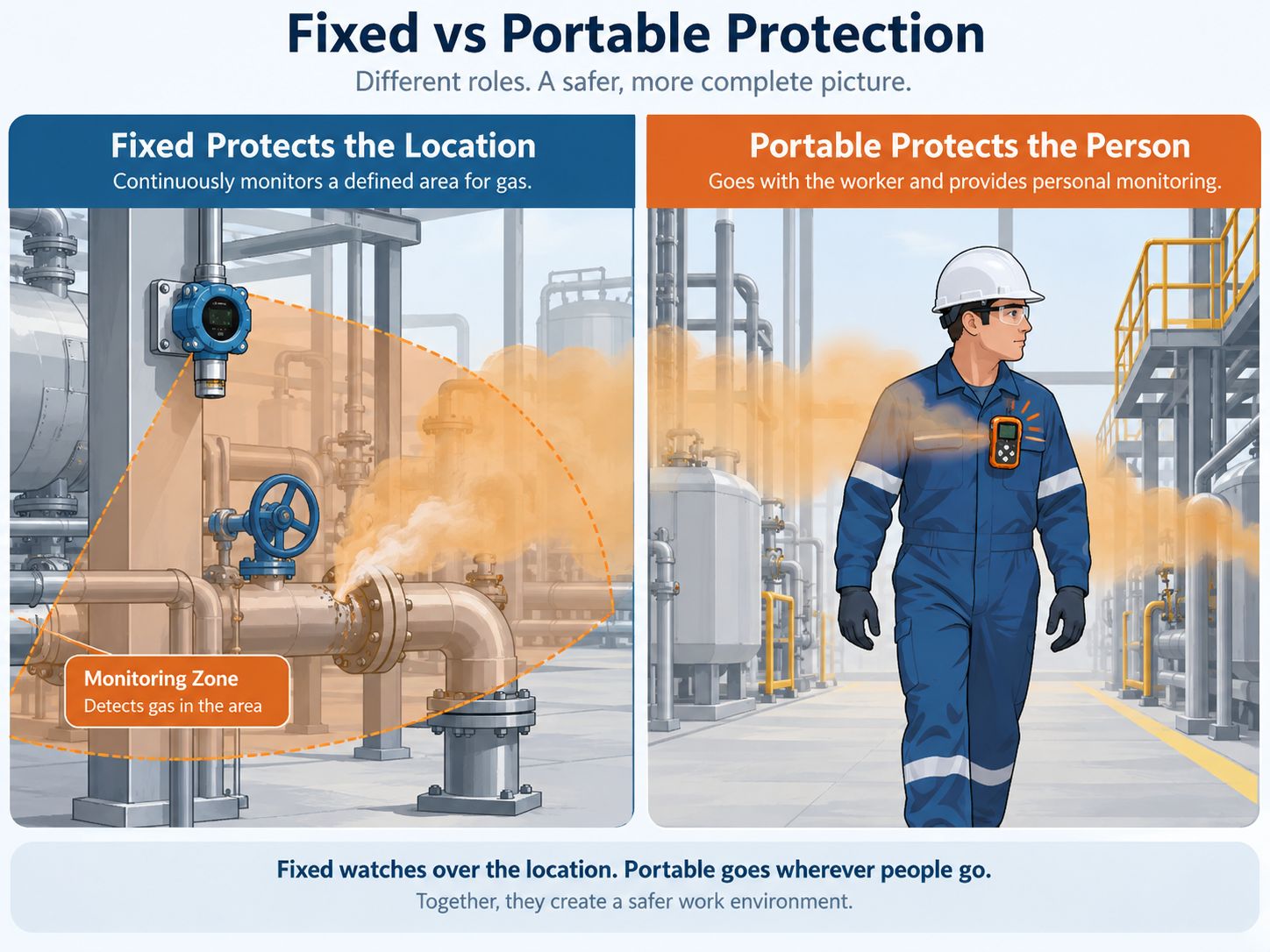
A fixed gas detector is normally installed permanently at a defined location and monitors that area continuously.
A portable gas detector moves with the worker or is temporarily deployed where a task is taking place.
A useful way to remember the difference is:
Fixed gas detection protects the location. Portable gas detection protects the person or temporary task.
But in many industrial facilities, the correct answer is not fixed or portable.
It is:
Fixed + portable gas detection as different layers of the same safety system.
A refinery may have permanent combustible and H₂S detectors around compressors and process equipment, while maintenance personnel still wear portable multi-gas monitors.
A wastewater plant may continuously monitor H₂S in a pump room while technicians use a pumped portable detector before entering a wet well.
A battery energy storage room may rely primarily on fixed continuous monitoring, while portable instruments are used during maintenance or emergency investigation.
The right choice depends on:
- where the hazard originates
- whether the hazard location is predictable
- whether workers move
- whether the area operates unattended
- whether automatic ventilation or shutdown is required
- whether the work is permanent or temporary
- whether confined-space sampling is required
Fixed vs Portable Gas Detectors: Quick Comparison
| Feature | Fixed Gas Detector | Portable Gas Detector |
|---|---|---|
| Main purpose | Protect a location or process | Protect a worker or temporary task |
| Installation | Permanently installed | Worn, carried or temporarily positioned |
| Monitoring | Continuous, often unattended | Continuous while operating/deployed |
| Measurement location | Fixed point | Moves with worker or task |
| Power | Commonly site-powered | Usually battery-powered |
| Central control integration | Strong | Increasingly available, but not equivalent to fixed control infrastructure |
| Automatic ventilation / shutdown | Can be integrated | Usually provides local alarm first |
| Personal breathing-zone monitoring | No | Major application |
| Confined-space pre-entry testing | Usually unsuitable by itself | Pumped portable instruments are well suited |
| Temporary maintenance | Less flexible | Major advantage |
| Unattended plant room | Major advantage | Limited unless temporarily deployed as an area monitor |
| Installation infrastructure | Higher | Lower |
| Mobility | None | High |
Neither technology is universally better.
The real question is:
What needs to be protected—the location, the worker, or both?
What Is a Fixed Gas Detector?
A fixed gas detector is permanently installed at a selected point within a facility.
Typical locations include:
- compressor rooms
- process skids
- tank farms
- chemical storage areas
- wastewater pump rooms
- battery rooms
- refrigeration machinery rooms
- gas cabinets
- enclosed production areas
- ducts and ventilation systems
- loading areas
- pipeline equipment
The detector continuously measures the atmosphere at its installed location.
A typical fixed gas detection architecture looks like this:
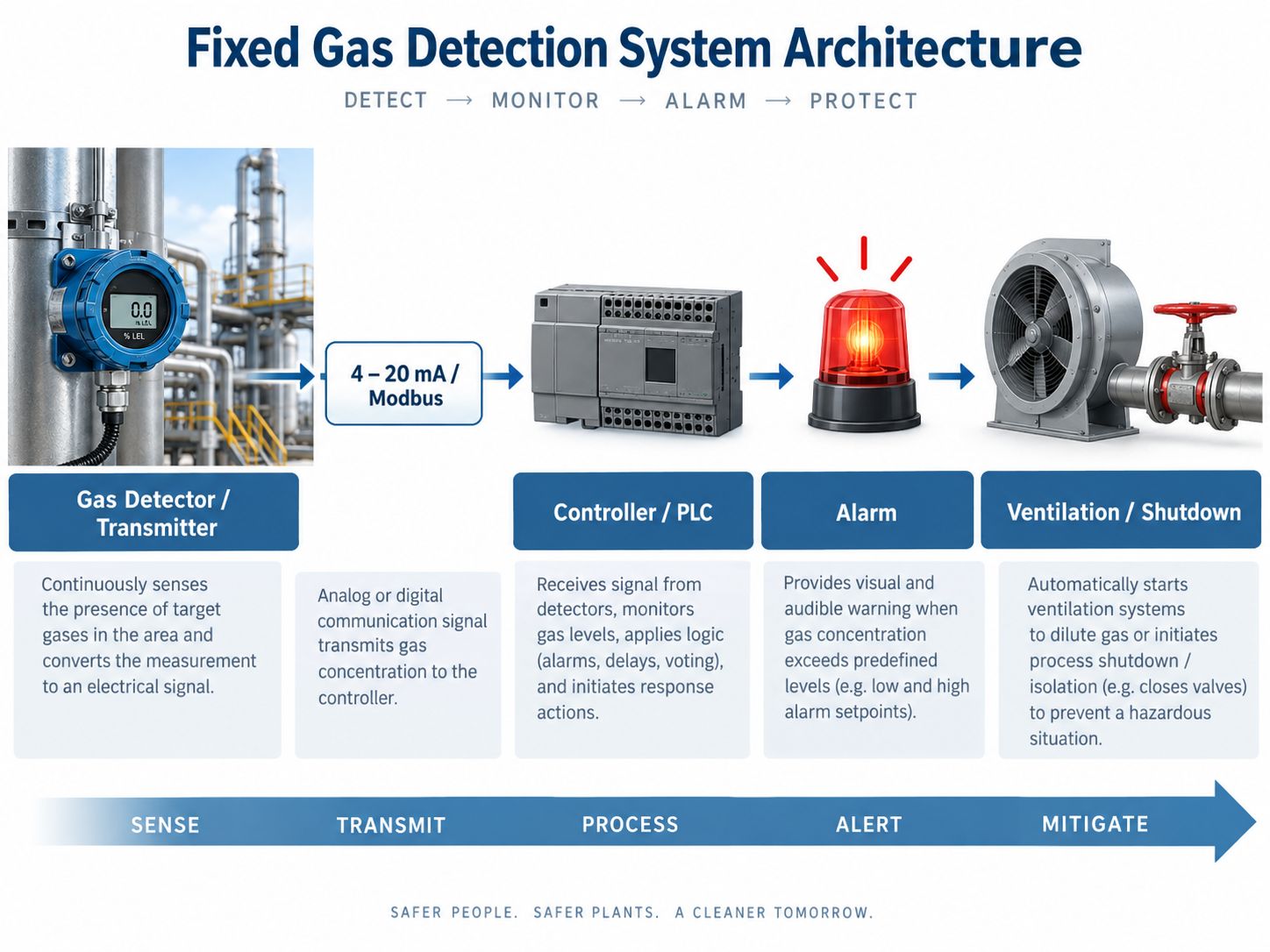
Gas detector / transmitter
↓
Analog or digital communication
↓
Controller / PLC / DCS
↓
Alarm logic
↓
Ventilation / shutdown / isolation
Common interfaces can include:
- 4–20 mA
- HART
- Modbus
- relays
- proprietary digital networks
The exact architecture varies considerably between applications.
What Can a Fixed Gas System Do?
Depending on system design, fixed detection can:
- provide continuous gas concentration readings
- activate audible and visual alarms
- start emergency ventilation
- close valves
- isolate equipment
- initiate process shutdown
- transmit alarms to a control room
- communicate with PLC or DCS systems
- store historical gas concentration trends
This is one of the biggest advantages of fixed detection:
It can respond even when nobody is standing next to the detector.
What Is a Portable Gas Detector?
Portable gas detection covers several different instrument types.
It does not only mean a standard four-gas monitor clipped to a worker’s chest.
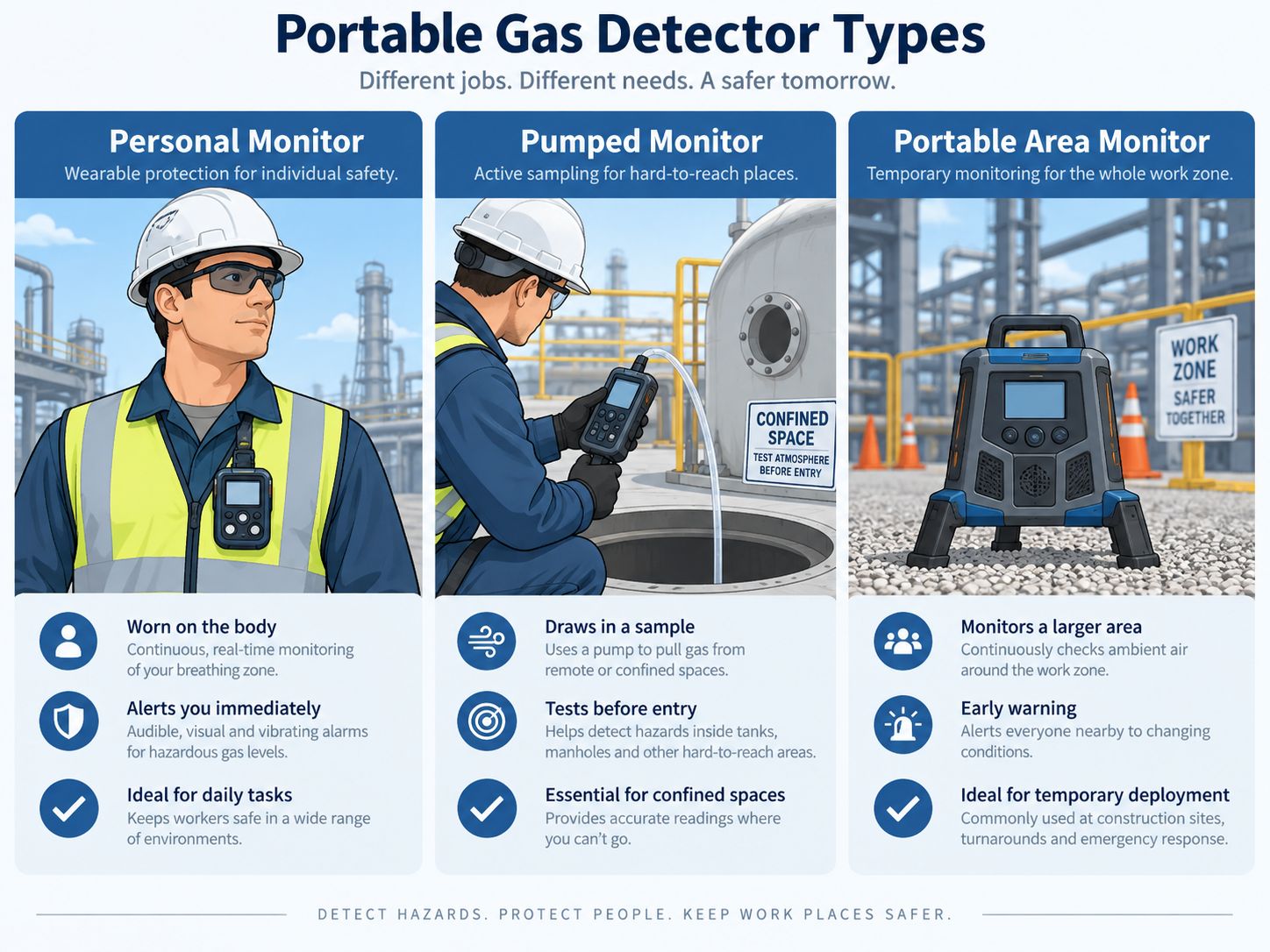
Personal Gas Monitor
A personal detector is normally worn near the worker’s breathing zone.
Typical gases include:
- O₂
- combustible gas / %LEL
- H₂S
- CO
- NH₃
- Cl₂
- SO₂
- VOCs
- other application-specific gases
The detector moves with the worker.
This is important because a worker may pass through locations that are not covered by a nearby fixed sensor.
Pumped Portable Gas Detector
A pump actively pulls an air sample through:
- tubing
- probe
- sampling hose
This is particularly useful for:
- confined-space pre-entry testing
- tanks
- vessels
- pits
- manholes
- remote sampling
- leak investigation
The worker can test the atmosphere before physically entering the hazardous location.
For a detailed procedure, see Confined Space Gas Monitoring: What Gases Should You Test Before Entry?.
Portable Area Monitor
A portable area monitor is temporarily placed in or around a work zone.
Common applications include:
- plant turnarounds
- shutdowns
- hot work
- construction
- emergency response
- temporary enclosures
- maintenance projects
It sits between conventional personal monitoring and permanent fixed detection.
The important distinction is:
Portable does not always mean wearable.
Why Fixed Detectors Cannot Fully Replace Personal Gas Monitors
A fixed gas detector measures the atmosphere at one installed location.
Gas, however, does not always travel toward that detector.
Consider a leak from a flange.
The gas plume may be influenced by:
- ventilation
- wind
- release pressure
- equipment geometry
- temperature
- obstacles
- doors
- fans
- process heat
The plume may pass around the installed fixed detector while moving directly toward a worker.
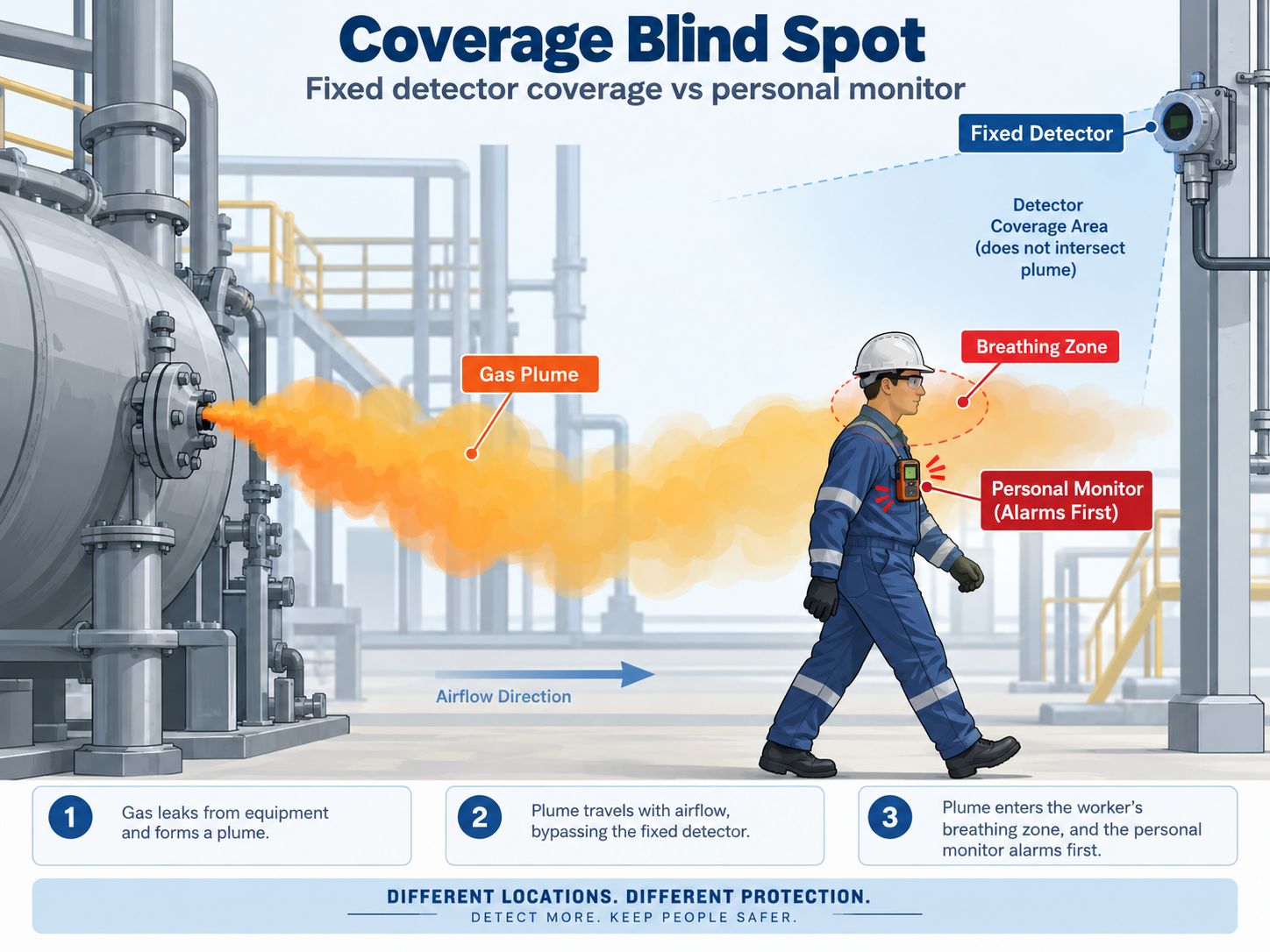
In that situation:
Fixed detector
may still read normal.
But:
Personal monitor
may alarm because it is inside the worker’s actual breathing zone.
This leads to an important engineering principle:
A fixed detector does not protect a circular “bubble” around itself. Gas must reach the sensing element before it can be detected.
The coverage area shown in gas-detection diagrams should therefore be understood conceptually.
Real coverage depends heavily on detector placement and gas dispersion.
Worker Exposure Moves
A fixed detector remains in one place.
Workers do not.
Maintenance personnel may:
- climb platforms
- enter pits
- walk behind equipment
- open flanges
- inspect vessels
- enter confined spaces
- work near temporary piping
- move outside permanent detector coverage
Their gas exposure changes as they move.
A personal detector follows them.
That is why:
A fixed system can indicate that the facility has a gas problem. A personal monitor can warn a worker that the problem has reached their immediate breathing zone.
Maintenance Can Change the Hazard
Another reason fixed systems cannot completely replace portable instruments is that maintenance changes normal operating conditions.
Opening:
- a flange
- valve
- vessel
- pump
- filter
- process line
can suddenly create a temporary leak source that did not exist when the fixed system was originally designed.
Portable monitoring provides flexibility for these changing tasks.
Why Portable Gas Detectors Cannot Replace Fixed Detection
The argument also works in the opposite direction.
Portable instruments are extremely useful, but they are not a substitute for every permanent gas monitoring system.
A personal detector only provides protection when:
- someone is actually wearing it
- the detector is switched on
- its sensors are functioning
- the battery is charged
- the correct gases are configured
- the instrument is properly maintained
Consider an unmanned compressor room at 2:00 a.m.
If a gas leak develops:
No worker is present
↓
No personal detector is present
↓
No personal alarm occurs
A fixed system, however, can continue monitoring.
It may then:
Detect
↓
Alarm
↓
Start ventilation
↓
Notify control system
↓
Initiate isolation or shutdown
before anyone enters the room.
This is why permanent, predictable hazards usually favor fixed detection.
When Should Fixed Gas Detection Be Prioritized?
Fixed detection becomes particularly valuable when several conditions are present.
The Hazard Location Is Predictable
Examples include:
- compressor seals
- gas valves
- cylinders
- storage vessels
- battery enclosures
- refrigeration machinery
- process skids
- gas cabinets
If the expected leak source stays in approximately the same location, detector placement can be engineered around it.
Monitoring Must Continue 24/7
Facilities may continue operating when:
- operators leave the immediate area
- rooms are locked
- only remote control-room personnel are present
- the plant operates overnight
Fixed systems are designed for continuous unattended monitoring.
Automatic Protective Action Is Needed
A fixed detector can be part of an engineered control sequence.
For example:
H₂ leak detected
↓
Alarm
↓
Increase ventilation
↓
Close gas valve
↓
Shutdown equipment
depending on the safety philosophy.
A worker carrying a portable detector normally cannot provide the same automatic safety-system function.
Centralized Monitoring Is Required
Large facilities may need dozens or hundreds of monitoring points connected to:
- control panels
- PLC
- DCS
- SCADA
- building management systems
Fixed architecture is particularly suitable for this.
When Should Portable Gas Detection Be Prioritized?
Portable detection is strongest when the hazard or worker location changes.
Typical applications include:
Personal Exposure Monitoring
The detector remains with the person.
Confined-Space Entry
Especially:
- pre-entry testing
- continuous breathing-zone monitoring
- remote pumped sampling
Maintenance
The work location may change every day.
Turnarounds and Shutdowns
Temporary hazards may appear throughout the facility.
Leak Investigation
Personnel need to move toward or around a suspected release.
Emergency Response
The hazard location may initially be unknown.
Temporary Work
Installing permanent detector infrastructure may not make sense for a task lasting:
- several hours
- several days
- several weeks
In these situations, portable instruments provide much greater flexibility.
Fixed + Portable for Confined Spaces
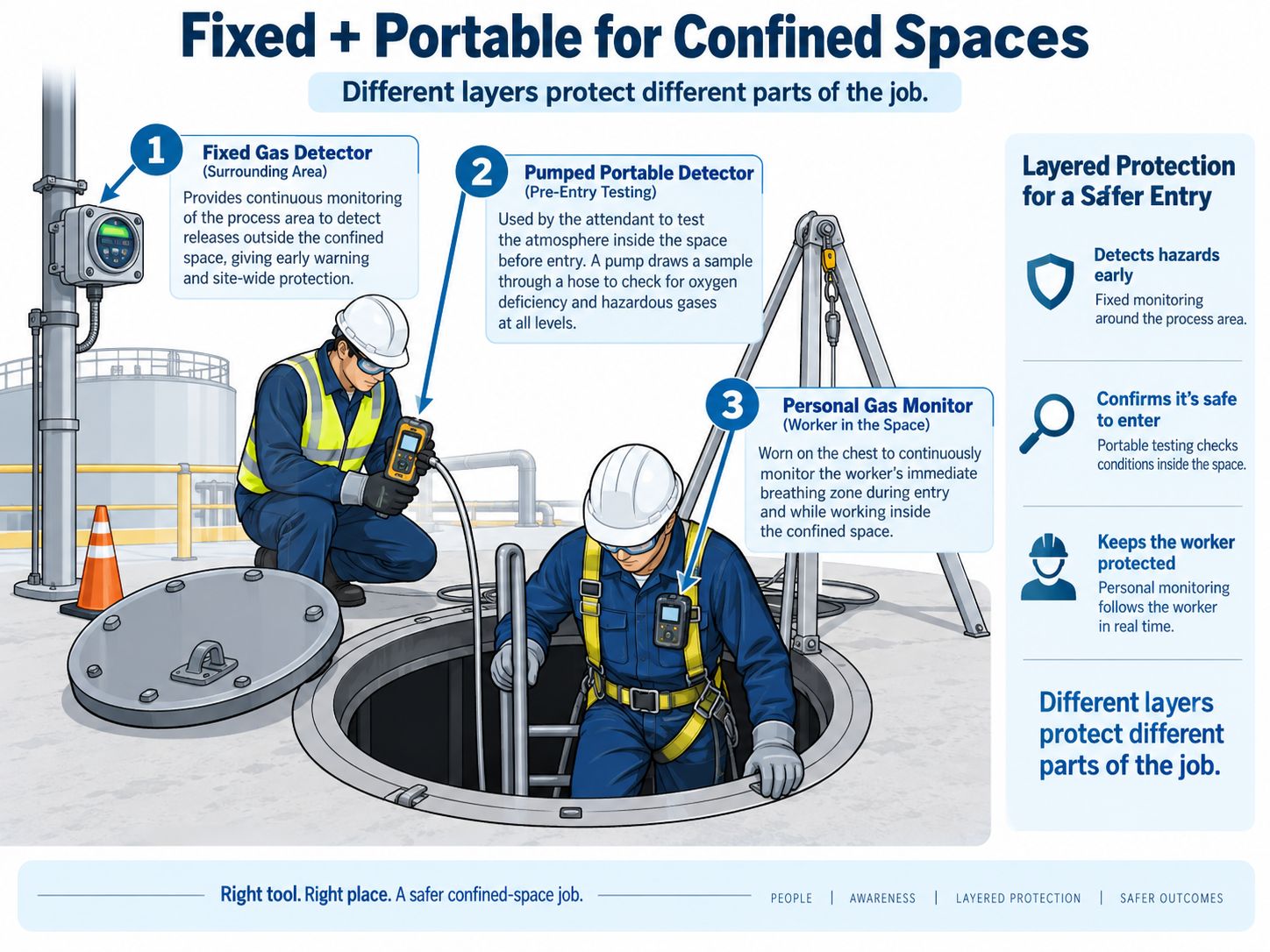
Confined-space work clearly demonstrates why gas detection often needs multiple layers.
Consider a vessel inside a chemical plant.
Layer 1 — Fixed Process Monitoring
Permanent detectors around nearby process equipment can provide early warning of releases affecting the surrounding area.
But they do not automatically tell you what the atmosphere is inside the vessel.
Layer 2 — Pumped Pre-Entry Testing
Before entry, a portable instrument can draw samples from inside the space.
Atmospheric testing may include:
- oxygen
- combustible gases
- toxic contaminants identified by the hazard assessment
For U.S. OSHA permit-required confined spaces, the internal atmosphere must be tested with a calibrated direct-reading instrument before entry for:
oxygen → flammable gases/vapors → potential toxic contaminants
in that order.
Official reference: OSHA 29 CFR 1910.146
Layer 3 — Personal Monitoring During Entry
Once the worker enters, atmospheric conditions may change.
A personal monitor follows the worker into the space and monitors the immediate breathing zone.
For large or continuous spaces, OSHA also requires monitoring appropriate to the actual areas where authorized entrants are working under applicable permit-space conditions.
The result is a much stronger architecture:
Fixed process detection
Pumped pre-entry testing
Personal continuous monitoring
Different layers protect different parts of the job.
Fixed vs Portable for Oil and Gas
Oil and gas facilities commonly need both.
Fixed Detection
Useful near:
- compressors
- separators
- storage tanks
- process skids
- enclosed modules
- gas turbines
- loading areas
Typical gases may include:
- hydrocarbons
- methane
- H₂S
- hydrogen
- toxic process gases
Portable Detection
Useful during:
- maintenance
- tank entry
- turnaround
- inspection
- leak investigation
- line opening
A worker performing maintenance may enter an area outside normal fixed detector coverage or create a temporary release point.
That makes personal monitoring especially valuable.
Fixed vs Portable for Wastewater Treatment
Wastewater facilities may generate:
- H₂S
- methane
- oxygen deficiency
- other process gases
Fixed Monitoring
Useful in:
- pump rooms
- wet-well structures
- sludge treatment areas
- enclosed process rooms
- digester-related areas
Portable Monitoring
Useful for:
- sewer entry
- manholes
- tank inspection
- maintenance
- confined spaces
Again, the two approaches address different exposure scenarios.
Fixed vs Portable for Refrigeration Systems
Refrigeration machinery rooms are another good example.
Depending on refrigerant type, potential hazards can include:
- ammonia
- CO₂
- A2L refrigerants
- oxygen displacement
- refrigerant-specific exposure
Fixed Detector
Particularly valuable because:
- machinery location is known
- potential leak areas are predictable
- continuous unattended protection is desirable
- ventilation may need automatic activation
Portable Detector
Useful for technicians performing:
- service
- leak tracing
- maintenance
- emergency investigation
Portable instrumentation complements the installed system rather than replacing it.
Fixed vs Portable for Battery Energy Storage Systems
Battery energy storage is another application where the hazard location is relatively fixed.
Depending on battery chemistry and safety strategy, early-warning gases may include:
- H₂
- CO
- VOCs
- other thermal-runaway-related gases
Because the battery enclosure or storage room remains in a known location:
continuous fixed monitoring can be particularly valuable.
A fixed detection system can potentially interface with:
- alarms
- ventilation
- fire and safety systems
- BMS / EMS logic
Portable instruments may still be useful during:
- commissioning
- maintenance
- incident investigation
- emergency response
But they are not a substitute for continuous monitoring when permanent early warning is required.
Fixed vs Portable for Temporary Work
Portable detection has a major economic and operational advantage for short-term work.
Imagine a two-week turnaround project.
Installing:
- permanent transmitters
- cable
- junction boxes
- controllers
- power supplies
only to remove them later may make little sense.
A temporary solution could instead combine:
Personal monitors
Portable area monitors
This is particularly useful during:
- plant shutdowns
- hot work
- construction
- tank cleaning
- temporary process modifications
The monitoring architecture should match the duration and mobility of the hazard.
Detector Placement Is Critical for Fixed Gas Detection
A fixed detector only works if gas reaches it.
This makes placement one of the most important design decisions.
Important factors include:
- likely leak source
- gas or vapor density
- airflow
- forced ventilation
- prevailing wind
- indoor vs outdoor environment
- release pressure
- temperature
- equipment geometry
- walls and obstacles
- worker occupancy
- accessibility for maintenance
Statements such as:
“Methane is light, so always mount the sensor at the ceiling.”
are too simplistic.
Methane density matters, but a high-pressure leak, ventilation airflow or building geometry can dominate gas movement.
Similarly:
“H₂S is heavy, so always mount the detector close to the floor.”
is not a universal engineering rule.
Gas detection system design should evaluate the credible release and dispersion behavior.
IEC 60079-29-2 provides international guidance for the selection, installation, use and maintenance of flammable-gas and oxygen detection equipment.
See: IEC 60079-29-2
Detector placement is important enough that it deserves its own GasNose guide, rather than being reduced to a simple gas-density table.
Can Fixed Gas Detectors Trigger Automatic Shutdown?
Yes, depending on the system architecture.
A fixed transmitter may send its measurement to:
- gas controller
- PLC
- safety PLC
- DCS
The control system can then apply programmed logic.
Possible responses include:
Low Alarm
Operator warning.
High Alarm
Escalated warning and site response.
Ventilation
Fan starts or airflow increases.
Isolation
Valve closes.
Process Shutdown
Affected equipment stops.
Remote Notification
Alarm goes to:
- control room
- SCADA
- BMS
- remote monitoring system
But:
The detector alone does not automatically create a safe shutdown system.
The entire architecture—including sensor, controller, voting logic, relays, final elements and safety design—must be engineered correctly.
Are Portable Gas Detectors Personal Protective Equipment?
Personal gas monitors are commonly worn as part of a worker’s safety equipment, but it is important to understand what they actually do.
A gas detector:
detects and warns
It does not:
- provide breathable air
- filter toxic gas
- prevent inhalation
- replace respiratory protection where respiratory protection is required
A detector alarm tells the worker that a hazardous condition may exist so the appropriate response can be taken.
It should not be confused with:
- respirator
- supplied-air system
- SCBA
Cost: Is Portable Gas Detection Cheaper?
Portable instruments normally require less infrastructure initially.
But simply comparing:
$1 portable detector
versus
$1 fixed detector
does not provide a meaningful system comparison.
Fixed-System Costs May Include
- transmitters
- sensors
- cable
- junction boxes
- power
- controllers
- PLC integration
- engineering
- installation
- commissioning
- hazardous-area wiring
- calibration
- maintenance
Portable-System Costs May Include
- detector fleet
- charging
- docking stations
- calibration gas
- bump testing
- battery replacement
- sensor replacement
- fleet software
- training
- lost / damaged instruments
- maintenance labor
For a large workforce, portable detector fleet management can become a significant operational system by itself.
The better comparison is:
What is the lifecycle cost of achieving the required protection?
not:
Which detector has the lowest purchase price?
Maintenance Is Different Too
Both systems require maintenance.
Fixed Gas Detection
Typical activities may include:
- inspection
- calibration
- sensor replacement
- optical cleaning
- controller testing
- loop testing
- alarm testing
- shutdown/interlock verification
Portable Gas Detection
Typical activities may include:
- charging
- bump testing
- calibration
- sensor replacement
- pump checks
- filters
- docking
- data management
OSHA’s current guidance for direct-reading portable gas monitors emphasizes that instruments should be maintained, tested and calibrated according to manufacturer recommendations.
See: OSHA — Calibrating and Testing Direct-Reading Portable Gas Monitors
Fixed vs Portable Gas Detection by Application
| Situation | Fixed | Portable | Typical Strategy |
|---|---|---|---|
| Permanent compressor room | ✓ | Optional | Fixed primary |
| Unmanned process room | ✓ | Fixed | |
| Known permanent leak source | ✓ | Worker supplement | Often both |
| Worker personal exposure | ✓ | Portable | |
| Confined-space pre-entry | ✓ | Pumped portable | |
| Confined-space entry | Surrounding system may help | ✓ | Personal portable essential where required |
| Temporary shutdown | ✓ | Personal + temporary area monitoring | |
| Tank cleaning | Possible surrounding coverage | ✓ | Portable primary |
| Battery energy storage room | ✓ | Maintenance supplement | Fixed primary |
| Refrigeration machinery room | ✓ | Service supplement | Often both |
| Wastewater pump room | ✓ | Maintenance supplement | Often both |
| Refinery process unit | ✓ | ✓ | Both |
| Emergency leak investigation | Existing fixed system | ✓ | Both |
| Short-term construction | Usually unnecessary | ✓ | Portable |
So, Which One Do You Actually Need?
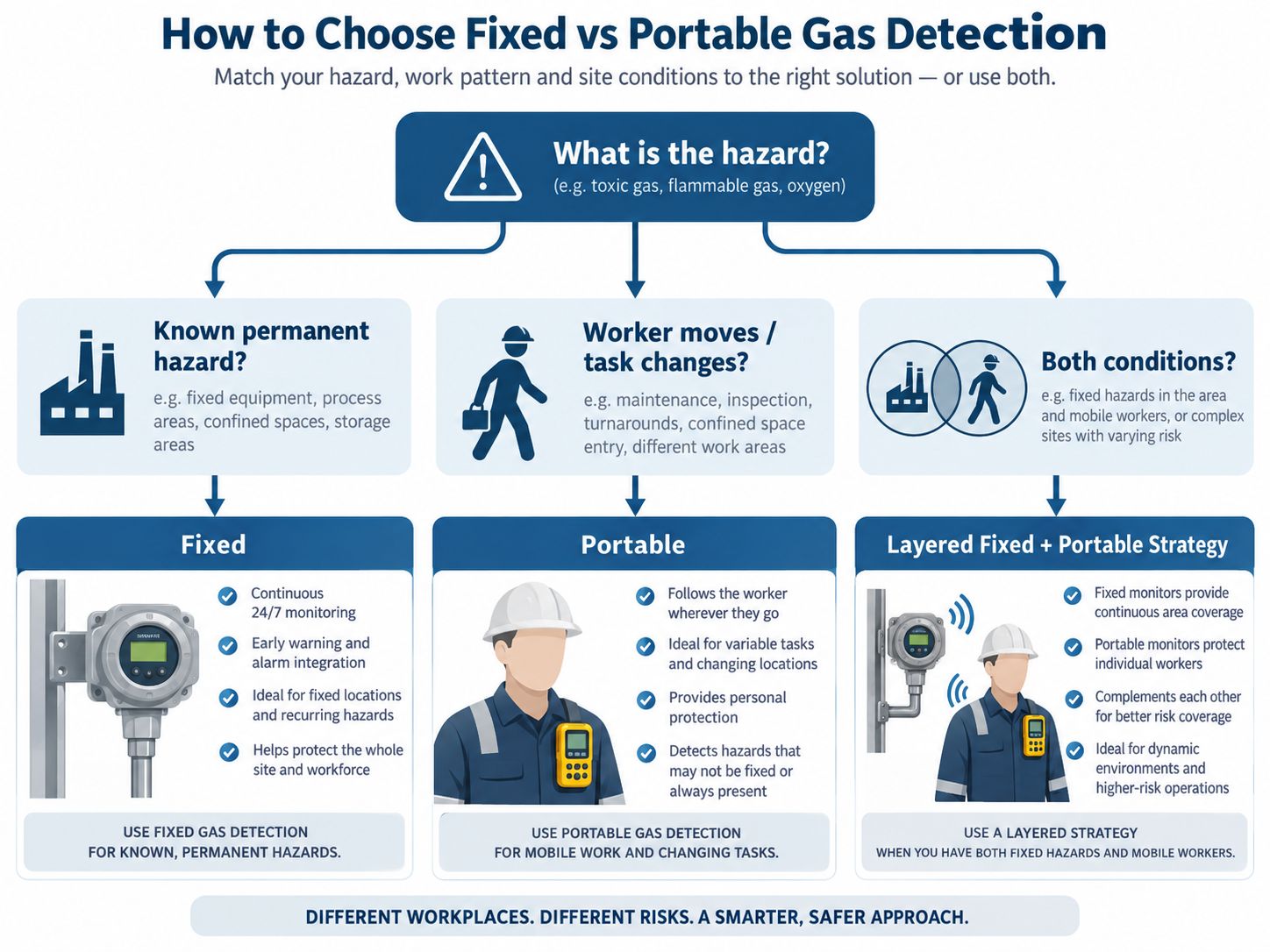
A practical selection method is:
Question 1 — Is the Hazard Permanent and Predictable?
Examples:
- compressor
- battery enclosure
- machinery room
- process vessel
- storage system
If yes:
Consider fixed detection first.
Question 2 — Does the Worker Move or Does the Task Change Location?
Examples:
- maintenance
- inspection
- confined-space work
- leak search
- emergency response
If yes:
Consider portable detection.
Question 3 — Is the Area Unattended?
If gas must still be detected when nobody is present:
Fixed detection becomes particularly important.
Question 4 — Is Pre-Entry Sampling Required?
If the atmosphere must be checked remotely before entering:
Pumped portable monitoring is usually much better suited.
Question 5 — Is Automatic Safety Action Required?
If gas detection must initiate:
- ventilation
- isolation
- shutdown
a fixed system integrated with the control architecture is normally required.
Question 6 — Do You Have Permanent Hazards and Mobile Workers?
Then the answer is often:
Use both.
Final Selection Checklist
Before deciding between fixed and portable gas detection, confirm:
- Which gases can be present?
- Where can they be released?
- Is the leak location predictable?
- Is monitoring needed when nobody is present?
- Do workers move beyond fixed detector locations?
- Is confined-space entry involved?
- Is pumped pre-entry testing required?
- Are temporary maintenance hazards expected?
- Is automatic ventilation required?
- Is automatic process isolation required?
- Is centralized monitoring required?
- What hazardous-area certification is required?
- How will detectors be calibrated?
- How will alarms be managed?
- What is the lifecycle cost?
- Is layered fixed + portable monitoring appropriate?
For choosing the gas channels themselves, see How to Choose Gases for a Multi-Gas Detector.
Frequently Asked Questions
Are fixed gas detectors better than portable gas detectors?
No.
Fixed detectors and portable detectors perform different functions.
Fixed systems are particularly useful for continuous monitoring of known locations. Portable instruments are better suited to mobile workers, temporary tasks, confined spaces and changing work locations.
Can portable gas detectors replace fixed gas detection?
Usually not where continuous unattended monitoring or automatic control actions are required.
Portable detectors depend on being correctly deployed and operating where the worker or task is located.
Do I still need a portable detector if my facility has fixed gas detectors?
Often yes.
A fixed detector only monitors its installed location. A portable personal monitor follows the worker and can detect hazardous atmospheres outside fixed detector coverage.
The requirement should be based on the site’s hazard assessment and procedures.
Can a fixed gas detector be used for confined-space entry?
A fixed detector outside the space cannot automatically represent the atmosphere inside it.
Confined-space entry commonly requires direct atmospheric testing of the internal space before entry, and monitoring may need to continue while people are inside.
What is a personal gas monitor?
A personal gas monitor is a portable detector worn by a worker, normally near the breathing zone, to provide immediate warning of selected atmospheric hazards.
What is a portable area monitor?
It is a portable instrument temporarily positioned in a work area to provide broader monitoring and alarms for workers nearby.
It is commonly used during temporary projects, turnarounds, shutdowns and emergency response.
Do fixed gas detectors run continuously?
Fixed gas systems are normally designed for continuous monitoring, provided the system has power and remains in proper operating condition.
Can fixed gas detectors automatically start ventilation?
Yes, a properly designed fixed detection system can send gas readings or alarms to a controller or PLC that initiates ventilation.
The exact control logic depends on the engineered safety system.
Can a fixed detector automatically shut down equipment?
Yes, where the detection and control system has been designed to perform that safety function.
The detector normally provides the measurement; the controller, logic system and final control elements perform the shutdown.
Which is cheaper: fixed or portable gas detection?
Portable instruments generally require less installation infrastructure, but total cost depends on the number of workers, maintenance, calibration, docking, replacement and required coverage.
Fixed systems have higher installation costs but may be the only practical approach for continuous unattended protection.
Where should fixed gas detectors be installed?
Placement should be based on:
- likely leak sources
- gas dispersion
- ventilation
- environment
- process geometry
- detector accessibility
- relevant standards
Gas density alone should not determine detector location.
Do battery storage rooms need fixed gas detection?
Where gas monitoring is part of the battery safety strategy, fixed monitoring is generally more appropriate for continuous early warning because the hazard location is permanent.
The actual gases and detection architecture depend on battery chemistry and safety design.
Should wastewater plants use fixed or portable H₂S detectors?
Many facilities benefit from both.
Fixed H₂S detection can protect permanent areas such as pump rooms, while portable instruments can protect workers during manhole entry, inspection and maintenance.
Final Takeaway
The question:
Fixed or portable gas detector?
often starts from the wrong assumption.
They are not two versions of the same solution.
Fixed gas detection
is strongest when:
- the hazard location is known
- monitoring must continue continuously
- the area may be unattended
- alarms need central visibility
- ventilation or shutdown needs automation
Portable gas detection
is strongest when:
- workers move
- tasks move
- hazards are temporary
- confined spaces need pre-entry testing
- personal breathing-zone monitoring is needed
- emergency investigation is required
And many industrial facilities have both conditions.
That leads to the most useful rule:
Fixed protects the location. Portable protects the person. A layered system can protect both.
A permanent gas leak hazard should not depend only on somebody happening to carry a detector nearby.
A moving worker should not depend only on a fixed sensor several meters away.
The most effective gas detection strategy matches each detector type to the part of the risk it can actually monitor.
References and Further Reading
- OSHA — Permit-Required Confined Spaces, 29 CFR 1910.146
- OSHA — Procedures for Atmospheric Testing
- OSHA — Calibrating and Testing Direct-Reading Portable Gas Monitors
- IEC — IEC 60079-29-2: Gas Detectors — Selection, Installation, Use and Maintenance
- GasNose — How to Choose Gases for a Multi-Gas Detector
- GasNose — Confined Space Gas Monitoring
- GasNose — What Does a 4-Gas Monitor Detect?
- GasNose — PID vs LEL Gas Detector
- GasNose — Catalytic vs NDIR vs TDLAS Methane Sensors
