




A gas sensor is usually designed around a target gas.
For example:
- a CO sensor measures carbon monoxide
- an H₂S sensor measures hydrogen sulfide
- an NO₂ sensor measures nitrogen dioxide
- a methane sensor measures CH₄
But real industrial atmospheres rarely contain only one gas.
Other gases, vapors, cleaning chemicals, combustion products and process by-products may reach the sensing element at the same time.
If a non-target gas changes the sensor output, the effect is called cross-sensitivity, or cross-interference.
The result may be:
- a reading that is too high
- a reading that is too low
- a false alarm
- an unexpected negative reading
- or, in the worst case, a real hazard that is partially masked
The key point is:
Cross-sensitivity does not only create false alarms. Some interfering gases can reduce the apparent target-gas reading and hide part of a real hazard.
For sensor selection, it is therefore not enough to ask:
What gas do I want to detect?
You also need to ask:
What other gases will be present while I am trying to measure it?
The featured illustration is conceptual. Cross-sensitivity depends on the exact sensor technology and model; it should not be interpreted as saying that every methane or LEL sensor responds to the specific interfering gases shown in the image.
What Is Gas Sensor Cross-Sensitivity?
Cross-sensitivity occurs when a sensor produces a response to a gas other than its intended target, or when another gas changes its response to the target gas.
For example:
Target sensor: CO
but the atmosphere contains:
H₂
If that particular CO electrochemical sensor also responds to hydrogen, the detector may display an apparent CO concentration even when part of the signal was actually caused by H₂.
Cross-sensitivity can therefore affect:
- portable gas detectors
- fixed gas transmitters
- multi-gas monitors
- OEM gas-sensing modules
- environmental analyzers
- process instruments
But the size and direction of the interference are highly sensor-specific.
Cross-sensitivity belongs to the sensor model—not simply to the gas name.
Cross-Sensitivity vs Selectivity vs Poisoning
These terms are often confused.
| Term | Meaning |
|---|---|
| Cross-sensitivity | A non-target gas changes sensor response |
| Selectivity | Ability to distinguish the target gas from other gases |
| Poisoning | A contaminant reduces sensor sensitivity, sometimes permanently |
| Drift | Sensor response gradually changes over time |
| Relative response | A broadly responsive sensor responds differently to different intended gases |
For example:
CO Sensor Responds to H₂
Usually:
cross-sensitivity
Catalytic LEL Sensor Damaged by Silicone
Usually:
sensor poisoning
MOS Sensor Responds to Several VOCs
Often:
broad or limited selectivity
These are related measurement problems, but they are not identical.
Positive vs Negative Cross-Sensitivity

Cross-interference does not always push the reading upward.
It can operate in either direction.
Positive Cross-Sensitivity
A non-target gas produces a signal in the same direction as the target gas.
For example:
Interfering gas present
↓
sensor current increases
↓
displayed target-gas concentration rises
Possible result:
False high or over-reading
If the target gas is actually absent, this may create a nuisance or false alarm.
If the target gas is also present, the reading may overestimate its concentration.
Negative Cross-Sensitivity
A non-target gas produces a signal in the opposite direction.
Conceptually:
Target gas creates + signal
while:
Interfering gas creates – signal
When both are present:
net reading becomes lower than the true target-gas response
Possible result:
False low or masked hazard
This can be more dangerous than a false positive.
A nuisance alarm is inconvenient.
A sensor that under-reports a genuine toxic atmosphere can create a false sense of safety.
Can Cross-Sensitivity Cause a Negative Gas Reading?
Yes.
Negative readings do not automatically mean a sensor is defective.
Possible causes include:
- negative cross-interference
- baseline drift
- environmental effects
- zeroing conditions
One well-documented electrochemical example involves SO₂ and NO₂.
Some SO₂ electrochemical sensors produce a positive response to SO₂, while NO₂ causes an electrochemical reaction in the opposite direction.
If both gases are present, the NO₂ signal can reduce the apparent SO₂ measurement.
For applications such as flue-gas measurement, this may require:
- measuring NO₂ separately
- understanding the exact cross-response
- applying a validated correction strategy
The important rule is:
Do not automatically hide negative readings in software without understanding their cause.
Why Are Electrochemical Sensors Cross-Sensitive?
Electrochemical gas sensors generate electrical current through chemical reactions at an electrode.
A simplified process is:
gas enters sensor
↓
diffuses through membrane
↓
reaches working electrode
↓
oxidation or reduction occurs
↓
electrical current generated
↓
instrument converts current to concentration
The problem is that an electrode catalyst is rarely capable of reacting with only one molecule under all conditions.
If another gas can also:
- oxidize
- reduce
- react at a similar electrode potential
it may also generate current.
Manufacturers improve selectivity using combinations of:
- catalyst material
- working-electrode potential
- electrolyte chemistry
- diffusion barriers
- membranes
- chemical filters
- additional electrodes
- compensation algorithms
But:
Electrochemical selectivity is engineered—it is not automatically absolute.
CO Sensors and Hydrogen: The Classic Cross-Sensitivity Example
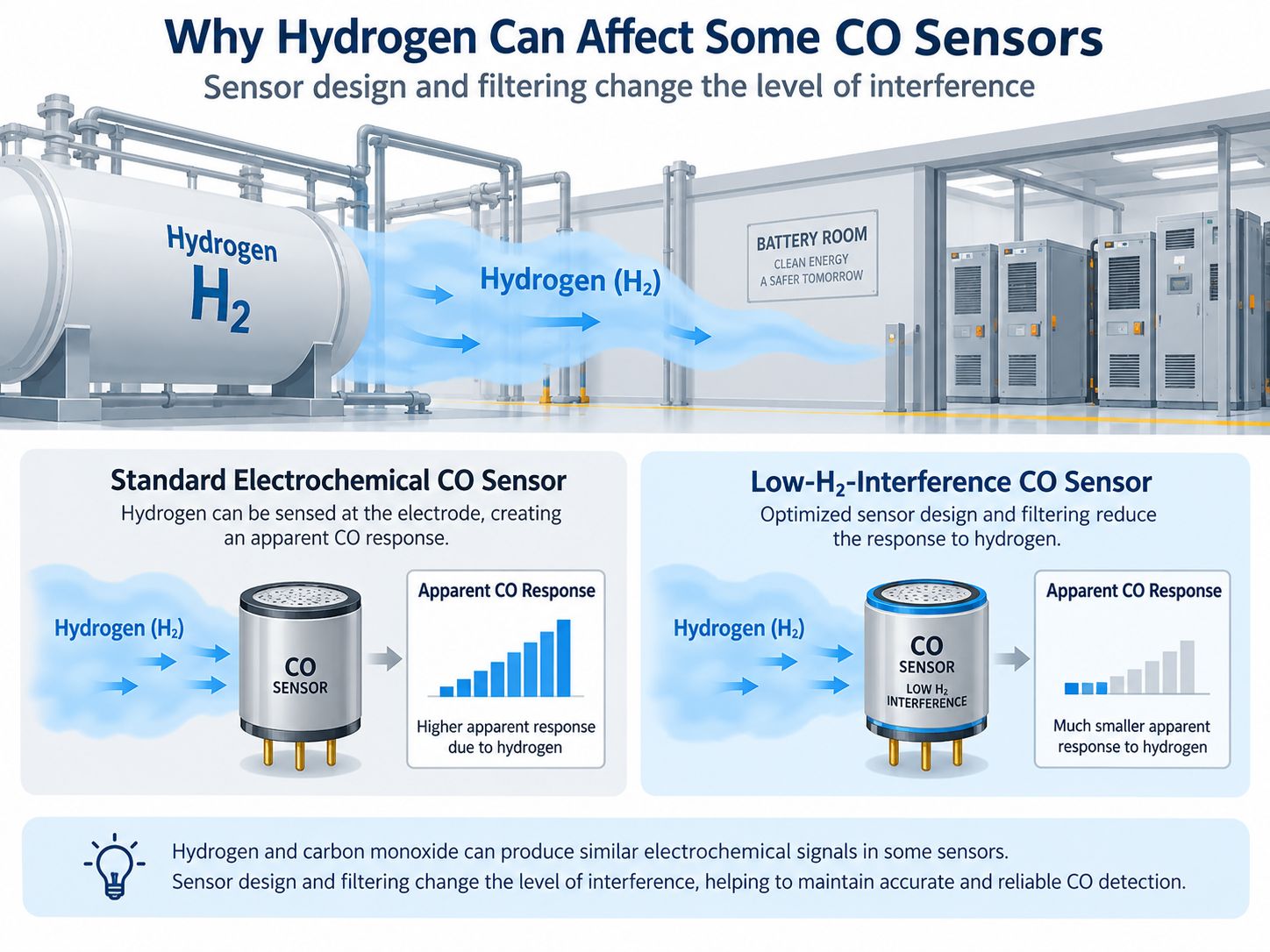
Hydrogen interference with electrochemical CO sensors is one of the best-known industrial examples.
This matters in applications such as:
- hydrogen production
- electrolyzers
- fuel cells
- reformers
- battery rooms
- steel processing
- refineries
- combustion systems
A conventional CO electrochemical sensor may respond to both:
CO
and:
H₂
If hydrogen is present, the detector may therefore indicate more apparent CO than is really present.
But different CO sensors can behave very differently.
Manufacturers offer low-H₂-interference CO sensors using:
- chemical filters
- optimized catalyst systems
- additional compensation
- different sensor architectures
For example, Alphasense currently offers filtered CO sensors specifically designed to reduce hydrogen cross-sensitivity for industrial environments where CO must be measured in the presence of H₂.
This creates an important purchasing question.
Do not only ask:
Do I need a CO sensor?
Ask:
Do I need a CO sensor in an atmosphere that also contains hydrogen?
For more CO sensor selection factors, see Carbon Monoxide Sensors.
A CO Alarm in a Hydrogen Area Is Not Automatically a False Alarm
Suppose a CO detector alarms inside a hydrogen facility.
One possible explanation is:
H₂ cross-sensitivity
But that does not prove the CO concentration is zero.
The atmosphere may contain:
- hydrogen only
- CO only
- both CO and hydrogen
Therefore:
Cross-sensitivity is something to investigate—not permission to ignore an alarm.
Follow the site’s approved alarm procedure first.
Then investigate the cause using:
- process information
- independent measurement
- another sensor technology
- detector logs
- calibration status
- cross-sensitivity data
Cross-Sensitivity Is Sensor-Specific
This point is extremely important.
You may find statements online such as:
“CO sensors have 20% hydrogen cross-sensitivity.”
That should not be treated as a universal engineering rule.
Industrial Scientific, for example, publishes different H₂ interference values for different CO sensor configurations, including a standard CO sensor and a low-H₂ CO version.
Sensor manufacturers may change cross-response through:
- catalyst
- filter
- electrode design
- package
- membrane
- firmware compensation
Therefore:
Never transfer the cross-sensitivity value from one CO sensor to another simply because both measure CO.
Always use the current datasheet for the exact sensor model.
How to Read a Gas Sensor Cross-Sensitivity Table

Manufacturer datasheets often include an interference table.
The format varies.
One table may show:
% cross-response
while another shows:
equivalent target-gas ppm
For example, conceptually:
| Sensor | Interfering Gas | Applied Gas | Apparent Target Response |
|---|---|---|---|
| CO | H₂ | 100 ppm | +X ppm CO equivalent |
This means that when the sensor was exposed to the stated H₂ concentration under specified test conditions, it produced a signal equivalent to some apparent CO response.
But before using the number, check several things.
Check the Exact Sensor Model
Cross-sensitivity is model-specific.
Check the Sign
+
means the interfering gas increased the apparent reading.
–
means it reduced the apparent reading.
Check the Units
The table may contain:
- percent response
- ppm equivalent
- ratio
- current
Check Applied Concentration
A response measured at one interferent concentration does not necessarily scale perfectly under every real-world condition.
Check Test Conditions
Cross-response can depend on:
- temperature
- relative humidity
- pressure
- sensor age
For example, published electrochemical interference tables are commonly measured under defined laboratory temperature, RH and pressure conditions.
Check Whether the Values Are Approximate
Manufacturers often state that cross-interference data:
- vary from sensor to sensor
- change with sensor age
- are reference values rather than guaranteed correction coefficients
A cross-sensitivity table is a selection and interpretation tool—not automatically a universal correction formula.
The table shown in the illustration above is intentionally illustrative. “GX-100” is not being presented as a real GasNose product or manufacturer sensor, and the example numbers should not be used for engineering calculations.
Three Ways Cross-Sensitivity Can Distort a Reading
1. False Positive
Target gas absent.
Interferent present.
↓
sensor responds
↓
detector displays apparent target gas
Possible result:
false alarm
2. Over-Reading
Target gas present.
Interferent also produces positive response.
↓
signals combine
↓
displayed concentration exceeds actual target concentration
3. Under-Reading or Masked Hazard
Target gas present.
Interferent produces negative response.
↓
signals partially cancel
↓
displayed target concentration becomes too low
The third case is especially important because the detector may appear reassuring while the actual hazard is greater.
Chemical Filters: How Manufacturers Improve Selectivity
A chemical filter can reduce selected interfering gases before they reach the sensing electrode.
The basic idea is:
gas mixture
↓
selective filter
↓
interfering compound reduced**
↓
target gas reaches sensing electrode
Filters are widely used in electrochemical sensor design.
Possible benefits include reduced response to:
- H₂
- H₂S
- SO₂
- NOx
- acidic gases
depending on the target sensor and filter chemistry.
However, filters are not universal.
A filter may have:
- finite capacity
- aging effects
- gas-specific behavior
- possible response-time impact
Some interfering gases also cannot be filtered easily without affecting the target gas.
This is why low-cross-interference performance must be evaluated at the complete sensor level.
Four-Electrode Sensors Can Help With Compensation
Some electrochemical sensors add a fourth electrode or auxiliary measurement channel.
Depending on sensor architecture, that extra signal can help with:
- baseline compensation
- background effects
- interferent estimation
For example, some hydrogen-compensated CO architectures use multiple electrochemical signals to distinguish CO from H₂ more effectively.
A fourth electrode does not automatically eliminate every cross-sensitivity problem, but it gives the instrument designer more information to work with.
Is Cross-Sensitivity Only an Electrochemical Sensor Problem?
No.
Every gas-sensing technology has its own selectivity limitations.
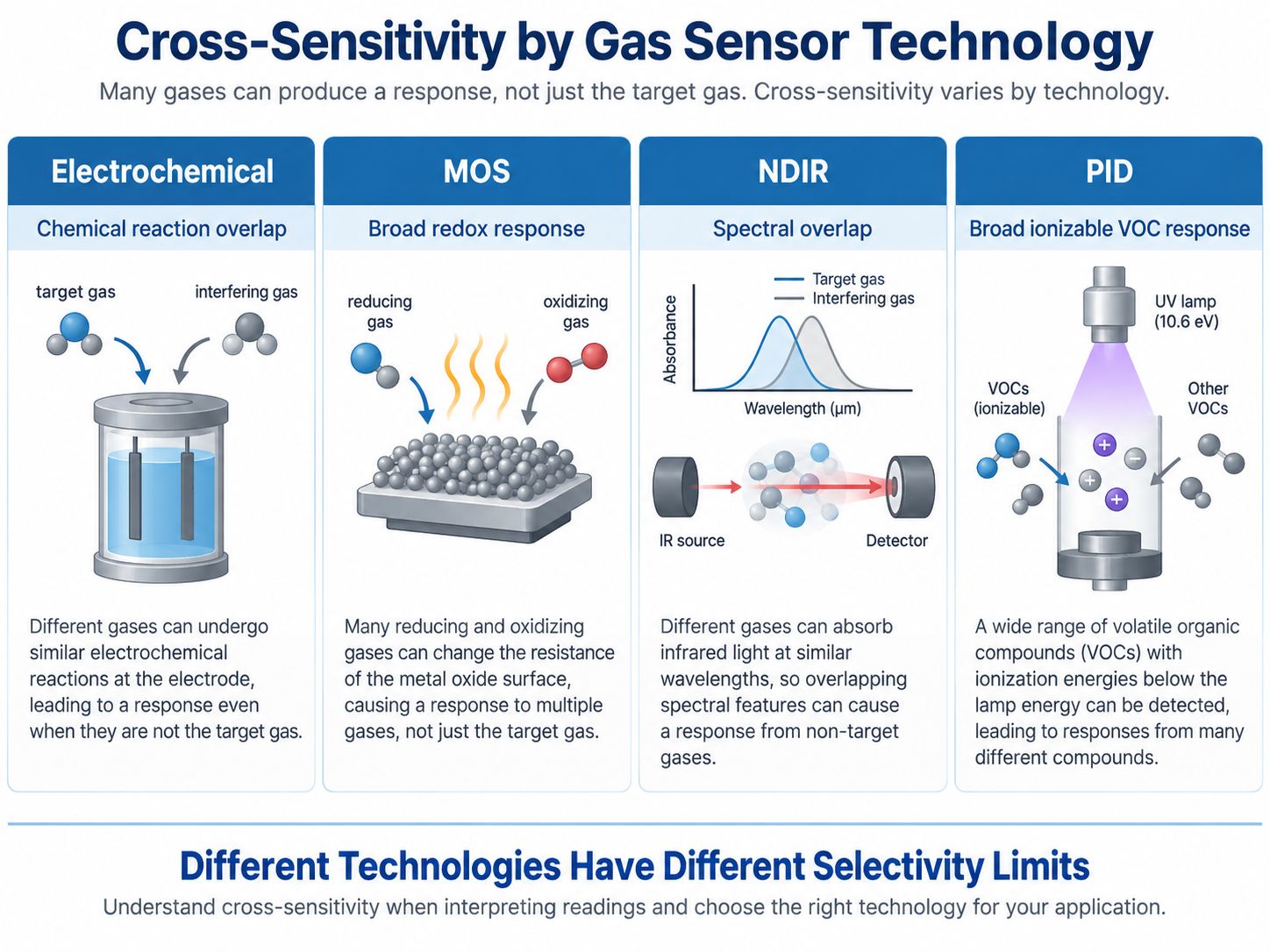
Electrochemical
Possible mechanism:
overlapping electrochemical reactions
Strength:
high selectivity can often be achieved.
Limitation:
other electroactive gases may still generate positive or negative response.
MOS / MOX
Metal-oxide sensors often respond broadly to several reducing or oxidizing gases.
Possible targets/interferents include:
- VOCs
- CO
- H₂
- alcohols
- hydrocarbons
- other reactive gases
MOS sensors can offer:
- low cost
- compact size
- high sensitivity
but often have lower inherent selectivity than a dedicated electrochemical sensor.
A 2024 systematic review in ACS Sensors identified selectivity and cross-sensitivity as central challenges in chemiresistive gas sensing and emphasized that real sensors operate in gas mixtures, while standardized mixed-gas cross-sensitivity test methods remain limited.
NDIR
NDIR uses infrared absorption.
It is generally more gas-selective than a broad MOS sensor because molecules absorb light in characteristic spectral regions.
But:
NDIR selective does not mean NDIR perfectly specific.
Possible interference can result from:
- overlapping absorption bands
- other hydrocarbons
- water vapor
- CO₂
- spectral filtering limitations
depending on the wavelength and target gas.
This is one reason optical filter design and compensation are important.
TDLAS
TDLAS uses a narrow-linewidth tunable laser to interrogate a specific absorption feature.
That usually gives it much higher spectral selectivity than broadband NDIR.
But even TDLAS is not magically interference-free.
System design still needs to consider:
- absorption-line selection
- nearby spectral lines
- water vapor
- pressure broadening
- temperature
- optical-path conditions
For methane optical technologies, see Catalytic vs NDIR vs TDLAS Methane Sensors.
PID Is Different: Broad VOC Response Is Part of the Design
A photoionization detector is intentionally broad.
A typical PID does not attempt to distinguish:
benzene
from:
toluene
from:
xylene
using one general measurement channel.
Instead, the UV lamp ionizes many compounds whose ionization energies are below the lamp energy.
The resulting signal can represent the combined response of several VOCs.
ION Science describes PID as:
non-selective and non-discriminatory
for mixed-gas composition.
Therefore it is often more accurate to describe PID behavior as:
broad VOC response
rather than treating every other VOC as an unwanted cross-sensitive gas.
For more detail, see PID vs LEL Gas Detector: What’s the Difference?.
A PID Can Also Be Suppressed by Gases It Does Not Normally Detect
There is another interesting interference mechanism.
Some gases may not themselves generate a conventional PID response but can still affect the measurement.
ION Science notes that gases such as:
- methane
- CO₂
- water vapor
can absorb or reduce some of the UV radiation available inside a PID.
The result can be:
less UV reaches detectable VOC molecules
↓
less ionization
↓
PID reading lower than expected
So:
An interferent does not always need to generate a positive sensor signal to change the reading.
This is another reason real gas matrices matter.
Catalytic LEL Sensors: Cross-Sensitivity or Intended Broad Response?
Catalytic combustible sensors require slightly different terminology.
A catalytic LEL sensor is intentionally designed to respond to multiple combustible gases.
It may detect:
- methane
- propane
- hydrogen
- pentane
- other combustible gases
The responses are not necessarily equal.
A sensor calibrated with methane can give a different response to pentane.
But this is often better described as:
relative combustible response
rather than an unwanted cross-sensitivity.
In other words:
Broad intended sensitivity is not automatically cross-sensitivity.
The engineering problem becomes:
- calibration gas
- relative response factor
- expected combustible
- sensor technology
Cross-Sensitivity vs Cross-Calibration
These two issues are related but different.
Cross-Sensitivity
A gas that is not intended to be measured affects the target channel.
Relative Response / Cross-Calibration
A sensor deliberately detects a family of gases, but its sensitivity differs between members of that family.
A catalytic combustible sensor is the clearest example.
This distinction matters when interpreting a multi-gas detector.
Can Calibration Remove Cross-Sensitivity?
Usually not by itself.
Calibration tells the instrument:
This sensor response corresponds to this known concentration of the calibration gas.
It does not fundamentally change the sensor’s chemistry.
If a CO sensor is inherently sensitive to hydrogen, calibrating it perfectly with CO does not eliminate hydrogen response.
However, calibration remains essential because drift and cross-sensitivity are separate issues.
If an instrument is producing suspicious readings, verify calibration before concluding that cross-sensitivity is responsible.
See Gas Detector Bump Test vs Calibration.
Can Software Correct Cross-Sensitivity?
Sometimes—but only when the system has enough reliable information.
Imagine:
Sensor A
responds to:
CO + H₂
while:
Sensor B
measures H₂ independently.
A validated algorithm may use Sensor B to estimate the hydrogen contribution to Sensor A.
Conceptually:
mixed CO/H₂ response
independent H₂ measurement
↓
compensation model
↓
better estimate of CO
But it is dangerous to create a generic rule such as:
“Subtract 20% of the H₂ reading from CO.”
Why?
Because cross-response depends on:
- sensor model
- sensor age
- filter condition
- temperature
- humidity
- concentration
- calibration
- gas mixture
Software compensation must be developed and validated around the actual sensor system.
Multi-Sensor Compensation
In some applications, the better solution is not trying to make one sensor perfectly selective.
Instead:
multiple sensors
↓
different response patterns
↓
algorithm
↓
better gas interpretation
For example:
SO₂ sensor
NO₂ sensor
can provide more information in a flue-gas environment where NO₂ creates a negative response on the SO₂ channel.
This is a relatively simple form of:
sensor fusion
Cross-Sensitivity and AI Nose Technology
This creates an interesting contrast.
For a conventional single-gas safety detector:
Cross-sensitivity is usually something we want to minimize.
For an electronic nose:
Controlled cross-reactivity can be useful information.
An AI Nose may use several sensors that each respond differently to a complex chemical mixture.
Instead of asking:
“Which sensor responds only to compound A?”
the system can ask:
“What response pattern does this entire sensor array produce?”
The pattern is then analyzed using:
- statistical classification
- machine learning
- neural networks
- reference fingerprints
This is why cross-sensitive MOS/MEMS arrays can be useful in electronic noses even though the same behavior might be undesirable in a single-gas safety detector.
For a full explanation, see What Is an AI Nose?.
Cross-sensitivity can be a measurement problem in one architecture and useful pattern information in another.
Why Cross-Sensitivity Causes Gas Detector False Alarms
Common industrial sources of unexpected responses include:
Cleaning Chemicals
Alcohols, solvents and degreasers.
Combustion Exhaust
May contain:
- CO
- NOx
- H₂
- hydrocarbons
Hydrogen Processes
Can affect some CO electrochemical sensors.
Welding
May produce multiple gases and process by-products.
Refrigeration and Chemical Processes
May expose sensors to vapors not considered during original detector selection.
Start-Up and Shutdown Conditions
Temporary process gases may differ from normal steady-state operation.
MSA’s 2026 fixed-gas guidance specifically highlights cleaning agents, exhaust, process vapors and changing operating conditions as causes that may resemble detector faults or nuisance alarms.
But chemical cross-sensitivity is only one cause of false alarms.
Also consider:
- condensation
- humidity
- temperature shifts
- calibration drift
- electrical problems
- sensor contamination
Never Dismiss an Alarm as Cross-Sensitivity Without Verification

A detector alarms.
Someone says:
“That’s probably hydrogen interfering with the CO sensor.”
That statement may be correct.
But it may also be dangerously wrong.
A better sequence is:
Step 1 — Treat the Alarm as a Real Hazard
Follow the approved site procedure.
Step 2 — Check Process Conditions
What gases could actually be present?
Step 3 — Review Cross-Sensitivity Data
Check the exact sensor model.
Step 4 — Verify Instrument Condition
Review:
- bump test
- calibration
- sensor age
- fault history
Step 5 — Use an Independent Measurement
If practical, use:
- another sensor principle
- another gas channel
- analyzer
- detector tube
- laboratory method
Step 6 — Determine the Cause
Possible outcomes:
real target gas
interfering gas
mixed gases
sensor fault
Step 7 — Correct the System
Possible actions include:
- different sensor
- selective filter
- additional gas channel
- different detector technology
- process control change
- calibration/maintenance
Cross-sensitivity is a diagnosis to verify—not a reason to ignore an alarm.
How Cross-Sensitivity Should Affect Sensor Selection

A gas sensor should not be selected using the target gas alone.
The real selection problem is:
Target Gas
Background Gases
Process Chemicals
Environmental Conditions
A useful application review should ask:
Target Gas
- Which gas?
- What concentration range?
- Safety or process measurement?
- ppm, ppb, %vol or %LEL?
Background Gases
- Is hydrogen present?
- Combustion exhaust?
- NOx?
- SO₂?
- CO₂?
- VOCs?
Process Chemicals
- solvents
- cleaning agents
- refrigerants
- acids
- alcohols
- process by-products
Environment
- temperature
- humidity
- pressure
- condensation
- dust
- airflow
Then review:
Cross-Sensitivity Matrix
↓
Sensor Technology
↓
Filters / Compensation
↓
Multi-Sensor Strategy
The strongest sensor-selection rule is:
Choose the sensor for the whole gas matrix—not the target gas alone.
What Should You Check in a Gas Sensor Datasheet?
Before approving a sensor, review more than range and response time.
Important parameters include:
- target gas
- measurement range
- sensitivity
- resolution
- T90
- zero current / baseline
- temperature range
- humidity range
- pressure effects
- overload
- expected lifetime
- cross-sensitivity
- chemical filter
- recommended calibration gas
For mixed-gas applications, the cross-sensitivity section may be one of the most important parts of the datasheet.
It should not be treated as an appendix that nobody reads.
Cross-Sensitivity and Multi-Gas Detectors
A multi-gas detector introduces another layer of complexity.
Suppose one instrument contains:
- CO
- H₂S
- O₂
- LEL
A gas could potentially affect more than one channel.
When selecting the detector, review:
- each sensor separately
- cross-response between expected gases
- calibration mixture
- alarm thresholds
- process environment
For the wider selection process, see How to Choose Gases for a Multi-Gas Detector.
Cross-Sensitivity and Alarm Settings
Cross-sensitivity can directly affect alarm behavior.
If an interferent produces a positive response:
Low alarm may activate earlier
If it produces a negative response:
alarm may be delayed
This means alarm values cannot compensate for a poorly matched sensor.
Do not simply raise an alarm threshold to stop nuisance alarms caused by interference.
Instead investigate:
- sensor technology
- interfering gas
- process conditions
- filter
- calibration
- alternative sensors
For alarm configuration principles, see Gas Detector Alarm Settings: Low, High, STEL & TWA Explained.
Cross-Sensitivity Selection Checklist
Before finalizing a gas sensor, confirm:
- Target gas defined
- Measurement range defined
- Background gases identified
- Process gases identified
- Cleaning chemicals reviewed
- Combustion products reviewed
- Positive cross-sensitivity checked
- Negative cross-sensitivity checked
- Exact sensor model table reviewed
- Test conditions reviewed
- Chemical filter understood
- Sensor technology compared
- Temperature considered
- Humidity considered
- Calibration gas confirmed
- Multi-sensor compensation considered
- Field validation planned
- Alarm response procedure defined
Frequently Asked Questions
What is gas sensor cross-sensitivity?
Cross-sensitivity occurs when a gas other than the intended target changes the sensor output.
It may create a positive, negative or otherwise altered reading.
What is the difference between selectivity and cross-sensitivity?
Selectivity describes how well a sensor distinguishes its target gas from other gases.
Cross-sensitivity describes the unwanted or secondary response to those other gases.
Can hydrogen cause a CO detector alarm?
Yes, some electrochemical CO sensors respond to hydrogen.
The amount depends on the exact sensor design.
Low-H₂-interference CO sensors are available for applications where hydrogen is expected.
Does every CO sensor respond to hydrogen in the same way?
No.
Cross-sensitivity varies considerably between sensor models.
Always use the current manufacturer data for the exact sensor.
Can cross-sensitivity cause a negative reading?
Yes.
Some interfering gases produce an electrochemical response in the opposite direction from the target gas.
The result can be a negative reading or reduced apparent concentration.
Can cross-sensitivity hide a real gas hazard?
Yes.
Negative interference can partially cancel the target-gas response and create an under-reading.
This is one reason negative cross-sensitivity deserves as much attention as false positive alarms.
Why does an SO₂ sensor respond to NO₂?
In some electrochemical SO₂ sensors, SO₂ and NO₂ undergo reactions that generate signals in opposite directions.
The exact behavior depends on the sensor design.
Are electrochemical sensors cross-sensitive?
Yes.
They are often highly selective, but most are not perfectly specific to only one gas.
Are MOS gas sensors selective?
MOS sensors frequently have relatively broad gas response.
Selectivity can be improved using materials, operating temperatures, filters, sensor arrays and algorithms.
Do NDIR sensors have cross-sensitivity?
They can.
NDIR is generally selective, but overlapping infrared absorption and other optical effects can create interference depending on wavelength and system design.
Does TDLAS have cross-sensitivity?
TDLAS usually provides very high spectral selectivity, but nearby absorption lines, water vapor, pressure and temperature still need to be considered.
Does a PID have cross-sensitivity?
A general PID is intentionally non-specific and responds to many ionizable VOCs.
It is better understood as a broad VOC detector rather than a single-compound sensor.
Can methane affect PID readings?
Methane is not normally detected by common PID lamps, but high methane concentrations can suppress the PID response to detectable VOCs by attenuating UV radiation.
What is the difference between cross-sensitivity and poisoning?
Cross-sensitivity produces an additional or altered response while the interfering gas is present.
Poisoning reduces sensor sensitivity through contamination or chemical damage and may persist after the contaminant is gone.
Can calibration remove cross-sensitivity?
No.
Calibration corrects the sensor’s relationship to a reference gas but does not fundamentally eliminate its response to another gas.
Can software compensate for cross-sensitivity?
Sometimes.
Software compensation can work when the cross-response is characterized and another measurement provides sufficient information.
The method must be validated for the actual sensor system.
How should I read a cross-sensitivity table?
Check:
- exact sensor model
- interfering gas
- applied concentration
- units
- positive/negative sign
- test conditions
- manufacturer notes
Do not copy a value from a different sensor model.
How do I prevent gas detector false alarms caused by cross-sensitivity?
Possible approaches include:
- choose a more selective sensor
- use chemical filtering
- add an additional gas channel
- use another sensing technology
- adjust the process environment
- use validated compensation
Do not raise the alarm threshold simply to silence unexplained alarms.
Final Takeaway
Cross-sensitivity is not simply a minor specification in a gas sensor datasheet.
It can determine whether a detector:
- alarms too often
- overestimates a gas
- underestimates a gas
- or fails to represent a mixed atmosphere correctly
The most important lessons are:
Positive cross-sensitivity
can create:
false high readings
Negative cross-sensitivity
can create:
false low readings or masked hazards
And the same target gas can require different sensors depending on the surrounding process chemistry.
A CO sensor in a normal building is not necessarily the same sensor you should select for a hydrogen facility.
An SO₂ sensor used in clean laboratory gas is not necessarily the same measurement problem as SO₂ in a NO₂-containing flue stream.
A PID detecting VOCs is not intended to identify every individual VOC.
A MOS array may deliberately use broad cross-reactivity when the goal is AI-based chemical pattern recognition.
That leads to the most useful engineering rule:
Choose the sensor for the whole gas matrix—not the target gas alone.
References and Further Reading
- Industrial Scientific — Electrochemical Sensor Cross-Interference Table
- MEMBRAPOR — Electrochemical Gas Sensor Application Note
- Alphasense — Low-H₂ Cross-Sensitivity CO-D4X Sensor
- ION Science — Cross Sensitivity of Photoionization Detectors
- MSA — Cross-Sensitivity and False Alarms
- ACS Sensors — The Cross-Sensitivity of Chemiresistive Gas Sensors
- GasNose — Carbon Monoxide Sensors
- GasNose — PID vs LEL Gas Detector
- GasNose — Catalytic vs NDIR vs TDLAS Methane Sensors
- GasNose — Gas Detector Bump Test vs Calibration
- GasNose — Gas Detector Alarm Settings
- GasNose — What Is an AI Nose?
