




The safest answer to “How long should workers wait before re-entering after blasting?” is not a fixed number of minutes.
Safe re-entry should be based on verified conditions, not time alone.
After a blast, workers may face:
- carbon monoxide (CO)
- nitrogen oxides, especially NO₂
- low or abnormal oxygen
- methane or other combustible gases already present in the mine
- smoke and dust
- misfires
- loose rock and unstable ground
- damaged ventilation or equipment
Ventilation needs time to dilute and remove blast fumes, but clearance time can vary significantly from one blast to another.
The explosive formulation, blast size, water in boreholes, confinement, ventilation rate, tunnel geometry, muck pile, geology and mine atmosphere can all influence how long hazardous gases remain.
A sound post-blast re-entry process therefore follows a simple principle:
Blast → Ventilate → Monitor → Inspect → Authorize Re-Entry
Not:
Blast → Wait a fixed number of minutes → Assume it is safe
Quick Answer: What Must Be Checked Before Re-Entry?
| Re-Entry Check | Why It Matters |
|---|---|
| Oxygen | Confirm a breathable atmosphere |
| Carbon monoxide | Major toxic blast fume |
| NO₂ / NOx | Important toxic blasting fumes |
| Methane / combustible gas | Explosion risk where relevant |
| Mine-specific toxic gases | Geology and process may create additional hazards |
| Smoke and dust | Visibility and respiratory conditions |
| Ventilation | Confirms fumes are being removed |
| Misfires | Undetonated explosives remain a severe hazard |
| Ground conditions | Blasting can loosen rock and damage support |
| Travel route | Workers must be able to reach the work area safely |
Gas readings are essential, but:
Acceptable gas readings alone do not make a blast area safe to enter.
A qualified inspection may also be required for misfires, loose ground, damaged services and other post-blast hazards.
What Gases Are Produced After Blasting?

Detonation does not convert all explosive material into harmless products.
NIOSH identifies carbon monoxide and oxides of nitrogen as the primary toxic gases associated with explosive detonation.
Important post-blast gases can include:
Carbon Monoxide — CO
CO is produced during explosive detonation and is particularly dangerous in underground or otherwise poorly ventilated environments.
Nitric Oxide — NO
NO may be generated during detonation.
Once released into air, some NO can oxidize to form nitrogen dioxide.
Nitrogen Dioxide — NO₂
NO₂ is a highly toxic respiratory irritant and one of the most important gases to consider after blasting.
Other Gases
Depending on explosives, geology and mine conditions, monitoring may also need to consider:
- CO₂
- CH₄
- H₂S
- SO₂
- other mine-specific gases
There is an important distinction here:
Not every gas detected after a blast was necessarily generated by the explosive.
Blasting can disturb rock formations, open new pathways and release methane, H₂S, CO₂ or other gases already trapped in the surrounding geology.
For a broader mine-gas overview, see Gas Detection in Underground Mines.
Carbon Monoxide: One of the Most Important Post-Blast Gases
CO deserves particular attention after underground blasting.
NIOSH notes that carbon monoxide from large surface blasts can disperse rapidly in open air, but underground blasting, trench blasting and confined construction present a much greater CO risk because the gas cannot disperse as easily.
An additional problem is the muck pile.
Blasted rock can continue releasing trapped blast fumes after detonation.
This means:
The explosion may be over, but the atmospheric hazard may continue.
CO is especially dangerous because it is:
- colorless
- odorless
- impossible to assess reliably using human senses
- toxic even when the atmosphere otherwise appears normal
For more information about CO sensing technologies, see the GasNose Carbon Monoxide Sensor Guide.
Nitrogen Dioxide: Why Orange-Brown Fumes Are a Warning Sign
Nitrogen oxides are another major post-blast concern.
A simplified process is:
NO generated during detonation
↓
NO reacts with oxygen in air
↓
NO₂ forms
High NO₂ concentrations can sometimes create a visible orange or brown plume.
That can be a valuable warning sign of poor blast-fume conditions.
But there is an important safety limitation:
No orange cloud does not mean no NO₂.
Lower but still hazardous concentrations may not create an obvious visible plume.
NO₂ therefore needs appropriate instrumentation when it is a credible post-blast hazard.
Human sight and smell are not substitutes for gas measurement.
Why Does One Blast Produce More Fumes Than Another?
Post-blast gas generation is not perfectly repeatable.
NIOSH research identifies several factors that can increase toxic fume production, including:
- explosive formulation
- wet boreholes
- poor confinement
- conditions that prevent proper detonation
Other practical influences may include:
- explosive loading
- oxygen balance
- blast design
- stemming
- water
- rock conditions
- initiation performance
This creates an important operational consequence:
The same mine can have different gas-clearance times after different blasts.
That is one reason a single fixed waiting time cannot prove atmospheric safety.
Is There a Standard Waiting Time After Blasting?
No Universal Waiting Time Guarantees Safe Re-Entry
Some mines, blasting procedures or regulations may specify a minimum waiting period.
But a waiting period and atmospheric clearance are not the same thing.
Actual clearance time depends on:
- amount of explosive
- explosive type
- toxic-fume generation
- ventilation airflow
- tunnel geometry
- blast location
- distance to exhaust
- muck-pile behavior
- geology
- methane or other mine gases
- ventilation interruptions
A mine could have acceptable gas conditions before a conservative fixed waiting period expires.
Another blast under different conditions could still have dangerous gas concentrations after the same waiting period.
The better question is therefore:
Have the required atmospheric and physical re-entry criteria actually been met?
Fixed Waiting Time vs Real-Time Post-Blast Monitoring
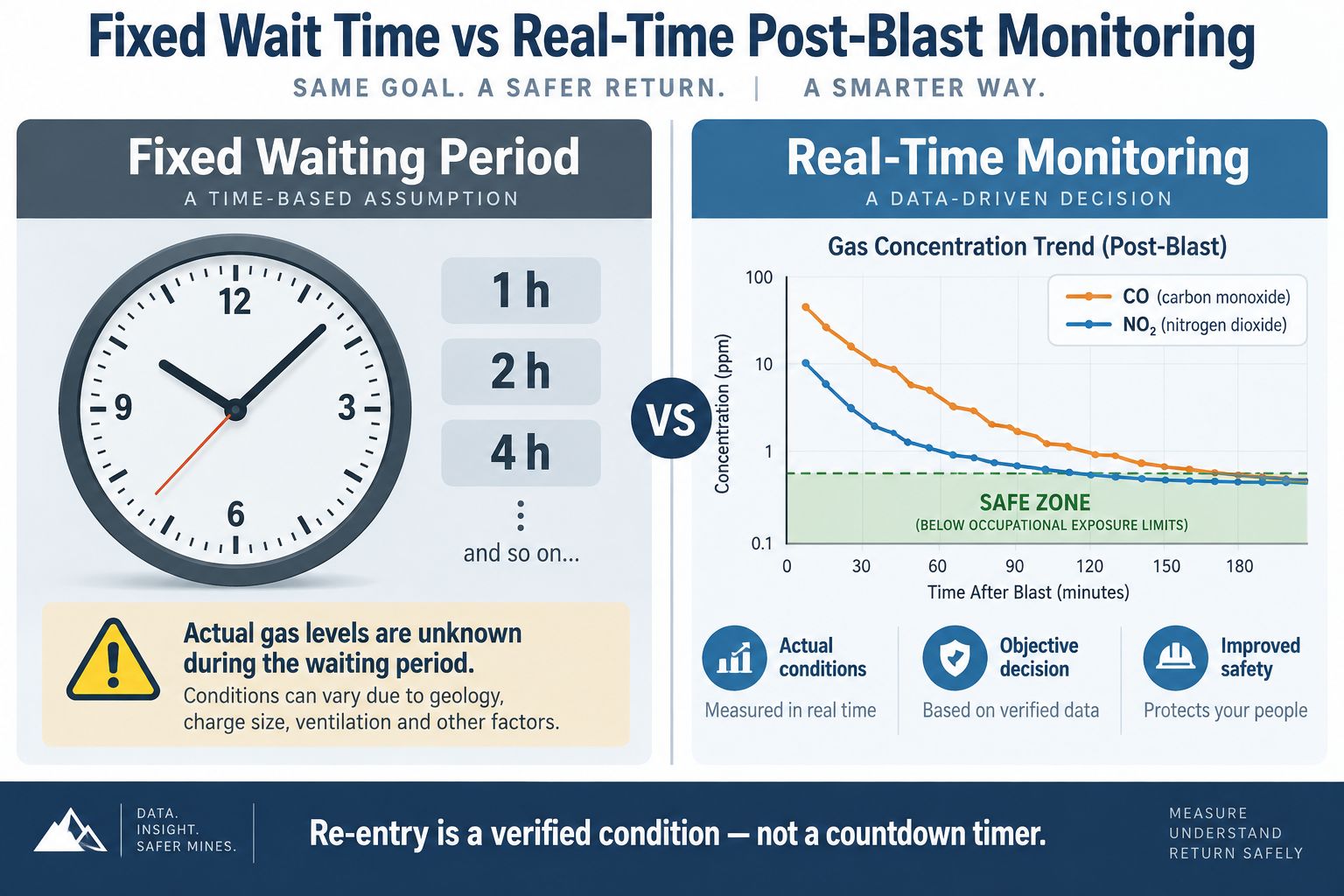
Traditional operations may use a conservative rule such as:
Wait X minutes or hours after blasting before inspection.
This can provide a procedural safety margin, but it does not tell the operator what gas concentrations are doing during that period.
| Fixed Waiting Period | Real-Time Gas Monitoring |
|---|---|
| Time-based | Measurement-based |
| Uses predefined delay | Uses actual atmospheric data |
| Gas concentrations remain unknown during much of the wait | Shows gas concentration trends |
| May cause unnecessary downtime | Can support earlier safe re-entry when criteria are met |
| May still require gas verification | Provides direct atmospheric verification |
| Same time may be used after different blasts | Reflects different gas-clearance behavior |
A 2026 underground silver-mine case published by Conspec Controls illustrates the commercial value of this approach. The mine had been relying on conservative estimates after blasts. Continuous real-time gas measurements allowed operators to observe gas dissipation directly and make re-entry decisions from measured conditions rather than fixed assumptions.
The operational value was not simply “faster entry.”
It was:
better atmospheric information → safer decision-making → less unnecessary waiting → more productive time
Real-time monitoring can also provide useful information for optimizing ventilation rather than simply running ventilation longer than necessary.
How Do Blast Gas Levels Change During Ventilation?
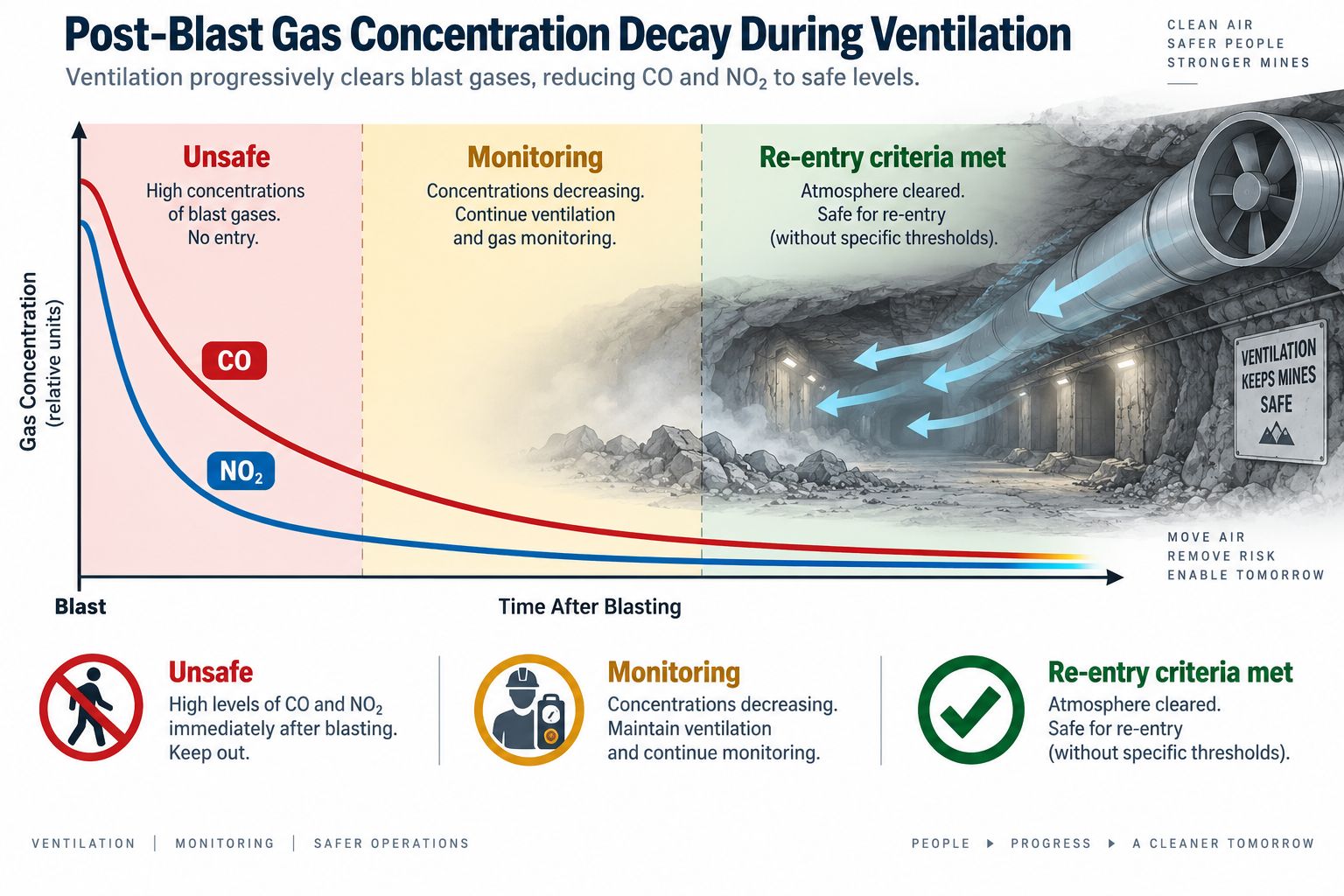
After blasting, a typical trend may look like:
Blast occurs
↓
Gas concentration rises
↓
Ventilation dilutes and moves fumes
↓
Concentrations decline
↓
Required atmospheric criteria are eventually met
The illustration above is conceptual rather than a universal concentration curve.
Actual gas concentrations and decay rates depend on the blast and mine conditions.
There should therefore be no universal graph saying:
“After 60 minutes CO will always equal X ppm.”
What matters is the measured trend in that operation.
Continuous monitoring can also reveal abnormal behavior.
For example:
- gas concentration stops declining
- concentration rises again
- ventilation is ineffective
- fumes accumulate in a dead zone
- methane enters the area after blasting
These patterns can provide more information than a single post-blast measurement.
What Gases Should Be Monitored After Blasting?
CO and NO₂ are particularly important blast-fume gases, but the complete monitoring list depends on the mine.
| Gas | Why Monitor It? | Possible Source |
|---|---|---|
| CO | Toxic exposure | Explosive detonation, combustion |
| NO₂ | Severe respiratory hazard | Blast-generated NOx |
| O₂ | Breathable atmosphere | Ventilation and gas displacement |
| CH₄ / combustible gas | Fire and explosion | Geological release / mine gas |
| CO₂ | High-concentration exposure / ventilation indicator | Blast, geology, respiration |
| H₂S | Acute toxicity where credible | Geological formations, water, mine conditions |
| SO₂ | Toxic irritant where credible | Site/explosive/geology specific |
Do not copy this entire list into every detector specification.
Instead ask:
Which gases could realistically be hazardous in this specific mine after this type of blast?
For a systematic selection method, see How to Choose Gases for a Multi-Gas Detector.
Is a Standard 4-Gas Monitor Enough After Blasting?
Not necessarily.
A common industrial four-gas detector measures:
- O₂
- %LEL
- H₂S
- CO
That is a useful configuration for many industrial applications.
But notice what may be missing:
NO₂
If the primary post-blast toxic hazards are:
CO + NO₂
then a detector configured for:
O₂ + LEL + H₂S + CO
does not measure one of the major blast-fume gases.
This is an excellent example of why detector selection should be based on hazards rather than the label:
4-gas detector
The number of channels does not tell you whether they are the right channels.
OSHA Underground Construction: A Useful Re-Entry Example
U.S. OSHA’s underground construction requirements provide a useful example of condition-based post-blast re-entry.
Under 29 CFR 1926.800, underground work areas must generally contain:
- at least 19.5% oxygen
- no more than 22% oxygen
This is worth noting because it differs from the 23.5% upper oxygen boundary commonly seen in other U.S. confined-space rules.
OSHA also requires underground areas to be tested quantitatively as necessary for contaminants including:
- CO
- NO₂
- H₂S
- other toxic gases, fumes and vapors
and for:
- methane
- other flammable gases
For underground operations using drill-and-blast excavation, flammable gas testing is required before re-entry after blasting.
Most importantly:
Following blasting, ventilation systems must exhaust smoke and fumes to the outside atmosphere before work resumes in affected areas.
The standard also states that employees cannot enter a work area following blasting until its air quality meets the applicable requirements.
Official source: OSHA 29 CFR 1926.800 — Underground Construction
U.S. Underground Coal Mines: Smoke Clearance Is Not the End of the Inspection
MSHA’s underground coal rules demonstrate another important point.
Under 30 CFR §75.1326, the blasting area cannot be entered until it is clear of:
- smoke
- dust
Once it has cleared, a qualified person must examine for:
- misfires
- methane
- other hazardous conditions
Therefore:
Clear air does not automatically equal complete re-entry authorization.
If a round has partially detonated, the rule also includes additional restrictions before the affected area can be re-entered.
Official source: 30 CFR §75.1326 — Examination After Blasting
Some Mines Have Specific Minimum Waiting and Gas Criteria
Some regulations combine a minimum ventilation period with gas measurements.
One clear example is the U.S. rule for certain Category II-A underground metal/non-metal mines.
Under 30 CFR §57.22603, following applicable blasting:
- the mine must be ventilated for at least 15 minutes
- ventilating air must pass over the blast area and through an atmospheric monitoring sensor
- methane must be below 0.5% before competent persons enter to test blast areas
If the monitoring system indicates methane at 0.5% or above, ventilation must continue and entry is prohibited until methane is below that level.
This demonstrates the correct way to interpret a minimum waiting period:
A specified time can be one re-entry condition, but it does not replace atmospheric measurement.
Official source: 30 CFR §57.22603
These are U.S.-specific examples. Mine operators elsewhere must follow their own national, regional and site requirements.
Where Should Post-Blast Gases Be Measured?
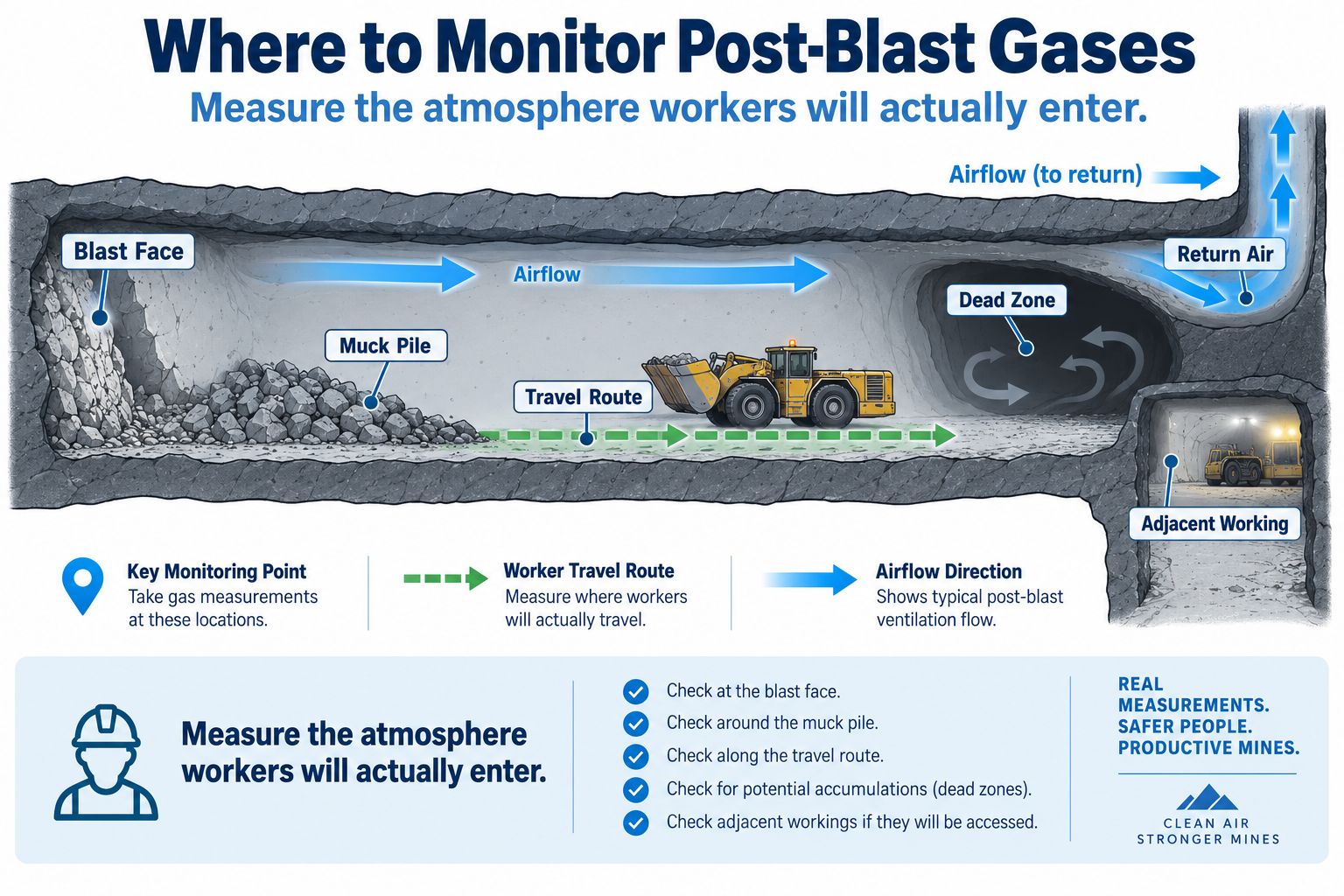
Testing only at the portal or one convenient monitoring point may not represent the atmosphere workers will actually encounter.
Important locations can include:
Blast Face
The area closest to detonation and freshly broken rock.
Muck Pile
Blast gases can remain trapped within fragmented rock and continue entering the mine atmosphere.
NIOSH specifically warns of CO emanating from the muck pile after underground blasting.
Worker Travel Route
Workers need safe air not only at the face but everywhere they pass on the way there.
Return Air
Monitoring can show whether ventilation is successfully carrying contaminants away from the blast zone.
Dead Zones
Poorly ventilated pockets may retain hazardous gas after the main airflow path has cleared.
Adjacent Workings
Blast fumes can migrate away from the immediate blast location.
NIOSH research has shown that blast fumes can move significant distances underground.
The practical rule is:
Measure the atmosphere workers will actually enter—not just the easiest place to put a sensor.
Ventilation Is the Main Control—but It Must Be Verified
Post-blast ventilation has two primary jobs:
Dilute contaminants
and
transport them out of the affected area
Factors influencing effectiveness include:
- airflow volume
- air velocity
- fan capacity
- ventilation duct position
- mine geometry
- distance to blast face
- recirculation
- dead zones
- muck pile
- changes in ventilation infrastructure
Running a fan does not automatically prove that contaminants have cleared.
The proper sequence is closer to:
Ventilate → Measure → Continue or adjust ventilation → Verify
rather than:
Ventilate for X minutes → Assume safe
Portable, Fixed and Remote Post-Blast Monitoring
There are several ways to obtain post-blast gas information.
Portable Gas Detector
A trained or qualified person can use a portable detector to check:
- travel route
- blast area
- muck pile
- suspected gas pockets
Advantages include:
- flexibility
- multiple measurement locations
- immediate verification
The disadvantage is obvious:
a person may need to approach the area before detailed measurements are available.
Fixed Gas Monitoring
Fixed detectors can provide:
- continuous measurements
- concentration trends
- automatic alarms
- remote visibility
- integration with mine communication or control systems
This is particularly attractive for areas where blasting occurs repeatedly.
Wireless / Temporary Monitoring
A mine without permanent wiring at an advancing heading may use:
- battery-powered monitors
- wireless communication
- temporary sensing nodes
This can provide continuous monitoring while following the moving production area.
UAV and Robotic Monitoring
A newer approach is to send the sensor into the hazardous area before sending the worker.
A 2025 field robotics study demonstrated an autonomous UAV carrying gas-sensing equipment into a real underground mine approximately 40 minutes after blasting.
The objective was not to replace mine safety procedures.
It demonstrated how remote platforms could collect:
- atmospheric information
- visual data
- spatial information
without initially exposing personnel to the blast area.
This is an important future direction for high-risk mine inspection.
Gas Monitoring Alone Is Not Enough
Post-blast re-entry is not only an atmospheric decision.
A blast can also create:
Misfires
Partially or completely undetonated explosives may remain.
Loose Rock
Blasting can destabilize the roof, ribs, face or surrounding ground.
Damaged Ground Support
Bolts, mesh, timber or other support systems may be affected.
Smoke and Dust
Even when toxic gases are decreasing, visibility and dust conditions may remain unacceptable.
Damaged Ventilation
Ducting or other ventilation infrastructure can be displaced or damaged.
Equipment and Electrical Damage
Blast effects can create secondary hazards.
Therefore the final re-entry decision needs to consider:
Atmosphere + Explosives + Ground + Access + Equipment
not gas concentration alone.
A Practical Post-Blast Re-Entry Decision Process

A practical framework is:
Step 1 — Complete the Blast and Secure the Area
Prevent unauthorized entry.
Step 2 — Start or Maintain Ventilation
Remove smoke, dust and gases from the blast area.
Step 3 — Monitor the Required Gases
Depending on the mine, this may include:
- CO
- NO₂
- O₂
- CH₄
- additional mine-specific gases
Step 4 — Evaluate Gas Trends and Limits
Ask:
- Are concentrations declining?
- Are site limits met?
- Are regulatory requirements met?
- Is ventilation continuing to work?
If not:
continue ventilation and monitoring.
Step 5 — Conduct Post-Blast Physical Inspection
A qualified person checks for:
- misfires
- loose ground
- damaged supports
- other hazards
Step 6 — Verify the Travel Route
Conditions must be acceptable along the route workers will use, not only at the blast face.
Step 7 — Authorize Re-Entry
Only the responsible or qualified person should authorize re-entry according to the mine’s established procedure.
The key principle is:
Re-entry is a verified condition—not a countdown timer.
How Real-Time Monitoring Can Improve Productivity
Safety is the primary objective, but real-time monitoring can also address a major operational problem:
unnecessary post-blast downtime.
Without gas data, operators may need to use conservative assumptions.
For example:
Blast → Wait several hours → Send examiner → Verify
Real-time monitoring can change this to:
Blast → Ventilate → Watch gas concentration trend → Inspect when criteria are met
A 2026 Conspec Controls case study at an underground silver mine in northern Mexico described this exact change.
The operation used battery-powered multi-gas monitors and its existing UHF communication infrastructure to obtain continuous post-blast readings.
According to the case study, this allowed the mine to:
- reduce dependence on fixed waiting estimates
- understand gas dissipation
- make data-driven re-entry decisions
- reduce unnecessary ventilation
- recover productive time
This is a vendor case study rather than an independent industry benchmark, so the claimed operational benefits should be interpreted in that context.
However, the underlying engineering principle is sound:
If atmospheric conditions determine re-entry, better atmospheric data can improve both safety decisions and operational efficiency.
What Should You Look for in a Post-Blast Gas Monitoring System?
When choosing monitoring equipment, evaluate the actual blast environment.
Required Gas Channels
Potential channels include:
- CO
- NO₂
- O₂
- CH₄
- mine-specific gases
Measurement Range
Immediately after blasting, concentrations may be much higher than normal workplace background levels.
Make sure the detector has an appropriate:
- range
- resolution
- over-range behavior
Response Time
Fast response is important for:
- inspection
- trend monitoring
- re-entry decisions
Monitoring Architecture
Decide whether the application needs:
- portable detector
- fixed monitor
- temporary wireless monitor
- remote inspection platform
- combination system
Communication
For remote systems, consider:
- UHF
- Wi-Fi
- mesh
- mine communication network
- wired connection
- SCADA / control room integration
Data Logging
Historical trends can help answer:
- How quickly did gases clear?
- Was ventilation effective?
- Are some blast locations consistently slower to clear?
- Is blast-fume performance changing over time?
Mining Approval
Equipment intended for hazardous underground atmospheres may require relevant:
- mining approval
- intrinsic safety
- explosion protection
depending on jurisdiction and mine classification.
Maintenance
Confirm:
- calibration procedure
- bump testing
- sensor replacement
- battery life
- environmental protection
- communication maintenance
Frequently Asked Questions
How long should you wait after blasting before re-entering a mine?
There is no universal waiting period that guarantees safe re-entry.
Some mine procedures or regulations specify minimum ventilation or waiting periods, but re-entry should still depend on required atmospheric testing, ventilation, physical inspection and applicable rules.
What gases are produced by blasting?
Explosive detonation commonly produces toxic gases including carbon monoxide and nitrogen oxides such as NO and NO₂.
Other gases detected after blasting may come from the mine geology or surrounding atmosphere rather than directly from the explosive.
Why is CO dangerous after blasting?
CO is colorless and odorless and can accumulate in underground environments.
NIOSH specifically warns that CO can continue emanating from blasted muck and may present a serious hazard to workers who approach too soon.
Why is NO₂ monitored after blasting?
NO₂ is a highly toxic respiratory irritant associated with blast fumes.
It may appear as orange-brown fumes at high concentrations, but hazardous NO₂ can also be present without an obvious visible cloud.
Is a standard 4-gas detector enough after blasting?
Not necessarily.
A typical 4-gas detector measures:
O₂ + LEL + H₂S + CO
but may not measure NO₂, which can be an important post-blast toxic gas.
Select channels from the actual blast and mine hazards.
Should methane be monitored after blasting?
Where methane is a credible geological or mine hazard, yes.
Blasting may disturb methane-containing formations or occur in an atmosphere where methane is already a regulated hazard.
Does ventilation alone make the area safe?
No.
Ventilation is used to remove gases and fumes, but atmospheric monitoring is needed to verify that the required conditions have actually been achieved.
Where should post-blast gas measurements be taken?
Possible locations include:
- blast face
- muck pile
- travel route
- return air
- dead zones
- adjacent workings
The exact strategy should follow the mine’s ventilation system, hazard assessment and procedures.
Can blast fumes move away from the blast site?
Yes.
NIOSH research has documented blast-generated CO migrating significant distances through underground pathways and even through ground strata into confined spaces.
Can fixed gas monitoring reduce re-entry time?
It can reduce unnecessary waiting when the mine’s procedure permits re-entry decisions to use verified real-time conditions.
It does not justify entering before required gas, physical and regulatory criteria are met.
Can drones monitor gases after underground blasting?
Yes, this is an emerging application.
A published 2025 field study demonstrated autonomous UAV gas measurements in an underground mine shortly after a real blast.
Who should authorize re-entry?
The responsible competent, qualified or authorized person defined by the mine’s procedure and applicable regulations should make the final re-entry decision.
A gas detector reading by itself should not be treated as authorization.
Final Takeaway
The question:
“How long after blasting can workers re-enter?”
sounds like a question about time.
In reality, it is a question about conditions.
Post-blast safety depends on:
Ventilation
CO / NO₂ / O₂ / mine-specific gas measurements
Gas concentration trends
Misfire inspection
Ground stability
Safe access
Only when the applicable criteria are satisfied should workers return.
That is why the most useful post-blast rule is:
Re-entry is a verified condition—not a countdown timer.
Real-time gas monitoring does not eliminate ventilation, mine rules, qualified inspections or minimum waiting periods where those are required.
What it does provide is something a clock cannot:
direct evidence of what is actually happening in the mine atmosphere.
References and Further Reading
- NIOSH Mining — Blasting and Explosives
- OSHA — 29 CFR 1926.800 Underground Construction
- 30 CFR §75.1326 — Examination After Blasting
- 30 CFR §57.22603 — Blasting From the Surface, II-A Mines
- NIOSH — Carbon Monoxide Poisoning After the Use of Explosives
- Journal of Field Robotics — Autonomous UAV Post-Blast Gas Inspection
- Conspec Controls — Improving Post-Blast Productivity in an Underground Mine
- GasNose — Gas Detection in Underground Mines
- GasNose — How to Choose Gases for a Multi-Gas Detector
- GasNose — What Does a 4-Gas Monitor Detect?
- GasNose — Confined Space Gas Monitoring
- GasNose — Carbon Monoxide Sensors
