




A gas sensor can produce a very strong signal from a very small amount of gas and still be a poor choice for the application.
Why?
Because sensitivity and selectivity describe two different sensor characteristics.
Sensitivity asks:
How strongly does the sensor respond when gas concentration changes?
Selectivity asks:
How well can the sensor distinguish the target gas from other gases?
A sensor may therefore be:
- highly sensitive but poorly selective
- highly selective but insufficiently sensitive
- strong in both areas
- or unsuitable in both
For real gas detection, neither parameter should be evaluated alone.
A useful engineering summary is:
Sensitivity determines whether the signal is large enough to measure. Selectivity determines whether that signal actually represents the gas you care about.
Sensitivity vs Selectivity: Quick Comparison
| Parameter | Sensitivity | Selectivity |
|---|---|---|
| Main question | How strongly does the sensor respond? | How specifically does it respond? |
| Main relationship | Concentration change → signal change | Target gas response vs interfering-gas response |
| High value means | Small concentration change produces a useful signal | Target gas dominates the response |
| Typical concern | Noise, range, saturation | Cross-sensitivity, false response |
| Often evaluated with | Sensitivity coefficient, slope, response factor | Cross-sensitivity tables, interference tests |
| Important for | Low-level measurement | Mixed-gas environments |
The ideal gas sensor would provide:
High sensitivity
High selectivity
Low drift
Fast response
Suitable range
Long-term stability
But practical sensor design involves trade-offs.
What Is Gas Sensor Sensitivity?
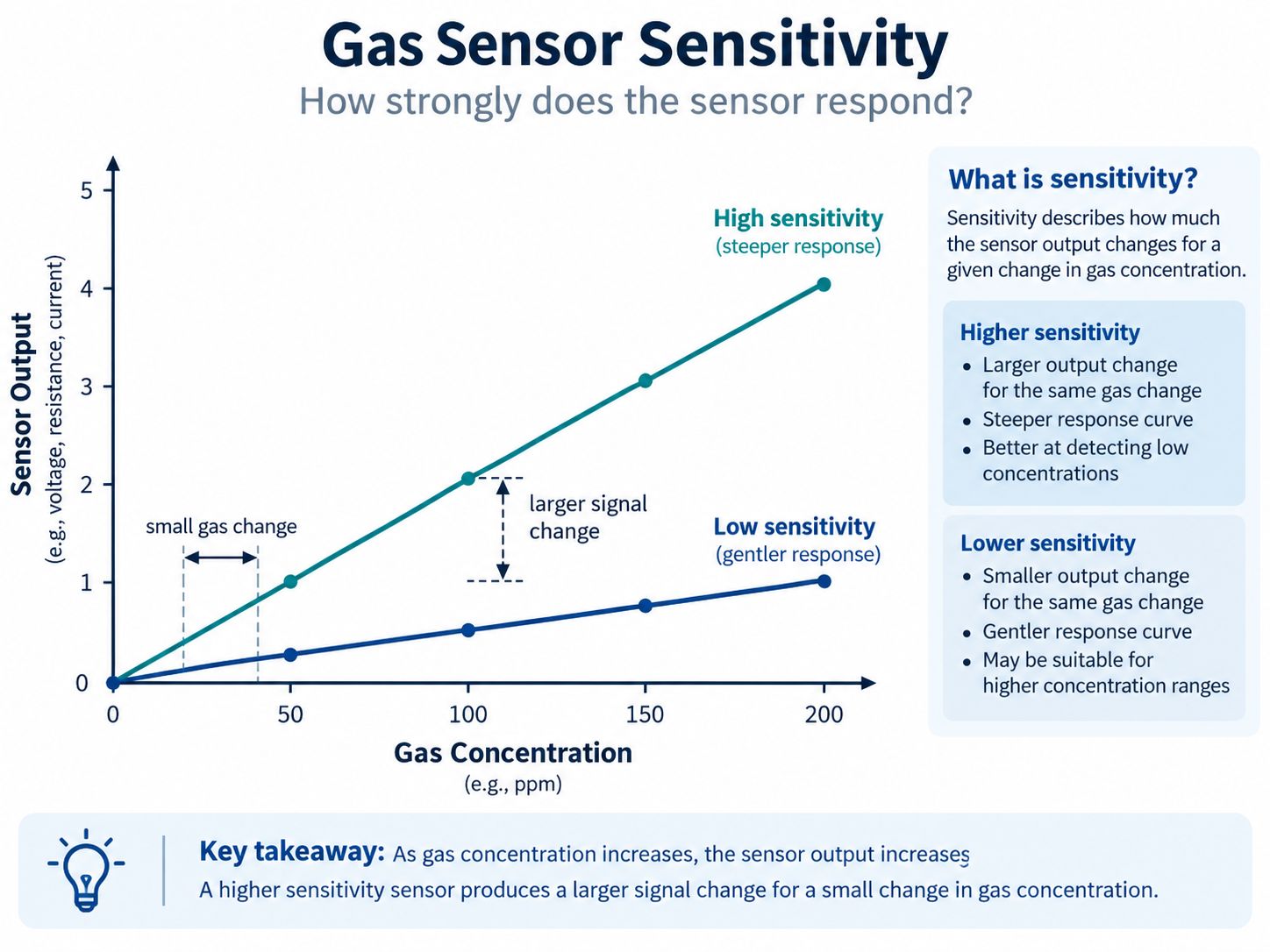
Gas sensor sensitivity describes how much sensor output changes when the target-gas concentration changes.
In a simple linear system:
Sensitivity
=
Change in sensor output
÷
Change in gas concentration
Suppose an electrochemical CO sensor produces:
0 nA at 0 ppm COand:
300 nA at 100 ppm COThe simplified sensitivity would be:
300 nA ÷ 100 ppm
=
3 nA/ppm
This means every additional ppm of CO produces approximately:
3 nAof additional signal within the relevant linear range.
The actual units depend on sensor technology.
Sensitivity might be expressed as:
- nA/ppm
- µA/ppm
- mV/ppm
- resistance ratio
- output counts per ppm
- absorbance change
- response factor
The basic concept remains the same:
Sensitivity describes how much useful output changes for a given change in gas concentration.
Higher Sensitivity Means a Steeper Response
Imagine two sensors exposed to the same concentration increase.
Sensor A
Gas change:
+10 ppmOutput change:
+100 unitsSensor B
Gas change:
+10 ppmOutput change:
+20 unitsSensor A has the steeper concentration-response relationship.
It is therefore more sensitive under those particular test conditions.
But that does not automatically mean Sensor A is the better sensor.
We still need to know:
- Does it respond to interfering gases?
- Is the signal stable?
- Is the noise low?
- Is the response linear?
- Does sensitivity drift over time?
- What is the useful measuring range?
Sensitivity is only one part of sensor performance.
Sensitivity Is Not the Same as Detection Limit
This is one of the most important distinctions.
A sensor can have high sensitivity but still have a poor practical detection limit.
Why?
Because low-concentration measurement also depends on:
- electrical noise
- baseline instability
- environmental effects
- drift
- resolution
- signal processing
Imagine:
Sensor A
Sensitivity:
10 units/ppmNoise:
±20 unitsA 1 ppm change gives:
10 unitsbut that signal is smaller than the noise variation.
The sensor may therefore be highly sensitive in terms of slope while still being unable to reliably distinguish 1 ppm from baseline.
This is why:
Sensitivity tells you how large the signal changes. Detection limit tells you how small a gas concentration can be distinguished reliably.
For the full distinction between detection limit, resolution and accuracy, see:
Gas Sensor Detection Limit: LOD vs Resolution vs Accuracy
Sensitivity Is Not the Same as Measurement Range
Suppose:
Sensor A
Range:
0–10 ppmwith very high sensitivity.
Sensor B
Range:
0–5,000 ppmwith lower sensitivity per ppm.
Sensor A may be excellent for:
- trace leaks
- toxic exposure
- early warning
while Sensor B may be more appropriate for:
- process monitoring
- high-concentration gas measurement
A larger sensitivity coefficient does not automatically mean a larger useful range.
In fact, very sensitive sensors can sometimes reach saturation sooner.
That distinction becomes important when reading gas sensor specifications.
For measurement units and concentration ranges, see:
Gas Detector Measurement Units: ppm vs ppb vs %LEL vs %Vol
What Is Gas Sensor Selectivity?
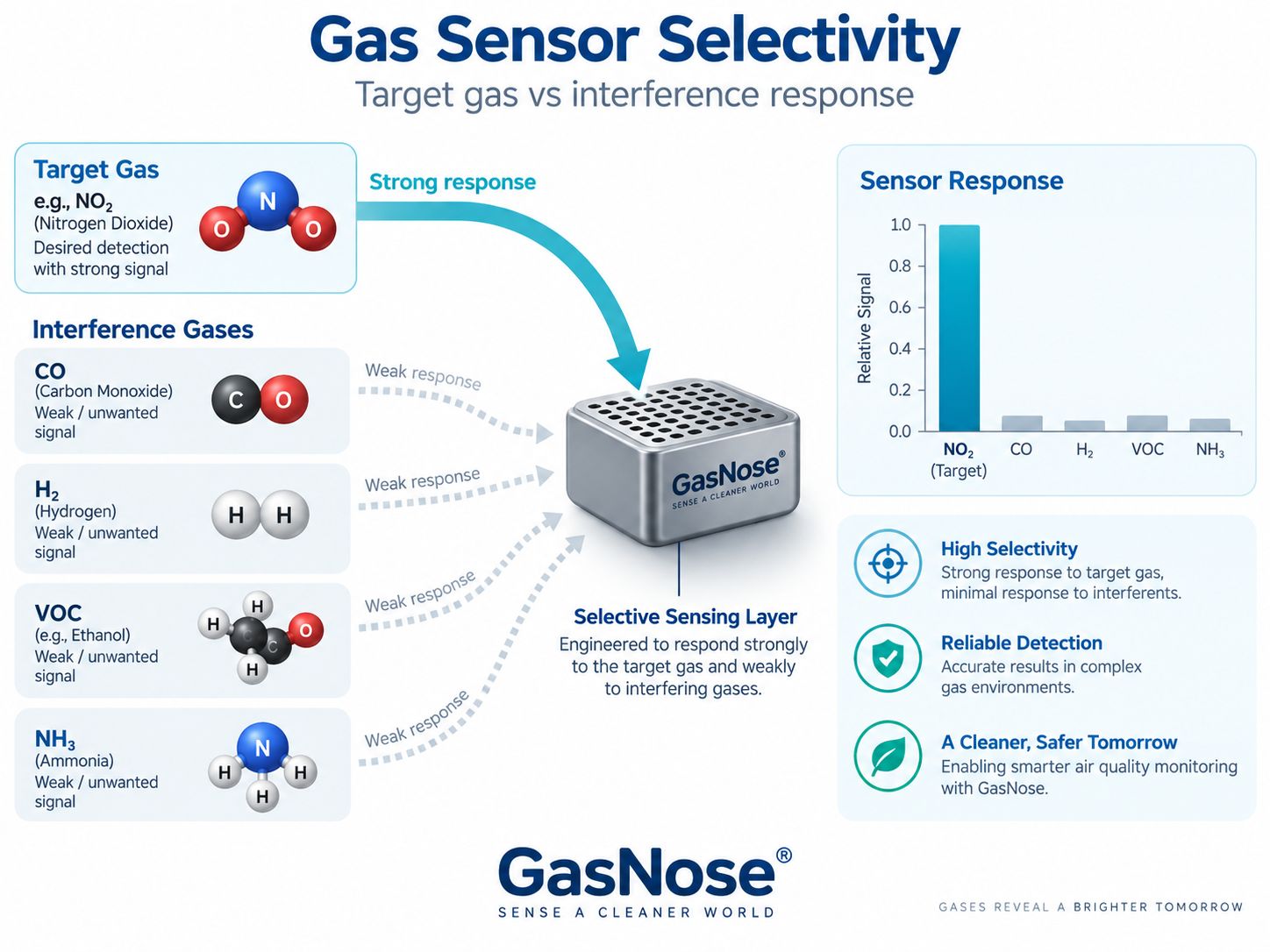
Selectivity describes how effectively a sensor responds to the intended target gas while minimizing response to other gases.
Imagine a sensor designed for:
NO₂
The surrounding atmosphere may also contain:
- CO
- H₂
- NH₃
- VOCs
- humidity
- other reactive gases
A highly selective NO₂ sensor should produce a useful response to NO₂ while limiting unwanted signals from those other components.
In simple terms:
Sensitivity asks whether the sensor can see the gas. Selectivity asks whether it knows which gas it is seeing.
Selectivity Does Not Mean Perfect Specificity
No real-world gas sensor should automatically be assumed to respond only to one molecule.
The degree of selectivity depends on:
- sensing mechanism
- electrode chemistry
- catalyst
- optical wavelength
- filters
- operating temperature
- bias voltage
- environmental conditions
Even sensors sold for a named target gas can have measurable responses to other compounds.
That is why professional gas sensor datasheets often contain a:
cross-sensitivity table
instead of simply saying:
“This sensor only measures CO.”
Selectivity vs Cross-Sensitivity
Selectivity and cross-sensitivity describe two sides of the same practical problem.
Selectivity
The desired characteristic:
How well does the sensor favor the target gas?
Cross-Sensitivity
The unwanted behavior:
How strongly does another gas produce a target-gas-like response?
For example, a CO electrochemical sensor may also respond to hydrogen.
If the instrument interprets all resulting current as CO, hydrogen can create a:
CO-equivalent reading
even when the actual CO concentration has not changed.
The exact magnitude is sensor-specific.
One CO sensor may show substantial hydrogen interference while another may use:
- different electrode chemistry
- filtering
- compensation
to greatly reduce it.
For a detailed explanation, see:
Gas Sensor Cross-Sensitivity Explained
Cross-Sensitivity Is Not Sensor Failure
Suppose a sensor is exposed to an interferent.
The output changes.
The interferent is removed.
The reading returns to normal.
That may simply be the known cross-sensitivity of the sensing chemistry.
It is not necessarily:
- drift
- poisoning
- calibration failure
- hardware damage
This distinction is important when troubleshooting gas detectors.
Persistent changes after exposure may indicate a different problem.
For long-term changes in sensor output, see:
What Is Gas Sensor Drift? Zero Drift, Span Drift & Baseline Drift Explained
Why a Highly Sensitive Sensor Can Still Be a Poor Sensor
Consider a hypothetical sensor that responds strongly to:
- CO
- H₂
- ethanol
- methane
- ammonia
It may have excellent overall chemical sensitivity.
But if the application requires:
accurate CO measurement
the sensor may perform poorly because it cannot determine which compound produced the signal.
This illustrates an important principle:
A large response is valuable only when you understand what caused it.
This is especially important in environments containing complex gas mixtures.
Examples include:
- combustion systems
- wastewater treatment
- battery energy storage
- chemical plants
- indoor air quality
- industrial processes
How Sensitivity Is Typically Evaluated
Sensitivity can be characterized using a concentration-response curve.
Gas concentrations are applied at several known levels:
0 ppm
25 ppm
50 ppm
100 ppm
200 ppm
The corresponding sensor output is recorded.
A linear sensor might produce:
Concentration ↑
Sensor output ↑ proportionally
The slope represents sensitivity.
But real sensors may become nonlinear at:
- very low concentration
- high concentration
- near saturation
Therefore a datasheet sensitivity number should be interpreted together with its:
linear range
For more on this distinction, see:
Gas Sensor Linearity and Linear Range Explained
How Selectivity Is Evaluated
Selectivity usually requires exposing the sensor to multiple gases independently.
For example:
Target gas:
CO: 100 ppmThen interferents:
H₂
H₂S
NO₂
SO₂
ethanol
NH₃
The output caused by each gas can then be compared.
A datasheet might present results as:
Test gas        Sensor equivalent response
CO              target response
H₂              small positive interference
NO₂             negative interference
CH₄             negligible response
The actual values depend on:
- sensor design
- test concentration
- temperature
- humidity
- calibration basis
This is why cross-sensitivity values from one sensor should not be copied to another model.
Sensitivity, Selectivity and Accuracy Are Different
These three terms are frequently confused.
Sensitivity
How much does output change when concentration changes?
Selectivity
How well does the sensor distinguish the target gas from interferents?
Accuracy
How close is the reported concentration to the true concentration?
A sensor can therefore be:
highly sensitive
but:
poorly accurate
if its signal is affected by:
- interference
- calibration error
- drift
- temperature
- humidity
Likewise, a sensor can be highly selective but have insufficient sensitivity for the required concentration range.
For the related distinction between repeatability and accuracy, see:
Gas Sensor Repeatability vs Accuracy: What’s the Difference?
Sensitivity and Selectivity Across Gas Sensor Technologies
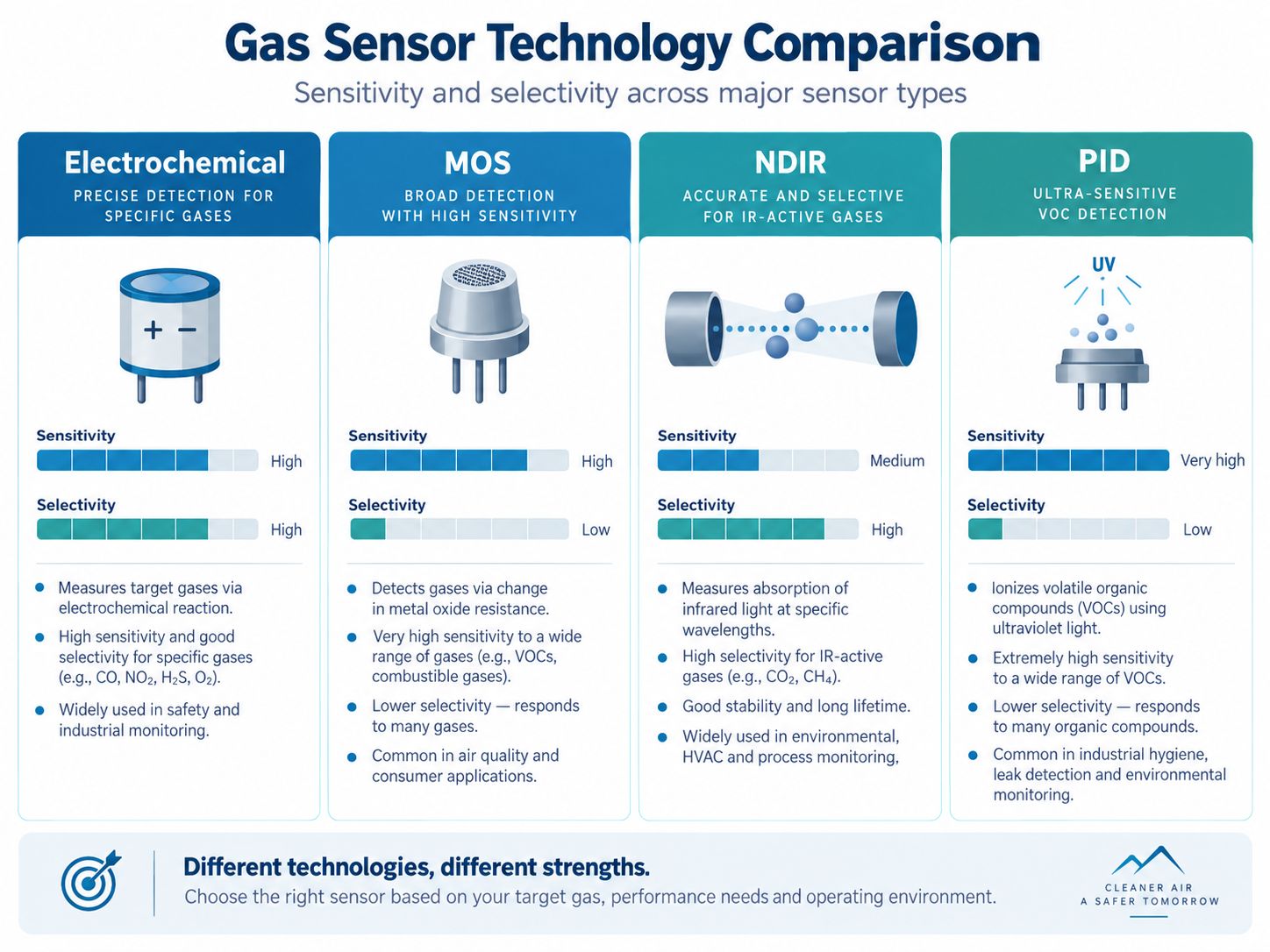
Different sensing technologies achieve sensitivity and selectivity in different ways.
The comparison should be understood as a technology-level overview, not a universal ranking. Individual sensor designs can perform very differently within the same category.
Electrochemical Sensors
Electrochemical sensors are widely used for toxic gas detection.
Typical applications include:
- CO
- H₂S
- NO₂
- SO₂
- Cl₂
- O₃
- NH₃
They can provide very useful ppm-level sensitivity.
Selectivity comes from factors such as:
- electrode catalyst
- operating potential
- electrolyte
- diffusion barrier
- chemical filters
However, electrochemical sensors can still have meaningful cross-sensitivity.
For example, Alphasense markets hydrogen-compensated and low-H₂-cross-sensitivity CO sensors specifically because hydrogen interference can matter in combustion and reformer environments.
The engineering lesson is:
Electrochemical does not automatically mean perfectly gas-specific.
MOS / MOX Sensors
Metal-oxide sensors are often highly responsive to changes in gas composition.
This makes them useful for applications including:
- indoor air quality
- combustible gas detection
- VOC trends
- odor sensing
- electronic noses
But broadband sensitivity can reduce compound-level selectivity.
A typical MOX element may respond to multiple reducing or oxidizing gases.
Sensirion’s technical description of MOX sensing similarly notes that these sensors are broadband-sensitive and cannot inherently determine which individual gas caused a mixed-gas response. ([Sensirion AG][1])
This does not make MOS technology poor.
It means it is often better suited to questions such as:
Has the gas composition changed?
than:
Is this signal definitely 3.4 ppm of one specific VOC?
NDIR Sensors
NDIR sensors use wavelength-specific infrared absorption.
This can provide strong selectivity when the target gas has an appropriate absorption band.
Common NDIR targets include:
- CO₂
- CH₄
- many refrigerants
- hydrocarbons
Selectivity can be improved using:
- optical filters
- multiple wavelengths
- reference channels
- compensation algorithms
However, NDIR selectivity is not unlimited.
Different gases can have overlapping infrared absorption bands.
Water vapor and other background gases may also require compensation depending on the wavelength and application.
So the correct statement is:
NDIR can provide strong molecular selectivity through spectral design, but selectivity still depends on the optical system and gas matrix.
PID Sensors
Photoionization detectors are extremely useful for VOC monitoring.
But their strength is usually:
broad VOC sensitivity
rather than compound identification.
ION Science explains that PIDs respond to many detectable volatile compounds and generally cannot determine the concentration of each individual component in a mixture. Response factors are therefore used to account for differences in sensitivity between compounds. ([Ion Science][2])
So a PID may answer:
Are ionizable VOCs present, and approximately how much response is there?
but usually cannot answer from one signal alone:
Is this benzene, toluene or xylene?
For the practical difference between VOC detection and combustible-gas measurement, see:
PID vs LEL Gas Detector: What’s the Difference?
Sensitivity vs Selectivity in Toxic Gas Detection
Toxic gas monitoring often requires both.
Suppose the application is H₂S worker safety.
The sensor must be sensitive enough to detect relatively low ppm concentrations.
But if it strongly responds to another common site gas, false alarms or incorrect concentration readings may result.
Therefore the real requirement is not:
maximum sensitivity
but:
sufficient sensitivity + acceptable selectivity for the real gas matrix
The words:
real gas matrix
are important.
A sensor performing perfectly in nitrogen and test gas may behave differently in an industrial atmosphere containing:
- humidity
- solvents
- combustion gases
- hydrogen
- reactive contaminants
Sensitivity vs Selectivity in Combustible Gas Detection
Combustible-gas safety has a different measurement objective.
A detector may need to estimate how close an atmosphere is to its:
Lower Explosive Limit
Here the requirement may deliberately favor response to a range of combustible gases rather than perfect selectivity to one molecule.
That is why a broad-response combustible sensor can be desirable in one application and undesirable in another.
For example:
Methane-Specific Process Measurement
Selectivity may be very important.
General Combustible Leak Warning
Broad combustible response may actually be beneficial.
So:
“More selective” is not universally better. The required selectivity depends on what the detector is supposed to protect against.
Sensitivity vs Selectivity in BESS Monitoring
Battery energy storage provides another good example.
An early-warning sensor may need strong sensitivity to:
- electrolyte vapor
- H₂
- CO
- other off-gas markers
But a broadly sensitive sensor can also respond to:
- cleaning chemicals
- adhesives
- environmental VOCs
- maintenance activity
That can increase false-alarm risk.
A BESS system may therefore combine:
- multiple sensing channels
- temperature
- battery data
- smoke / aerosol
- trend analysis
rather than relying on one gas signal.
See:
Gas Detection for Battery Energy Storage Systems: What Gases Should Be Monitored?
How Can Gas Sensor Selectivity Be Improved?
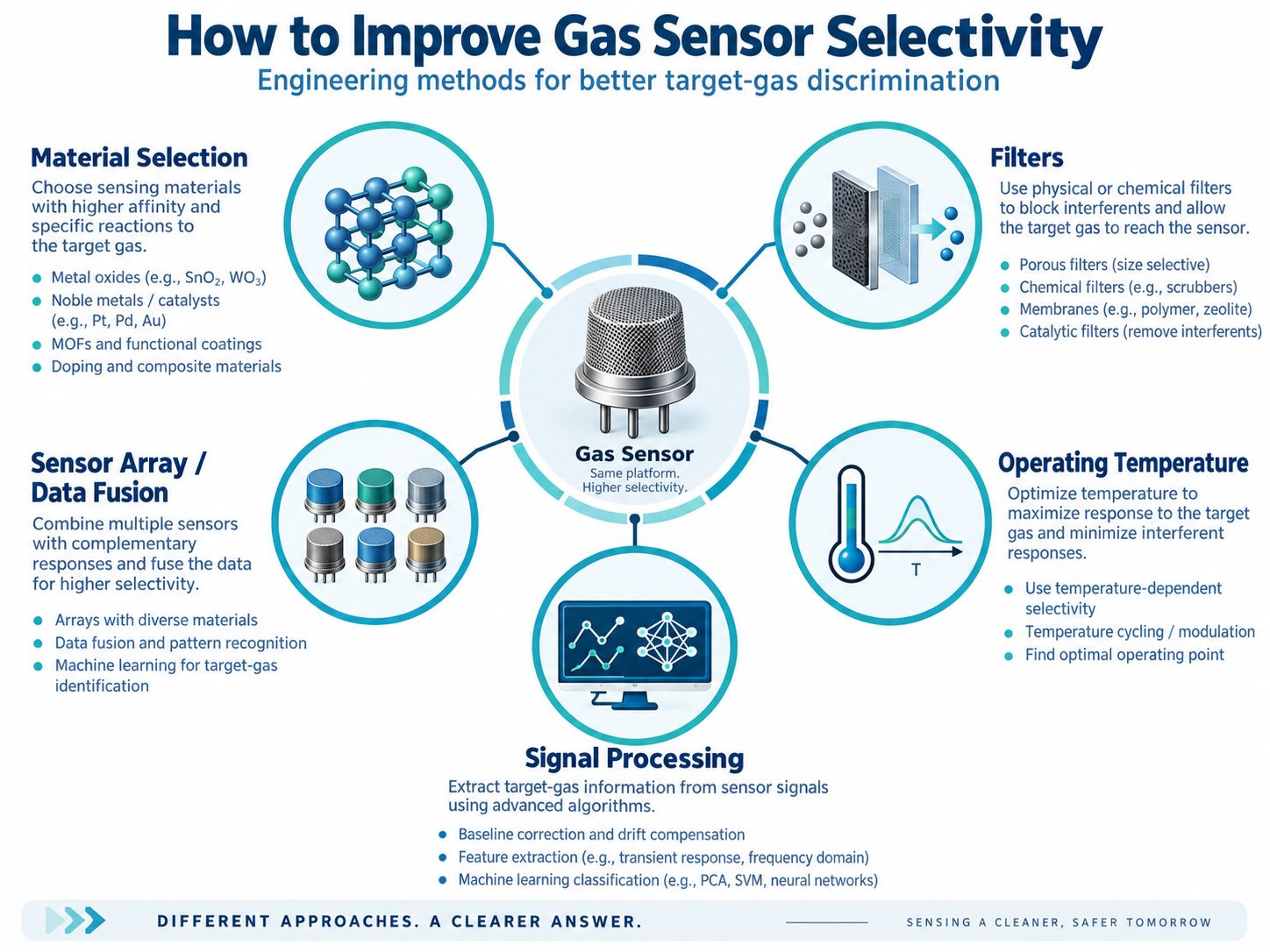
Selectivity does not come from one method alone.
Engineers can improve it at several levels.
1. Sensing Material Selection
Different materials have different affinities and reaction kinetics.
Examples include:
- metal oxides
- noble-metal catalysts
- functional coatings
- composite materials
Material design can increase the relative response to one gas or gas family.
2. Chemical or Physical Filters
A filter may:
- remove interferents
- slow selected molecules
- catalytically consume unwanted gases
- protect the sensing element
For example, filtered electrochemical CO sensors can reduce interference from certain unwanted gases.
But filters create trade-offs.
They can also affect:
- response time
- lifetime
- gas transport
3. Operating Potential
In electrochemical sensing, bias voltage affects which reactions are favored at the working electrode.
Changing bias can therefore alter:
- sensitivity
- selectivity
- response time
- recovery time
This is why electrode potential should not be optimized from sensitivity alone.
4. Operating Temperature
MOS selectivity can change with heater temperature.
Different gases interact with the sensing layer differently at different temperatures.
Engineers may therefore use:
- fixed optimized temperature
- temperature cycling
- temperature modulation
to extract additional gas information.
5. Optical Wavelength Selection
NDIR selectivity depends strongly on:
- target absorption band
- optical filters
- reference wavelength
- spectral overlap
Choosing the right optical channel can greatly improve gas discrimination.
6. Sensor Arrays
Instead of asking one sensor to be perfectly selective, a system can combine several partially selective sensors.
For example:
Sensor A response
+
Sensor B response
+
Sensor C response
+
environmental parameters
The combined response pattern can contain more information than any single channel.
7. Signal Processing
Algorithms can use:
- baseline correction
- temperature compensation
- humidity compensation
- cross-sensitivity compensation
- response ratios
- temporal features
to improve practical discrimination.
8. Machine Learning
Electronic-nose systems may apply algorithms to multi-sensor patterns.
The goal is not necessarily:
make each individual sensor perfectly selective
but:
make the whole sensing system discriminate useful patterns.
This can be powerful, but the model still depends on:
- representative training data
- sensor stability
- environmental coverage
- drift management
AI cannot recover chemical information that was never present in the sensor signals.
Why Filters Do Not Make a Sensor Perfectly Selective
A filter can suppress some interferents.
But filters themselves have limitations.
Their performance can depend on:
- contaminant loading
- humidity
- temperature
- lifetime
- interferent concentration
A chemical filter can also become exhausted.
So a filtered sensor should still be evaluated with:
cross-sensitivity data
rather than simply assuming:
filtered = interference-free.
Sensor Arrays: Sensitivity Without Perfect Individual Selectivity
Electronic noses use a fundamentally different strategy.
Instead of one highly selective sensor, they may use:
multiple broadly sensitive sensors
Each sensor responds differently.
For example:
Gas A → Pattern 1
Gas B → Pattern 2
Gas C → Pattern 3
The system classifies the response pattern.
This is one reason sensitivity and selectivity need to be considered at both:
sensor level
and:
system level
A single MOS element may have poor molecular selectivity while an appropriately designed sensor array may still distinguish useful odor or gas classes.
Sensitivity, Selectivity and Sensor Drift
A sensor’s sensitivity and selectivity are not necessarily constant throughout its entire life.
Aging can change:
- baseline
- sensitivity
- relative response to interferents
Suppose a new sensor has:
Target response = 100 units
Interferent response = 5 units
After aging:
Target response = 70 units
Interferent response = 8 units
The sensor has not merely lost sensitivity.
Its effective discrimination has also changed.
This is one reason calibration history and long-term stability matter.
See:
Sensitivity and Response Time Are Different Too
A highly sensitive sensor does not automatically respond quickly.
One sensor may produce:
a large eventual signal
but require:
60 seconds
to reach that signal.
Another may produce a smaller signal but respond in:
10 seconds
These are different characteristics.
Sensitivity describes:
signal magnitude relative to concentration
Response time describes:
how quickly that signal develops
For T50 and T90 definitions, see:
Gas Sensor Response Time: T50 vs T90 Explained
And for the reverse transition:
Gas Sensor Response Time vs Recovery Time
Sensitivity and Linearity Are Not the Same
A sensor may have high sensitivity over a small concentration range but become nonlinear at higher concentrations.
For example:
0–50 ppmmay produce a clean proportional response.
But above:
200 ppmthe sensor may begin approaching saturation.
Sensitivity measured in the linear region should therefore not automatically be extrapolated across the entire possible concentration range.
See:
Gas Sensor Linearity and Linear Range Explained
How to Read Sensitivity in a Datasheet
When a datasheet states sensitivity, check:
Target Gas
Sensitivity to which gas?
Concentration
At what test concentration?
Temperature and Humidity
Under what environment?
Output Unit
Examples:
- nA/ppm
- mV/ppm
- resistance ratio
Typical vs Minimum
A specification such as:
Typical sensitivity = 70 nA/ppmis different from:
Sensitivity range = 50–90 nA/ppmLinear Range
Does the sensitivity remain valid throughout the full measurement range?
Sensor-to-Sensor Variation
Individual sensor elements may require calibration.
How to Read Selectivity in a Datasheet
Selectivity is often less obvious.
Look for headings such as:
- Cross Sensitivity
- Interference
- Relative Response
- Interfering Gases
- Filter Performance
- Response Factor
Do not just ask:
Does this sensor detect CO?
Ask:
What else can produce a CO-like response?
For a real application, create a list of gases that may be present and compare that list with the manufacturer’s interference data.
The Gas Matrix Matters More Than a Single Datasheet Number
Suppose two CO sensors are available.
Sensor A
Higher CO sensitivity.
But strong H₂ response.
Sensor B
Slightly lower CO sensitivity.
But significantly reduced H₂ response.
For a normal residential alarm, Sensor A might be sufficient.
For:
- fuel-cell systems
- reformers
- hydrogen facilities
- battery applications
Sensor B may be much more useful.
That is why:
The best sensor is the one that performs well in the real gas matrix—not the one with the biggest sensitivity number.
Sensitivity vs Selectivity: Which Is More Important?
Neither has universal priority.
It depends on the question.
Trace Leak Detection
Often prioritizes:
high sensitivity
Toxic Gas Measurement
Usually requires:
both sensitivity and selectivity
Broad VOC Screening
May intentionally accept:
high sensitivity with broad selectivity
Compound Identification
Requires much stronger:
selectivity / analytical separation
Combustible Safety
May favor:
broad useful response across combustible gases
Process Measurement
Often places greater emphasis on:
selectivity + accuracy + stability
So the correct question is not:
Sensitivity or selectivity—which is better?
It is:
How much of each does this application require?
Practical Gas Sensor Selection Workflow
When comparing sensors, use this sequence.
Step 1 — Define the Target Gas
What exactly are you trying to detect?
Step 2 — Define the Required Concentration Range
Is it:
- ppb
- low ppm
- high ppm
- %LEL
- %Vol
Step 3 — Define the Detection Objective
Is the system for:
- early leak detection
- worker safety
- process control
- air quality
- combustible-gas alarm
- gas identification
Step 4 — List Likely Interfering Gases
Do not wait until field testing to discover them.
Step 5 — Compare Sensitivity
Is the target signal large enough at the required concentration?
Step 6 — Compare Cross-Sensitivity
Will another gas create a meaningful error?
Step 7 — Check Environmental Effects
Review:
- temperature
- humidity
- pressure
- contamination
Step 8 — Check Dynamic Performance
Consider:
- response time
- recovery time
Step 9 — Check Long-Term Stability
Consider:
- drift
- sensor aging
- calibration frequency
Step 10 — Evaluate the Complete System
Sometimes the correct solution is not a better individual sensor.
It may be:
sensor + filter
or:
multiple sensors + algorithm
Common Mistakes When Comparing Sensitivity and Selectivity
Mistake 1 — Choosing the Sensor With the Highest Sensitivity
A stronger signal is not useful if it mainly comes from interferents.
Mistake 2 — Assuming the Target-Gas Label Means Perfect Selectivity
A “CO sensor” can still respond to other gases.
Mistake 3 — Ignoring the Cross-Sensitivity Table
This is one of the most useful parts of many electrochemical datasheets.
Mistake 4 — Treating Detection Limit as Sensitivity
They are related, but not identical.
Mistake 5 — Comparing Sensitivity Values With Different Units
A MOS response ratio cannot be directly compared with nA/ppm from an electrochemical sensor.
Mistake 6 — Ignoring Temperature and Humidity
Environmental changes can alter both target and interferent responses.
Mistake 7 — Assuming One Technology Is Always More Selective
Specific sensor design matters more than a simple technology label.
Mistake 8 — Ignoring Sensor Aging
Selectivity can change as sensitivity and baseline drift.
Mistake 9 — Assuming PID Can Identify Individual VOCs
A PID is generally a broad VOC detector rather than a compound-identification instrument.
Mistake 10 — Assuming AI Can Make Any Broad Sensor Selective
Algorithms can improve discrimination only when useful information exists in the sensor data.
Sensitivity and Selectivity Checklist
Before selecting a gas sensor, confirm:
- Target gas
- Required concentration range
- Required detection limit
- Sensitivity specification
- Linear range
- Expected interfering gases
- Cross-sensitivity data
- Temperature range
- Humidity range
- Response time
- Recovery time
- Drift specification
- Calibration requirements
- Expected lifetime
- Filter requirements
- Sensor-to-sensor variation
- Application gas matrix
Frequently Asked Questions
What is gas sensor sensitivity?
Gas sensor sensitivity describes how much the sensor output changes for a given change in gas concentration.
It is often represented by the slope of the concentration-response relationship.
What is gas sensor selectivity?
Selectivity describes how well a sensor responds to the intended target gas while limiting response to other gases.
What is the difference between sensitivity and selectivity?
Sensitivity describes response strength.
Selectivity describes gas discrimination.
A sensor can have high sensitivity but poor selectivity.
Does higher sensitivity mean a better gas sensor?
No.
Sensitivity is only one performance parameter.
A highly sensitive sensor may still have:
- poor selectivity
- high noise
- strong drift
- insufficient range
Is selectivity the same as cross-sensitivity?
Not exactly.
Selectivity is the desired ability to favor the target gas.
Cross-sensitivity is the unwanted response to another gas.
Can one gas sensor detect only one gas?
Very few practical sensor systems are perfectly specific to one molecule under every condition.
The degree of cross-sensitivity depends on the sensing principle and design.
Why do electrochemical sensors have cross-sensitivity?
Other gases may participate in electrochemical reactions at the sensor electrodes and generate current.
Filters, catalysts and bias control can reduce some interference.
Why are MOS sensors often broadly sensitive?
MOS sensors respond to changes in surface chemistry caused by many reducing and oxidizing gases.
Their broad sensitivity is useful for air-quality and electronic-nose applications but limits direct molecular identification.
Are NDIR sensors more selective?
NDIR can provide high selectivity by measuring wavelength-specific infrared absorption.
However, spectral overlap and environmental interference still need to be considered.
Are PID sensors selective?
PIDs are selective in the sense that only compounds with ionization energies below the lamp photon energy can be ionized.
Within that detectable group, however, a PID generally responds to multiple VOCs rather than identifying each one individually.
What is the relationship between sensitivity and detection limit?
Higher sensitivity can help achieve a lower detection limit, but detection limit also depends on:
- noise
- baseline stability
- drift
- resolution
So sensitivity alone does not determine LOD.
Can software improve selectivity?
Yes.
Algorithms can compensate for known interferents or classify patterns from multiple sensors.
But software cannot create chemical information that the sensing system never captured.
Which is more important: sensitivity or selectivity?
It depends on the application.
Trace detection may prioritize sensitivity.
Mixed-gas quantitative measurement may place greater emphasis on selectivity.
Many safety applications require both.
Final Takeaway
Sensitivity and selectivity answer two fundamentally different questions.
Sensitivity:
How strongly does the sensor respond?
Selectivity:
How confidently can that response be attributed to the target gas?
A highly sensitive sensor can still be poor at identifying a specific gas.
A highly selective sensor can still be unsuitable if its signal is too weak at the required concentration.
Reliable gas sensor selection therefore requires more than choosing the largest sensitivity number.
Evaluate:
Sensitivity
Selectivity
Detection Limit
Range
Response
Drift
Environmental Effects
Actual Gas Matrix
The most useful engineering principle is:
A good gas sensor does not merely produce a strong signal. It produces a useful signal for the gas, concentration and environment that actually matter.
