




A PID and an LEL detector can both respond to gases and vapors in an industrial atmosphere, but they are designed to answer different safety questions.
A LEL detector primarily asks:
Is there enough combustible gas or vapor to create a fire or explosion risk?
A PID — Photoionization Detector — primarily asks:
Are ionizable volatile organic compounds present at ppm or ppb concentrations?
That distinction matters because many VOCs can create a worker-exposure problem long before their concentration approaches the lower explosive limit.
A tank may therefore show:
0% or very low %LEL
while a PID simultaneously shows a significant VOC concentration.
Neither instrument is necessarily wrong.
They are simply measuring different hazards.
The most useful rule is:
LEL is primarily about flammability. PID is primarily about ionizable vapor detection at much lower concentrations.
In many refinery, tank-entry, solvent, coating, chemical and spill-response applications, the correct solution is therefore not PID versus LEL.
It is:
PID + LEL
PID vs LEL: Quick Comparison
| Feature | PID | LEL Detector |
|---|---|---|
| Full name | Photoionization Detector | Lower Explosive Limit / Combustible Gas Detector |
| Main question | Are detectable VOCs present? | Is a combustible atmosphere developing? |
| Typical display | ppm / ppb | %LEL |
| Typical targets | VOCs, solvents, aromatics, fuels | Methane, propane, hydrogen and combustible vapors depending on sensor |
| Typical concentration range | Low ppm / ppb to higher ppm depending instrument | Combustible concentrations relative to LEL |
| Methane detection | No with common PID lamps | Yes with suitable combustible technology |
| Benzene / solvent screening | Often useful | May remain near 0% LEL while exposure is already significant |
| Identifies exact compound? | No | No |
| Typical calibration | Often isobutylene | Methane, pentane or other specified combustible gas |
| Main purpose | VOC screening / occupational exposure / leak finding | Fire and explosion prevention |
The two instruments are therefore complementary, not interchangeable.

What Does an LEL Detector Actually Measure?
LEL means:
Lower Explosive Limit
It is the minimum concentration of a combustible gas or vapor in air at which flame propagation can occur under specified conditions.
A portable combustible-gas detector commonly displays the reading as:
%LEL
For example, if a gas has an LEL of 2% by volume:
100% LEL = 2%vol
and, as a simplified proportional example:
10% LEL = 0.2%vol = 2,000 ppm
That is why %LEL and ppm should not be treated as interchangeable units.
For a deeper explanation, see What Is a Safe LEL Level?.
OSHA points out an important limitation of combustible-gas instruments: the LEL of many flammable gases and vapors is several percent by volume — often tens of thousands of ppm.
Those concentrations can be far higher than occupational exposure limits for toxic VOCs.
So:
A low LEL reading does not automatically mean the atmosphere is safe to breathe.
How Does an LEL Sensor Work?
There is no single universal “LEL sensor.”
Two important technologies are commonly used.
Catalytic Bead / Pellistor
A catalytic sensor uses a heated catalyst.
The simplified process is:
Combustible gas + oxygen
↓
Catalytic oxidation
↓
Heat generation
↓
Electrical resistance changes
↓
%LEL measurement
Catalytic sensors are widely used because they can respond to a broad range of combustible gases.
Important limitations include:
- oxygen dependence
- catalyst poisoning
- catalyst inhibition
- differences in response between calibration gas and target gas
Silicones and certain sulfur-containing compounds are among the contaminants that can reduce catalytic-sensor sensitivity.
Infrared LEL Sensor
Infrared combustible sensors use molecular absorption rather than combustion.
This provides several advantages:
- no oxygen required for the sensing mechanism
- no catalyst poisoning
- useful methane and hydrocarbon measurement
- potentially long sensor life
But infrared combustible sensors are not universal.
For example, conventional hydrocarbon IR sensors generally do not detect hydrogen.
This is why the expected combustible gas should be identified before selecting an LEL sensor technology.
For methane specifically, see Catalytic vs NDIR vs TDLAS Methane Sensors.
What Is a PID Gas Detector?
PID stands for:
Photoionization Detector
Instead of measuring combustion, a PID uses high-energy ultraviolet light to ionize certain gas molecules.
The simplified process is:
VOC enters the sensor
↓
UV photons hit the molecule
↓
Electron is removed
↓
Positive ion + electron are produced
↓
Electrical current is measured
↓
PID displays a ppm or ppb-equivalent reading
The amount of current is related to the concentration of compounds that the PID lamp can ionize.
PID sensors are particularly useful for many:
- aromatic hydrocarbons
- solvents
- fuels
- paints
- coatings
- cleaning chemicals
- industrial VOCs
They can often detect these compounds at concentrations far below those required to produce a meaningful %LEL reading.
Why Can a VOC Be Dangerous While the LEL Detector Still Reads Near Zero?

This is probably the most important reason to understand PID technology.
Consider two completely different thresholds:
Occupational Exposure
This may occur at:
ppm or even sub-ppm concentrations
depending on the chemical.
Flammability
The LEL may occur at:
thousands or tens of thousands of ppm
The two thresholds can therefore be orders of magnitude apart.
This means an LEL detector can correctly indicate:
0% or 1% LEL
while workers are already exposed to a VOC concentration that requires attention.
The detector has not failed.
It simply was not designed to answer the toxic-exposure question.
No LEL alarm does not mean no VOC hazard.
Benzene Is a Good Example
Benzene illustrates the difference particularly well.
The NIOSH Pocket Guide lists benzene’s LEL at approximately:
1.2% by volume
which corresponds to roughly:
12,000 ppm
Therefore:
10% LEL ≈ 1,200 ppm
By comparison, OSHA’s benzene limits for covered general-industry operations are:
- 1 ppm — 8-hour TWA
- 5 ppm — 15-minute STEL
NIOSH recommends still lower occupational exposure levels because benzene is a carcinogen.
The difference in scale is obvious:
Occupational concern: around ppm level
versus
Flammability: thousands of ppm
A worker can therefore have a serious benzene exposure issue while the atmosphere remains nowhere near benzene’s LEL.
Official references:
Does That Mean a PID Is a Benzene Analyzer?
No.
That distinction is important.
A general PID can respond strongly to benzene, but it can also respond to other VOCs.
If the atmosphere contains:
- benzene
- toluene
- xylene
- gasoline vapors
- mixed solvents
a general PID reading does not automatically tell you how much of that reading is benzene.
Benzene-specific measurement may require:
- selective filtering
- pre-tubes
- compound-specific PID methods
- detector tubes
- analytical methods
- other dedicated instruments
So PID is extremely useful for VOC screening, but:
PID response is not the same as chemical identification.
What Determines Whether a PID Can Detect a Gas?
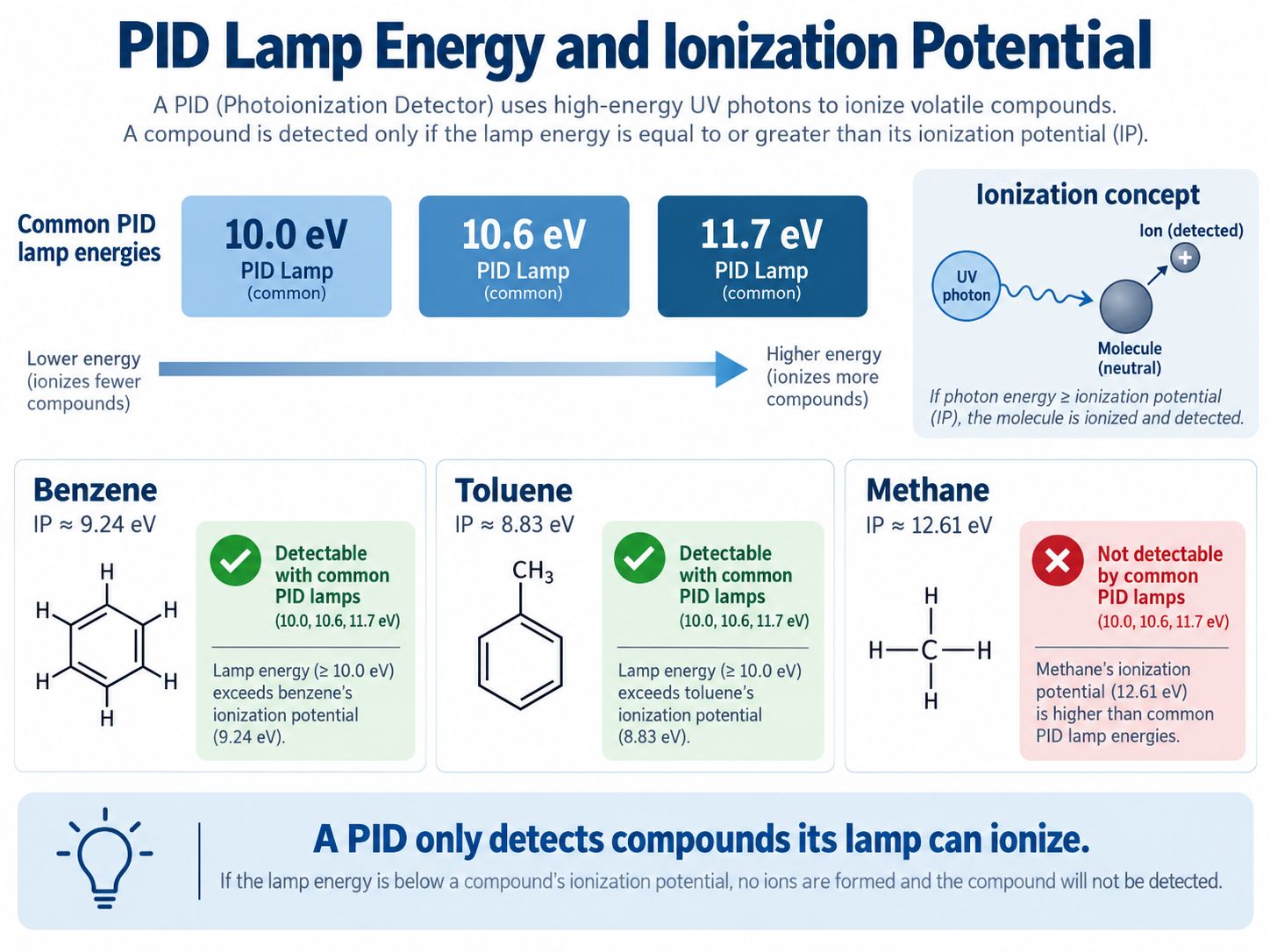
The key concept is:
Ionization Potential / Ionization Energy
A PID can only ionize a compound when the energy of its UV photons is sufficient for that molecule.
Common PID lamp energies include:
- 10.0 eV
- 10.6 eV
- 11.7 eV
A higher-energy lamp can generally ionize more compounds.
But that does not automatically mean it is better.
A lower-energy lamp may provide more selectivity because some higher-ionization-potential compounds will not respond.
Why Can’t a Standard PID Detect Methane?
Methane has an ionization potential above the energy available from common PID lamps.
Therefore common:
10.0 eV
10.6 eV
and even:
11.7 eV
PID configurations are not methane detectors.
This has an important safety consequence.
If you are looking for:
- natural gas
- coal-mine methane
- biomethane
- methane explosion risk
you should not select a PID as the primary methane detector.
Use an appropriate methane or combustible-gas technology such as:
- catalytic
- NDIR
- other methane-specific technology
depending on the measurement task.
PID does not replace an LEL detector for methane safety.
10.0 eV vs 10.6 eV vs 11.7 eV PID Lamps
Different lamp energies provide different detection windows.
| PID Lamp | General Characteristic |
|---|---|
| 10.0 eV | More selective; detects compounds with relatively low ionization potentials |
| 10.6 eV | Common general-purpose VOC lamp |
| 11.7 eV | Can detect additional higher-IP compounds |
The target chemical should determine the lamp.
Not:
Higher eV = automatically better PID
Higher-energy lamps can broaden the range of compounds detected, but that can also reduce selectivity and may involve different maintenance or service-life considerations.
Always check the PID manufacturer’s compound-response table.
Does a PID Tell You Which VOC Is Present?
No.
A standard PID is generally a non-specific detector.
Suppose an instrument displays:
35 ppm
That does not automatically mean:
35 ppm benzene
or:
35 ppm toluene
The sensor may be responding to one VOC or a mixture of several compounds.
This makes PID very useful for questions such as:
- Is VOC contamination present?
- Where is the leak?
- Is concentration increasing?
- Has ventilation reduced vapor concentration?
- Which area has the highest VOC response?
It is less suitable for answering:
What exact chemical is this?
without additional information or analytical methods.
What Is a PID Response Factor?
Different VOCs produce different PID responses at the same actual concentration.
A PID is therefore commonly calibrated using a reference gas such as:
isobutylene
The instrument manufacturer then provides response factors or correction factors for other compounds.
For example, the same actual concentration of:
- benzene
- toluene
- acetone
- hexane
may not produce exactly the same PID indication.
This is one reason you should not use a universal response-factor equation copied from another manufacturer.
Different manufacturers may define their factors differently.
The correct approach is:
Use the response-factor convention and table supplied for the actual PID instrument and lamp.
When Should You Use an LEL Detector?
An LEL detector should be a primary consideration when the hazard is:
Methane / Natural Gas
For:
- natural gas leaks
- underground methane
- landfill methane
- biogas safety
LPG
Including:
- propane
- butane
Hydrogen
With a sensor technology specifically capable of detecting H₂.
Hydrocarbon Fire and Explosion Risk
Examples:
- refinery operations
- fuel storage
- tanks
- chemical processes
- confined spaces
The main question is:
Could the atmosphere ignite?
When Should You Use a PID?
PID becomes particularly useful when the question is:
Are VOCs present at concentrations much lower than their flammable range?
Typical applications include:
Tank Cleaning
Residual:
- fuels
- solvents
- coatings
- petrochemicals
may create VOC exposure even when the LEL reading is low.
Painting and Coating
Processes can release:
- aromatic hydrocarbons
- solvents
- thinners
- other VOCs
Refinery and Petrochemical Maintenance
PID can help screen:
- hydrocarbon vapors
- solvent contamination
- VOC leaks
Fuel and Chemical Spills
A PID can help locate:
- contamination zones
- concentration gradients
- leak sources
Industrial Hygiene Surveys
PID can provide rapid screening before more specific sampling or laboratory analysis.
HazMat Response
PID is useful when VOC contamination is suspected, provided the compounds are within the lamp’s detection capability.
When Do You Need Both PID and LEL?
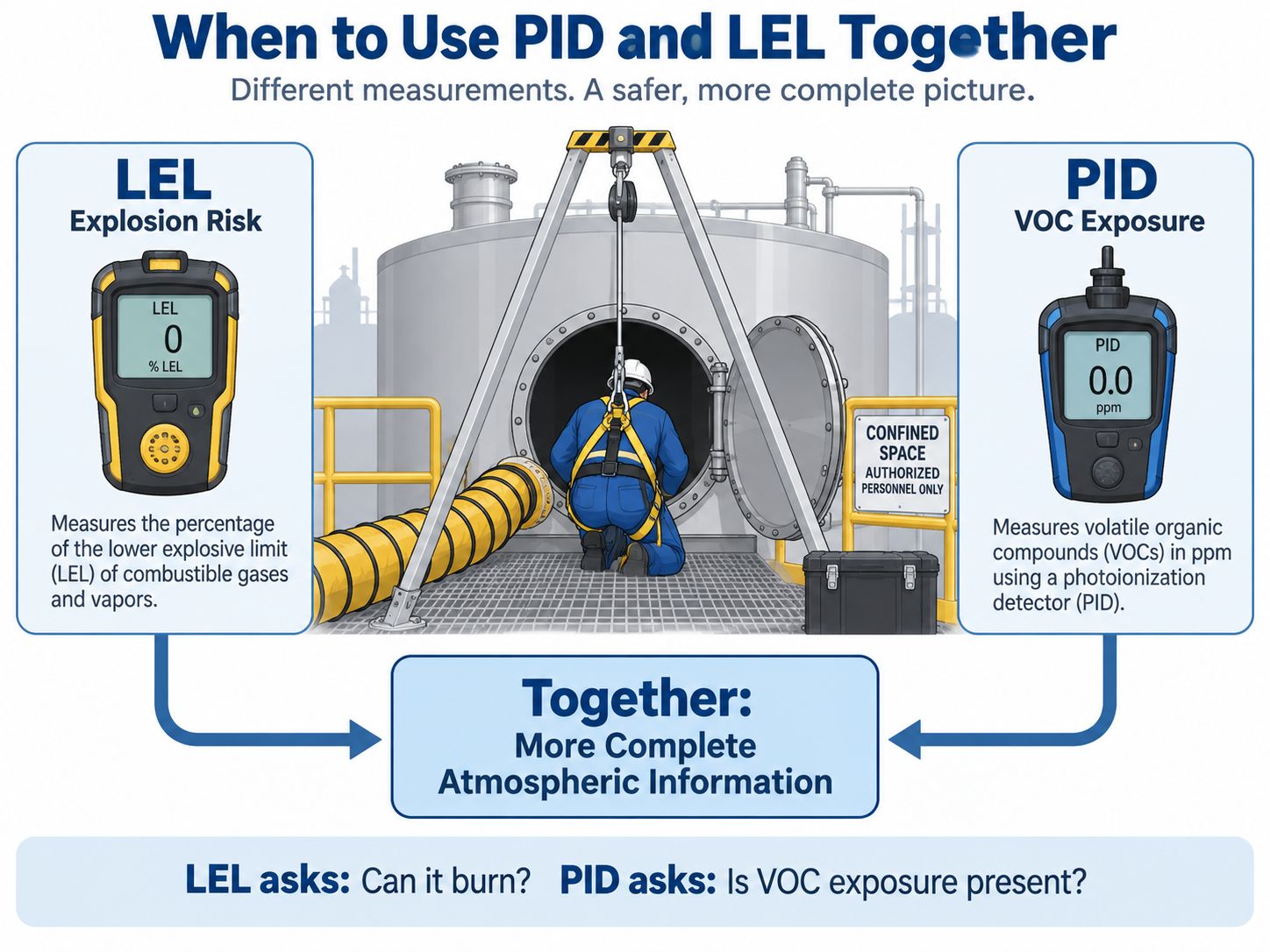
Many real industrial applications involve both:
toxicity
and
flammability
This is where PID and LEL channels work especially well together.
Tank Entry
LEL asks:
Is the atmosphere approaching a combustible range?
PID asks:
Are detectable solvent or hydrocarbon vapors present at lower concentrations?
Refinery Turnaround
LEL:
fire / explosion risk
PID:
VOC exposure and leak screening
Solvent Cleaning
LEL:
flammability
PID:
worker vapor exposure
Fuel Spill
LEL:
combustible zone
PID:
VOC concentration and plume tracking
Using both sensors gives a more complete picture because the two channels measure different parts of the risk.
PID + LEL in Confined Spaces
A standard four-gas monitor commonly contains:
- O₂
- LEL
- H₂S
- CO
That configuration is useful for many confined spaces.
But consider a tank that previously contained:
- benzene-containing product
- solvents
- paint
- gasoline
- aromatic hydrocarbons
The four standard channels may not adequately characterize low-level VOC exposure.
A PID may therefore need to be added.
For the complete atmospheric testing process, see Confined Space Gas Monitoring: What Gases Should You Test Before Entry?.
This is also a good example of why detector selection should begin with the process rather than simply asking for a “4-gas” or “5-gas” instrument.
See How to Choose Gases for a Multi-Gas Detector.
Can a PID Replace an LEL Detector?
In general:
No.
A PID can provide valuable concentration information for many combustible VOCs, and if the compound is known, its PID response and flammability characteristics can sometimes support additional interpretation.
But that does not make PID a universal combustible-gas detector.
Important limitations include:
- methane is not detected by common PID lamps
- not every combustible compound can be ionized
- mixtures complicate interpretation
- response factors vary
- flammability measurement and VOC screening serve different purposes
For general explosion protection:
Use an appropriate combustible-gas detector.
Use PID when ionizable VOC measurement provides additional information.
Can an LEL Detector Detect Benzene and Other VOCs?
A combustible sensor may respond to benzene and many other combustible organic vapors.
But that does not make it an appropriate low-level benzene exposure monitor.
Remember the concentration difference:
Benzene OSHA TWA PEL: 1 ppm
versus:
Benzene LEL: approximately 12,000 ppm
An LEL sensor is fundamentally operating in a different risk range.
So:
Response to a VOC does not mean sufficient sensitivity for occupational exposure monitoring.
Why Can Some LEL Sensors Struggle With Heavy Hydrocarbon Vapors?
Another selection issue is that combustible sensors do not respond equally to every compound.
Response can depend on:
- calibration gas
- molecular size
- diffusion
- sensor design
- vapor properties
- catalytic activity
OSHA specifically warns that some combustible-gas indicators may provide poor sensitivity to certain higher-boiling or high-flash-point fuels and vapors.
Examples can include:
- diesel fuel
- jet fuel
- some heavier hydrocarbons
PID can sometimes provide much more useful low-level vapor screening in these environments.
That does not mean PID replaces fire/explosion monitoring.
It means the atmosphere may require more than one measurement principle.
Important PID Limitations
PID is powerful, but it is not a universal gas detector.
It Does Not Detect Every Gas
Common PID lamps do not detect gases such as methane.
It Does Not Identify the Compound
A general PID reports a combined ionizable-vapor response.
Response Factors Matter
Different chemicals generate different responses.
Humidity Can Matter
Instrument design and compensation influence humidity performance.
Lamp and Window Contamination Matter
Oil, dust and contamination can reduce UV transmission and sensor response.
Mixed VOCs Are Harder to Interpret
A single ppm value may represent several compounds.
Compound-Specific Exposure Assessment May Need Additional Methods
For regulatory exposure monitoring, a PID screening value may not replace a compound-specific sampling or analytical method.
Important LEL Detector Limitations
LEL detectors also have limitations.
Catalytic Sensors Need Oxygen
Very low oxygen can reduce combustible-gas response.
Catalytic Sensors Can Be Poisoned
Silicones and other contaminants can permanently reduce sensitivity.
Calibration Gas Matters
A detector calibrated with methane may respond differently to pentane, propane or other vapors.
IR Does Not Detect Every Combustible Gas
Conventional hydrocarbon IR sensors generally do not detect hydrogen.
Very Rich Gas Atmospheres Can Be Misleading
A combustible concentration above the upper flammable range does not make an uncontrolled atmosphere safe.
Sensor behavior can also change at very high concentrations.
Always follow the instrument’s over-range procedures.
PID vs LEL by Application
| Application | LEL | PID | Both |
|---|---|---|---|
| Natural gas leak | ✓ | ||
| Methane explosion safety | ✓ | ||
| Hydrogen combustible hazard | ✓* | ||
| General VOC leak survey | ✓ | ||
| Solvent exposure | ✓ | ||
| Benzene screening | ✓** | ||
| Paint / coating VOC survey | ✓ | ||
| Solvent tank entry | ✓ | ||
| Refinery turnaround | ✓ | ||
| Fuel spill | ✓ | ||
| Petrochemical tank cleaning | ✓ | ||
| Unknown combustible + VOC atmosphere | ✓ |
* Use combustible technology suitable for hydrogen.
** A general PID responds to benzene but is not automatically benzene-specific. Selective measurement may require additional methods.
How to Choose PID vs LEL
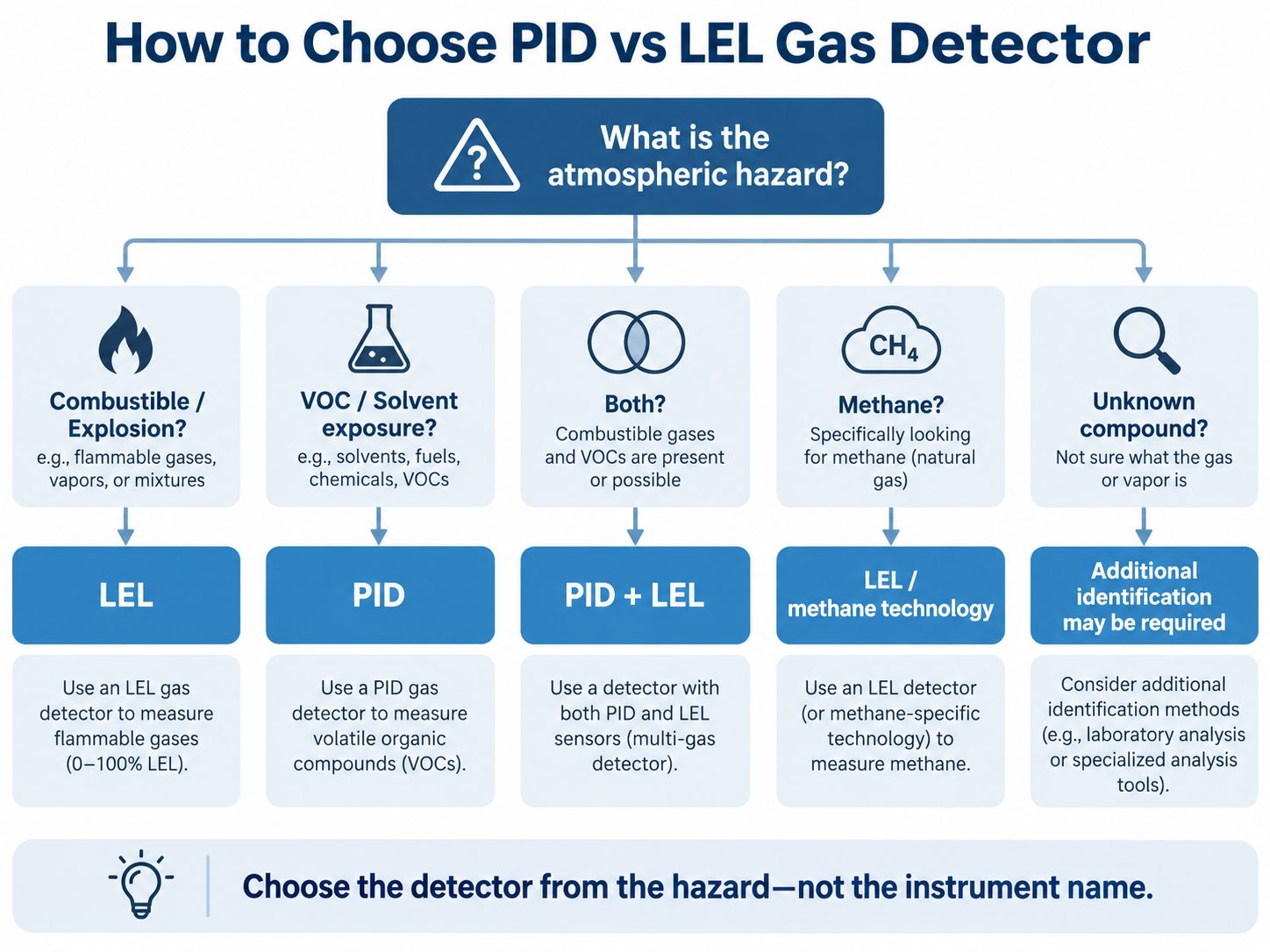
Start with the hazard.
Is the Primary Concern Fire or Explosion?
Consider:
LEL detector
Is the Primary Concern VOC or Solvent Exposure?
Consider:
PID
Are Both Flammability and VOC Exposure Possible?
Consider:
PID + LEL
Is Methane the Main Target?
Use:
appropriate methane / LEL technology
not a standard PID.
Is the Compound Unknown?
PID can indicate that detectable ionizable vapors are present.
LEL can indicate combustible risk.
But neither instrument necessarily identifies the compound.
Additional:
- detector tubes
- spectroscopy
- chromatography
- compound-specific sensors
- laboratory sampling
may be required.
The most important selection rule is:
Choose the detector from the hazard—not the instrument name.
PID vs LEL Selection Checklist
Before selecting an instrument, confirm:
- What chemicals can realistically be present?
- Have SDS documents been reviewed?
- Is the concern toxicity, flammability, or both?
- What concentration range matters?
- Is methane possible?
- Is hydrogen possible?
- Are VOCs present?
- Is the exact chemical known?
- Can the PID lamp ionize the target compound?
- Is the correct PID response factor available?
- Is the combustible calibration gas appropriate?
- Could oxygen become deficient?
- Could catalyst poisons be present?
- Are humidity or condensation significant?
- Is compound-specific exposure monitoring required?
- Is bump testing and calibration planned?
Frequently Asked Questions
What is the main difference between PID and LEL?
An LEL detector primarily measures combustible-gas concentration relative to the lower explosive limit.
A PID measures many ionizable VOCs at ppm or ppb concentrations.
LEL mainly addresses fire and explosion risk; PID is particularly useful for lower-level VOC detection and exposure screening.
Can a PID measure LEL?
A PID can measure concentrations of some combustible VOCs, but it is not a universal LEL detector.
You must know the compound, PID response, lamp capability and flammability characteristics before making any such interpretation.
Can a PID detect methane?
No, common PID lamps do not have enough photon energy to ionize methane.
Use a suitable catalytic, infrared or other methane-specific sensor.
Why can a VOC be dangerous at 0% LEL?
Because occupational exposure limits can be far below flammable concentrations.
An LEL instrument may therefore show little or no response while a toxic VOC is already present at an occupationally significant concentration.
Can an LEL detector detect benzene?
A combustible detector may respond to benzene, but it is generally not sensitive enough to assess low-level occupational benzene exposure.
Benzene’s LEL is roughly 12,000 ppm, while OSHA’s covered general-industry 8-hour PEL is 1 ppm.
Does a PID identify the gas?
No.
A standard PID responds to many ionizable compounds and normally cannot identify which chemical produced the signal.
What does a PID ppm reading mean?
The reading represents the PID response according to its calibration and target-compound response.
If the instrument is calibrated to isobutylene, another VOC may require the manufacturer’s response factor for quantitative interpretation.
Why is isobutylene commonly used for PID calibration?
It is stable, practical for calibration and produces a useful response with common PID lamps. Manufacturers then publish response factors for other detectable compounds.
Does a higher-energy PID lamp always work better?
No.
Higher lamp energy allows more compounds to be ionized, while lower-energy lamps can provide useful selectivity.
Choose the lamp from the target compounds.
Should I use PID or LEL for tank entry?
It depends on the tank contents.
If both combustible vapors and low-level VOC exposure are credible, using both LEL and PID channels can provide much more complete atmospheric information.
Do refineries need PID and LEL?
Many refinery and petrochemical tasks can benefit from both because hydrocarbons may present both flammability and occupational-exposure hazards.
The exact detector configuration should follow the task-specific hazard assessment.
Can a standard four-gas monitor detect VOCs?
A standard O₂ + LEL + H₂S + CO monitor does not contain a PID.
Its LEL sensor may respond to combustible VOCs, but that does not provide the same low-level VOC information as a PID.
Final Takeaway
PID and LEL detectors should not be treated as two competing technologies designed to do the same job.
They answer two fundamentally different questions.
LEL asks:
Can this atmosphere burn or explode?
PID asks:
Are detectable ionizable VOCs present at potentially significant concentrations?
That distinction becomes critical with substances such as benzene and many industrial solvents, where occupational exposure can become important at concentrations far below the lower explosive limit.
Therefore:
Combustible-gas hazard → LEL
VOC exposure / screening → PID
Both hazards → PID + LEL
And if the target is methane:
do not rely on a standard PID.
The most useful rule is:
Measure the hazard you actually need to control—not simply the gas category printed on the detector brochure.
References and Further Reading
- OSHA Technical Manual — Direct-Reading Instruments
- OSHA — Benzene Standard, 29 CFR 1910.1028
- NIOSH — Benzene
- ION Science — PID Sensor Product Guide
- Dräger — PID Sensor Technology
- GasNose — What Is a Safe LEL Level?
- GasNose — Confined Space Gas Monitoring
- GasNose — What Does a 4-Gas Monitor Detect?
- GasNose — Multi-Gas Detector Gas Selection
- GasNose — Catalytic vs NDIR vs TDLAS Methane Sensors
