



Humidity can change a gas sensor’s baseline, sensitivity, response time, recovery behavior and long-term stability.
But the phrase “humidity effect” can describe several different situations:
- a rapid change in relative humidity that creates a temporary baseline transient
- prolonged exposure to very dry or very humid air
- water vapor interacting with a sensing surface
- humidity changing the sample matrix
- liquid water condensing on a sensor, membrane, optical surface or sampling line
These should not be treated as one failure mode.
The most useful starting point is:
High relative humidity, a rapid humidity change and liquid-water condensation are three different environmental conditions.
A sensor may operate normally at 90% RH when the atmosphere is non-condensing, yet behave very differently if its surface falls below the dew point and liquid water forms.
Humidity effects are also strongly technology-specific. An electrochemical toxic-gas cell, an MOS sensor, a PID and an NDIR module do not interact with water vapor in the same way.
Relative Humidity Is Not the Same as Water Content
Relative humidity is usually expressed as:
%RH
It describes how close the air is to saturation at the current temperature.
Therefore:
50% RH at 5°C
does not contain the same amount of water vapor as:
50% RH at 35°C
Warm air can hold much more water vapor before becoming saturated.
This is why environmental compensation often needs both:
Temperature + Relative Humidity
rather than RH alone.
Depending on the application, engineers may also use:
- absolute humidity
- water-vapor concentration
- dew point
This is closely connected to temperature dependence. See How Temperature Affects Gas Sensor Readings.
What Can Humidity Change in a Gas Sensor?
| Humidity Condition | Possible Effect |
|---|---|
| Rapid RH change | Temporary zero / baseline spike |
| Prolonged low RH | Electrolyte water loss or long-term sensitivity change in some sensors |
| Prolonged high RH | Water uptake, material or surface-chemistry changes |
| MOS surface humidity | Baseline resistance and target-gas response may change |
| PID humidity | False-low response or, in some contaminated designs, false-high response |
| Condensation | Blocked gas diffusion, leakage paths, optical contamination or unstable readings |
| Calibration humidity mismatch | Field readings may differ from dry calibration behavior |
| Humidity + temperature interaction | Compensation can become inaccurate if only one variable is considered |
The key point is:
Humidity can affect both the sensing element and the way gas reaches the sensing element.
Humidity Transient vs Long-Term Humidity Exposure
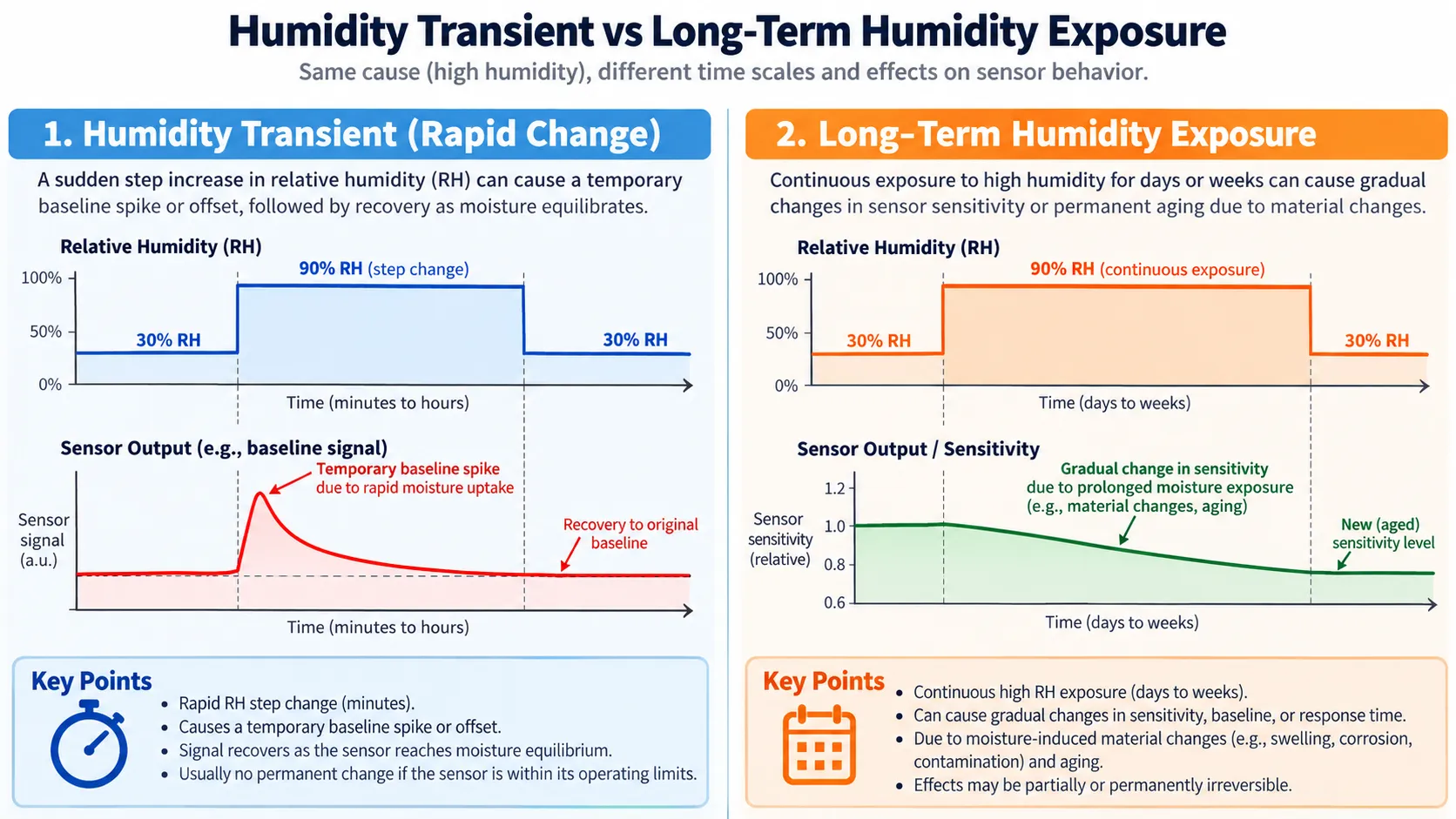
A sudden humidity step and several weeks at extreme humidity are not the same test.
Short-Term Humidity Transient
Imagine the surrounding air changes from:
30% RH
to:
80% RH
within a short time.
Some sensors can show:
RH step
↓
temporary baseline disturbance
↓
apparent gas reading
↓
gradual return toward baseline
SPEC Sensors documents this behavior for electrochemical sensors. Its AN-104 application note states that rapid RH changes can produce a baseline spike, while the immediate effect on span sensitivity is typically much smaller.
See: SPEC Sensors AN-104 — Environmental Effects
Alphasense likewise states that humidity transients can create current spikes in toxic-gas sensors and notes that they typically decay on a minutes-scale.
See: Alphasense AAN 110 — Environmental Changes
Long-Term Humidity Exposure
Now consider a sensor that operates for:
days
weeks
months
in a persistently dry or humid environment.
That can affect:
- electrolyte water balance
- sensing-material condition
- baseline
- sensitivity
- recovery
- long-term stability
So:
A humidity transient is mainly a short-term measurement problem. Prolonged extreme humidity can become a material, sensitivity and lifetime problem.
See Gas Sensor Lifetime: What Determines Sensor End of Life?.
How Humidity Affects Electrochemical Gas Sensors
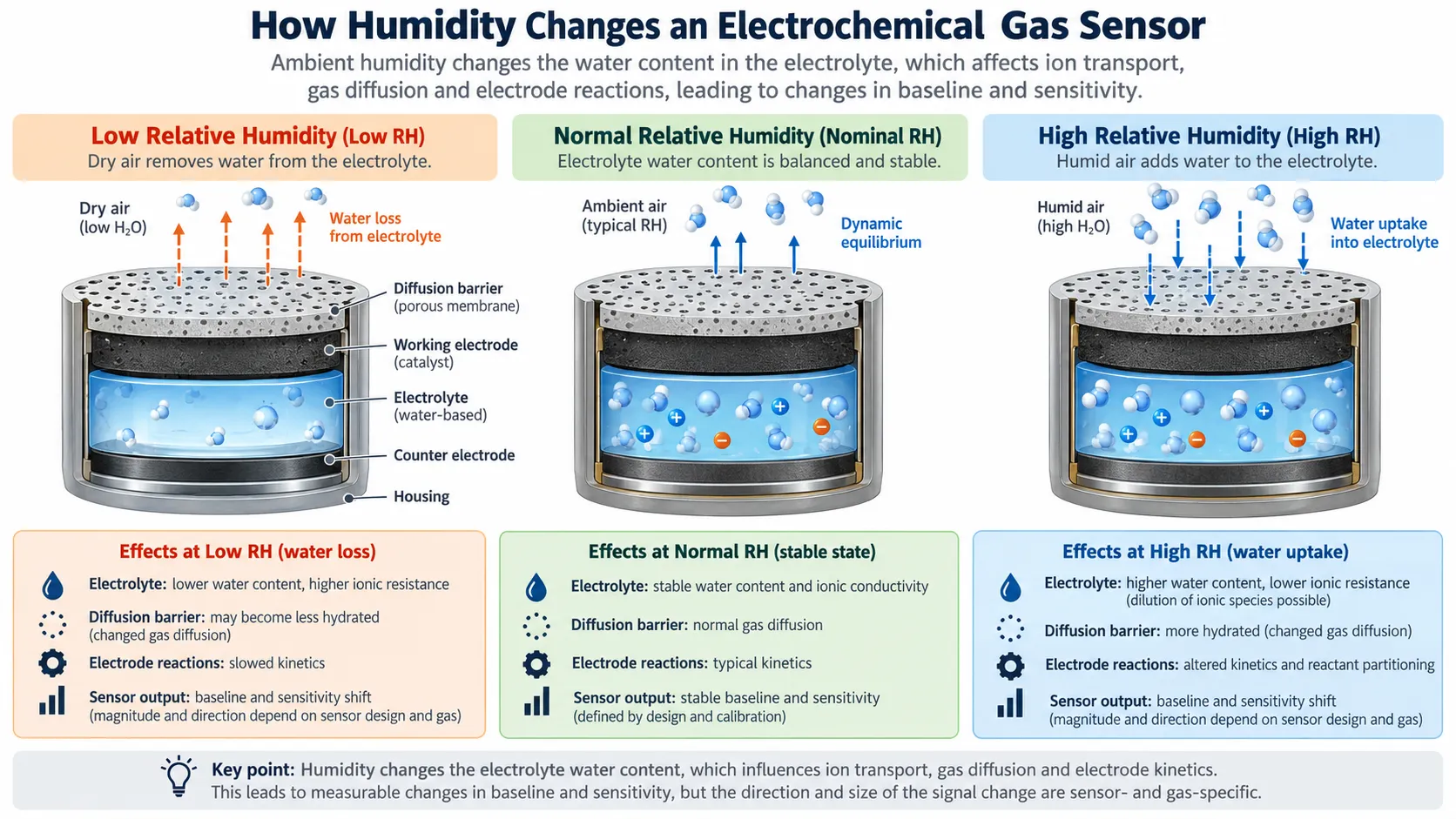
Note: The illustration is conceptual. Actual signal direction and magnitude are sensor- and gas-specific.
Electrochemical toxic-gas sensors commonly contain:
Gas diffusion barrier
↓
Working electrode
↓
Electrolyte
↓
Counter / reference electrodes
Humidity matters because many electrochemical cells use an aqueous electrolyte.
Alphasense explains that the diffusion barrier not only controls target-gas flux but also affects how quickly electrolyte absorbs or loses water.
See: Alphasense AAN 104 — How Electrochemical Toxic Gas Sensors Work
Rapid RH Changes Can Create False Gas Readings
Suppose the true target-gas concentration is:
0 ppm
but humidity changes rapidly.
The sensor may generate a temporary current:
0 ppm target gas
+
rapid RH change
↓
temporary current transient
↓
apparent gas concentration
This can look like:
- zero drift
- cross-sensitivity
- a real gas event
even though no target gas was introduced.
SPEC Sensors reports that a rapid RH increase often produces one direction of zero-current spike and an RH decrease can produce the opposite direction, with the exact magnitude and width depending on the sensor and conditions.
That is why environmental history is important when troubleshooting unexpected low-level readings.
Humidity Transient Is Not the Same as Drift
A short RH-induced spike is not necessarily long-term drift.
A useful distinction is:
Humidity transient:
minutes-scale response to changing RH
versus:
Drift:
persistent change over time under comparable conditions
If a reading shifts after:
- opening a cold-room door
- moving an instrument outdoors
- entering a humid process area
- switching sample streams
check humidity and temperature before concluding that the sensor has aged.
See What Is Gas Sensor Drift? Zero Drift, Span Drift & Baseline Drift Explained.
Why Electrochemical Electrolyte Changes With Humidity
For an aqueous electrochemical sensor, the electrolyte exists in equilibrium with the surrounding environment.
Prolonged Low Humidity
Very dry conditions can encourage water loss from the sensor.
Conceptually:
Low RH
↓
electrolyte loses water
↓
electrolyte concentration / volume changes
↓
ion transport and sensor characteristics can change
Prolonged High Humidity
A humid environment can drive water uptake.
Conceptually:
High RH
↓
electrolyte gains water
↓
electrolyte concentration / volume changes
↓
sensor behavior can change
The actual result is not simply:
low RH = lower reading
high RH = higher reading
Different gas cells respond differently.
The effect depends on:
- electrolyte formulation
- target gas
- diffusion barrier
- sensor geometry
- duration
- temperature
So:
There is no universal humidity coefficient for all electrochemical gas sensors.
Low Humidity Can Be a Serious Long-Term Condition
High humidity gets more attention, but prolonged low humidity can also matter.
Very dry air can gradually remove water from an electrochemical electrolyte.
Possible consequences include:
- altered sensitivity
- slower response
- higher internal resistance
- reduced long-term stability
This is especially relevant in:
- desert climates
- heated indoor spaces
- dry industrial process gas
- conditioned sample streams
The correct engineering approach is model-specific validation rather than assuming all toxic-gas sensors behave alike.
High Humidity Does Not Affect Every Electrochemical Sensor the Same Way
Long-term humid exposure can also change sensor characteristics.
Depending on the sensor, prolonged high RH may produce:
- little measurable sensitivity change
- increased response
- reduced response
- altered baseline
- slow recovery after returning to nominal conditions
Therefore:
Humidity response is gas- and sensor-model-specific.
Humidity Can Affect Response and Recovery Time
Humidity may influence more than the final steady reading.
It can also change:
- T50
- T90
- recovery time
- memory effects
The mechanism depends on technology.
For electrochemical sensors, changes in electrolyte and diffusion behavior can affect response dynamics.
For MOS sensors, adsorption/desorption competition can change both rise and recovery.
For VOC systems, water interaction with sampling lines or sensing surfaces can also alter recovery.
So:
T90 measured at 50% RH
should not automatically be assumed identical at:
95% RH
unless the manufacturer has characterized that condition.
See:
How Humidity Affects MOS / Semiconductor Gas Sensors
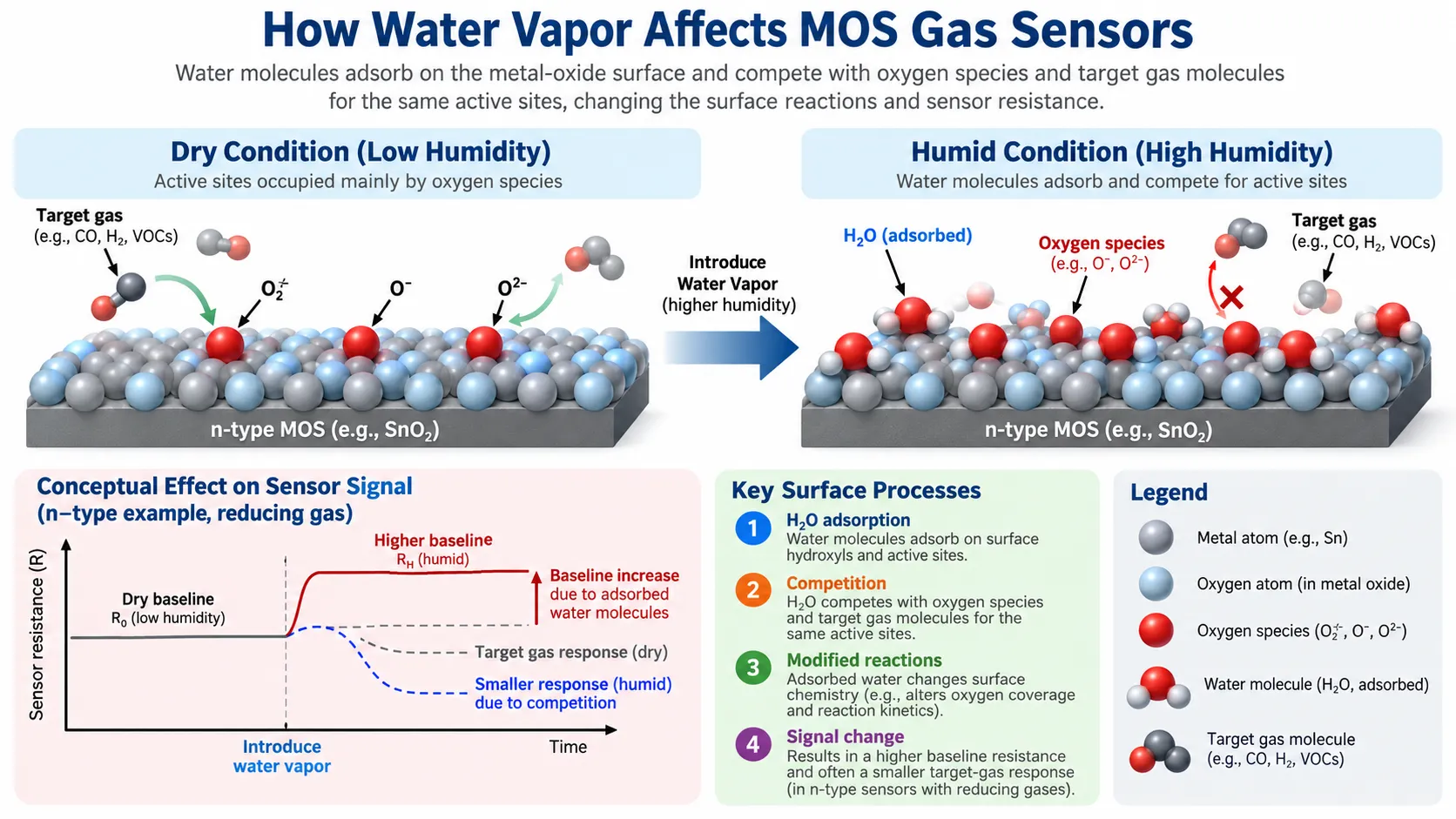
Note: The figure illustrates an n-type MOS / reducing-gas example. The actual response direction depends on material, target gas and operating temperature.
MOS gas sensing depends on chemical interactions at a heated metal-oxide surface.
The sensing layer can involve:
- oxygen adsorption
- target-gas adsorption
- charge transfer
- surface reaction
- desorption
Water molecules can also adsorb on that surface.
Therefore humidity can change:
- baseline resistance
- oxygen coverage
- target-gas adsorption
- reaction kinetics
- sensitivity
Water Vapor Can Compete for Surface Sites
A simplified MOS model is:
Drier condition
oxygen species occupy surface
+
target gas reaches active sites
↓
surface reaction
↓
resistance change
More humid condition
H₂O adsorbs on surface
↓
surface chemistry changes
↓
target gas / oxygen interactions change
↓
sensor resistance and gas response change
For an n-type MOS sensor exposed to a reducing gas, humidity may reduce target-gas response in some designs.
In other sensors or operating conditions, the trend can differ.
Therefore:
Water adsorption is a mechanism. “Humidity always decreases MOS response” is not a universal rule.
For MOS fundamentals, see Semiconductor Gas Sensors.
MOS Baseline Can Shift Even Without Target Gas
Suppose:
Target gas = 0 ppm
but RH changes.
The baseline resistance can change:
RH changes
↓
surface water coverage changes
↓
Rs changes
If the algorithm assumes all resistance change comes from target gas, the instrument may report an apparent concentration change.
This is especially relevant to:
- indoor-air-quality sensors
- low-cost VOC sensors
- electronic noses
- machine-learning gas classifiers
because humidity can become a strong confounding variable.
Humidity Matters in Electronic-Nose Systems
An electronic nose often uses a pattern of several partially selective sensors rather than one highly selective channel.
If humidity changes, the entire feature vector can shift.
That can make the same odor appear different to a classifier.
Good e-nose development therefore often requires:
- RH-balanced training data
- environmental features
- humidity compensation
- matched reference and sample streams
A machine-learning model can compensate for humidity only if the training data represent the real environmental range.
How Humidity Affects PID VOC Sensors
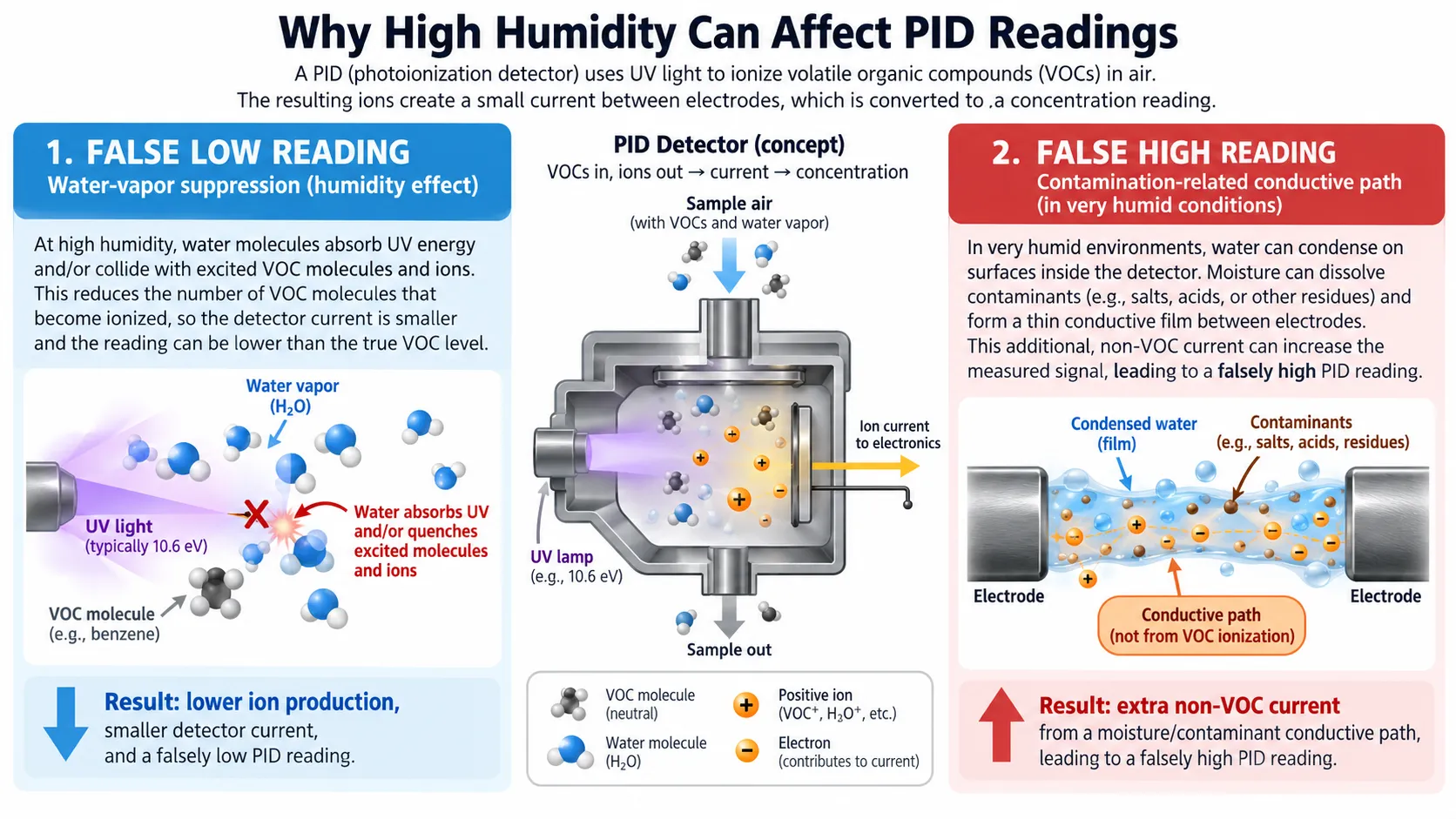
Traditional photoionization detectors can show both false-low and false-high humidity behavior.
ION Science documents both mechanisms.
See: ION Science — What Is Humidity and Can It Affect PID Results?
PID False-Low Reading at High Humidity
A PID uses UV photons to ionize VOC molecules.
Conceptually:
VOC
+
UV photon
↓
ions / electrons
↓
electrical current
↓
VOC reading
ION Science explains that water vapor can reduce the measured PID signal at high humidity, producing a lower reading than the true VOC concentration.
So:
actual VOC present
+
high humidity
↓
smaller PID response
↓
false-low VOC reading
The exact magnitude depends on:
- PID design
- lamp
- VOC
- humidity
- contamination
- instrument compensation
PID False-High Reading in Humid, Contaminated Conditions
High humidity can also create the opposite problem in some conventional PID designs.
If contamination accumulates between electrodes, moisture can create an unwanted conductive path.
Conceptually:
High humidity
+
electrode contamination
↓
conductive leakage path
↓
extra current
↓
false-high PID reading
ION Science notes that this behavior can become especially problematic at very high RH in contaminated sensors.
This means:
Humidity interference in PID instruments is not always in one direction.
For PID application selection, see PID vs LEL Gas Detector: What’s the Difference?.
PID Humidity Performance Is Instrument-Specific
Modern PID designs may use:
- hydrophobic barriers
- different electrode geometries
- fence electrodes
- software compensation
to reduce humidity-related errors.
But not every PID has the same protection.
When comparing instruments, look for actual manufacturer data showing:
- humidity range
- humidity-induced error
- cleaning requirements
- compensation approach
rather than relying only on the word “PID.”
Why Simple PID Humidity Compensation Can Be Difficult
A basic software idea might be:
PID raw signal
+
RH measurement
↓
correction factor
But there is a timing problem.
The PID channel and RH sensor may not have the same response time.
If humidity changes rapidly:
PID responds to humidity effect
↓
RH sensor catches up later
↓
temporary incorrect correction
This is a general compensation challenge:
Environmental compensation works best when the environmental sensor measures the same gas stream with comparable timing.
High Humidity vs Condensation: Not the Same
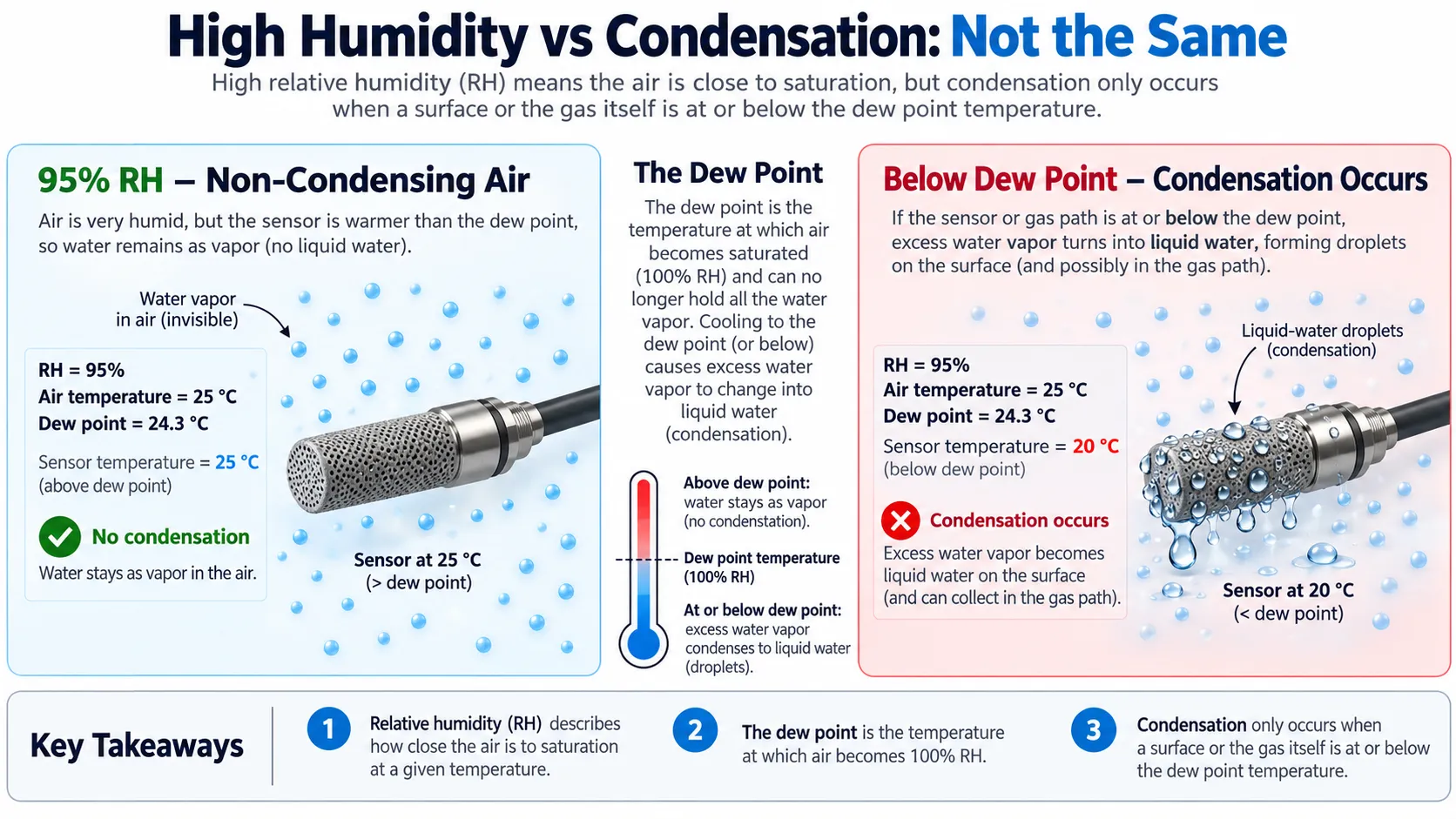
A gas detector can be rated for:
95% RH, non-condensing
without being rated for liquid water forming on the sensing element.
Dräger’s PointGard 3100, for example, specifies:
0–95% RH, non-condensing
That wording matters.
High RH, non-condensing
Water remains in the gas phase.
Condensation
The sensor or gas path falls to or below the dew point:
surface temperature ≤ dew point
↓
water vapor condenses
↓
liquid droplets form
Liquid water introduces additional failure mechanisms.
What Condensation Can Do to a Gas Sensor
Condensation can:
- block diffusion openings
- wet hydrophobic membranes
- create electrical leakage
- contaminate optical windows
- change sampling flow
- trap soluble gases
- cause corrosion
- freeze at low temperature
Figaro specifically warns that condensation inside MOS sensor housings may cause sensor-characteristic drift.
See: Figaro — MOS Sensor Cautions
So:
A sensor rated to 95% RH is not automatically rated for water droplets.
Dew Point Is the Key Condensation Variable
Condensation risk depends on more than the ambient RH number.
Consider:
Warm humid gas
↓
cold sample tube
↓
gas cools below dew point
↓
liquid water forms
The detector room may not appear excessively humid, yet water can still form inside the sampling train.
For sampled gas systems, engineers should consider:
- sample-gas temperature
- tubing temperature
- sensor temperature
- ambient RH
- dew point
This is often more useful than looking at RH alone.
Condensation Can Change the Gas Sample
Liquid water does not merely threaten electronics.
It can alter the sample.
Water-soluble or reactive gases may:
- dissolve in condensate
- adsorb onto wet tubing
- be delayed
- be partially removed before reaching the sensor
That can create a falsely low concentration even when the sensing element itself is healthy.
This is why sample conditioning must be validated for the exact target gas.
Should You Add a Dryer?
In some sampled-gas systems, a dryer such as a Nafion-type conditioner can reduce humidity variation.
But it is not automatically safe for every gas.
A dryer may also introduce:
- response delay
- gas loss
- adsorption
- maintenance requirements
For reactive gases, even small losses in the sample line can significantly change the reported concentration.
So:
Do not add a dryer, membrane or filter without validating recovery of the target gas through the complete sampling train.
How Humidity Affects NDIR and Optical Gas Sensors
Optical gas sensors avoid electrolyte and catalyst-surface mechanisms, but humidity can still matter.
Possible effects include:
- spectral influence from water vapor
- environmental changes in source or detector behavior
- condensation on optical windows
- changes in gas conditions
- contamination of the optical path
The importance of direct water-vapor spectral interference depends on:
- target gas
- wavelength
- optical filter
- algorithm
Therefore:
Do not assume that humidity always produces the same NDIR cross-response.
Modern optical modules often include environmental compensation.
Sensirion’s SCD53, for example, integrates temperature and humidity compensation and provides optional pressure correction for CO₂ measurement.
See: Sensirion SCD53
For optical sensing fundamentals, see NDIR Gas Sensors.
How Humidity Affects Catalytic Bead Sensors
Catalytic bead sensors use a heated active bead and matched compensator.
The bridge design helps reject some environmental effects.
But a catalytic detector is still a complete physical system.
Humidity-related issues can include:
- changes in thermal conditions
- condensation
- blocked sinters or filters
- water entering the gas path
So:
A compensated pellistor is not the same as a humidity-proof detector.
For catalytic fundamentals, see Catalytic Bead Gas Sensors.
Calibration Humidity Matters
Calibration is often carried out under controlled conditions.
But field gas may be:
- much drier
- much wetter
- changing rapidly
SPEC Sensors recommends evaluating electrochemical sensor performance under intended environmental conditions when high accuracy is required.
See: SPEC Sensors AN-104
This creates an important rule:
A calibration performed in dry or moderate-RH gas does not automatically prove identical performance in a very humid process stream.
Reference Air and Sample Humidity Should Be Controlled
This is particularly important in laboratory characterization and e-nose work.
Suppose:
Reference air = 20% RH
Sample gas = 80% RH
and you observe a sensor change.
That change may contain:
target-gas effect
+
humidity effect
If you want to measure only target-gas response, the humidity of the reference and sample streams should be controlled or included in the model.
Otherwise humidity becomes a hidden experimental variable.
Humidity Can Look Like Cross-Sensitivity
Cross-sensitivity usually refers to a non-target gas producing sensor response.
Water vapor can also act as an environmental interferent.
If:
target gas absent
+
RH changes
↓
sensor output changes
the behavior may be mistaken for chemical cross-sensitivity.
During troubleshooting, check:
- what gases changed
- what humidity changed
- what temperature changed
rather than assuming every unexpected signal comes from another chemical.
See Gas Sensor Cross-Sensitivity Explained.
Humidity Can Look Like Sensor Aging
Long-term seasonal changes can also be misleading.
For example:
winter:
dry indoor air
versus:
summer:
humid ambient air
may change the sensor baseline or sensitivity.
If the environment is not recorded, the engineer may conclude:
sensor aging
when part of the effect is environmental.
A better practice is to compare sensor health under comparable:
- temperature
- humidity
- pressure
- gas conditions
before attributing all change to lifetime degradation.
Long-Term Extreme Humidity Can Affect Sensor Life
Humidity can become a lifetime issue when exposure is prolonged.
Possible long-term mechanisms include:
- electrolyte water loss
- electrolyte water uptake
- seal stress
- corrosion
- surface contamination
- material swelling
- optical contamination
The importance varies widely by sensor.
So:
Humidity operating limits are not only about immediate accuracy; they can also protect long-term sensor condition.
See Gas Sensor Lifetime: What Determines Sensor End of Life?.
How Gas Sensor Humidity Compensation Works
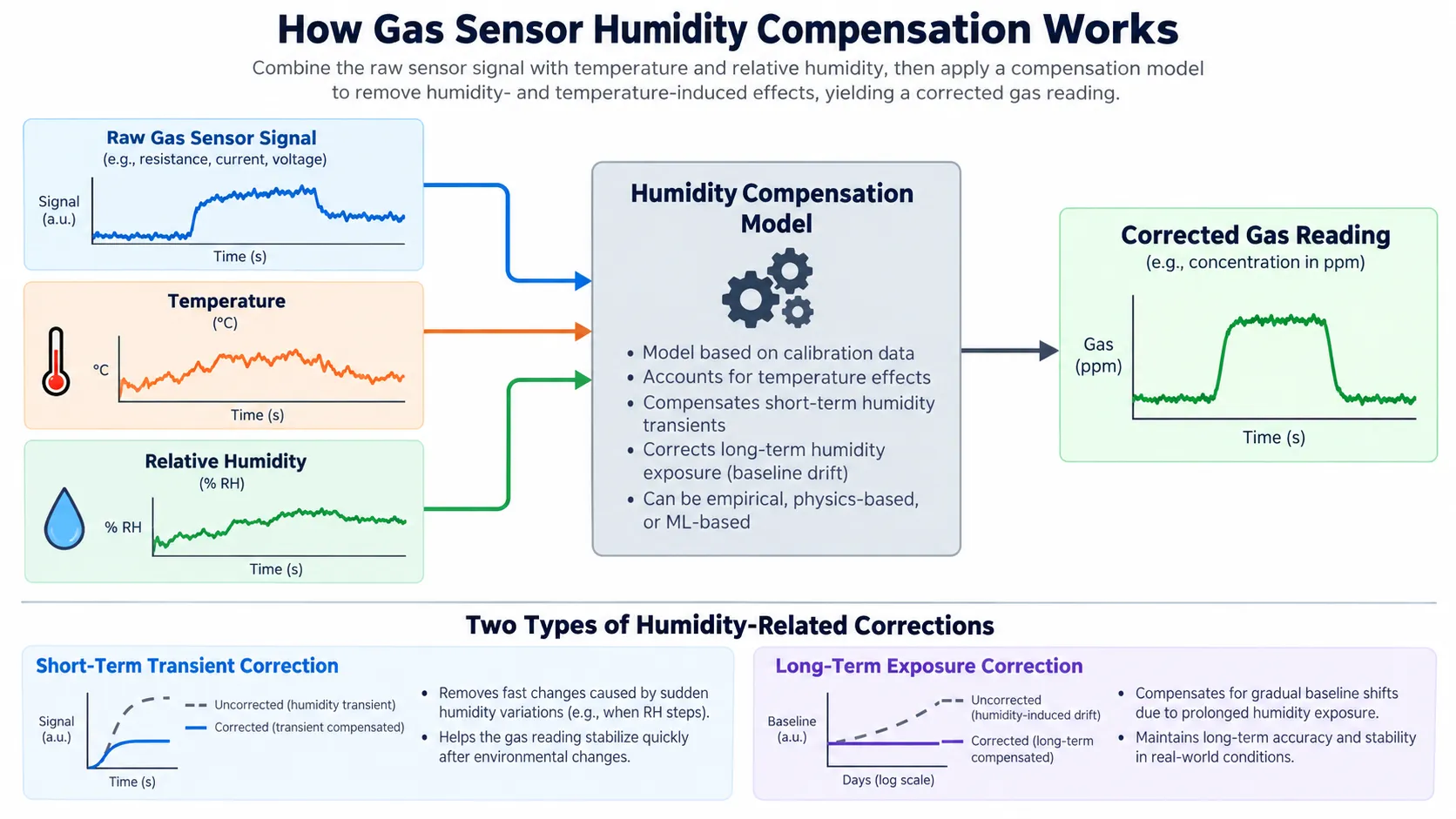
A modern compensated gas-sensing system may combine:
Raw gas signal
+
temperature
+
relative humidity
↓
compensation model
↓
corrected gas reading
The model can be:
- lookup table
- polynomial
- piecewise function
- physics-based model
- statistical model
- machine-learning model
But the important word is:
validated.
The model should be based on data from the actual sensor or sensor family under realistic conditions.
Short-Term and Long-Term Compensation Are Different Problems
A fast RH transient is a dynamic effect.
Long-term humidity exposure is a slow material-state effect.
They may require different correction strategies.
Short-term transient correction
May use:
- present RH
- rate of RH change
- temperature
- sensor-specific transient model
Long-term correction
May use:
- environmental history
- moving-average RH
- long-term baseline trend
- recalibration
This distinction matters because a compensation algorithm that fixes a 30-second humidity spike may not correct a three-week sensitivity change.
One Humidity Compensation Curve Is Not Universal
Do not assume that:
CO sensor A
and:
CO sensor B
need the same RH correction just because they detect the same gas.
Humidity behavior can vary with:
- sensor geometry
- diffusion barrier
- electrolyte
- sensing material
- filters
- package
- firmware
The safest approach is:
Use manufacturer-specific correction data or build your own validated environmental model.
Humidity Sensor Placement Matters
A compensation RH sensor must measure conditions that actually represent the gas reaching the sensing element.
This can be difficult because:
- MOS sensors self-heat
- NDIR sources self-heat
- airflow varies across the PCB
- enclosure vents create gradients
- sample lines can change temperature
Since RH is temperature-dependent, local self-heating can make a nearby humidity reading unrepresentative.
So:
A humidity sensor on the same PCB is not automatically measuring the humidity experienced by the gas-sensing element.
How to Test Humidity Dependence Properly
A useful OEM validation procedure should separate humidity from temperature as much as possible.
Step 1 — Hold Temperature Constant
This is critical because changing temperature automatically changes RH relationships.
Step 2 — Select Relevant RH Levels
For example:
20%
40%
60%
80%
90% RH
Choose values that match the application.
Step 3 — Measure Baseline at Each RH
Record the zero response.
Step 4 — Apply the Same Target Gas
At each RH, record:
- sensitivity
- steady-state response
- T50
- T90
- recovery
Step 5 — Test Rapid RH Steps
For example:
30% → 80%
and:
80% → 30%
Measure transient behavior separately from steady-state sensitivity.
Step 6 — Test Long-Term Exposure if Required
If the product will operate for months in an extreme climate, a five-minute chamber test is not enough.
Step 7 — Test Increasing and Decreasing RH
This helps reveal:
- hysteresis
- recovery
- moisture-history effects
Step 8 — Avoid Condensation Unless You Intend to Test It
Otherwise the test changes from:
humidity dependence
to:
liquid-water / condensation performance
Step 9 — Test Multiple Sensors
One device cannot represent production variation.
Step 10 — Validate the Compensation Model Independently
Do not judge the model only at the RH points used to build it.
How to Read Humidity Specifications in a Datasheet
Look for more than one RH number.
Check:
Operating RH range
Example:
15–90% RH
Non-condensing qualifier
This is extremely important.
Test RH
At what RH were:
- sensitivity
- accuracy
- T90
- zero
specified?
Storage humidity
Storage may have a different limit.
Humidity compensation
Is a correction built into the module?
Humidity transient behavior
Does the manufacturer publish zero-current spikes or RH-step data?
Long-term extreme humidity
Is lifetime or sensitivity degradation characterized?
Sensor vs complete instrument
A bare sensing element may have different environmental limits from the finished detector enclosure.
Common Humidity-Related Gas Sensor Mistakes
Mistake 1 — 50% RH always means the same water concentration
False.
RH depends on temperature.
Mistake 2 — High RH and condensation are the same
False.
Condensation requires the surface or gas to reach the dew point.
Mistake 3 — Humidity only changes sensitivity
False.
It can also change zero, response time and recovery.
Mistake 4 — A humidity transient is sensor drift
False.
Rapid RH changes can create temporary zero-current transients.
Mistake 5 — Low humidity is harmless
False.
Long-term dry conditions can affect some electrochemical sensors.
Mistake 6 — High humidity always lowers readings
False.
Direction and magnitude depend on sensor technology and design.
Mistake 7 — One RH correction works for every sensor
False.
Humidity dependence is model-specific.
Mistake 8 — A nearby RH sensor always measures the sensor’s true RH
False.
Self-heating and airflow can create local differences.
Mistake 9 — Dry calibration automatically represents humid field gas
False.
Environmental mismatch can create additional error.
Mistake 10 — A dryer can always be added safely
False.
A dryer or filter may delay or remove part of the target gas.
Frequently Asked Questions
Does humidity affect gas sensor readings?
Yes.
Humidity can affect baseline, sensitivity, response time and long-term stability. The magnitude and direction depend on sensor technology and model.
Why does humidity cause gas detector errors?
Humidity can change:
- electrolyte water balance
- sensing-surface chemistry
- adsorption
- electrical leakage
- optical conditions
- gas transport
Can humidity cause a false gas reading?
Yes.
Rapid humidity changes can create temporary baseline shifts, and some technologies can show humidity-related interference even without target gas present.
Does high humidity make gas sensors read high or low?
Either is possible.
There is no universal direction.
The effect is sensor- and gas-specific.
Does low humidity affect electrochemical gas sensors?
It can.
Prolonged dry conditions can cause water loss from some aqueous electrolytes and change sensitivity or response.
Why do electrochemical sensors respond to sudden RH changes?
A rapid humidity change alters the water equilibrium around the electrolyte and diffusion system, producing a transient current until the sensor re-equilibrates.
How long does a humidity transient last?
There is no universal value.
Alphasense describes about ten minutes as a typical decay time for humidity-induced current spikes in some toxic-gas sensors, but actual behavior depends on the sensor and conditions.
Does humidity affect MOS gas sensors?
Yes.
Water adsorbs on the metal-oxide surface and can change baseline resistance and target-gas response.
Does humidity affect PID detectors?
Yes.
Traditional PIDs can produce false-low readings in high humidity, while high humidity combined with electrode contamination can create false-high readings in some designs.
Why can PID read low in high humidity?
Water vapor can reduce the effective PID response, resulting in a lower measured VOC signal.
Can high humidity cause false-positive PID readings?
Yes, in some traditional PID designs when humidity combines with contamination to create an unwanted conductive path.
Does humidity affect NDIR sensors?
It can.
The importance depends on wavelength, target gas, optical design and compensation. Condensation on optical surfaces is a separate and often more serious issue.
What is the difference between high RH and condensation?
High RH means water is still primarily vapor.
Condensation means liquid water has formed because the surface or gas has reached the dew point.
What is dew point?
Dew point is the temperature at which air becomes saturated and water begins to condense if further cooling occurs.
What is gas sensor humidity compensation?
Humidity compensation uses RH, usually together with temperature and sensor characterization data, to reduce humidity-related measurement error.
Should calibration gas have the same humidity as the field sample?
For high-accuracy work, environmental matching or validated compensation is useful.
Always follow the sensor or instrument manufacturer’s calibration procedure.
Can extreme humidity shorten gas sensor life?
Yes.
Long-term dry or humid exposure can change electrolyte condition, sensing materials, seals and other components in some sensor types.
Should I use a Nafion dryer?
Only after validating it with the exact target gas and sampling system.
A dryer can reduce humidity variation but may also affect gas recovery and response time.
Final Takeaway
Humidity affects gas sensors through several different mechanisms.
Remember:
Rapid RH change
=
possible short-term baseline transient
Long-term extreme RH
=
possible sensitivity / material / lifetime change
High RH
≠
condensation
Condensation
=
liquid water forms at or below dew point
and:
Humidity effect
=
technology-specific and model-specific
For electrochemical sensors, water balance inside the electrolyte is especially important.
For MOS sensors, water adsorption changes surface chemistry.
For PID instruments, humidity can create both false-low and false-high behavior depending on design and contamination.
For optical sensors, environmental compensation and condensation control matter.
A robust gas-sensing system therefore needs:
- temperature and humidity characterization
- separation of transient and long-term effects
- condensation prevention
- representative T/RH sensing
- validated compensation
- environmental conditions recorded during calibration and troubleshooting
The core engineering rule is:
Do not ask only “What RH can the sensor operate at?” Ask whether the condition is stable or changing, how long exposure lasts, whether condensation can occur, and how that exact sensor model responds.
References and Further Reading
- Alphasense — AAN 110: Environmental Changes: Temperature, Pressure, Humidity
- Alphasense — AAN 104: How Electrochemical Toxic Gas Sensors Work
- Alphasense — FAQs
- SPEC Sensors — AN-104: Environmental Effects
- SPEC Sensors — AN-108: Extreme Environment Operation
- ION Science — What Is Humidity and Can It Affect PID Results?
- ION Science — Humidity Effects on PID Instruments
- Figaro — MOS Sensor Cautions
- Dräger — PointGard 3100
- Sensirion — SCD53 CO₂ Sensor
- GasNose — Temperature Effects on Gas Sensors
- GasNose — Gas Sensor Drift
- GasNose — Gas Sensor Response Time: T50 vs T90
- GasNose — Gas Sensor Response vs Recovery Time
- GasNose — Electrochemical Gas Sensor Zero Current
- GasNose — Gas Sensor Cross-Sensitivity
- GasNose — Gas Sensor Poisoning vs Cross-Sensitivity
- GasNose — Gas Sensor Lifetime
- GasNose — Semiconductor Gas Sensors
- GasNose — NDIR Gas Sensors
- GasNose — Catalytic Bead Gas Sensors
- GasNose — PID vs LEL Gas Detector
