




A gas detector gives an unexpected reading.
Is another gas interfering with the sensor?
Or has a contaminant actually damaged the sensing element?
Those are two very different problems.
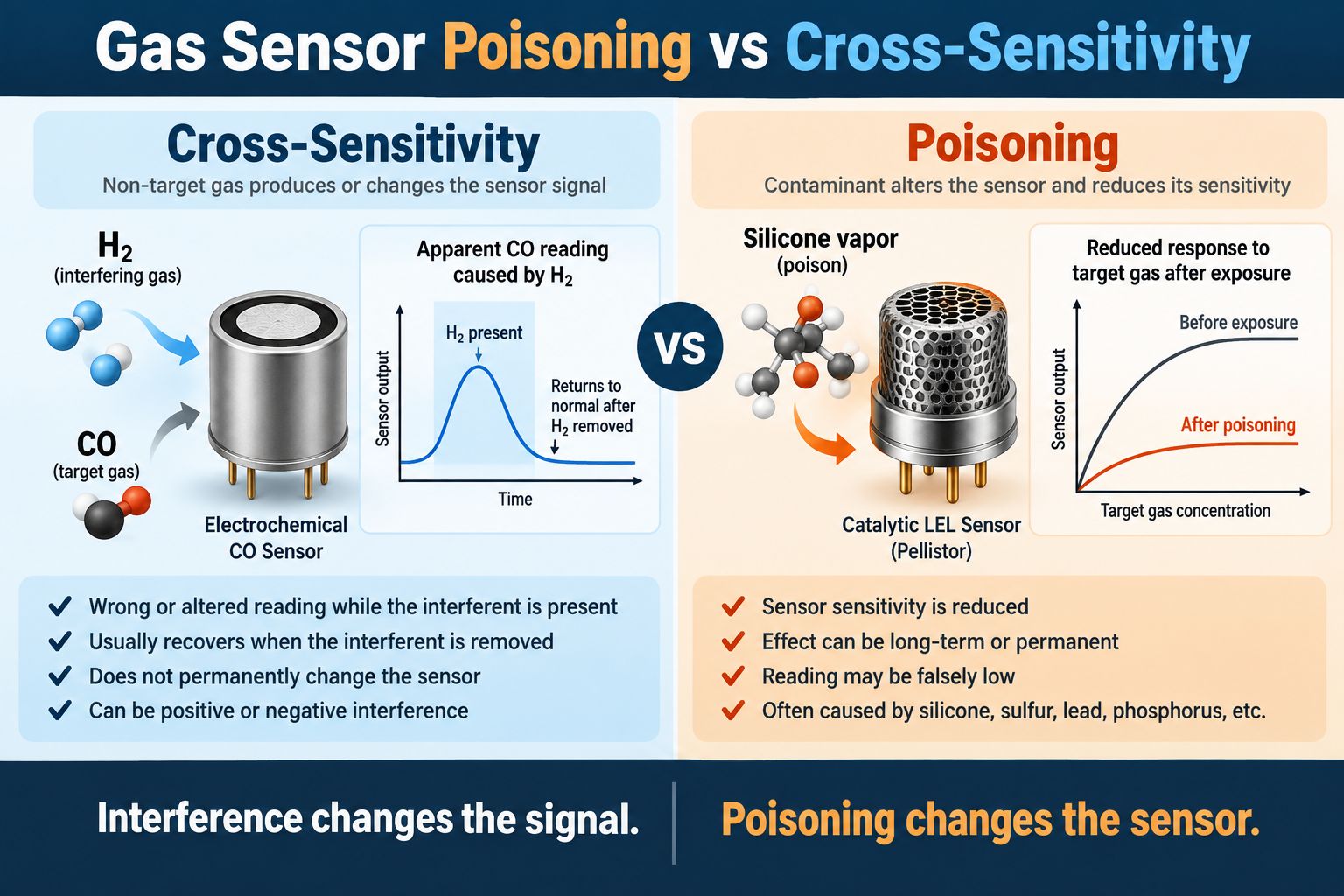
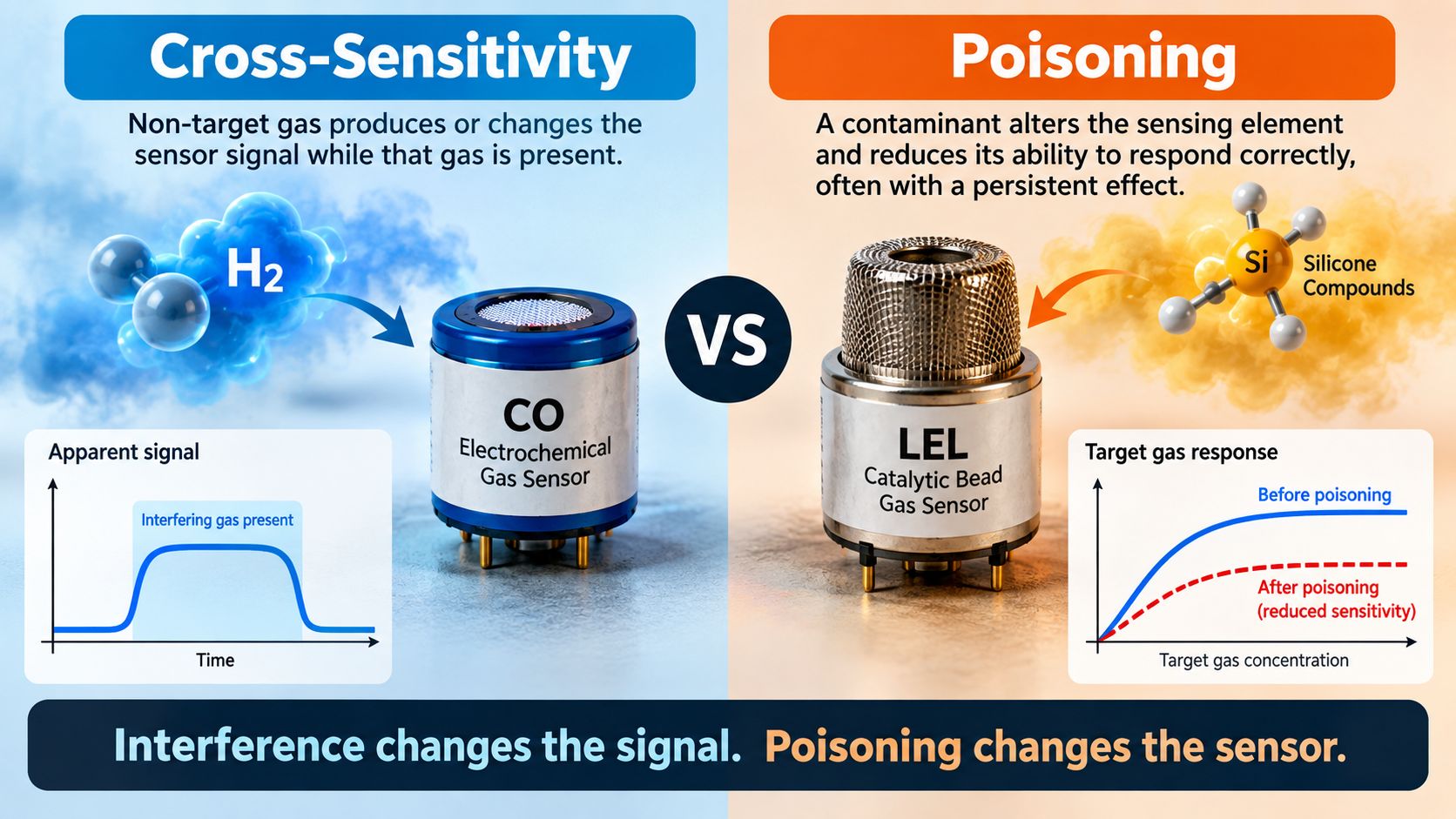
Cross-sensitivity means a non-target gas produces or changes the sensor signal while that gas is present.
Poisoning means a contaminant changes the sensing element itself and reduces its ability to respond correctly, often with a persistent or irreversible loss of sensitivity.
A useful engineering summary is:
Cross-sensitivity changes what the sensor reads. Poisoning changes what the sensor is capable of sensing.
There is also a third term that matters:
inhibition.
Inhibition temporarily suppresses sensor response and may recover after the inhibitor is removed and the sensor spends sufficient time in clean air.
These three conditions can look similar in the field, but they do not have the same cause or solution.
Poisoning vs Cross-Sensitivity: Quick Comparison
| Characteristic | Cross-Sensitivity | Inhibition | Poisoning |
|---|---|---|---|
| Main effect | Non-target gas changes the reading | Sensor response is temporarily suppressed | Sensor sensitivity is degraded |
| Typical duration | Mainly while interferent is present | Often temporary | Can be persistent or irreversible |
| Fresh air may restore normal behavior? | Often, after interferent clears | Often, depending on exposure | Not necessarily |
| Can cause false high reading? | Yes | Not usually the defining behavior | Not usually the defining behavior |
| Can cause false low reading? | Yes, depending on interference direction | Yes | Yes |
| Does target-gas sensitivity remain unchanged? | Usually | May recover | May remain reduced |
| Typical example | CO sensor responding to H₂ | Catalytic LEL sensor temporarily inhibited | Catalytic LEL sensor poisoned by silicone compounds |
| Typical response | Identify interferent, use filter/compensation/selective sensor | Remove exposure, allow recovery, verify with gas | Function test, calibration check, replacement if required |
Honeywell’s technical guidance for catalytic LEL sensors explicitly distinguishes poisoning from inhibition: poisoning is described as permanent degradation, while inhibition is usually recoverable in clean air.
See: Honeywell — Handling LEL Sensor Poisons
Two Different Gas Sensor Failure Behaviors
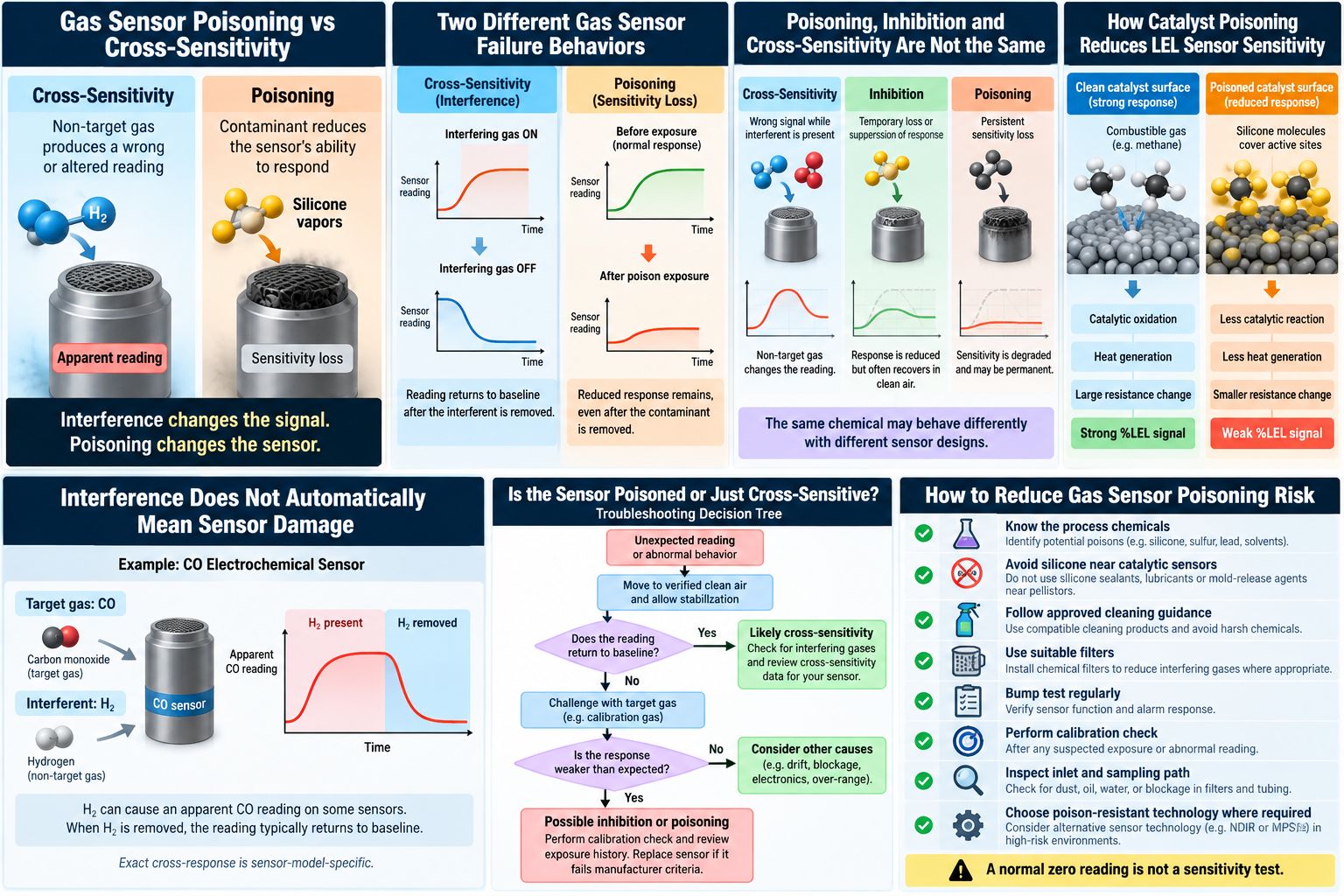
The easiest way to separate cross-sensitivity from poisoning is to compare what happens after the unwanted gas or contaminant is removed.
Cross-Sensitivity Example
Suppose a CO electrochemical sensor is exposed to hydrogen.
The behavior may look like:
H₂ appears
↓
CO channel develops an apparent response
↓
H₂ is removed
↓
Signal returns toward its normal baseline
The sensor has not necessarily been damaged.
It may simply be responding to an electrochemically active interferent.
Poisoning Example
Now consider a catalytic LEL sensor exposed to a catalyst poison.
The behavior may look like:
Normal methane response
↓
Poison exposure
↓
Contaminant is removed
↓
Methane test is repeated
↓
Sensor response remains much lower than before
The key difference is not whether the sensor produced an unusual reading during exposure.
The key question is:
Has its ability to respond to the correct target gas changed afterward?
Poisoning, Inhibition and Cross-Sensitivity Are Not the Same
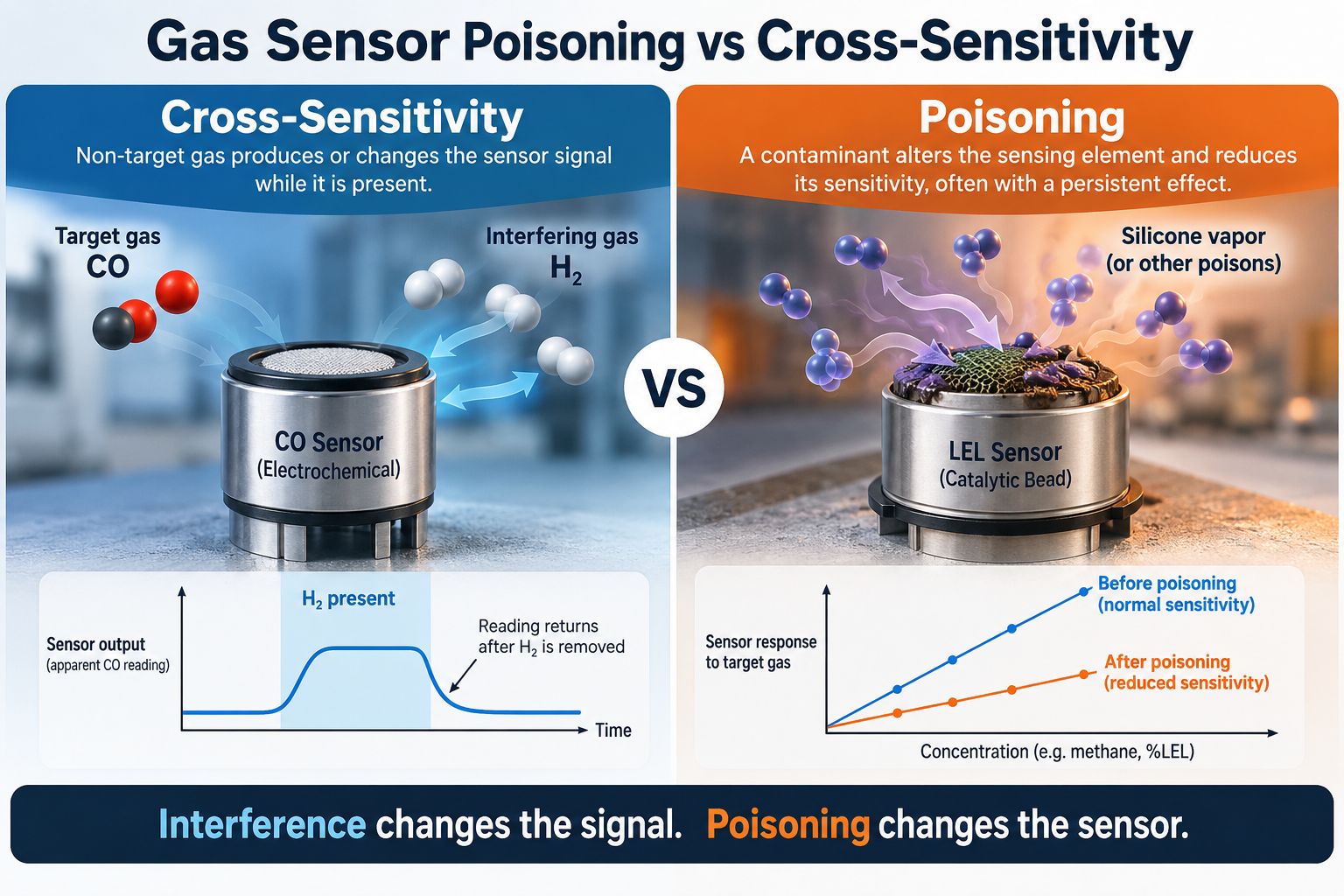
These terms are related but describe different mechanisms.
Cross-Sensitivity
A non-target gas produces a signal that the detector may interpret as target gas.
The effect can be:
- positive
- negative
- concentration dependent
- temperature dependent
- sensor-model-specific
The sensor may return to normal after the interferent disappears.
Inhibition
A compound temporarily suppresses the sensor’s response.
The sensor may initially appear to have lost sensitivity.
After the inhibitor is removed and the sensor operates in clean air, some or all sensitivity may return.
Poisoning
A contaminant changes or deactivates the sensing surface.
The result can be:
- persistent sensitivity loss
- failed calibration
- slow or weak target-gas response
- inability to reach the expected span signal
The same chemical should not automatically be classified the same way for every sensor.
Honeywell notes that many compounds can behave as poisons or inhibitors to different degrees depending on the material, dose and sensor design.
What Is Gas Sensor Cross-Sensitivity?
Cross-sensitivity occurs when a gas other than the intended target produces a meaningful sensor response.
For example, a sensor intended to measure:
COmay also respond to:
H₂The detector electronics may not know that part of the current came from hydrogen.
It simply sees electrical output and converts that output using the CO calibration relationship.
The result can be an apparent CO reading.
This is why a product name such as:
CO Sensor
does not mean:
responds only to CO under all conditions.
Alphasense currently offers several CO sensor variants specifically designed to reduce interference from gases such as H₂, H₂S, NO₂, NO and SO₂. Its CO-CX, for example, uses additional filtration to reduce hydrogen cross-sensitivity in combustion environments.
See: Alphasense CO-CX Carbon Monoxide Sensor
For the full mechanism and sensor-selection implications, see Gas Sensor Cross-Sensitivity Explained.
Cross-Sensitivity Can Be Positive or Negative
Cross-sensitivity is often described as a false-positive problem.
That is incomplete.
An interferent can produce:
Positive Cross-Sensitivity
The sensor output moves in the same direction as the target-gas response.
The detector may read:
more target gas than is actually presentThis can cause:
- false alarms
- overestimated exposure
- incorrect process control
Negative Cross-Sensitivity
The interferent drives the sensor response in the opposite direction or suppresses the apparent target response.
The detector may read:
less target gas than is actually presentThis can be more dangerous because a real hazard may be underestimated.
So:
Cross-sensitivity is not only a nuisance-alarm problem. It can also produce falsely low measurements.
The direction and magnitude must come from the specific sensor’s cross-sensitivity data.
Electrochemical Cross-Sensitivity Example
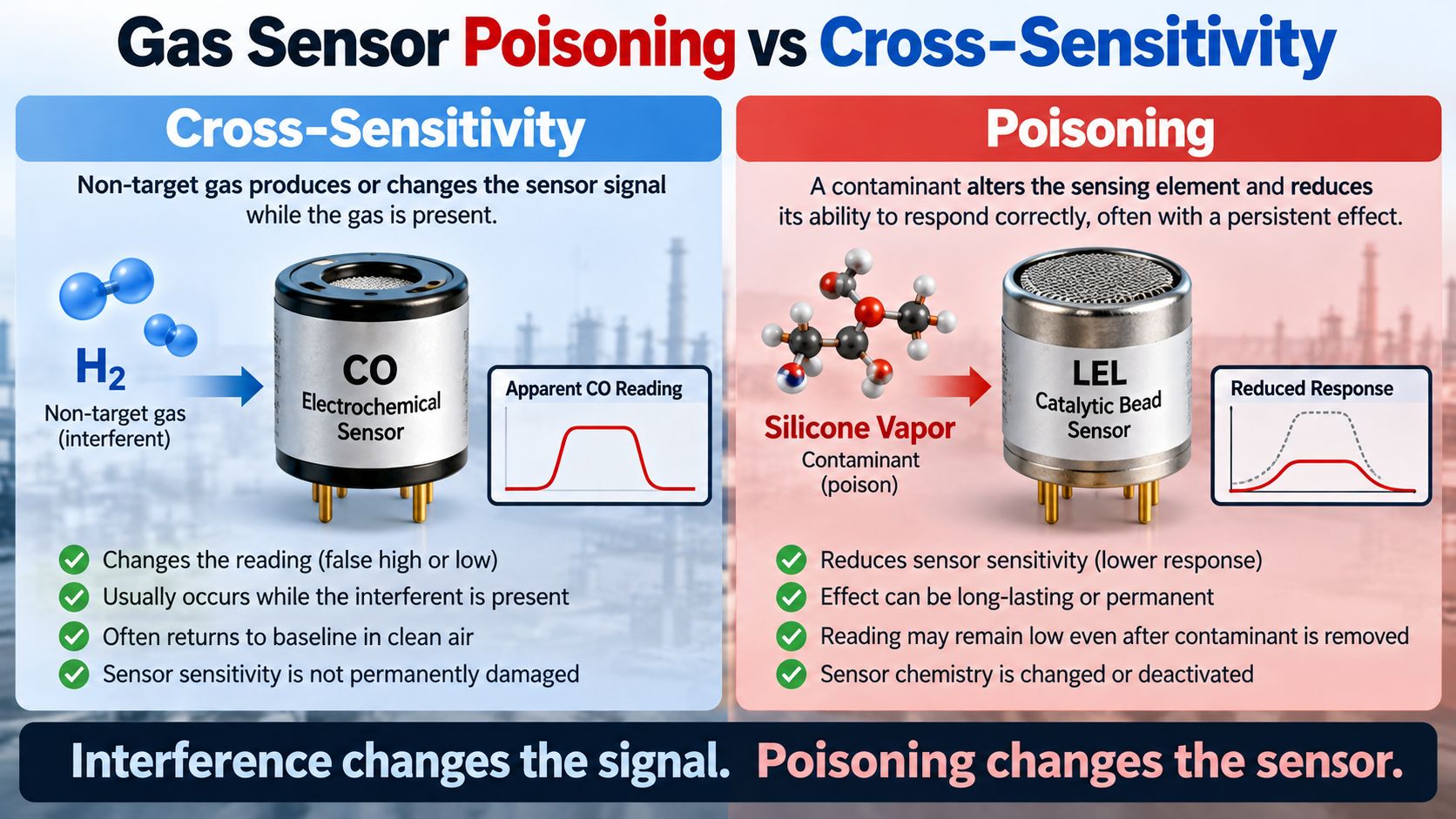
Consider a CO electrochemical sensor.
Target gas:
COInterferent:
H₂A simplified sequence is:
CO absent
+
H₂ present
↓
Electrochemical current appears
↓
Instrument interprets part of the current as CO
↓
Apparent CO reading
When hydrogen is removed:
H₂ disappears
↓
Interference response decays
↓
CO channel returns toward baseline
This behavior is consistent with cross-sensitivity.
It does not automatically mean the sensor has been poisoned.
The exact hydrogen response is highly sensor-model-specific.
Some manufacturers address the problem through:
- electrode chemistry
- chemical filters
- dedicated H₂-filtered CO sensors
- multi-sensor compensation
Alphasense’s current CO product family includes multiple low-H₂-cross-sensitivity variants for exactly this reason.
See: Alphasense Carbon Monoxide Sensors
What Is Gas Sensor Poisoning?
Sensor poisoning is a more serious mechanism.
A contaminant reaches the sensing element and reduces its ability to carry out the reaction that produces the measurement signal.
This is especially well known in:
catalytic bead / pellistor combustible gas sensors
A catalytic sensor normally works through:
Combustible gas
↓
Catalyst surface
↓
Oxidation
↓
Heat release
↓
Bead temperature / resistance changes
↓
Bridge output
↓
%LEL reading
If the catalyst becomes poisoned:
Combustible gas
↓
Less catalytic reaction
↓
Less heat
↓
Smaller resistance change
↓
Lower electrical output
↓
Falsely low %LEL reading
The detector can therefore underestimate a real combustible-gas hazard.
For the complete technology explanation, see Catalytic Bead Gas Sensors: Pellistor Working Principle, %LEL, Poisoning & Selection Guide.
How Catalyst Poisoning Reduces LEL Sensor Sensitivity
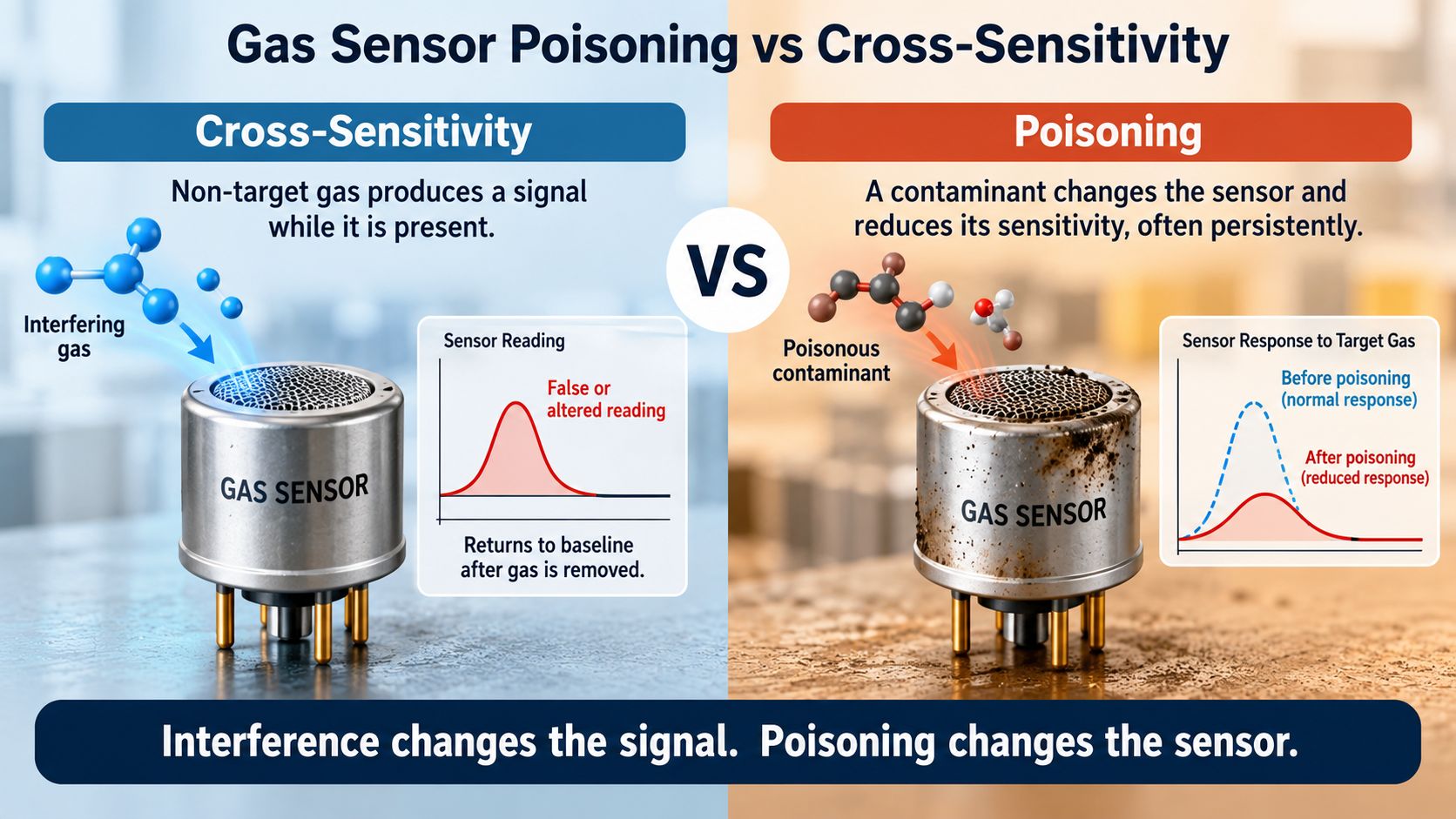
Catalytic detection depends on an active catalyst surface.
In a healthy pellistor:
Methane / combustible gas
↓
Active catalyst sites
↓
Efficient oxidation
↓
Heat generation
↓
Strong sensor signal
After poison exposure:
Poison molecules interact with catalyst
↓
Fewer effective active sites
↓
Less oxidation
↓
Less heat generation
↓
Reduced signal
The dangerous part is that the gas concentration has not necessarily decreased.
Only the sensor’s ability to convert that gas exposure into electrical output has changed.
Honeywell’s current safety instructions for catalytic LEL sensors state that certain compounds can decompose on the catalyst and create a barrier over the active surface; prolonged exposure can lead to irreversible sensitivity loss.
See: Honeywell / City Technology — LEL Sensor Instructions for Safe Use
Common Catalytic Sensor Poisons
Catalytic-bead sensors are particularly vulnerable to certain chemical families.
Silicone and Silicon-Containing Compounds
These are among the best-known catalytic poisons.
Possible sources include:
- silicone sealants
- RTV compounds
- silicone lubricants
- mold-release agents
- polishes
- silicone rubber
- adhesives
- some personal-care products
Honeywell identifies silicon compounds such as silanes, silicones and silicates as particularly serious catalytic poisons.
Lead Compounds
Lead compounds can reduce catalyst activity.
Historically, leaded fuels were a well-known concern for catalytic combustible sensors.
Sulfur-Containing Compounds
Sulfur compounds can interfere with catalytic activity.
Depending on:
- compound
- concentration
- exposure time
- catalyst formulation
the effect may behave more like inhibition, poisoning or a combination.
Phosphorus-Containing Compounds
Certain phosphates and phosphorus-containing compounds can degrade catalytic performance.
Halogenated Compounds
Some chlorinated or halogenated compounds may inhibit or corrode catalytic sensors, especially at elevated bead temperatures.
The correct lesson is not:
Every trace of these substances instantly destroys every pellistor.
It is:
Known catalyst poisons must be considered in sensor selection, installation and maintenance because the effect depends on both dose and sensor design.
Poisoning Is Often Dose-Dependent
Poisoning risk is not determined by concentration alone.
A useful conceptual model is:
Poison exposure severity
≈
Concentration
×
Exposure duration
×
Sensor susceptibility
A high concentration for a short time can be damaging.
A lower concentration over a much longer period can also accumulate enough exposure to reduce sensitivity.
This is why a statement such as:
“The silicone concentration was low, so the sensor must be fine.”
is not sufficient.
The correct question is:
How much exposure did this particular sensor experience, and does it still respond correctly to target gas afterward?
What Is Sensor Inhibition?
Inhibition is often confused with poisoning because both can reduce sensitivity.
The key difference is reversibility.
A simplified sequence is:
Normal response
↓
Inhibitor exposure
↓
Response suppressed
↓
Inhibitor removed
↓
Operation in clean air
↓
Sensitivity partly or fully returns
Honeywell’s LEL safety instructions identify hydrogen sulfide and halogenated hydrocarbons as examples that can inhibit catalytic sensors, with sensitivity loss often recovering after operation in clean air.
However, do not turn that into a universal rule.
A sufficiently severe or prolonged exposure may have a more persistent effect.
The sensor must be verified with the manufacturer’s approved functional or calibration procedure.
Can the Same Chemical Cause Both Inhibition and Poisoning?
Yes.
This is one of the most important nuances.
The terms describe effects, not permanent labels assigned to individual chemical names.
A compound can behave differently depending on:
- sensor catalyst formulation
- concentration
- exposure duration
- temperature
- previous sensor condition
Honeywell explicitly notes that many compounds fall into poison and inhibitor categories to different degrees.
So:
Cross-sensitivity describes what happens to the measurement signal. Inhibition describes temporary loss of response. Poisoning describes persistent loss of sensing capability. These effects are not always mutually exclusive.
Why a Poisoned Sensor Can Look Normal in Fresh Air
This is one of the most dangerous characteristics of catalytic poisoning.
Imagine a detector that shows:
Power: normal
Battery: normal
Display: normal
Fresh-air reading: 0% LEL
Alarms: available
Everything appears healthy.
But now apply a known combustible calibration gas.
Expected response:
50% LELActual response:
10% LELor even much lower.
The detector looked normal because zero air does not test combustible sensitivity.
A poisoned catalyst may still sit at a perfectly reasonable zero.
Therefore:
A normal zero reading is not a sensitivity test.
This is one reason real challenge gas matters.
OSHA distinguishes a bump test from electronic startup checks: a bump test physically exposes the sensor to test gas to verify that the sensing and alarm path actually responds.
See: OSHA — Calibrating and Testing Direct-Reading Portable Gas Monitors
Why Cross-Sensitivity Usually Looks Different
Cross-sensitivity commonly follows the presence of the interfering gas.
For example:
Interferent absent
→ normal baseline

Interferent present
→ unexpected signal

Interferent removed
→ signal returns toward normal
If the sensor later responds normally to its intended target gas, the event is more consistent with interference than poisoning.
But do not use this as an absolute diagnosis.
Other effects can imitate the same pattern, including:
- slow recovery
- adsorption
- inhibition
- tubing contamination
- changing temperature
- humidity transients
That is why troubleshooting should include a target-gas challenge rather than relying only on whether the display returns to zero.
Cross-Sensitivity vs Selectivity
Cross-sensitivity is closely related to sensor selectivity.
A highly selective sensor produces:
- strong target-gas response
- much smaller interferent response
A poorly selective sensor may respond significantly to several gases.
That does not automatically mean the sensor is defective.
It may simply be a limitation of the sensing chemistry.
For the deeper relationship between these terms, see Gas Sensor Sensitivity vs Selectivity: What’s the Difference?.
Can Electrochemical Sensors Be Poisoned?
Electrochemical sensors are often discussed mainly in terms of cross-sensitivity, but they are not immune to damaging chemical exposure.
Their chemistry is different from a catalytic pellistor, so it is not always appropriate to use “catalyst poisoning” in exactly the same sense.
However, electrochemical sensors can experience long-lasting performance changes from:
- aggressive chemicals
- solvents
- corrosive gases
- contamination
- extreme concentration exposure
- electrolyte damage
- membrane damage
Possible symptoms include:
- zero shift
- sensitivity loss
- unstable output
- slow response
- failed calibration
The correct diagnosis should be based on the specific sensor manufacturer’s compatibility and exposure guidance.
So:
Electrochemical cross-sensitivity is common, but electrochemical sensors can also be damaged or degraded by unsuitable chemical exposure.
What About MOS / Semiconductor Sensors?
MOS sensors use surface chemistry on a heated metal-oxide material.
They can respond broadly to many gases, which creates selectivity challenges.
They can also be affected by:
- surface contamination
- silicone compounds
- corrosive chemicals
- extreme concentrations
- environmental exposure
But the mechanism should not automatically be described as identical to catalytic-bead poisoning.
A better distinction is:
- cross-sensitivity — another gas causes a response
- contamination / surface deactivation — sensing material performance changes
- drift — baseline or sensitivity changes over time
For MOS fundamentals, see Semiconductor Gas Sensors.
Are NDIR Sensors Immune to Poisoning?
NDIR sensors do not depend on a hot catalytic surface, so they avoid the classic pellistor poisoning mechanism.
That is a major advantage in some combustible-gas applications.
But NDIR sensors can still be affected by:
- dust
- condensation
- dirty optical windows
- oil mist
- blocked gas paths
- optical source aging
- spectral interference
So:
Avoiding catalyst poisoning does not mean avoiding maintenance.
For methane applications where catalytic poisoning is a major risk, infrared detection may be attractive if the target gas, range, response requirements and certification fit the application.
See NDIR Gas Sensors.
What About TDLAS?
TDLAS also avoids catalytic oxidation.
Instead, it measures wavelength-specific optical absorption.
That removes classic catalytic poison vulnerability, but the complete optical system can still be affected by:
- dirty windows
- optical alignment
- condensation
- dust
- gas-path obstruction
For the sensing principle, see TDLAS Gas Sensors.
PID Broad Response Is Not Automatically “Cross-Sensitivity”
A PID detector is intentionally designed to respond to many ionizable VOCs.
Therefore:
benzene response
toluene response
xylene response
should not automatically be treated as three sensor faults.
Broad VOC response is part of PID operation.
The real question is whether the detector is being used as:
- broad VOC screening
- total VOC measurement
- compound-specific estimation
and whether appropriate response factors are applied.
For the practical difference between broad VOC and combustible-gas detection, see PID vs LEL Gas Detector: What’s the Difference?.
Poisoning vs Saturation vs Over-Range
These three conditions are also frequently confused.
Poisoning
Sensing chemistry or catalyst activity is degraded.
Saturation
The sensor output approaches a limit and no longer increases proportionally.
Over-Range
The gas concentration exceeds the sensor or instrument’s specified measurement range.
An over-range exposure may:
- recover normally
- require a long recovery
- temporarily saturate the sensor
- damage the sensor
- contribute to permanent sensitivity loss
But:
Over-range is not poisoning by definition.
For the complete distinction, see Gas Sensor Saturation and Over-Range Explained.
Poisoning vs Drift
Poisoning and drift can also overlap in symptoms.
Drift
The sensor’s baseline or sensitivity gradually changes over time.
Poisoning
A contaminant exposure causes loss of sensitivity or altered response.
A poisoned sensor may eventually appear as:
- span drift
- calibration failure
- reduced sensitivity
But not all drift comes from poisoning.
Normal aging, electrolyte changes, optical aging and environmental history can also cause drift.
See What Is Gas Sensor Drift? Zero Drift, Span Drift & Baseline Drift Explained.
Poisoning vs Contamination or Blockage
A weak gas response does not automatically mean poisoning.
Gas may simply be failing to reach the sensor.
Examples include:
- dust-blocked filter
- oil on a membrane
- water covering the inlet
- clogged tubing
- contaminated sampling line
- damaged pump
- incorrect calibration cap
Suppose a catalytic sensor should receive:
50% LEL methanebut a blocked inlet allows only a small amount of gas to reach it.
The detector may show a weak response that looks like sensitivity loss.
The sensing element itself may still be healthy.
Therefore:
Poor gas delivery can imitate sensor poisoning.
Troubleshooting must include the entire sampling path.
Is the Sensor Poisoned or Just Cross-Sensitive?
Use a structured process rather than guessing from one abnormal reading.
Step 1 — Move to a Verified Zero-Gas Environment
Confirm that the target gas and likely interferents are no longer present.
Depending on the instrument, this may require:
- clean ambient air
- certified zero air
- another manufacturer-specified zero gas
Step 2 — Allow Proper Recovery and Stabilization
Do not diagnose poisoning while the sensor is still recovering.
Slow recovery can be caused by:
- adsorption
- sensor chemistry
- tubing
- filters
- high prior exposure
See Gas Sensor Response Time vs Recovery Time.
Step 3 — Ask Whether the Abnormal Reading Disappears
If the reading returns to baseline after the suspected interferent is removed:
possible explanations include:
- cross-sensitivity
- recovery
- temporary inhibition
Do not stop the diagnosis there.
Step 4 — Challenge the Sensor With the Correct Target Gas
This is critical.
A sensor that returns to zero but has lost target-gas sensitivity may still be poisoned.
Use:
- correct gas
- correct concentration
- correct regulator
- correct flow
- correct procedure
Step 5 — Compare Response With the Expected Value
If target-gas response remains normal:
cross-sensitivity becomes more likely.
If target-gas response is substantially weaker:
investigate:
- inhibition
- poisoning
- blocked gas path
- sensor aging
- calibration drift
Step 6 — Review Cross-Sensitivity Data
Check the actual sensor datasheet.
Do not use generic assumptions such as:
all CO sensors respond X% to hydrogenStep 7 — Review Chemical Exposure History
Ask whether the detector was exposed to:
- silicone sealant
- silicone lubricant
- sulfur compounds
- solvents
- cleaners
- adhesives
- sprays
- chlorinated compounds
Step 8 — Inspect the Gas Path
Check:
- filters
- tubing
- membrane
- pump
- inlet
- calibration cap
Step 9 — Perform the Manufacturer’s Calibration Check
If the sensor response is outside allowed limits, follow the required calibration or replacement procedure.
Step 10 — Remove the Detector From Service if Reliability Is Uncertain
Safety instruments should not remain in service simply because they still power on.
Follow the detector manufacturer’s acceptance and replacement criteria.
Bump Test vs Calibration Check for Suspected Poisoning
A bump test and a calibration check answer different questions.
Bump Test
OSHA describes a bump test as a qualitative function check.
It asks:
Will the detector respond to challenge gas and activate its alarms?
A severely poisoned combustible sensor may fail a bump test because its response is too weak to reach the alarm threshold.
Calibration Check
A calibration check asks:
Is the indicated concentration close enough to the known test-gas concentration?
This is much more informative when investigating partial sensitivity loss.
Example:
Applied methane:
50% LEL

Detector reads:
18% LEL
The detector clearly responds.
It may even pass a low-threshold alarm test.
But the calibration check reveals serious sensitivity loss.
OSHA explicitly states that a bump test does not measure instrument accuracy, while a calibration check compares the displayed value with the known test gas.
See: OSHA — Calibrating and Testing Direct-Reading Portable Gas Monitors
For the full maintenance comparison, see Gas Detector Bump Test vs Calibration.
Can Calibration Fix a Poisoned Sensor?
Usually not if the poisoning has physically deactivated the sensing catalyst.
Calibration can correct:
- zero offset
- moderate span error
- normal sensitivity drift within the supported adjustment range
Calibration cannot regenerate a permanently damaged catalyst surface.
Suppose a sensor originally produces:
100 unitsfor a defined test gas.
After poisoning it produces:
20 unitsIt may be technically possible for electronics to multiply the small signal by a larger factor.
But that does not mean the sensor has returned to its original performance.
Problems can remain in:
- signal-to-noise ratio
- response speed
- reserve sensitivity
- stability
- reliability
Therefore:
Calibration can compensate for acceptable sensitivity change. It cannot reverse physical poisoning.
If the sensor cannot meet the manufacturer’s performance limits, replacement is the appropriate action.
Can Calibration Fix Cross-Sensitivity?
Ordinary zero/span calibration does not remove the underlying cross-response.
If a CO sensor inherently responds to H₂, calibrating it with CO does not make hydrogen chemistry disappear.
Reducing cross-sensitivity may require:
- a more selective sensor
- chemical filters
- improved electrode chemistry
- an independent interferent channel
- a validated compensation algorithm
- another sensing technology
This is why manufacturers offer filtered sensor variants instead of simply telling instrument designers to recalibrate.
Alphasense’s CO-AF, CO-CX and low-H₂-cross-sensitivity CO variants are practical examples.
See: Alphasense CO-AF Carbon Monoxide Sensor
How Chemical Filters Help
Chemical filters can improve selectivity by stopping or reacting with unwanted gases before they reach the working electrode.
Depending on the design, filters may reduce interference from gases such as:
- H₂S
- NO₂
- NO
- SO₂
- H₂
But a filter is not magic.
Potential limitations include:
- finite chemical capacity
- aging
- environmental effects
- added response time
- incomplete removal of interferents
Therefore:
Filtered does not mean interference-proof.
The complete sensor should still be validated against the real gas mixture in the application.
Cleaning Products and Maintenance Chemicals Matter
Maintenance activity itself can expose gas sensors to harmful chemicals.
Potential sources include:
- cleaning sprays
- alcohols
- solvents
- silicone sealants
- lubricants
- adhesives
- disinfectants
A product that is harmless to the detector housing may not necessarily be harmless to the sensing element.
For catalytic sensors, silicone-containing products are a particular concern.
For electrochemical, PID and MOS sensors, aggressive solvents or cleaners can also alter performance.
The safest practice is:
Use cleaning products and maintenance materials approved for the instrument and keep incompatible chemicals away from exposed sensor inlets.
Why Poisoning Can Create a Dangerous False Sense of Safety
Cross-sensitivity often creates a reading when the user expects zero.
That is noticeable.
Poisoning can do the opposite.
Imagine:
Real combustible hazard increases
↓
Poisoned sensor responds weakly
↓
Displayed %LEL remains too low
↓
Alarm may be delayed or not reached
That is why catalytic poisoning deserves special attention.
Crowcon’s current T4 manual warns that catalytic sensors may be permanently degraded by exposure to silicones, sulfur-containing gases such as H₂S, lead or chlorine compounds.
See: Crowcon T4 Manual
The practical lesson is:
A false high reading is inconvenient. A poisoned sensor that reads falsely low can hide a real hazard.
How to Reduce Gas Sensor Poisoning Risk
Poisoning prevention begins before installation.
Know the Process Chemicals
Identify whether the environment contains:
- silicones
- sulfur compounds
- lead compounds
- halogenated solvents
- corrosive gases
- cleaning chemicals
Avoid Silicone Near Catalytic Sensors
Be careful with:
- silicone RTV
- sealants
- silicone grease
- mold-release agents
especially during installation and maintenance.
Follow Approved Cleaning Guidance
Do not spray unknown cleaners directly around exposed gas-sensor inlets.
Use Appropriate Filters
Where supported by the sensor manufacturer, filters can help protect against certain interferents and contaminants.
Perform Functional Tests
A real gas challenge is the most direct way to confirm that the detector still responds.
Recheck After Suspicious Exposure
Do not wait for the next routine service interval after:
- known poison exposure
- high gas exposure
- chemical spill
- unusual cleaning activity
- failed or weak response
Inspect the Gas Path
Check:
- inlet
- filter
- tubing
- pump
- membrane
before assuming the sensing element is damaged.
Select the Technology for the Environment
If catalyst poisons are unavoidable, consider whether another suitable technology provides better resistance.
The final choice must still satisfy:
- gas coverage
- range
- response time
- certification
- oxygen dependence
- environmental conditions
- power
- maintenance
- cost
When Should You Consider Another Combustible Sensor Technology?
Catalytic bead sensors remain widely used because they can detect a broad range of combustible gases.
But environments with persistent catalyst poisons may justify consideration of another technology.
NDIR
Potential advantages:
- no hot catalytic oxidation surface
- resistant to classic catalyst poisoning
- useful for gases with suitable infrared absorption
Limitations:
- not every combustible gas is equally suitable
- optical contamination still matters
- gas-specific response must be considered
MPS
Some modern molecular-property-based combustible sensors are designed to be highly resistant to traditional catalyst poisons.
Crowcon’s T4 documentation, for example, states that its MPS sensor is highly poison resistant compared with the catalytic channel.
This does not mean:
MPS is always the best combustible sensor.
Sensor selection still depends on:
- target gases
- approvals
- oxygen conditions
- required range
- power
- response
- application validation
TDLAS
TDLAS can be highly selective for specific target gases and avoids catalyst poisoning, but it is not a universal replacement for broad-spectrum %LEL sensing.
The correct technology depends on the measurement objective.
How to Read Poisoning and Cross-Sensitivity Information in a Datasheet
When comparing sensors, look beyond the headline target gas.
Cross-Sensitivity Section
Check:
- interfering gas
- test concentration
- response direction
- response magnitude
- temperature
- humidity
- filter configuration
Poison / Inhibitor Guidance
Check for:
- known poison families
- exposure warnings
- recovery instructions
- prohibited materials
- cleaning guidance
Filter Information
Ask:
- which interferents are removed?
- is filter capacity specified?
- does the filter affect response time?
- can it be replaced?
Maximum Exposure
A high maximum concentration does not automatically mean no long-term damage.
Calibration Limits
Can the sensor still pass the manufacturer’s span requirement after exposure?
Technology
A catalytic sensor, electrochemical sensor, MOS sensor and optical sensor do not fail in the same way.
Common Poisoning vs Cross-Sensitivity Mistakes
Mistake 1 — Cross-Sensitivity Means the Sensor Is Damaged
False.
It may simply be normal response to an interferent.
Mistake 2 — Poisoning Mainly Causes False High Readings
False.
Poisoning often causes loss of sensitivity, which can produce dangerously low readings.
Mistake 3 — A Normal Zero Means the Sensor Is Healthy
False.
A poisoned catalytic sensor can read 0% LEL in clean air and still fail a combustible-gas challenge.
Mistake 4 — Fresh Air Always Fixes Poisoning
False.
Fresh air may help recover inhibition, but permanent poisoning may remain.
Mistake 5 — Calibration Reverses Poisoning
False.
Calibration cannot physically restore a deactivated catalyst.
Mistake 6 — Negative Cross-Sensitivity Is Harmless
False.
Negative interference can suppress a real target-gas reading.
Mistake 7 — Every Silicone Exposure Destroys Every Sensor
False.
Effect depends on sensor technology, concentration, exposure time and design.
Mistake 8 — Every Four-Gas Detector Responds the Same Way
False.
Different detector models can use different:
- LEL technologies
- filters
- CO cells
- algorithms
Mistake 9 — A Chemical Filter Lasts Forever
False.
Chemical filters have finite performance and capacity.
Mistake 10 — Electronic Self-Test Proves Gas Sensitivity
False.
A detector can pass electronic startup checks while the sensing element has lost sensitivity.
A real challenge-gas test checks the gas-response path.
Troubleshooting Checklist
If you suspect poisoning or cross-sensitivity, check:
- What target gas is the sensor designed for?
- What other gases were present?
- Does the datasheet list those gases as interferents?
- Did the abnormal reading disappear in verified clean air?
- Was enough recovery time allowed?
- Does the sensor still respond correctly to target calibration gas?
- Does the calibration check pass?
- Was the sensor exposed to silicone, sulfur, lead, solvents or cleaners?
- Is the sensor inlet blocked?
- Are filters or tubing contaminated?
- Has the detector experienced over-range exposure?
- Is the sensor near end of life?
- Does the manufacturer require replacement after this exposure?
Frequently Asked Questions
What is gas sensor poisoning?
Gas sensor poisoning is persistent degradation of a sensing element caused by chemical exposure. In catalytic combustible sensors, poisons can deactivate or cover catalyst sites and reduce sensitivity to combustible gas.
What is gas sensor cross-sensitivity?
Cross-sensitivity is a response to a gas other than the intended target gas.
The interferent may create a positive or negative measurement error.
What is the difference between poisoning and cross-sensitivity?
Cross-sensitivity primarily changes the sensor signal while an interfering gas is present.
Poisoning changes the sensing element and can reduce target-gas sensitivity even after the contaminant has been removed.
What is gas sensor inhibition?
Inhibition is a temporary suppression of sensor response that can often recover after the inhibitor is removed and the sensor operates in clean air.
Is inhibition the same as poisoning?
No.
Poisoning generally describes persistent or irreversible sensitivity loss.
Inhibition is usually more reversible.
Can the same chemical cause both inhibition and poisoning?
Yes.
The effect depends on sensor design, concentration, exposure time and conditions.
Can cross-sensitivity damage a sensor?
Cross-sensitivity itself describes an unwanted measurement response and does not necessarily imply damage.
However, the same compound could also damage or inhibit a particular sensor depending on chemistry and exposure.
Why do silicone compounds poison catalytic sensors?
Silicone-related compounds can interact with the hot catalyst surface and reduce the number or effectiveness of active catalytic sites, lowering combustible-gas response.
Does H₂S poison catalytic sensors?
H₂S is commonly discussed as an inhibitor in catalytic sensor guidance, but its effect depends on dose and sensor design. Severe exposure can produce more persistent degradation.
Can electrochemical gas sensors be poisoned?
They can be degraded or damaged by incompatible chemicals, solvents, corrosive gases or extreme exposures.
The mechanism differs from classic catalytic-bead poisoning.
Can cleaning products damage gas sensors?
Yes.
Some cleaners, solvents, silicone products and disinfectants can alter sensor performance.
Use products approved by the detector manufacturer.
Can sensor poisoning cause a false low reading?
Yes.
This is one of the most important risks.
A poisoned sensor may produce less signal than expected for the actual gas concentration.
Can a poisoned LEL sensor still read zero normally?
Yes.
Zero air only verifies the baseline.
It does not prove the sensor still responds correctly to combustible gas.
Can calibration fix a poisoned gas sensor?
Calibration can correct acceptable zero or span changes.
It cannot reverse permanent chemical damage to a sensing element.
Does a bump test detect poisoning?
A bump test can reveal severe loss of response if the detector fails to respond or alarm.
A calibration check provides stronger quantitative evidence of partial sensitivity loss.
How do I know if my LEL sensor is poisoned?
Apply the correct target calibration gas according to the manufacturer’s procedure.
If the response is abnormally low or the instrument cannot pass its calibration check, investigate poisoning, inhibition, blockage, aging or other failure mechanisms.
Are NDIR sensors immune to poisoning?
NDIR sensors avoid classic catalytic poisoning because they do not rely on a catalytic oxidation bead.
They can still suffer from optical contamination, condensation, blocked gas paths and other problems.
What sensor technology is best in a poisoning-prone environment?
There is no universal best technology.
For combustible gases, NDIR or other poison-resistant technologies may be useful where catalytic poisons are expected, but the choice must also consider target gases, certification, oxygen dependence, range, response and application requirements.
Final Takeaway
Gas sensor poisoning and cross-sensitivity are not the same failure mode.
Remember:
Cross-Sensitivity
=
another gas changes the measurement signal
Inhibition
=
sensor response is temporarily suppressedPoisoning
=
sensor sensitivity is persistently degradedThe most important practical distinction is what happens after the unwanted exposure is gone.
If the sensor returns to baseline and still responds normally to the correct target gas, interference is more likely.
If target-gas response remains substantially weaker, investigate:
- poisoning
- inhibition
- blockage
- aging
- calibration drift
A normal zero reading does not prove the sensor is healthy.
A power-on self-test does not prove gas sensitivity.
And recalibration does not physically repair a poisoned catalyst.
The most reliable engineering approach is:
Unexpected reading
↓
Verify clean atmosphere
↓
Allow recovery
↓
Check cross-sensitivity data
↓
Challenge with target gas
↓
Perform calibration check
↓
Inspect filters / gas path / exposure history
↓
Replace the sensor if manufacturer criteria are not met
That leads to the core rule:
Interference changes the signal. Poisoning changes the sensor. The only reliable way to tell the difference is to verify how the sensor responds to the correct target gas after the suspected exposure.
References and Further Reading
- Honeywell — Handling LEL Sensor Poisons
- Honeywell / City Technology — 1 LEL Sensor Instructions for Safe Use
- OSHA — Calibrating and Testing Direct-Reading Portable Gas Monitors
- Alphasense — Carbon Monoxide Sensors
- Alphasense — CO-AF Carbon Monoxide Sensor
- Alphasense — CO-CX Carbon Monoxide Sensor
- Crowcon — T4 Portable Gas Detector Manual
- GasNose — Gas Sensor Cross-Sensitivity
- GasNose — Gas Sensor Sensitivity vs Selectivity
- GasNose — Catalytic Bead Gas Sensors
- GasNose — Electrochemical Gas Sensors
- GasNose — Semiconductor Gas Sensors
- GasNose — NDIR Gas Sensors
- GasNose — TDLAS Gas Sensors
- GasNose — Gas Sensor Drift
- GasNose — Gas Sensor Response Time vs Recovery Time
- GasNose — Gas Detector Bump Test vs Calibration
- GasNose — Gas Sensor Saturation and Over-Range
- GasNose — PID vs LEL Gas Detector
