




Open a gas sensor datasheet and you may see specifications such as:
T50 < 10 s
or:
T90 < 30 s
At first glance, it seems obvious that the sensor with the smaller number must be faster.
That comparison can be wrong.
T50 and T90 describe different points on the same response curve. T50 is the time needed for the sensor output to reach 50% of its defined final response after a change in gas concentration, while T90 is the time needed to reach 90%.
For most gas detection applications, T90 is the more commonly quoted specification because it tells us how quickly the sensor approaches a useful approximation of its final reading.
But even T90 does not tell the whole story.
A real gas detector must first get the gas to the sensing element, often through:
- air movement
- diffusion barriers
- membranes
- filters
- flame arrestors
- sampling probes
- tubing
After the sensing element responds, the signal may still pass through:
- electronics
- digital filtering
- compensation algorithms
- alarm logic
before the instrument displays a reading or activates an alarm.
The most important principle is therefore:
Sensor response time and complete gas detector response time are not necessarily the same thing.
T50 vs T90: Quick Answer
| Parameter | Meaning |
|---|---|
| T10 | Time to reach 10% of the defined final response |
| T50 | Time to reach 50% of the defined final response |
| T90 | Time to reach 90% of the defined final response |
| T95 | Time to reach 95% of the defined final response |
| Recovery Time | Time required for the signal to return toward baseline after the gas concentration decreases |
For example, a sensor may have:
T50 = 8 seconds
T90 = 25 seconds
There is nothing contradictory about this.
The sensor can respond quickly at first, then approach its final value more slowly.
What Is Gas Sensor Response Time?
Gas sensors do not normally jump instantly from one stable reading to another.
Imagine a sensor initially exposed to:
0 ppm CO
and then suddenly exposed to:
100 ppm CO
The output may develop approximately like this:
0 ppm
↓
20 ppm
↓
50 ppm
↓
75 ppm
↓
90 ppm
↓
97 ppm
↓
100 ppm
The time-dependent transition between the initial and final signal is the response curve.
Response time describes how quickly that curve develops after the gas concentration changes.
For gas detection engineering, this matters because a detector may need to:
- warn a worker
- detect a leak
- initiate ventilation
- shut down equipment
- track a process change
before the atmosphere becomes more dangerous.
What Does T50 Mean?
T50 is the time required for the sensor output to reach 50% of its defined final response.
Suppose the stable response after applying a calibration gas is:
100 units
The T50 point occurs when the sensor output first reaches:
50 units
If that happens 8 seconds after the test gas reaches the sensor:
T50 = 8 s
T50 tells us something useful about the initial response speed.
But at T50, the signal is still only halfway to its final value.
That is why T50 alone is usually insufficient for describing how quickly a gas detector approaches an accurate steady reading.
What Does T90 Mean?
T90 is the time required for the sensor output to reach 90% of its defined final response.
Using the same example:
Final response = 100 units
T90 occurs when the signal reaches:
90 units
If that requires 25 seconds:
T90 = 25 s
The UK Health and Safety Executive describes T90 in gas detector specifications as the time required for sensor output to reach 90% of its final value after a step change in gas concentration.
That is also why T90 appears frequently in commercial gas sensor datasheets.
For example, electrochemical sensor specifications may state response time in a form such as:
t90 < 60 s
from zero to a defined concentration
The concentration and test conditions matter just as much as the number itself.
T50 and T90 Are Points on the Same Response Curve
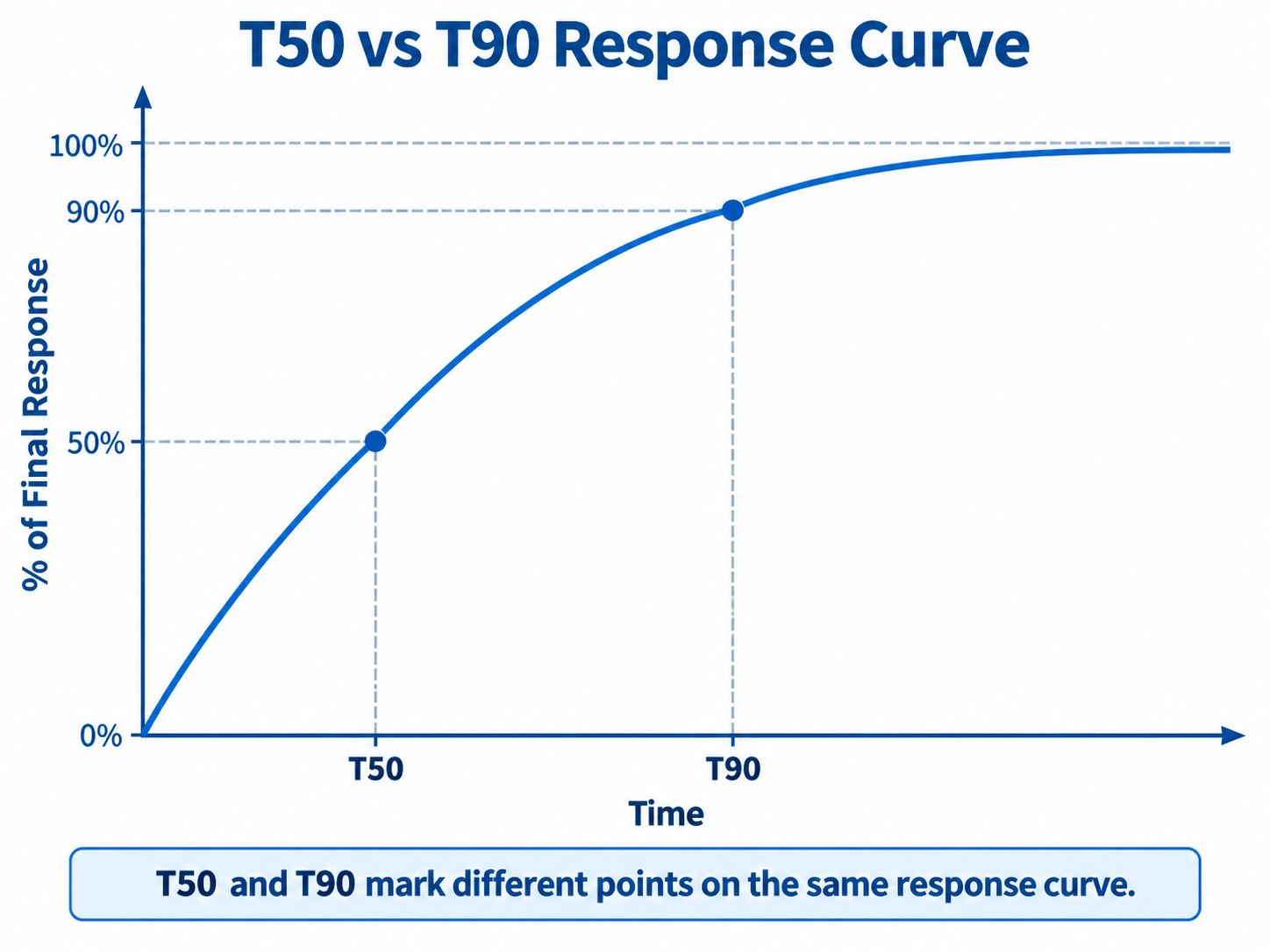
The graph above shows the basic relationship.
The vertical axis represents:
percentage of final sensor response
while the horizontal axis represents:
time
The sensor first responds rapidly.
It reaches:
50% response → T50
Then the curve continues upward.
It reaches:
90% response → T90
Finally, the signal approaches its stable final value.
For a response beginning at S₀ and ending at Sƒ, the corresponding response levels can be written as:
S50 = S₀ + 0.50 × (Sƒ − S₀)
and:
S90 = S₀ + 0.90 × (Sƒ − S₀)
T50 and T90 are the elapsed times required to reach those two points.
Why Is T90 More Common Than T50?
A gas sensor response curve often becomes progressively flatter as it approaches its final value.
The first part of the response may therefore be relatively fast.
Reaching 50% proves that the sensor has reacted strongly to the gas, but the reading may still differ substantially from its final value.
T90 provides a more useful indication of:
How long does the sensor need to get reasonably close to the final reading?
This makes it useful for:
- gas sensor datasheets
- safety detector performance
- process instrumentation
- OEM sensor comparison
However, even T90 should not be treated as a complete measure of sensor quality.
A sensor can be fast but still have poor:
- selectivity
- stability
- accuracy
- lifetime
- cross-sensitivity performance
Response time is one specification among many.
T90 Is Not the Time Until Gas Is First Detected
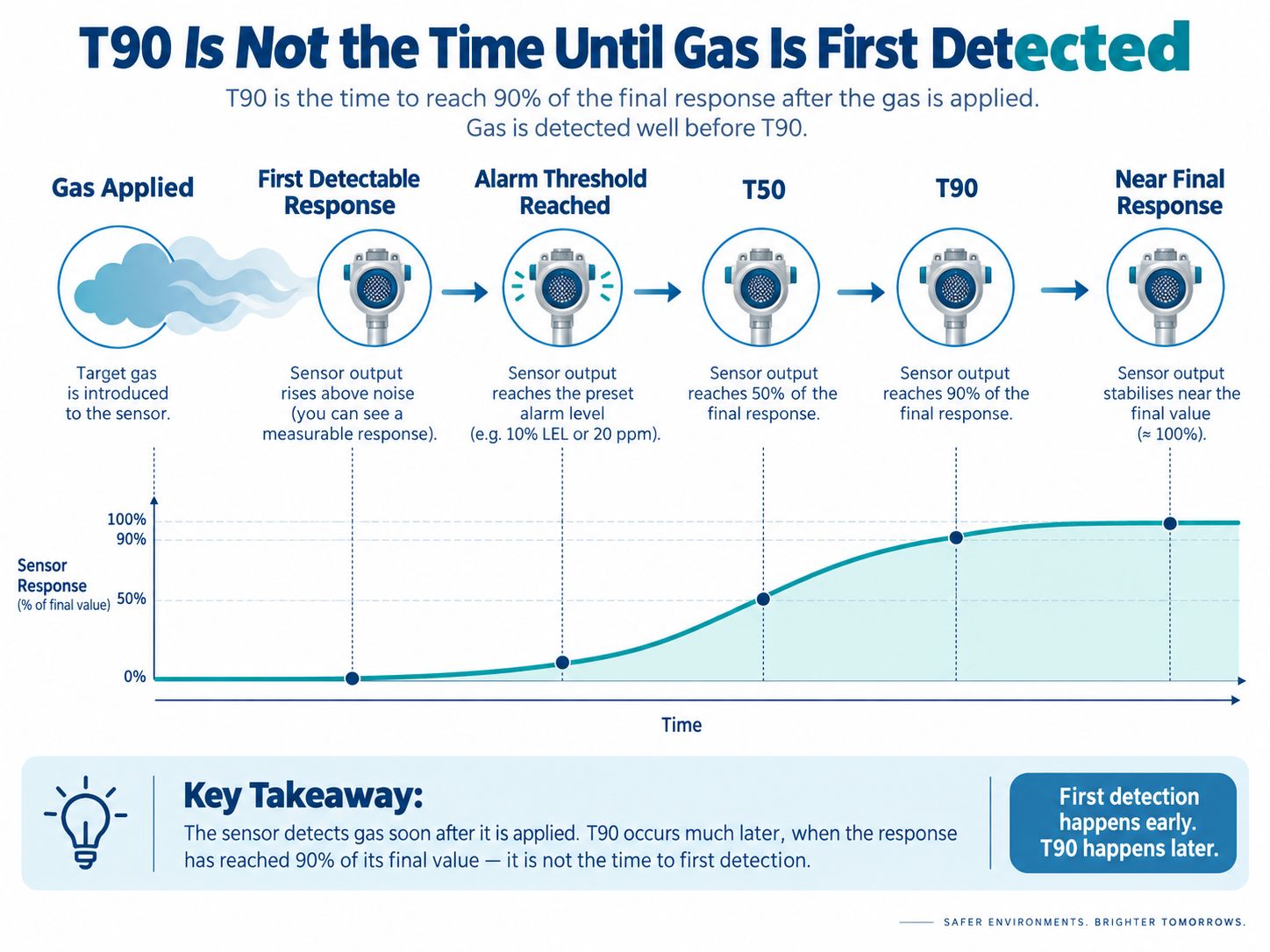
This is one of the most common misunderstandings.
Suppose a sensor has:
T90 = 30 seconds
That does not mean the detector remains at zero for 30 seconds and suddenly detects gas at the end.
A more realistic sequence may look like:
Gas reaches sensor
↓
Initial measurable response
↓
Alarm threshold reached
↓
T50
↓
T90
↓
Near-final response
The sensor may begin responding within a few seconds.
An alarm may also occur long before T90 if the alarm threshold is substantially below the final concentration.
For example:
Actual gas concentration: 100 ppm
Alarm threshold: 20 ppm
The detector only needs its signal to cross the 20 ppm equivalent threshold to activate the alarm.
It does not need to wait until it reaches 90 ppm.
Therefore:
T90 describes progression toward the final response. It is not synonymous with detection delay or alarm delay.
T90 Is Also Not Necessarily the Time to a Perfectly Stable Reading
T90 means:
90% of the defined final response
—not 100%.
The last portion of a sensor response can take significantly longer because many sensing systems asymptotically approach equilibrium.
A sensor with:
T90 = 20 s
might still continue changing slowly after 20 seconds.
For applications requiring a highly stable analytical measurement, response-time requirements may therefore differ from those of a safety alarm.
What Does “Final Response” Actually Mean?
The phrase sounds simple, but it is one of the reasons datasheet T90 values cannot always be compared directly.
A manufacturer may determine the final response using a defined:
- gas concentration
- exposure time
- gas flow
- temperature
- relative humidity
- calibration adapter
- test chamber
For example, a response specification might be measured after exposing the sensor to a fixed concentration under controlled laboratory flow.
Another manufacturer might use a different:
- concentration
- fixture
- flow rate
- exposure method
Both may correctly report T90.
But the numbers are not automatically equivalent.
A response-time value is meaningful only together with its test conditions.
Do Not Compare T50 Directly With T90
Consider:
Sensor A
T50 < 8 s
Sensor B
T90 < 20 s
It would be incorrect to conclude:
Sensor A is more than twice as fast.
Sensor A’s specification only tells us when it reaches 50%.
It tells us nothing about when it reaches 90%.
Sensor A could theoretically have:
T50 = 8 s
T90 = 35 s
while Sensor B has:
T90 = 20 s
Sensor B would then reach 90% considerably sooner.
Always compare:
T90 with T90
or:
T50 with T50
under comparable test conditions.
Sensor Response Time vs Complete Detector Response Time
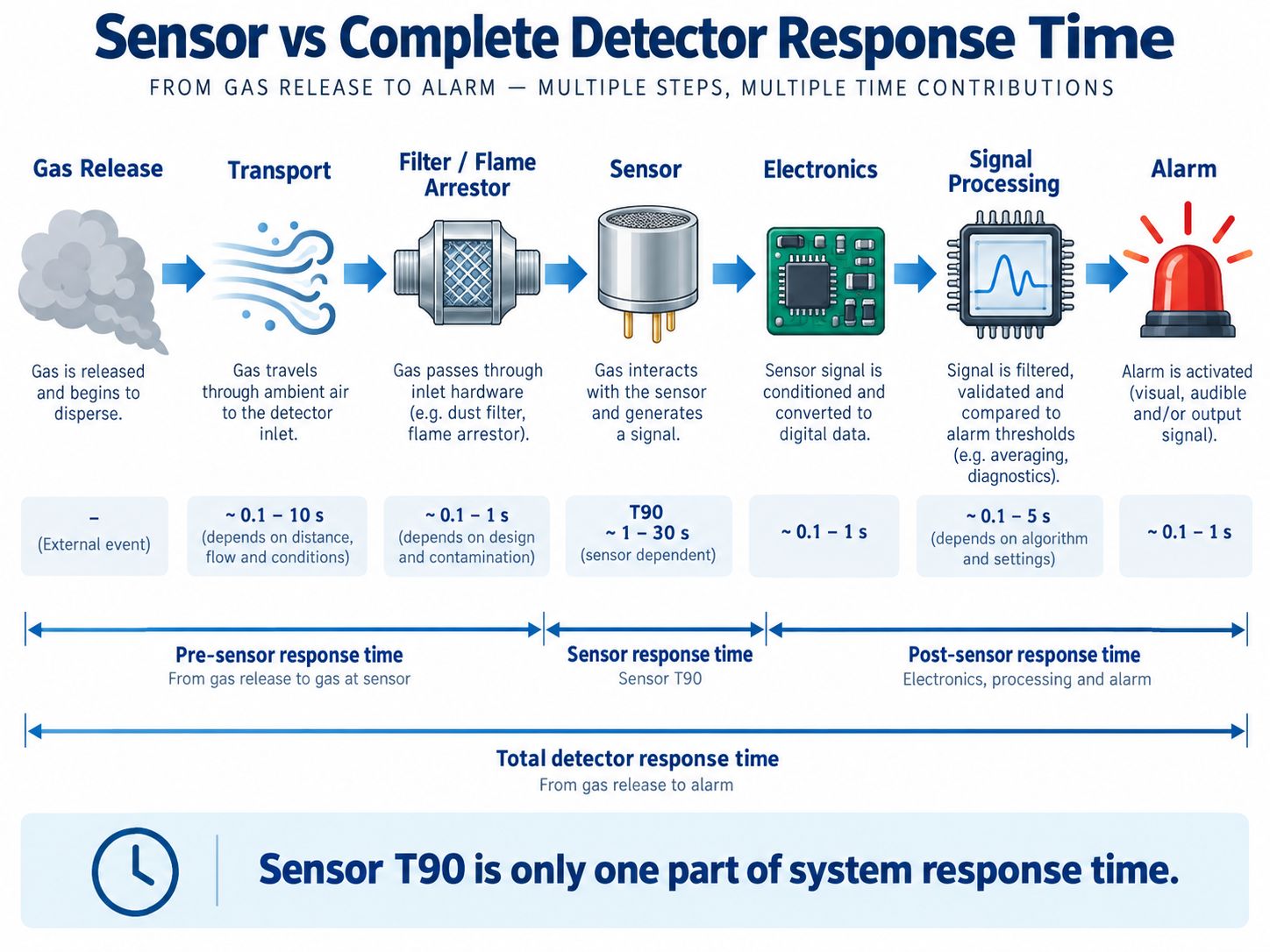
A bare gas sensor datasheet may describe only the sensing element.
A complete detector has many additional stages.
A real detection chain may be:
Gas Release
↓
Gas Transport
↓
Detector Inlet
↓
Filter / Membrane / Flame Arrestor
↓
Gas Sensor
↓
Analog Electronics
↓
Digital Signal Processing
↓
Alarm Logic
↓
Alarm Output
Each stage can add delay.
The Health and Safety Executive separates overall gas detection response into three major contributions:
- the intrinsic sensing mechanism
- signal-processing electronics
- transport of the sample to the sensor
This leads to one of the most useful rules when reading datasheets:
A sensor with a T90 of 20 seconds does not automatically create a detector with a total response time of 20 seconds.
The individual time ranges shown in the illustration above are conceptual examples rather than universal specifications. Actual delays must come from the sensor, detector and sampling-system manufacturer.
Why Gas Transport Matters
Before the sensor can respond, gas must physically reach it.
For a fixed detector installed directly in an atmosphere, this may involve:
- atmospheric dispersion
- local airflow
- diffusion through an inlet
- diffusion through a protective membrane
For a pumped detector, the sample may need to travel through:
- probe
- tubing
- filters
- water traps
- pump
- internal flow path
No sensor can respond to gas that has not yet arrived.
This is particularly important for remote sampling.
Diffusion vs Pumped Gas Detector Response Time
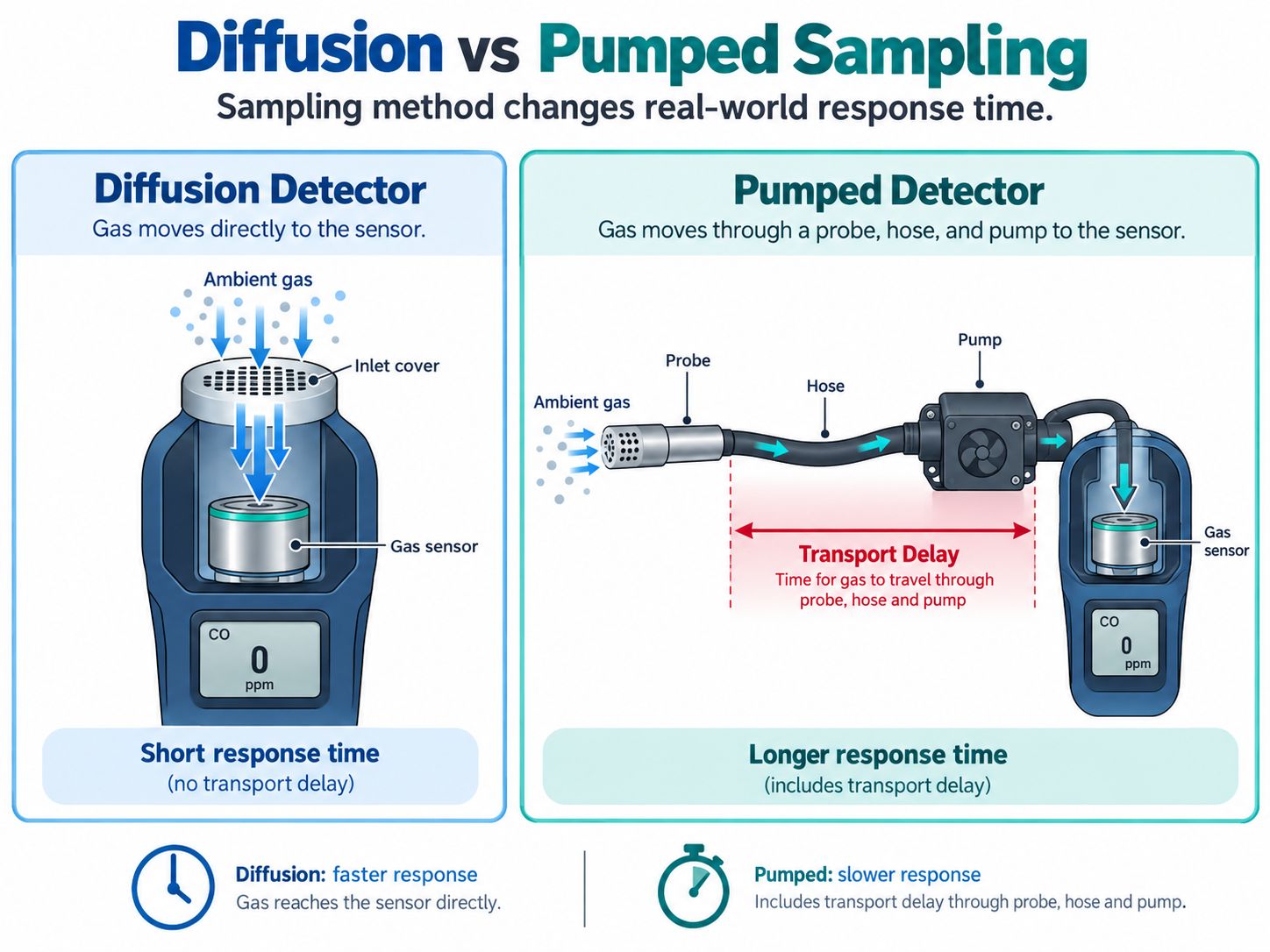
Diffusion Detector
A diffusion detector allows gas to reach the sensing element through natural:
- diffusion
- convection
- ambient airflow
There is no long remote sample line.
That can eliminate one major source of transport delay.
Pumped Detector
A pumped detector actively draws gas through:
Probe
↓
Tube
↓
Pump
↓
Sensor
This is particularly useful for:
- confined-space pre-entry testing
- remote sampling
- tanks
- pits
- ducts
- inaccessible locations
But the sample must first travel through the entire sampling system.
This adds transport time.
However, one important qualification is necessary:
Pumped sampling is not universally slower than diffusion.
A properly designed pump can deliver gas rapidly from a remote sampling point, while a poorly ventilated diffusion detector may take longer for gas to reach its inlet.
The real comparison depends on:
- sampling distance
- hose length
- pump flow
- dead volume
- detector geometry
- ambient airflow
- gas properties
The illustration should therefore be understood as a transport-delay concept, not a universal rule that every diffusion detector is faster than every pumped detector.
Hose Length Affects Detection Delay
Long sample lines increase:
transport distance
and:
internal volume
So gas takes longer to reach the sensor.
A simplified transport estimate may consider:
Tubing internal volume
÷
sample flow rate
but real sampling systems can be more complicated because gases may also interact with the tube surface.
For pumped instruments, manufacturers often specify either:
- transport delay per metre
- maximum tubing length
- recommended sampling time
These instructions matter during confined-space testing.
If the instrument is connected to a long hose and the operator begins interpreting the result before the gas sample reaches the sensor, the reading may represent the air near the instrument—not the remote space being tested.
For broader confined-space principles, see Confined Space Gas Monitoring: What Gases Should You Test Before Entry?.
The Sampling Tube Material Can Be as Important as Its Length
Transport delay is not always caused only by volume.
Some gases and vapors can:
- adsorb onto tubing walls
- react with tubing materials
- condense
- diffuse slowly through the sampling system
The UK Health and Safety Executive investigated a serious incident in which unsuitable sampling tubing significantly delayed detection of a flammable vapor.
Laboratory testing found that the same detector and sampling configuration could respond to its methane calibration gas in less than five seconds, while the target vapor required more than 15 minutes to reach 90% of the final reading because of adsorption in the sample line.
This is an extreme but important example.
The lesson is:
Fast sensor + wrong sampling system can still create a dangerously slow detector.
See the HSE safety alert: Failure to detect dangerous gas/vapour due to incorrect specification of sample tube.
Filters, Membranes and Flame Arrestors Can Slow Response
Gas detectors often need protection against:
- dust
- water
- rain
- splash
- insects
- flame propagation
- contamination
This can require components such as:
- sintered filters
- hydrophobic membranes
- splash guards
- dust filters
- flame arrestors
- weather shields
Gas must pass through these components before reaching the sensing element.
That introduces additional diffusion resistance.
The engineering trade-off is therefore:
Environmental Protection
↕
Gas Access
↕
Response Time
A protective accessory can be absolutely necessary even if it slightly increases response time.
The correct goal is not:
Remove everything that slows diffusion.
It is:
Achieve the required response while maintaining the protection needed for the environment and hazardous-area design.
Why Different Gases Can Have Different T90 Values
Even the same detector can respond differently to different gases.
Factors include:
- molecular size
- diffusion rate
- membrane permeability
- adsorption
- chemical reaction rate
- catalytic activity
- infrared absorption characteristics
For example, a combustible optical detector may have different response specifications for:
- methane
- propane
- ethylene
even though the sensing hardware is the same.
So when reading a datasheet, do not stop at:
T90 < 20 seconds
Check:
T90 for which gas?
Electrochemical Sensor Response Time
Electrochemical gas sensors typically depend on several steps:
Gas diffusion through sensor inlet
↓
Gas diffusion through membrane / capillary
↓
Reaction at working electrode
↓
Electrochemical current
↓
Electronic conversion
Changing the diffusion barrier can alter:
- sensitivity
- measurement range
- response time
A barrier that restricts gas flow may improve certain performance characteristics but can also slow response.
Different target gases also have different electrochemical reaction rates.
This is why electrochemical CO, H₂S, NO₂, Cl₂ or SO₂ sensors do not necessarily share the same T90.
MOS Gas Sensor Response Time
Metal-oxide semiconductor sensors operate through gas interaction with a heated sensing surface.
Response dynamics depend on:
- operating temperature
- adsorption
- desorption
- target gas
- humidity
- sensing material
MOS sensors may respond rapidly to some gases but recover slowly from others.
That is one reason response time and recovery time need to be considered separately.
NDIR Gas Sensor Response Time
NDIR sensors measure infrared absorption.
Their intrinsic optical measurement can be fast, but total response depends on how rapidly the target gas reaches and replaces the gas in the optical chamber.
Factors include:
- chamber volume
- gas diffusion
- flow rate
- protective filter
- signal averaging
So:
Fast optical electronics do not automatically mean fast gas exchange.
For methane technology comparisons, see Catalytic vs NDIR vs TDLAS Methane Sensors.
PID Response Time
Photoionization detectors can provide rapid VOC response because ionization occurs quickly once the vapor reaches the UV lamp.
But complete PID response can still be affected by:
- pump system
- inlet filter
- sampling tube
- lamp contamination
- compound adsorption
- humidity
Some sticky or easily adsorbed compounds can move through tubing much more slowly than lighter, less reactive gases.
This is another reason a response time measured using one calibration gas may not represent every VOC.
What Factors Affect Gas Sensor Response Time?
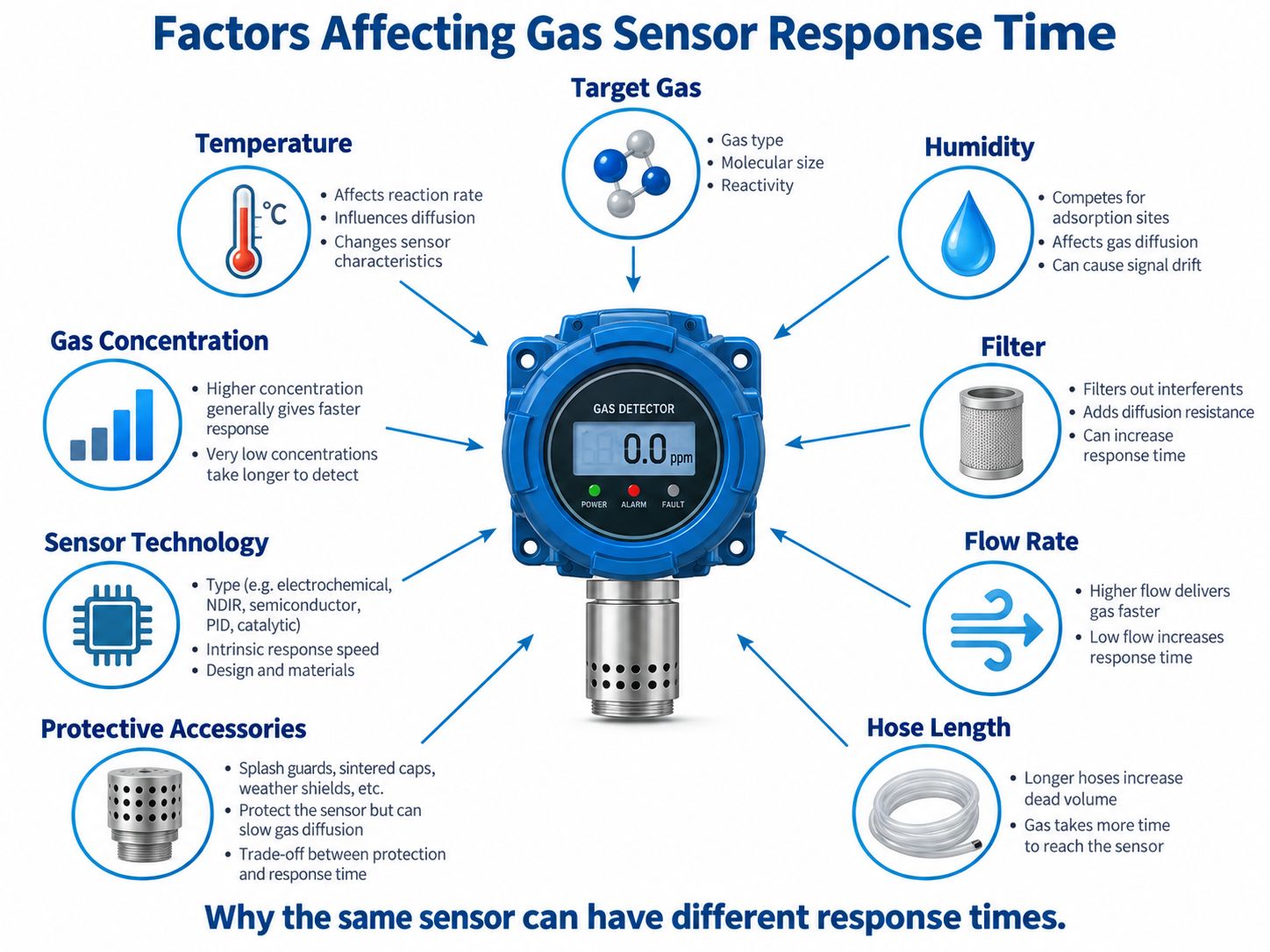
Response time can be affected by several variables simultaneously.
Sensor Technology
Electrochemical, catalytic, MOS, PID and infrared sensors use different physical mechanisms.
Target Gas
Different gases:
- diffuse differently
- react differently
- adsorb differently
Gas Concentration
The apparent detection or alarm time can change with concentration because a higher challenge concentration may cross a threshold sooner.
The normalized T90 itself should still be interpreted according to the manufacturer’s defined test method rather than assuming a universal concentration rule.
Temperature
Temperature can affect:
- chemical reaction rates
- diffusion
- adsorption
- sensor sensitivity
Low temperatures can slow the response of some electrochemical and semiconductor sensors.
Humidity
Humidity can affect:
- membranes
- electrolyte balance
- adsorption behavior
- MOS surfaces
- PID response
Flow Rate
In a controlled flow system, insufficient flow can increase gas-delivery time.
Excessive flow may also create conditions outside those specified by the manufacturer.
Filters
Filters can improve:
- selectivity
- contamination resistance
- environmental protection
but may slow diffusion.
Hose Length
Longer hoses generally add sample transport time and can increase adsorption risk.
Protective Accessories
Accessories such as:
- splash guards
- weather shields
- diffusion caps
can change the gas path and therefore the complete response.
Temperature Can Change T90
A sensor specification is frequently measured at approximately room temperature.
For example:
20°C
or:
25°C
A detector installed at:
-20°C
may respond differently.
This is especially relevant for:
- cold storage
- outdoor winter installations
- refrigerated facilities
- hydrogen equipment
- remote industrial sites
The datasheet operating-temperature range only tells you that the sensor can operate within that range.
It does not automatically mean:
T90 remains identical at every temperature.
For the wider terminology series, this will be covered in detail in How Temperature Affects Gas Sensor Readings.
Humidity Can Change Response Dynamics
Humidity can influence both response and recovery.
For electrochemical sensors, humidity affects electrolyte water balance.
For MOS sensors, water molecules can occupy surface adsorption sites and alter reaction behavior.
For PID instruments, humidity can influence VOC response and sampling behavior.
Again, this does not mean every humidity change causes a dangerous response delay.
It means the environmental test conditions should be considered when interpreting a datasheet specification.
Response Time vs Recovery Time
Response and recovery are two different measurements.
Response Time
Gas concentration changes:
Low → High
Sensor output moves:
Baseline → Gas Response
Recovery Time
Gas concentration changes:
High → Low
Sensor output moves:
Gas Response → Baseline
These times are not necessarily symmetrical.
A sensor might have:
T90 response = 20 s
but require much longer to return close to baseline.
Adsorption is one reason this can happen.
Certain vapors can accumulate on:
- sensor materials
- membranes
- filters
- tubing
and then desorb slowly.
So:
Fast T90 does not guarantee fast recovery.
The next terminology article, /knowledge/gas-sensor-response-vs-recovery-time/, will examine this distinction in detail.
Response Time vs Alarm Response Time
Another important distinction is:
T90 ≠ alarm response time
Consider:
Gas concentration after release: 100 ppm
Low alarm: 20 ppm
Sensor T90: 30 s
The sensor may cross:
20 ppm
well before it reaches:
90 ppm
So the detector can alarm before T90.
However, the actual alarm timing may also include:
- signal averaging
- firmware validation
- alarm delay
- transport delay
This means alarm response is a system behavior, not simply a property of the bare sensor.
For alarm logic, see Gas Detector Alarm Settings: Low, High, STEL & TWA Explained.
Does Faster T90 Always Mean a Better Gas Sensor?
No.
Suppose two sensors have:
Sensor A
T90 = 10 s
but also:
- high zero drift
- significant cross-sensitivity
- short operating life
Sensor B
T90 = 25 s
but offers:
- higher selectivity
- better stability
- lower drift
- longer lifetime
Which is better?
There is no universal answer.
It depends on the application.
For a rapidly developing toxic leak:
response speed may be critical.
For long-term environmental monitoring:
stability and detection limit may be more important.
For OEM products, the correct comparison includes:
- response time
- sensitivity
- selectivity
- measurement range
- accuracy
- resolution
- drift
- lifetime
- cross-sensitivity
If long-term response is important, see What Is Gas Sensor Drift?.
Why Response Time Matters in Personal Safety
Personal gas monitors are intended to warn workers of changing atmospheric hazards.
Rapid response can be particularly important for:
- H₂S
- CO
- Cl₂
- NH₃
- combustible gas
- oxygen deficiency
But detector placement matters too.
A detector attached outside clothing may experience the atmosphere differently from one hidden beneath protective clothing.
The fastest sensor cannot provide an early warning if gas cannot reach it.
Why Response Time Matters in Confined Spaces
Confined-space monitoring introduces an additional problem:
remote sampling.
Workers may use a pumped detector to test:
- top
- middle
- bottom
of a tank, pit or manhole before entry.
The instrument must be allowed enough time for:
- gas to travel through the tubing
- the sensor to respond
Testing too quickly can produce a false impression of safety.
See Confined Space Gas Monitoring: What Gases Should You Test Before Entry?.
Why Response Time Matters in BESS Early Warning
Battery energy storage systems demonstrate another important principle.
A fast off-gas sensor installed far from the battery may still provide later warning than a slightly slower sensor mounted close to the rack airflow.
Total warning time depends on:
Failure occurs
↓
Cell vents
↓
Gas travels
↓
Sensor receives gas
↓
Sensor responds
↓
Alarm logic acts
This is why BESS early-warning design must consider both:
sensor response
and:
sensor placement / gas transport
See Gas Detection for Battery Energy Storage Systems.
Response Time Can Change as a Sensor Ages
A gas sensor’s response characteristics do not necessarily remain identical throughout its service life.
Aging may affect:
- membrane diffusion
- electrolyte condition
- electrode activity
- optical surfaces
- lamp performance
A sensor that once met its response specification may later become slower.
This is one reason a functional test can provide information beyond simply asking:
Does the sensor produce any signal?
Response behavior itself can be part of condition monitoring.
For maintenance fundamentals, see Gas Detector Bump Test vs Calibration.
How to Compare Gas Sensor T90 Datasheets
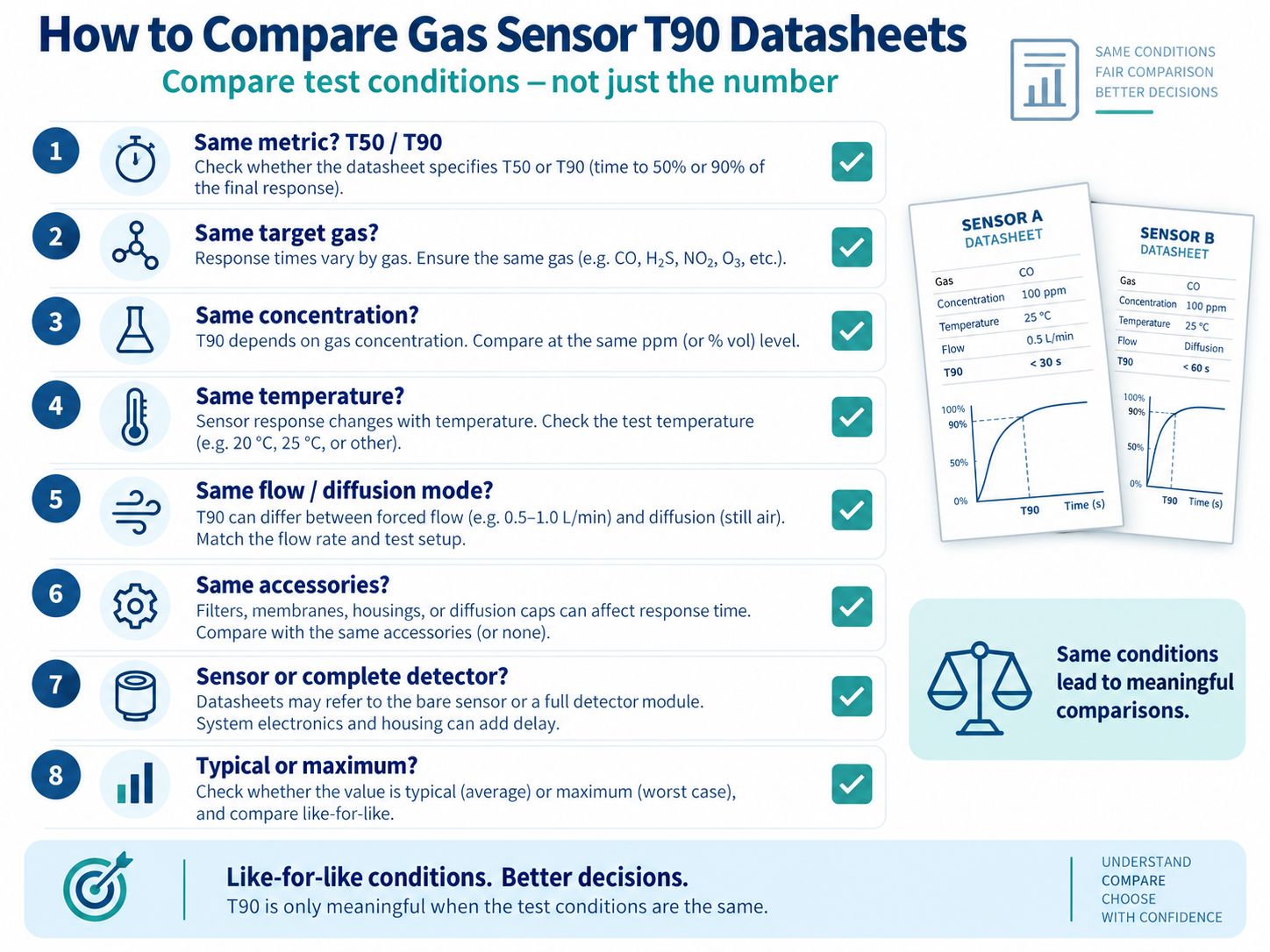
Before deciding that one sensor is faster than another, check the following.
1. Same Metric?
Compare:
T90 vs T90
not:
T50 vs T90
2. Same Target Gas?
Response to:
CO
cannot automatically be compared with response to:
H₂S
even when the sensing technology is similar.
3. Same Gas Concentration?
Compare tests conducted at comparable challenge concentrations.
4. Same Temperature?
A value at:
25°C
does not necessarily represent performance at:
-20°C
5. Same Humidity?
Check whether RH was controlled or specified.
6. Same Flow or Diffusion Method?
Compare:
- pumped flow
- controlled chamber
- natural diffusion
carefully.
7. Same Accessories?
A sensor with:
- filter
- membrane
- splash guard
may respond differently from the bare sensor.
8. Bare Sensor or Complete Detector?
This is one of the most important checks.
9. Same Definition of Final Response?
Review the manufacturer’s test method.
10. Typical or Maximum?
These are different specifications:
Typical T90 = 15 s
versus:
T90 ≤ 30 s
The first describes representative performance.
The second may describe an upper specification limit.
Compare test conditions—not just the T90 number.
Common Gas Sensor Response-Time Mistakes
Mistake 1 — Comparing T50 With T90
They represent different response percentages.
Mistake 2 — Treating T90 as First Detection Time
The sensor usually begins responding earlier.
Mistake 3 — Treating Sensor T90 as Complete Detector Response
Housing, filters, electronics and transport can add delay.
Mistake 4 — Ignoring Sampling Tubing
Long or unsuitable tubing can dominate system response.
Mistake 5 — Assuming Pumped Is Always Faster
A pump actively transports gas but also introduces a sampling path. The complete system must be evaluated.
Mistake 6 — Ignoring Accessories
Protective hardware can affect gas diffusion.
Mistake 7 — Comparing Different Target Gases
One sensor may respond faster to methane than propane, or to CO faster than another toxic gas.
Mistake 8 — Ignoring Temperature
Laboratory T90 does not guarantee identical low-temperature performance.
Mistake 9 — Assuming Lower T90 Means Better Sensor
Other performance parameters matter.
Mistake 10 — Ignoring Sensor Aging
Response time can change over service life.
Gas Sensor Response-Time Selection Checklist
Before choosing a sensor based on T90, confirm:
- Target gas
- T50 or T90
- Test concentration
- Temperature
- Relative humidity
- Test flow
- Diffusion or pumped configuration
- Bare sensor or complete detector
- Filter configuration
- Protective accessories
- Sample tubing
- Calibration gas
- Typical or maximum specification
- Required alarm response
- Operating environment
- Expected sensor lifetime
Frequently Asked Questions
What is T90 in a gas sensor?
T90 is the elapsed time required for the sensor output to reach 90% of its defined final response after a change in gas concentration reaches the sensing point.
What is T50 in a gas sensor?
T50 is the time required to reach 50% of the defined final response.
It describes an earlier point on the same response curve.
What is the difference between T50 and T90?
T50 measures the time to 50% response.
T90 measures the time to 90% response.
T90 is therefore normally longer.
Why is T90 commonly used for gas sensors?
T90 shows how long a sensor requires to get reasonably close to its final response and is therefore useful for performance and safety evaluation.
Is T90 the time until a gas detector first detects gas?
No.
The sensor normally begins responding before T90.
T90 is the point where the response reaches 90% of the defined final value.
Does a detector alarm at T90?
Not necessarily.
If the alarm threshold is reached earlier on the response curve, the detector may alarm before T90.
Is lower T90 always better?
A shorter T90 generally means faster response, but it does not make a sensor better in every respect.
Also compare:
- accuracy
- sensitivity
- selectivity
- stability
- drift
- lifetime
What is a good gas sensor response time?
There is no universal number.
The required response depends on:
- gas
- hazard development speed
- application
- detector placement
- regulatory / performance requirements
A value acceptable for slow environmental monitoring may be inappropriate for a rapidly developing toxic-gas hazard.
Is sensor response time the same as detector response time?
No.
A detector also includes:
- gas transport
- housing
- filters
- electronics
- signal processing
- alarm logic
Does tubing affect gas detector response time?
Yes.
Long tubing adds transport delay, and some gases or vapors may adsorb onto inappropriate tubing materials.
Is pumped sampling always faster than diffusion?
No.
Pumping can rapidly move gas from a remote location, but tubing and probe volume introduce transport delay.
The actual system design determines total response.
Do filters slow gas sensor response?
They can.
Filters and membranes can add diffusion resistance, although they may be essential for selectivity, environmental protection or hazardous-area design.
Does temperature affect T90?
Yes.
Temperature can influence:
- diffusion
- reaction rate
- adsorption
- sensor sensitivity
The effect depends on sensor technology.
Does humidity affect gas sensor response time?
It can.
Electrochemical, MOS and PID technologies can all be affected by humidity in different ways.
Why can one detector have different T90 values for different gases?
Different gases have different:
- diffusion properties
- reaction kinetics
- adsorption behavior
- optical or catalytic characteristics
What is the difference between response time and recovery time?
Response time describes movement toward a new gas reading after concentration increases.
Recovery time describes return toward baseline after the gas is removed or reduced.
They are not necessarily equal.
Final Takeaway
T50 and T90 are simple concepts, but response time is often misunderstood in real gas detection systems.
Remember:
T50
= time to 50% of final response
T90
= time to 90% of final response
But also remember:
T90 ≠ first detection time
and:
Sensor T90 ≠ complete detector response time
A real detector must consider:
Gas transport
Housing / Filters
Sensor Response
Electronics
Signal Processing
Alarm Logic
For pumped instruments, also add:
Probe + Hose + Pump + Sampling Delay
That leads to the most useful engineering rule:
Do not compare T90 values until you know what was tested, with which gas, at what concentration, under what conditions, and whether the number describes a bare sensor or the complete detector.
A fast sensor is valuable.
A fast and correctly engineered gas detection system is what ultimately protects the process and the people.
References and Further Reading
- Health and Safety Executive — The Selection and Use of Flammable Gas Detectors
- Health and Safety Executive — Failure to Detect Dangerous Gas/Vapour Due to Incorrect Specification of Sample Tube
- Alphasense — H₂S-A4 Technical Specifications
- Dräger — Fixed Gas Detection Technical Documentation
- GasNose — What Is Gas Sensor Drift?
- GasNose — Gas Detector Bump Test vs Calibration
- GasNose — Gas Detector Alarm Settings
- GasNose — Gas Detector Measurement Units
- GasNose — Confined Space Gas Monitoring
- GasNose — BESS Gas Detection
